
“It always seems impossible until it’s done.” These famous words spoken by the iconic, revolutionary Nelson Mandela hold immense meaning in all walks of life, particularly when something, or someone, is staring down the barrel of the gun of adversity.
The improbability of impossibility is why many grew to love football. Tales of Leicester City’s Premier League title win, Porto’s path to European glory and even the Greeks’ gargantuan triumph in the Euros are all examples where the impossible became permanent landmarks in football folklore.
Wayne Rooney is trying to add his own stamp on the history of the beautiful game by pulling off what could be arguably the greatest escape in English football history.
Down and out with a 21 points deduction, and sitting rock bottom of the EFL Championship, Derby County are rising from the ashes like one colossal phoenix to claw their way from the depths of despair.
Rooney has done an inconceivable job in charge of the Rams. Despite the disastrous ongoings off the pitch, Derby are massively overperforming on it. Having picked up a possible 36 points this season so far, Rooney’s men would be sitting in 13th instead of 23rd had it not been for the league’s punishment.
But what tactical model has Rooney put in place at Pride Park to allow for Derby to try and tackle the impossible? This article will be a tactical analysis of the Rams under the England great, in the shape of a team scout report, to find out just how their tactics have allowed them to be so proficient this season.
Adaptable formation-wise
Rooney is not in a position where he can be dogmatic in regard to his formation choices in every match. While coaches undoubtedly have a preferred system choice in their own minds, quite often they will need to be adaptable to the players available within the squad.
Rooney has favoured the notoriously balanced 4-2-3-1 this season but has also used a plethora of other structures too, depending on the opposition. The 4-2-3-1 has been utilised in 33 percent of Derby’s games so far in all competitions this season.
The 4-4-2 is Derby’s second most used formation with the 4-3-3, 4-5-1 and 4-4-1-1 not far behind.

On occasion though, particularly in recent matches, the Rams have looked to deploy a back three formation. This is generally in matches where the opponent is playing with a three-man backline also.
For instance, Derby have faced West Bromwich Albion twice this season, home and away, and managed to pick up four points from a possible six without conceding a single goal. The 35-year-old head coach switched to a 3-4-3 in both games to match the Baggies’ shape which worked perfectly.
Rooney will only set Derby up in a back three system if it makes sense from a tactical perspective. Despite his playing career as a world-class forward, the ex-Manchester United captain is very opposition-oriented in his game plans. This is an overarching factor behind the team’s success from a defensive perspective.
Pressing cautiously but pressing efficiently
Like almost all modern coaches, Rooney wants his side to press high up the pitch and keep the ball as far away from their own goal as possible. However, pressing relentlessly during a 46-game season, with a squad stripped to the bare bone and flooded with academy youngsters, is next to impossible.
Rooney instructs his side to press high, but Derby are rather cautious with their approach, often looking to navigate the opposition’s play as opposed to applying much pressure, particularly when the attacking side are building out from the back.
The Rams have boasted a Passes allowed Per Defensive Action this season of 14.5 which is the fifth-highest in the Championship this season. The higher the PPDA, the less a team presses as they allow the opposition to play a higher volume of passes before applying pressure.

Interestingly, Derby have actually scored five goals in the league campaign from pressing sequences. Essentially, Derby tend not to press too extensively but still do so efficiently. Only four clubs have bagged more goals from pressing than Rooney’s Rams.
During the high-pressing phase, Derby’s main aim is to cut off one side of the pitch and force the opponent to play to the wide areas. From here, pressing traps can be triggered with multiple players hunting the ball down.
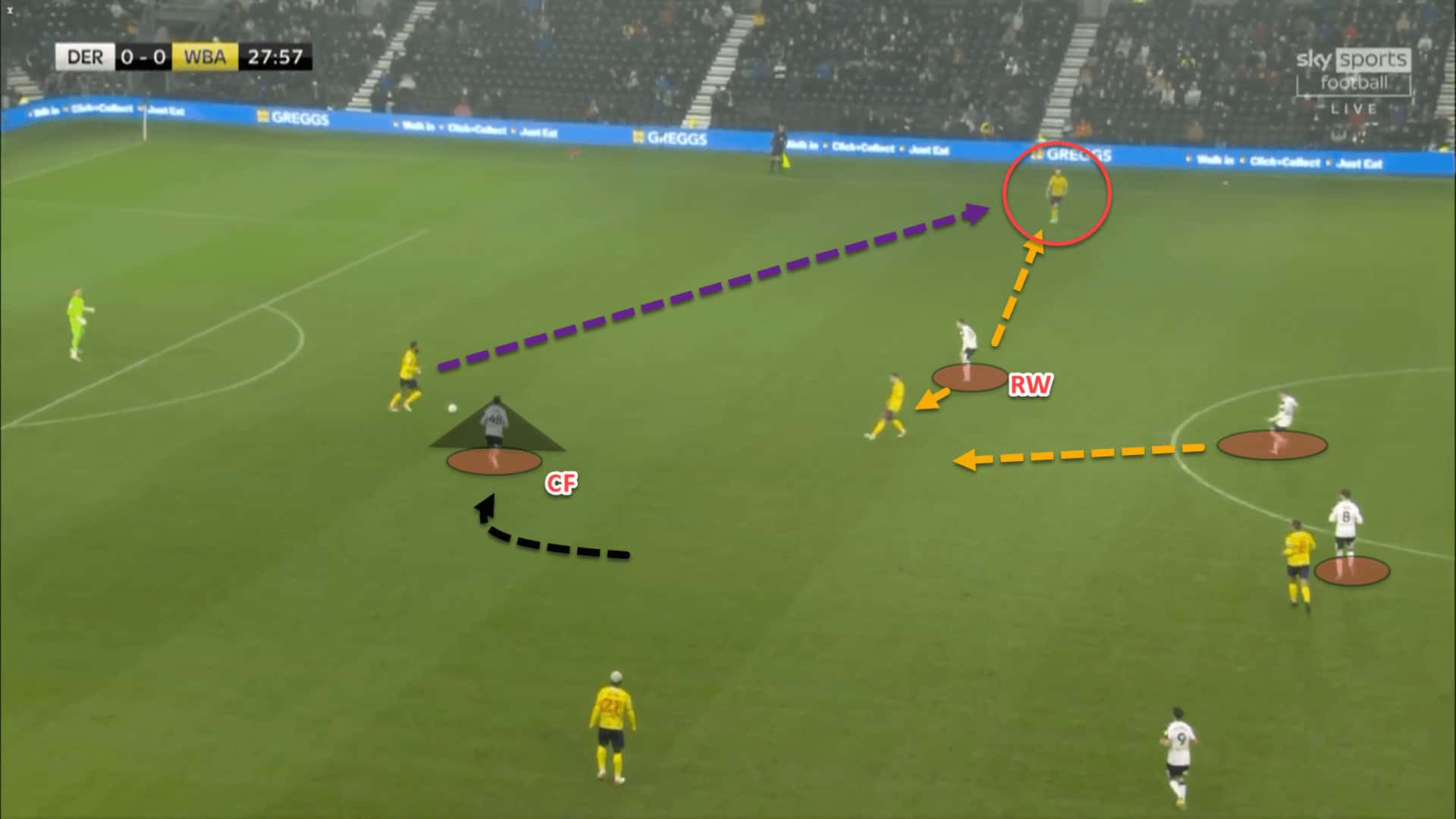
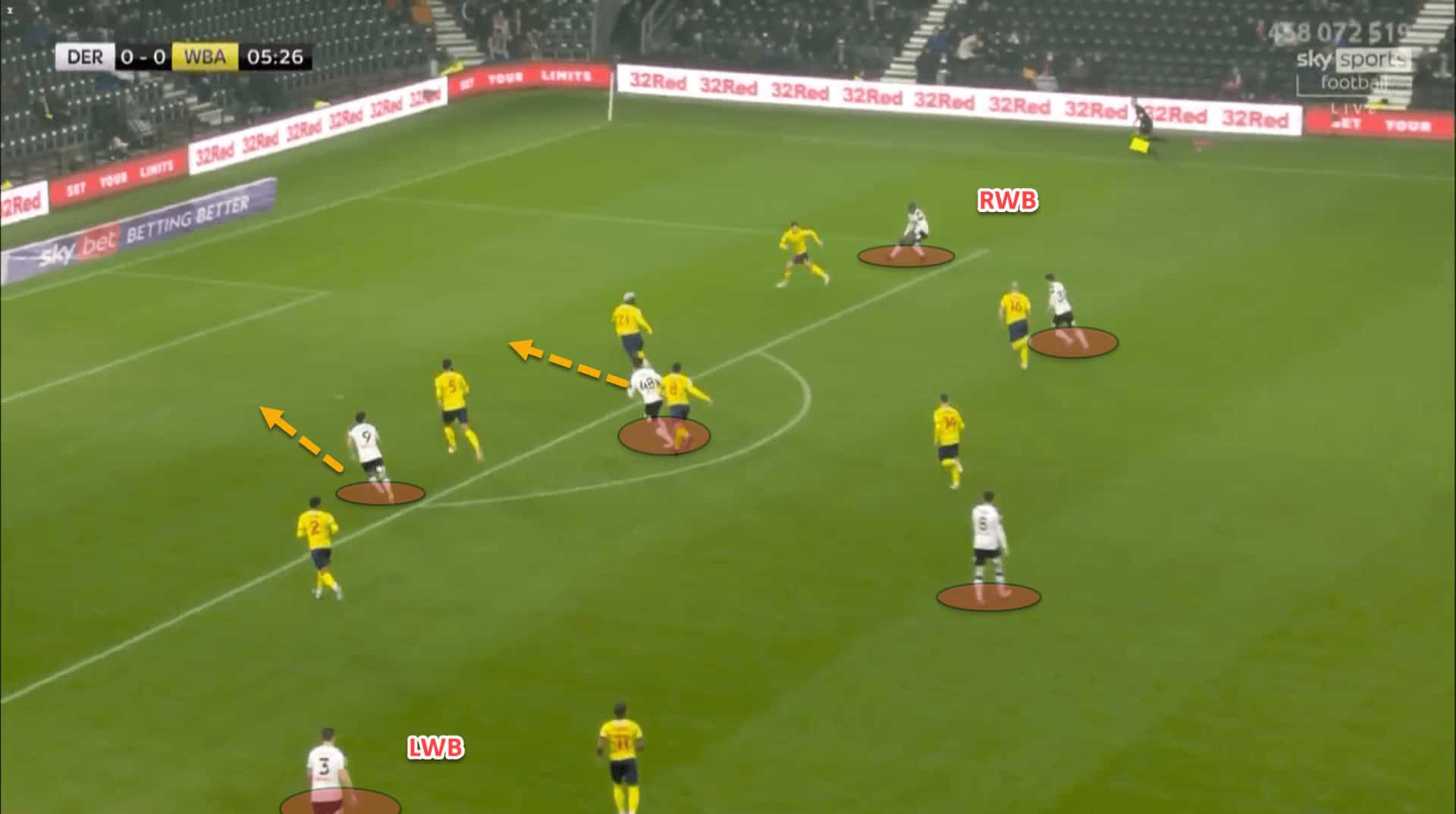
In this example, Derby are pressing high in their 5-4-1/5-2-3 defensive shape against West Brom. The centre-forward, Luke Plange, has led the press, cutting off the passing angle to the right centre-back by angling his pressure.
In correlation to this, the right-winger is orienting his body, cutting off the inside pass with the help of the nearest central midfielder, and preparing himself for the ball to be played out wide to the Baggies’ left centre-back.
The Derby players are allowing the ball out to the free-man on the left flank by cutting off options in the centre and on the far side. This reduces the pitch that the attacking side have to play in. Once the pass is played, they pounce, trying to win the ball by using the touchline as an extra man.

Looking at all 85 of Derby’s ball recoveries from this game, the vast quantity was in the wide areas. The press isn’t very intense or exhaustive, but it’s efficient.
Asking the players to apply a vigorous press in every match throughout a long and gruelling season, without the squad depth to compensate, would be nothing short of football suicide by Rooney.
In essence, Derby don’t necessarily press to win the ball back with extensive pressure from the forwards. They instead coerce the opponent into a false sense of security by allowing a free-man to have the ball, luring him to premeditated danger, before striking when their guard is down.
Defensive and midfield line in constant cooperation
One element of Derby from a defensive perspective that makes the side so astute is the constant cooperation between the midfield and backline. Like most sides, Rooney wants his team to be narrow whilst in a defensive block and compact between the lines, using the touchline as a ‘twelfth man’ while defending.
The central midfield players are very active whilst the Rams are sitting in any defensive block, whether it be in the high, medium or low defensive phase. They often tend to push up alongside the lone centre-forward too which creates a two-man first line of pressure.
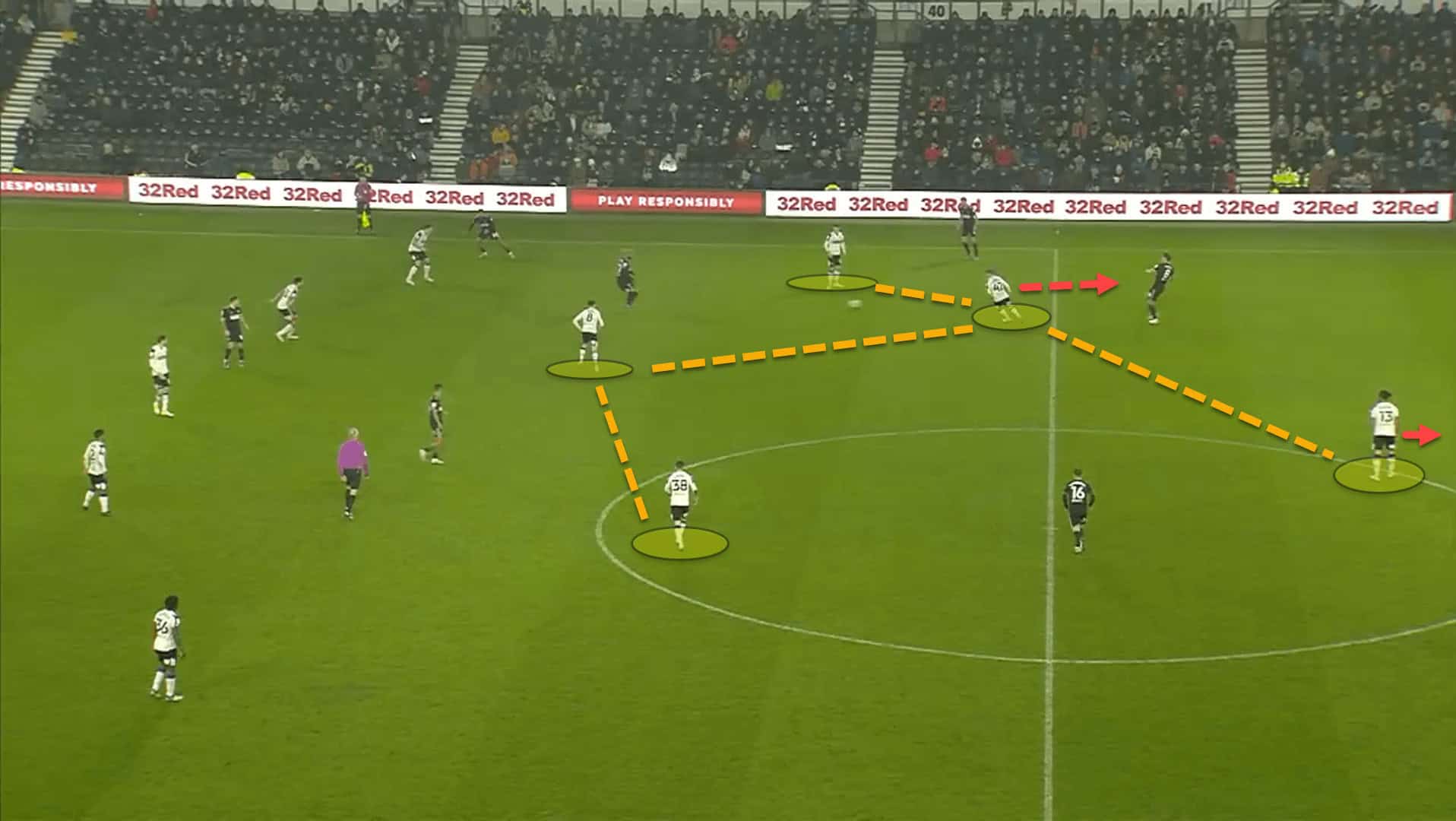
Here, Liam Thompson has pushed past the midfield line to press the opposition’s backline alongside the centre-forward. This has created a temporary two-man first line of pressure. Consequentially, the remaining midfielders come closer together to reduce the space left by the presser.
Of course, allowing a midfielder to step up to the first line while defending is problematic because it does leave space between the lines for the opponent’s attackers to receive the ball in.
Derby deal with this problem in two different ways. Firstly, and certainly the most risk-averse, is that the backline recedes instantly when the player between the lines receives the ball and turns on it.
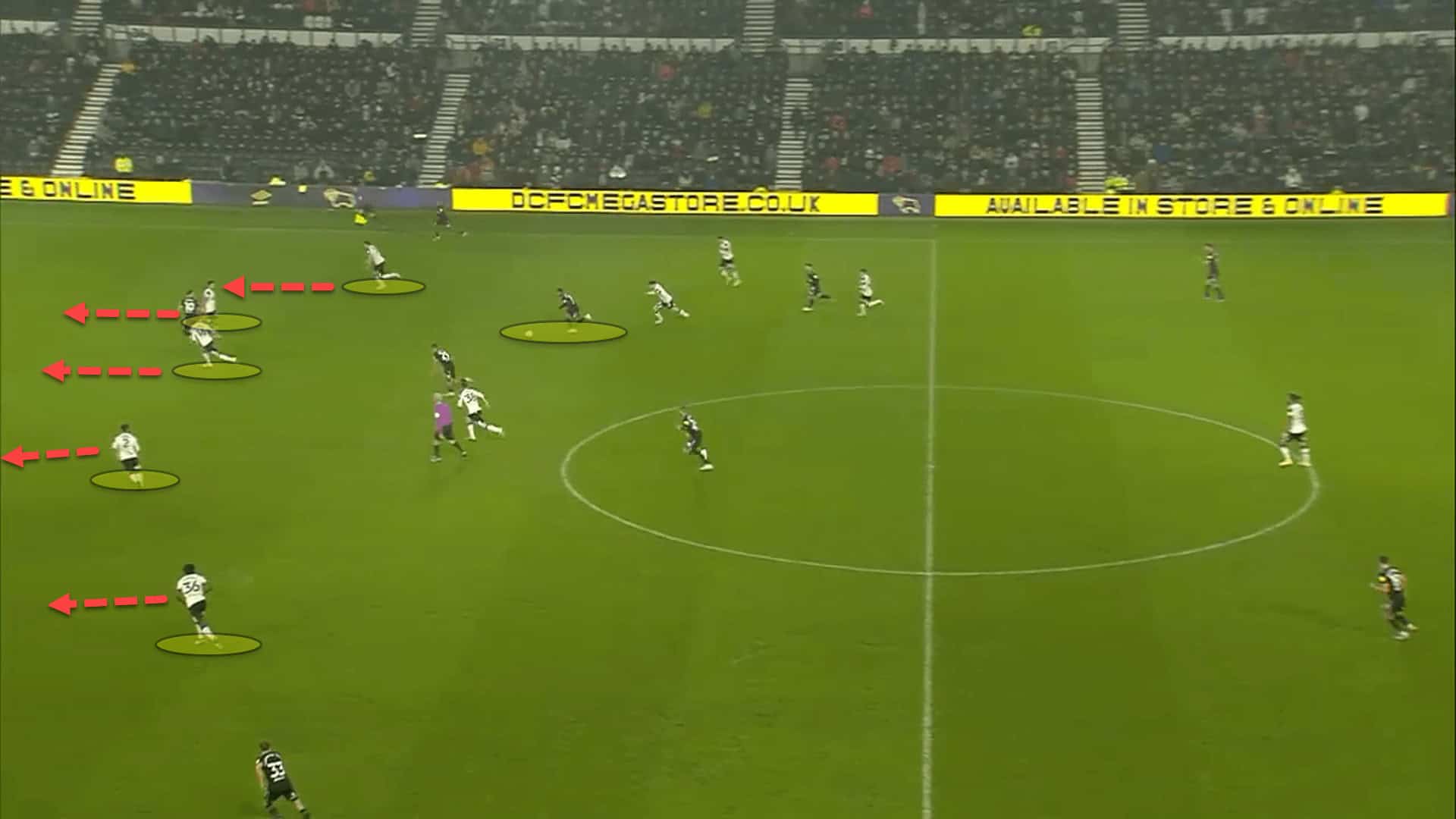
Here, the attacker has received the ball between the lines. The player is given a plethora of space and so turns on the ball, facing goalward. The wisest option to take for Derby in this instance is to drop back as quickly as possible, tracking runners who are making moves in the seams.
The ball carrier’s intentions were clear. If the backline had have stepped up, he simply would have slipped in a runner into the space behind them. By backtracking, Derby’s defenders were reducing this space.
In this example, and as they so often do under their young manager, Derby’s defenders took the correct option as the ball-carrier tried to slip in a forward-running teammate as the backline dropped, but the pass was intercepted.
Another variation of dealing with players receiving the ball between the lines is to close the distance to the midfielders. This way the centre-backs and fullbacks can tightly man-mark any players in front of them.
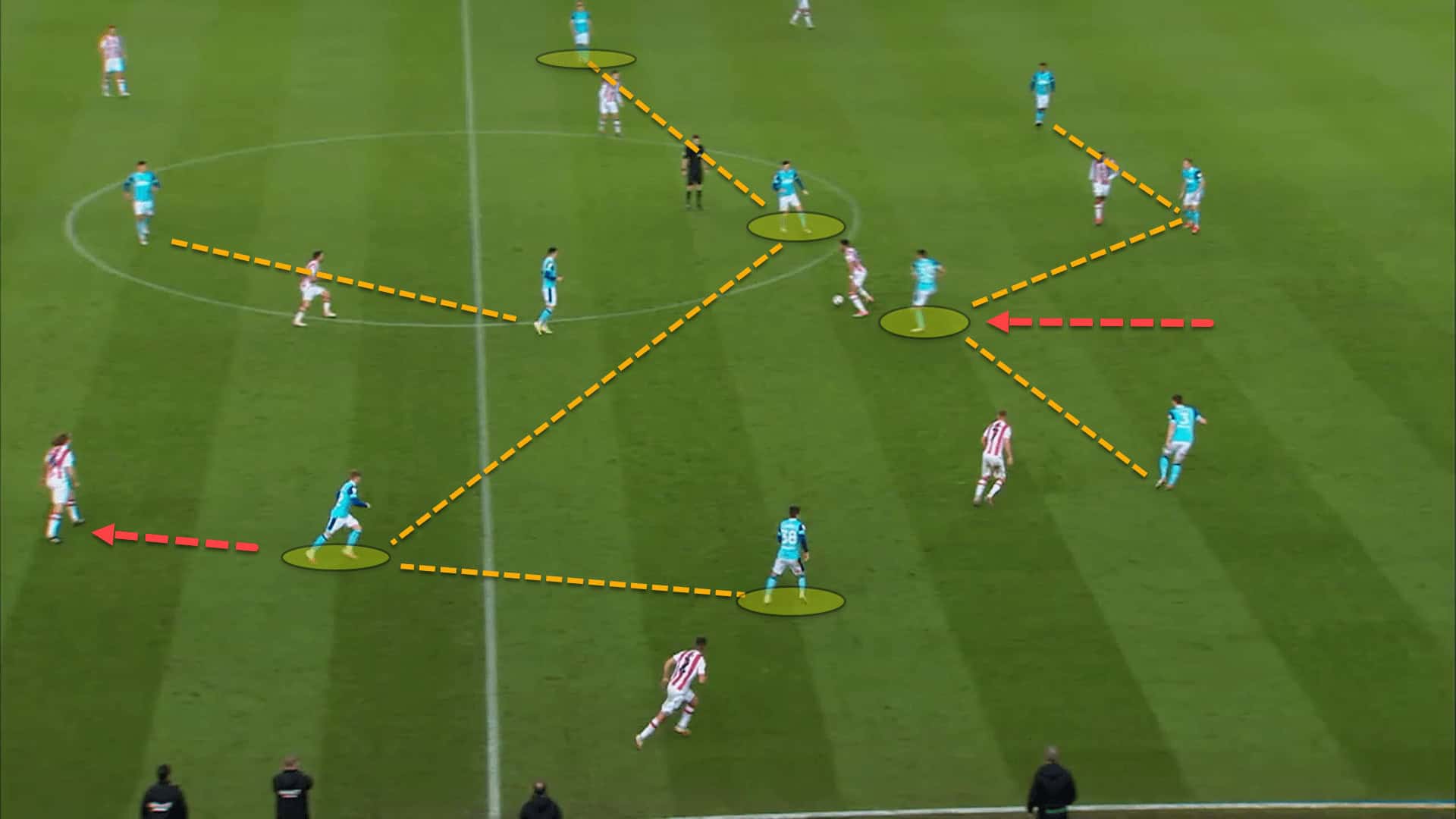
For example, in this image, the central midfielder has stepped out to close down Stoke City’s centre-back. This has left space for the opponent’s player to receive between the lines as the midfield failed to squeeze together while the central player was pressing.
As Derby play with their backline and midfield very compact vertically, the left centre-back Curtis Davies was able to step up and jump the ball-receiver before they could turn and drive forward.
In a recent analysis from the Championship, TFA noted how Derby’s Championship consociates Middlesbrough use aggressive defending between the lines to great success, allowing them to press high up the pitch with their central midfielders without them needing to worry about what’s occurring behind them.
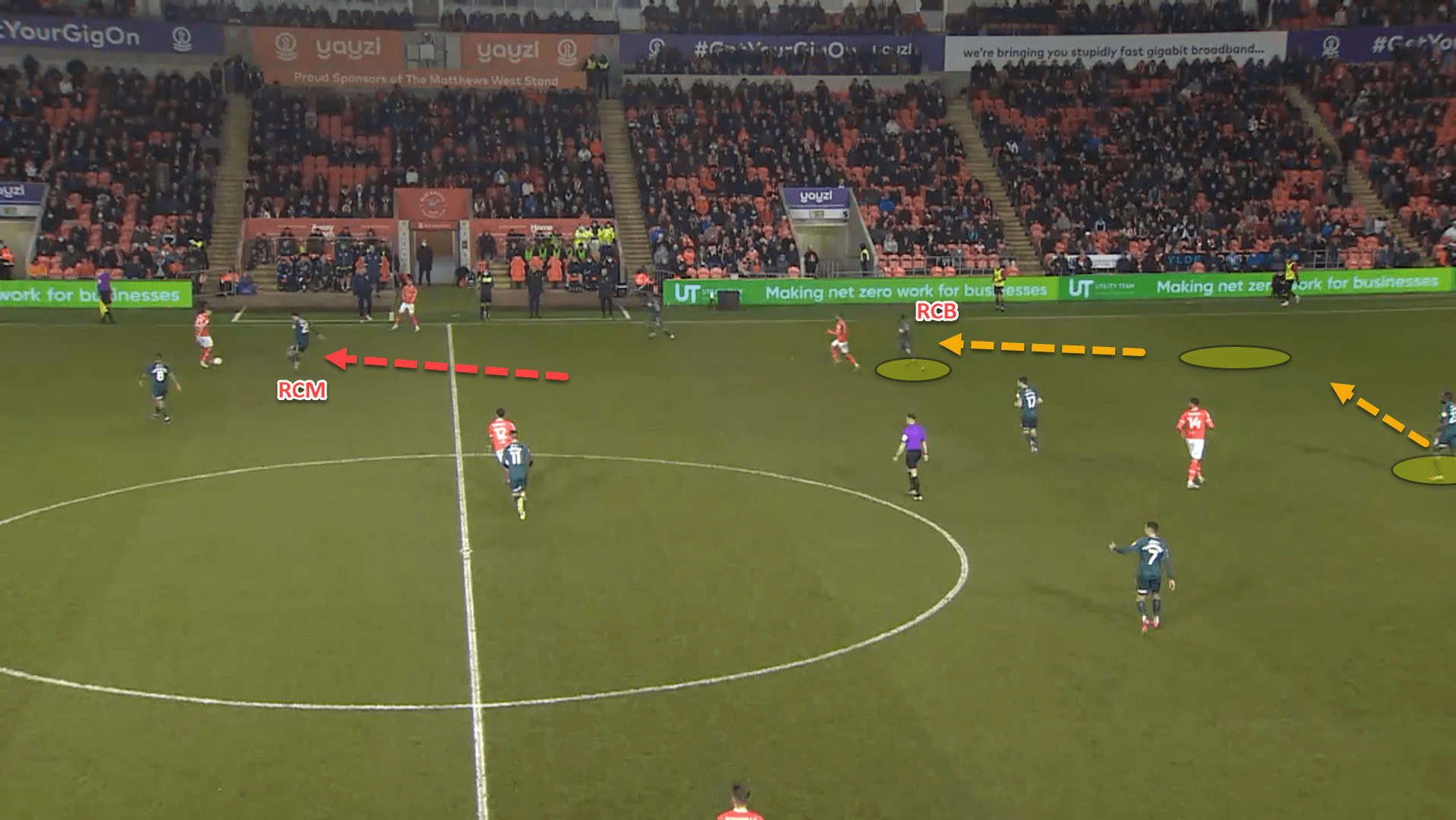
Having centre-backs capable of being aggressive in these scenarios is a great tool as it deters the opponent away from the goal. In Boro’s case though, manager Chris Wilder has been absolutely dogmatic with his deployment of 3-5-2.
With an extra player at the back, three-man defensive systems are more facilitative for aggressive defending between the lines as there will still be two wingbacks and two other central defenders to squeeze the space together.
Derby are predominantly set up in a back four which can be problematic at times for this type of defending. This isn’t to say that a four-man defensive line can’t be efficient at doing so. Derby are a perfect example of a team who are very comfortable defending this way, in a three and a four, but it’s simply riskier.
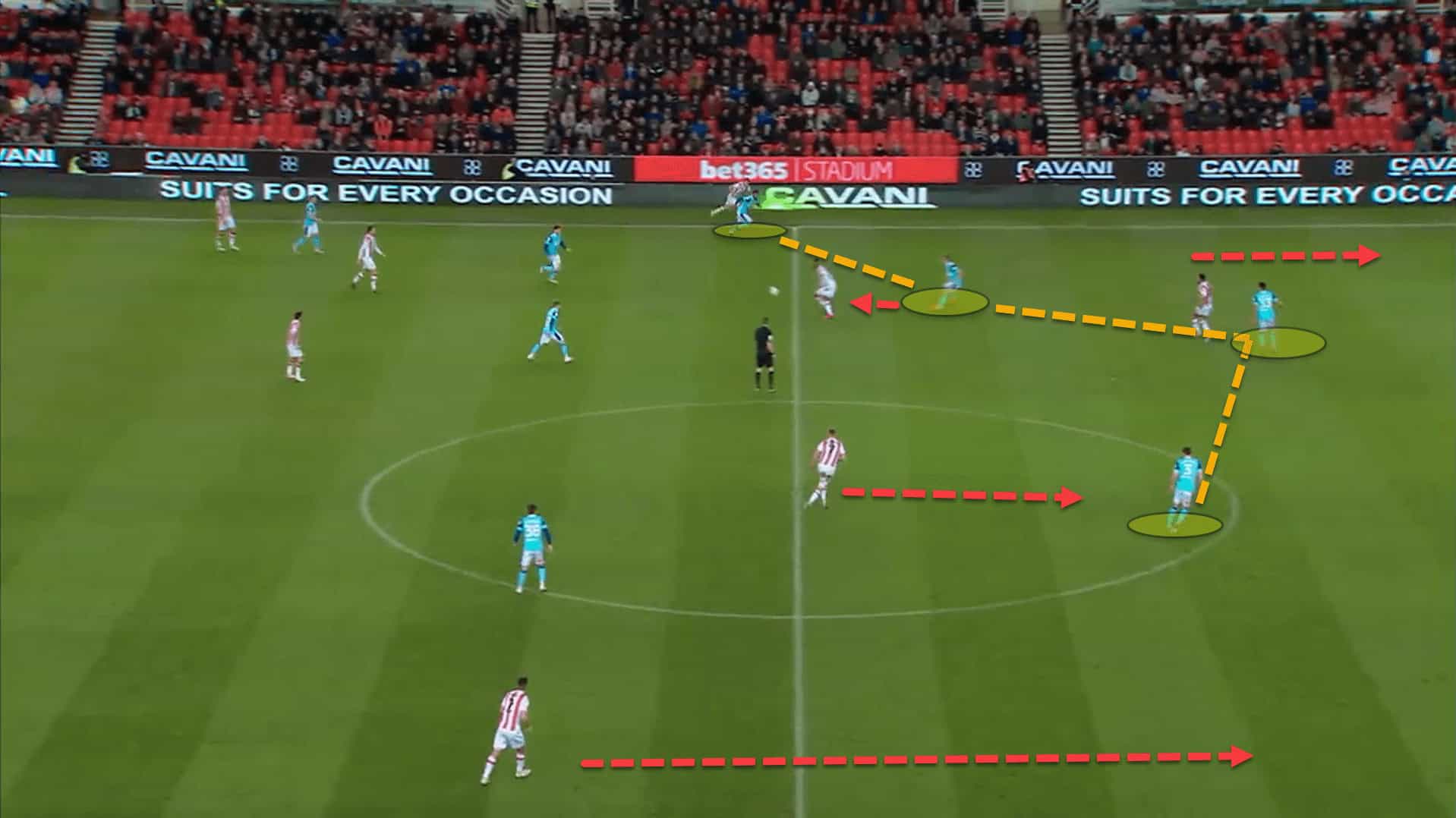
Look at this example, for instance. The veteran defender Phil Jagielka has stepped out here to close down the Stoke player who has received the ball behind midfield lines. The Potters now have alarming space to play into if the ball-carrier can find the right pass. With a back five in this scenario, there would have been far less danger forthcoming.
Nevertheless, the instructions from Rooney are to keep the team in possession as far away from their goal as humanly possible. Having defenders stepping forward to jump players between the lines is a coherent way of doing this, providing that all the players are working in coordination.
Pushing up as a unit is another way of pushing the attacking side away from Derby’s goal. This entails managing the depth of the backline which the Rams do very well given the wealth of experience with players such as Davies, Jagielka, and even Richard Stearman.
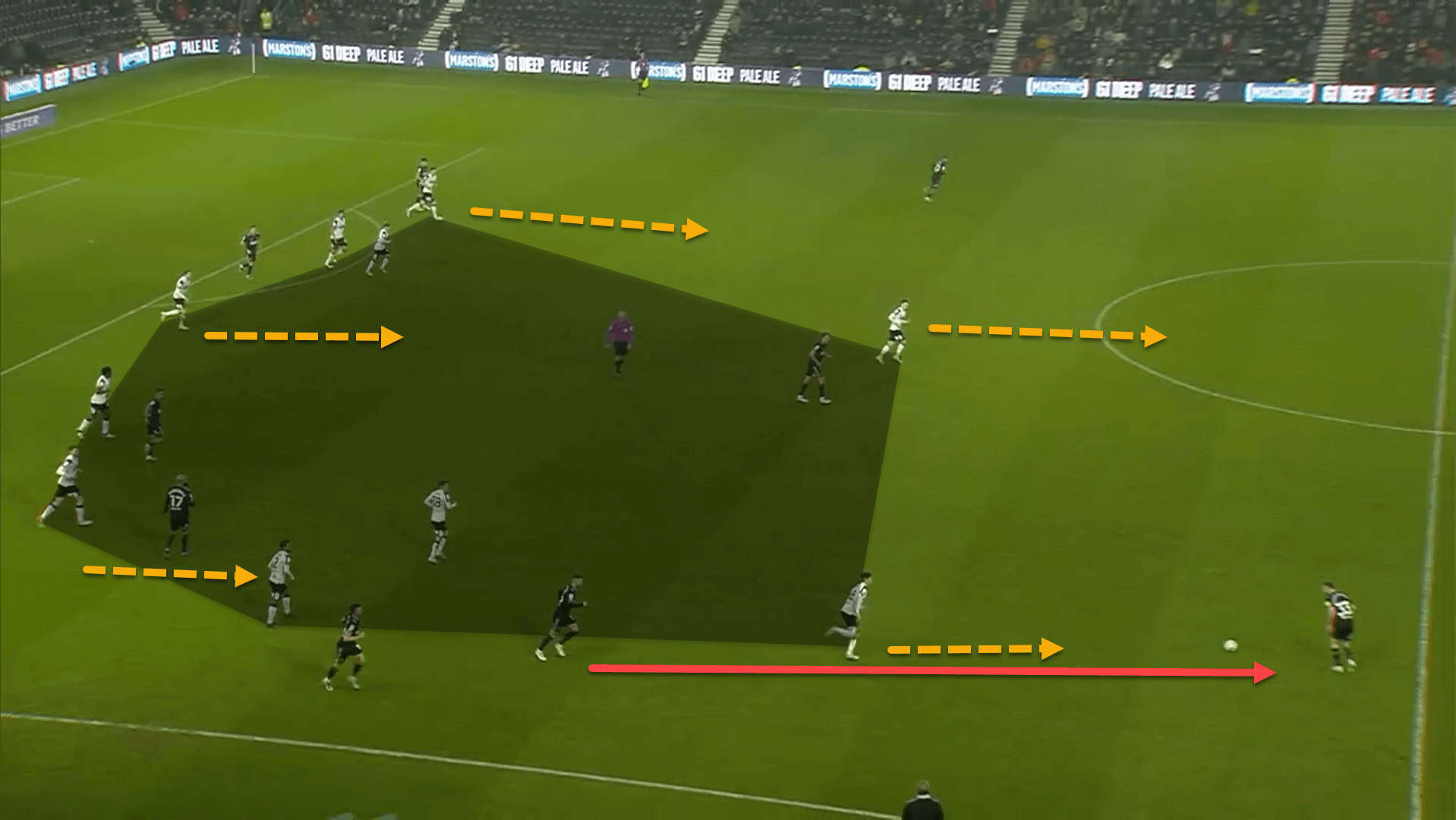
When the offensive team plays backwards, Derby step up straight away in unison, smothering any space between the lines that opens up whilst trying to force another backwards pass from the opposition.
Stepping up when required and dropping when necessary, Derby’s centre-backs deserve a lot of credit for their defensive solidity. One could probably argue that without such experienced players at the back, their defensive record wouldn’t be nearly as impressive, but Rooney is getting the very best out of them.
Inviting the opponent to press
Many coaches influenced by Pep Guardiola’s ‘juego de posición’ want their sides to play out from the back, enticing the opposition to press them in deep areas before playing through them.
Rooney is no different than any other modern coach and wants his side to play out from the back, but Derby do things slightly differently.
When in the build-up phase, Derby’s centre-backs split wide to accommodate the goalkeeper who often pushes up to the edge of the area, creating an unconventional back three.

Generally, the double-pivot position themselves behind the opposition’s first line of pressure and so this tends to create a 3-2 or 3-1-1 build-up structure. Of course, this depends on the formation choice on the day.
Nevertheless, Derby want to invite the opponent on to press them high up the pitch and then take advantage of the space behind the backline. As team’s press high, their backline will move up to the halfway line, leaving almost an entire half of space behind them.
Derby will constantly have runners attacking the depth and this space. The passing is done by the centre-backs and even the goalkeeper Ryan Allsop who is very adept at long-distance passing.
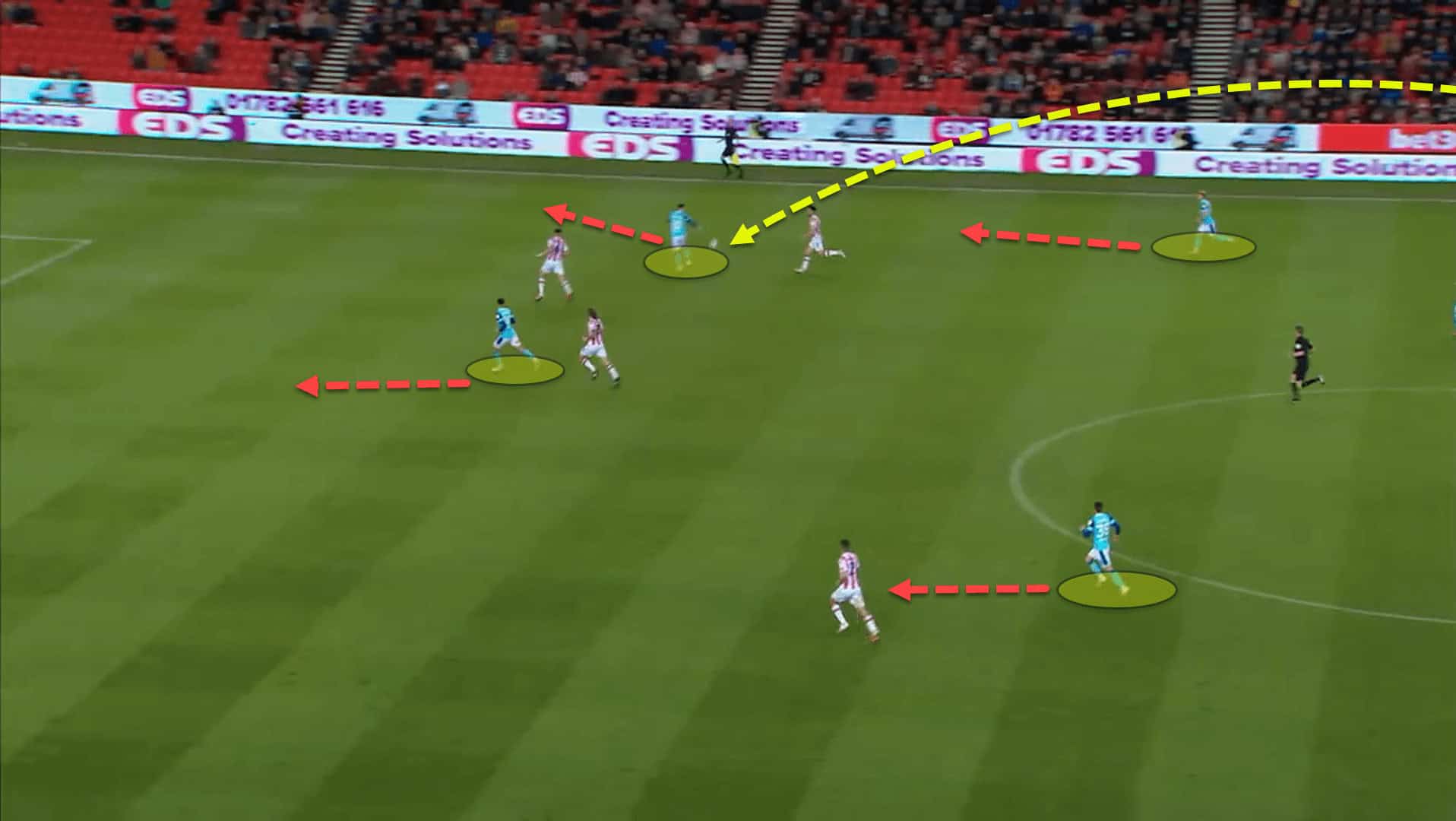
The attacking players make runs into the seams, more commonly known as the channels between the opponent’s defensive players. The wingers will always try and support the attack, alongside at least one central midfielder, giving the Rams a lot of attacking power.
This is a very direct form of offensive play by Derby who have averaged just 3.01 passes per possession sequence this season as well as 48.03 long balls per 90, a rather high figure which aggregates roughly 12 percent of their overall passes per game in all competitions.
Being as respectful as possible, Derby lack quality up front, with the exception of Tom Lawrence and perhaps Colin Kazim-Richards. To combat this, they attack with as many bodies as possible without unbalancing the team entirely in their positional attacks, allowing the fullbacks/wingbacks to advance forward and put balls into the box.
The fullbacks are a primary source of creation for the Rams. One method Rooney’s side uses to free up the fullbacks to cross is by creating wide overloads on one side of the pitch, generating an imbalance on the opposite flank, allowing the ball-far fullback to receive the ball in a 1v1 situation.
This works extremely well if the fullbacks excel in 1v1 scenarios. Generally, Derby will try and find the Bundesliga-linked Festy Ebosele in these qualitative superior situations due to the Irishman’s speed and ability to take on players and put good balls into the area.
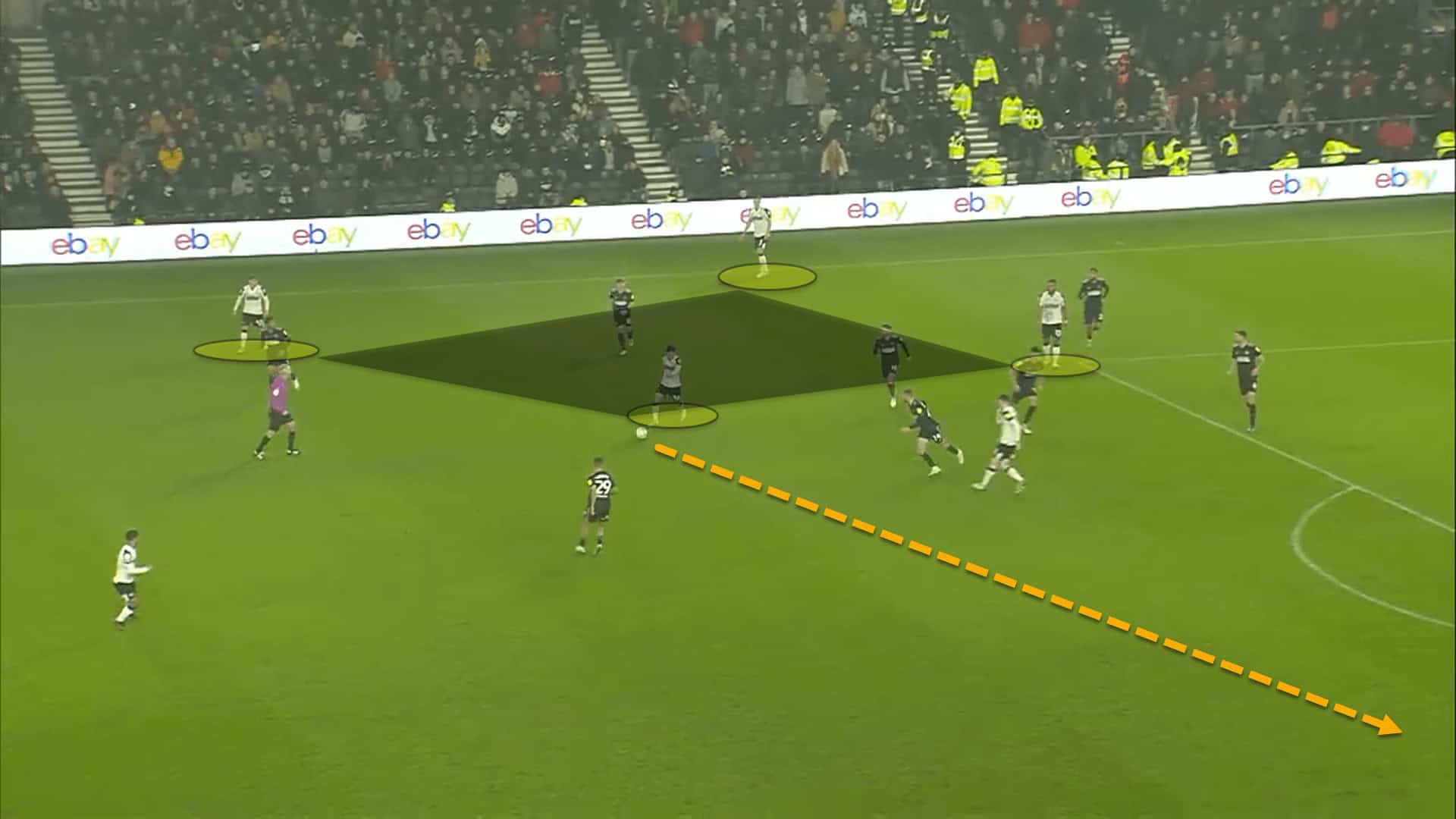
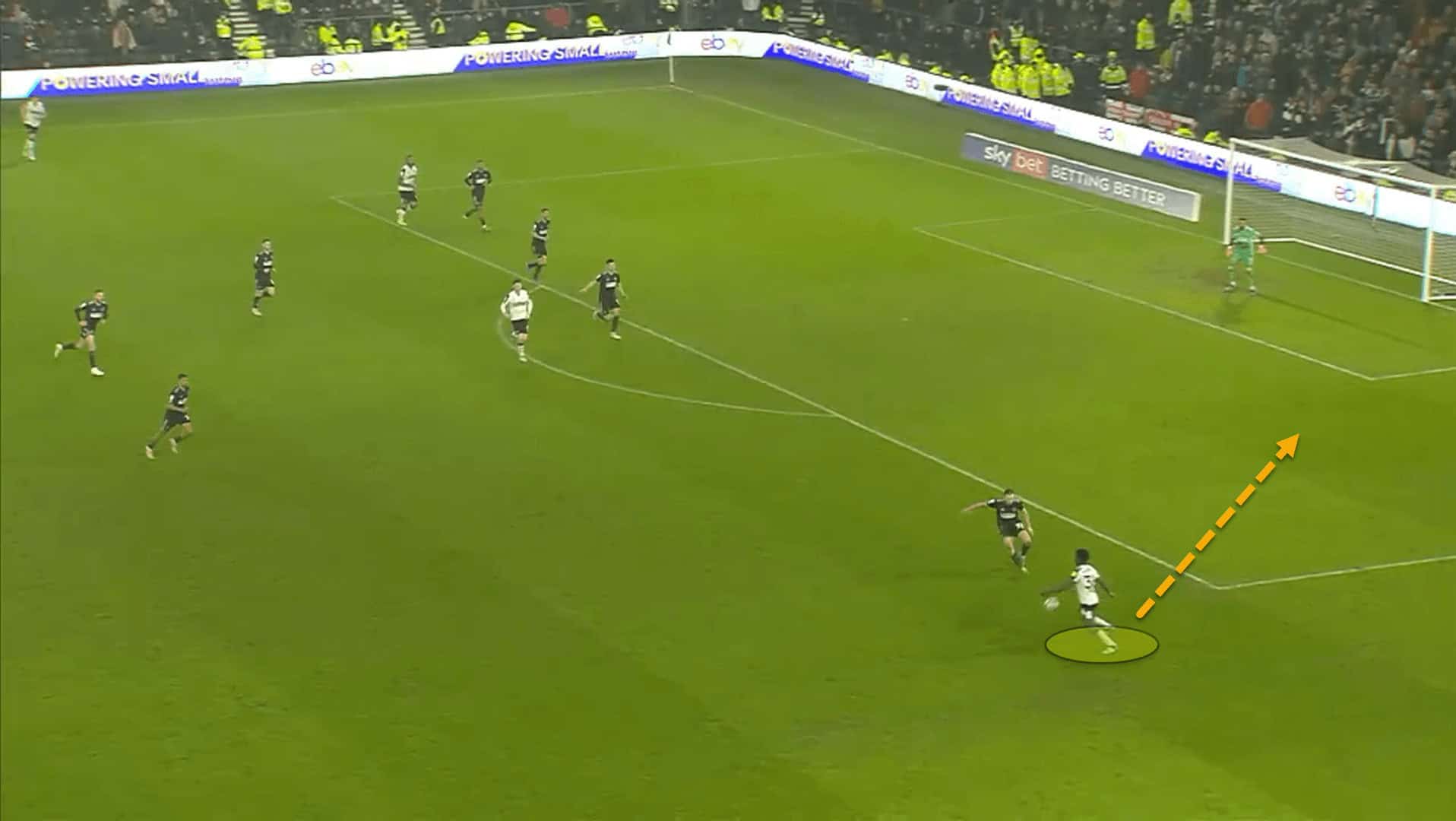
In this situation, as is the nature of a wide overload, Sheffield United have collapsed their entire defensive block to one side to defend against the increased numbers on the left flank. This has subsequently left Ebosele free on the right to receive a switch of play and take on the nearest defender 1v1.
These overloads and 1v1 situations are commonly found in Derby’s offensive play and are a great way for the Rams to exploit their strengths, as well as their notorious deep counterattacks with the immense speed they possess upfront.
Conclusion
The spectacular job Rooney is doing at Derby has earned him the honour of being linked with the vacant Everton job.
As a player, he never gave up, and it looks as though this hasn’t changed during his short managerial career. A captain should always go down with his ship and in Rooney’s case, regardless of the links to Goodison Park, the England legend looks prepared to battle in order to stay afloat, or else go down with his vessel.
