


Manchester United enter the January transfer window with a structurally vulnerable midfield that has been repeatedly exposed throughout the 2025/2026 campaign.
Rúben Amorim’s system places heavy tactical and physical demands on the double-pivot; the current squad profiles lack the balance, control, and defensive presence required to stabilise the team.
Casemiro’s declining mobility and Bruno Fernandes’ advanced attacking orientation create a partnership that struggles to manage transitions, sustain pressure-resistant build-up, or provide reliable defensive coverage.
The alternatives, including Manuel Ugarte and Kobbie Mainoo, have not fully addressed these shortcomings, leaving the Red Devils without a consistent midfield foundation to support Amorim’s aggressive wing-back structure.
This report uses detailed data analysis to evaluate the profiles most suited to solving Manchester United’s midfield imbalance.
By examining both Man United’s current midfield metrics and the performance data of Carlos Baleba and Adam Wharton, we aim to determine which profile offers the strongest fit for Amorim’s tactical framework and the club’s long-term requirements.
Manchester United Midfield Flaws
Manchester United’s midfield issues across the first thirteen league matches of the 2025/2026 season stem primarily from the structural demands of Rúben Amorim’s system and the squad’s inability to supply the right profiles to operate within it.
Amorim typically deploys a double pivot of Casemiro and Bruno Fernandes, a pairing that lacks natural balance.
Casemiro’s declining mobility leaves him exposed when facing the Premier League’s rapid transitional play.
While Bruno functions more as an advanced creator than a controlling midfielder, capable of dictating tempo or providing defensive stability.
The alternatives have not solved these gaps.
Manuel Ugarte, though industrious, struggles to provide composure in build-up, often rushing his decisions under pressure.
At the same time, Kobbie Mainoo still lacks the physical robustness and experience to consistently anchor midfield battles.
Within Amorim’s 3-4-3 or 3-4-2-1 structure, the wing-backs push high, meaning the central unit must cover large spaces, protect defensive transitions, and recycle possession under pressure.
Highlighting Manchester United Midfielders By Successful Defensive Actions

The lack of depth in this area, with summer recruitment prioritising attacking roles, means that even rotation or in-game adjustments do not meaningfully address the underlying imbalance, allowing the weakness to persist throughout the early campaign.
Midfield Profiles: Carlos Baleba Vs Adam Wharton
Manchester United currently face a dilemma in defining the ideal profile to operate within Rúben Amorim’s demanding system.
While both Carlos Baleba and Adam Wharton are central midfielders, their playing styles and tactical inclinations differ significantly, offering contrasting solutions to Manchester United’s midfield imbalance.
Carlos Baleba, at Brighton, primarily functions as a defensive-minded central midfielder, often positioned deeper in the double pivot or in a 4-2-3-1 formation.
In the 2025/2026 season, his activity is concentrated in the right half-space, reflecting both positional discipline and a preference for defending vertical channels.
Carlos Baleba Heat Map & Positional Distribution 2025/2026
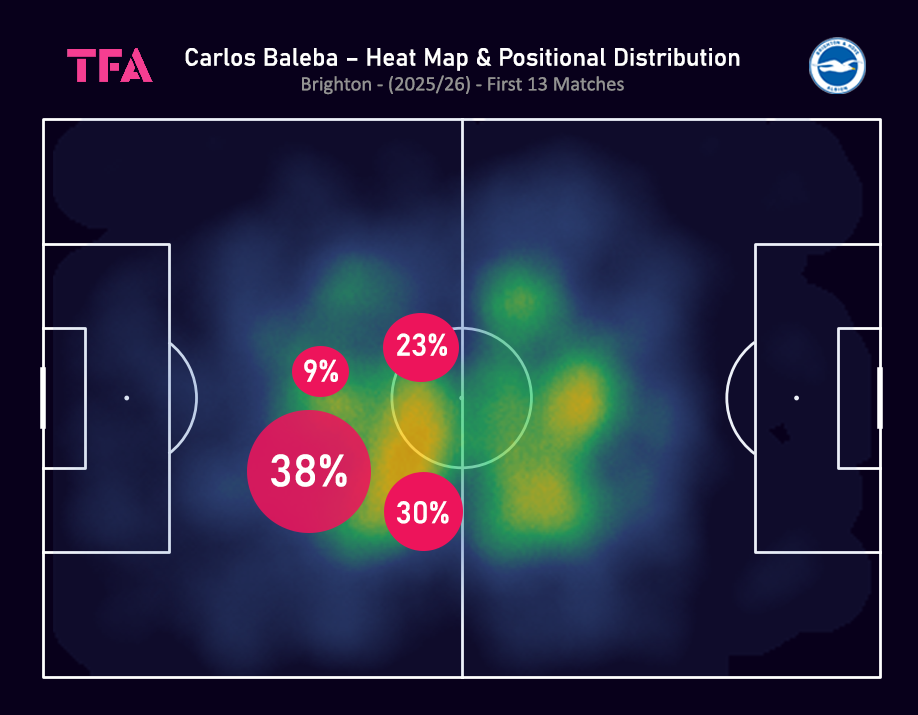
Baleba excels in shielding the backline, breaking opposition play, and recycling possession efficiently.
His ability to operate as a right-sided partner allows flexibility to slot alongside Bruno Fernandes or potentially replace Casemiro, offering defensive stability and tactical balance.
His vision and mobility enable him to safely transition the ball from deep areas, making him particularly suited to structured buildup phases and high-intensity defensive scenarios.
Adam Wharton, representing Crystal Palace, demonstrates a contrasting, more versatile central midfield profile.
Operating within a double pivot alongside Will Hughes, he supports a system prioritising width and fluidity, typically in a 3-4-2-1 framework.
Adam Wharton Heat Map & Positional Distribution 2025/2026
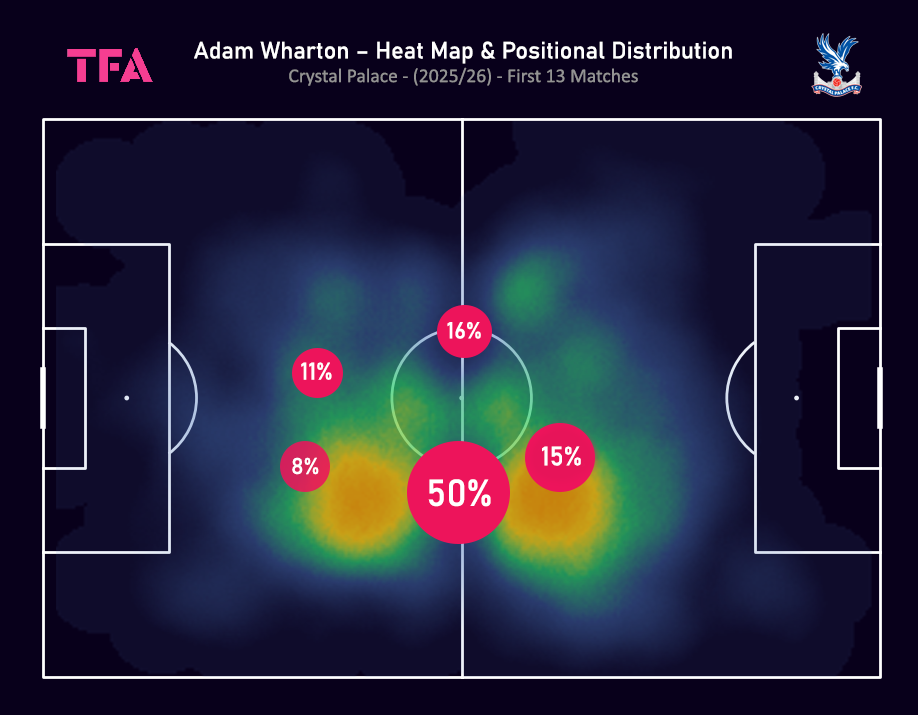
Wharton combines defensive awareness with the ability to advance the ball, freeing Bruno Fernandes to operate higher up and allowing wing-backs to push forward aggressively.
His positioning ensures depth while offering tactical flexibility, contributing both to transitional phases and attacking support.
Wharton blends a disciplined pivot role with offensive freedom, making him an intriguing candidate for United’s midfield, particularly in setups that require a balance between control and attacking dynamism.
Defensive Comparison: Carlos Baleba (Deep Defensive Anchor) Vs Adam Wharton (Advanced Pressing Midfielder)
Across the opening thirteen gameweeks of the 2025/2026 Premier League campaign, the defensive output of Carlos Baleba and Adam Wharton reveals two very different midfield profiles shaped not only by individual qualities but also by the tactical environments in which they operate.
Defensive Comparison – Wharton Vs Carlos Baleba 2025/2026
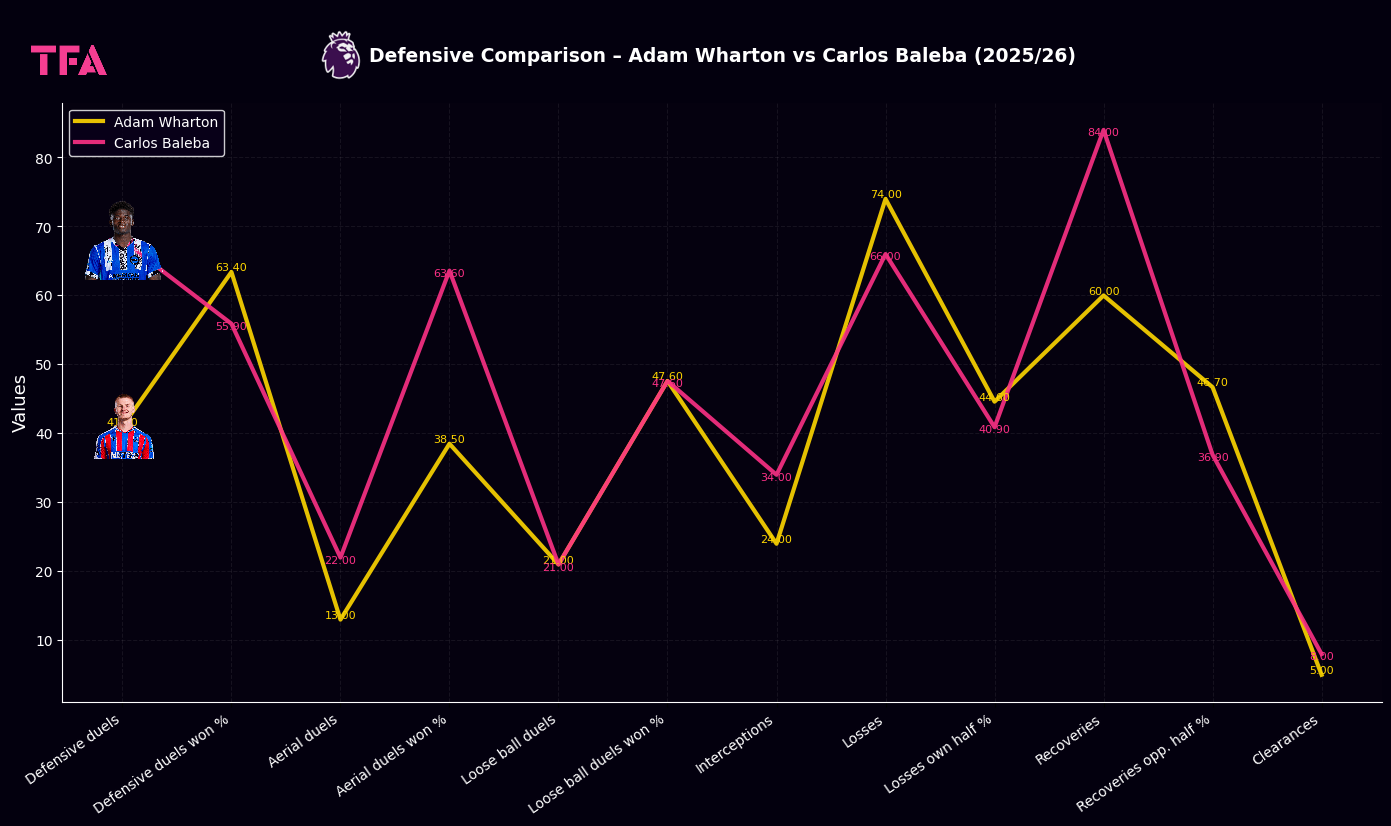
Baleba, playing in a deeper double-pivot role for Brighton, is required to defend larger spaces in his own half, protect the back line, and engage directly in duels during defensive transitions.
This naturally inflates his involvement in core defensive metrics; his numbers go beyond structural context and point to genuine defensive superiority.
Wharton, meanwhile, functions higher in Crystal Palace’s 3-4-2-1 system, where he steps forward to press, cover wide channels, and support advanced regains.
His recoveries are therefore more possession-oriented and occur frequently in the opposition half, reflecting a more proactive rather than reactive defensive role.
While Baleba provides the profile of a stabilising anchor, strong in duels, interceptions, and recoveries, Wharton offers defensive value through anticipation, pressure, and territorial gains.
For Manchester United, who require both defensive protection and dynamic counterpressure within Amorim’s system, these contrasting profiles highlight a clear strategic choice between a deeper destroyer and a more advanced presser.
Carlos Baleba Defensive Actions Map With Brighton 2025/2026
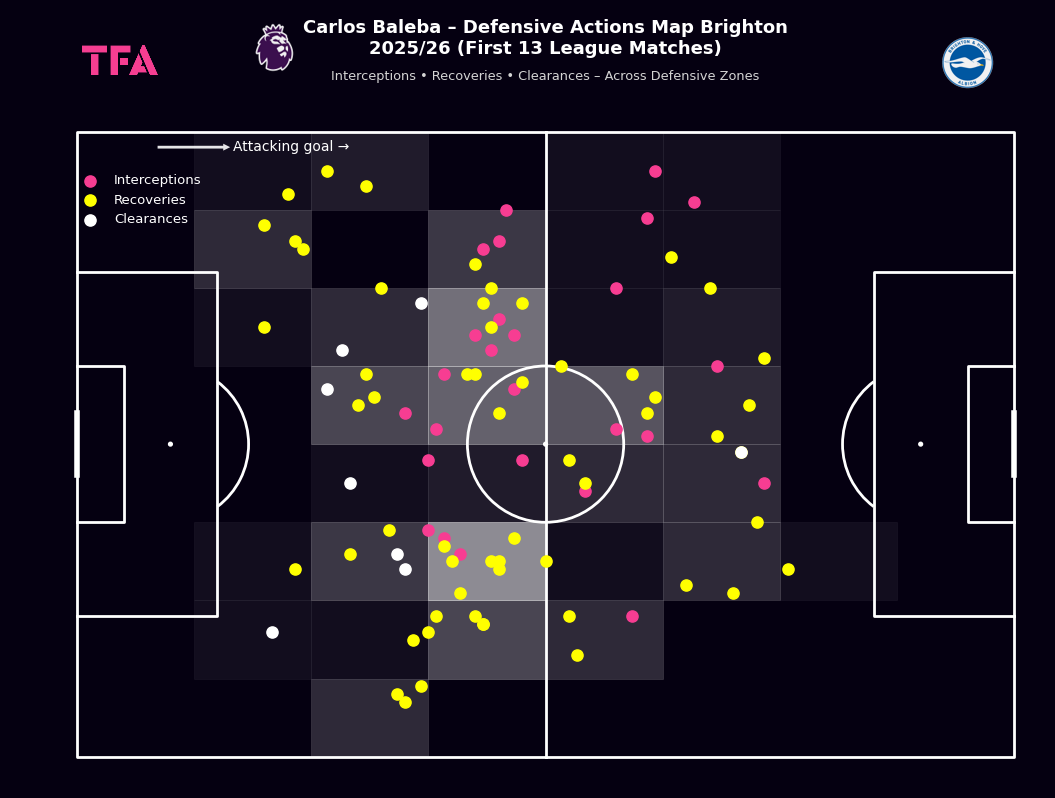
Baleba records 34 interceptions, 84 recoveries, 68 defensive duels, and eight clearances, showcasing dominance in core defensive actions.
His higher duel volume and 63.6% aerial success underline his suitability for deeper roles.
These metrics explain United’s strong interest, as he provides reliable protection during transitional moments.
Adam Wharton Defensive Actions Map With Crystal Palace 2025/2026
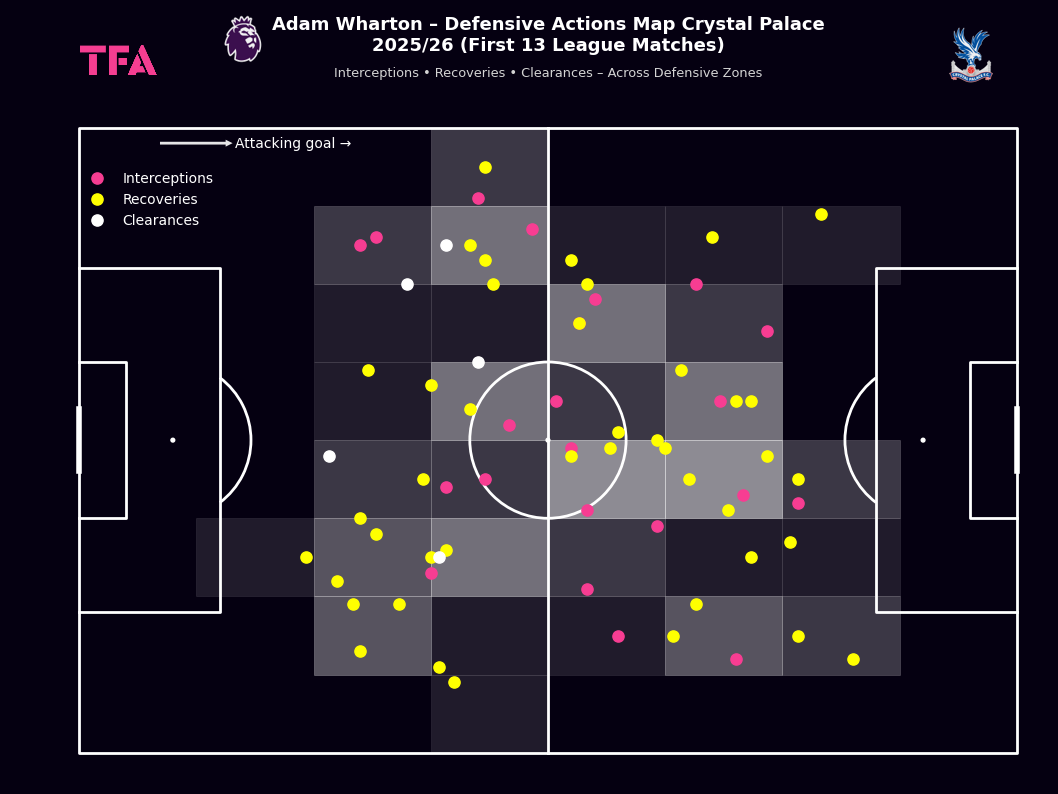
Wharton registers 24 interceptions, 60 recoveries, 41 defensive duels, and five clearances, with nearly 47% of recoveries in the opposition half.
Although his total recoveries are lower than Baleba’s, their advanced positioning highlights his pressing value and suitability for Amorim’s high-engagement midfield structure.
Ball Progression & Play-Building: Adam Wharton vs Carlos Baleba
Ball progression and organisation are central to any midfield solution, and the data for 2025/2026 show a clear edge for Adam Wharton over Carlos Baleba in passing, structuring play, and driving forward transitions.
Passing Comparison – Adam Wharton vs Carlos Baleba
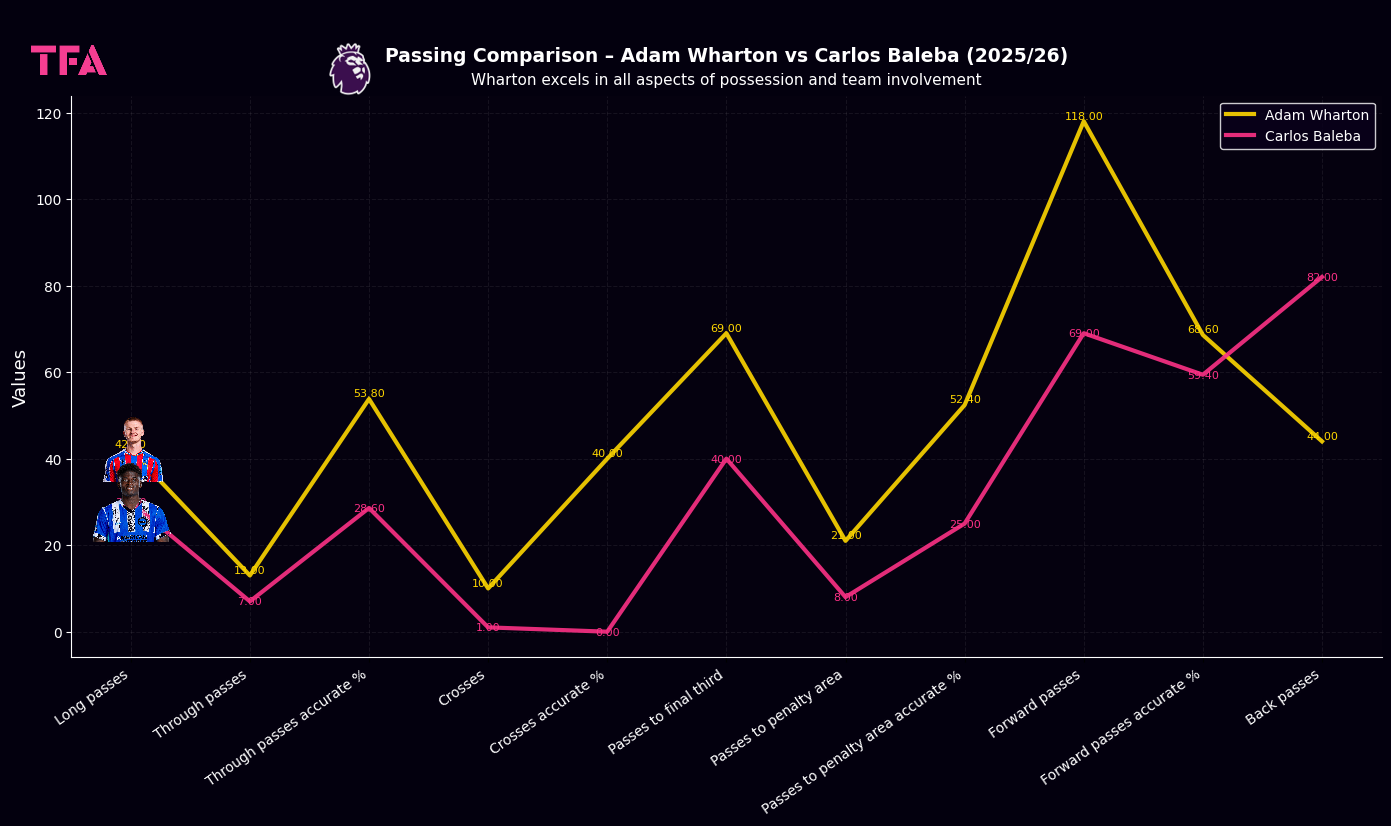
Wharton attempted 341 passes with a pass-accuracy rate of around 79.5%, completing 42 long balls (42.9% accurate), 13 through-passes (53.8% accurate), and 10 crosses.
His tendency to attempt progressive, risky passes, rather than just safe lateral ones, underscores a midfield profile built for verticality and transition.
Indeed, his per-90 passes completed (31.6) make him significantly more involved in build-up phases.
Moreover, Wharton’s background as a midfielder capable of breaking lines with progressive passes is well documented.
He was among the Premier League leaders in progressive passes per 90 last season, and often the top passer “between the lines,” crucial for linking defence to attack in tight spaces.
By contrast, Baleba’s minutes saw 286 passes completed at an 86 % pass-accuracy rate, numerically tighter on simpler passes, but offering less forward thrust, 30 long balls (53.3% accuracy), only seven through-passes (28.6%) and a single unsuccessful cross.
His lower involvement in progressive distribution suggests a role more oriented toward deep stability than creative build-up.
Why Wharton Makes More Long-Term Sense for United?
In the context of Manchester United’s current tactical demands under Rúben Amorim, Adam Wharton stands out as the midfielder who best aligns with both the immediate and long-term requirements of the team’s evolution.
United need more than a defensive anchor; they require a midfielder capable of sustaining controlled possession, progressing the ball under pressure, and providing consistent vertical access into advanced zones.
Wharton’s blend of line-breaking distribution, composure in tight areas, and willingness to attempt progressive passes offers a more future-proof profile than Baleba’s deeper, stability-focused approach.
While Baleba provides valuable defensive security, Wharton adds structural sophistication, build-up reliability, and transitional fluency.
Consequently, he represents the more comprehensive long-term investment, especially for a system seeking a balance among protection, control, and purposeful progression.
Conclusion
Manchester United’s search for the ideal midfield profile under Rúben Amorim ultimately comes down to identifying the player who can correct long-standing structural flaws while supporting the team’s long-term tactical direction.
Both Carlos Baleba and Adam Wharton offer clear strengths; the data highlight a decisive difference in suitability.
Baleba provides defensive assurance and depth, but his influence remains confined mainly to stabilising the first phase.
Wharton, by contrast, delivers progression, control, and tactical versatility, qualities Manchester United consistently lack in their build-up.
Given the demands of Amorim’s system, Wharton emerges as the more complete and forward-thinking solution.

