


You can now listen to this article on the TFA Podcast!
Subscribe for free on Apple Podcast, Spotify, or via RSS.
Barcelona Recent Weakness At Defending Corners
On Wednesday, the world’s attention turns to the UEFA Champions League semi-final match between Barcelona and Inter Milan.
In a challenging match like this, both teams need to focus on all possible details that could determine the superiority of one over the other.
Undoubtedly, set-pieces are among the most crucial of these factors.
Barcelona’s set-piece statistics are relatively strong, as they have conceded the fewest goals from set pieces in La Liga (three goals) and rank third in the league for the lowest expected goals (xG) conceded from set pieces, with 6.03.
Nevertheless, Hansi Flick‘s side has recently struggled to defend against corner kicks across competitions, notably in their matches against Real Madrid in the Copa del Rey final and against Borussia Dortmund in the UEFA Champions League.
This means that opponents have recently begun to decode their defensive tactics.
In this analysis, we will explain that Barcelona’s problem is both tactical and individual.
We should mention that Inter Milan is the most scoring team from corners in Serie A, with eight goals so far.
They also scored two goals against Bayern Munich from corners in their last UEFA Champions League match.
This tactical analysis will be a set-piece analysis about Barcelona’s weaknesses in defending corner tactics, which should be solved before facing Inter Milan.
What Is Barcelona Defending Scheme For Corners?
As shown below, Barcelona tactics defend with a man-marking system featuring two zonal defenders (yellow) and a close player ready to move to short corners (red), starting here to help in case the cross is played to the corner of the six-yard box and to cut the direct passing lane to the penalty spot.
If the opponent has six attackers, Barcelona will have six man markers and one player on the edge of the box for the rebound.
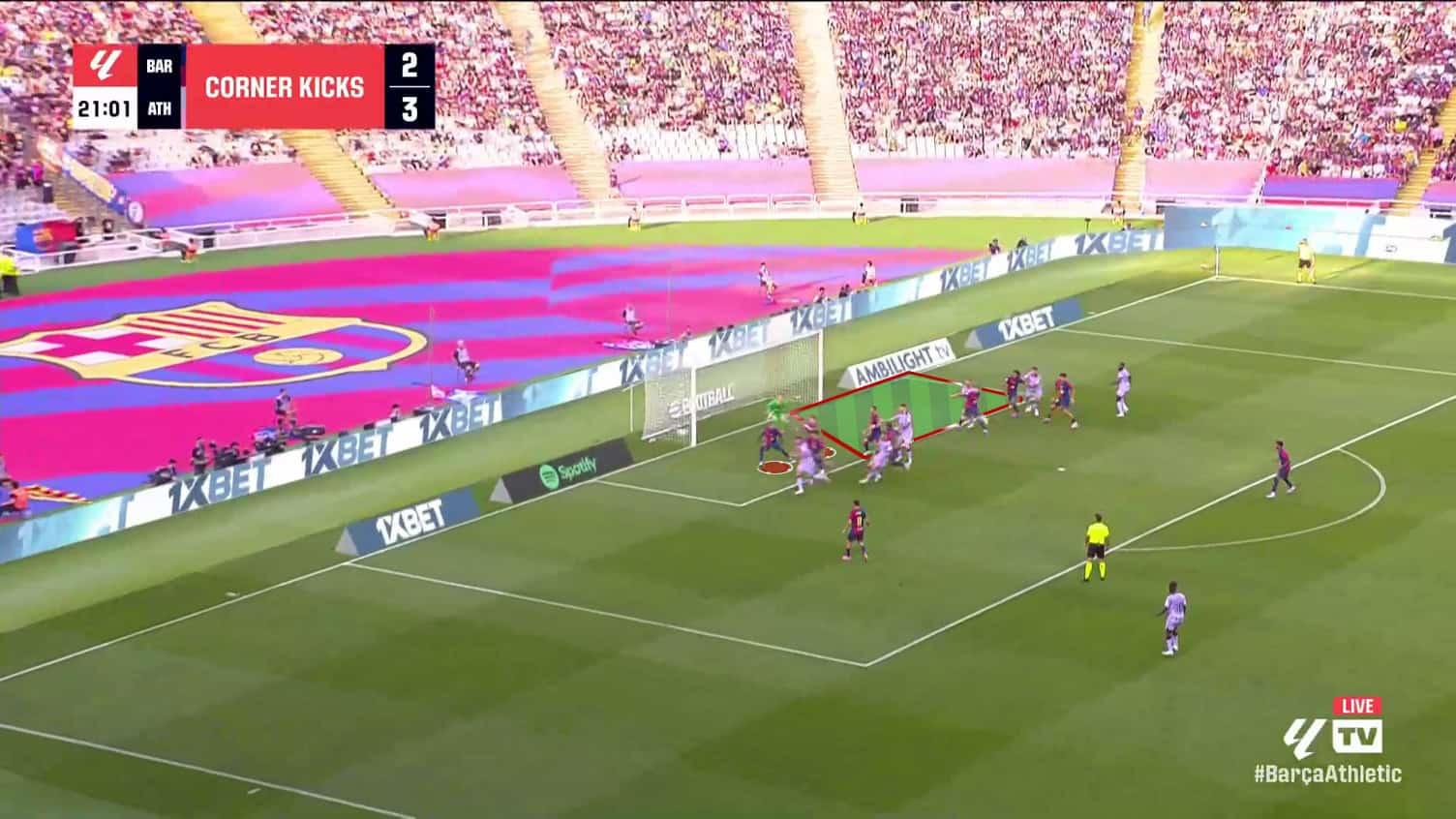
If the opponent has five attackers, as shown in the photo below, they will have five man markers and two rebound players on the edge of the box (green).
They will react with a man-marking reference, following the attacker in case he runs inside.
This leaves the area behind the two zonal defenders under the goalkeeper’s responsibility, who should go out to claim the ball if possible.

Barcelona Weaknesses At The Far Post & The Middle
Starting with the far post and the middle, we can find the most common weaknesses for any man-marking system, which are orientation and separation problems.
Barcelona Orientation & Separation Problems
In man-marking systems, most teams put two zonal defenders on the near post, which means the zones behind it are not well protected.
This means that if the targeted player removes his marker, he will threaten the goal (after evading the goalkeeper) because we can easily instruct the remaining players to evacuate the targeted area, dragging their markers with them.
The remaining question is how the targeted player overcomes his marker!
As shown below, the first way is to ask him to fake a step toward the near post when the ball is played and then move toward the middle or far post.
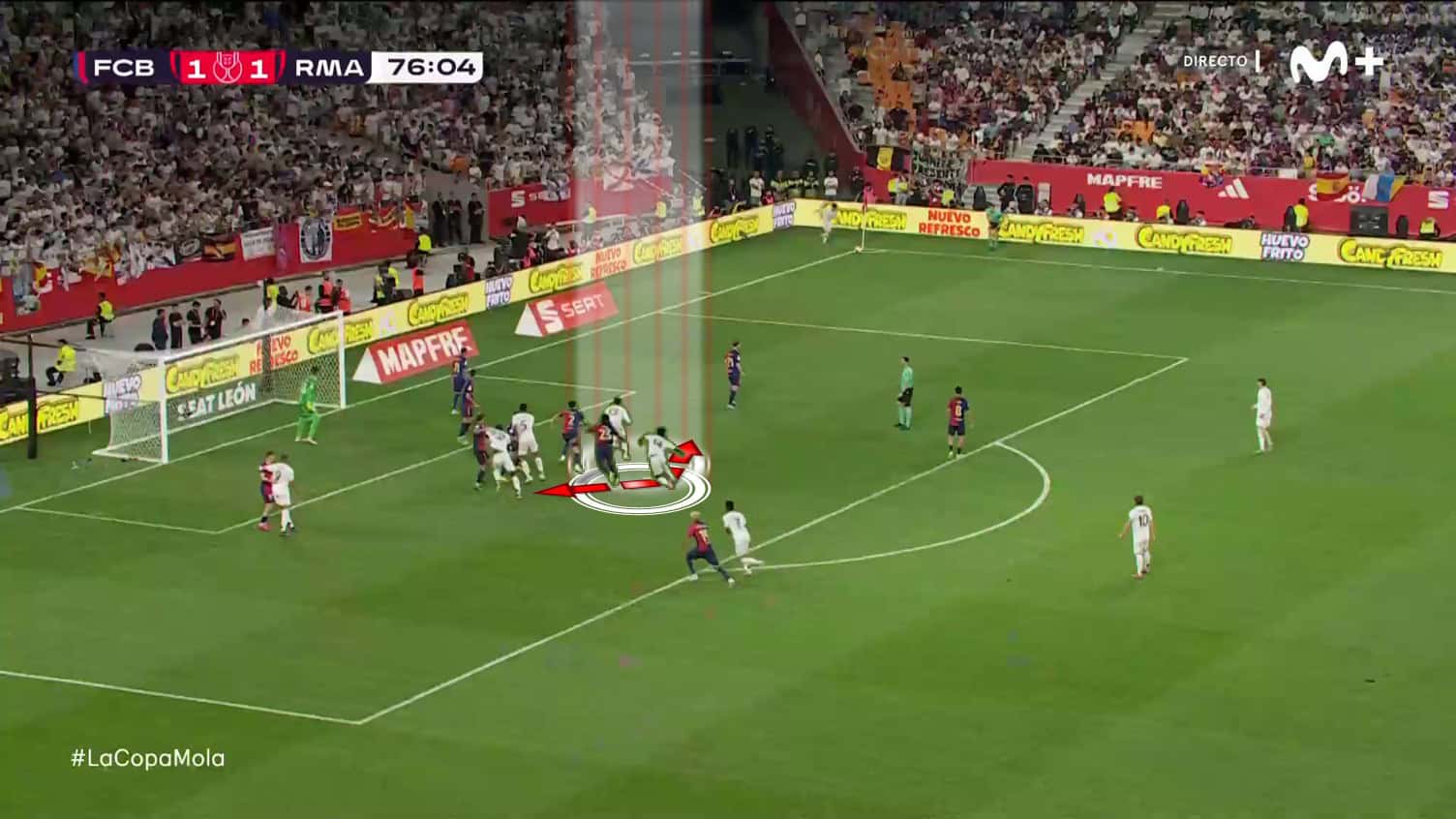
This type of movement (even if it was unintended) will cause an orientation problem for the marker, who doesn’t know whether to track the ball in front of him or turn around to track the attacker behind him.
It leads to losing contact with the attacker for a moment and trying to jump with his back.
It gives the attacker an advantage, as they see the full scene and can jump without disturbance, scoring a goal for Real Madrid.
We can also see the goalkeeper who hesitates to claim the ball and then comes back because he thought the cross was far from him, which evacuates the targeted area in the middle.
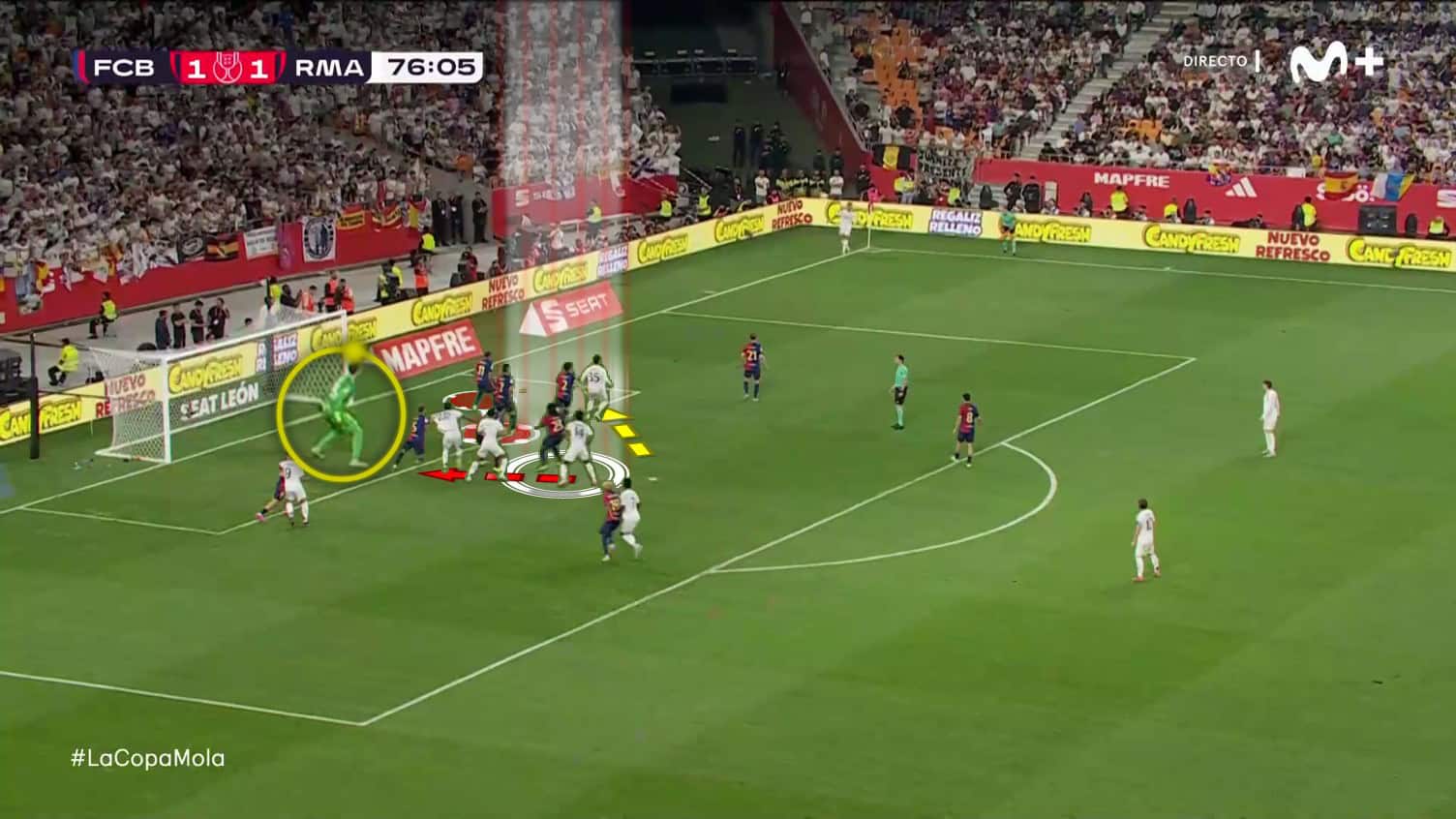
As shown below, the targeted player (white) starts within a pack of his mates to be separated from his man marker.
On the other hand, the player who starts next to the goalkeeper moves toward the near post in a decoy run, while the other attacker on the near post turns around to take his place.
This movement draws the goalkeeper’s attention, making him worry about what’s happening around him, and also helps the coming attacker separate from their man to block the goalkeeper effectively.
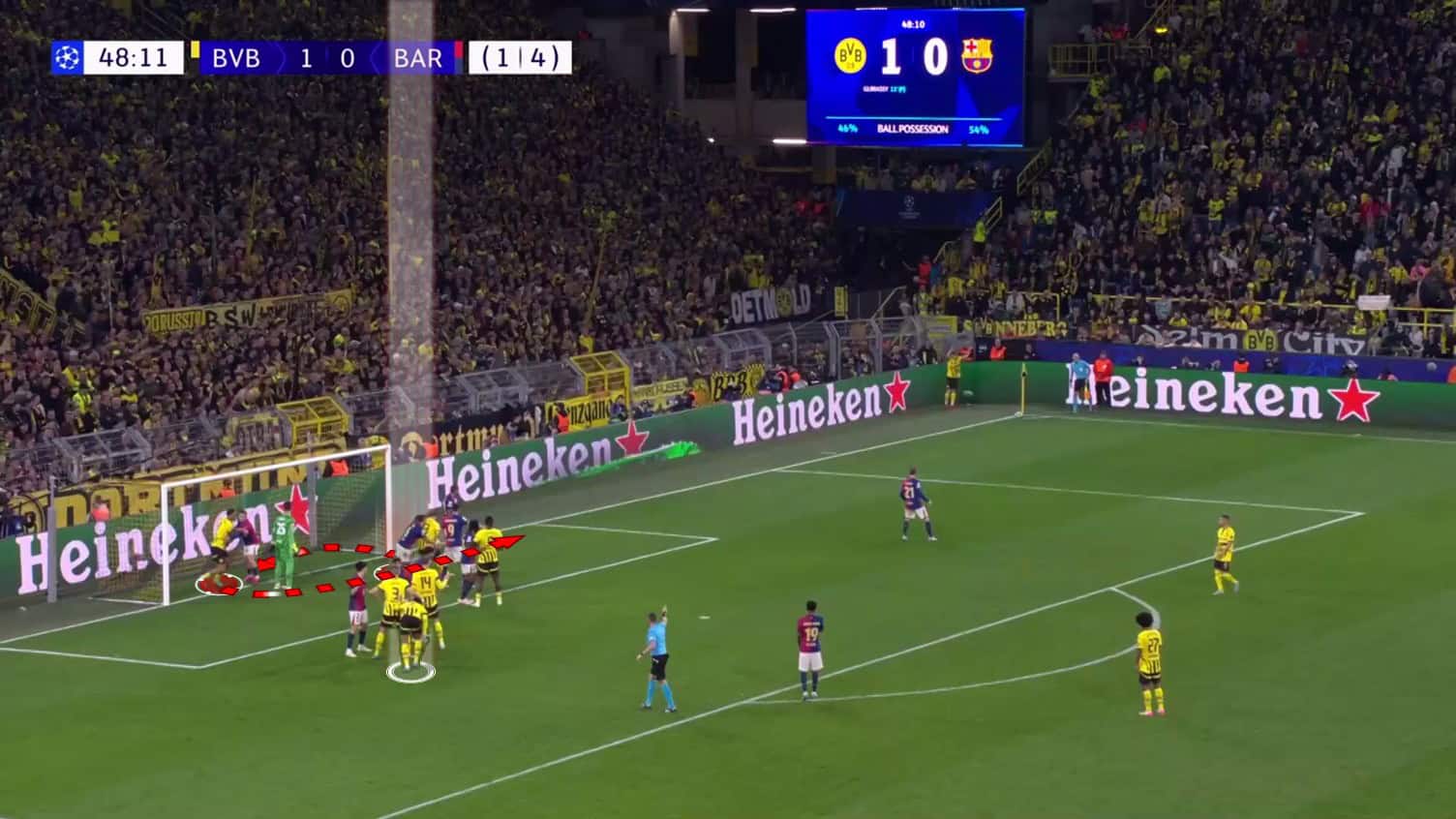
As shown below, the targeted player (white) is now separated from his man marker, who also suffers from an orientation problem because he turns around to see the ball in the air.
It is also clear that the player who comes to block the goalkeeper comes before his man because of this circular movement.
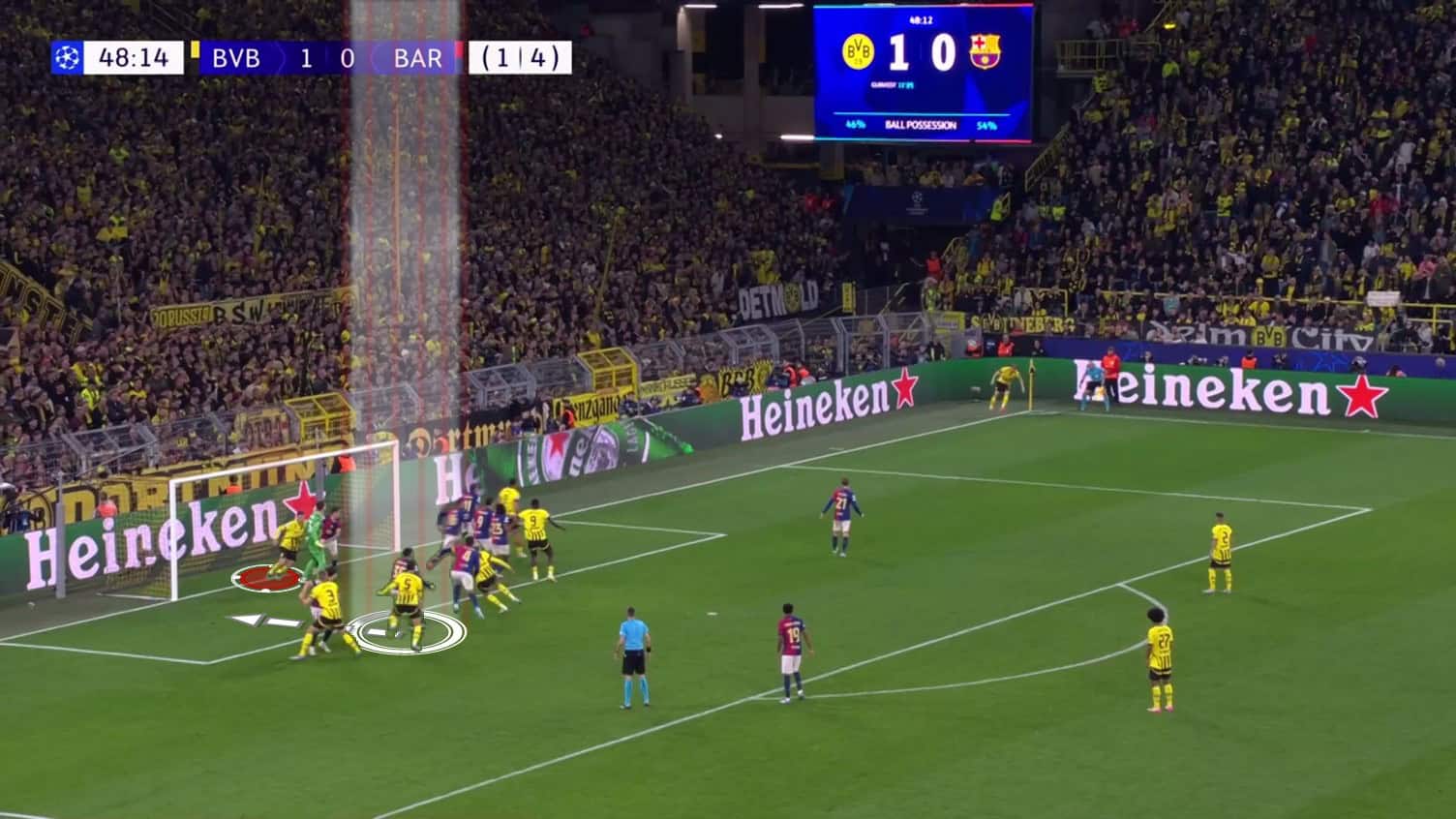
Finally, the targeted player fully controls the scene while the marker is forced to jump with his back to him, and the goalkeeper is also slowed down so as not to reach the far post (the targeted area).
At the same time, his teammates wait for the headed pass, framing the goal and ensuring they are onside because Raphinha, the first zonal defender, steps back toward the goal.
The result was a goal.
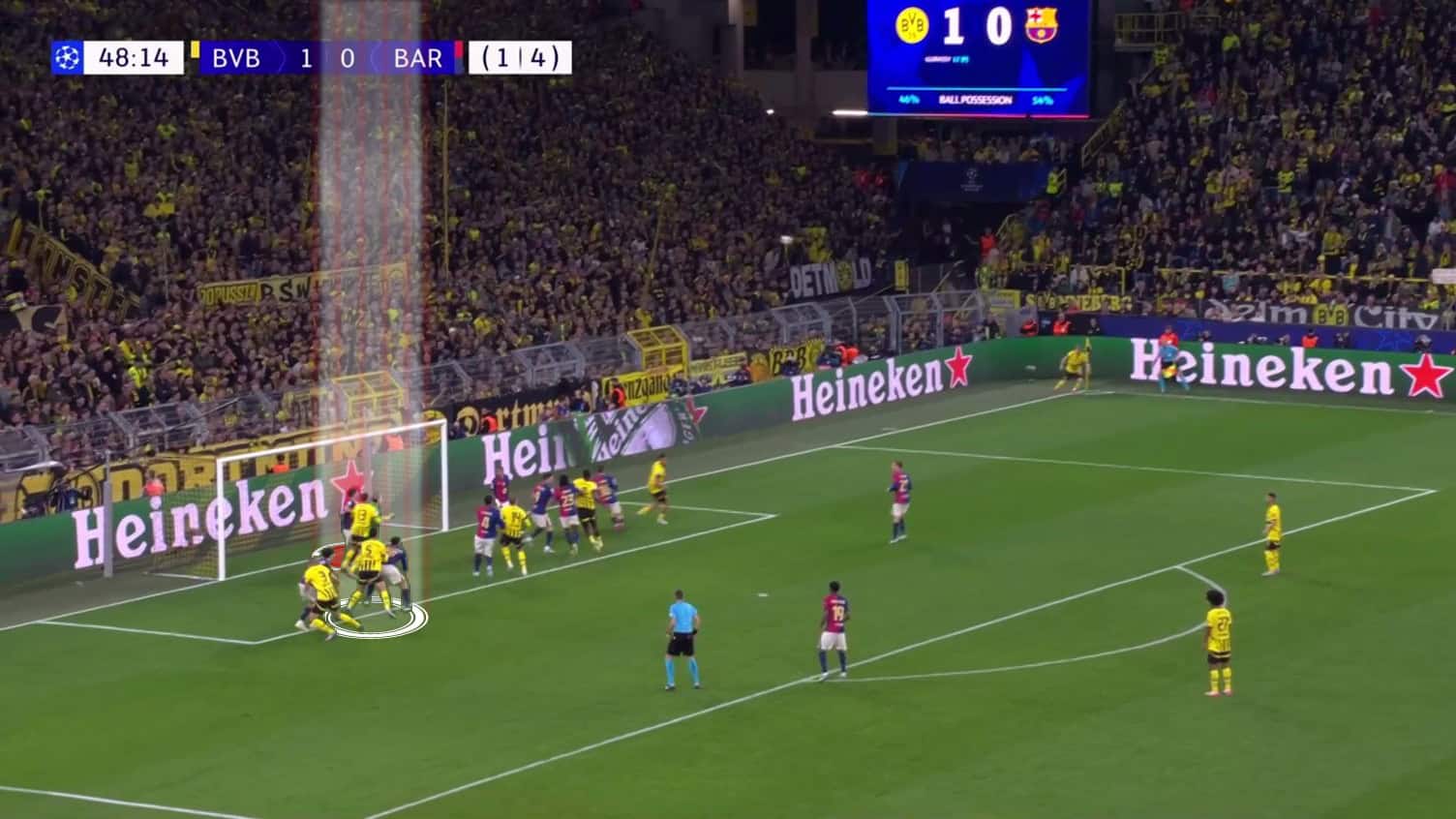
To address these orientation and separation issues, opponents had various ideas.
As shown below, the pack starts beyond the far post, making the marker unable to track the ball at his back and the attacker in front of him simultaneously.
The other two runners (red arrows) go to block the goalkeeper and the second zonal defender.
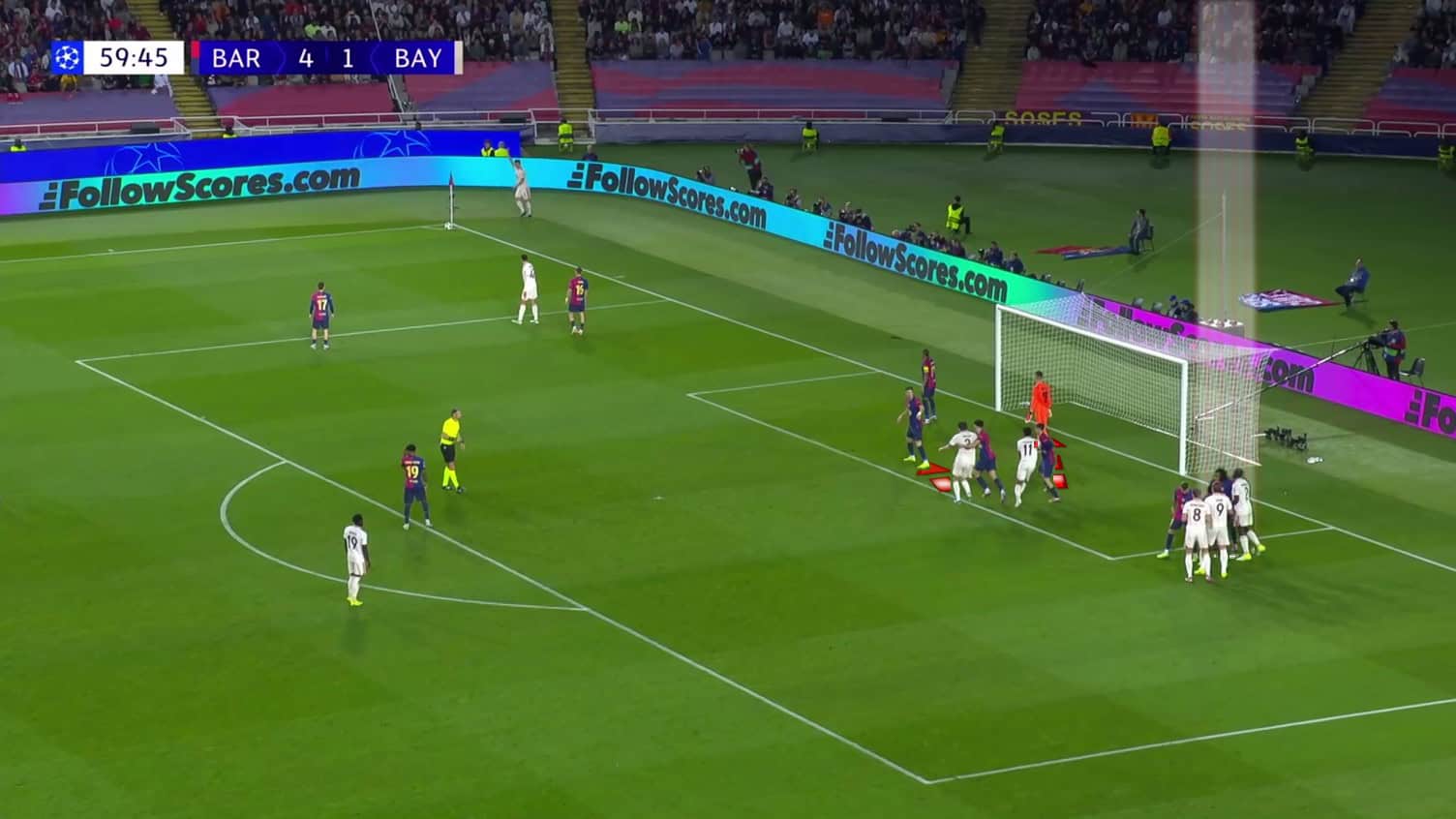
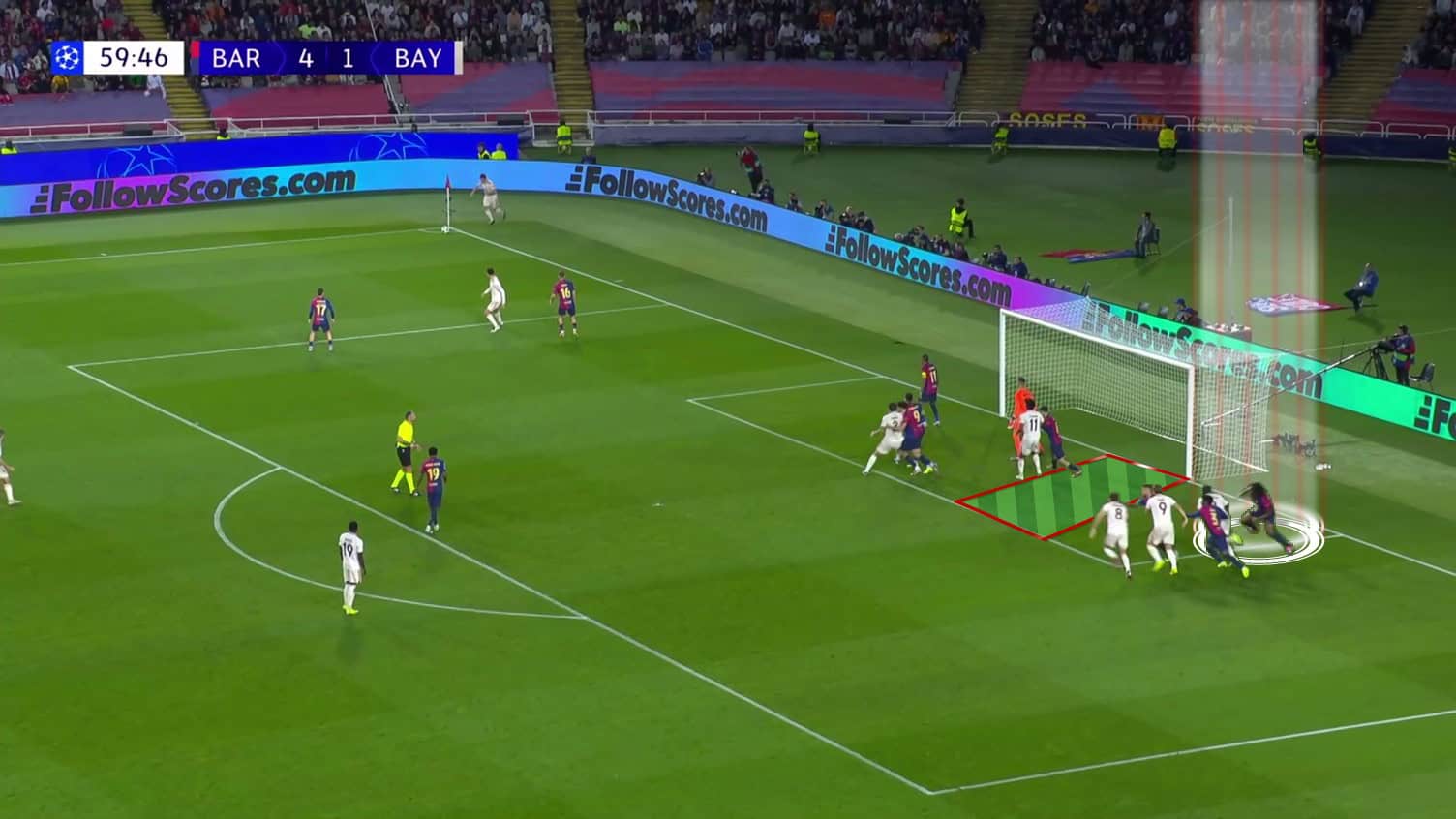
When the marker turns around as the ball is played, the targeted player becomes separated from them and can move to the targeted area, as shown below.
This time, the marker could save the situation with difficulty in the last moment.
Barcelona Conceded Short Corner Tactics
We are still explaining how opponents targeted the far post, capitalising on the man-marking system.
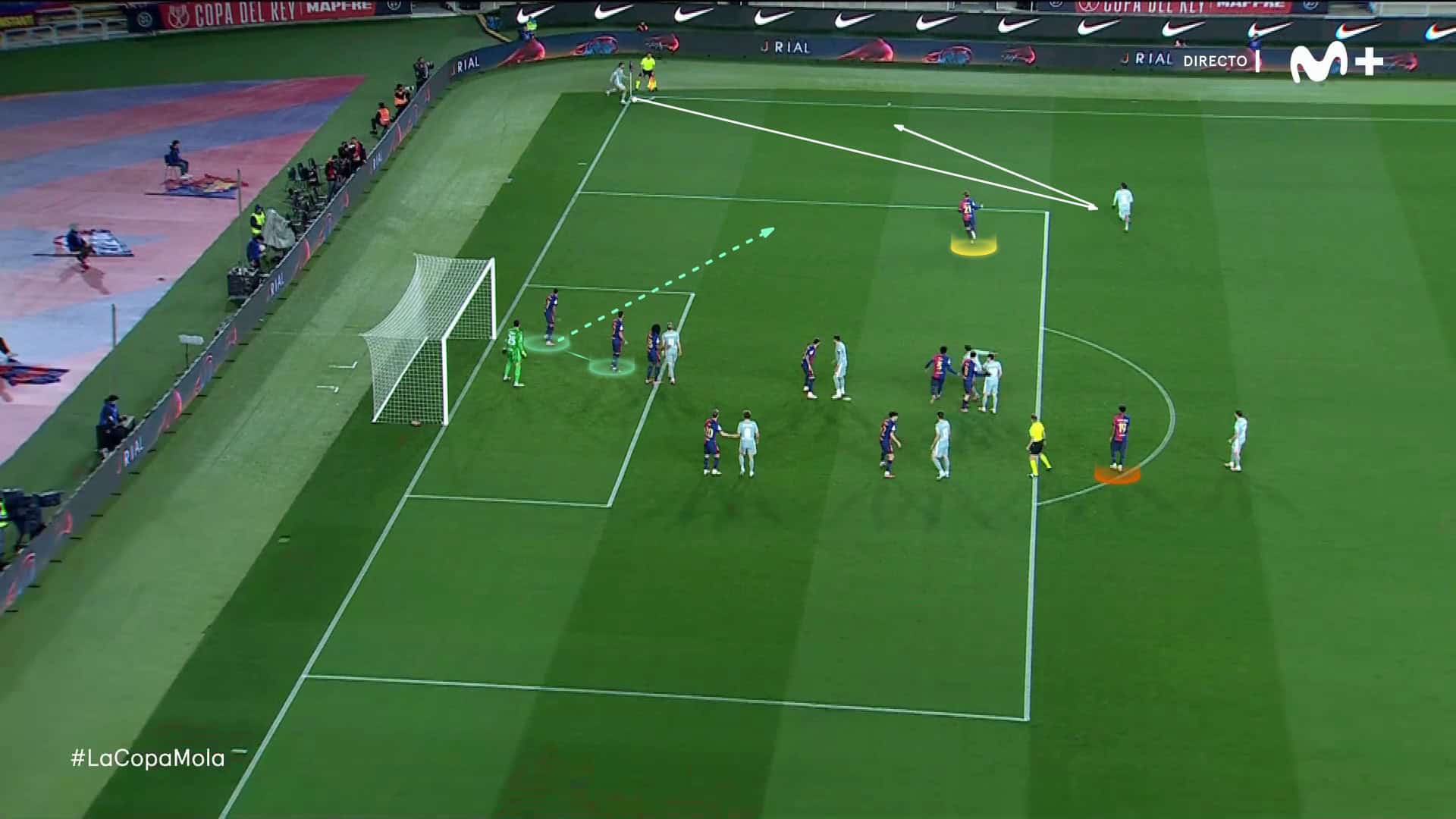
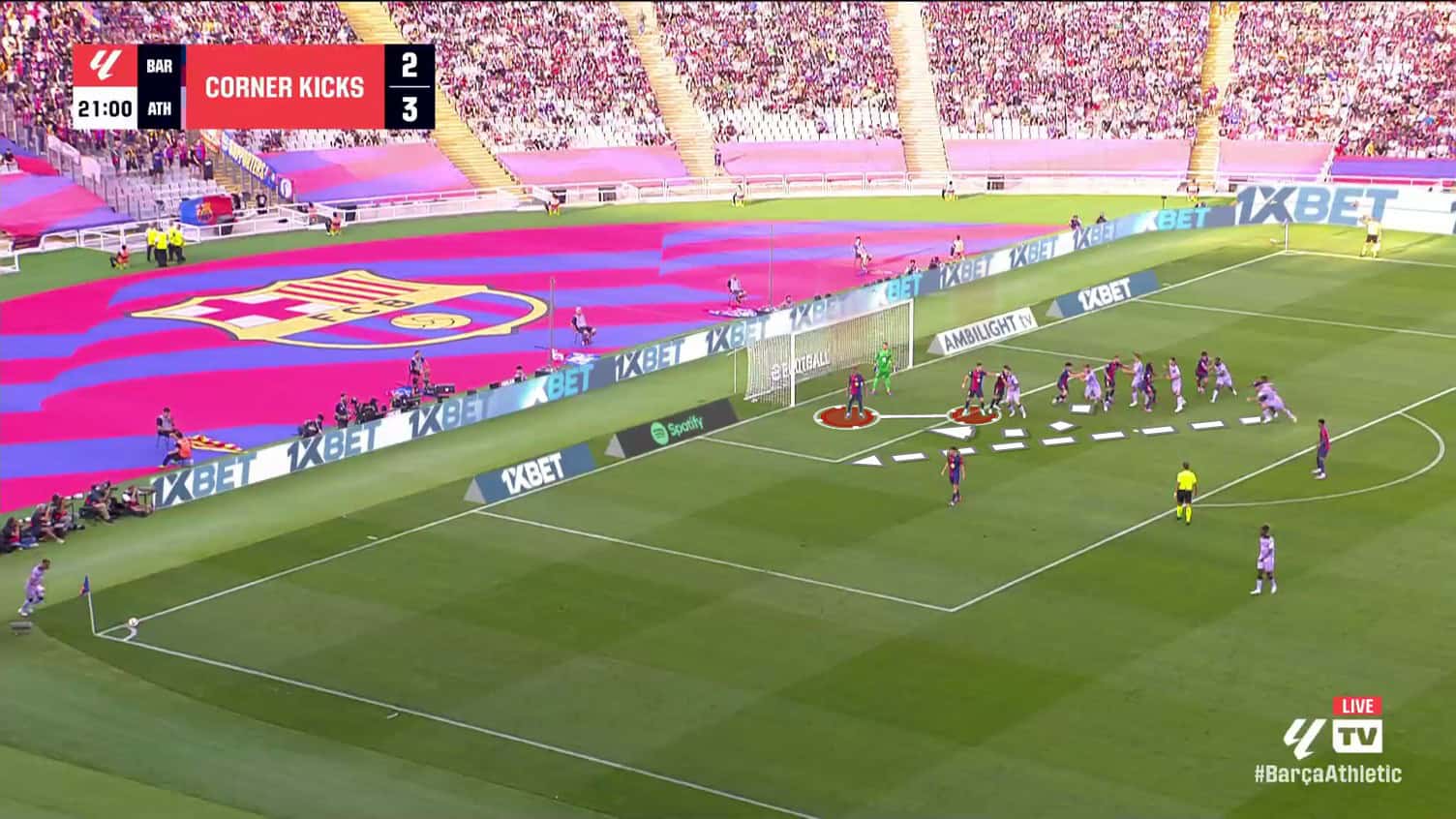
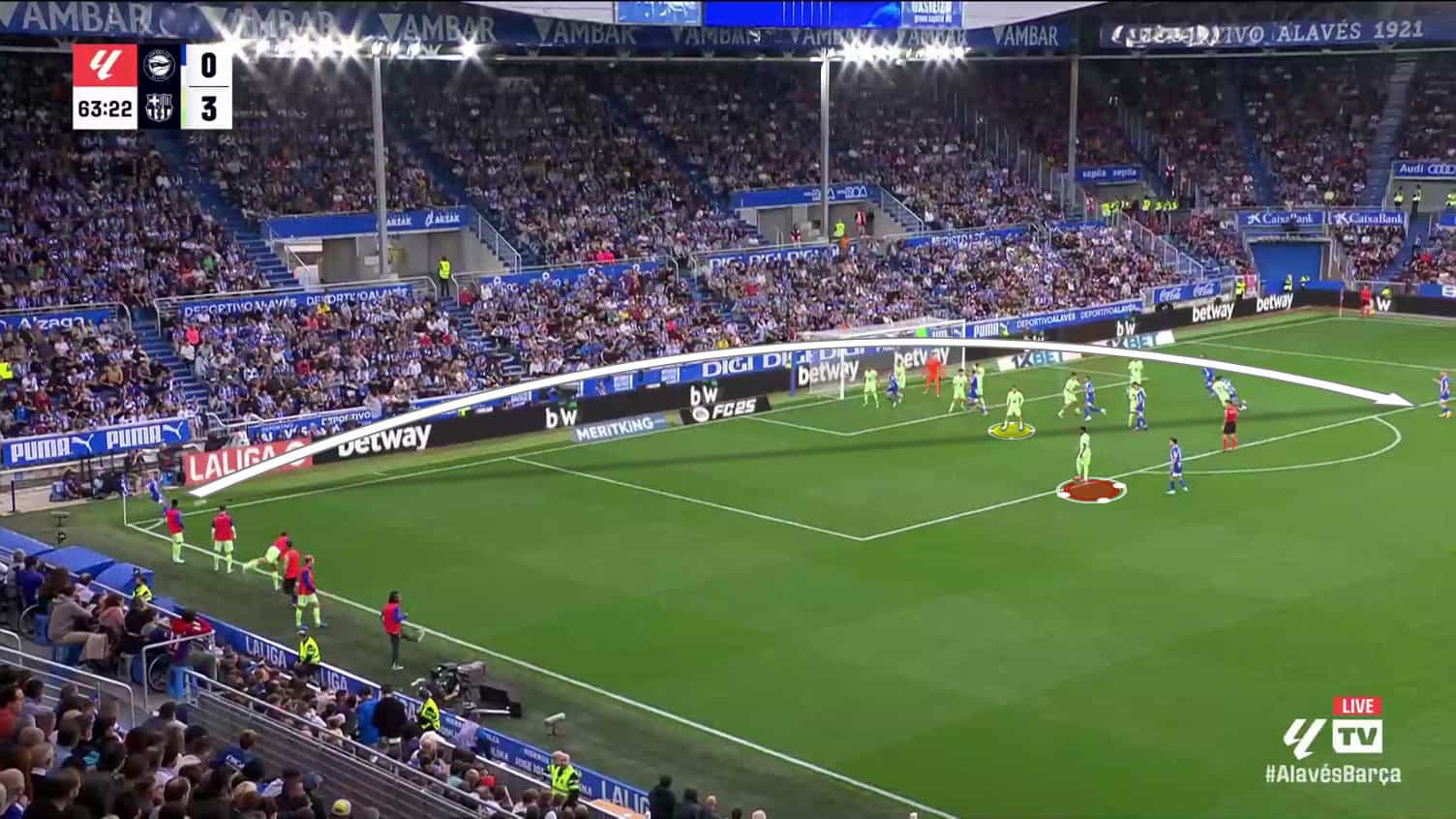
As shown in the photo below, FC Barcelona defend with a man-marking system, using only two zonal defenders (green), a short-option defender (yellow), and a rebound defender on the edge of the box (orange).
On the other hand, Atlético Madrid started with six players in the box: two players on the edge of the box, a counterattack defender at the back, and the taker.
Atlético Madrid’s first player on the edge of the box sprints toward the taker to receive the ball and play it back to the taker, who will send the cross from a nearer position.
This exploits the quick 2v1 situation against the yellow short-option defender because the first zonal defender should take a long path to help.
In the photo below, we focus on the second part of the plan inside the box so that we can concentrate on the six attackers inside.
The first is Julián Alvarez (blue), who will score the goal.
He will move to the empty far post while the second player (pink) returns to stand on the edge of the box for the rebound, evacuating the targeted area by this trick and dragging a marker with him from the beginning.
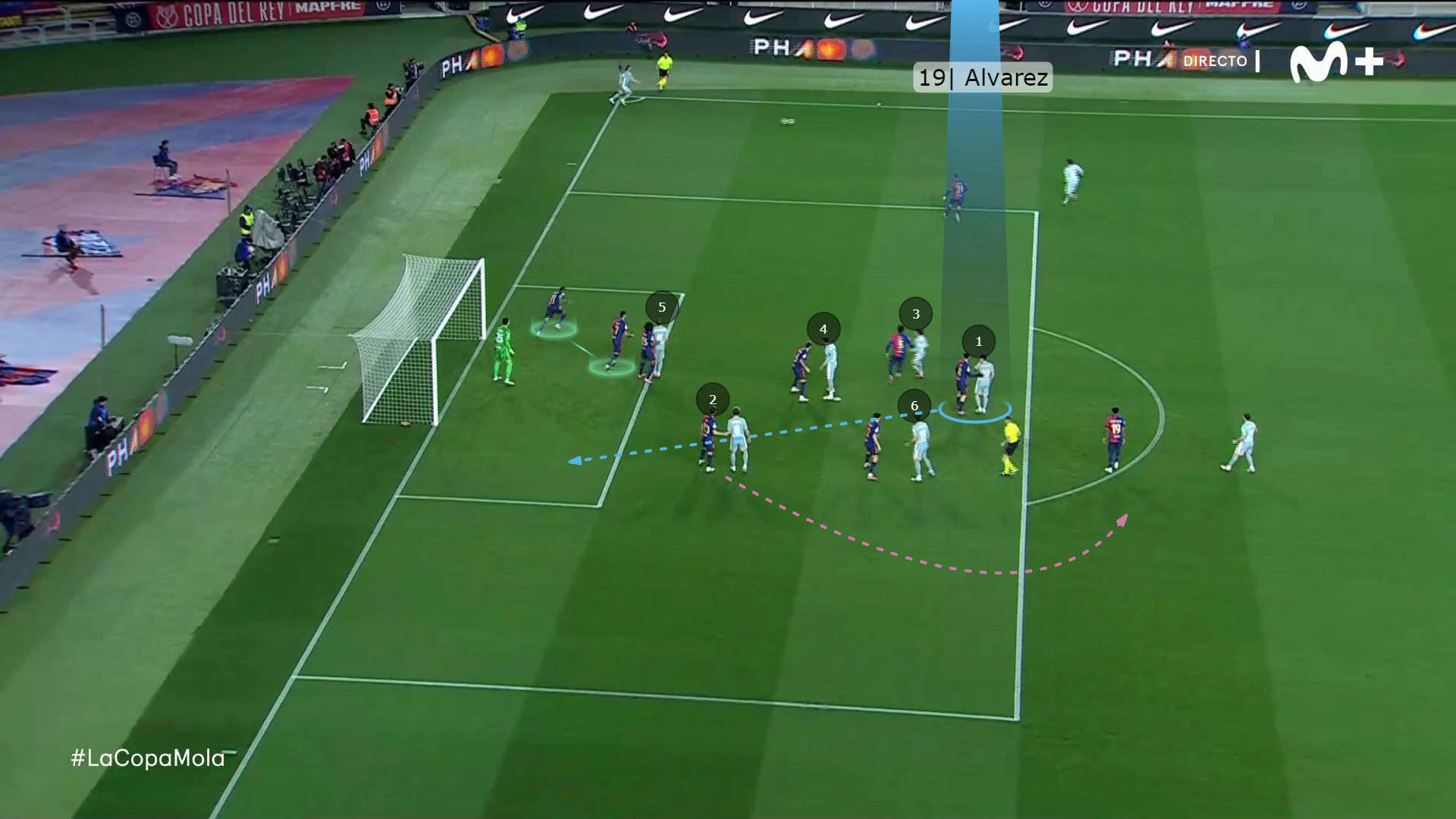
It’s clear below that the second player’s man marker (pink) is dragged a little forward and doesn’t know what to do.
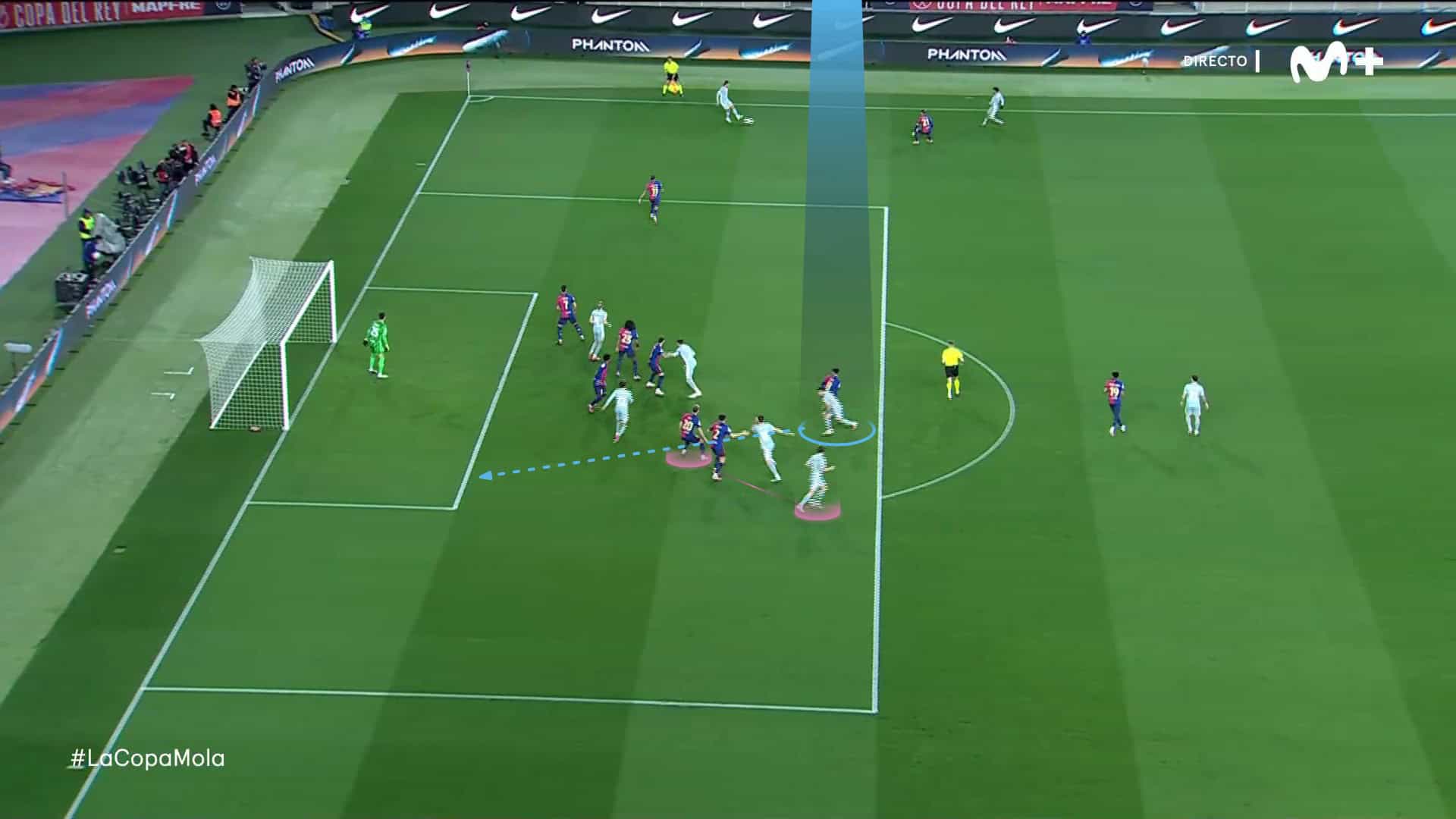
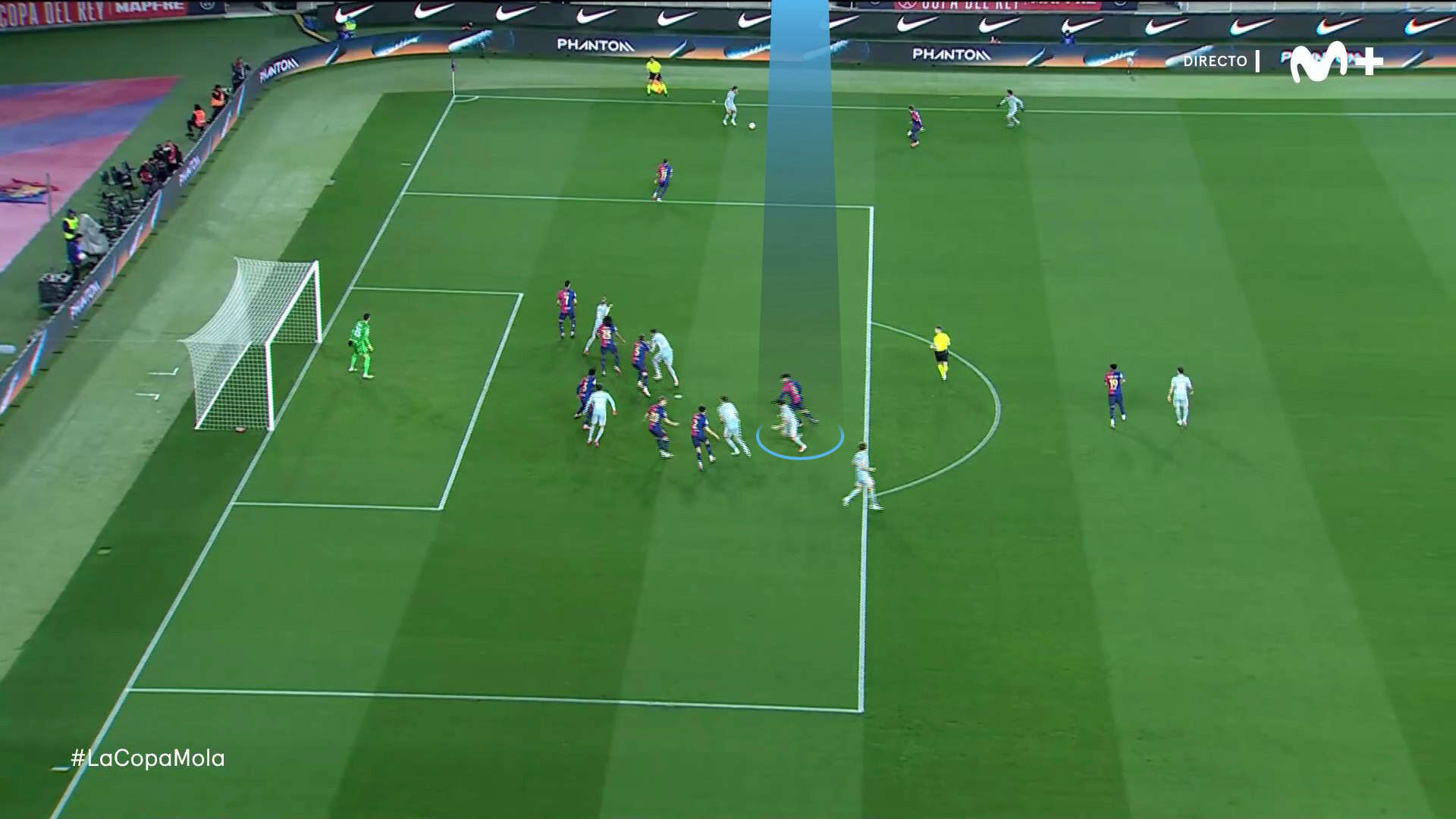
As shown below, Julián Alvarez’s late starting position and his movement from the middle to the far post, while the ball is in motion, make it difficult for Pedri to track both him and the ball simultaneously.
Therefore, Alvarez can escape from his blind side while tracking the ball’s movement and run to his targeted area, which he knows well, while Pedri is forced to turn around and keep running behind him, trying to catch him, as shown in the two photos below.
As shown below, the third player will also go to the area ahead of the far post in case the ball is underhit.
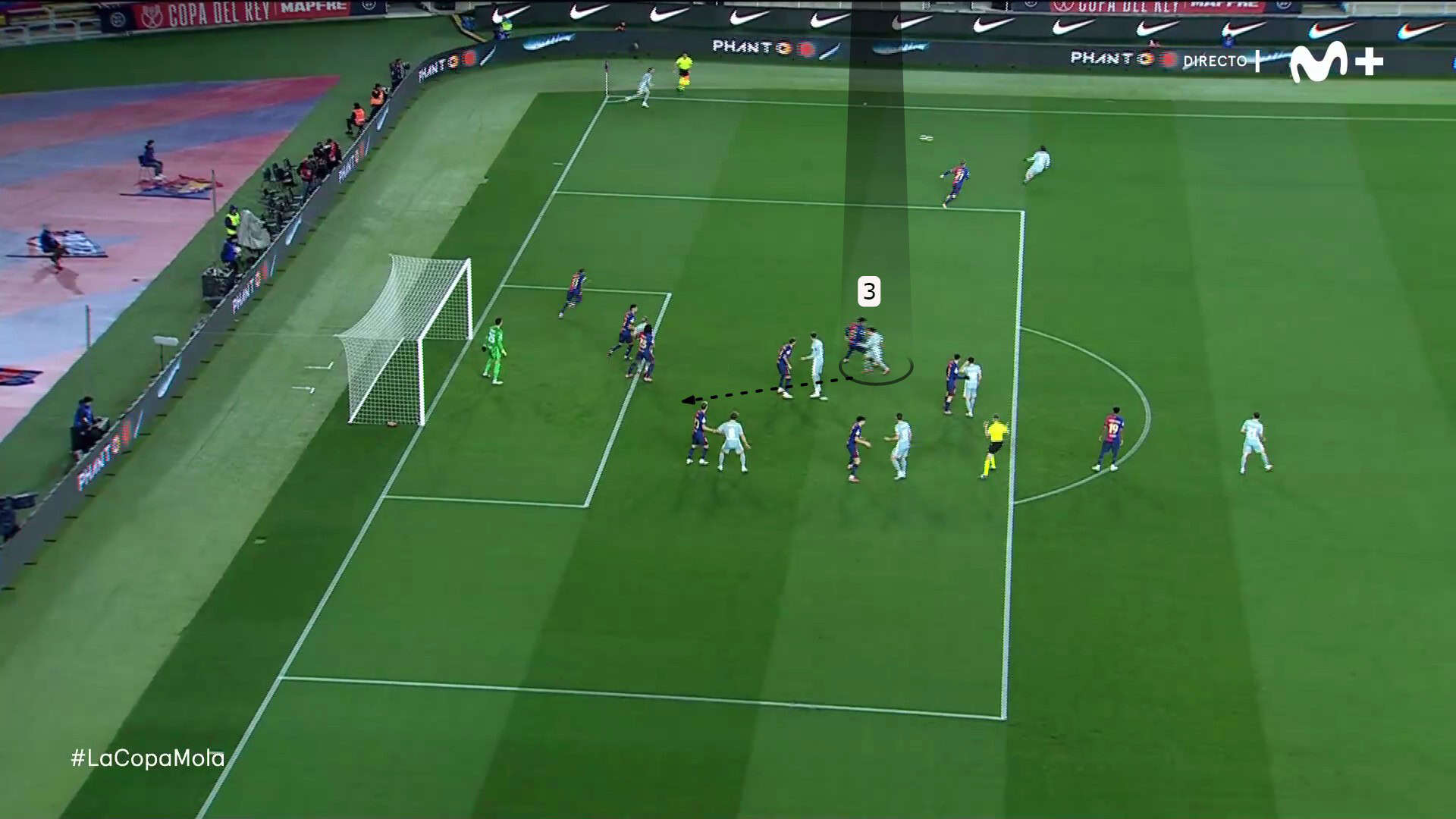
To ensure that the second zonal defender is out of the game, the fourth and fifth attackers make these runs: one runs ahead of him to drag him forward, while the second runs to his back to ensure that he won’t step back, as shown below.
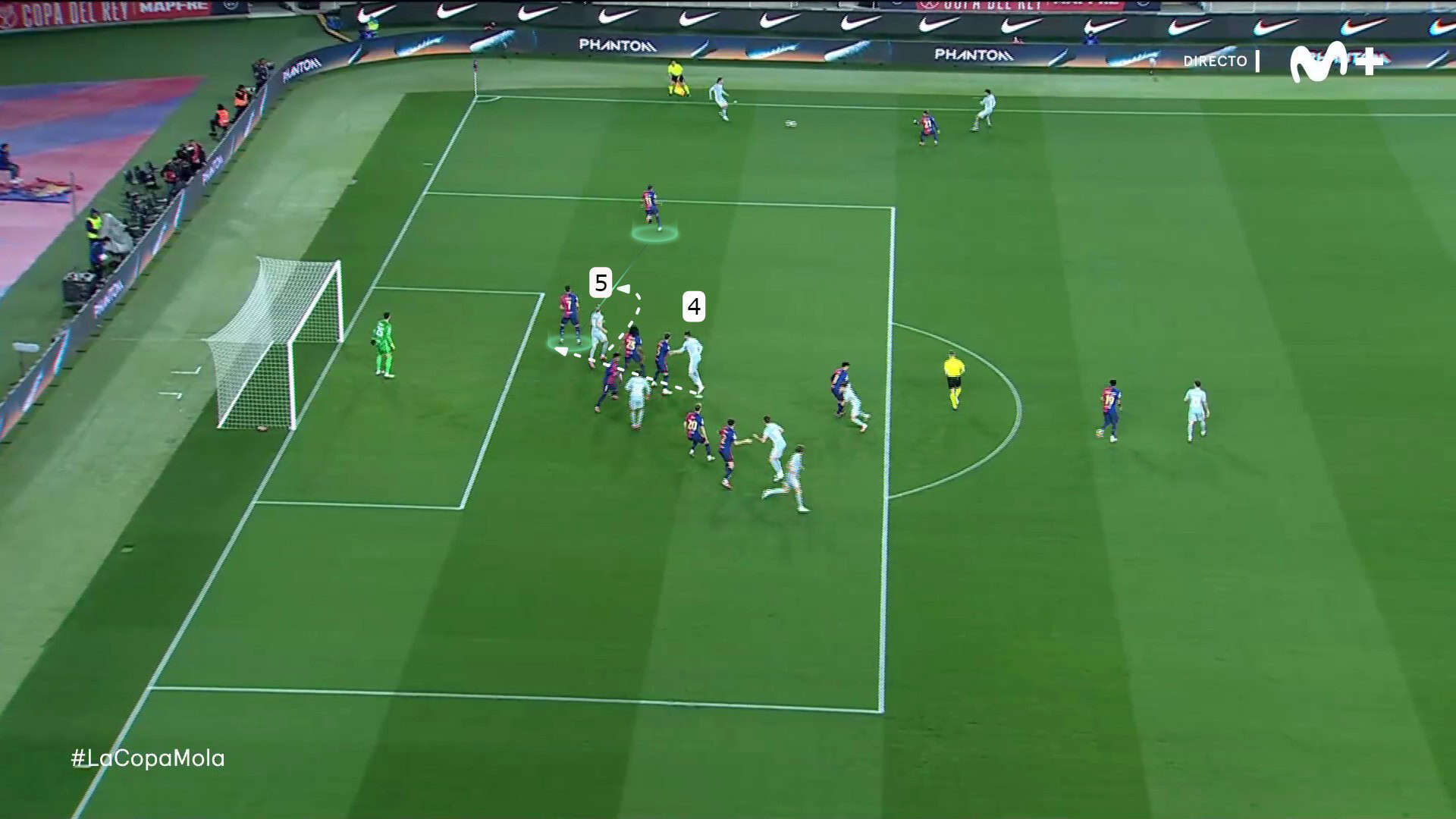
The sixth player runs to the area behind them, having a greater sight angle than his marker and a long path to run before his jump to flick the ball to the far post.
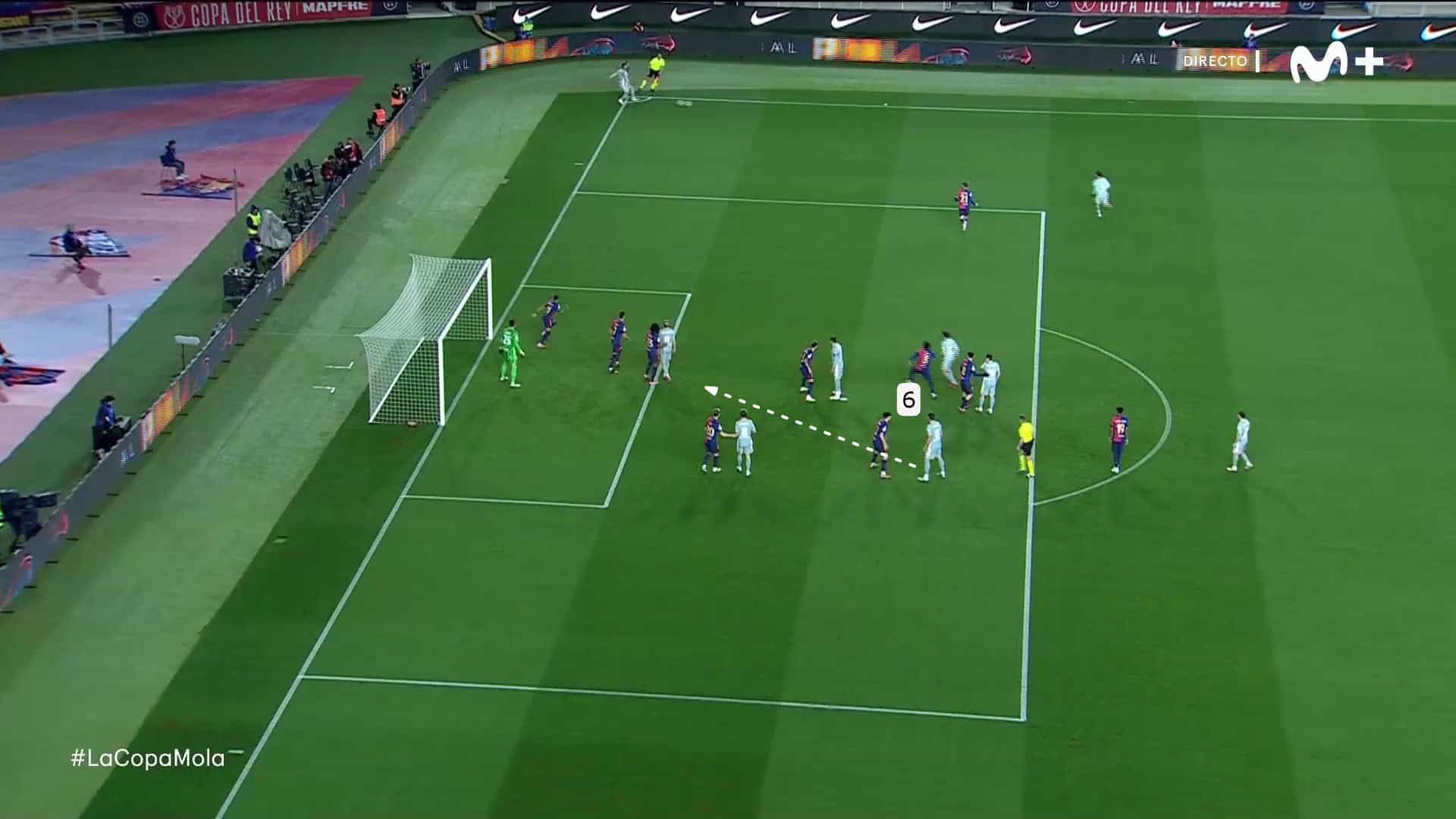
As shown below, the plan is completed.
Perhaps they didn’t initially target this player and instead wanted to target Alvarez directly.
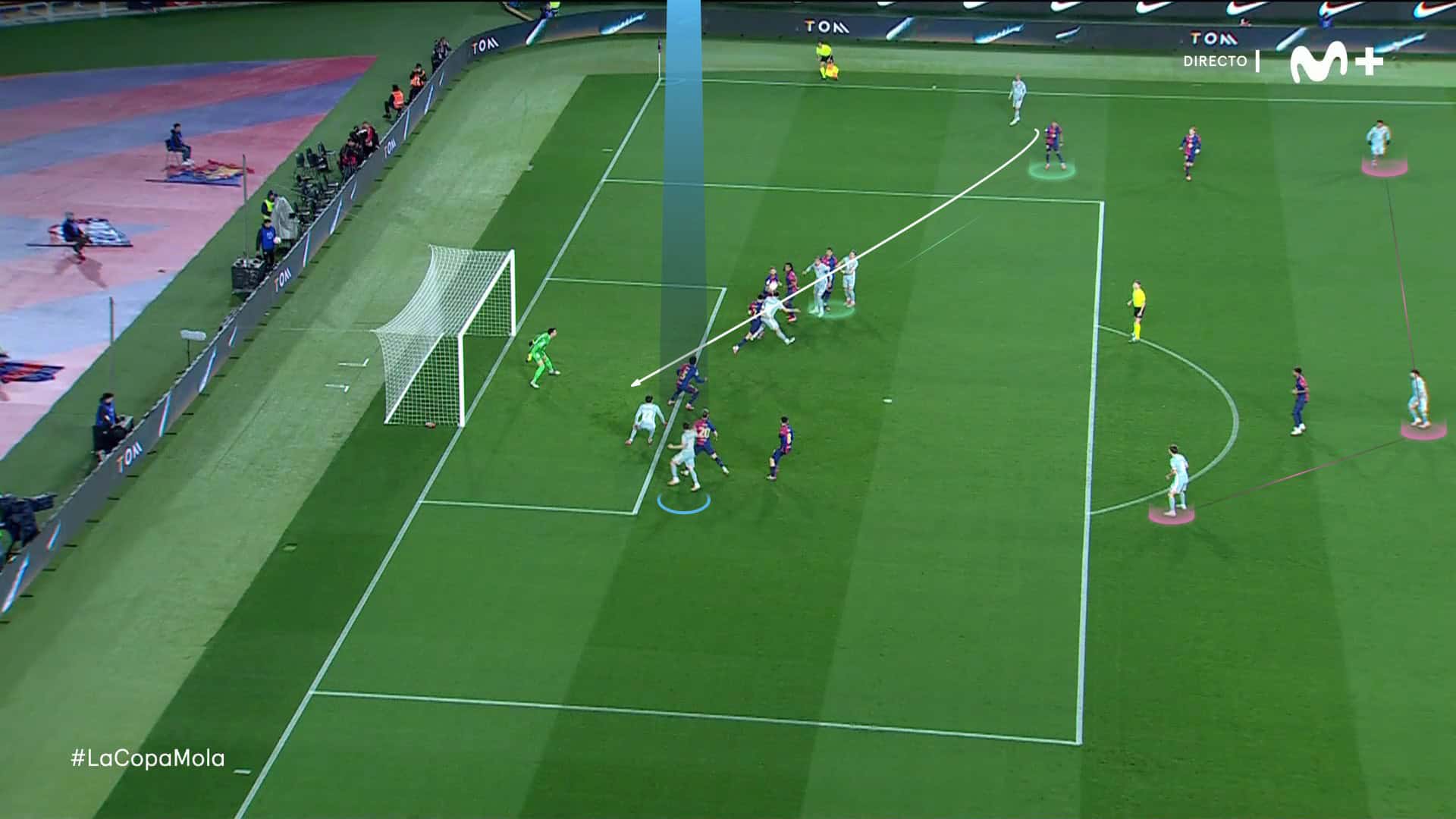
However, the purpose of these movements is to frame the ball’s path so that you will see all the attackers in the ball’s path be ready, regardless of the cross accuracy.
Finally, we should also note that such a cross is too difficult for the goalkeeper to claim because it comes from a far point, unlike the normal in-swinging cross from the beginning.
Barcelona Weaknesses At The Near Post
Going back to the two zonal defenders, we should know that they are usually Raphinha and Robert Lewandowski.
There are many tricks to manipulate them, forcing them to shift.
Flick-Ons & Fake Flick-On Tactics Against Barcelona
As shown below, we should first know that Raphinha doesn’t stick to the near post to be able to go to chase the first touch (flick-ons) in case the ball is played ahead of the near post.
The attacking plan was to ask the targeted player to stand in the shown position on the blind side of the two zonal defenders.
After that, he pushes his marker and suddenly goes to the targeted area from Raphinha’s blind side, which makes him go out late.
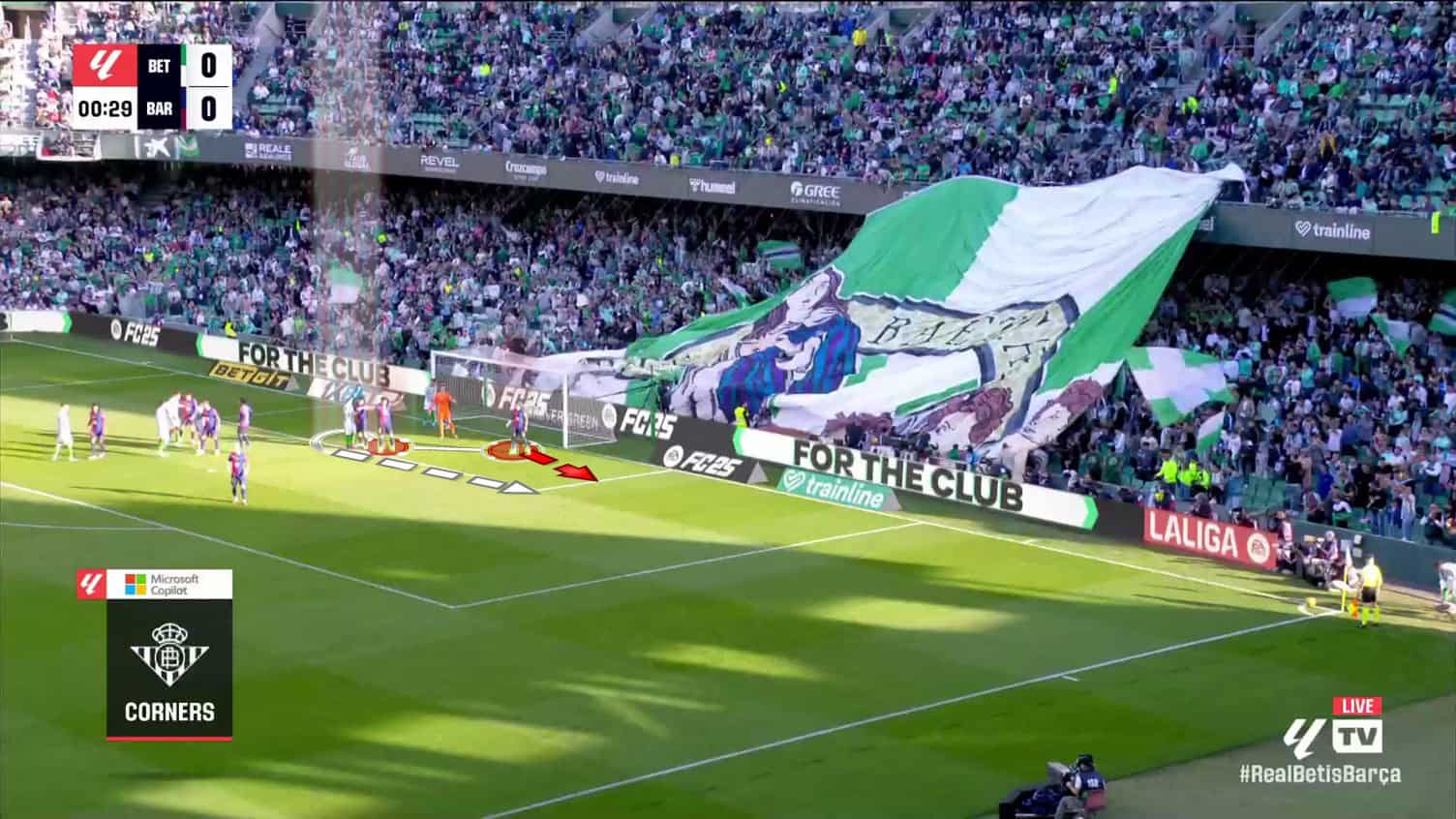
In the end, they succeeded in getting the first touch to flick the ball to other attackers framing the goal, as shown below.
As an important note, Barcelona have a lot of weak man markers in aerial duels, and you can notice that at the mismatch that happened between the targeted player and Pedri.
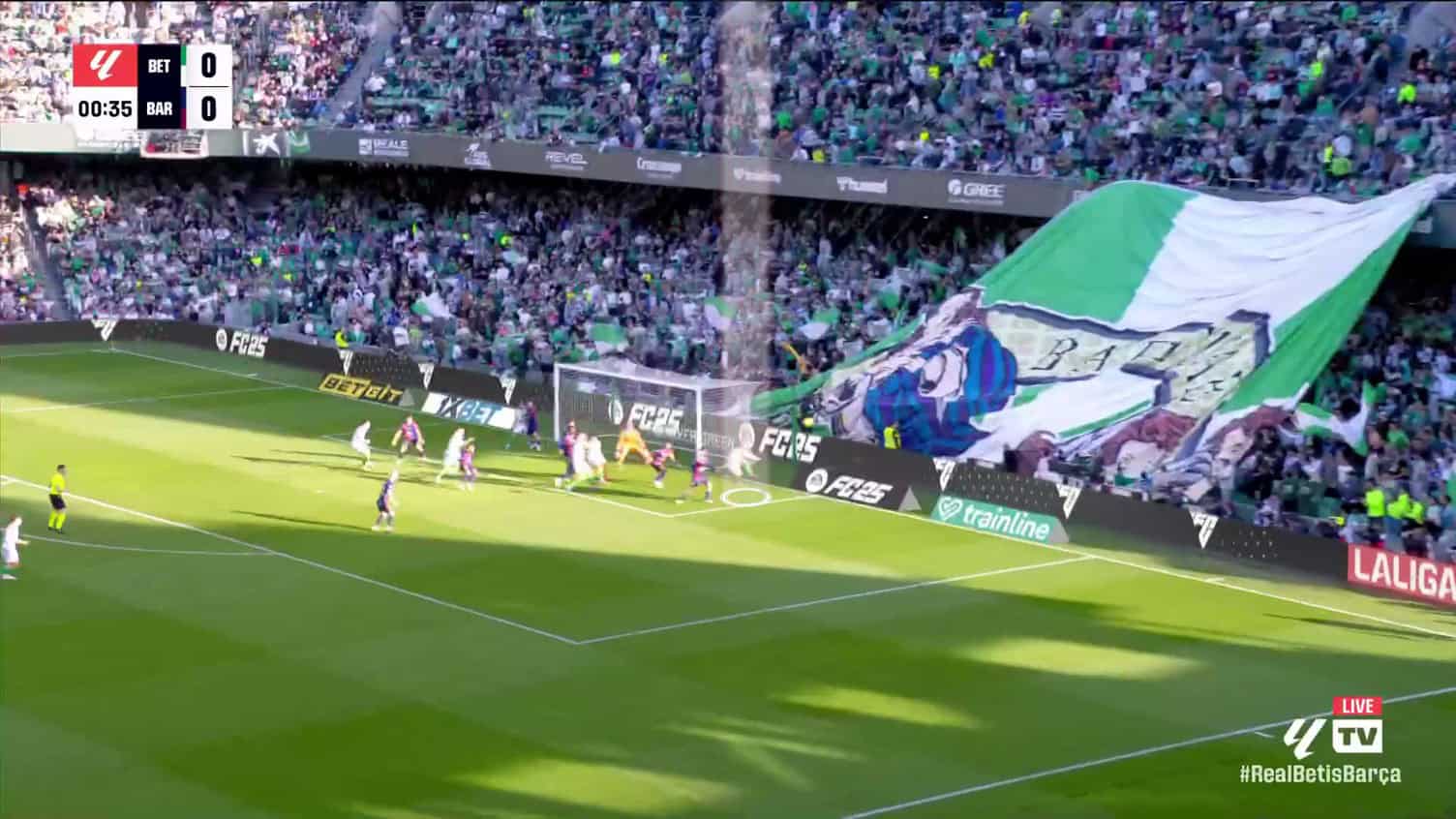
Sometimes, this run causes chaos because Lewandowski is dragged into trying to help get the first touch.
As shown below, a similar idea is used with two players coming from the blind side of the zonal defenders.
The problem is that Lewandowski also shifted, trying to help, which leaves a huge area free behind him, as shown below.
As a variation, some teams ask a player to fake a run to drag Raphinha and widen the area between him and Lewandowski to target it.
As shown below, the red player does a decoy run to drag the first zonal defender while the targeted player behind him goes behind the first zonal defender, knowing that it is difficult for such man markers to keep tracking the runners all this distance.
Some teams also exploited Raphinha’s positioning to drag him towards the target, aiming to score directly on the near post behind him or target an attacker near the goal line.
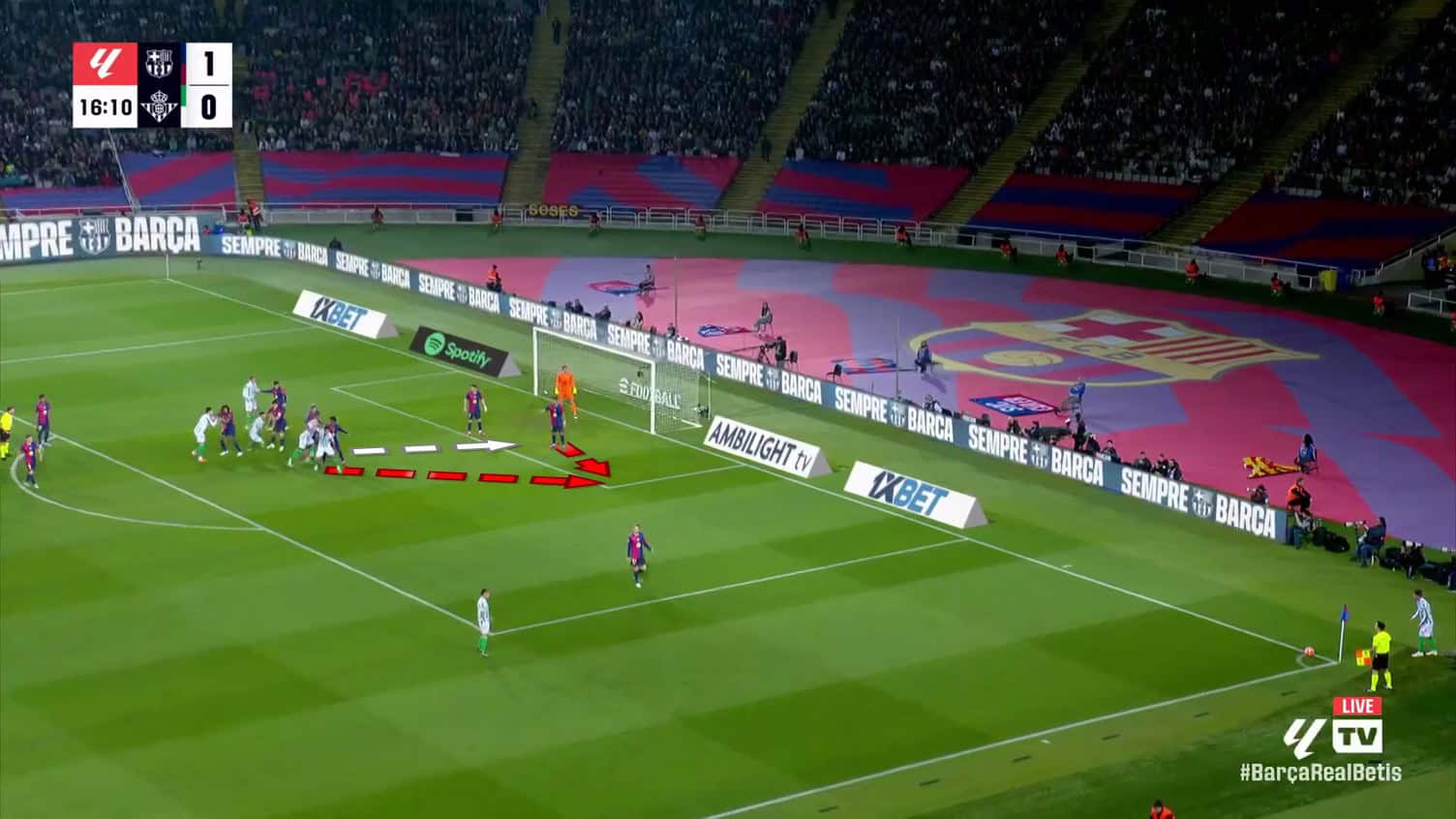
Using Stacks Against Barcelona
The attackers can use the previous orientation and separation problems to target the near post, too.
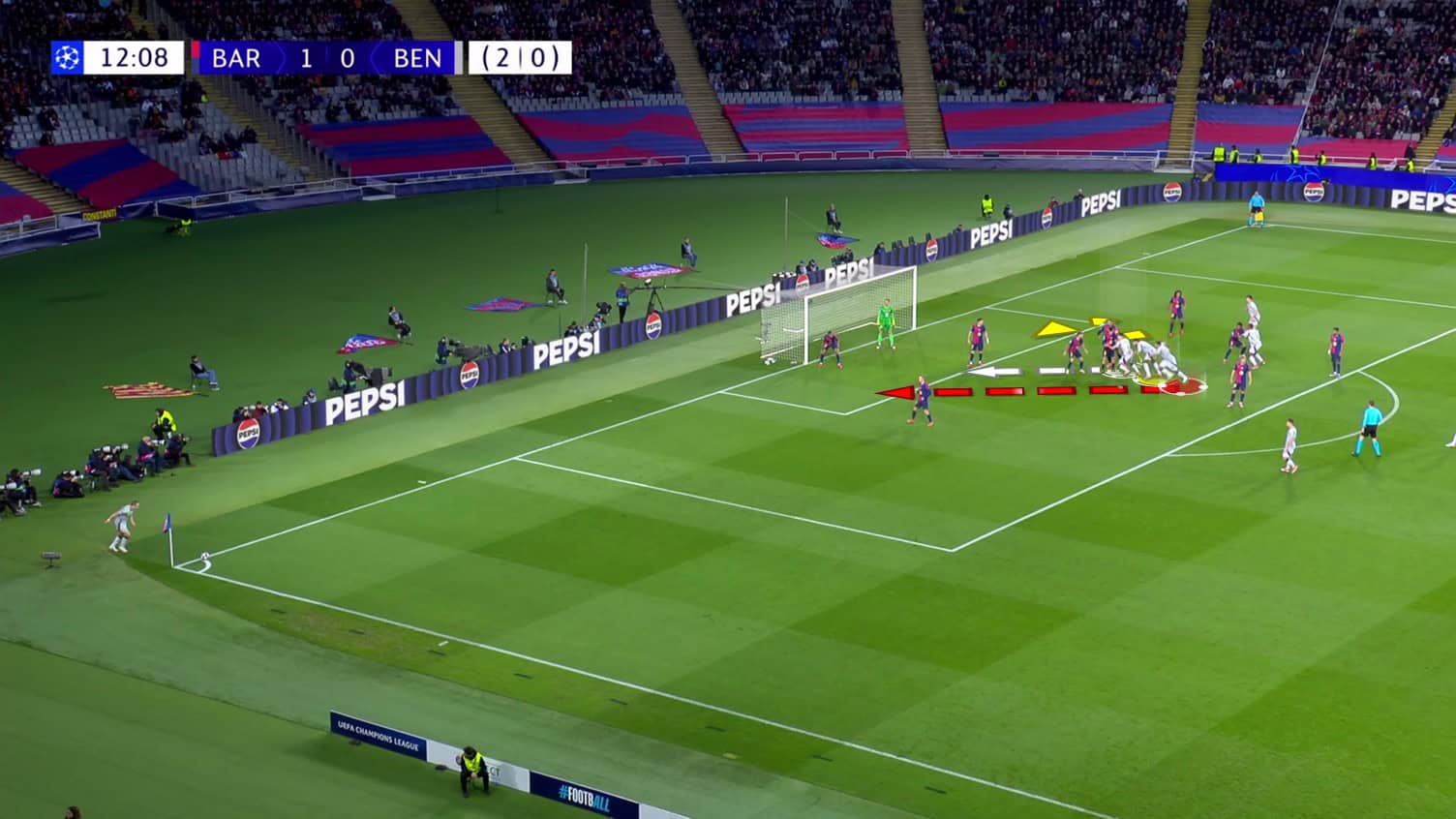
As shown below, Benfica‘s three attackers stand behind each other in a stack.
This stack prevents the markers from sticking to their assigned attackers, so they stand horizontally, waiting for them.
This means that the attackers can take many steps, separated from the markers.
The other thing is that the markers can’t judge where the attackers will go: right or left!
Hence, when two players go to the left, it is surprising.
The player with the red arrow goes first, followed by the white one (who will go to get the ball), and then the last one (yellow arrow) goes to the far position.
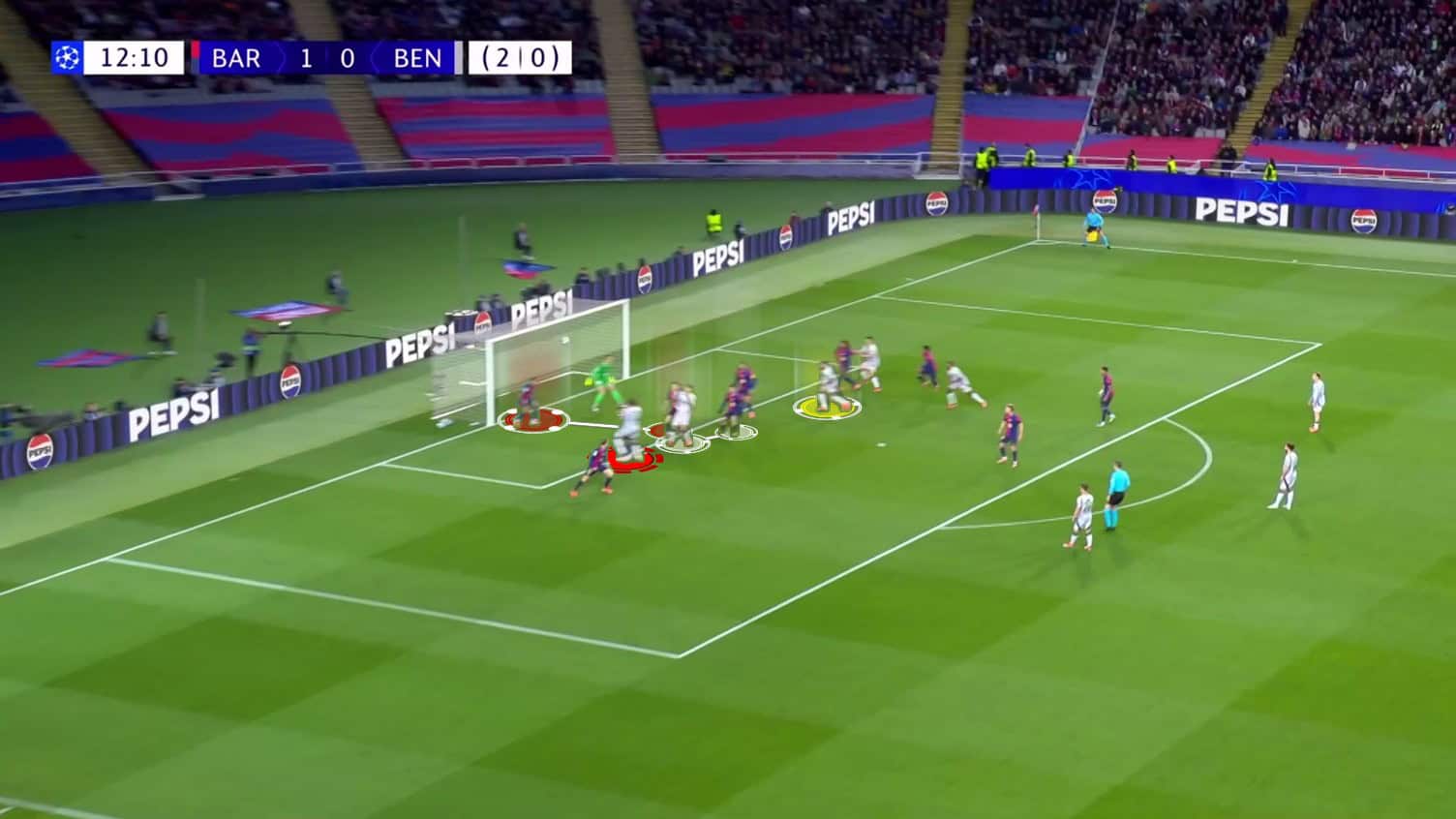
As shown below, the white one is separated from his man marker and overcomes Lewandowski, the second zonal defender.
You can say that Lewandowski should have got the ball, and you aren’t wrong, but he may have an excuse that he jumped from a stationary phase while the separated target player jumps from running, which may lead to a dynamic disadvantage.
In the end, the ball nearly passed both of them, going to the yellow one who scored the goal.
Using Screens & Blocks Against Barcelona
In general, there are many methods for getting rid of the man marker.
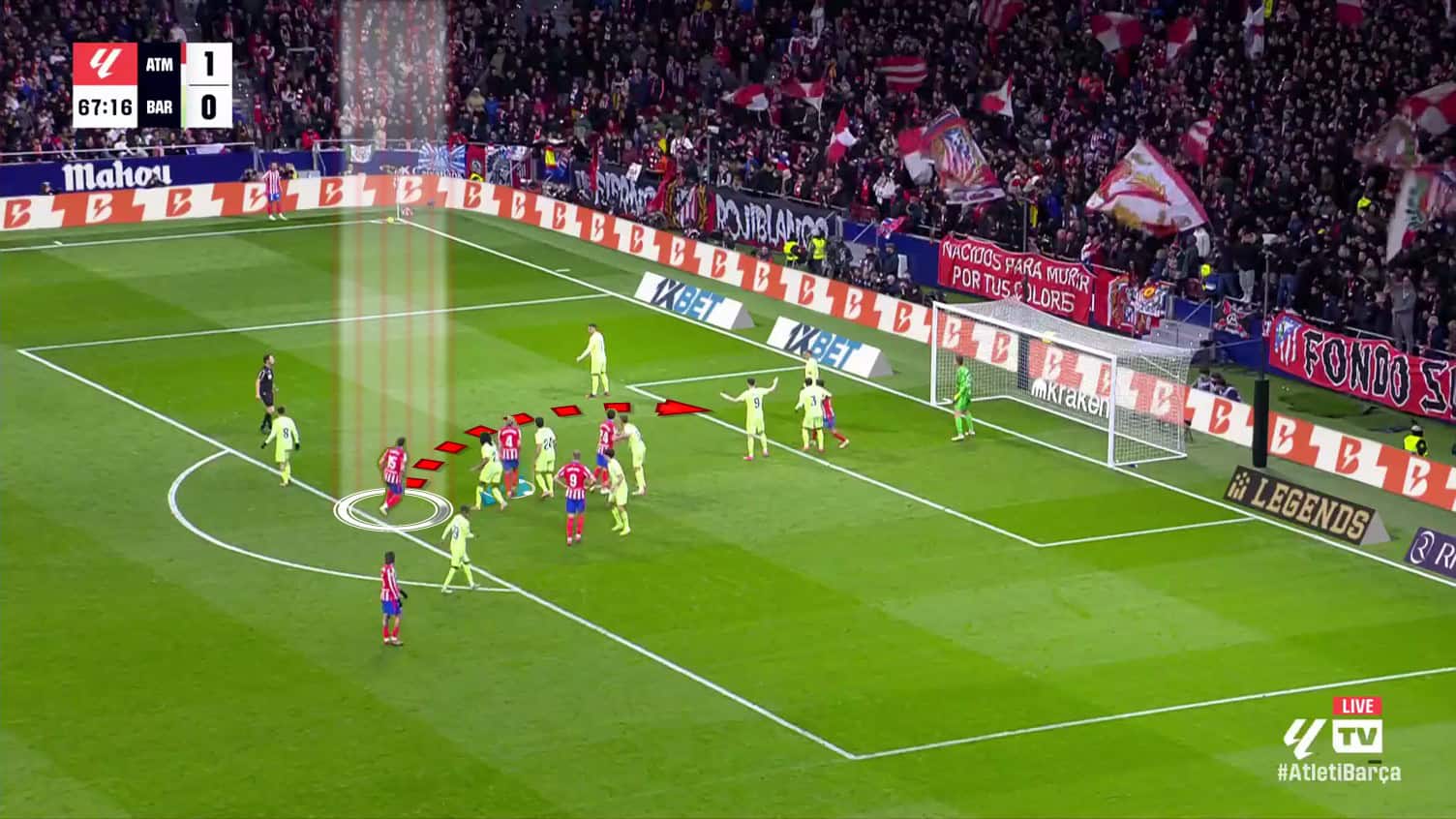
Screens are an important method for that, which is asking a teammate to block the targeted player’s man marker.
As shown below, the targeted player (white) goes to the targeted area, while his mate (blue) will simply stand in his marker’s way without committing a foul.
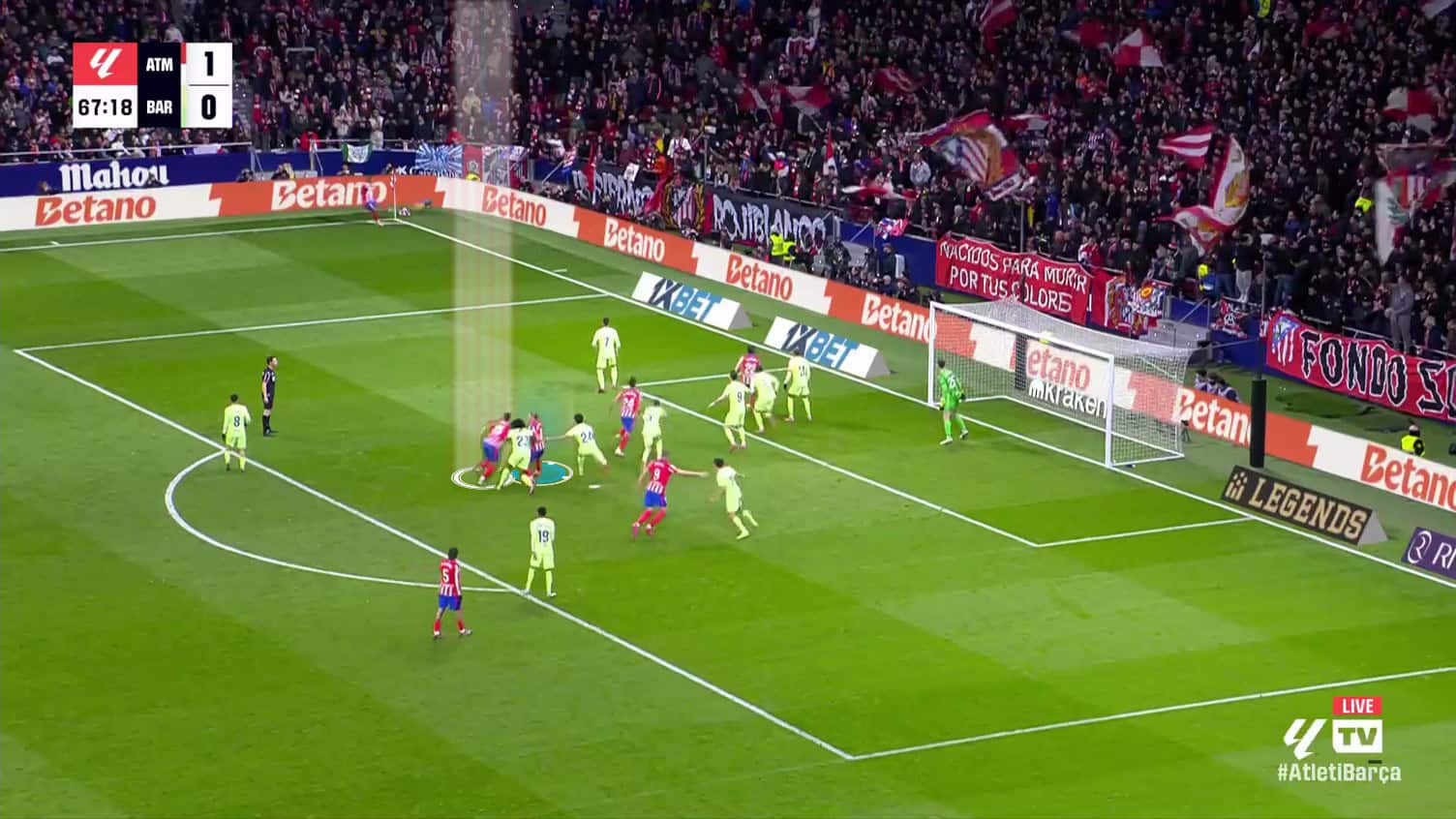
The screen is already done effectively below.
The techniques of screens are a lot.
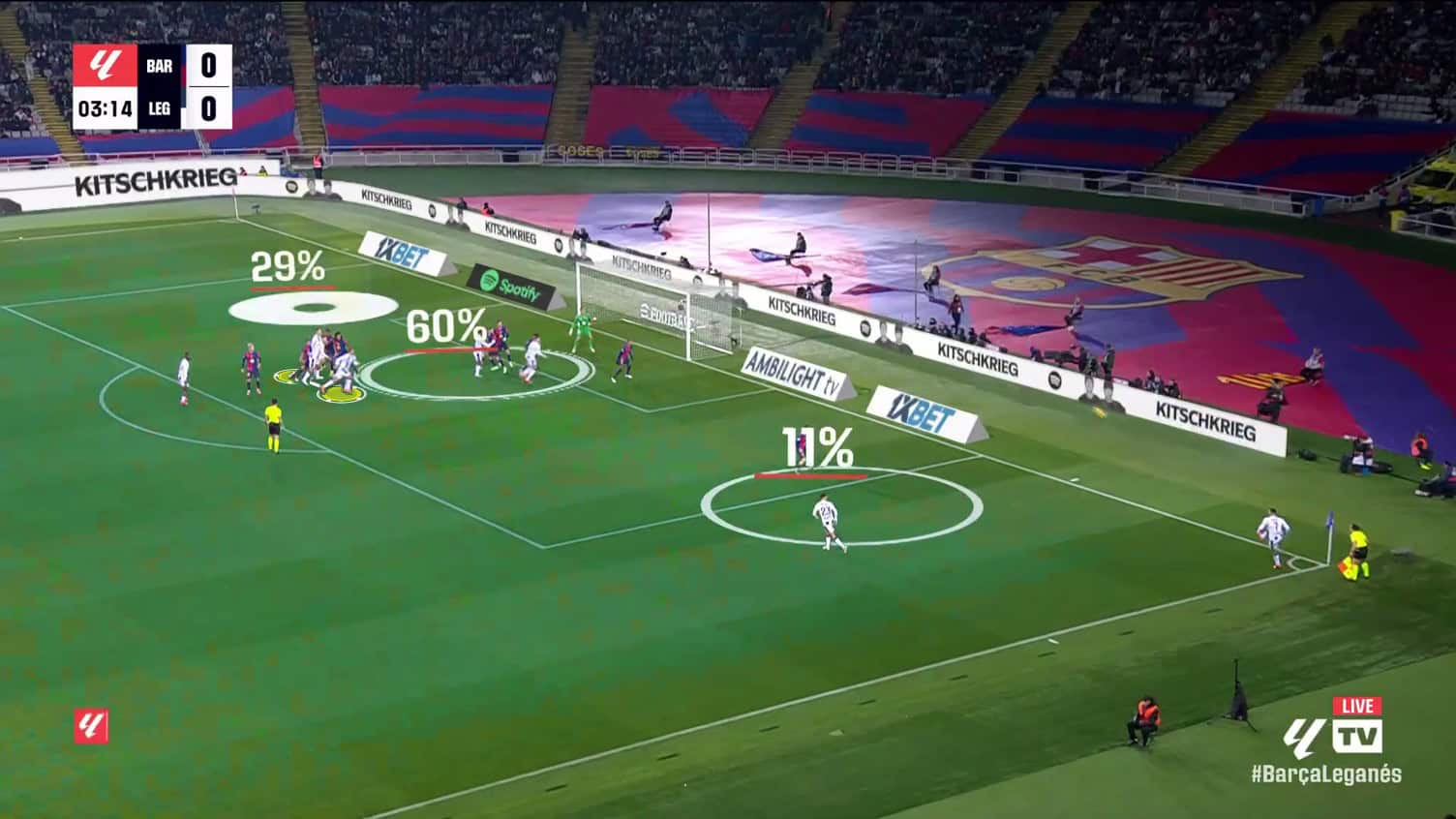
Another one of them is asking a player to stand as the last one, a little bit behind his two mates, as shown below.
He will do the shown curved run toward the near post while his tw mates try to step back to prevent his marker from reaching him.
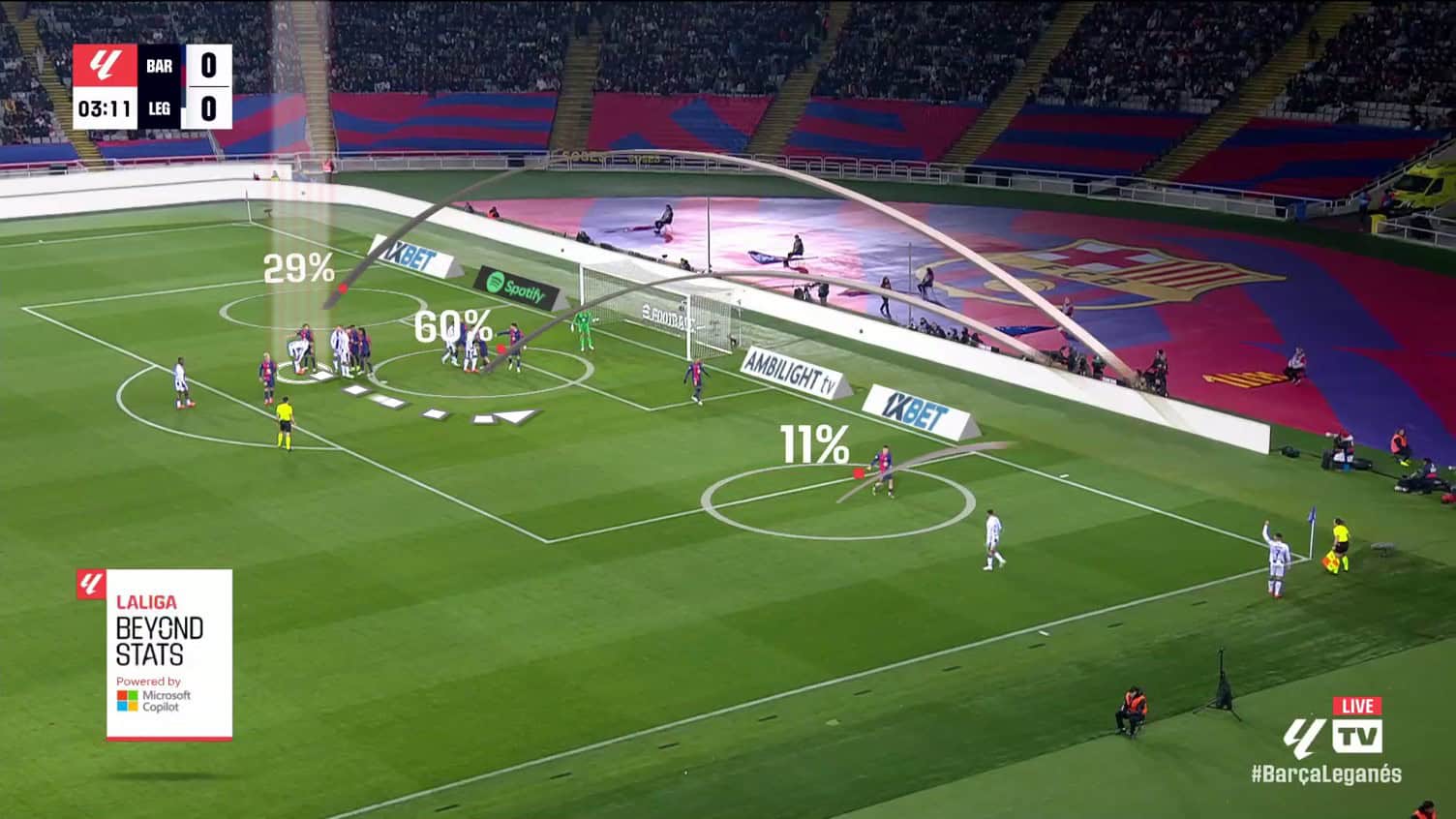
As shown below, the man marker cannot track his attacker, who is now free.
Targeting The Edge Of The Box Against Barcelona
Finally, some opponents exploited the deep starting position of the short-option defender (yellow below) and dragged the rebound player toward the side of the ball to send a direct cross to the far rebound player, as shown below.
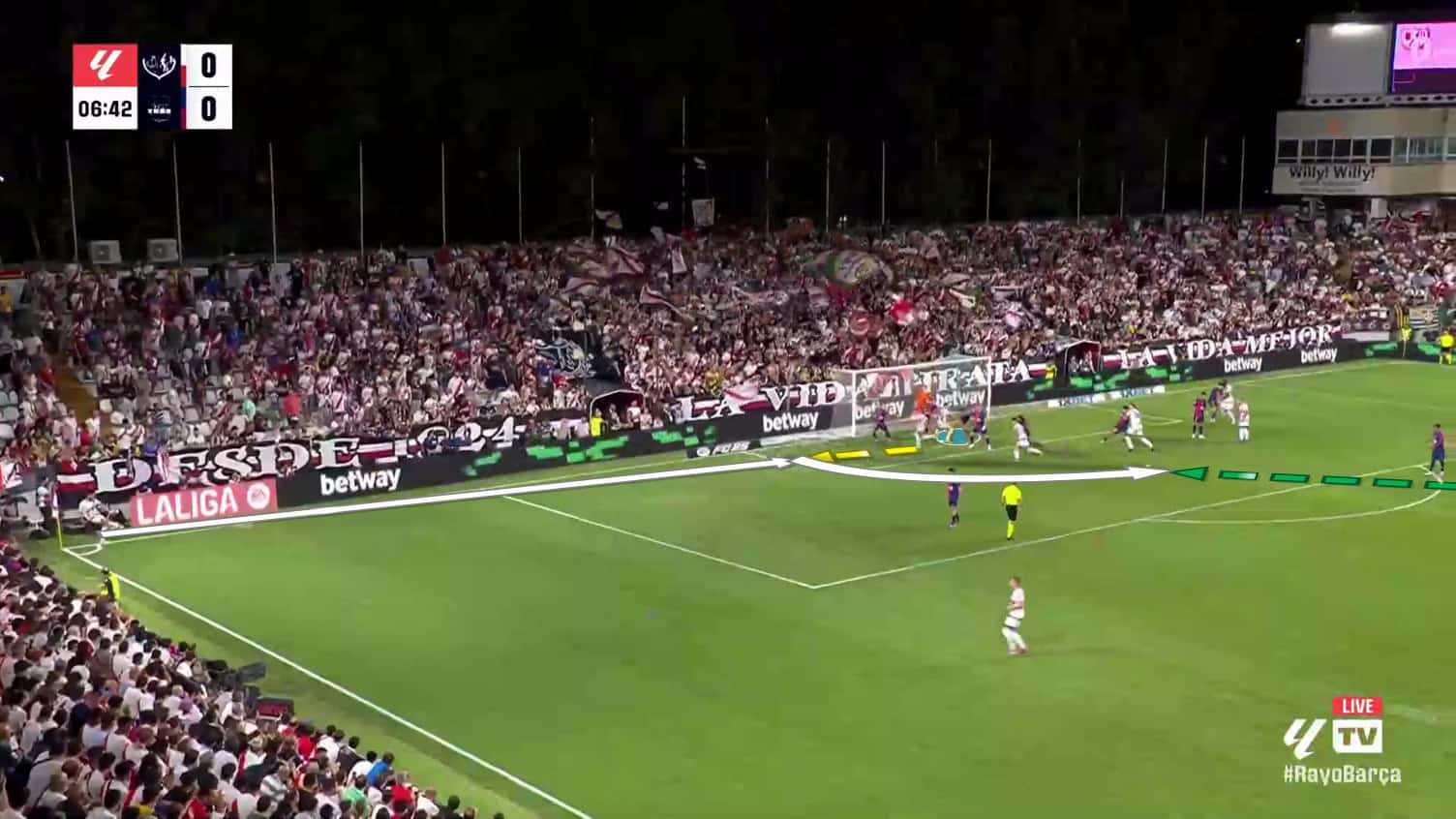
Similarly, the far rebound player can be targeted with a different idea.
In the photo below, the first targeted player (yellow) starts behind the zonal defenders and suddenly comes to receive a grounded pass, while his mate (blue) blocks his man marker.
He passes it directly to the coming far rebound player (green—out of the shot), who comes suddenly while all layers focus on the ball.
Conclusion
After this analysis, we can conclude that Barcelona have problems defending corners, and their opponents have started to decode their defensive scheme many times recently.
Barcelona generally have a problem with the heights of their players and their abilities in aerial duels.
This may make Barcelona’s coaches (Hansi Flick, Heiko Westermann, and Deila) not trust other players as stationary zonal defenders who jump from a stationary state while the attackers hump from movement.
It also takes time to train trusted zonal defenders so decoy runs do not drag them and can defend zonally properly.
However, we think they have a huge problem defending corners and need to add at least an additional zonal defender against Inter Milan to survive.
They may also try to adjust their man-marking, such as making some wait for the runners instead of initially going with them in far areas.

