
Ralph Hasenhüttl’s arrival at Southampton in December 2018 started a new era at St. Mary’s stadium as the fans witnessed a transformation from a possession-based side to a side that plays a high-tempo and a high-pressing style of football. Under the Austrian manager, Southampton is a team that, regardless of the opposition, plays attacking football and likes to take the game against the opponent by pressing them with high intensity in their own half.
Southampton’s PPDA metric of 8.16 was the lowest during the previous season and they have the lowest PPDA of 6.56 during the ongoing season as well. These metrics show that the Saints press with the highest intensity amongst the other Premier League teams.
On their day, Hasenhüttl’s Southampton can be a difficult side to play against. Their intense high-pressing can trouble even the best teams, as the 2-2 draw against Manchester United and the 1-0 win against Manchester City during the latter half of the previous season exemplified it.
Having said that, the high-press high-line system is still a work in progress as some prominent issues on the defensive side were exposed by the likes of Crystal Palace, Tottenham, and Brentford as the Saints conceded eight goals in their first three games of the 20/21 season.
In this tactical analysis in the form of a scout report, we seek to analyse the major causes of the defensive issues within Hasenhüttl’s pressing system. However, before delving deep into the problems, let us begin by presenting an introductory analysis of their pressing game in the next section.
Southampton’s high-pressing tactics under Hasenhüttl
Hasenhüttl’s basic principles of play are built around four parts of the game – in possession, losing the ball, winning the ball, and working against the ball. While the first principle defines his team’s behavior on the ball, the remaining three principles are related to their pressing system as we shall see in this section.
Losing the ball and winning the ball principles correlate to the counter-pressing/gegenpressing tactic. It requires players to immediately press and attempt to win the ball back rather than regrouping into their tactical shape after losing possession in the opposition half. The idea behind this tactic is to deny the opposition time to construct an attack while they are disoriented. Moreover, it also allows recovering the ball in advanced positions. Since the attacking players do not fall back, the defensive line continues to hold the high line. The following image shows an example where Oriol Romeu’s pass was intercepted by a Brentford player.

The following figure shows Southampton’s reaction to losing possession. Rather than falling into a defensive shape, the players conducted a counter-press wherein the ball-near players pressed the man in possession while the ball-far players closely marked the Brentford players to cut all the short passing options.

Working against the ball is a significant principle of Hasenhüttl’s system that highlights Southampton’s high pressing style when an opponent tries to build from the back. Once again, the idea is to win possession as high up the field, possibly in dangerous areas, which also ensures protection for their back four.
The pressing is structured into three layers, which the Austrian refers to as “filters”. Each filter is a bank of two players from the 4-2-2-2 who are responsible to press in the opposition half. The first filter consists of the two strikers who press the opposition centre-backs and the goalkeeper (in case of a back-pass). The two wide number 10’s form the second filter. Their high positioning means that they can reach early passes to opposition full-backs in case the ball is distributed wide. The final filter consists of the two pivots who stays close to the opposition central midfielders to disrupt the passing routes in the central and the ball-sided inside channel.
Besides, certain triggers invoke a press from the first filter. It is important for the remaining filters to respond to the trigger in a co-ordinated manner for the press to be effective. While the pressing triggers are tweaked based on oppositions, the most common trigger is a pass from one centre-back to the other. The modus operandi of such a trigger is to force the man in possession of a decision to either play a long ball centrally or go towards a wide player. In the first case, the high backline and the two pivots create numerical superiority in the center to force a possession turnover. While in case the ball is shifted wide, the press is intensified to congest the inside channel, forcing a long ball or possession turnover.

The above figure shows an instance of Southampton’s pressing style. As the left centre-back of Brentford received the ball, Danny Ings triggered the initial press as he started to press the defender. Observe that Che Adams stayed closer to the #6 rather than making a run towards the goalkeeper. This is because the man in possession’s body shape indicated a possible pass to his full-back rather than the goalkeeper or the other central defender. In case if the defender had chosen to pass back to the goalkeeper, Adams would have started to press the goalkeeper while Ings would then mark the defender.
As soon as the first filter triggered the press, the subsequent filters intensified the press as they looked to get closer to their appropriate markers. Southampton congested the inside channel as Romeu marked the #26, Adams stuck to #6, and Ings cut a passing option back to the central defender by providing cover shadow. Moreover, Martin Tella’s press on the full-back forced him to go long. Consequently, the Saints won possession in the opposition half. The second phase of the press is shown in the following figure.

As Southampton makes use of a high pressing system, it is natural to organise the defenders in a high line in order to avoid ceding space between the lines. Having said that, it is also a risky tactic, especially against an opponent who can attack or counter-attack with pace, if the team is not efficient in the high press and/or does not have the right defensive personnel to play in a high backline. Indeed, Southampton have conceded 50% of their goals this season on counter-attacks, which exposes the defensive issues around the press and the high line system, as we shall explain in the subsequent sections.
Lack of cohesion in the high press
When a team employs a high-pressing system as Southampton does, it is pivotal for the players to respond to the pressing triggers together in a systematic way. If the press is not conducted cohesively, the shape of the team becomes disorganised and gaps start to appear between the lines which can give an opposition time and space to easily manoeuvre the ball beyond the defensive line. Consider the following instance from a game against Tottenham.

The initial press was triggered because of a back pass from Eric Dier to Harry Winks. While the first filter (Ings and Adams) is already in the pressing phase as they are closer to their opponents, observe that the second and third filters have just started their run which means they were slow in reacting to the trigger. As Moussa Djenepo started his run late, he is significantly far away from Davinson Sánchez (not in the picture) leaving him free on the other side of the defence. Similarly, Romeu is also a few yards away from Tanguy Ndombele that allows the Frenchman to receive the ball in space. Consequently, the Spurs midfielder had enough time to make a turn, evade a late challenge from Romeu, and play a forward pass to the left-back Ben Davies, who made an advancing run on the left flank, as shown in the following figure. Notice the space that Davies has on the flank as Romeu’s lethargic reaction to the pressing trigger compromised his team’s high backline.

The following figure shows an example of the same match which highlights another instance of co-ordination issue in Southampton’s high-press high-line system. As soon as the Saints lost the ball in the middle third, the nearby players started to counter-press the Spurs player in possession, abiding by the losing the ball and winning the ball principles, as established earlier.

As you can see in the figure, Adams, Stuart Armstrong, and James Ward-Prowse began to press Winks as soon as he won the ball. However, notice that Southampton’s defensive line stayed static rather than pushing high in order to provide close the gap with the midfield line. Consequently, they lost the vertical compactness and provided a pocket of space between their lines which Ndombele looked to expose.

A quick pass from Winks to Ndombele in the space put Southampton in a dangerous situation as the high defensive line meant that Ndombele had enough time to pick a pass beyond the backline for either Harry Kane, Son Heung-min, or Lucas Moura.
The lack of cohesion in the press may be attributed to the unsynchronised fitness levels of the players after a break as we saw similar results after “Project Restart” during the previous season. Hence, better fitness and more training must improve their pressing performances over time.
Lack of personnel to play in a high line
A team using a high-pressing and high-defensive-line system naturally tends to cede spaces between the lines and beyond. Hence, it is pivotal to possess centre-backs who are comfortable playing in a high line as oppositions may look to expose them on counter-attacks. For a centre-back to be secure in a high line, he must possess the following attributes: –
Speed – A centre-back needs to be quick in making deep recovery runs when an opposition’s quick attacking players seek to expose the high backline on counter-attacks or look for a long ball beyond the high backline.
Anticipation – A centre-back needs to be an excellent reader of the game to be able to snuff a danger quickly before it arises. Accordingly, he must be able to decide to either step out in order to close down an opponent or stay in position.
Aggression & physicality – A centre-back playing in a high line will often find himself indulging in one versus one duels against the opposition forwards, especially when an opponent plays with two forwards. Hence, it is crucial to be strong in the air as well as ground challenges as a lost duel may isolate the goalkeeper against an opposition forward.
Southampton’s first-team centre-backs Jan Bednarek, Jack Stephens, and Jannik Vestergaard are “no-nonsense” defenders which means they good at defensive attributes like tackling, interceptions, and blocking but lack one or more qualities that are mentioned above. Hence, they are more adept at playing closer to their own goal rather than in a high line.
Standing at over 190 cm., Bednarek has impressive physicality which makes him strong in the air as well as on the ground. The Polish international had won 64.9% of the defensive duels and 70.65% of the aerial duels last season. His 14.28 recoveries and 8.08 interceptions per 90 minutes are the league’s second and third highest statistics respectively for the current season, which demonstrates the defensive qualities of the 24-year old. However, Bednarek lacks speed which makes him vulnerable against attacking players with pace. The following image shows an instance of Southampton’s season opener against Crystal Palace.

As the Eagles bypassed the midfield line of the Saints and found Andros Townsend between the lines, Bednarek stepped out to engage in a duel against the winger. Townsend easily created a goalscoring opportunity by pushing the ball beyond the defender and entering the opposition half as a free man in the wide channel. A centre-back with pace, in this case, would have had an option to retreat in order to cede space in front of him rather than behind him. However, Bednarek’s lack of pace against Townsend meant that the defender was left with no choice but to draw out of position to try to close down the opponent.
Stephens did a fine job of resurrecting his career at St. Mary’s during the last season. He provides more speed and better ball-playing ability than Bednarek and Vestergaard. Like Bednarek, the 26-year-old is also good at making interceptions and last-ditch tackles. However, the academy graduate lacks anticipation, aggression, and physicality. Moreover, Stephens’ lack of concentration, slack positioning, and ineffective decision-making makes him error-prone, as shown in some of the following figures.


Vestergaard’s 198 cm. height and 212 lbs. weight gives him a significant advantage in aerial as well as ground duels. However, his body frame also makes him extremely sluggish on his feet which makes him ineffective against most of the teams that like to attack with pace. It is no coincidence that the Dane has only started against Burnley and West Bromwich Albion, two teams who are not renowned to play fast attacking football.
In the absence of Vestergaard, Bednarek has mostly played on the left-hand side of the defence. However, the 24-year old is more suited on the right not only because he is right-footed, but also because Kyle Walker-Peters (#2) is responsible to protect on the right contrary to Ryan Bertrand (#3), who is more adventurous on the left, as shown in the following position map from one of the matches, which stays more or less similar for every game.

Mohammed Salisu’s arrival as the left centre-back should provide more balance to this Southampton defence not only because it will allow Bednarek to return to his favoured position, but also because the 21-year-old possesses the qualities required to play in a high defensive line. The youngster is quick on his feet, he has a strong physique which gives him ground and aerial prowess in one versus one duels and has an impressive game-reading ability. Moreover, he is naturally left-footed which provides him better passing angles with his strong foot on the left-hand side, thus elevating his ball-playing abilities.
Defensive issues due to the narrow wingers
We have already established that Southampton press in a 4-2-2-2 structure. This system is a slight variation of the 4-4-2 where the wide midfielders play centrally between the pivots and the two forwards as the two number 10’s. While this structure allows them to press in a compact shape, opponents can look to expose the wide spaces to isolate the ball-side defenders, as shown in the following example.

The narrow positioning of Armstrong has not only provided significant space to Ben Davies at the edge of the final third, but it has also isolated Kyle Walker-Peters two versus one as the right-back was forced to step out of his position, in turn, allowing Son to expose the space in the wide channel behind him.
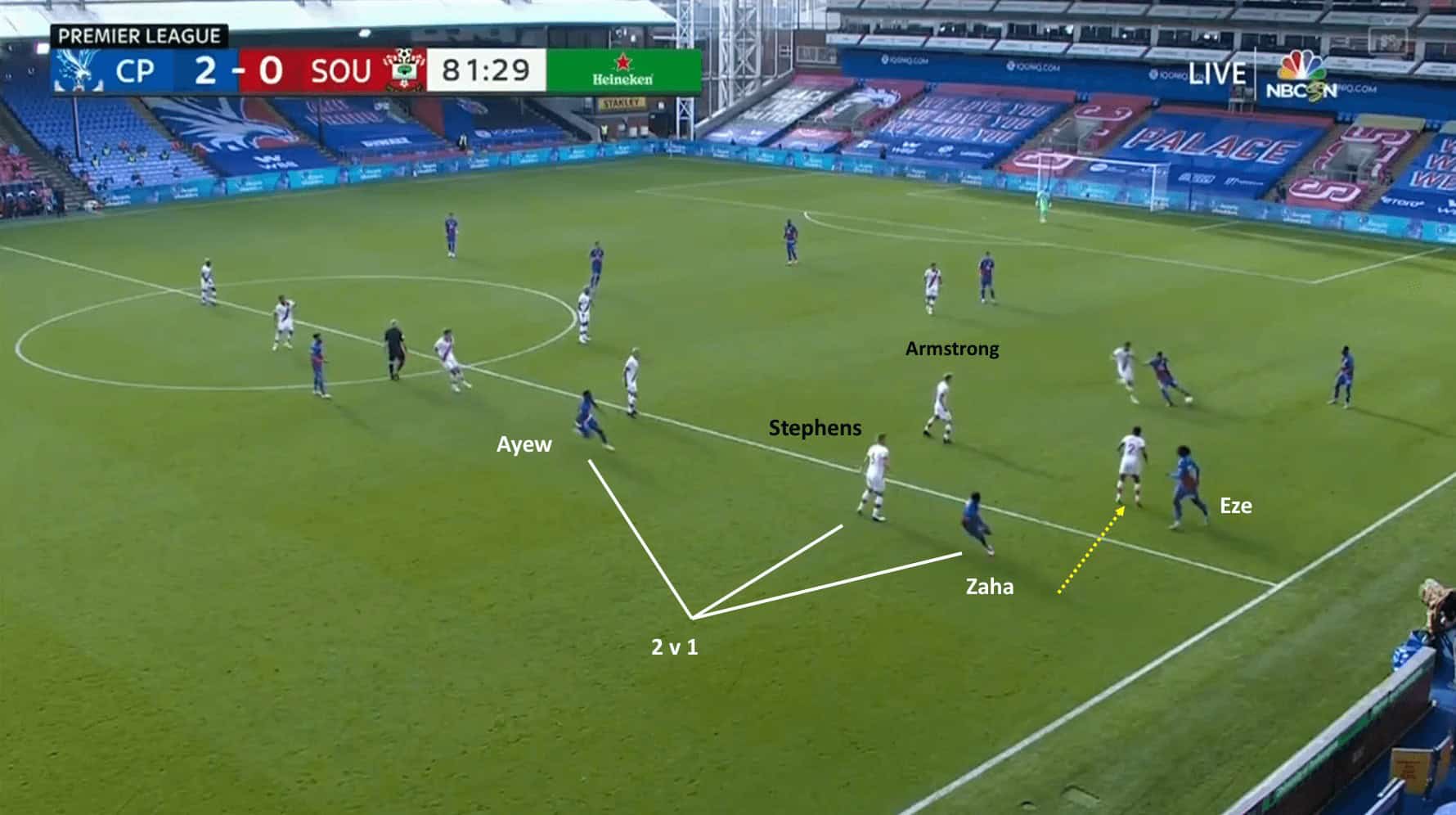
The above figure highlights a similar situation where Armstrong’s narrow positioning forced Walker-Peters (#2) to draw out of his defensive line to deny Eberechi Eze to receive possession in space on the left flank. Although Stephens covered Wilfred Zaha, the centre-back was isolated two versus one as Jordan Ayew also looked to make a run beyond the defensive line.
This issue is closely related to the tactics more than the personnel. As Bertrand constantly ventures forward, Romeu, who is more defence-minded, covers the space on the left as he is the near-sided pivot. However, since Ward-Prowse is generally in more advanced positions than Romeu, Walker-Peters does not get sufficient cover on his side while he ventures forward during the attacking phase. Moreover, the full-back not being the best in terms of defensive positioning makes it worse as the teams who have inflicted defeats to Southampton have all targeted their right-side. For instance, Tottenham’s 48%, Crystal Palace’s 54%, and Brentford’s 42% attacks came from their left.
Conclusion
Southampton have become an attractive side to watch under Hasenhüttl with his high-press high-line philosophy. The Austrian had achieved massive success at his former club, RB Leipzig, with this philosophy as he led his side to a second-place finish in the Bundesliga. However, the Leipzig side was trained to play with similar methods under Ralf Rangnick before Hasenhüttl. Southampton, on the other end, were not used to playing football at such a high intensity before Hasenhüttl’s reign as it is evident from their defensive issues that suggest that the team is still some distance away to perform at the desired level.
While the consecutive clean sheets against Burnley and West Bromwich Albion can be correlated to their improved pressing because of improved match fitness, the concern remains if they can thrive against the quality teams that play fast attacking football.
