
Ajax’s 0-2 away victory over Feyenoord marked a strong statement under manager Francesco Farioli, showcasing disciplined, well-organised tactics, as we will see in this match analysis.
In this tactical analysis and scout report, we’ll break down Ajax’s tactical approach, emphasising Farioli’s key strategic choices.
Then, we shift to a pre-match analysis of Ajax’s upcoming clash with PSV Eindhoven, considering how Ajax’s tactics may evolve.
Post-Match Analysis: Feyenoord Vs Ajax (0-2)
One of the more intriguing aspects of Francesco Farioli’s formation was his choice to field Wout Weghorst and Chuba Akpom together, forming an unconventional partnership.
Although Wout Weghorst’s style of play is more traditionally a target man, his role was adapted to disrupt Feyenoord’s build-up by targeting their central defenders.
The move was risky, as it made Ajax’s press reliant on 1v1 engagements across the pitch, demanding high levels of commitment, fitness, and positional awareness.
By pressing Feyenoord’s centre-backs, Weghorst and Akpom limited Feyenoord’s ability to build from the back, forcing them to rely on long balls.
This setup meant that Ajax had to stay compact to minimise gaps between midfield and defence, a task managed well in the early stages as they established control.
Brian Priske‘s Feyenoord struggled to break through Ajax’s high-pressing setup, failing to create significant chances in the first half due to Ajax’s suffocating press.
High-Intensity Man-Marking
Francesco Farioli’s tactical plan was clear: a high-intensity, man-marking system aimed to close down Feyenoord’s central playmakers and prevent them from dictating the tempo.
Davy Klaassen and Kenneth Taylor marked Feyenoord’s midfielders Quinten Timber and Hwang In-beom, while Mika Godts shadowed Feyenoord’s right-back, closing off the pass options.
The intent was to restrict Feyenoord’s players from receiving passes between the lines, forcing them into areas where Ajax’s compact defensive shape could effectively double down.
Francesco Farioli’s coaching style resulted in a disruptive and restrictive game for Feyenoord, with only limited moments when they managed to break through Ajax’s press.
Although this required Ajax players to be fully alert to Feyenoord’s off-the-ball movement, their disciplined marking throughout the game was central to stifling Feyenoord’s flow.
Ajax’s setup allowed them to transition quickly from defence to attack and vice versa.
With players like Taylor and Godts anticipating Feyenoord’s moves, Ajax could effectively recover the ball, ensuring a seamless transition back into the offence.
This readiness in transitional moments was essential for maintaining their defensive shape and counteracting Feyenoord’s attacks.
Feyenoord’s Man-Marking Weaknesses
Ajax’s first goal, scored by Kenneth Taylor, was a product of quick, intelligent play that exploited Feyenoord’s vulnerabilities.
From the outset, Ajax aimed to use Feyenoord’s man-marking tendencies against them.
They achieved this by moving their forwards and attacking midfielders to draw Feyenoord’s defenders and midfielders out of position, creating pockets of space behind them.

In the build-up, Wout Weghorst moved wider, drawing Feyenoord’s defender, Gernot Trauner, out of his position.
Similarly, Godts pushed into the midfield, dragging a defender out of position and thus creating a massive gap in Feyenoord’s central defence.
Feyenoord’s right-back failed to effectively track Taylor’s deep run, allowing him an easy finish.
The goal epitomised Ajax’s tactical mastery over Feyenoord’s rigid defensive structure.
Pressing & Defensive Solidity
Farioli’s game plan incorporated a structured pressing system, which saw Ajax deploy a high line.
The pressing was coordinated, with Ajax’s attackers constantly harassing Feyenoord’s defenders while Ajax’s midfielders kept close tabs on their Feyenoord counterparts.
Godts, crucial in this system, covered passing lanes and aggressively pressed when the ball reached Feyenoord’s midfielders.
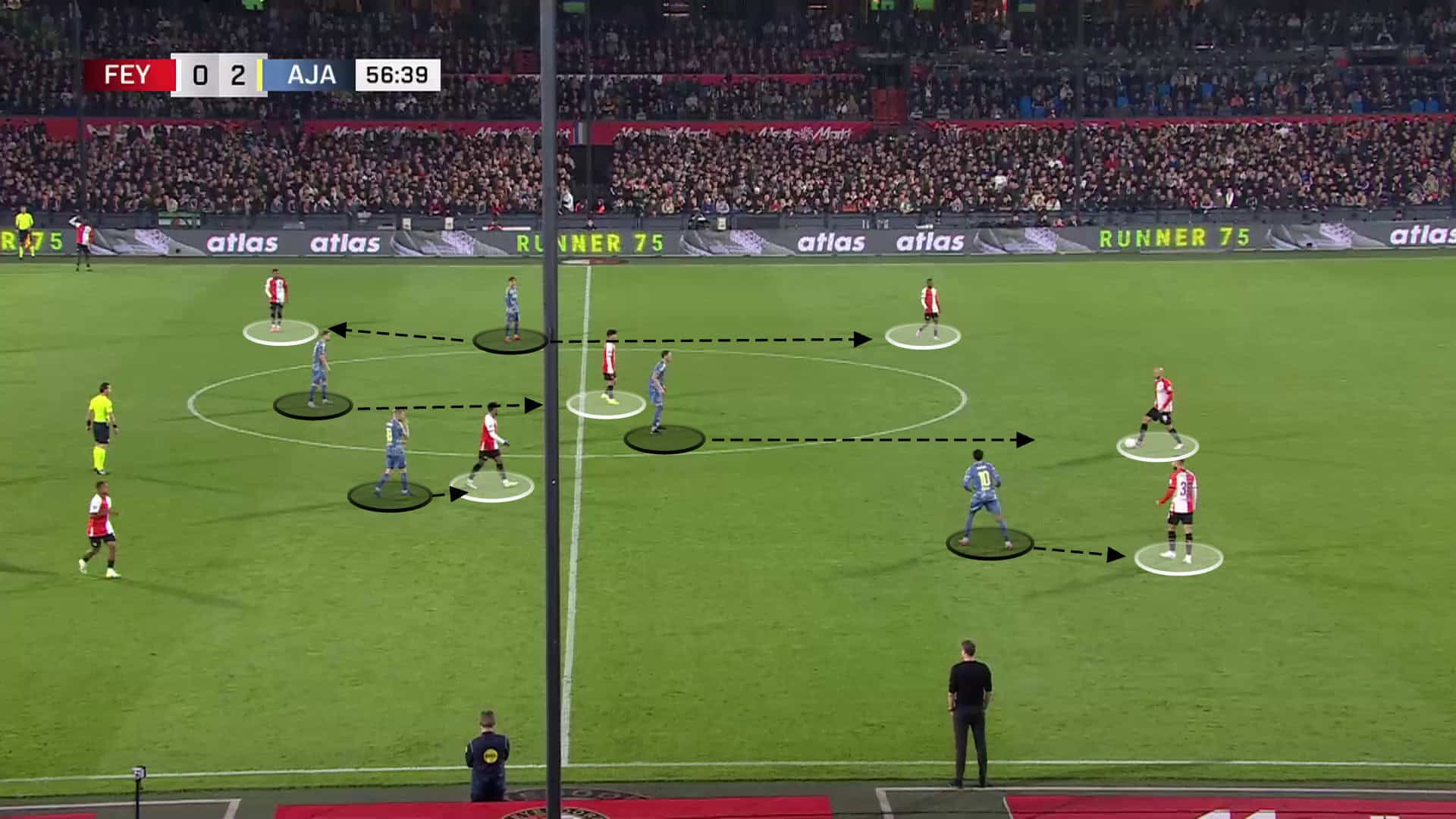
As Feyenoord started to push higher in the second half, the defensive duo of Jorrel Hato and Devyne Rensch demonstrated excellent composure under pressure.
When Feyenoord attempted to play through Ajax’s lines by initiating vertical passes, Hato and Rensch quickly responded by reading passes and often stepping out to intercept.
This structure meant that Ajax could sustain their high press without overcommitting, maintaining balance and ensuring they did not get caught out of shape when Feyenoord broke forward.
Ajax’s man-marking system neutralised Feyenoord’s ability to control possession and break lines, a critical factor that dictated the match’s flow.
The team’s discipline and cohesive movements allowed them to apply pressure without compromising defensive integrity.
Francesco Farioli’s tactics worked well as Ajax exploited Feyenoord’s lack of runners behind Ajax’s defensive line.
Set-Piece Opportunities
Farioli’s meticulous attention to set-piece routines displayed Ajax’s ability to capitalise on small margins, which made a decisive impact in a tightly contested match.
Taylor’s delivery and Weghorst’s physical presence were perfectly choreographed, showcasing Ajax’s prowess in turning routine corners into scoring opportunities.
Ajax took advantage of Feyenoord’s weaknesses at set-pieces, particularly corners.
Notably, Farioli’s side had identified that Feyenoord’s goalkeeper, Timon Wellenreuther, was vulnerable to crosses, especially without protection near the five-yard line.
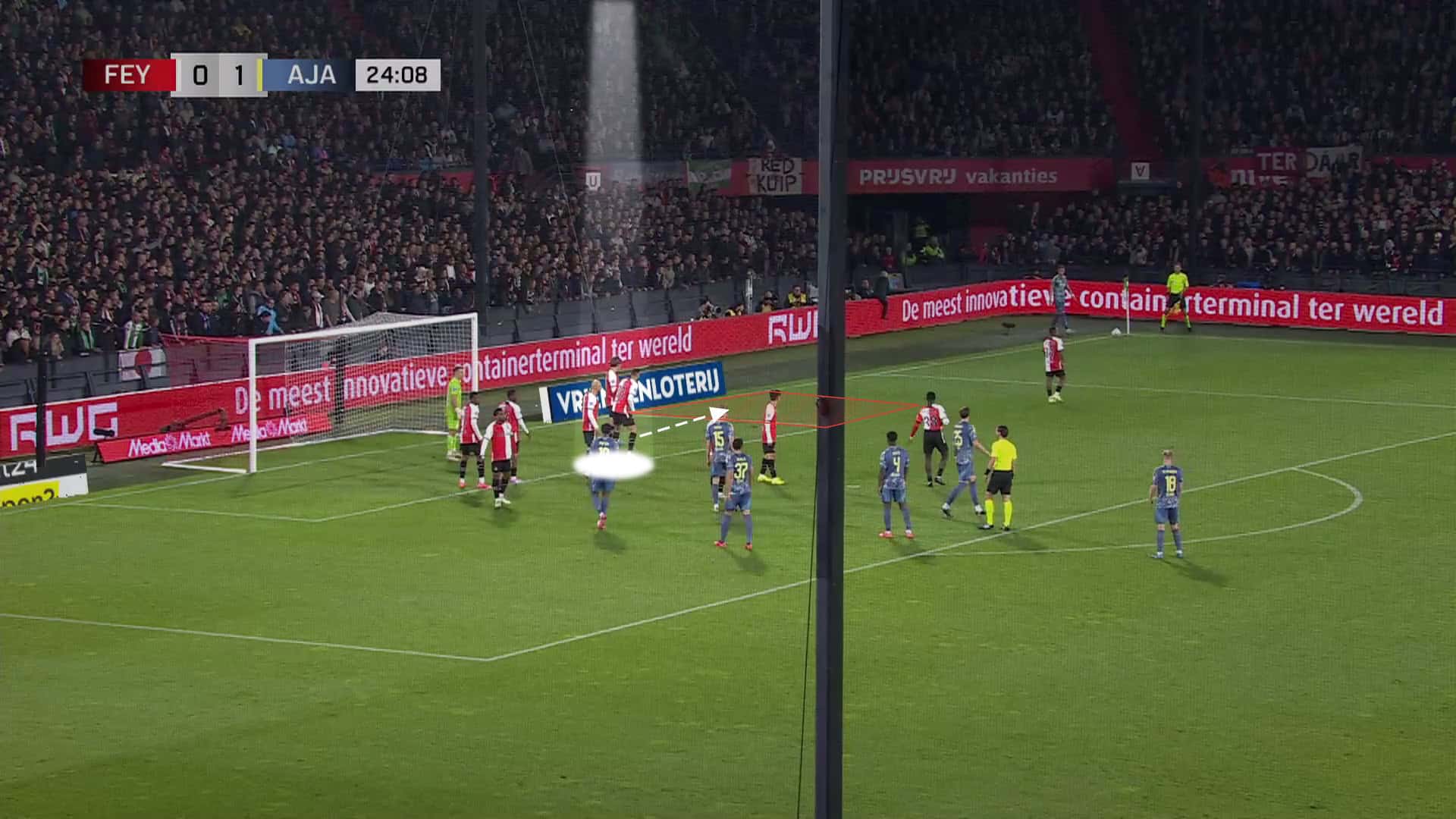
In Ajax’s corner routine, Weghorst strategically positioned himself to create chaos, drawing markers away and leaving Wellenreuther exposed.
Taylor’s perfectly executed corner resulted in a scrambled clearance, which Ajax capitalised on to double their lead.
This proactive approach to set pieces speaks volumes about Farioli’s preparation and attention to detail, making the most out of Feyenoord’s defensive weaknesses.
Game Management In The Final Stages
As the game progressed into the last quarter, Ajax adopted a more defensive stance to manage Feyenoord’s increased offensive urgency.
Recognizing that Feyenoord was pressing more aggressively, Farioli adjusted Ajax’s build-up by pushing Hato higher into midfield.
At the same time, Rensch dropped deeper to add stability and offer a safer outlet.
Klaassen dropped back to support the defence, giving Ajax an additional player between the lines to prevent any surprise runs from Feyenoord’s midfielders.
Francesco Farioli’s tactical adjustments paid dividends, as they limited Feyenoord’s opportunities and maintained control over the game’s tempo until the final whistle.
Pre-Match Analysis: Ajax Vs PSV
Following their tactical success against Feyenoord, Ajax faces a different challenge against a PSV side known for high-intensity, attacking play.
Given PSV’s form and offensive firepower under Peter Bosz’s style of play, this clash will likely require a more nuanced approach from Ajax.
PSV’s potent attacking trio presents a significant threat.
To counteract PSV’s offensive capabilities, Ajax may adopt a slightly more conservative setup, particularly in the early stages.
Instead of relying on a strict man-marking system, Farioli could opt for a zonal marking strategy, especially in central areas, to avoid leaving spaces open for PSV’s runners.
Rensch and Hato will need to stay compact to cover through balls and prevent PSV from creating overloads in wide areas.
While Ajax’s high press proved successful against Feyenoord, they will need to be cautious against PSV’s midfield, which excels in breaking press lines and launching quick transitions.
Instead of aggressively pressing PSV’s centre-backs, Ajax may adopt a more calculated press, focusing on cutting off passing lanes to PSV’s wingers, particularly Johan Bakayoko, whose dribbling and speed can quickly exploit any gaps.
PSV excels in creating overloads, particularly when transitioning from defence to attack.
To counter this, Ajax will need a disciplined midfield structure, with Klaassen and Taylor providing extra support in wide areas.
Godts could be instrumental here, dropping back into midfield to reinforce the press and prevent PSV’s midfield from building up momentum in Ajax’s half.
Against PSV’s potentially vulnerable high defensive line, Ajax’s set-piece precision could again come into play.
Taylor’s ability to deliver accurate balls into the box, combined with Weghorst’s aerial threat, offers Ajax a tactical edge.
Additionally, Ajax’s counterattacking speed through players like Akpom and Godts will be crucial, especially if PSV commits men forward in search of goals.
Farioli may favour a 4-3-3 formation, with Klaassen anchoring the midfield alongside Taylor and Godts.
The defensive pair of Rensch and Hato will be essential in breaking up PSV’s attacking moves, while the offensive line will need to stretch PSV’s defence to open up space.
Conclusion
Ajax’s victory over Feyenoord showcased Francesco Farioli’s tactical acumen, adapting a man-marking system and pressing structure that stifled Feyenoord’s play.
His innovative setup emphasised Ajax’s ability to control the game, from disrupting Feyenoord’s defensive transitions to exploiting set-piece weaknesses.
Looking ahead to their encounter with Peter Bosz’s PSV, Ajax will likely need a more adaptable defensive approach, with a focus on cutting passing lanes and containing PSV’s transitions.
While Ajax compete in the UEFA Europa League and PSV plays in the UEFA Champions League, Ajax should not be underestimated.
This Ajax side, reinvigorated under Francesco Farioli tactics, shows great promise as they blend disciplined pressing, tactical flexibility, and set-piece ingenuity.
These key attributes could well determine the outcome in their showdown with PSV.
