
The Canadian national team have entered one of their most exciting periods.
After qualifying for the 2022 World Cup, Canada now looks forward to the next edition of the competition, where they will be one of the host nations.
Les Rouges consists of elite players, such as Alphonso Davies and Jonathan David, who compete at some of the highest levels of European football, and a manager who, for the first time, is bringing his renowned style to international football.
Jesse Marsch took over the reins of the Canadian national team in May.
The American has divided opinion, particularly after his mixed spell with Leeds United in the Premier League.
However, during Canada’s first Copa América, it was fascinating to witness the implementation of Jesse Marsch’s style of play in such a short period.
In this tactical analysis, we will provide an in-depth analysis of four key areas of Jesse Marsch’s tactics that have seen the Maple Leafs qualify for the quarter-finals in their first Copa América.
Considerations will also be made regarding the areas Canada must improve if they wish to progress further in the competition.
Jesse Marsch Intense Pressing
With the American coach having spent a season as an assistant coach to Ralf Rangnick at RB Leipzig, it’s evident that he has adopted many components of the Red Bull Group Philosophy.
Wherever Marsch has gone, he has looked to employ an intense pressing strategy that Red Bull teams are famous for.
Within just four games, there have been many signs that Canada is well on its way to cementing this as part of its tactical setup.
Statistically, it can be seen that per 90 minutes, Canada averaged the fourth most tackles and interceptions in the tournament so far.
Canada set up looking to consistently match up their opposition during their opponent’s build-up phase.
In his first games, Marsch has set up his sides to play in a 4-2-2-2 and 4-2-3-1.
This was clearly visible during their first match against Argentina.

As seen here, Canada’s front two and midfield four remain compact, ensuring little space for Argentina to penetrate the middle.
This, in turn, has forced the ball to be played out wide to the full-backs, which throughout the tournament has acted as a trigger for Canada to press aggressively.

In this example, the ball is played out wide.
The aggressive press was initiated by the left-winger Liam Millar.
Canada’s left centre-forward Cyle Larin begins to creep out of position to ready himself to press if the ball is played back to Argentina’s right centre-back.
Alphonso Davies presses high as the ball travels down the line to Argentina’s wide player, who has dropped deep to receive the ball.
He can do this due to sufficient cover and balance being provided by his fellow defenders, demonstrating how well the Canadian players have adopted Jesse Marsch’s collective pressing.

Canada have also adapted their pressing scheme to allow them to press high, regardless of their opposition’s set up.
In the second half of the game against Argentina, the world champions changed their setup during their build-up play.
Leandro Paredes dropped between the two centre-backs to create an overload.
Most teams playing a 4-4-2 would combat this by dropping off and allowing the opposition to have the ball, as Argentina have a numerical advantage as they begin to build up.
Yet Canada stuck true to their principles.
Marsch changed the 4-2-2-2 system to where it resembled more of a 4-3-3.
This involved the two centre forwards, one of the wide midfielders pressing right onto Argentina’s back three, and a midfield three consisting of the initial two central midfielders, Ismaël Koné and Stephen Eustáquio, along with the other wide midfielder, Millar.
Jesse Marsch High Line
As seen previously, high pressing has many advantages and has been used effectively at times by Canada.
However, one of the significant drawbacks of this system is the risk associated with the high line that needs to be deployed for it to be effective.
Playing against some of the deadliest forwards in world football, Canada have suffered from using this tactic.
So far in the tournament, Canada’s backline has been penetrated with 12 passes, with eight of these coming against Argentina.

Here, we can see the clear benefit of having a high line.
Against a side like Argentina, which has numerous creative attackers who are willing to pick up positions between the lines, it considerably reduces the space for these players to operate.
The ball is passed into the highlighted area and is easily won back by Canada, which can deal with the forward pass.

Yet, in this example, we see the system’s downfall.
In Canada’s warm-up game against the Netherlands, having a high line helped reduce the space in which creative forwards like Memphis Depay had to operate.
Though this appeared effective, the space left behind for the Dutch’s lightning-fast players proved costly.
Here, Georginio Wijnaldum picks the ball up in a high position.
Canada’s centre-back, Derek Cornelius, presses the Netherlands’s number 8, leaving a massive gap in Canada’s defence.
Wijnaldum plays the ball over the top to the rapid Jeremie Frimpong, who goes through on goal to score.
To play a high line, individual defenders must have great defensive awareness of their surroundings so they know what penetrating runs their opponents are making.
This is achieved through constant scanning and maintaining the correct body shape to identify the opposition’s attackers.
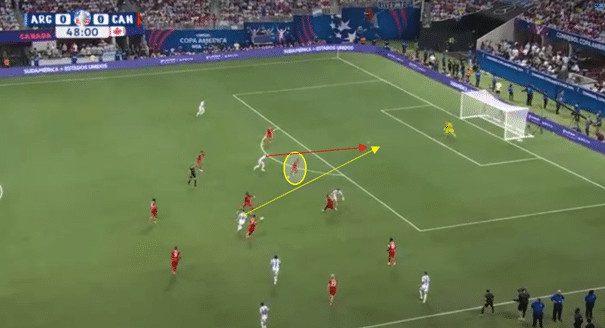 Argentina, in this example, easily penetrated Canada’s backline.
Moïse Bombito is completely focused on the ball and has a closed-body position.
This allowed Alexis Mac Allister to make a run on his blind side, resulting in the Liverpool midfielder setting up Julián Álvarez for the opening goal of the game.
Jesse Marsch Wide Rotations
Many of Canada’s most exciting players can be found in wide positions.
Captain Alphonso Davies has had a mixed start to his Copa América campaign and has appeared at times weighed down by the expectation placed on him.
Nevertheless, much of what has been good for Les Rouges has come from him and Canada’s wide attacks.
The wide rotations of Canada’s full-backs and wingers have created the space for Davies to get on the ball in wide areas.
Davies lined up as left-back, the position he plays for his club side, FC Bayern, during the first match against Argentina and the final group game against Chile.
Marsch has also used the 23-year-old as a left winger throughout the tournament.
Alphonso Davies’ attacking threat is evident in his percentile rankings of 98 and 90 for progressive carries and successful take-ons, respectively, compared to other full-backs in the tournament.
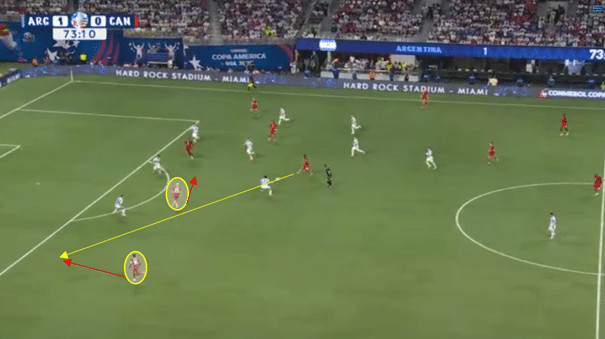
In this situation from the Argentina game, we see Liam Millar coming inside.
This has created the space for Davies to make a progressive run forward and penetrate Argentina’s backline out wide, allowing him to have a shot on goal.

Canada also attempted to use the opposite rotation when Davies was playing as a left winger.
Here, we see the left-back coming inside, attracting Peru’s right-sided midfielder inside.
This isolates Davies 1v1 with Peru’s right-back.
Davies has not been the only wide player to impress for Canada.
Jacob Shaffelburg has impressed with his direct dribbling and the number of crosses that he has delivered into the box.
The Nashville SC winger has averaged 5.63 crosses and 3.75 progressive carries per 90.
The rotations that Canada used in the wide areas have helped to release him and the other wide players.

Here, we see Shaffelburg starting in an inverted position.
Alistair Johnston has the ball close to the touchline.
In an attempt to penetrate the defence, Shaffelburg makes an in-to-out run and is slipped down the line.
He then plays a dangerous pass inside, leading to the ball being worked into a promising position.
Jesse Marsch Build-up Play
Canada have used a varied approach when build up play, electing to go both long and short.
However, they have struggled when attempting to progress the ball through the thirds.
This has not only limited their attacking potential but has put them into a great deal of trouble at times.
Argentina & Peru High Regains Map Vs Canada
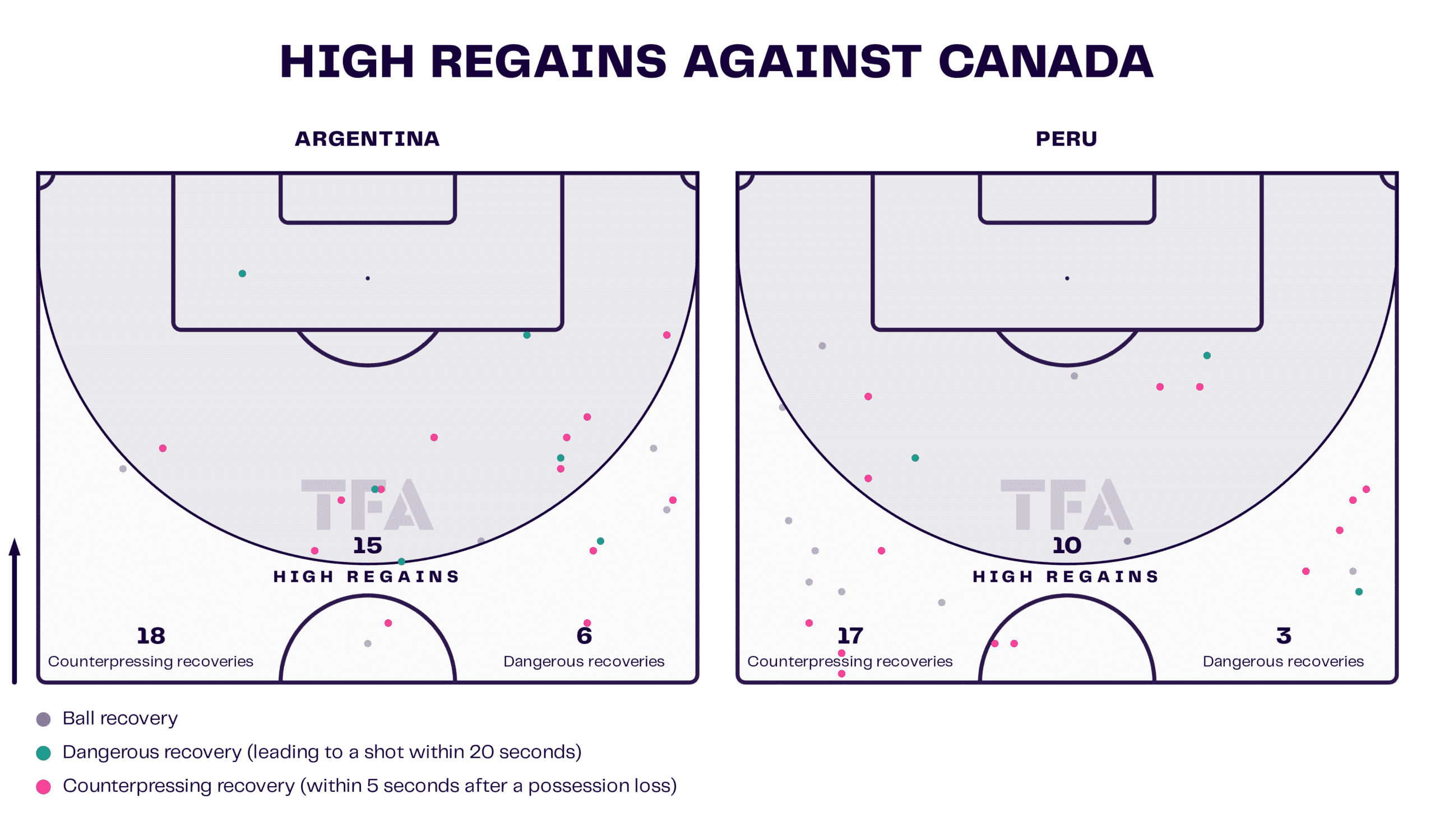
In both graphics, it is visible that Peru and Argentina have had many high regains against Canada.
The graphic also demonstrates the number of these regains that have led to shots.
Despite Canada winning the ball back impressively through their structured press, in all three of their games, the sides they have faced have had more high regains than Canada when facing the North American side.
This is mainly due to Canada’s tendency to give possession away cheaply through its build-up play.

Many of the problems have occurred from the structure that Les Rouges have set up to progress play.
As seen in this situation, Canada’s midfielders are often either matched or, on many occasions, outnumbered.
Despite Koné pulling out wide to gain space in this scenario, he’s closely marked, unable to provide an option for Eustáquio, who, under intense pressure, gives the ball away.
These problems can be clearly seen in numbers.
The Maple Leafs have been dispossessed more times than any other team in Copa América.
The two midfielders, Koné and Eustáquio, have only received a combined total of three progressive passes.
Canada’s build-up play’s greatest success comes when Jonathan David drops deep.
In all matches, David’s role allows him relative freedom to go where he pleases.
Often, he will drop deep to offer an option for a progressive pass.
David has received more progressive passes than any other Canadian player in the tournament so far.

Here, Jonathan David drops deep and provides a forward option for his teammates to progress the ball up the pitch.
He acts as a link player, laying the ball off to the supporting run of midfielder Jonathan Osorio, who can drive forward with the ball.
Conclusion
Canada can be pleased to have progressed to the quarter-finals, overcoming what was a difficult group.
This will undoubtedly give them confidence that they’re heading in the right direction, particularly when you consider this is only the beginning of Marsch’s tenure.
Canada’s aggressive pressing and creativity in the wide areas have helped them secure a place in the last eight.
However, to go further in the competition, they will need to improve Canada’s build-up play and ensure that teams with pace don’t exploit Canada’s high defensive line.
