
The 2021/22 season was a difficult one for fans of Leeds United. Before being too critical of performance, however, we have to consider the context. This was the club’s second season back in the Premier League after too long spent outside the spotlight and hindsight tells us that the second season is often the most difficult one. For fans of the club, a difficult season and a relegation battle were hard to cope with but those issues paled into insignificance with the fact that this difficult season led to the departure of the club’s Argentine coach Marcelo Bielsa.
The mercurial Bielsa was revered in Leeds as the mastermind that took the club back to the Premier League and who instilled a playing style that made Leeds the talk of world football. Bielsa, however, is renowned for his intense methods and, as the season wore on it, became evident that his time at Elland Road was coming to an end.
The club’s hierarchy was quick to move and appoint the former RB Leipzig coach Jesse Marsch as the successor to Bielsa. The American coach came into the club in a difficult period with limited time to install his style of play into the playing squad. In the end, relegation was avoided but it was very, very close but Leeds could prepare for a third consecutive season of Premier League football.
At this point, we saw a Leeds squad that had been built for the very specific style of play for Bielsa and changes needed to be made to fit the way that Marsch likes to play. He is very much a product of the Red Bull environment in that he had worked for New York Red Bulls, Red Bull Salzburg and RB Leipzig. Marsch had been described at one point, somewhat disparagingly, as a ‘company man’ who represented the footballing arm of Red Bull. To an extent this is true, but only in that Marsch represents the positive aspects of the Red Bull style of play.
He trusts young players and wants his sides to play with aggression on the front foot. He likes aggressive pressing as Bielsa did, and he wants verticality in possession with the ball being moved quickly through the thirds. We should pause at this point to say that vertical football isn’t the same as route one or long ball with driven vertical passes being moved through the thirds as the play is connected. Leeds, however, had to find a way to balance their budget whilst also bringing in players to meet the style wanted by Marsch.
The answer was simple if upsetting, for Leeds fans as the club were met with significant interest in their better players from rival clubs. This interest saw the club lose their Brazilian international wide player Raphinha, for a reported £52M to Barcelona, and home-grown midfield dynamo Kalvin Phillips, for a reported £43M to Manchester City. While the sale of these players hurt in the short term, it made sense from a financial and squad-churning perspective.
This weekend past, we saw the opening matches of the 2022/23 Premier League season as Leeds United hosted Wolverhampton Wanderers and won 2-1. Leeds fans got their first chance to see the new look side in action and, although there are still raw edges to the performance, the early signs were positive.
In this tactical analysis, we will look at how Leeds United played in this first match of the season and how they may look to replace the output of Raphinha and Kalvin Phillips. This analysis piece will be a team scout report of Leeds early doors, looking at how Marsch has tweaked the side’s tactics.
The Brenden Aaronson effect
One of the most intriguing signings that we have seen this summer from Leeds United was the £29M signing of the American international Brenden Aaronson from Red Bull Salzburg. There were many at the time who said that Leeds were only interested in the 21-year-old attacking midfielder because he was a compatriot of Marsch and the two had been at the Austrian club together previously. Indeed, Marsch was the coach of Red Bull Salzburg when Aaronson moved to Europe from Philadelphia Union of MLS for £11M.
Anybody who saw this match, however, will have reassessed that performance as Aaronson buzzed around the Elland Road pitch with relentless energy and intent. He is not a direct replacement for Raphinha as the Brazilian international is more comfortable in wide areas when receiving the ball before then looking to carry the ball into dangerous areas. Aaronson is more of a ’10’ than a natural winger and even when, as he was in this match, he is played nominally from the right-side of the structure he will come into the half-spaces or even the central areas in order to link the play and combine with teammates.
This positioning from the American is more in keeping with the style of football that we can expect from Leeds under Marsch and indeed, while at both Red Bull Salzburg and RB Leipzig, he looked to play in a 4-2-2-2 structure with the two more advanced midfielders positioned in more of a narrow shape together.
Aaronson was perhaps unlucky that the winning goal for Leeds has gone down as an own goal as it was the American who was sliding in at the back post looking to get the ball over the line. His overall performance, however, was about far more impressive than that moment. He was continually available to teammates as he dropped into pockets of space behind the opposition to receive the ball and his off the ball movements were aggressive and incisive. When in the defensive phase of the game Aaronson often led the press for Leeds in acting on pressing triggers and engaging the ball carrier.

In the early stages of the game, Aaronson’s movement was creating danger for Wolves although teammates were struggling to access these runs.
We see an example of this here as, in the 11th minute, Leeds were building the attack with the ball carrier coming inside from the left half-space. As you can see, despite Aaronson being listed as the right-sided winger in the attacking structure, he is very much positioned in the central areas. His run is aggressive and incisive as he moves past the blind side of the nearest opposition player.
From this position, the run that Aaronson will make is dependent on the orientation of the striker for Leeds. In this instance, we see that Patrick Bamford, back from a long term injury, is positioned on the blind side of the central defender away from the ball. That means that Aaronson will attack the space on the other side of the defender.
As Leeds players get used to the tendencies of Aaronson, we will see these runs taking on a whole new dimension in terms of the danger they create.
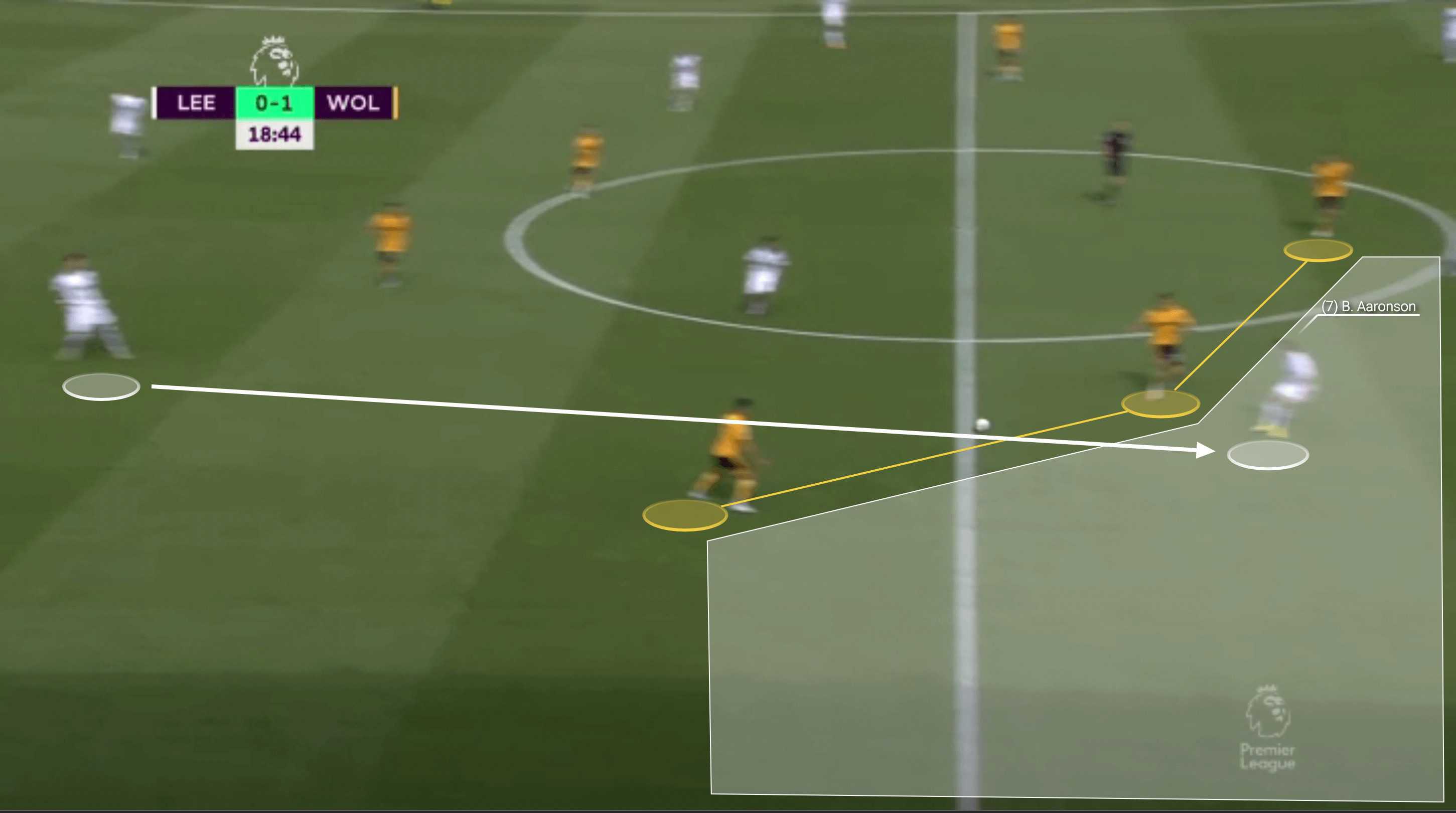
When the Leeds central defenders, Robin Koch and Diego Llorente in this game, were in possession they looked for opportunties to play vertical line breaking passes. This is a key part of Marsch’s game model as he wants the ball to come out from the first-line aggressively while trying to break the opposition press to find players in space behind the midfield line. In order to play this way, you need your central defenders to be comfortable when playing out from the back and being aggressive, as Koch and Llorente are. But you also need players who understand how to drop into spaces behind these lines in order to receive the ball. This is where Aaronson comes in.
Here, he receives the vertical driven pass from Koch and takes the ball on the turn, allowing him to move aggressively in possession to drive into the opposition half of the pitch.
Raphinha would typically receive the ball wide in these positions and then look to attack diagonally into the same space.

This time, we see another example of the dangerous types of runs that Aaronson will look to make for Leeds in the final third.
As the ball is played through into the final third, he is almost on the same line as Bamford, the central striker. Once again his run is into space, away from Bamford, and this run creates real danger for the opposition because the central defender who is caught between Bamford and Aaronson has to adjust and choose which player to cover.

Out of possession, the energy and aggression from Aaronson really helped Leeds to limit the threat from Wolves as they were looking to build out from the back.
We see an example here with Wolves looking to play out from the first-line. It is interesting to note already that Aaronson is playing in the half-space as opposed to positioning himself wide. As the ball is played out to the left-back, note his body position. He receives facing the ball as opposed to opening his body out to be more positive. This acts as a pressing trigger and we see Aaronson move aggressively to close down the man in possession and engage the ball.
Crucially, Aaronson presses very well. He is active with quick feet and he takes good angles on the ball. This means that the player in possession cannot easily play through the press.
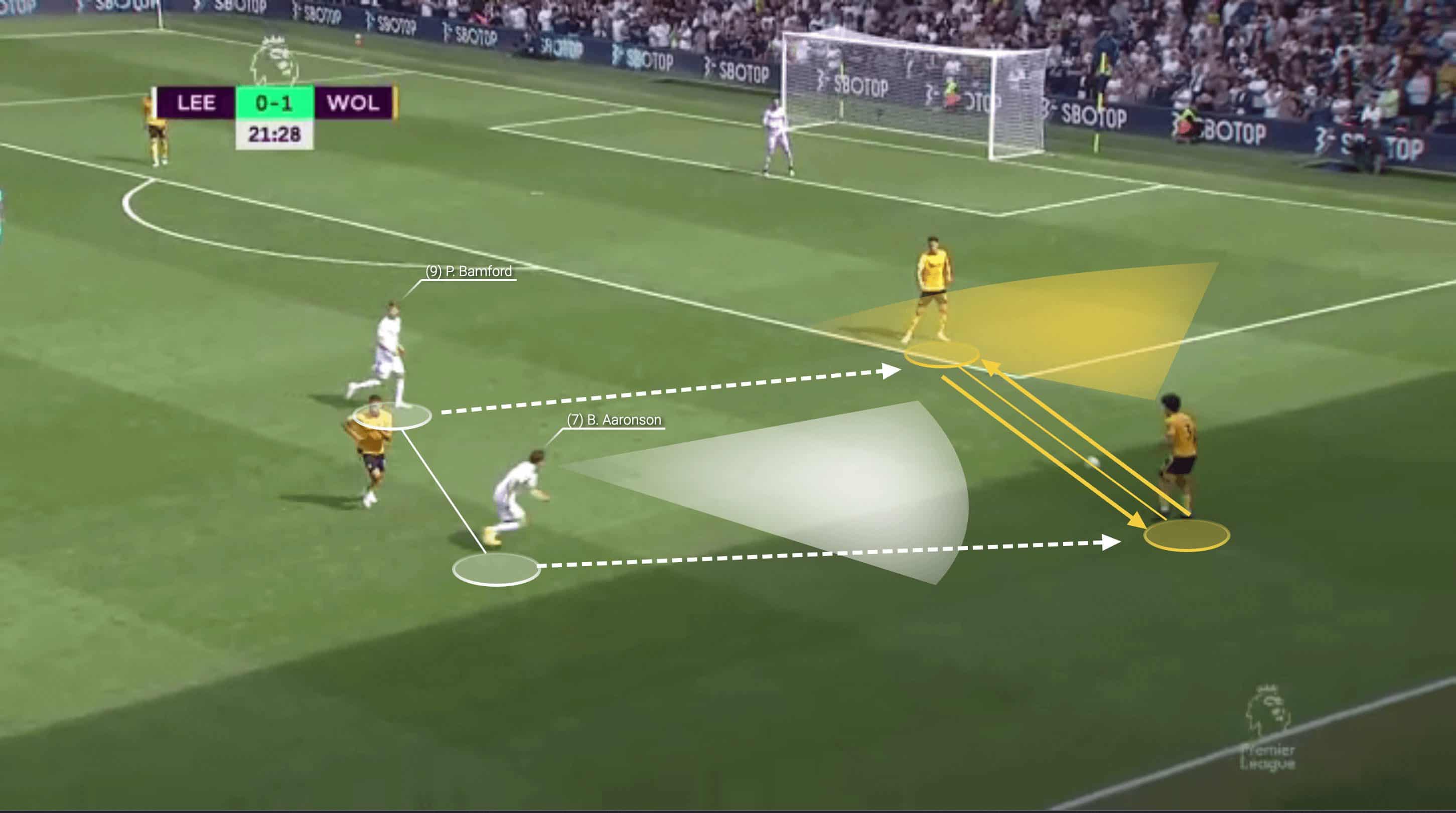
A similar situation here as Aaronson and Bamford work together to press Wolves into the corner. As the ball is played out initially, the receiving player is once again facing the ball and the American reacts aggressively to engage. He is so quick that the pressure is intense and the ball is played back to the defender, again, triggering the press from Bamford.
Brendan Aaronson had a very strong Premier League debut in this match and early signs are that he is a player that Leeds fans will enjoy and relate to. His work ethic across all phases of the game is very strong but this is combined with both tactical intelligence and technical ability.
Replacing Phillips in the aggregate?
Replacing a player in the aggregate is a term that rose to prominence after the film, and indeed the book, Moneyball was released. As the Oakland Athletic’s are considering how to replace star first baseman Jason Giambi who had left to join the New York Yankees. The Athletic’s general manager Billy Beans knew that they could not afford a replacement that could replicate the same performance as Giambi directly and, instead, looked for ways to replace his output with two or three players, thus replacing him in the aggregate.
To an extent, that is what we have seen this summer from Leeds as they replace Kalvin Phillips. Although, in replacing the England international using two players, they have actually solved an issue from last season in that Phillips was often expected to do too much.
Tyler Adams, yes, another American, has joined Leeds from RB Leipzig this summer for a fee reported to be in the region of £15M while the Spaniard Marc Roca has also joined, this time from Bayern Munich for £10M. Those two players lined up in this match as the double pivot at the base of the midfield and they showed signs of promise as a duo who will compliment one another stylistically and tactically.
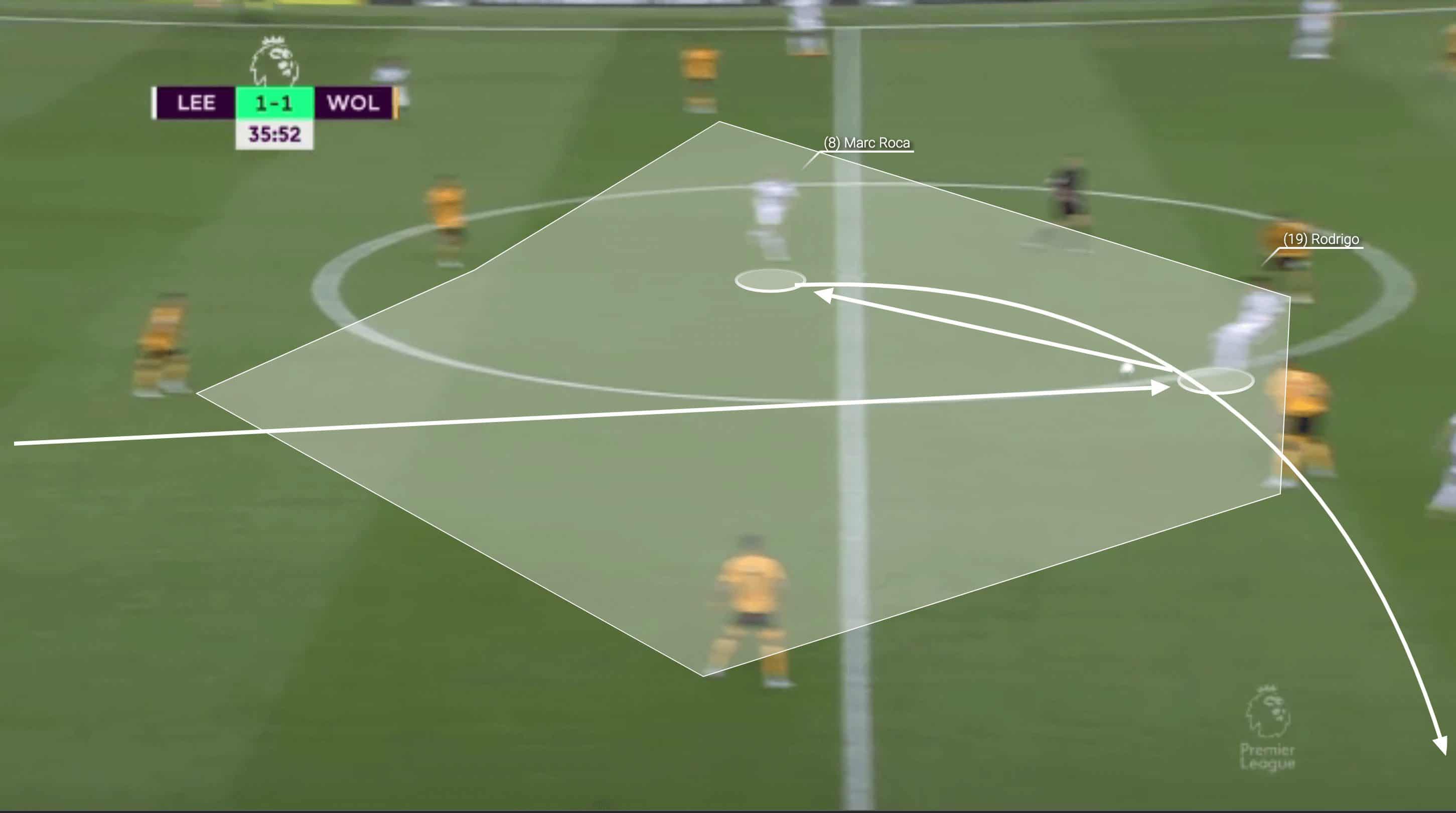
Roca impressed with his positioning and understanding of the game and game model as he continually seemed to be available to receive the ball.
Crucially, when the Spaniard was in possession he was quick to play the next pass and he displayed the ability to play the ball aggressively through lines to move the ball into the next third or out to the wide areas to access space that Wolves were giving up through their defensive positioning.
Roca is technically very good on the ball and his ability to weight a pass on minimal touches was important for Leeds as they looked to maintain the high pace of their attacking build-up play. In this example, Roca is the key to an ‘up, back and through’ passing combination, something that Leeds fans will see a lot of under Marsch, as the first pass goes to an advanced player before getting set back to a midfielder, Roca in this instance, before being played again quickly.
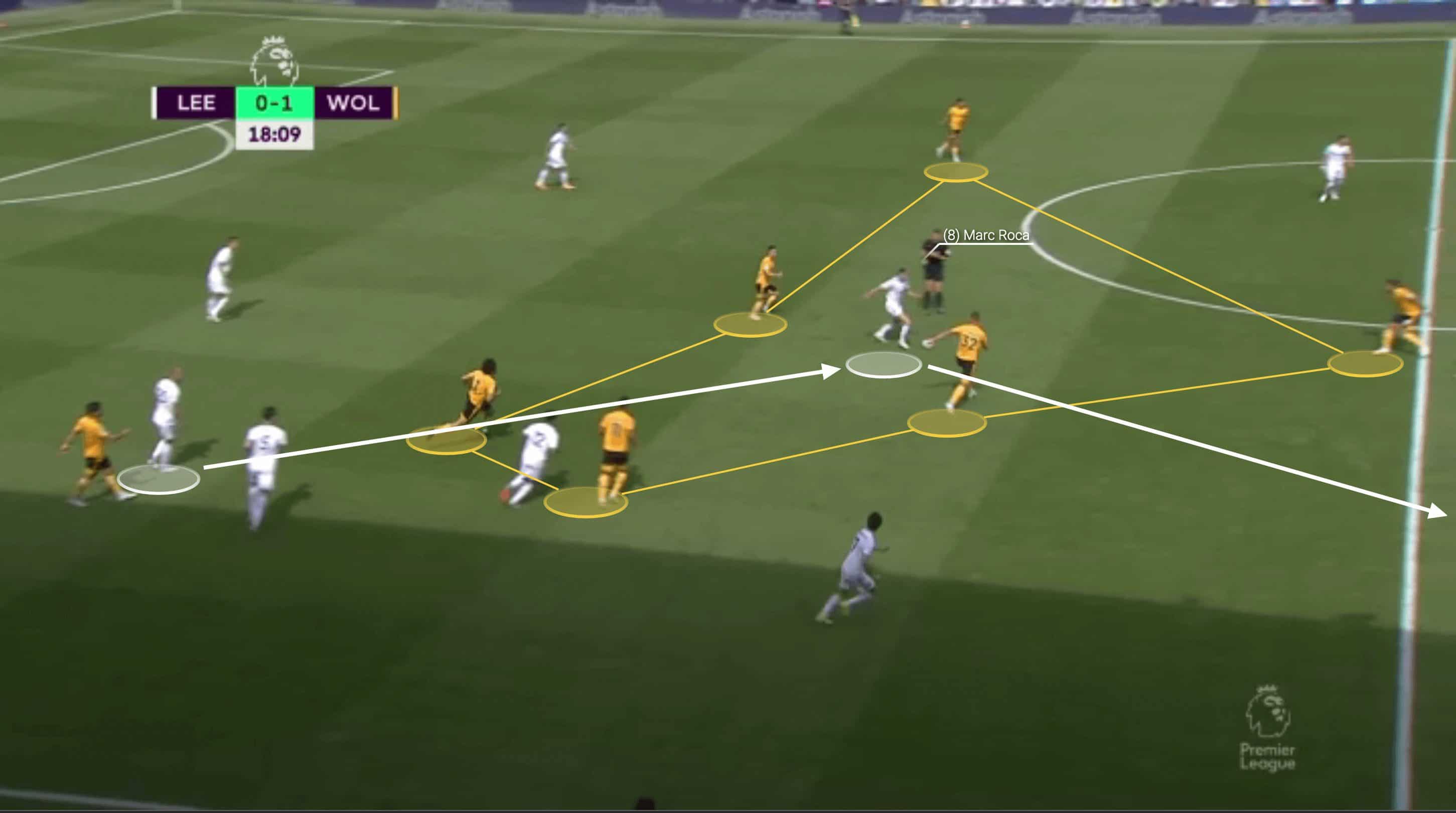
A similar situation here for Roca as he receives the ball in transition from a teammate. Straight away, you start to see the positional awareness of the Spaniard as he has drifted into a pocket of space between the Wolves players and when he receives the ball, plays aggressively with one touch to find a teammate in the opposition half.
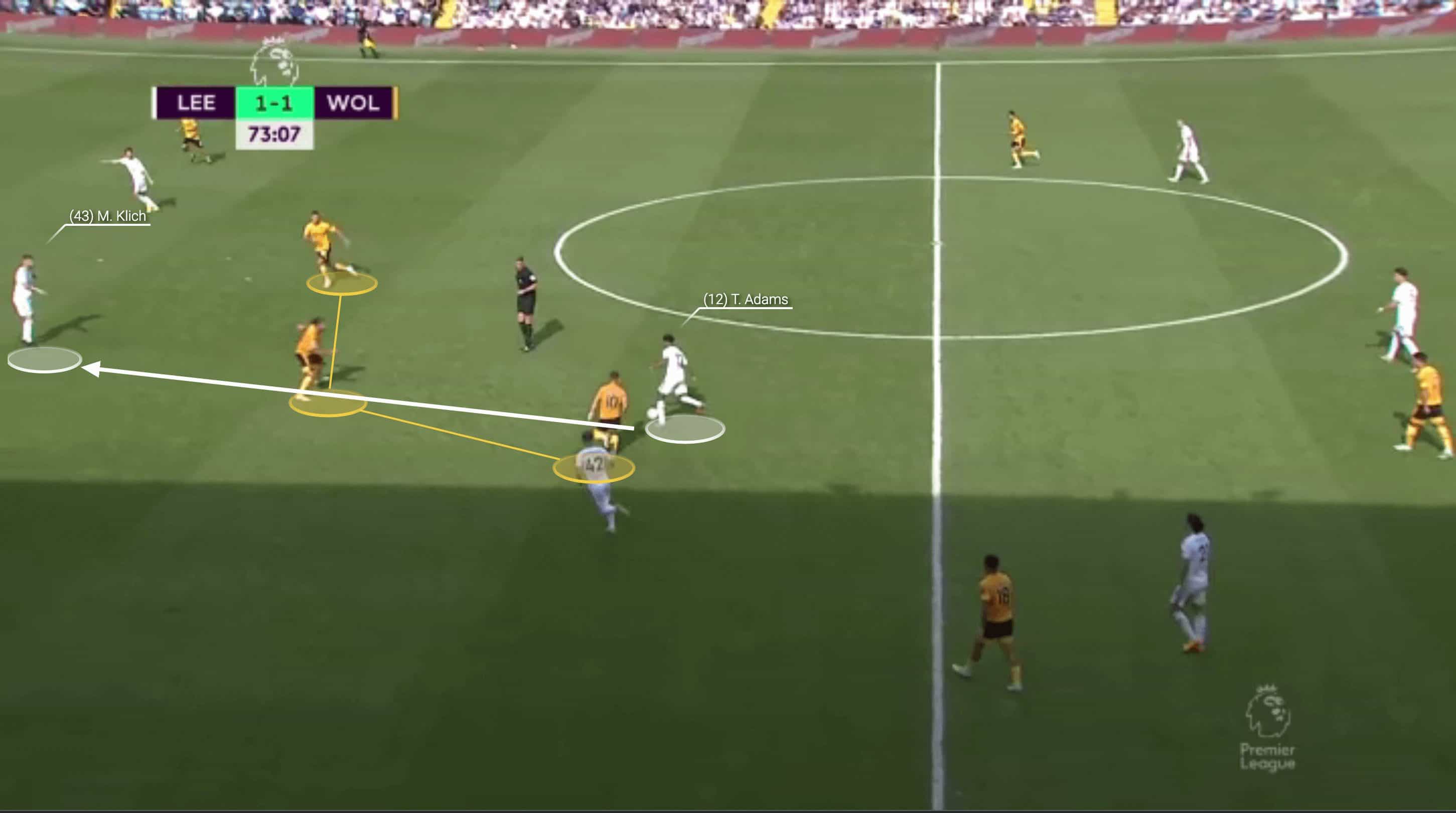
Tyler Adams was perhaps more dynamic in terms of his movement than Roca but he also showed signs of being able to bring some of the qualities that Leeds have lost that were the same as Phillips. When he was signed, there was some concern that his passing profile would not quite fit what Leeds were looking to do under Marsch, but in this match, he was aggressive in his approach to moving the ball into dangerous areas.
We see an example of that above in the build-up to the second Leeds goal as Adams is on the ball in the midfield. He passses aggressively to release Mateusz Klich into space and breaks the line of Wolves’ pressure in front of him while doing so.
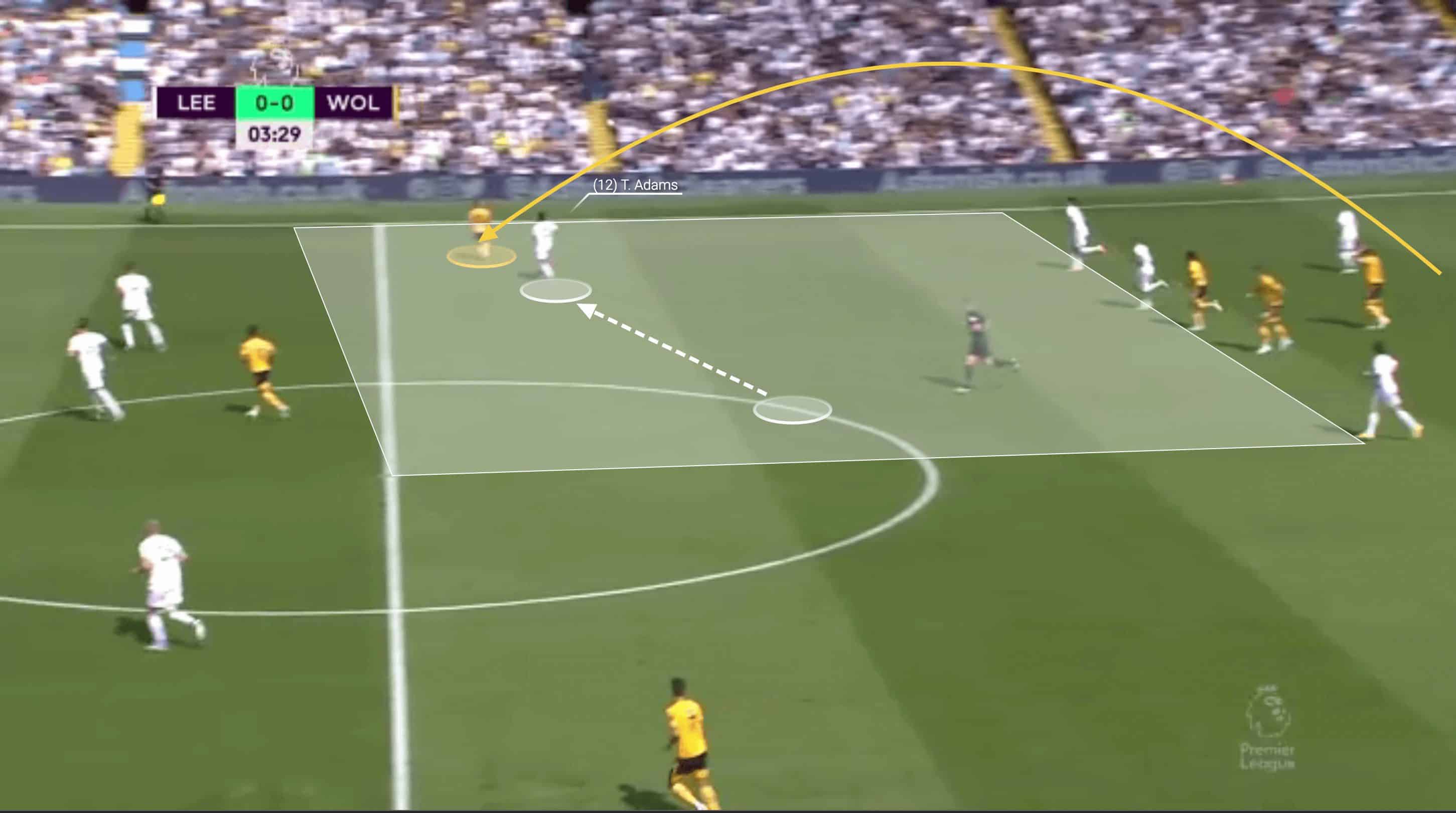
While Roca was often the more advanced of the two we saw a lot more of Adams in terms of controlling the space when the opposition looked to attack in transition. He was quick to cover the width of the pitch as the Leeds fullbacks moved high into attacking positions. Adams was often the player who was positioned to pressure the ball in transition and either look to regain possession or simply disrput and delay the opposition’s counterattack.
Conclusion
It is, of course, still very early days for this version of Leeds United under Jesse Marsch, but it is difficult to think that Leeds fans will be anything other than encouraged. They went a goal down and then weathered a difficult spell in the second half, but they showed resilience and tactical flexibility and came away from opening weekend with all three points.
It was interesting to see Aaronsen, Roca and Adams all playing important roles in this match and to see the difference from Leeds in using these players as opposed to Raphinha and Kalvin Phillips.
