
After staying up in the Premier League for a tenth consecutive season, Southampton will look to improve on a disappointing end to their campaign.
The Saints have had a running theme of starting seasons well, but seemingly running out of steam towards the latter parts of the season.
Strength in depth and a younger squad should help the Saints keep momentum throughout the entire season, preventing burnout.
Southampton’s recent transfer strategy has been interesting, and it could help them stay ahead of the curve before other teams catch on.
In recent seasons, the Saints have targeted youth academy players from the top six clubs.
They sign players who have received high-quality coaching but lack the game time to prove their worth.
The big six in the Premier League—Chelsea, Spurs, Arsenal, Liverpool, Manchester United, and Manchester City—stockpile youth players in their academies in the hope that one of the larger group of players will turn out to be world-class, increasing the chance of their youngsters being successful.
Having a large number of players means that some players don’t get the game time they deserve and look to leave the club in search of first-team football.
These players arrive at cheaper prices due to their unknown quality and how that may translate to Premier League football.
Kyle Walker-Peters, Tino Livramento, Gavin Bazunu, and Armando Broja are just some of the names that fit the description. The three who played for them, excluding Bazunu, have all displayed their quality, proving that if you are good enough, you are old enough.
Next in line is Romeo Lavia.
The 18-year-old Belgian defensive midfielder joins the club for £12 million, with Man City having the option to buy him back for £40 million.
After the purchase of Kalvin Phillips, with Rodri already blocking his path to first-team football, Lavia’s only option was to leave the club if he wanted regular first-team football, which he should receive at Southampton if he can prove himself to the boss, Ralph Hasenhuttl.
In this scout report, a tactical analysis of Romeo Lavia’s style of play, strengths, and weaknesses will be examined to evaluate whether the transfer was worth the fee and to assess the player’s potential.
Furthermore, Southampton’s tactics will be reviewed, and an analysis will detail how Lavia will fit in at his new club.
Roméo Lavia Style Of Play
Romeo Lavia spent the last season playing for Manchester City’s under 23’s in the Premier League 2.
Manchester City won the league, finishing six points ahead of 2nd placed West Ham.
In that winning run, Lavia played a key role as the lone 6, starting 20 of the 26 games.
Lavia also played a couple of games for the first team in the Carabao cup.
The heat map below highlights the positions he enjoys to play in.

Lavia is a holding midfielder who excels in his ability to retain the ball in the build-up phase and play progressive passes to more creative players in the final third.
Lavia is a tenacious ball winner and ball carrier.
The map above shows his willingness to be on the ball in both halves, whilst staying central and always offering his teammates a passing option.
Although he is right-footed, Lavia is comfortable playing in tight areas with both his right and left foot.
Reliable on the ball
Romeo Lavia has stated that one of his inspirations is Sergio Busquets.
It should be no surprise that Lavia tries to play like him and has a similar role in his team to Busquets‘s for Barcelona under Pep Guardiola.
In the build-up phase, Man City plays out from the back, looking to play the ball through the opposition team’s press.
Lavia frequently offers himself in those situations, allowing the team to progress the play with his excellent ball-playing abilities.
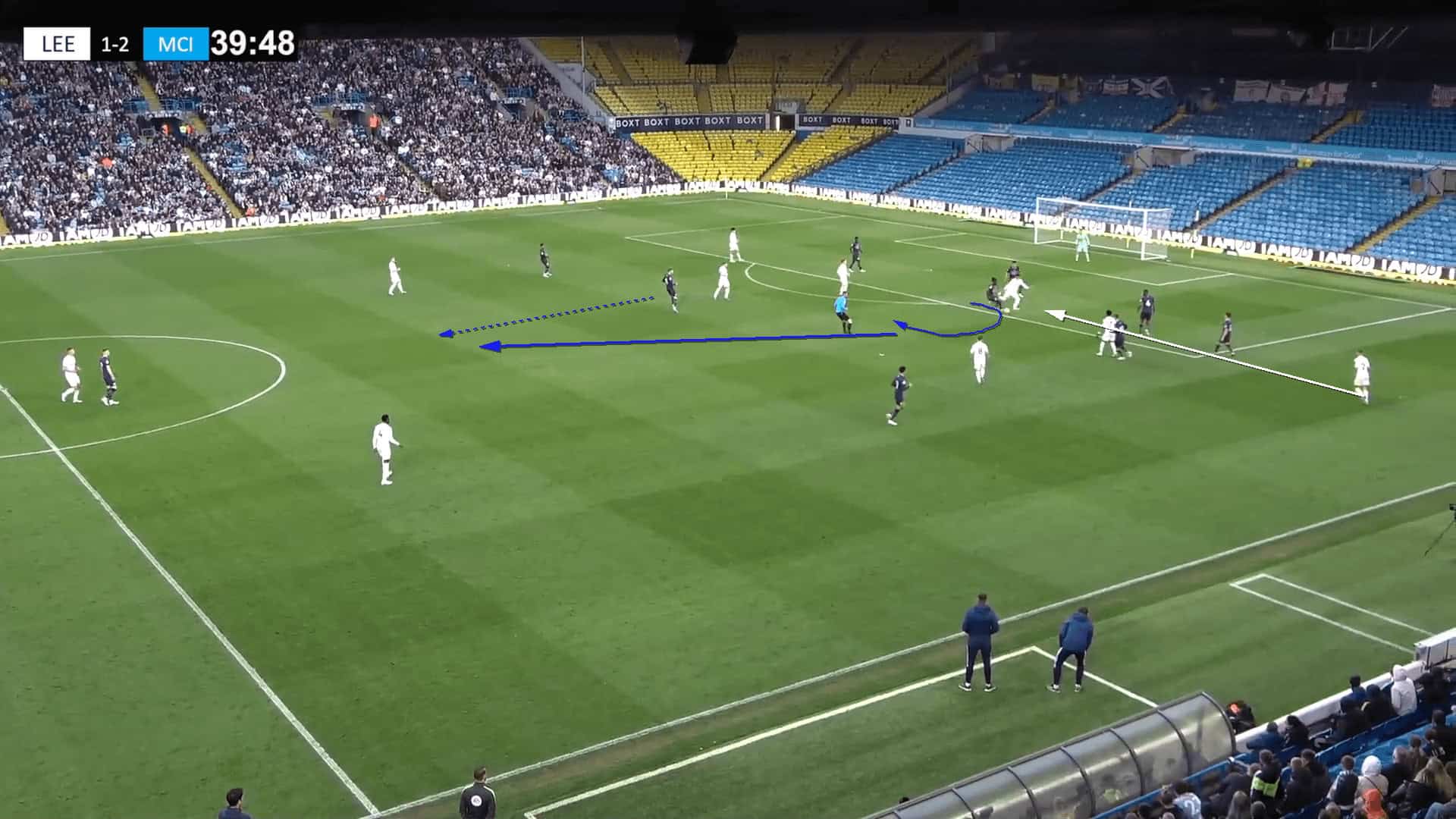
Lavia is very comfortable with playing short simple passes, with either foot.
The image below shows his ability to stay composed on the ball in a dangerous position, before using his vision to find a teammate in space which helps lead to a dangerous counter attack.
Lavia’s ability to consistently play ‘simpler’ passes without error allows his team to keep the ball and progress it through him.
The defenders behind him are comfortable with giving him the ball, knowing he will take care of it almost every time.
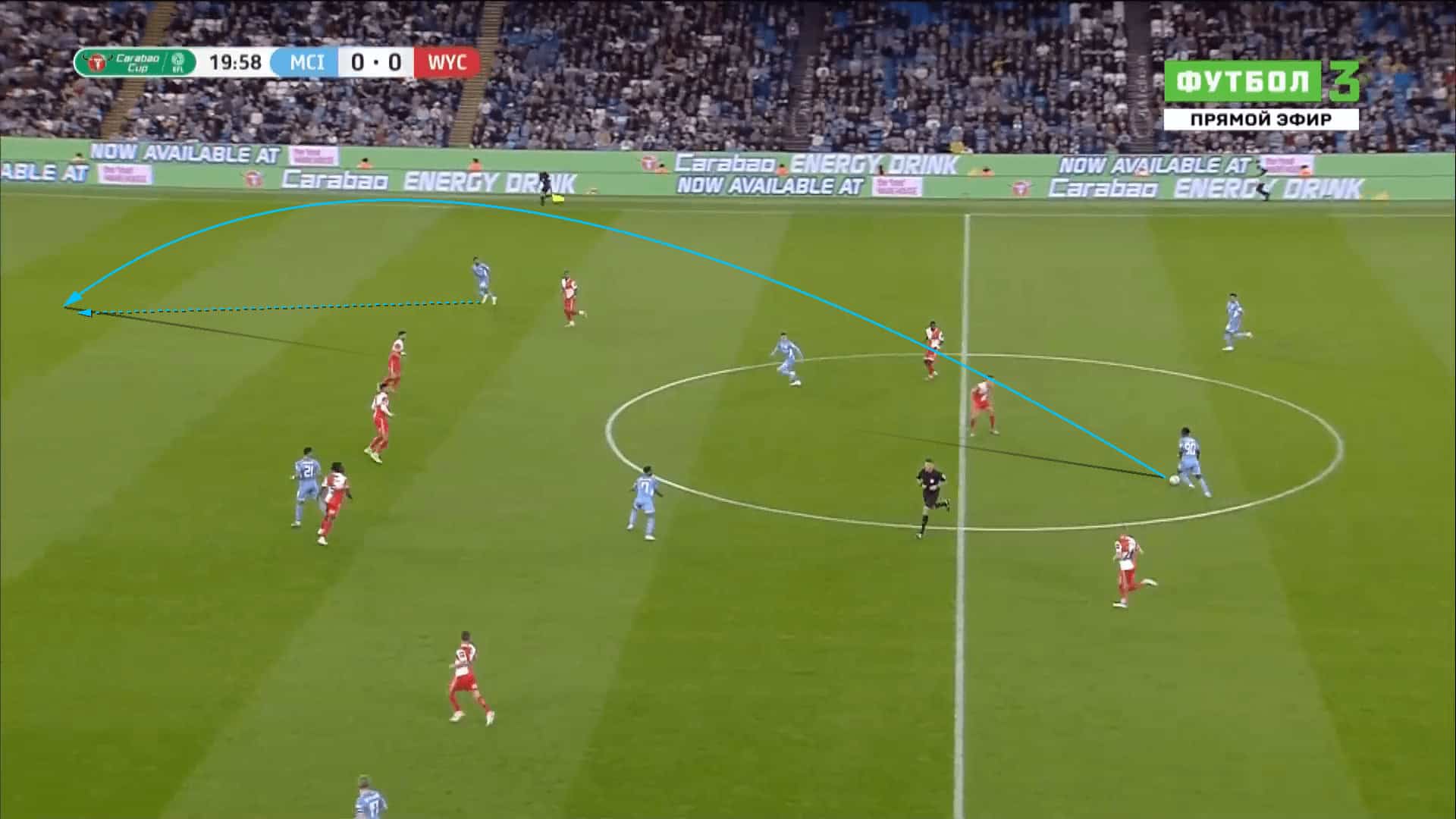
When teams sit higher up against Man City, Lavia also has the ability to unlock defences through longer ranged passes over the opposition’s backline.
The image below shows Wycombe struggling to exert any pressure on Man City due to Lavia’s ability to find outlets with space.
Having a range of passing skills allows Lavia to be a more complete player, although this sort of ball over the top hasn’t been attempted too many times. He often prefers a shorter pass, perhaps due to the coach’s instructions.
Whilst Lavia is primarily a first—and second-phase player, offering both build-up security and progression through the thirds, he has also shown his ability to play in the final third, combining with the attackers further up.
Lavia does not look out of place and still manages to complete passes even when the margin of error is smaller.
Roméo Lavia Press Resistance
Another one of Lavia’s biggest areas of strength is his ability to evade pressure, due to his excellent dribbling abilities.
Romeo Lavia is excellent at keeping the ball close to his feet, accelerating past opponents when necessary, and conceiving his intentions through his body movements.
Furthermore, Lavia likes to use his dribbling ability to break lines of pressure, by carrying the ball past the press.
He consistently beats the press without needing to pass the ball, so it will be hard for teams to press whoever Lavia plays for.
The lightning-quick feet Lavia possesses are too quick to even capture an image! It is all a blur.
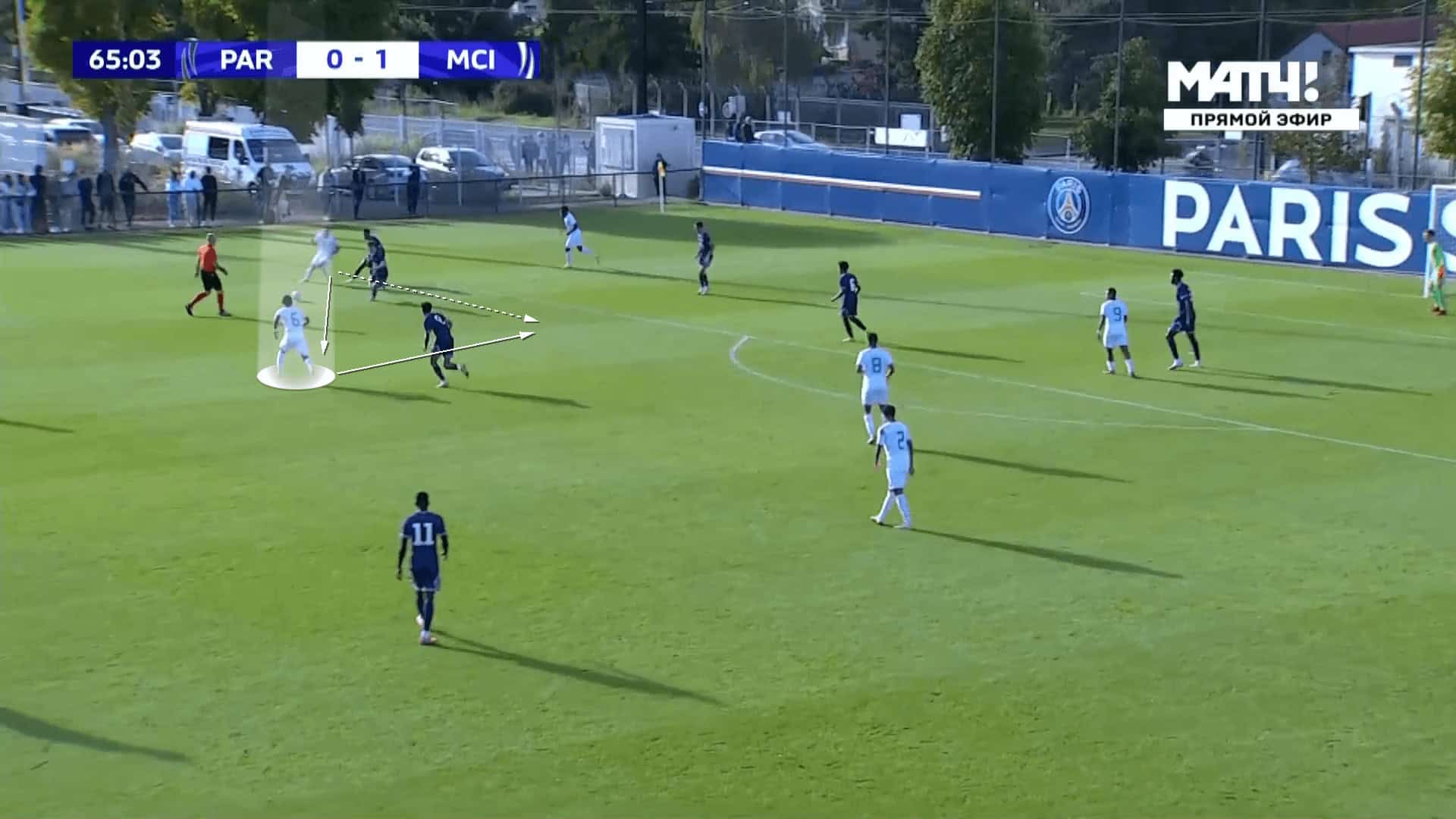
The image below shows him feinting one way, which lures a defender in, before turning out the other way and into lots of space.
Lavia’s ability to use his body allows him to create space for himself while dribbling, opening up more passing angles for himself to progress the ball.

Another strength Romeo Lavia brings to the table is his awareness.
Constantly scanning over his shoulder allows Lavia to gain a clear image of everything around him so he knows exactly what to do when the ball arrives.
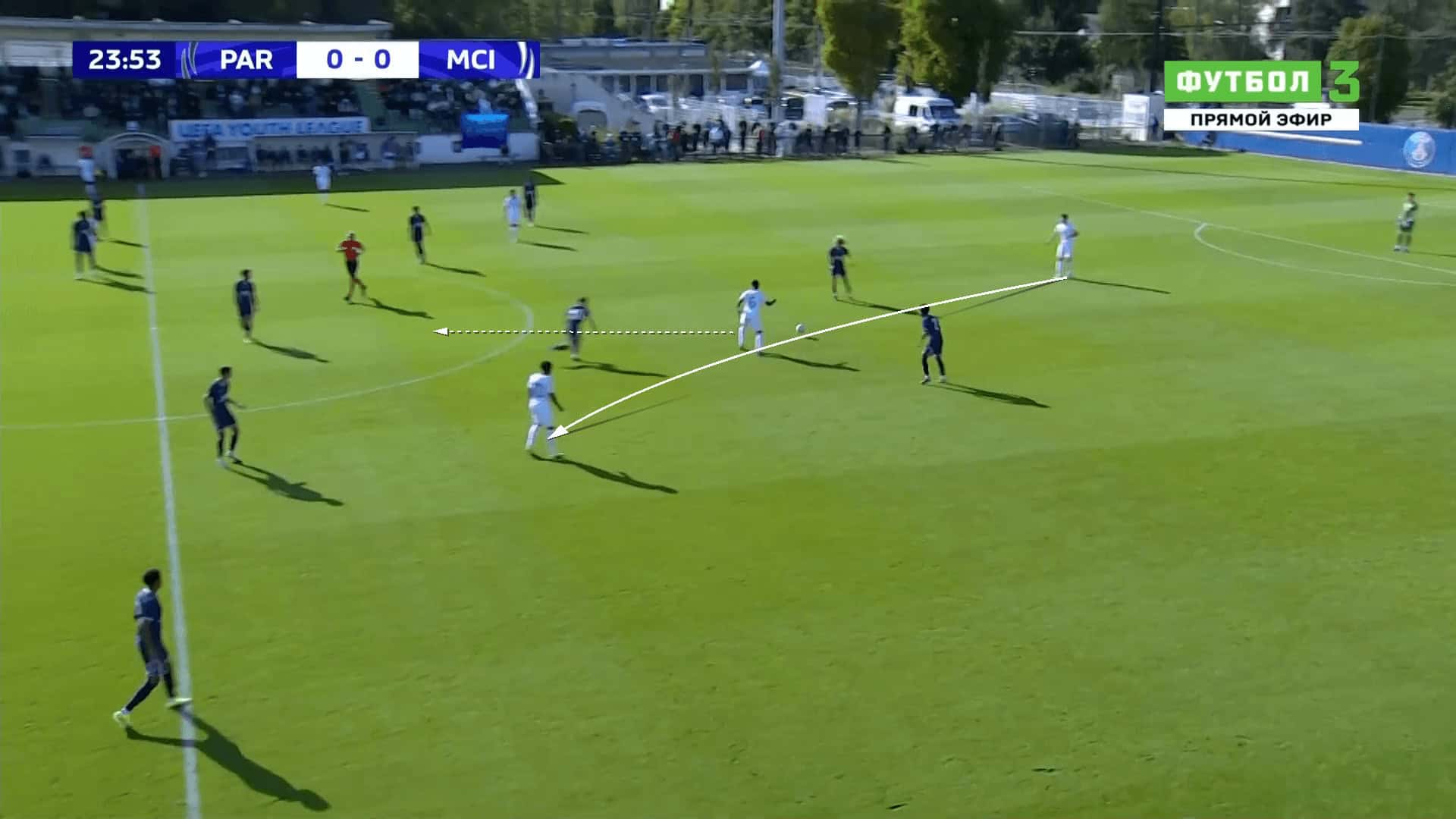
The image below shows how the ball is played to his feet, but Lavia knows the onrushing PSG player.
He allows the ball to go through his legs, which eliminates the PSG player Edouard Michut from the game.
Lavia then has the awareness to position himself in a spot for optimal ball progression, although this time the ball is not played to him.
Reading of the game
There are two reasons as to why Lavia is comfortable playing as a lone 6 for Man City at such a young age.
Firstly, Romeo Lavia is very intelligent, and can often predict where the opponent will play the pass before it is kicked.
His great reading of the game and strong positional discipline allow him to be in the right place at the right time to win the ball back as soon as it is lost.
Furthermore, Romeo Lavia is tenacious and athletic.
He can cover a large amount of distance in a shorter amount of time, which allows him to intercept passes even if he is slightly out of position.
The image below show Lavia rushing up to intercept the pass and begin a counter attack.
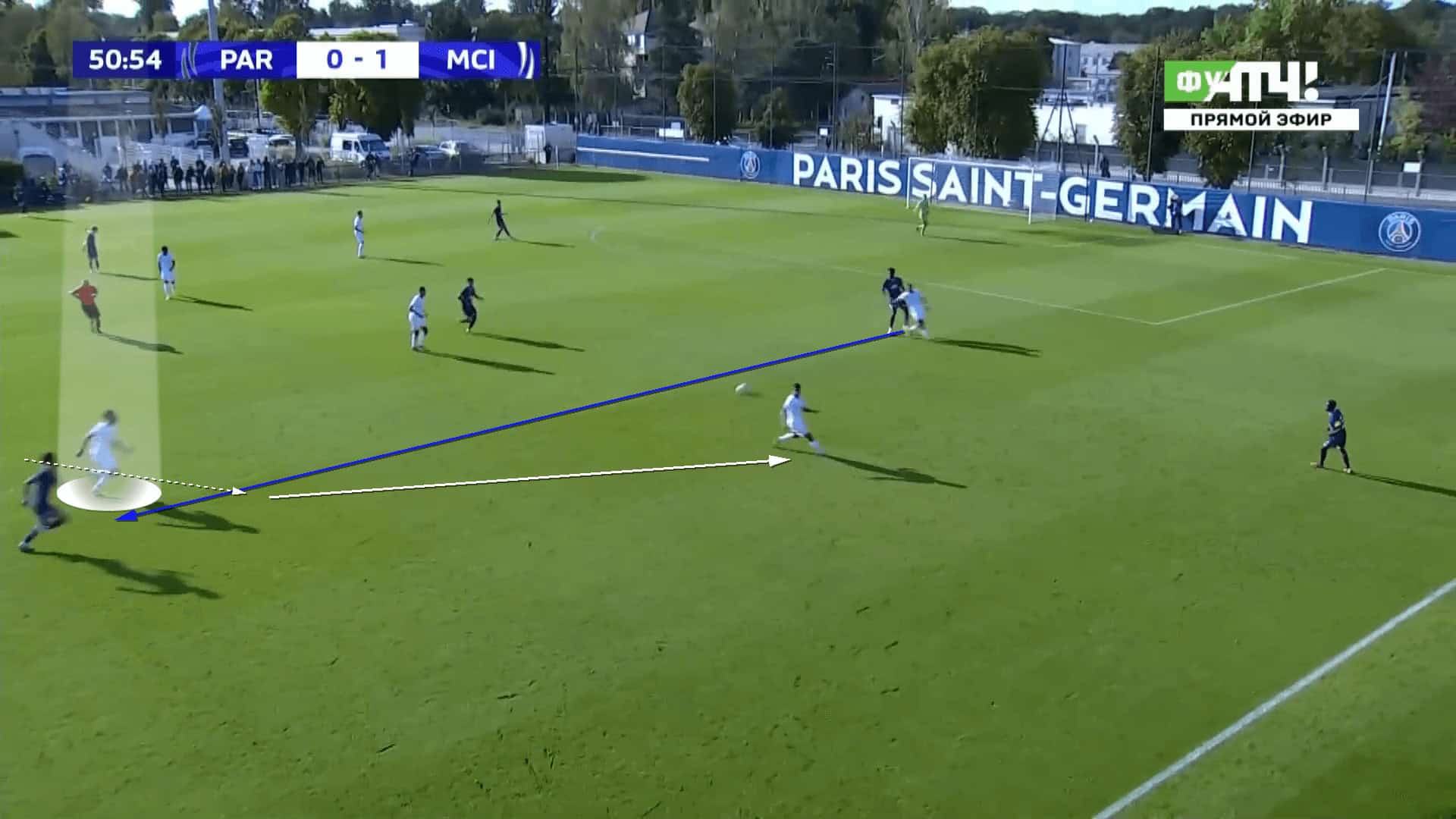
Romeo Lavia also has the positional awareness in his own third, allowing him to be in the right place to prevent deadly passes from being made past him.
The image below shows how there is originally quite a large gap for the ball to be played through before Lavia comes across to block the passing lane and win the ball back, preventing a clear cut chance for Leeds.
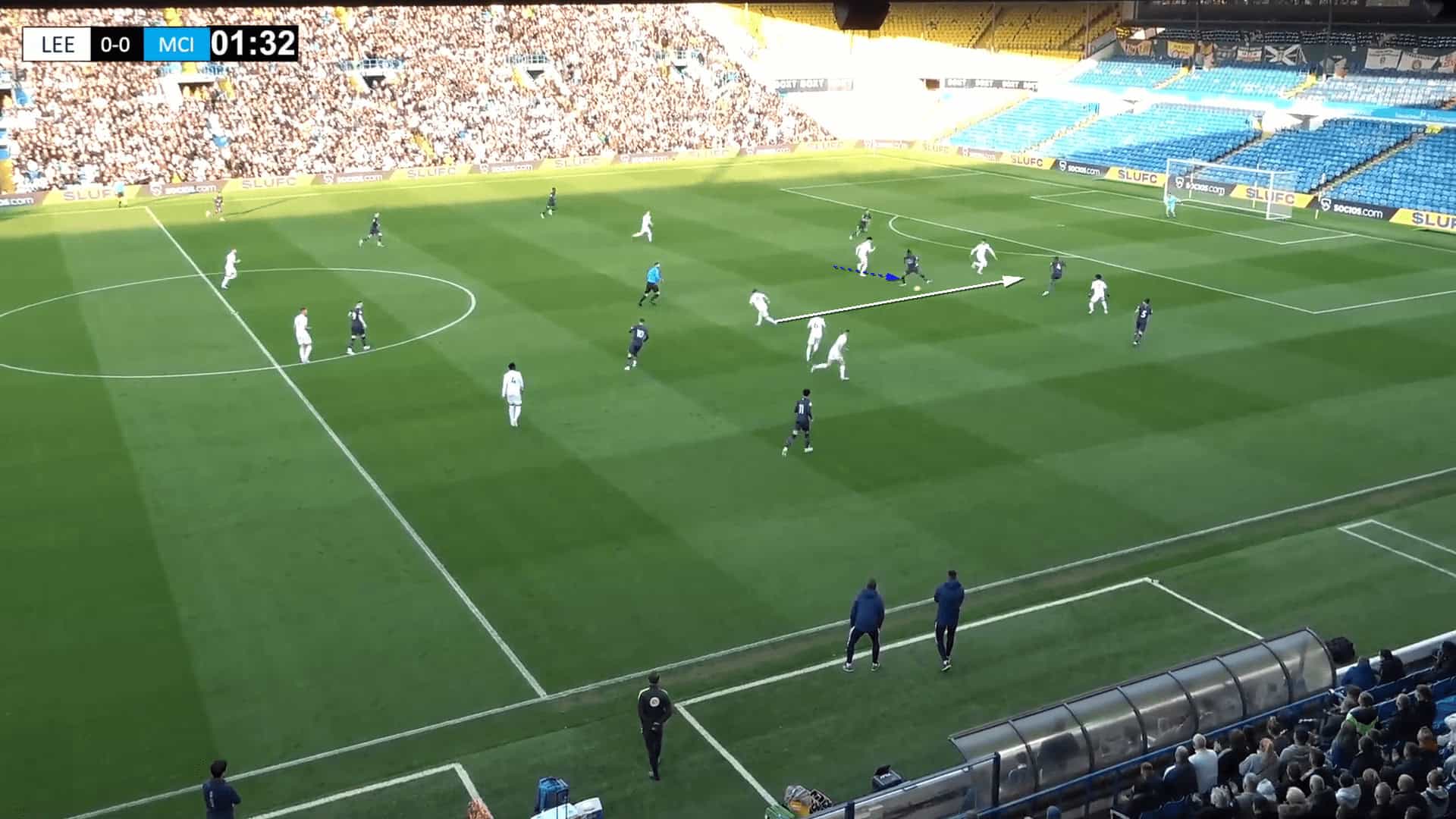
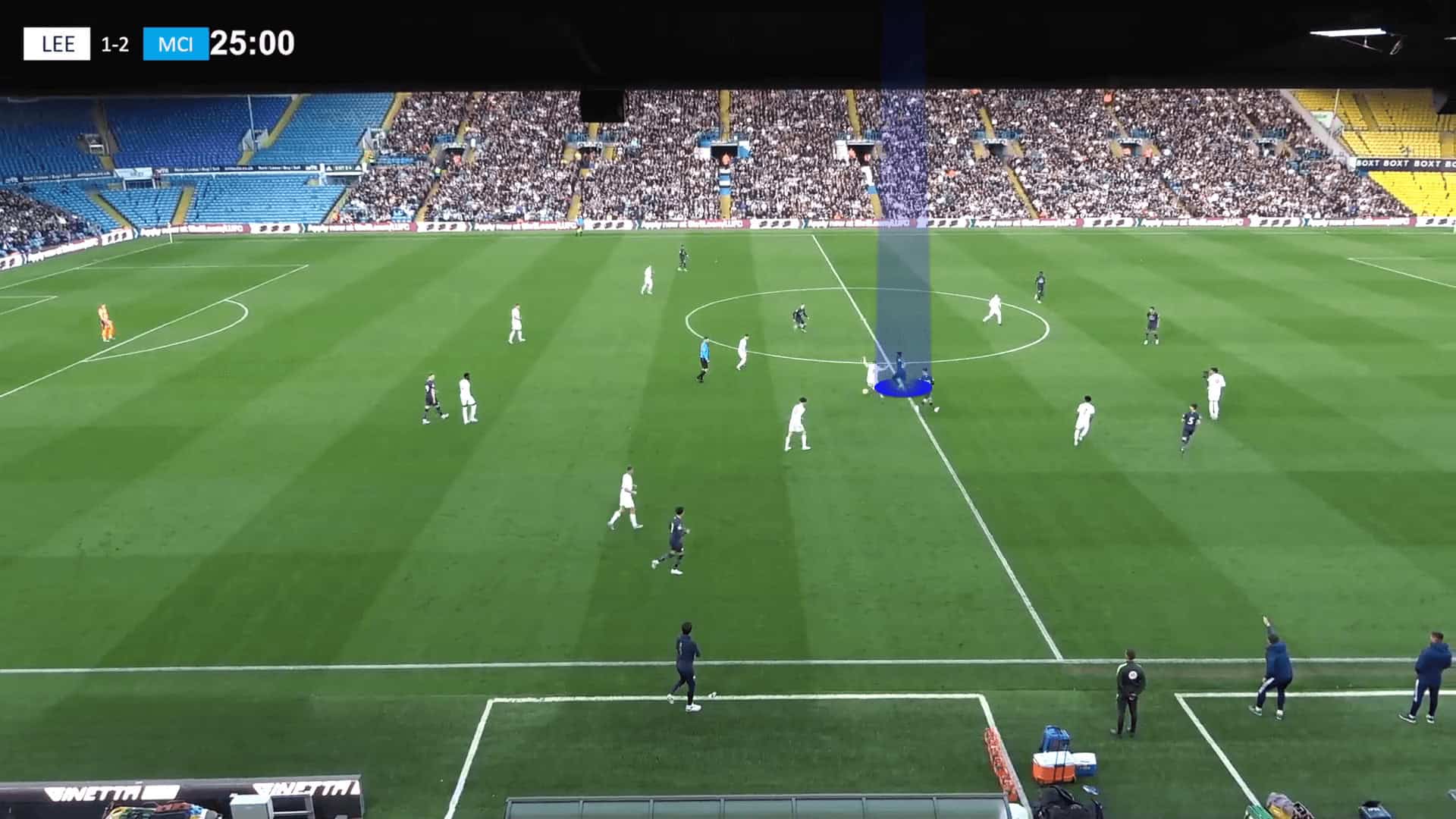
In addition to his positional awareness, Lavia has the ability to win ground duels consistently.
His athleticism allows him to easily jockey opponents and when they show too much off the ball, he is quick off the mark to nick the ball.
Lavia has not displayed this as regularly as some of his other qualities, but the need for it is less when you play for a possession-heavy team like Man City.
Roméo Lavia Weaknesses
While Lavia has shown that he is a very good player, there is a reason he hasn’t been playing for Man City’s first team in the league.
The holding midfielder is a position where you must be reliable in possession, and while for the most part Lavia is that, his tendency to carry the ball up the pitch through dribbling has at times backfired.
On occasion, he has tried to take on too many players, causing him to lose the ball in dangerous positions outside his penalty area.
This is something that will be regularly punished at the top level, and these mistakes in decision-making will need to be ironed out from his game.
Another area where Lavia may struggle in is his physicality.
Lavia has not yet played first-team football in the league, so there are questions about whether he will be able to handle himself when facing men.
Further questions remain over how he will react to losing and spells of time without possession of the ball, having been part of one of the best academies in Europe.
At Southampton, he should not expect to be winning games each week.
These mental and physical flaws are common in younger players, and if given adequate time, they should strengthen over time and not be a problem.
After all, he is an 18-year-old about to play his first season of competitive first team football.
Conclusion
In conclusion, Lavia is a technically excellent player who also has a good tactical understanding thanks to the time spent at Man City.
Southampton plays with a 4-4-2/4-2-2-2, and Lavia will play next to a more offensive partner in the double pivot.
Having a player next to him will allow Lavia to carry the ball with more cover next to him, helping make the most of his skill set.
He will offer more reliability in the build-up phase, allowing the Saints to keep more possession of the ball and he will offer greater progressive passing to either the wide players or the front two.
His great athleticism will also allow him to press aggressively, which Hasenhuttl likes to do.
The arrival of Lavia will improve Southampton’s ability to build play from the back, alongside the signing of Bazunu in goal and Armel Bella-Kotchap in defence.
A more reliable base in the build-up will help Southampton sustain pressure more often, as will the high press they had employed previously.
Southampton will also be harder to press due to Lavia’s ability to evade pressure with his dribbling.
Having said all that, it is important to remember that this is an 18-year-old who hasn’t had any first team football in the past in the Premier League.
Patience is necessary, although Livramento has shown that if the quality is there, experience is not necessary.
If Lavia continues to develop under Ralph Hasenhüttl tactics, the buy-back clause may be activated a couple of years down the line.
