
In football, increasingly conditioned by speed, reduced spaces, and coordinated pressing, a technical detail or a tactical reading can determine the direction of a play or even the outcome of an entire match.
Rodrigo Bentancur, the Uruguayan midfielder from Tottenham Hotspur, is one of those few players capable of giving meaning to chaos.
His competitive intelligence and understanding of the game enable him to operate effectively within the most congested areas of the pitch, transforming recoveries into productive sequences and converting decisions under pressure into collective advantages.
His recent performances, both with Uruguay and with Spurs, once again showcased a set of virtues that distinguish him: reading of context, technique oriented toward progression, and the ability to regulate the rhythm of play.
Bentancur represents a model of midfielder that synthesises two worlds: the methodical precision of English football and the rhythmic sensitivity of the Río de la Plata school.
In this Rodrigo Bentancur scout report, we will delve into Bentancur’s game in depth, examining his pressing intelligence, scanning habits, and ability to manipulate rhythm and create structural balance.
Through tactical analysis of specific sequences, we will analyse how the Uruguayan midfielder embodies a modern archetype: one that connects control with chaos, and reflection with acceleration.
Rodrigo Bentancur Intelligent Pressing
Tottenham’s 4-1-4-1 becomes a dynamic system of interconnected responsibilities.
Rodrigo Bentancur, starting either from the double pivot or as a box-to-box interior, assumes an essential role in pressing mechanisms.
The action against Brighton clearly illustrates how a simple opponent’s mistake can become, for a player of his intelligence, a strategic opportunity.
The key moment comes when Carlos Baleba receives a poor pass: mid-height, overhit, and with his back to goal.
Most would interpret the situation as a misplaced pass; Bentancur reads it as a pressing trigger.
He calculates distance, entry angle, and the exact time to intervene.

His movement does not respond to instinct, but to a rational anticipation of possible ball trajectories and opponent reactions.
With a short, aggressive sprint, he pressures Baleba’s control, forces an uncomfortable touch, and provokes a loss in a favourable zone.
That recovery is not an end in itself: it is the first step of a coordinated sequence.
From that turnover, Tottenham activates its offensive transition with Bentancur as the connecting axis.
What could have been a sterile recovery becomes an attack with positional advantage.
This type of action summarises the nature of his game: an understanding of football as a chain of causes and effects, where the reading before movement defines the outcome of the play.
In a context where pressure is often seen as a matter of intensity, Bentancur demonstrates that intensity without direction is merely dispersed energy.
Rodrigo Bentancur Scanning & Body Orientation
After the recovery or during the support phase, Rodrigo Bentancur’s second essential trait emerges: his mastery of profiled reception.
In the same match, after regaining the ball, he performs a quick scan of his surroundings before offering himself as a passing option.
That gesture, minimal yet decisive, allows him to anticipate the position of Brighton’s backline and detect the free space behind it.
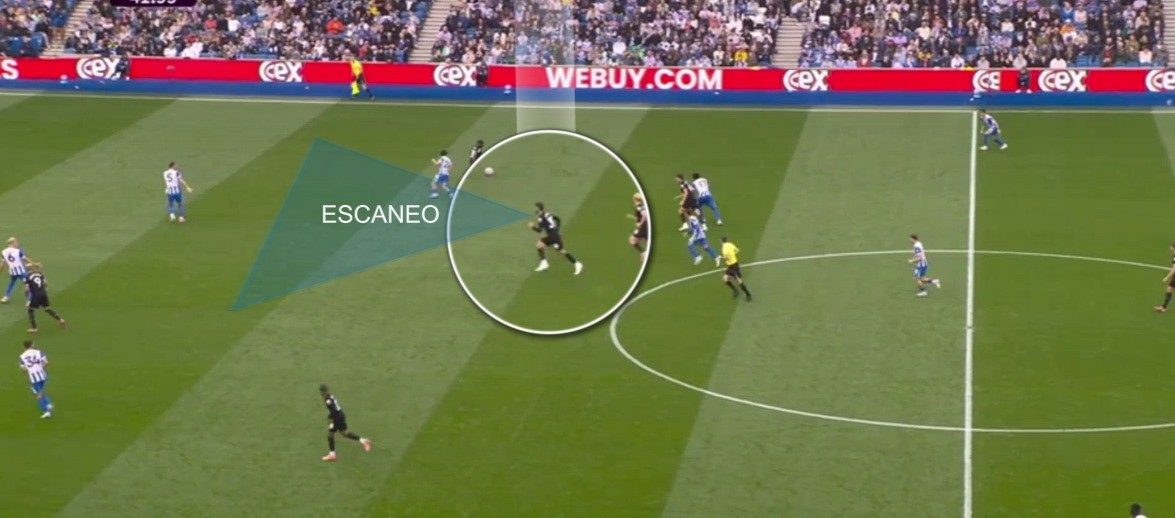
The immediate consequence is an oriented reception.
He controls with the leg furthest from the opponent and opens his body toward progression.
He doesn’t need an extra touch to adjust direction: the control already contains the intention of the next pass.
In terms of micro-technique, that purposeful control avoids temporal friction, allowing Tottenham to advance with fluidity.
At the elite level, where every second is measured as a unit of advantage, this ability to receive with differential orientation marks the boundary between functional midfielders and those with a more structural approach.
Bentancur clearly belongs to the latter category.
This command of scanning and reception is not explained solely by his technique, but also by his cognitive capacity to integrate visual and spatial information in real-time.
He scans before receiving, profiles according to context, and decides based on the network of relations rather than fixed positions.
His football, ultimately, is relational: it is built from interactions rather than predefined patterns.
Rodrigo Bentancur Manipulation Of The Opponent
Once possession is secured, Rodrigo Bentancur displays another uncommon trait in the modern midfielder: his ability to manipulate the opponent’s structure through rhythm and deception.
In the sequence that leads to Tottenham’s first goal against Brighton, he begins a calm, almost clinical carry that forces the defensive line to retreat.
His control of timing is surgical: he doesn’t accelerate without purpose, nor slow down out of hesitation.
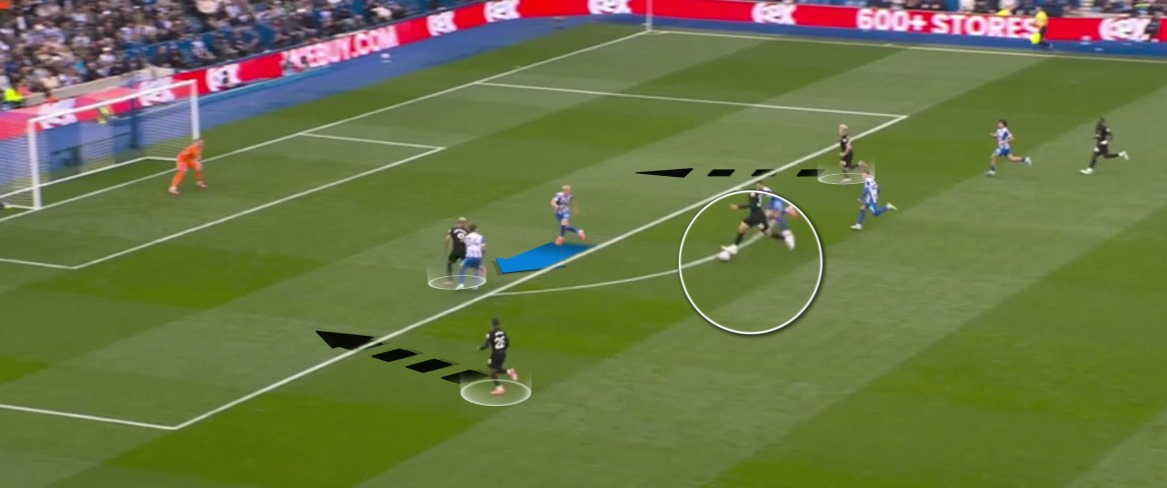
As he advances, he observes his teammates’ movements.
Runs in behind are not only passing options, but collective manipulation mechanisms.
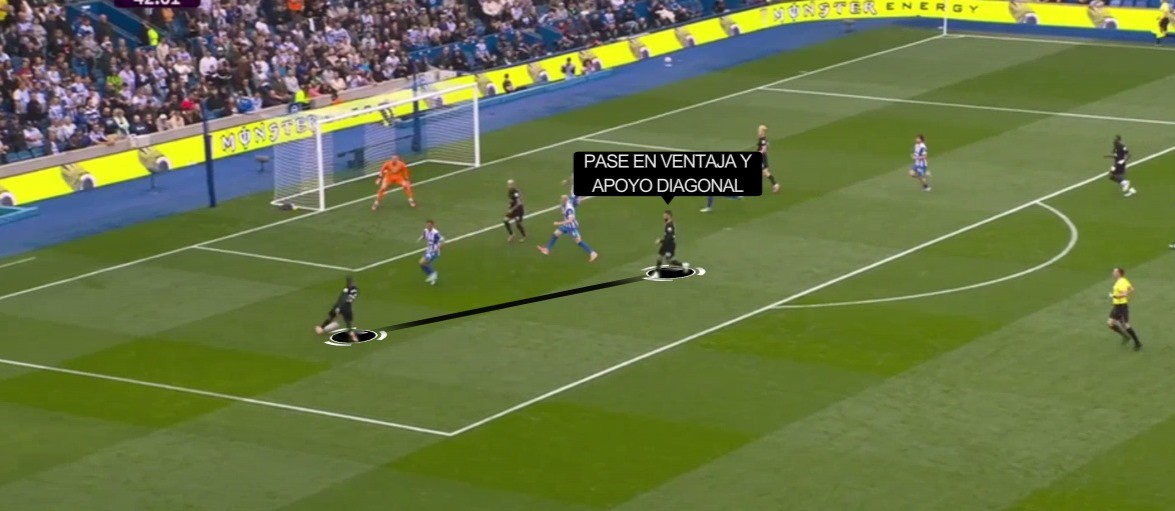
He feints a diagonal through ball, provoking Brighton’s defensive shift; at that instant, he changes direction and filters an interior pass toward the free man.
Such plays reveal his mastery of tempo, a concept Richard Sennett associates with rhythm control in craftsmanship: knowing when to accelerate, when to pause, when to hold the beat.
For Bentancur, rhythm is not about speed but about the temporal relationship between movements.
His game introduces a variable rhythm that destabilises rigid defences and grants Tottenham an uncommon ability to advance without relying on chaotic transitions.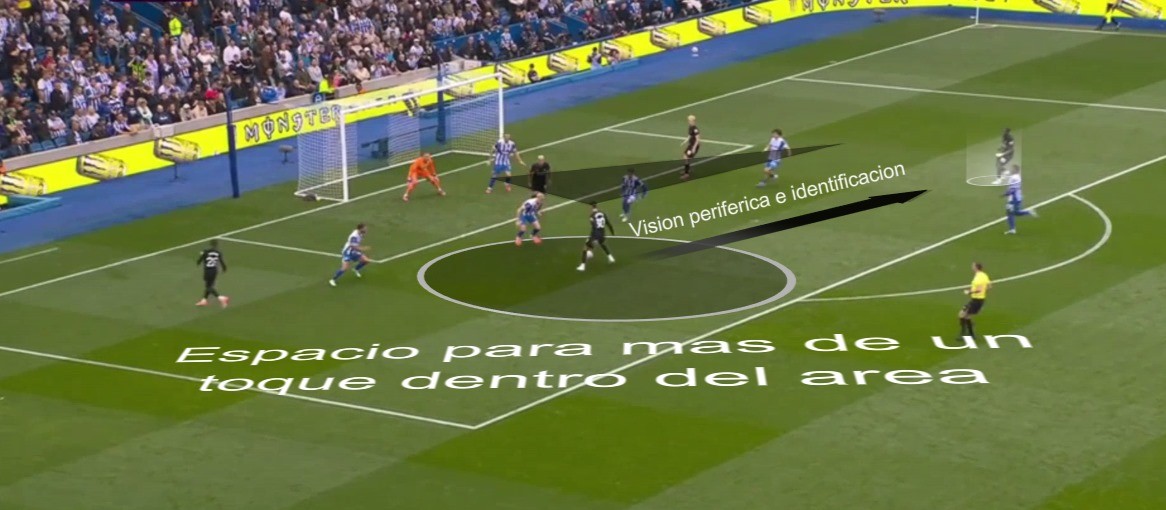
At the collective level, his presence generates order.
At the individual level, it generates time.
In a football world dominated by constant acceleration, Bentancur represents an anomaly: a player who slows down to think and thinks in order to accelerate.
Rodrigo Bentancur Role In The Uruguayan National Team
Rodrigo Bentancur’s case with the Uruguayan National Team reinforces his condition as a structural midfielder.
Under Marcelo Bielsa’s management, his role has been crucial in helping the team escape opposition pressure and build from interior zones.
In an environment abundant in straight runs and vertical sequences, Bentancur introduces an essential variable: reflective pause.
His performance against Colombia exemplified how spatial control can replace physical dominance.
In one representative sequence, he evades the marking of three opponents: Luis Díaz, Jhon Durán, and Quintero, solely through diagonal trots and small pauses.
Without touching the ball, he manages to disrupt the pressing line and create a new passing angle for the centre-backs.
When he finally receives, his body orientation allows him to turn 180 degrees and find Darwin Núñez to his feet, transforming a potential clearance into a clean offensive sequence.
Bentancur does not need many touches to alter the structure of play: his mere presence changes the team’s rhythm.
As Bielsa once said about another of his midfielders at Leeds United, some players “receive the first pass in the most difficult area of the pitch,” and their absence changes the nature of attacks.
That description perfectly fits the Uruguayan.
In Uruguay, his influence extends across three levels of the pitch: he allows the centre-backs to find interior lines, the midfielders to position themselves behind the pressing line, and the forwards to receive in advantageous positions.
That is why Bielsa described him as “a player who fills the pitch.”
Analytically, Bentancur is a spatial amplifier: he increases the number of available passing options and reduces cognitive distances between teammates.
However, his profile does not match that of a classic regista nor that of a creative playmaker.
He is an intermediate specialist: his jurisdiction lies between the base and the final third.
That zone, often undervalued, is where teams decide whether to progress with meaning or collapse under linearity.
In the matches where Bentancur was unavailable, Uruguay suffered precisely from the absence of a link: attacks became predictable, interior passes disappeared, and advantages were lost.
Rodrigo Bentancur Rhythm, Intelligence & Continuity
Rodrigo Bentancur’s impact cannot be measured solely in statistical terms.
His value lies in how he conditions his team’s collective behaviour.
Each of his actions, a body orientation, an apparently trivial short pass, a pause before receiving, is a unit of rhythm that synchronises the rest.
In this sense, one could say Bentancur is more of a rhythm creator than a playmaker.
His talent lies not in producing the final pass, but in ordering the intermediate ones.
The passes that seem harmless are, in reality, strategic impulses that reorganise the opponent’s structure and give his team oxygen.
At Tottenham, his influence translates into the ability to connect phases.
In Uruguay, into the possibility of surviving pressure and building with clarity.
In both cases, his game embodies the idea that the quantity of actions does not explain football, but rather the quality of the relationships those actions generate.
Bentancur not only interprets the game; he makes it comprehensible for others.
When he receives, he guides the team.
When he passes, he sets the tempo.
When he pauses, he injects intelligence into the collective flow.
In a context where most seek to accelerate, he teaches that thinking is also a way of moving forward.
Conclusion
Rodrigo Bentancur belongs to a rare category: midfielders who give meaning to transitions.
His reading of the game enables him to anticipate opponents’ errors; his technique transforms recovery into progression; his rhythmic intelligence turns pauses into advantages.
At Tottenham, he embodies the figure of a midfielder who connects defence and attack without the need for spectacle.
For Uruguay, he represents the memory of collective play: the element that restores balance and control to a team full of energy and verticality.
In a global football landscape where spaces shrink and decisions accelerate, Bentancur offers a lesson that transcends systems and fashions: true talent lies not in doing faster, but in understanding better.
