
AZ Alkmaar academy product Calvin Stengs (182cm/6’0”, 74kg/163lbs) has been one of the most closely watched and highly-rated young players in the Eredivisie for the last few seasons.
During his time at Alkmaar, the left-footed right-winger/attacking midfielder competed against domestic giants like PSV Eindhoven and Ajax and European greats like Manchester United.
Stengs even reportedly obtained the admiration of one Ronald Koeman, who is said to have expressed his desire to sign the playmaker for Barcelona to the La Liga side’s board and recruitment staff last summer.
However, that move ultimately never transpired.
The 22-year-old is not going to link up with compatriot Koeman at Camp Nou but is instead set to become part of Christophe Galtier’s Nice side, in a project that the 2020/21 Ligue 1-winning manager with Lille described as “colossal” on his unveiling as the new boss at Allianz Riviera.
So, following his €15m transfer this summer, how will the Netherlands U21 star – who’s been routinely dubbed a “baller” and “wonderkid” throughout his young career – fit into this Nice side?
How might Galtier and Stengs’ new Les Aiglons teammates accommodate him in their quest to improve on their ninth-place finish last term and rise up the Ligue 1 table?
This tactical analysis, in the form of a scout report, will attempt to answer those questions.
We’ll provide some analysis of Galtier’s potential Nice tactics, make some comparisons to relevant players (Rony Lopes – Nice’s primary right-winger last season and Luiz Araújo – Galtier’s primary right-winger at Lille last season), analyse Stengs’ playing style and look at some of the key strengths and weaknesses in the youngster’s game to give Nice fans a taste of what to expect from their new signing.
Calvin Stengs Passing
What kind of player is Stengs?
To explain in the simplest possible way – Stengs is a playmaker who loves to operate in the right half-space, primarily in the final third, but also in the middle third.
He is comfortable receiving the ball out wide on the right-wing before carrying it into the half-space, while he’s also comfortable receiving the ball immediately in the half-space, or centrally, on the half-turn and playing a teammate through on goal, either right away or after carrying it forward to a better position.
Stengs is also comfortable receiving the ball deep as well as more advanced areas.
When receiving the ball deep, he often takes it on the half-turn before carrying it forward and then attempting to play a teammate through on goal.
However, he’s well capable of playing creative, line-breaking passes from deep too and he’s showcased this on occasion thus far in his young career.
Generally speaking, passing is one of Stengs’ strengths – he thrives in several ‘passing’ areas.
For example, relative to other wingers and attacking midfielders in last season’s Eredivisie, Stengs made a high number of passes to the penalty area (4.73 per 90) with high accuracy (57.24%), as well as a high number of through passes (3.0 per 90) with a high through pass accuracy percentage (51.09%).
The now-former AZ Alkmaar man also ended last season with the sixth-highest xA (7.33) of any winger/attacking midfielder in the Eredivisie, per Wyscout, highlighting his creative threat.
He’s very much a creative passer who likes to take risks and play the ball forward to break lines as much as possible.
As a result, he opts for risky passes a lot.
He was very involved in all possession phases with Alkmaar and thus, made a relatively high number of passes in general.
While he’s capable of playing simple passes and retaining possession, this just isn’t what you put him in the team to do – you put Stengs in the team to flick the switch and turn phases of possession into goalscoring chances.
He is a very effective creator and risk-taker, this is what he’ll offer Nice.

In this section of the analysis, we’ll highlight some of Stengs’ more commonly played passes, starting with the passage of play beginning in figure 1, which will highlight an example of Stengs playing a through pass inside the final third.
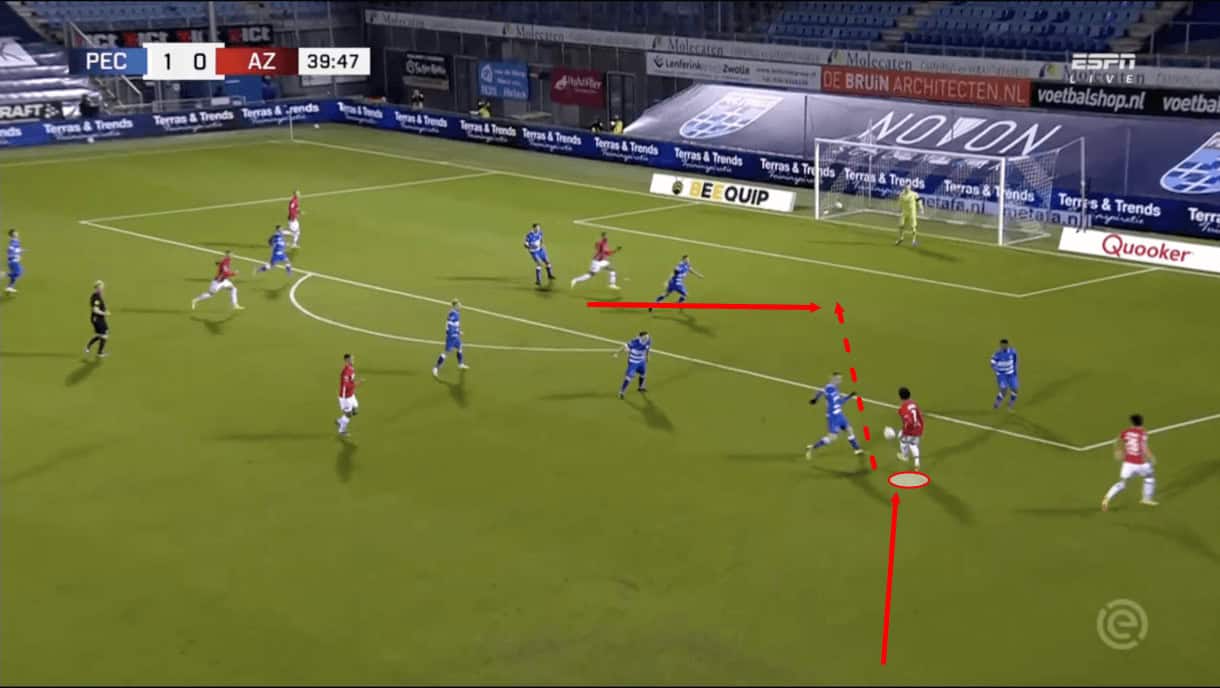
In figure 1, we see the playmaker receiving the ball on the right wing, just outside of the final third.
As mentioned, it’s common to see Stengs receive the ball in this position, with the 22-year-old having played the majority of his games in the base ‘right wing’ position with Alkmaar.
However, he doesn’t carry the ball down the wing.
He essentially always tends to cut inside onto his stronger left foot to create from the half-space or even ‘zone 14’.
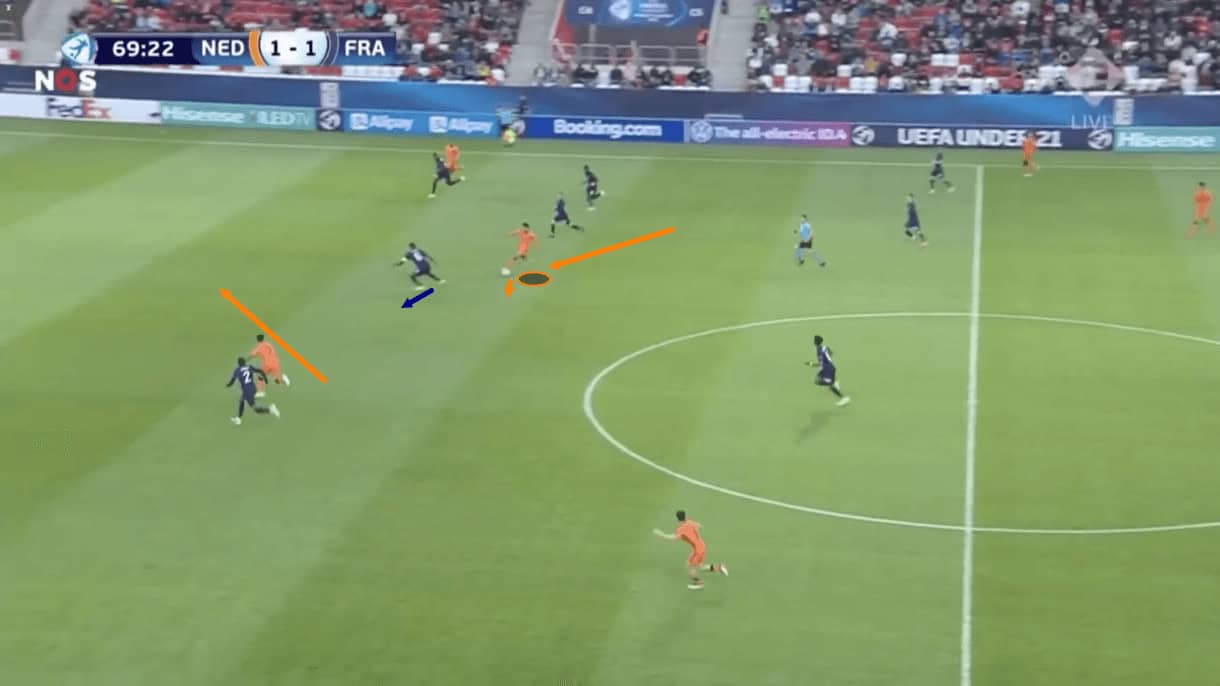
As this passage of play progresses into figure 2, we see that Stengs did end up in the half-space, just outside of the penalty box, where he opted to play a through ball to his centre-forward teammate in the box.
It’s worth noting the direction of this pass – it’s played between the near full-back and near centre-back, across the face of that near centre-back with the attacking teammate running in behind him.
Stengs loves to play this kind of pass in the final third.
It’s a through ball which is almost vertical, he loves to carry the ball forward into the half-space/centre, line his body up to face the opposite wing, and then play the through ball forward, cutting through the half-space.
We see his teammate running from the left side of the box to the right to take advantage of this pass in this example.
This can be somewhat deceptive due to Stengs’ body positioning, as well as that when he plays this pass he doesn’t tend to lift his leg back very much – just a little.
This disguises that the pass is coming – as opposed to another touch – essentially helping Stengs to catch the opposition off-guard to an extent.
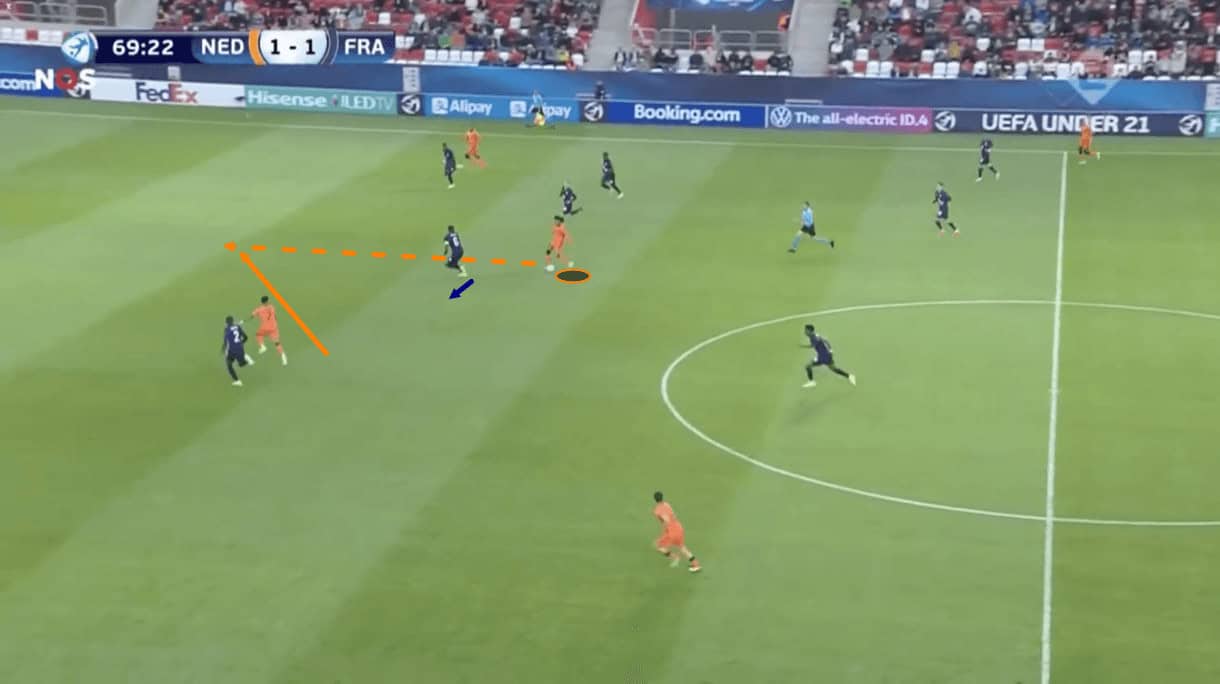
We’ll see another example of this type of pass in the passage of play beginning with figure 3, which shows Stengs in action for the Dutch U21s.
Here, like in the previous example, Stengs has carried the ball from the right-wing into the right half-space, with the opposition’s left centre-back having to address his threat.
At this point, knowing Stengs’ tendency to play the through ball across the face of the nearest opposition centre-back, we know there’s only one thing on the playmaker’s mind.
However, this passage of play highlights the playmaker’s ability to deceive the opposition defenders via his movement on the ball.
In figure 3, we see that Stengs is just knocking the ball slightly more centrally with the outside of his left foot.
Meanwhile, he’s repositioning his body to face the opposite wing, which is common as discussed when analysing the previous example.
As Stengs knocks the ball more centrally and turns his body to the opposite wing, the near opposition centre-back reacts by taking some steps backwards while remaining side-on – a good defensive body position for recovering should Stengs try to dribble past him.
However, Stengs doesn’t tend to try and go all the way on his own very much, if at all.
He’s a good dribbler, as we’ll discuss at greater length in our next section of analysis, but he tends to use his dribbling to get out of tight spaces and to carry the ball upfield – not to go beyond the opposition’s last line.
He tends to rely on his passing at this point where we see him in figure 3.
We can see Stengs’ centre-forward teammate running across from the left to the right and we know that Stengs has eyes for this ball, not a take-on.
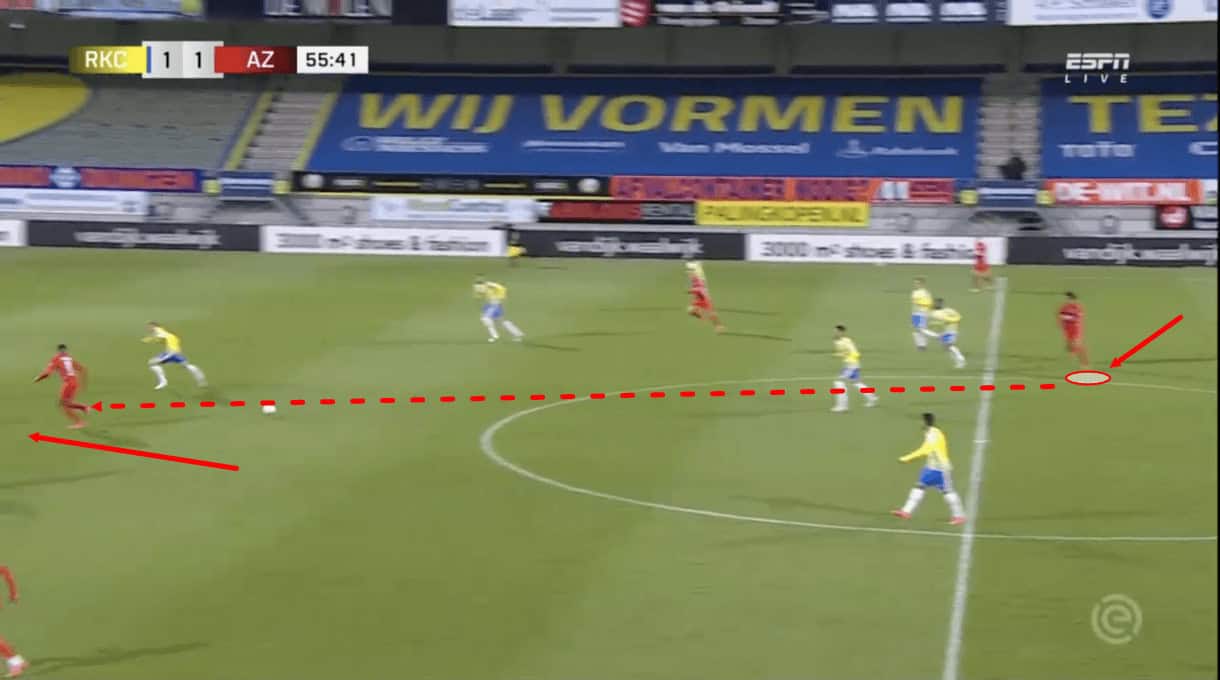
After manipulating the opposition centre-back into taking some steps backwards and opening the gap for Stengs to aim through, we see how he ever-so-slightly lifted his leg while lining up and quickly playing the through ball across the face of that defender to the striker running across to the right side of the pitch in figure 4.
This highlights how Stengs can deceive and manipulate the opposition defenders through his intelligent movement and positioning to open up his favoured through passing angle – this pass across the face of the nearest opposition centre-back to a teammate moving across the width of the box.
As mentioned previously, Stengs is also comfortable with playing creative, defence-splitting through balls from deeper positions, which figure 5 provides an example of.
Just before this image, Stengs received the ball on the right wing, during the ball progression phase, inside his own half.
He then carried the ball into the right half-space, got his head up and played a defence-splitting through ball to a teammate running in behind the opposition’s backline.
Stengs has great vision.
He’s good at keeping track of his teammates’ movement via diligent and intelligent scanning, while he’s also technically more than good enough to pick out teammates with dangerous through balls from these deeper positions.
As was the case in this example, Stengs can play accurate through balls at pace along the ground which when combined with his vision and prior scanning makes him a threat from these deeper positions.
He can’t be allowed too much time and space from the middle third onwards.

Lastly, something of a signature in Stengs’ passing game is a drilled, outside-of-the-boot through ball – an example of which can be seen in figure 6.
Just before this image, Stengs picked the ball up deep, advanced into this position where he spotted a teammate’s run in behind the opposition backline and opted to split the defence via a visually-pleasing outside-of-the-boot through pass.
Stengs played more than his fair share of these during his time at Alkmaar but it’s an element of his game that he’s clearly practised a lot over time, as his technique with these passes is quite good.
This adds another threat to his passing game, particularly when positioned deep, as was the case in figure 6, as he tends to play these passes at some pace, so needs the ball to have some distance to travel.
This ability in Stengs’ game simply makes him more difficult to defend against.
In figure 6, we see that an opposition midfielder has closed down Stengs in an attempt to deny him space and time to create, demonstrating awareness of his creative threat.
The opposition player is showing Stengs onto his weaker right foot – which he tends to avoid using and is definitely weaker than his left – while at the same time denying him room to turn onto his stronger left foot via some good defensive body positioning.
However, that player didn’t account for the fact that Stengs could play this outside-of-the-boot through ball to split the opposition defence, essentially using his left foot as he would use his right if it were stronger, to play the attacking runner in behind and curving the ball into his path.
This is a useful skill of Stengs’ that makes him more difficult to press and control in attack.
All in all, we see from this section how creative passing is one of Stengs’ greatest strengths and this is definitely something that Nice will want to exploit this season by setting up these types of scenarios for the Dutchman as much as possible.
Dribbling and ball control
Like passing, dribbling is another area in which this playmaker generally fares well.
As mentioned in the previous section, Stengs isn’t one to try and take the ball past the last line very much.
However, he relies a lot on his dribbling and ball control qualities to carry the ball upfield during the ball progression phase, carry the ball into the centre before creating chances, and receive in tight areas while surrounded by several opposition defenders, successfully evading their challenges and protecting the ball.
He isn’t an extremely high-frequency dribbler but he is quite good with the ball at his feet and tends to perform quite well in dribbling scenarios when required.
Relative to other Eredivisie wingers/attacking midfielders, Stengs made a fairly average number of dribbles last season (5.06 per 90) with a pretty good success rate (57.42%).
Stengs is quite press-resistant.
He has great technical ability, noticeably scans quite regularly before receiving the ball, and possesses impressive agility which helps him to turn quite sharply and evade challenges from opposition defenders.
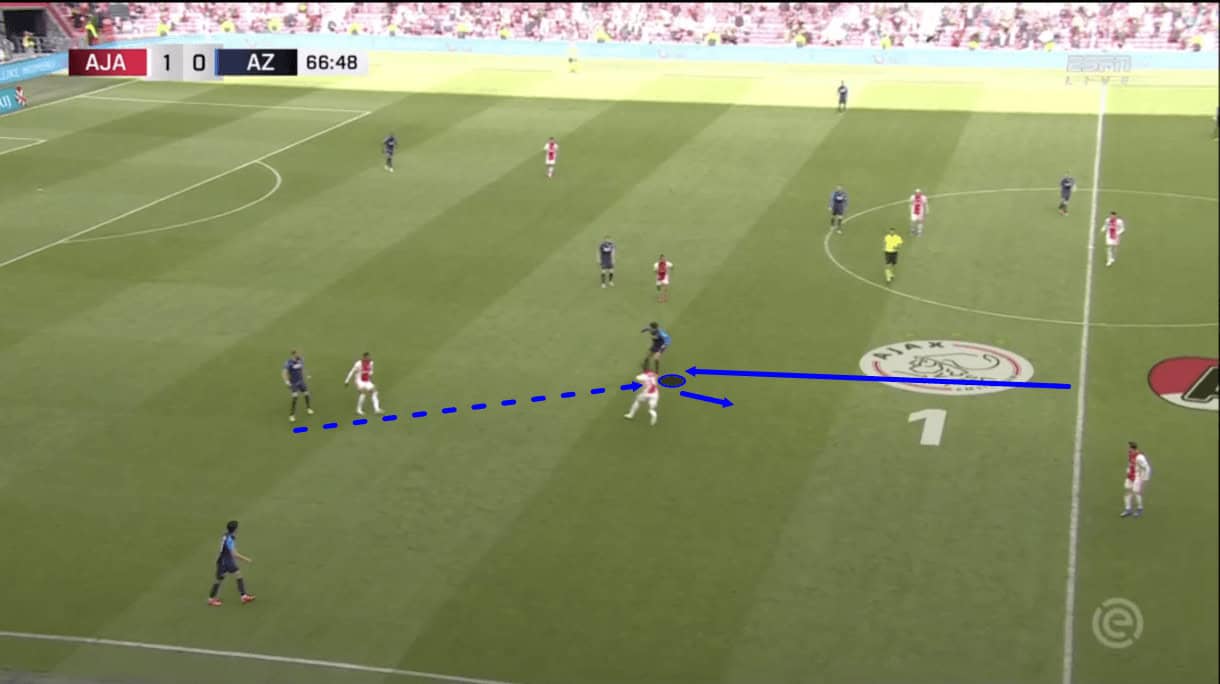
This passage of play beginning with figure 7 provides an example of Stengs’ press-resistance, technical quality, and agility in action for Alkmaar versus Eredivisie rivals Ajax.
As mentioned earlier, Stengs is comfortable with receiving the ball in deeper areas as well as more advanced areas.
His technical quality and agility help him to take the ball on the half-turn and evade challenges, which is very helpful for his side when trying to play out from the back versus an aggressive press, as was the case in figure 7.
Here, Stengs has just dropped from his more advanced position to this deeper one, all the while occupying the right half-space.
Just before this image, the playmaker was facing his team’s backline but as he received this pass from the right centre-back, he quickly and smoothly began to turn.
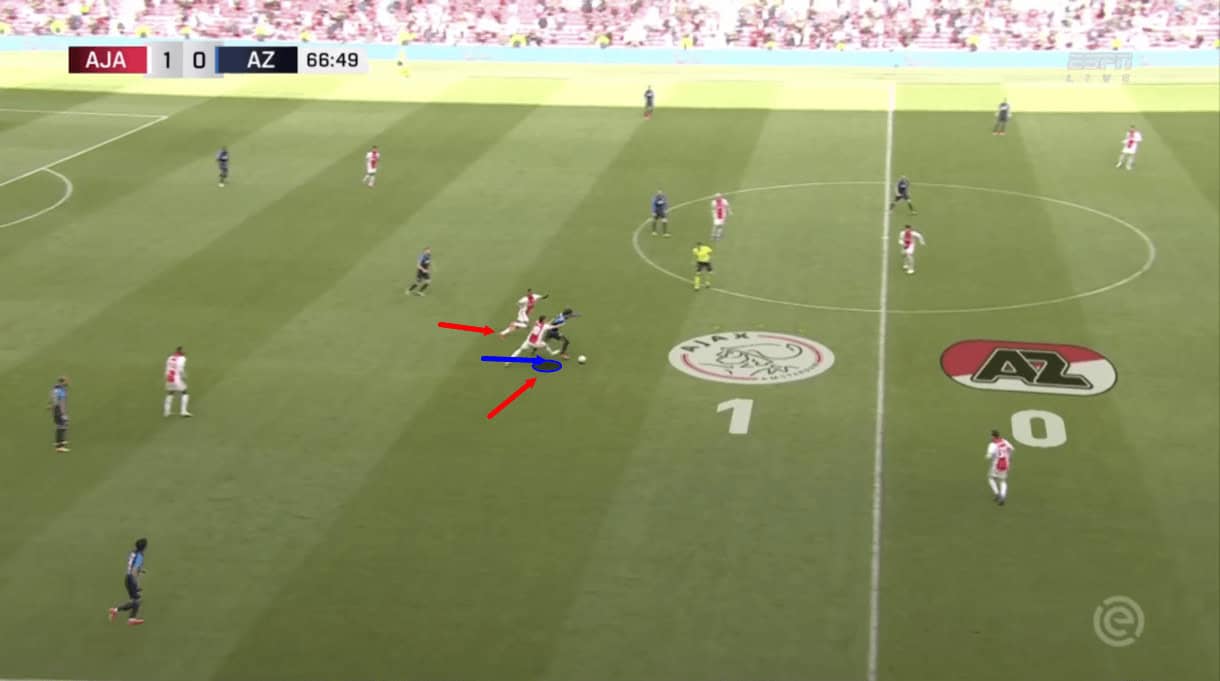
In figure 8, we see that although two Ajax players quickly closed in on Stengs to try and force a high turnover, the 22-year-old was very quick to turn on the ball and face the opposition half.
By the time these two opposition players got within touching distance of Stengs, the playmaker had begun to burst forward, having taken his first stride.
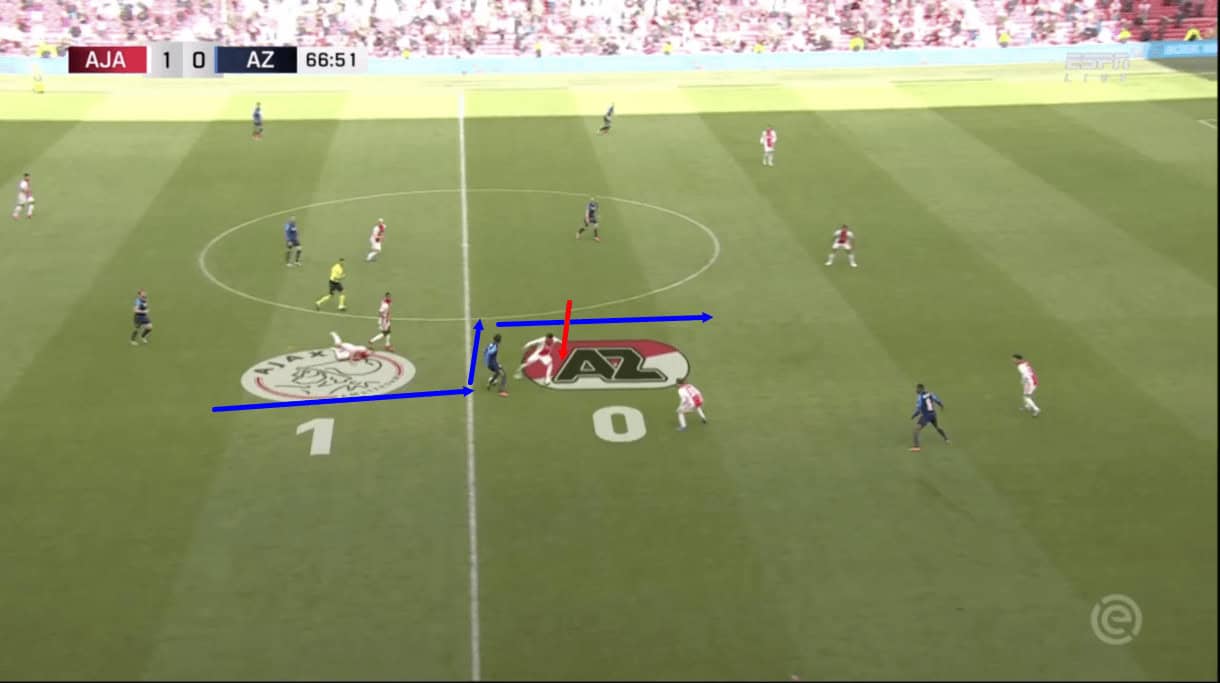
As play moves on into figure 9, we see Stengs pick up pace.
His quick acceleration left the previous two Ajax players in the dust, with one of them even taking a tumble to the ground for the efforts to press Stengs, and while another opposition midfielder now left the centre to close down Stengs, the 22-year-old demonstrated his elite agility and technical dribbling quality by bating the challenge and quickly turning direction to evade this player’s challenge, progress around him and advance into the final third, as a result, leaving another Ajax man in his tracks.
Stengs isn’t incredibly quick.
He’s not slow either but over a mid-long distance, he can be caught by pacier defenders.
However, he accelerates well, making him difficult to press in these types of situations where he’s just beginning to run.
He’s also able to change up his speed, as we saw in figure 9 where he slowed down after accelerating to deceive the third opposition obstacle, drawing a challenge out of the player before turning, evading the challenge and moving on.
This passage of play highlights some of the key elements to Stengs’ dribbling and ball control quality.
As well as what we’ve discussed here, it’s worth mentioning that Stengs generally has a very impressive first touch.
During his time at Alkmaar, he demonstrated great ability to trap powerful, low, drilled passes played with pace.
This is useful for his team when Stengs receives passes in deeper areas, as was the case in this last example because deeper players under pressure can afford to play strong passes to Stengs (within reason) knowing he’s got the ball control quality to deal with them.
This skill is also useful in the final third, as when playing through the lines, teams are often required to play hard, fast passes and Stengs’ ability to trap the ball, as well as receive it on the half-turn with relative ease, makes him a great passing option when playing with his back to goal, as he often does versus a low-block.
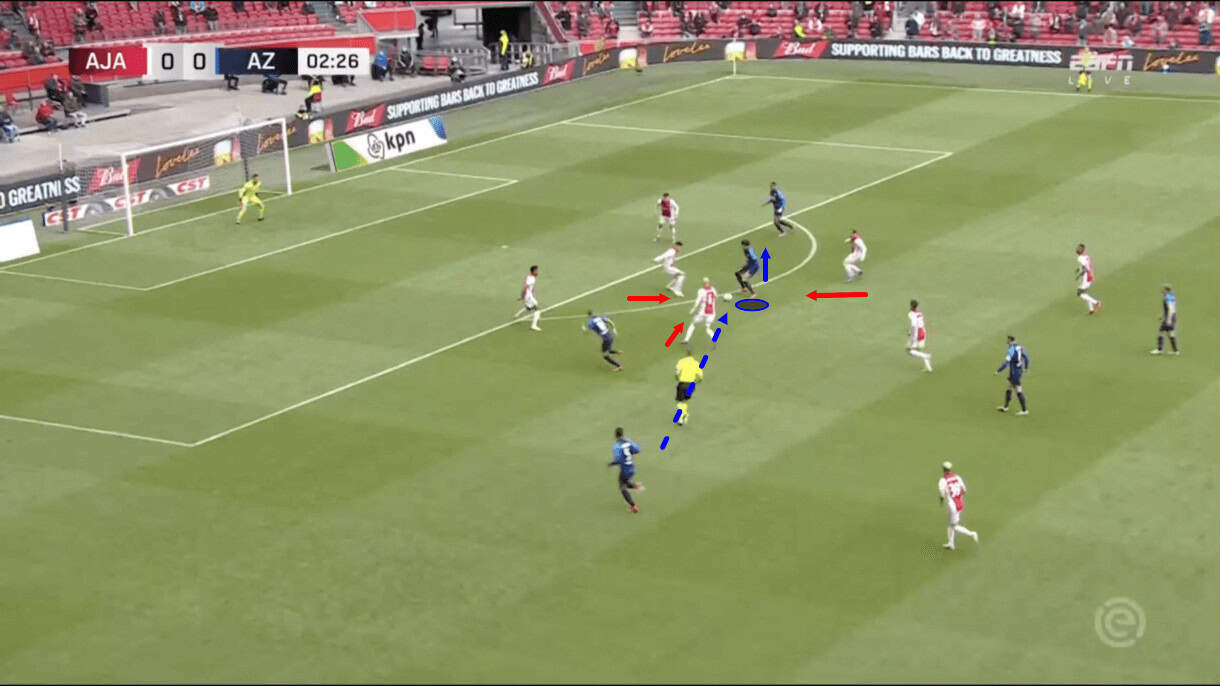
Another skill that makes Stengs very useful in this role in the final third is his comfortability with playing in tight spaces while surrounded by several opposition players.
We see an example of this in figure 10.
Just before this image, Stengs received the ball from his teammate in the left half-space while positioned in zone 14.
Ajax didn’t give the playmaker much room to work in here, as three defenders immediately closed in on Stengs as he received possession.
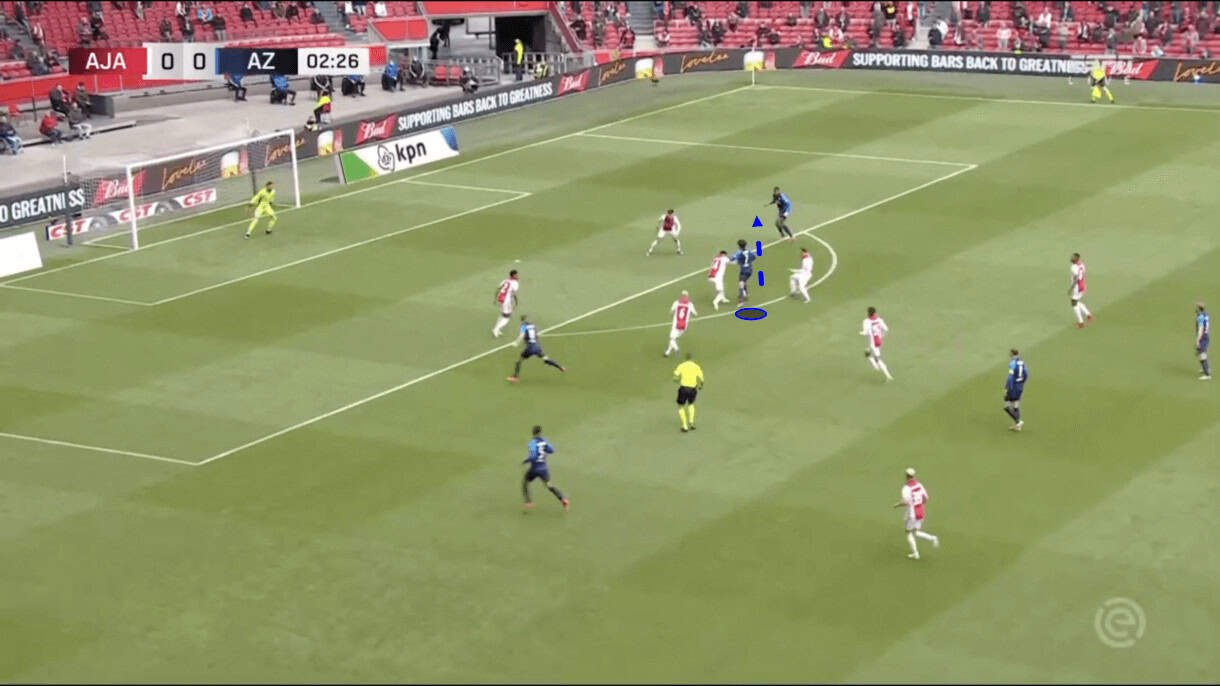
However, as we see in figure 11, Stengs managed to weave his way out of this tricky scenario by receiving the ball very smoothly on the half-turn before then playing a more advanced teammate, positioned on the shoulders of the last opposition defenders, through on goal.
It’s quite common to see Stengs receive the ball under lots of pressure in the final third, as was the case here, both in the centre and the half-spaces.
His technique and agility help him to fare well in these situations and he’s generally quite a difficult player for the opposition defenders to close in on and dispossess.
He can often find a way through the opposition defenders to create despite their pressure.
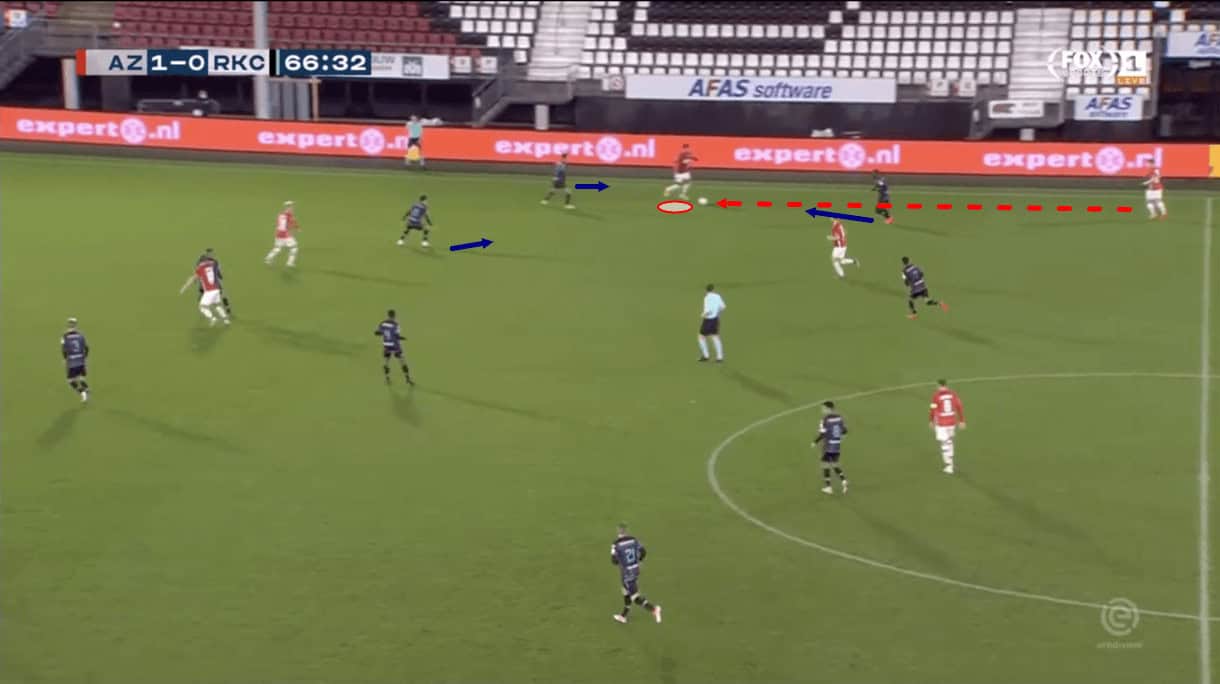
Stengs can be seen receiving the ball out wide on the right in figure 12.
Here, his team are seen using him as an outlet to progress into the final third.
This is a common sight and an area where the 22-year-old’s dribbling shines.
While Stengs wasn’t under much pressure before receiving the ball – having managed to find some space on the right-wing – now that he’s got possession, we can see that he’s attracting attention from a few opposition players – two of whom are positioned behind him, closer to the opposition goal.
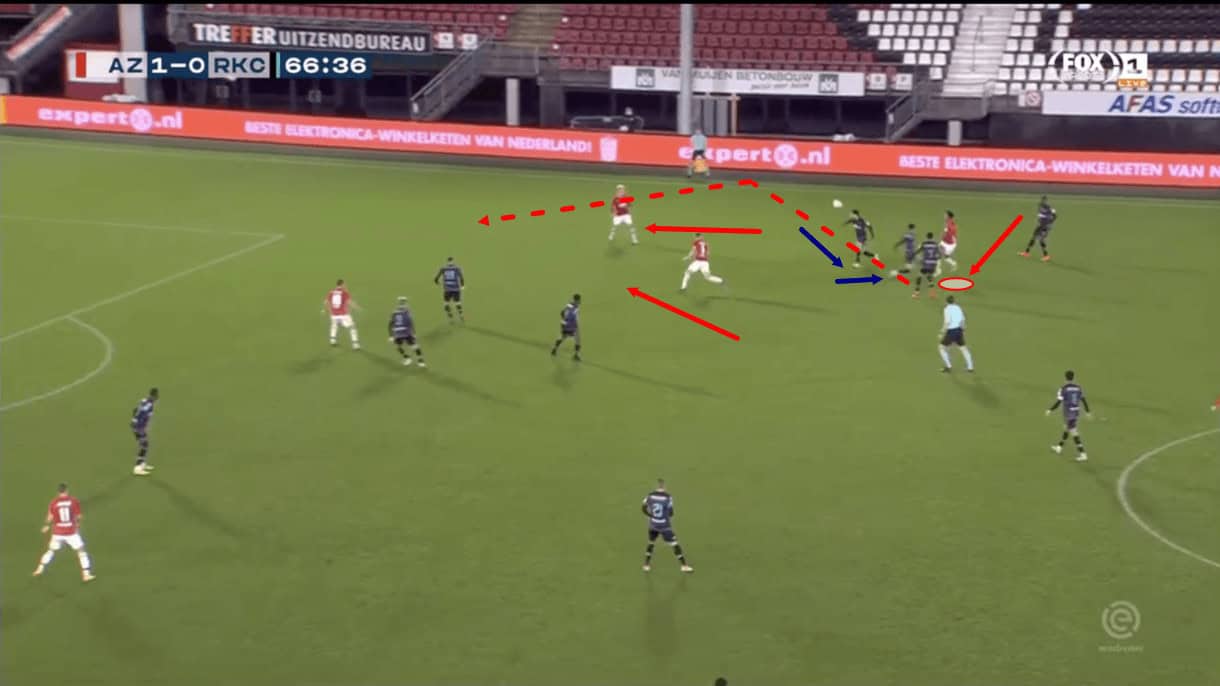
As play moves on into figure 13, we see that Stengs did very well to continue attracting these opposition defenders towards him as he carried the ball more centrally into the right half-space.
Stengs’ dribbling quality makes him difficult to dispossess but it also often means that he can draw attention from several opposition defenders at once.
This can limit Stengs’ space and make it far more difficult for him to progress further or even create.
However, as we see in figure 13, when Stengs attracts attention from multiple opposition players, it also creates extra space for his attacking teammates and due to his impressive ability in tight spaces, Stengs is often able to retain possession under this pressure thanks to his agility and ball control to forge an opening for a creative pass.
On this occasion, Stengs managed to create an opening for a short lofted through pass played down the right-wing, over the two defenders pressing him from closer to the opposition goal who vacated their places in the backline to confront Stengs.
This was an excellent pass selection, as it allowed Alkmaar to take advantage of the space that Stengs’ dribbling created and enter the opposition penalty box.
So, it’s clear from this example that Stengs is a handful for opposition defenders thanks to his dribbling quality.
He is difficult to dispossess and very good at evading challenges to retain possession.
This helps him to create space for teammates to attack which he tries and often succeeds to exploit through his passing ability.
From this section, we see how Stengs thrives as a dribbler and, like with his passing, this is something that Nice will want to exploit in the 2021/22 campaign.
As a result, we could see Stengs used in the ball progression phase, receiving the ball deep in the middle third, and we could see him playing with his back to goal in tight spaces just outside the penalty box in the chance creation phase when playing versus a deeper backline.
Negatives
So, while these previous two sections highlighted some areas in Stengs’ game that Nice will likely look to exploit this season, we should also take some time to highlight areas in Stengs’ game that could do with improvement and Nice may look to hide/minimise this term.
Firstly, while Stengs is a great creative passer in central areas, particularly with line-breaking through passes, his crossing ability could do with some work.
Relative to Eredivisie’s wingers and attacking midfielders, Stengs made a very low number of crosses last term (1.3 per 90) and had a very low cross success rate (32.5%).
He doesn’t cross regularly and when he does cross, he doesn’t tend to be very successful.
As mentioned previously, Stengs doesn’t tend to spend very long out wide, preferring to create via more central areas and perhaps his crossing ability provides one reason for why that is the case.
However, if he improved his crossing, Stengs could add even more weapons to his Arsenal.
He could threaten more if forced down the wing and he could give opposition defenders something else to worry about when cutting into the half-space.
So, while Nice probably won’t look to create a lot of traditional crossing scenarios for Stengs immediately this season, perhaps this is an area that Galtier and his team should immediately look to work with the Dutch playmaker and develop his ability to make him an even greater, more well-rounded threat.
Stengs scored seven goals from 6.8 xG last season – indicating that he scored about as much, but technically a little bit more than he would’ve been expected to based on the quality of goalscoring chances presented to him.
However, Stengs had a relatively poor goal conversion rate for an Eredivisie winger/attacking midfielder.
He was wasteful with some of the shooting opportunities he took, which isn’t unusual for a young player but is just something for him to be aware of and think about improving as he advances in his career.
While Stengs is an impressive dribbler, with a good dribble success rate, his offensive duel success rate is less impressive.
A lot of this comes down to his physicality.
In general, it isn’t very difficult for opposition defenders to effectively bully Stengs and outmuscle him to regain possession.
This is common when Stengs is playing with his back to goal, which as we mentioned previously, he often does versus a deeper defence.
He’s great in these situations thanks to his dribbling quality, but you won’t see Stengs backing into players and trying to compete with them physically, you’ll see him dropping into space before receiving the ball and using his technique and agility to evade challenges and remain in some space.
You don’t see Stengs backing into players because despite being a decent size for a winger/attacking midfielder, he’s not the most physically imposing player and does tend to lose out in physical duels.
This also sees Stengs typically lose out in shoulder-to-shoulder duels – another scenario that he tries to avoid, instead preferring to hurdle opposition defenders like obstacles during his dribbles through his agility, ball control, and changes of pace, as analysed previously.
Lastly, relative to other Eredivisie wingers/attacking midfielders, Stengs completed a low number of successful defensive actions (5.15) last season.
He doesn’t offer his team a lot defensively.
For the most part, this could be combined with the issue of his physicality.
Stengs is quick to close down players and press aggressively.
However, he’s undoubtedly at his most effective when closing down players from the front because he can access the ball more easily without needing to enter a physical duel.
When the opposition player is beside Stengs or in front of him with the Dutchman chasing from behind, he is not very effective defensively because he isn’t very physical and struggles to disrupt their run.
So, physicality is definitely an area for Stengs to be aware of and think about focusing on to improve as his career progresses.
However, again, this isn’t totally unexpected at all for a 22-year-old and we can expect Stengs to naturally make some improvement in this area in the future.
While Stengs has many strengths which Nice will look to exploit next season, he’s still a young player who needs to develop further and as a result, he’s got some clear areas for Galtier and his coaching staff to focus on in training.
These areas of improvement are also areas that we expect Nice to try and avoid Stengs having to showcase very often in competitive action this season.
How will Stengs fit in at Nice?
Rony Lopes, on loan from La Liga side Sevilla, was Nice’s primary right-winger last season.
The Portuguese playmaker’s loan spell has now ended and Stengs maybe not only a natural replacement for the 25-year-old but arguably an upgrade in several key areas.
Nice fans can expect to see a major upgrade in passing, particularly, as this isn’t an area in which Lopes thrives.
For example, whereas Stengs’ through balls are one of the highlights of his game, Lopes was poor in this area at Allianz Riviera last term, playing a relatively low number of through balls and ending the campaign with a poor through ball success rate.
So, the likes of Kasper Dolberg and Amine Gouiri – a pairing who are likely to start in attack for Nice along with Stengs this term in either a 4-4-2 or a 4-3-3 (two common formations in Galtier’s wheelhouse) – will have to get used to a much different right-winger but as we’ve seen in this scout report, Stengs is very dangerous from the left half-space and can create some great opportunities for more advanced teammates once they’re used to his tendencies and vice versa.
Lopes was a good crosser, however, so as Stengs doesn’t offer this as much, his new teammates will also have to get used to less service in that regard.
Ultimately, though, Lopes made just one assist for Nice in Ligue 1 last term so Les Aiglons aren’t going to lose much by taking a different approach.
Provided Stengs’ teammates adapt quickly to his game and make the runs to take advantage of his common passes, we feel Nice could benefit heavily from the switch to Stengs from Lopes.
Lopes and Stengs performed very similarly in terms of dribbling last season, so while the two players dribble in different ways and typically occupy different positions, Nice shouldn’t experience a significant difference in this area in terms of effectiveness.
Also similar to Stengs, Lopes didn’t engage in many defensive duels last season, however, the 25-year-old was generally quite successful in his defensive duels, so as Stengs generally struggles in this area, that’s something for his Nice teammates to be aware of – they may have to give the 22-year-old more defensive support than they had to give Lopes.
All in all, though, Stengs’ pros outweigh his cons and we feel that this is a nice upgrade at right-wing for Nice.
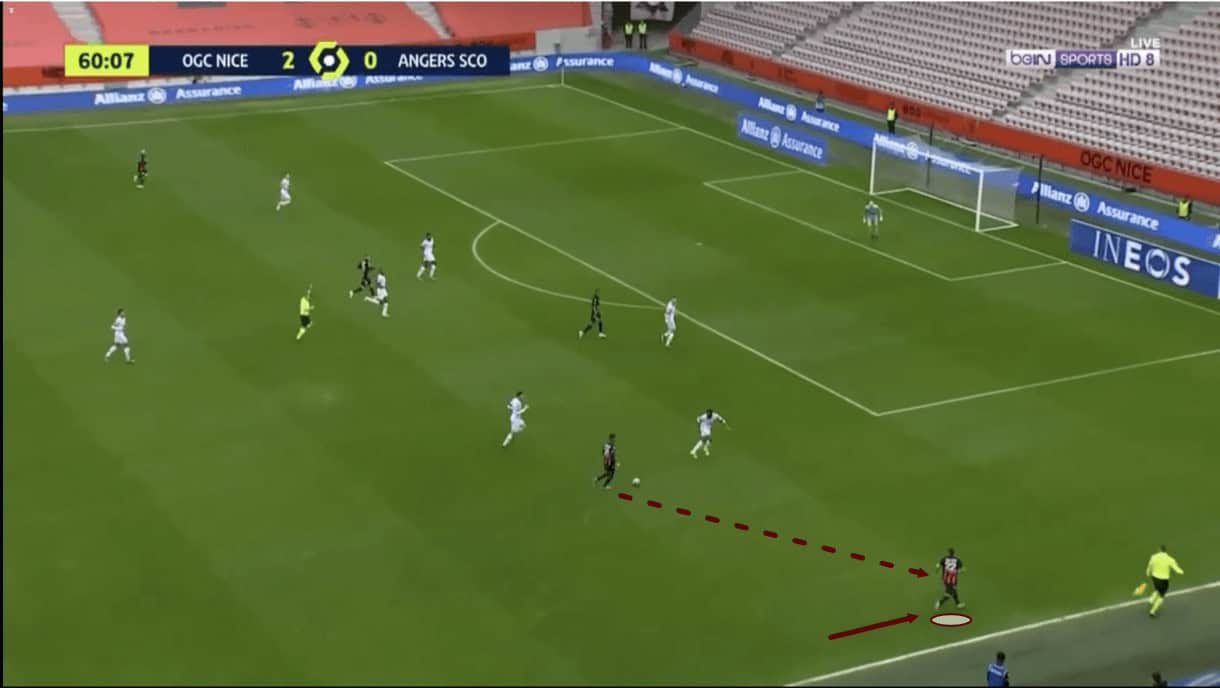
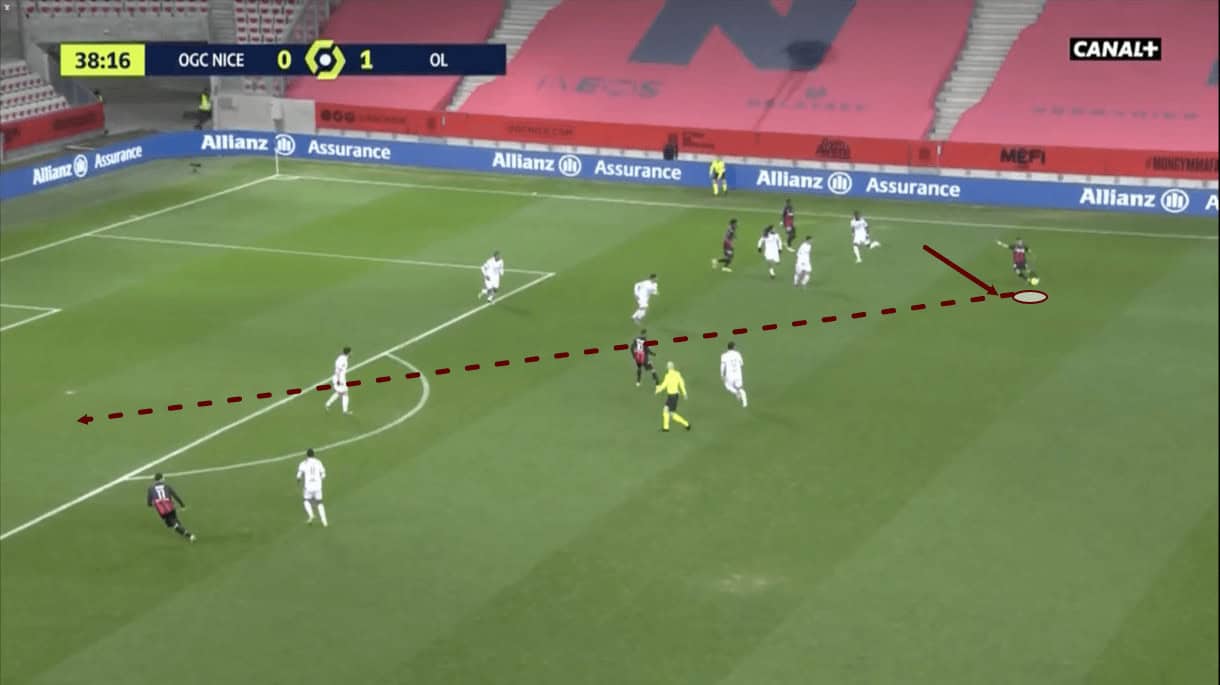
In terms of playing style, figure 14 shows Lopes occupying the right-wing position, providing the width for Nice inside the final third.
Lopes tended to hug the touchline quite a lot during his time at Allianz Riviera – something that Les Aiglons fans shouldn’t expect from Stengs, who will typically play far more centrally.
Lopes was much more of a traditional winger – though an inverted one – whereas Stengs is a playmaker whose starting position is often wide but shouldn’t be the one providing the width inside the final third.
In the setup seen in figure 14, you’d expect to see Stengs in the right half-space, where the player passing to Lopes is located.
Meanwhile, in figure 15, we see how Lopes liked to cut in on his left foot similar to Stengs.
Lopes liked to play crosses into the box from this deep, wide area frequently last season.
A lot of his chance creation came from here.
He’d receive the ball out wide on the right wing and then pull it back onto his stronger left foot while moving more centrally before sending a cross into the penalty area.
Stengs will occupy this position at times but won’t send a cross into the box, expect to see Stengs perform as he did in figures 1, 2, and 13 when playing in this position.
He’ll dribble centrally before playing through passes – mostly on the ground but sometimes lobbed when the opportunity presents itself.
Last season at title-winning Lille, Galtier’s primary right-winger was Luiz Araújo – another left-footed right-winger.
We expect Stengs to operate more similarly to Araújo within Galtier’s tactics than Lopes.
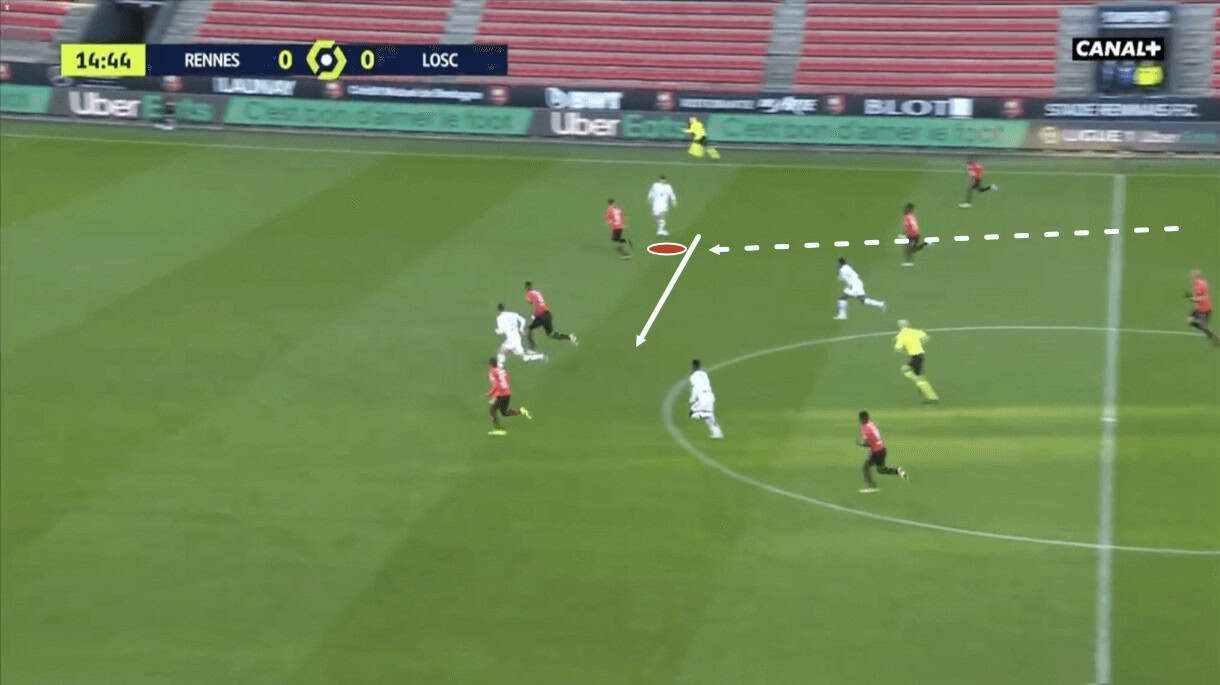
Araújo liked to occupy more central areas and cut in similarly to Stengs within Galtier’s 4-4-2 system.
Figure 16 shows a typical example of Araújo picking up the ball out wide on the right and carrying it into the right half-space.
He loves to drive into the centre with the ball like Stengs, so the Lille man does provide a good example of how Galtier has used players somewhat similar in style to Stengs in the past.
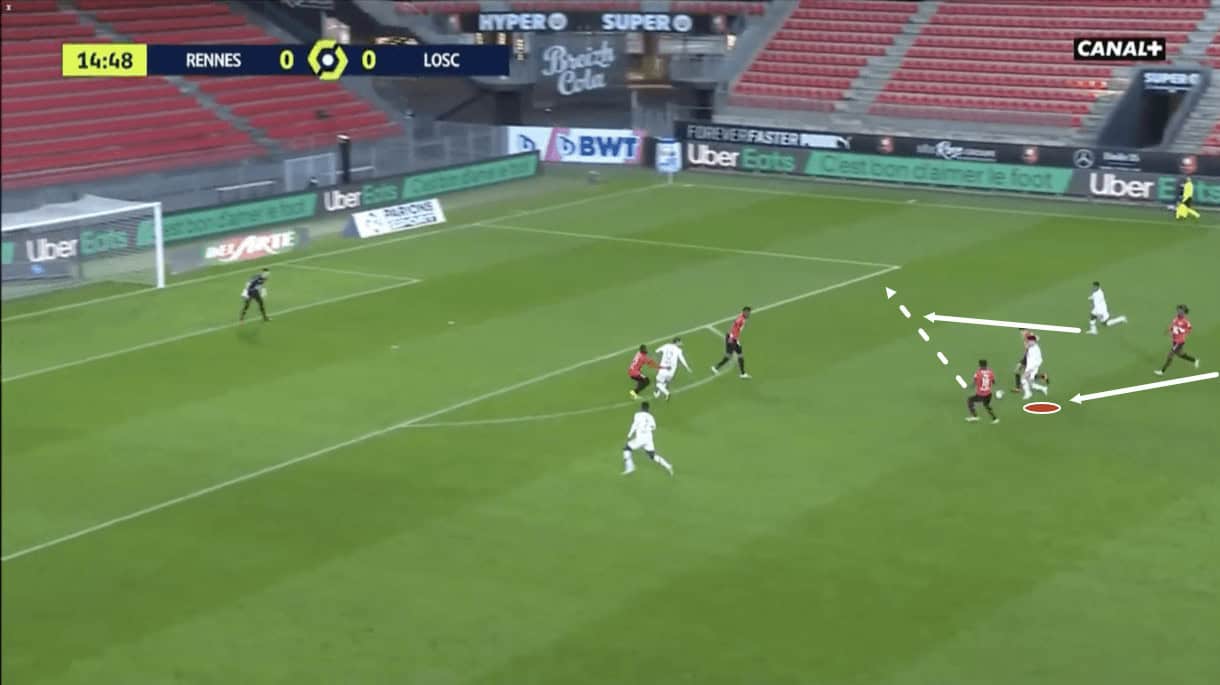
As this particular passage of play moves on into figure 17, we see Araújo end up in this central position before playing a through ball to an overlapping runner.
This pass isn’t one that Stengs typically plays but expect to see Stengs given the freedom to play his normal game, as analysed previously, within the framework of Galtier’s system.
So, instead of this pass, expect to see the more vertical through pass in front of the near centre-back from Stengs.
However, what will be consistent about Araújo’s performance and Stengs’ performance under Galtier isn’t the exact passes, but the role in general.
Whether it’s a 4-4-2 or a 4-3-3 from Galtier, his right-winger will be given the freedom to heavily occupy the right half-space and create from there with runners ahead of him.
Conclusion
To conclude our tactical analysis, we feel that Stengs’ move to Nice from Alkmaar is an exciting and positive move for all involved.
Stengs will perform differently to Nice’s right-winger last term – Lopes – so may take some getting used to for his new teammates.
However, in terms of style, he isn’t a million miles away from Araújo, who Galtier had at Lille last term, so Stengs can perform the same role that the Brazilian did for the 2020/21 Ligue 1 title winners.
Expect Nice to exploit Stengs’ creative passing from central areas and ball control/dribbling quality in tight, congested spaces.
Meanwhile, also expect Nice to minimise instances of Stengs being forced out wide, physical duels, and isolated defensive duels.
