
Whilst he featured in 55 games for Manchester United and was seen by former interim manager Ralf Rangnick as a player that the club should build their first team around, the truth of the matter is that Anthony Elanga was never more than a bit-part player during his time at Old Trafford.
Once Rangnick’s successor, Erik ten Hag, was appointed, he was quickly sidelined and given appearances that were few and far between, with it clear that the former Ajax head coach never rated him in the same way.
As a result, it came as little surprise when Manchester United accepted an offer from Nottingham Forest to sign the Sweden international in the summer of 2023, with Elanga penning a five-year deal at the City Ground.
Whilst some might have initially raised eyebrows at the move, time has shown that it was a smart piece of business by Nuno Espírito Santo’s outfit.
Elanga quickly established himself as a key part of the Portuguese coach’s tactics and became a player that the club simply can’t be without.
With that in mind, this tactical analysis will take a closer look at why Elanga has become so irreplaceable for his current employers.
The scout report will highlight his strengths in different areas of the field and show where he can continue to improve as he and Nottingham Forest attempt to challenge for even more in the future.
Anthony Elanga Wing Play
While Anthony Elanga has operated in a variety of positions during his time at Nottingham Forest, there is no doubt that where he is most at home is on the wing.
He has spent the majority of his career playing in this position, and his key attributes have proven vital in propelling his team up the Premier League standings.

One of the things that particularly stands out is his pace, which Elanga looks to use at every opportunity.
With that in mind, it has been common to see him staying in advanced spaces but also dropping into deeper areas, meaning that he can turn and run and attempt to exploit any gaps that opponents leave exposed.
This is one situation in which that allowed Nottingham Forest to apply pressure on the front foot, with Manchester United pushing high up the pitch but leaving themselves vulnerable to the counterattack.
This is something that Elanga notices and so, as soon as Elliot Anderson receives the ball here, he immediately gets alongside Noussair Mazraoui and looks to offer his teammate a way to access the open territory behind the visitors’ back line.
This has particularly worked well against teams that set up with a back three, as Ruben Amorim’s side has here.
This is because the wing-backs will always have a natural freedom to push higher up the pitch whenever their team have the ball and don’t always track back as quickly as they need to, and that is why Manchester United have been left so unprotected here.
Whilst Anderson might have opted for the cautious approach on this occasion, with him sending the ball towards Morgan Gibbs-White instead of directly into Elanga’s path, the intent that the latter shows is still there.
It is that which has made him such a dangerous player whenever Nottingham Forest are on the attack.
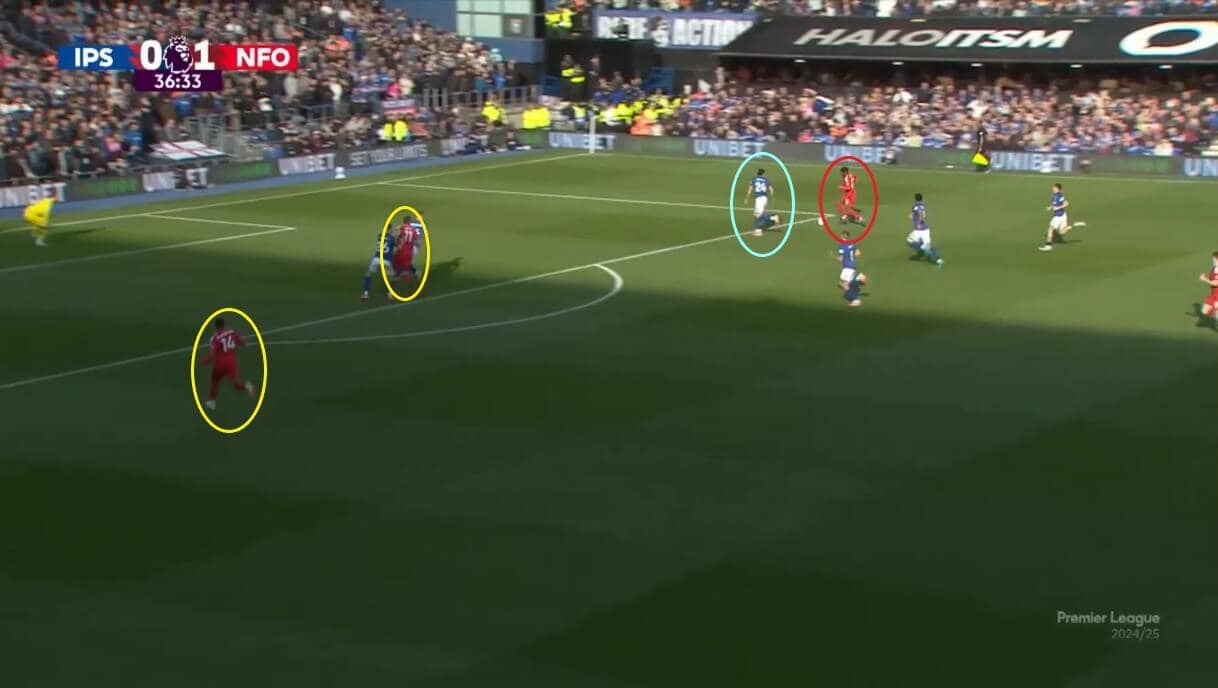
Whenever he does get into those spaces behind opposing lines, Elanga plays with a strong sense of unpredictability, with it never entirely apparent what his intentions are.
In this case, Ipswich Town have come under pressure inside their own half, and Elanga has the ball on the far side of the field.
Kieran McKenna’s side have naturally assumed that the winger will look to find Chris Wood in the middle of the goal area and so have closed him down, but Elanga has other ideas and so manipulates the situation to ensure that the attack does not come to an end as a result of that.
To do this, he slows down and reacts to what is happening around him.
Jacob Greaves doesn’t adapt and ends up continuing his defensive run for too long.
Once the former Hull City defender is out of the picture, Elanga can then cut the ball back inside and can target the gap between him and the rest of the defensive line, which results in him finding the far corner of the net.
In short, whilst Elanga is capable of crossing the ball in from these areas and has picked up eight assists already this season (despite only having a 26.8% crossing accuracy), he is just as capable of shooting whenever options are taken away from him.
This additional threat is shown by his scoring six goals this season and seeing 48.7% of his shots be on target, which gives his team different ways of testing their opponents.
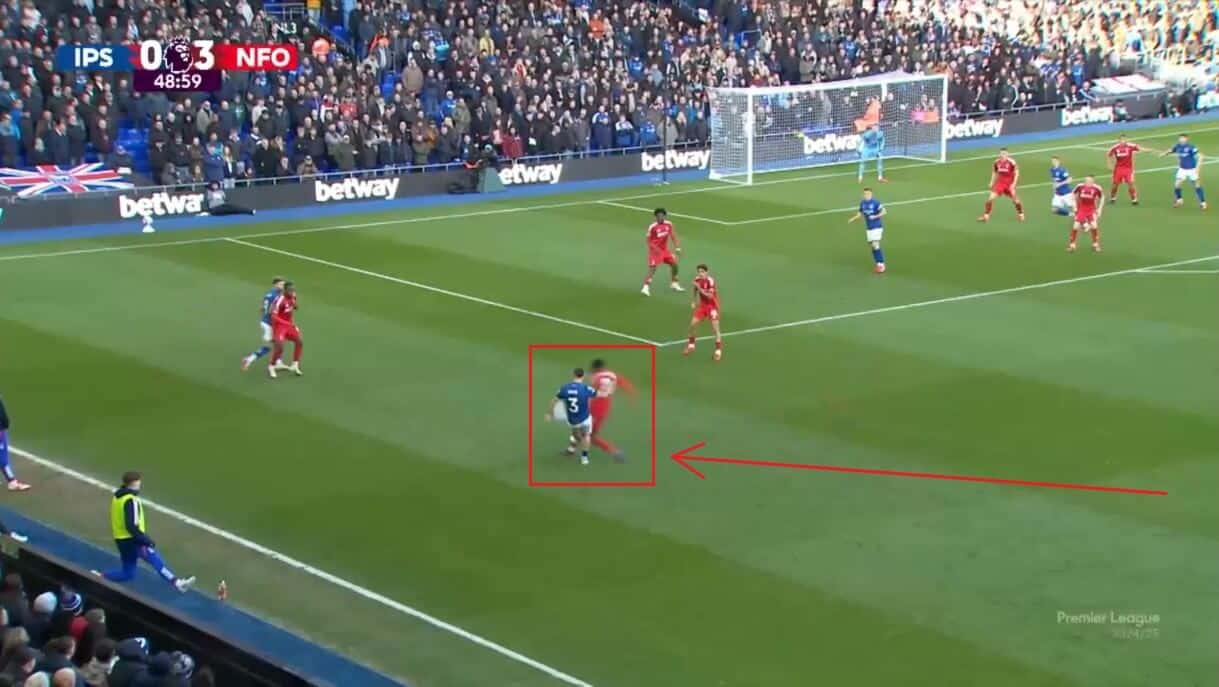
This is not to say that Elanga only comes into use once Nottingham Forest regains possession, though.
Instead, he has proven to be just as useful when they lose the ball.
It is common to see him tracking back and helping those behind him remain as secure as possible.
This was one such occasion when he needed to get back, with Ipswich left-back Leif Davis attempting to make a delivery into the middle of the goal area.
Davis is known for his attacking threat and ability to set up shots on goal, so this is not uncommon, but what he has not realised here is that Elanga has read his intentions and has moved towards him at speed to bring the attack to an end.
This is not a one-off; instead, it has been another common feature of Elanga’s play.
He did exactly the same thing against Lewis Hall when his team travelled to St. James’ Park.
With him succeeding in 71.9% of his defensive duels in all competitions this season, it highlights once again why Rangnick was so keen on him and why many have questioned Manchester United’s desire to part with him so easily.
Anthony Elanga Central Threat
No doubt, having Anthony Elanga on the wing has greatly enhanced Nottingham Forest’s offensive threat.
His pace and power continually trouble opponents.
However, during his time at the City Ground, his game has evolved significantly, and he can now play in other areas of the field.
He is often used in makeshift roles whenever Espírito Santo needs to find solutions to problems that arise.
This is another reason he has been so paramount to their progression under the former Wolverhampton Wanderers coach, and it is why they currently have a strong chance of featuring in next season’s Champions League.
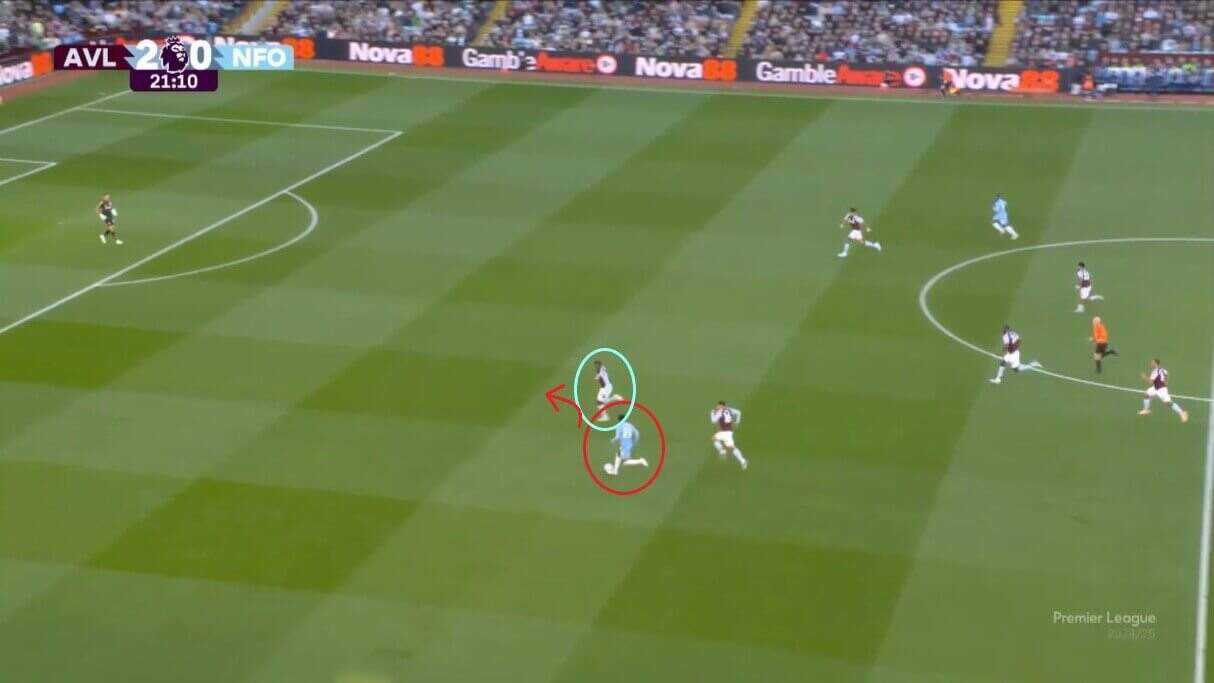
Despite the different aspects of each role he has been asked to play, the same characteristics have been clear to see, and that is what has allowed him to adapt so easily to them.
In this case, he is leading a counterattack against Aston Villa from a more central position, but his speed and decisiveness are once again what have driven him forward and allowed him to get into this space.
To their credit, Aston Villa have worked hard to limit his options, and the 2-v-1 situation that Andrés García and on-loan Chelsea defender Axel Disasi have created seems to hand them the advantage here.
However, as with Greaves in the previous section, this is where Elanga once again demonstrates his ability to manipulate situations in his favour.
His ability to change direction on the spot is apparent as he initially shapes to run between the two defenders and then twists back towards the goal line.
It might have only been a slight movement, but it was key in facilitating a shot on goal here.
Disasi (who had his back to the Swedish attacker and so struggled to adapt his own body positioning here) was unable to stop Elanga from running past him and testing his luck.
The angle might have been against him and have led to the effort travelling across goal on this occasion.
Still, the fact that Elanga netted the only goal of the game against Manchester United from a similar run shows how effective he can be when teams do afford him opportunities like this.
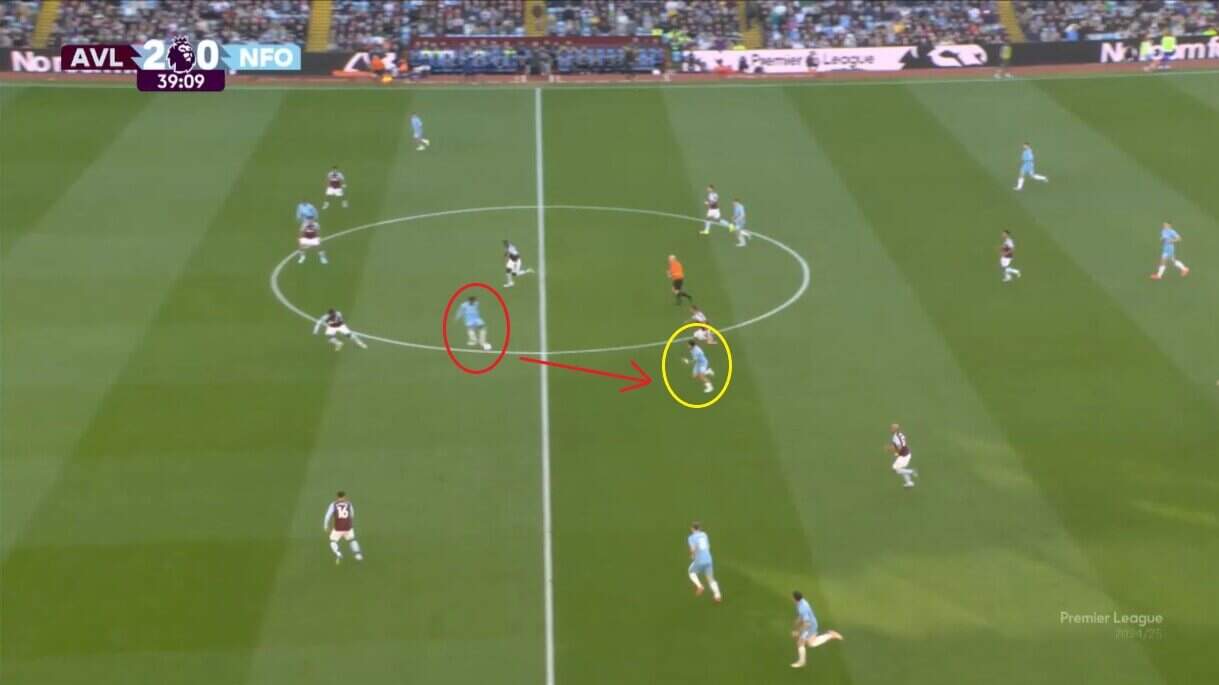
This offensive threat led to Elanga starting upfront when Wood picked up an injury during the most recent international break.
This is where the aforementioned problem-solving comes into the equation, with Espírito Santo turning to Elanga and the equally dangerous Callum Hudson-Odoi to form a front line and tasked Gibbs-White with sitting behind them in a playmaker role.
It was a decision that proved a masterstroke, and what really made it work was the freedom that the trio were afforded.
Whilst they had their roles, they were allowed to rotate positionally and to both push forward (with Elanga averaging 3.21 touches inside the penalty area this season) and to drop back.
In this case, the Sweden forward has done the latter as he moves into a pocket of space in front of the Aston Villa defenders, receiving a pass from Gibbs-White before returning it back to him immediately.
It might not seem like much, but what this provides a demonstration of is how Elanga’s game has become more well-rounded in recent seasons.
These are not areas that he would have likely accessed whilst with Manchester United, and yet his 76.5% passing accuracy means that it is something he can bring to the table.
This is another reason why he has become such a vital player for Nottingham Forest to have on the field.
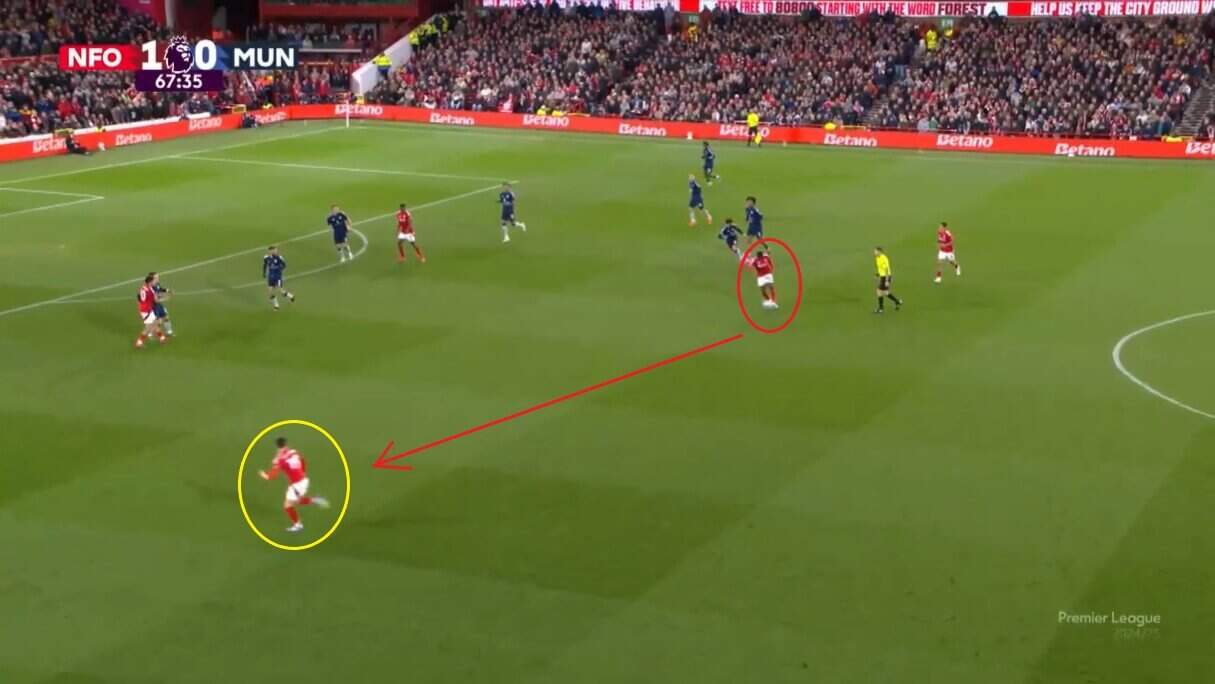
That ability to play wide and to operate in central spaces with equal ability is no clearer to see than when he switches the direction of play from one side of the pitch to the other, with him not often doing so in an orthodox manner.
In this case, he has received the ball from Nicolás Domínguez and has instantly cut back inside, looking to get into a position from which he can find a teammate on the nearside wing.
In the process of doing so, his quick feet allow him to evade multiple tackle attempts made by Manchester United to win the ball from him before he manages to find the run of on-loan Aston Villa left-back Àlex Moreno.
The decision to operate with wing-backs has really aided this part of his game.
Domínguez is ordinarily a midfielder but has been asked to move out and cover for Elanga as games go on.
As a result, the latter has had the freedom to make these interior runs and to look for space in all different areas of the field, and the way Elanga has used that to create chances for the likes of Moreno and Wood (who have developed a strong understanding inside the final third) shows another reason that he has been such a good fit for their style of play.
Anthony Elanga Areas To Improve On
Whilst it is clear from the analysis so far that there is a lot to like about Anthony Elanga, with him becoming one of the jewels in the crown for Nottingham Forest this season, it should be made clear that he is by no means the finished article yet.
Instead, as with all players, there are aspects of his play that can continue to be worked on as his career goes on, and doing so will be key if he is to stay with the team and contribute to their desire to keep reaching new heights.
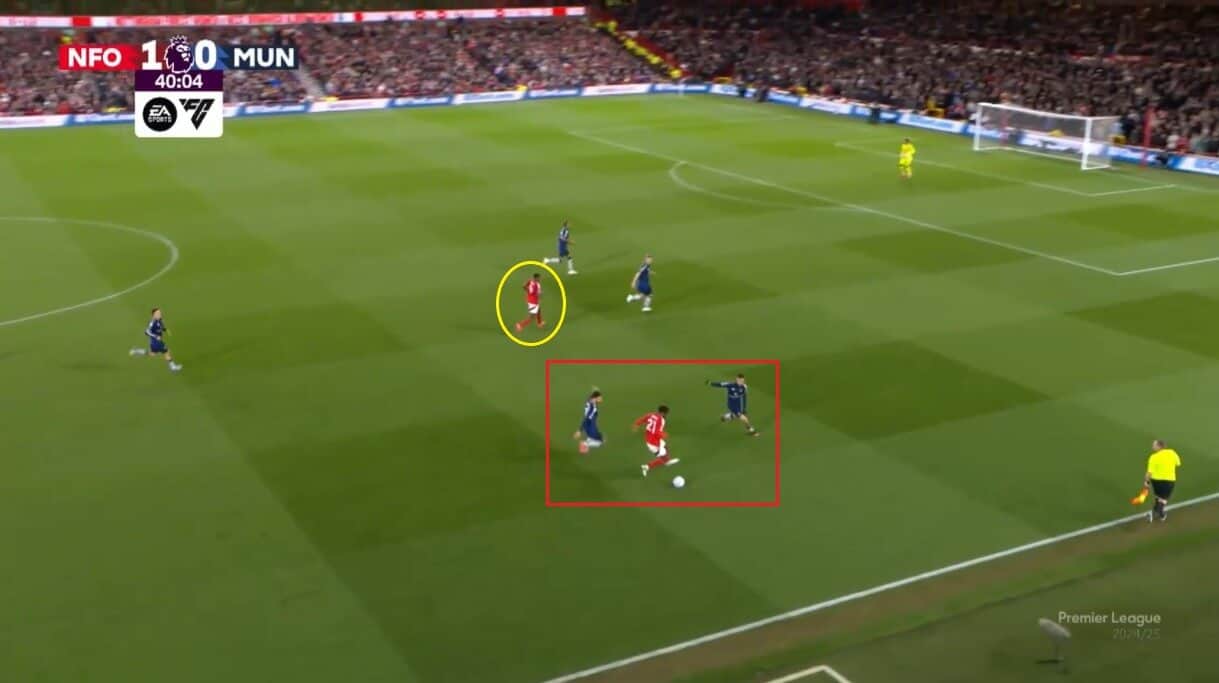
One of the things that Elanga does need to be wary of is not overcomplicating matters when there is no need to do so.
This situation was one in which he did just that, making another run up the field and once again searching for space to break through the Manchester United lines.
With Manchester United this time managing to get both Mazraoui and captain Bruno Fernandes back, there is not as much space available for Elanga to get behind them.
As a result, his best option here is to pass the ball between his opponents and to find former Liverpool striker Taiwo Awoniyi, who could then form a link between Elanga and the rest of the Nottingham Forest players.
This, though, is not what happens, and it seemed as though Elanga was caught in two minds as he tried to keep the attack alive.
As a result, he made a poor touch, inviting pressure from Mazraoui and Fernandes, who swiftly concluded the advance.
It might be only a small thing, but it is not the only time that Elanga’s quick feet have got the better of him.
It is telling that, despite his threat, he has only succeeded in 48.1% of his offensive duels this season.
Therefore, if he is to grow even more into the player that so many feel he can and will be, he may need to look at ensuring that he doesn’t let chances like this go begging.
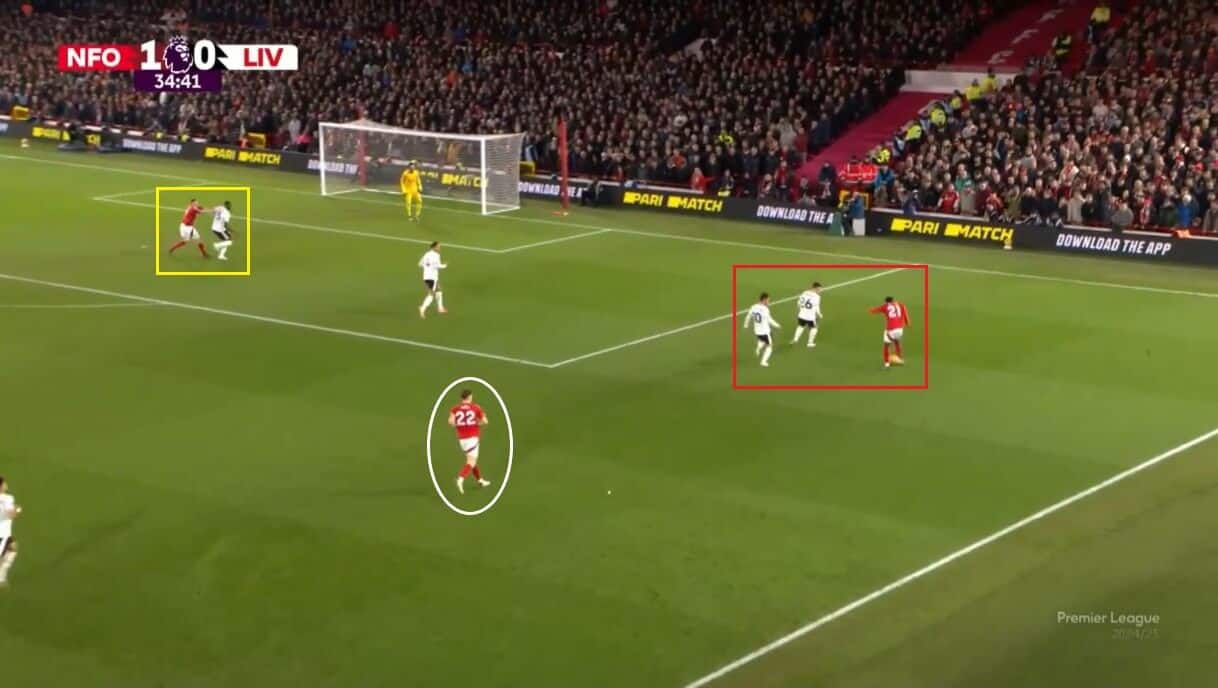
That occasional poor decision-making has manifested itself in other ways too, which is why it is something that he needs to address.
In this case, it was simply a case of not fully assessing his surroundings before making a judgement, which resulted once again in a chance of breaking down prematurely.
On this occasion, Liverpool are the opposing side, and Elanga has progressed to the edge of their goal area.
Similar to Ipswich earlier in the analysis, Arne Slot’s side has tried to get numbers back and marshal Wood’s threat, with Ibrahima Konaté staying tight to the New Zealand captain in the middle.
The difference here is that Elanga has not one but two players in his vicinity, Andrew Robertson and Alexis Mac Allister, and so simply slowing down and looking for a way inside would not have worked in the same way here.
As a result, he needed to feed the ball back to captain Ryan Yates here and allow him to try and find a way into the goal area.
With Yates in space, he would have time to look for a teammate or to make a run forward on his own.
Elanga, though, doesn’t seem to recognise this and so sends the ball towards the two Liverpool players, which only leads to it ricocheting off Robertson and towards the sideline.
Whilst Yates did manage to reach it in time, he no longer had the time or space that he could have had and the pressure that Mac Allister and Luis Díaz immediately applied meant that, once again, Nottingham Forest and Elanga had squandered a chance to really test their opponents.
Anthony Elanga Statistics 2024/2025
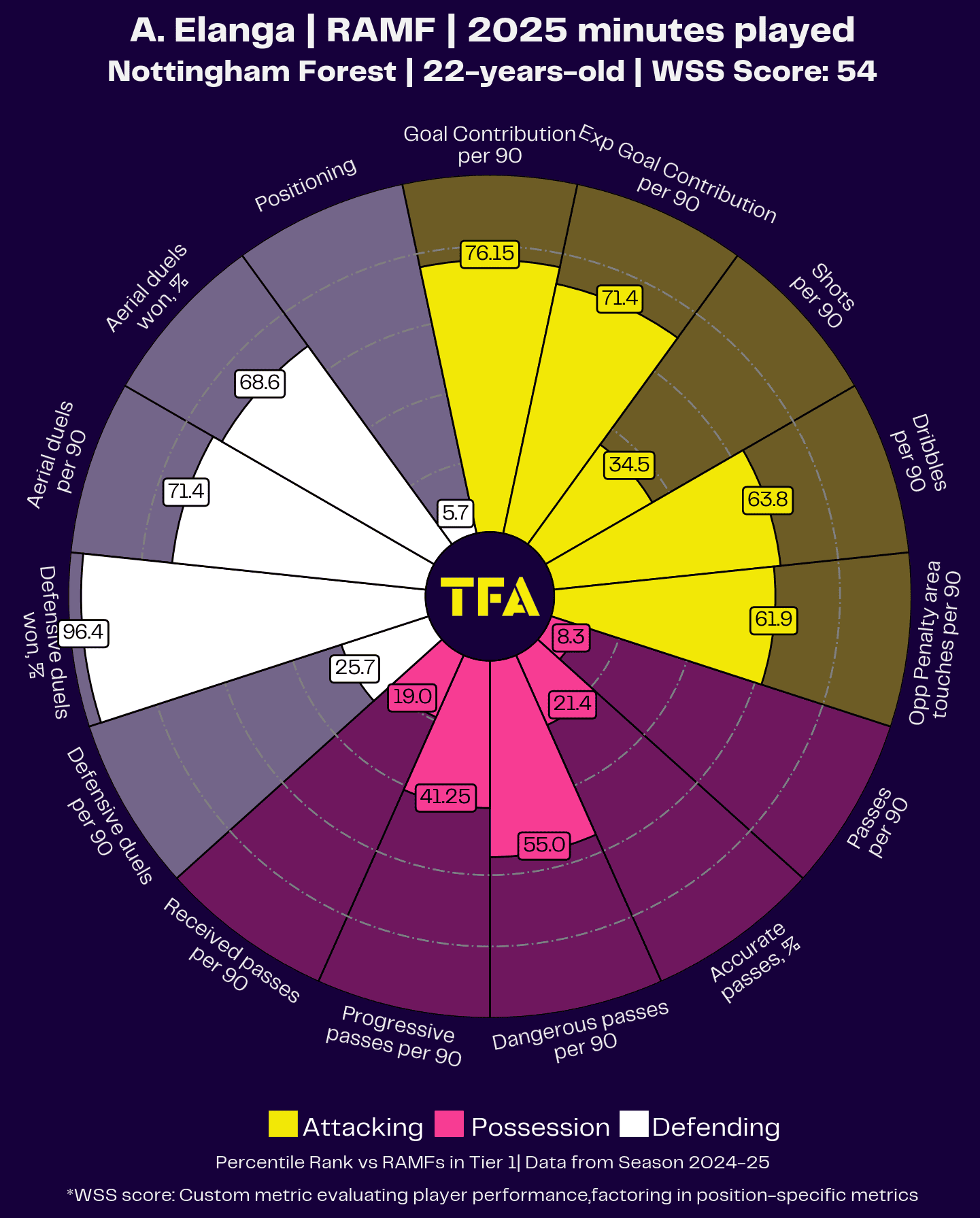
When looking at Elanga’s statistics for the campaign, the impact that this has can be seen clearly.
As is shown, the winger ranks favourably in comparison to other Tier 1 players in his position for things like goal contributions, dribbles, touches in the opposing penalty area and defensive duels won per game (all in percentile terms), but where he does not sit as highly in the bands is for the majority of the passing statistics.
This is not to say that he is a bad passer.
There have been several instances when he has received the ball and made the right call regarding fashioning shots on goal for others (the opening goal against Liverpool FC came after a well-weighted through pass for Wood to fire beyond Alisson Becker, while he has seen 82.8% of his passes to the final third reach their intended targets).
However, if he continues to make better decisions more often, this aspect of his game will continue to improve, and he will start to add even more to his game than he currently has.
Conclusion
In conclusion, this tactical analysis has examined Anthony Elanga more closely, highlighting why he has become such a key part of Nottingham Forest’s team this season and why being without him could mean the difference between victory and defeat.
As the analysis has shown, what really catches the eye about Elanga is the way that he has developed his game and added new layers to it since leaving Manchester United.
He is now not solely a winger but more of a wide forward who can operate inside the pitch, too.
This has led to him becoming a handful for opponents, whom they do not relish facing.
He will need to improve next season if he is to keep growing, which will be especially important if Nottingham Forest experiences top-tier European football next season, as expected.
However, he certainly has the raw ability and capability to thrive in all stages, and he is quickly becoming one to watch.
