
Barcelona arrived at Anoeta with the intention of confirming their strong start to the year and maintaining a four-point lead over Real Madrid at the top of La Liga, after the capital side had won their respective match.
The context, however, was far from simple: awaiting them was a Real Sociedad side strong at home and in need of points to move closer to the European qualification places.
The outcome was unexpected yet hard-earned for the txuri-urdin, who prevailed through a well-coordinated high press and a clear plan to disrupt the two Barcelona midfielders who had been standout performers in recent matches, including the latest Clásico: Frenkie de Jong and Pedri.
Not even a brilliant performance from Lamine Yamal, who repeatedly dismantled the opposition’s pressure through his outstanding creativity, was enough for a Barcelona side that failed to capitalise on their chances and missed a golden opportunity to consolidate their domestic dominance.
This tactical analysis article examines key aspects of the match and how Real Sociedad managed to neutralise one of the most dominant teams in European football.
Lineups & Formations
Pellegrino Matarazzo mainly set the home side up in a 4-4-2 shape.
Álex Remiro started in goal for Real Sociedad behind a back four of Jon Aramburu, Jon Martín, Igor Zubeldía and Sergio Gómez, from right to left.
Takefusa Kubo and Gonçalo Guedes played on the right and left wing, respectively, with Beñat Turrientes and Carlos Soler in the middle of the park.
Brais Méndez and Mikel Oyarzabal led Real Sociedad’s attack from the front.
Hansi Flick set the visitors up in their typical 4-3-3 shape.
Joan García played in net with Jules Koundé at right-back, Pau Cubarsí at right centre-back, Eric García at left centre-back, and Alejandro Balde at left-back.
Frenkie de Jong sat in the holding midfield position behind Fermin López and Pedri.
Lamine Yamal and Dani Olmo played off the right and left wing, respectively, with Ferrán Torres leading the line.

Real Sociedad Pressure On Barcelona’s First Build-Up Line
Real Sociedad’s defensive plan was structured from the outset around a clear principle: to disrupt Barcelona during the earliest phases of progression, particularly in the first build-up line.
To achieve this, the txuri-urdin adopted a high 4-4-2 block, implementing an aggressive, well-organised press designed to disrupt Barcelona’s first passes and restarts.
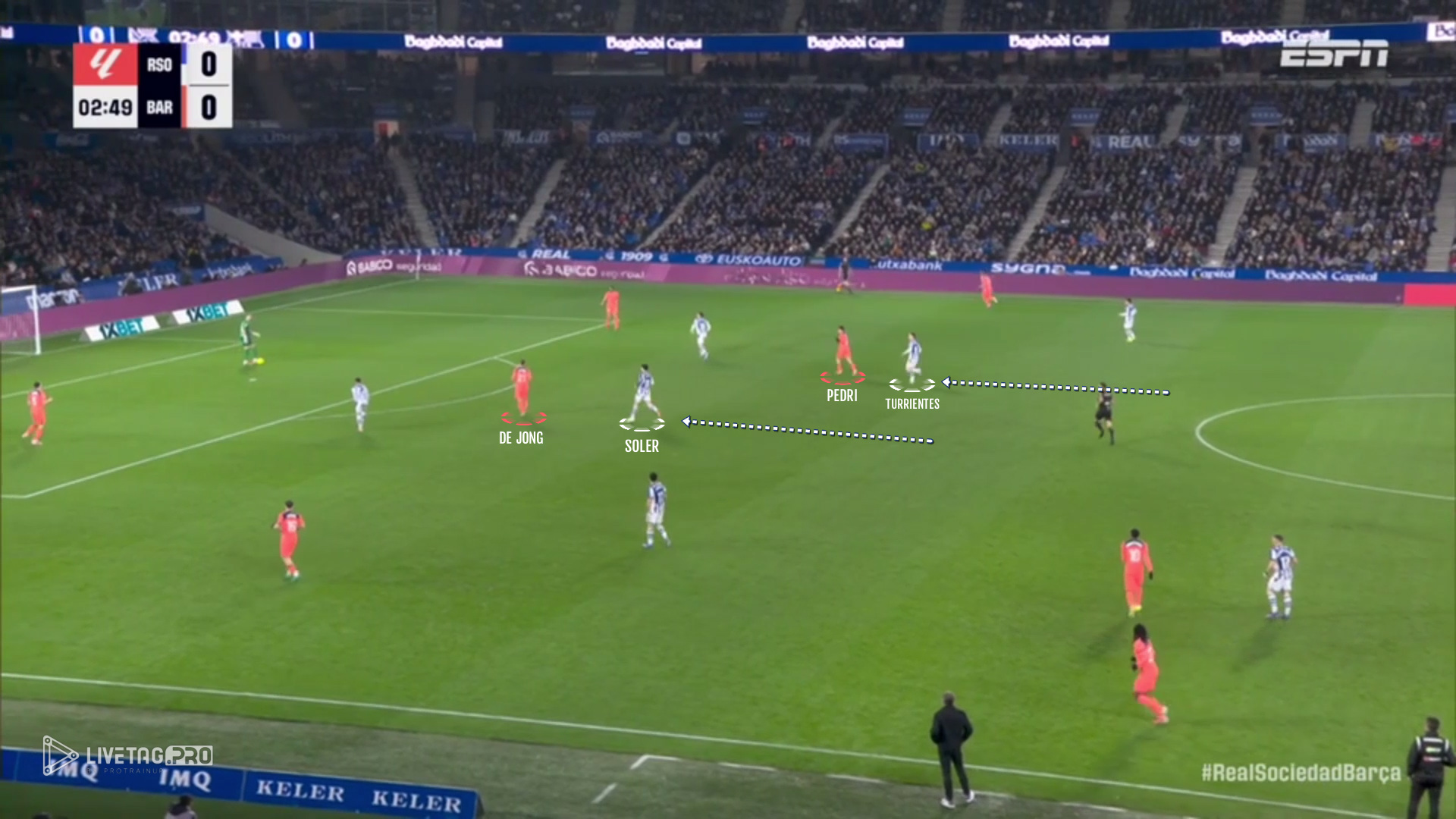
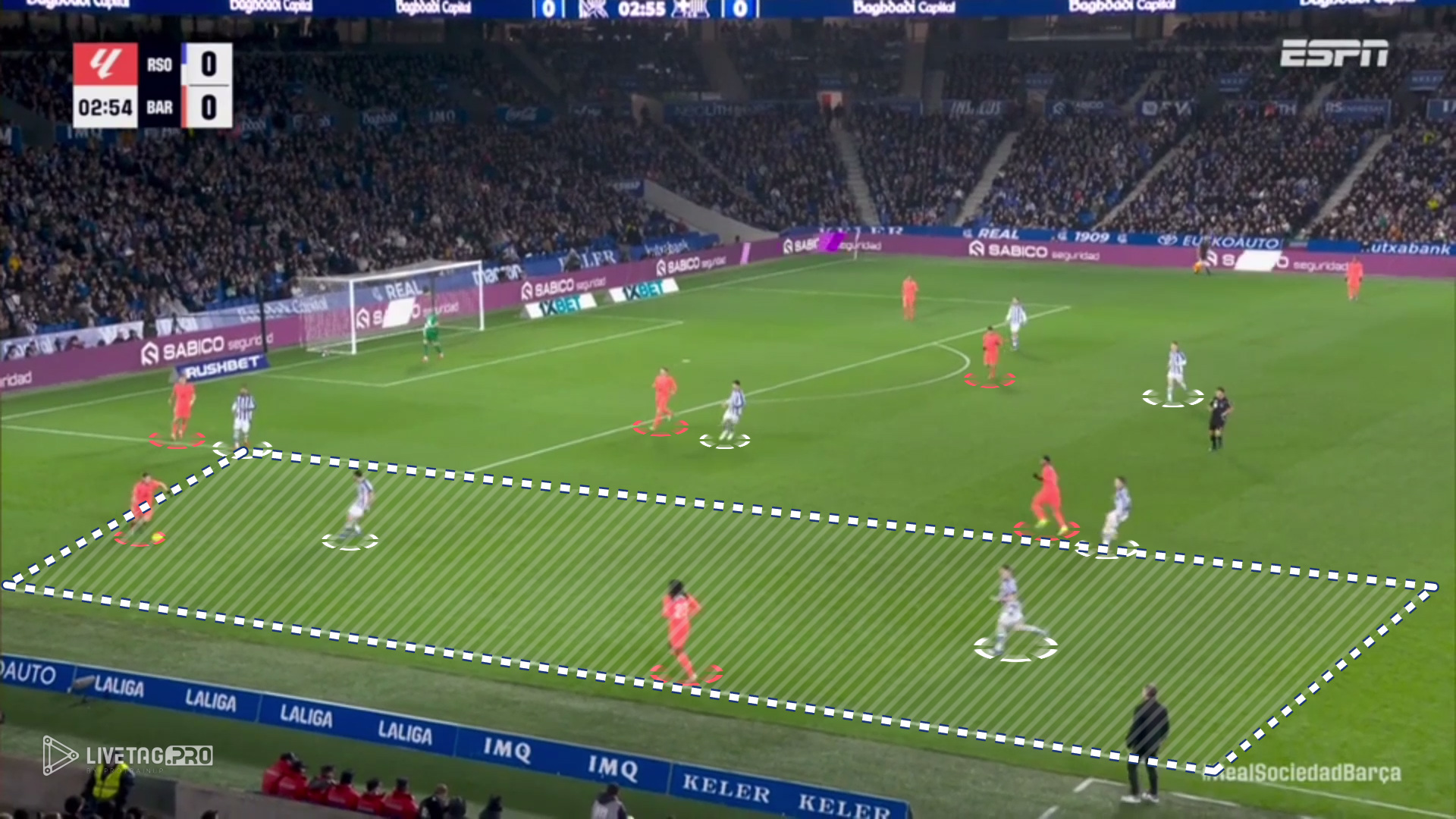
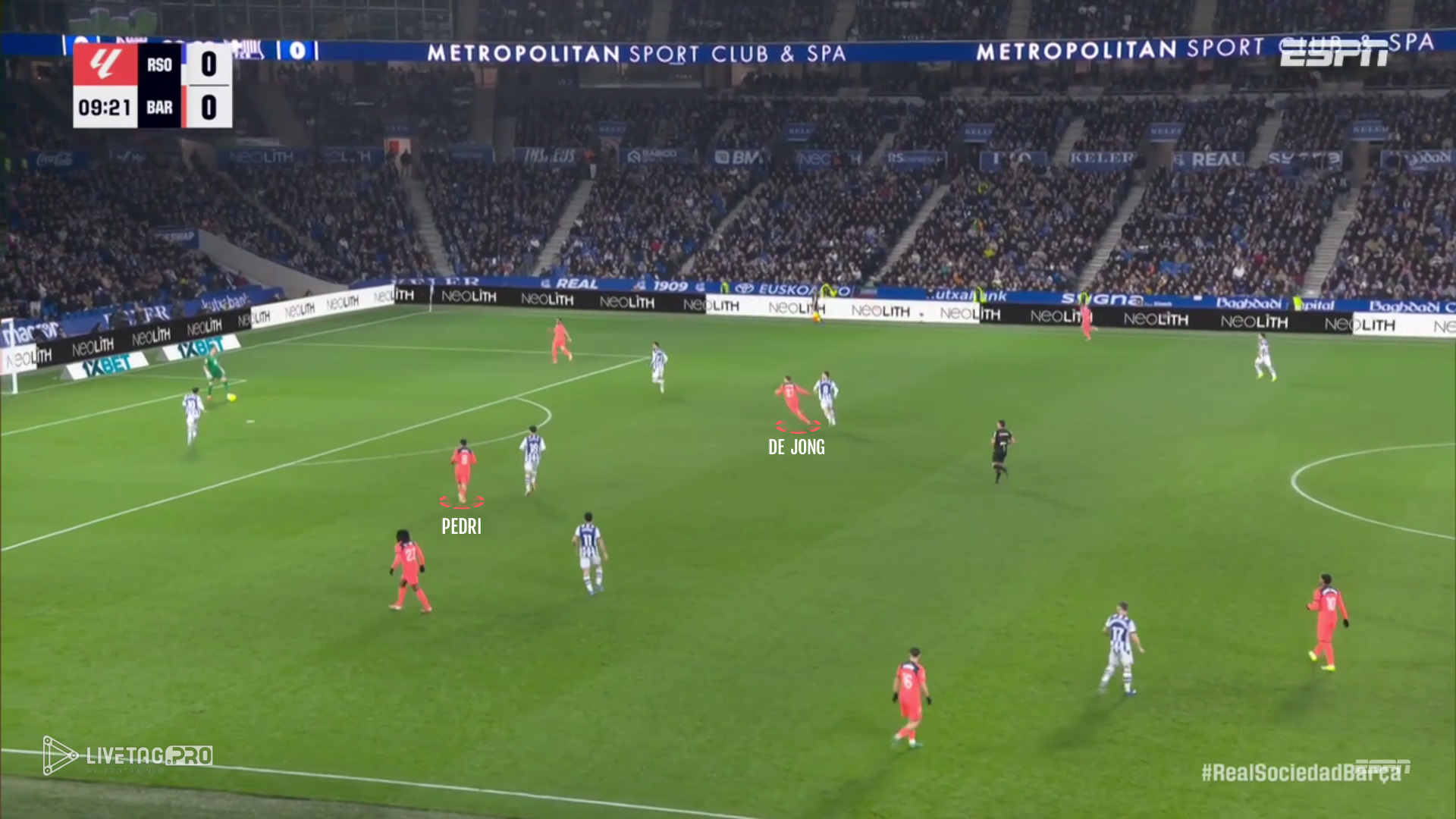
The primary focus was on denying freedom to Pedri and Frenkie de Jong, identified as the structural nodes sustaining Barcelona’s fluency and the socio-affective chemistry that underpins both their build-up and progression.
Real Sociedad’s double pivot stepped out aggressively to engage Barcelona’s midfielders, while the forwards fixed references on the centre-backs and steered circulation towards less dangerous wide areas.
This press was not purely zonal but relational, dynamically adjusting to nearby supports and the lateral movements of Barcelona’s interiors.
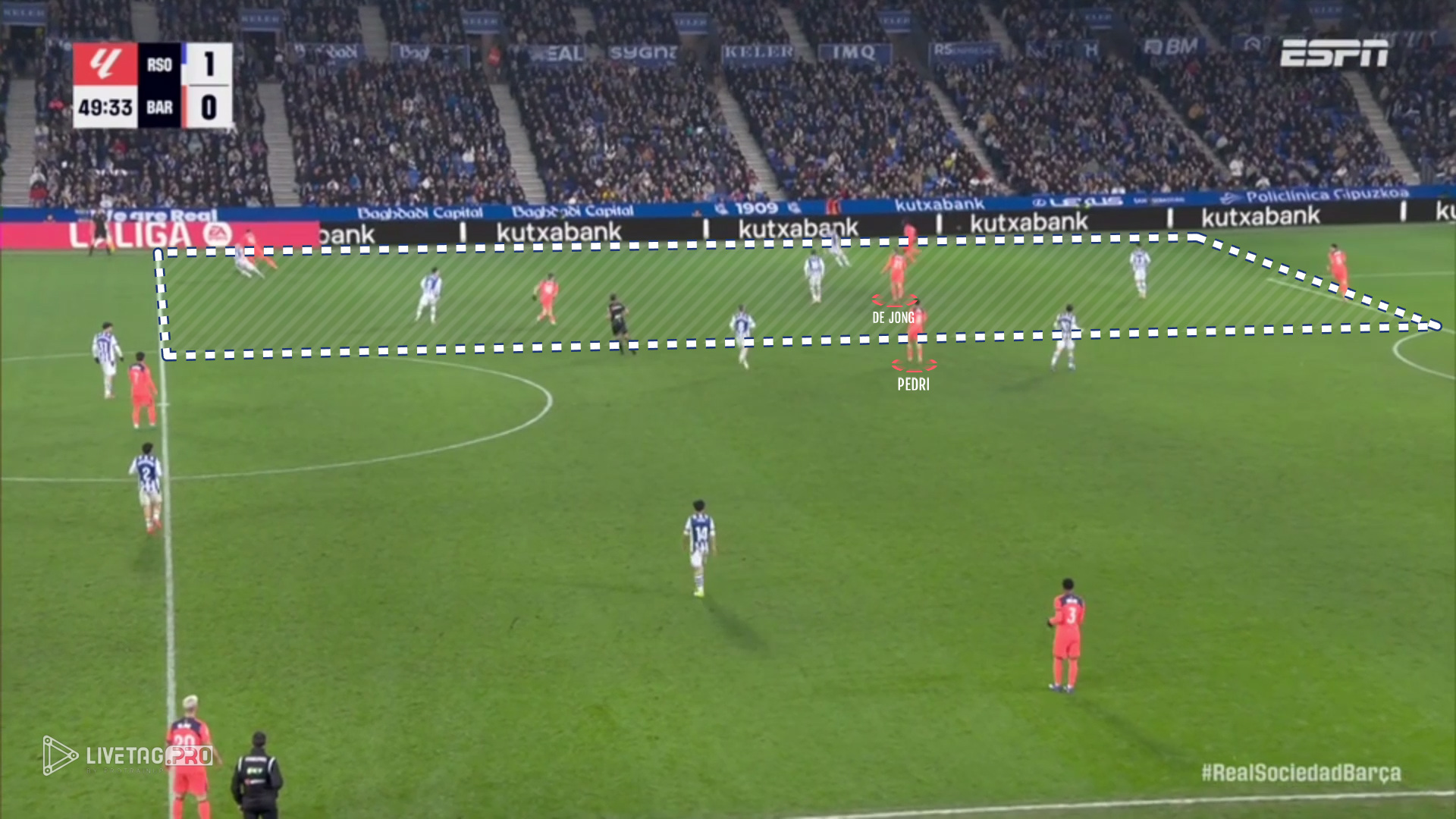
As a consequence, Barcelona were forced to initiate many sequences from uncomfortable positions, receiving with their backs to goal and under immediate pressure, which slowed circulation and led to more predictable decisions in the first passes following recoveries or restarts.
Real Sociedad Defensive Adjustments: From High Block To Compact Low Block
One of the most solid aspects of Real Sociedad’s approach was their ability to adjust defensive heights without losing coherence.
When Barcelona managed to break the first line of pressure, the home side quickly dropped into a mid-block and, in more settled attacking phases from Barcelona, into a very compact low block.
In this context, the priority was protecting the central lane and drastically reducing inter-line spaces.
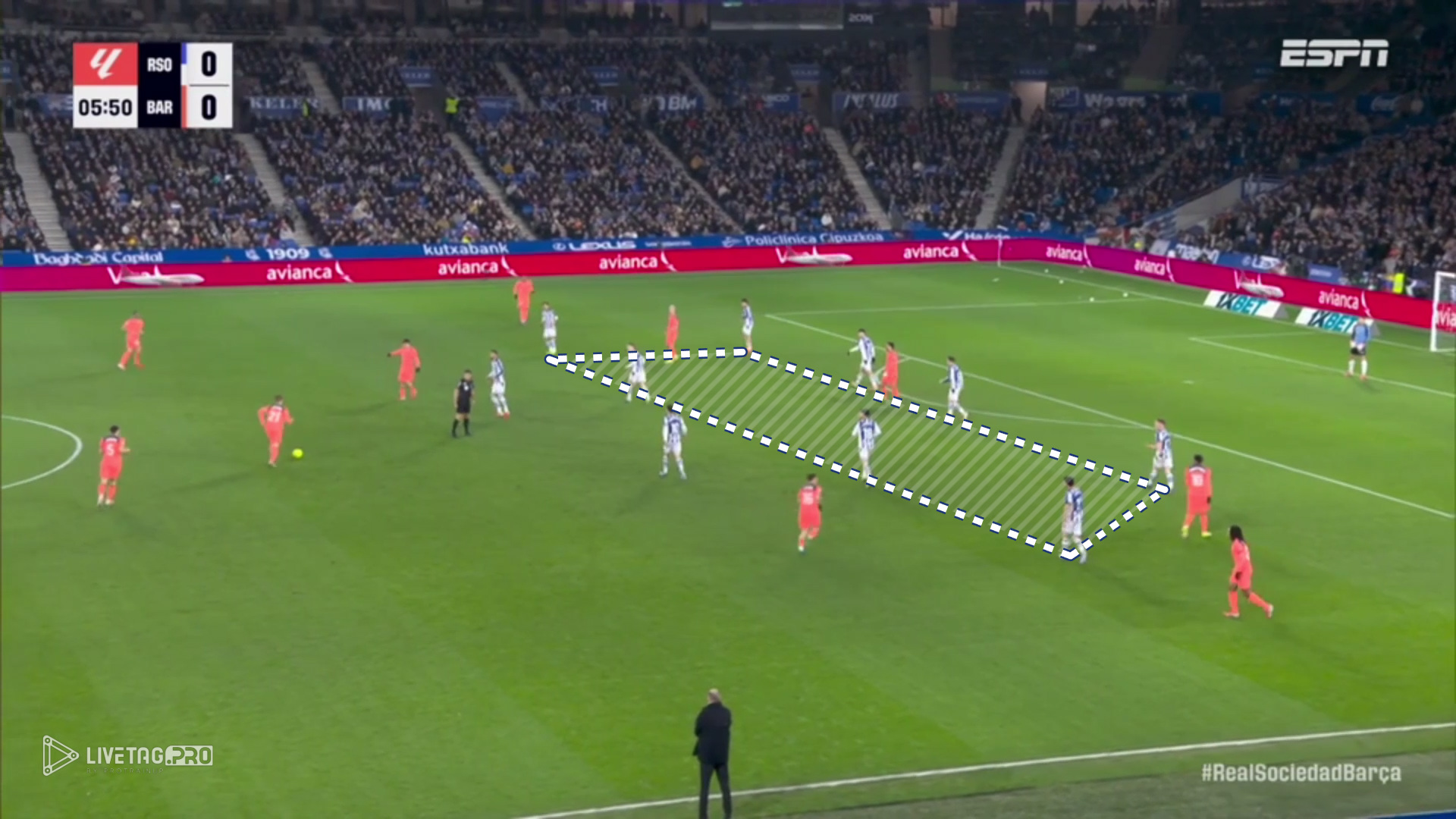
Distances between the defensive and midfield lines were minimal, limiting the drops of Ferran Torres and the interior movements of Dani Olmo and Fermín López, who attempted to position themselves behind the opposition midfield to facilitate progression and generate advantages facing goal.
Real Sociedad accepted a degree of Barcelona’s circulation on the outside but were highly effective at closing interior channels and denying profile-oriented receptions that would allow turns and acceleration.
Collective shifting and the ability to recompress after each adjustment were key in sustaining this behaviour over long stretches of the match.
Barcelona Solutions Against Central Density
Faced with this high-friction scenario and reduced spaces, Barcelona found some isolated solutions, mainly through coordinated movements in intermediate zones.
The simultaneous or alternating drops of Ferran, Olmo, and Fermín aimed to attract markers and generate small disconnections in the man-oriented pressure applied by Real Sociedad’s double pivot.
At times, these behaviours disrupted individual references and opened brief windows to progress.
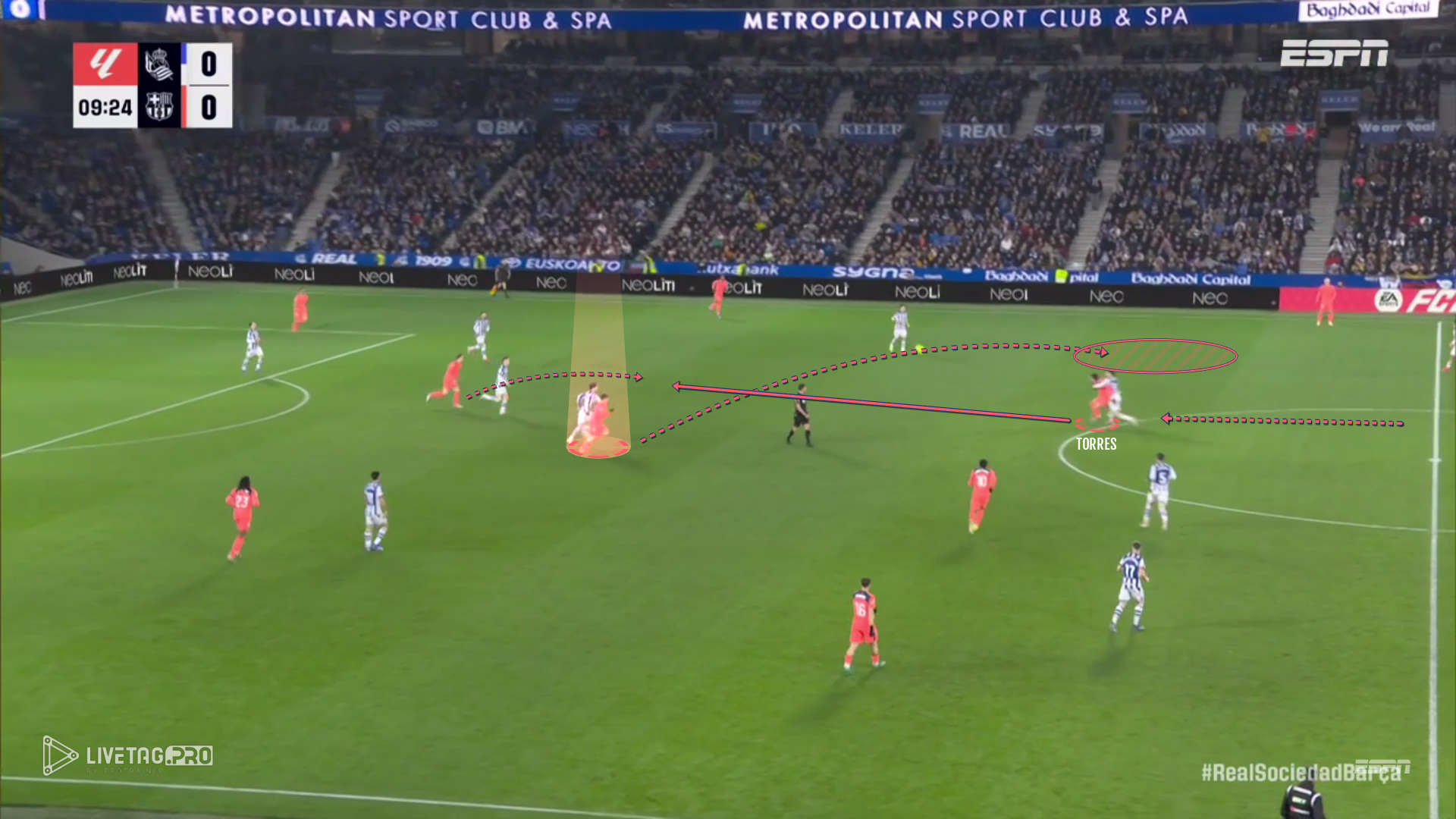
However, many of these advantages proved short-lived.
Real Sociedad showed a strong capacity to shift laterally, readjust references, and close spaces again, limiting the continuity of Barcelona’s long possession sequences.
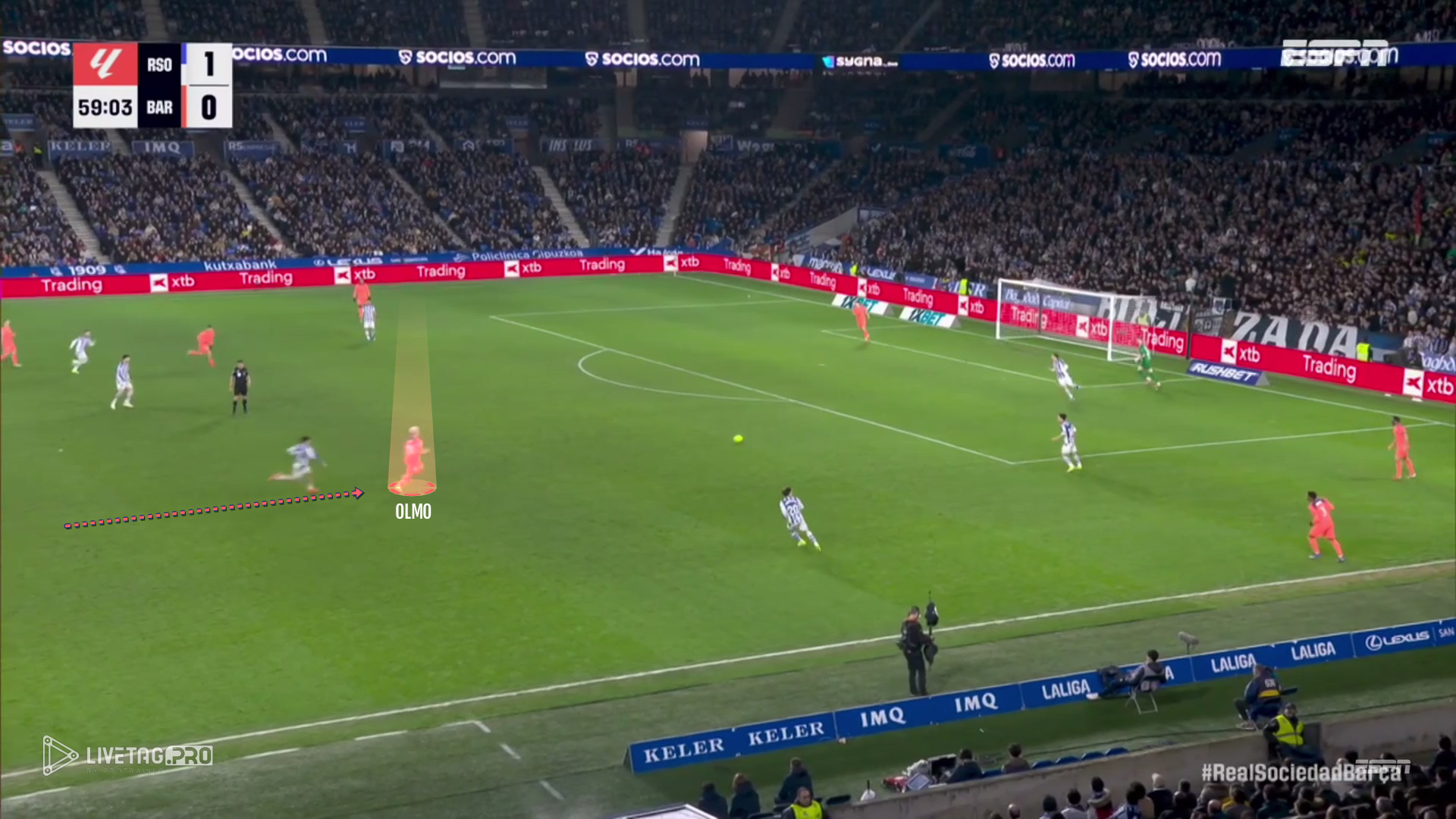
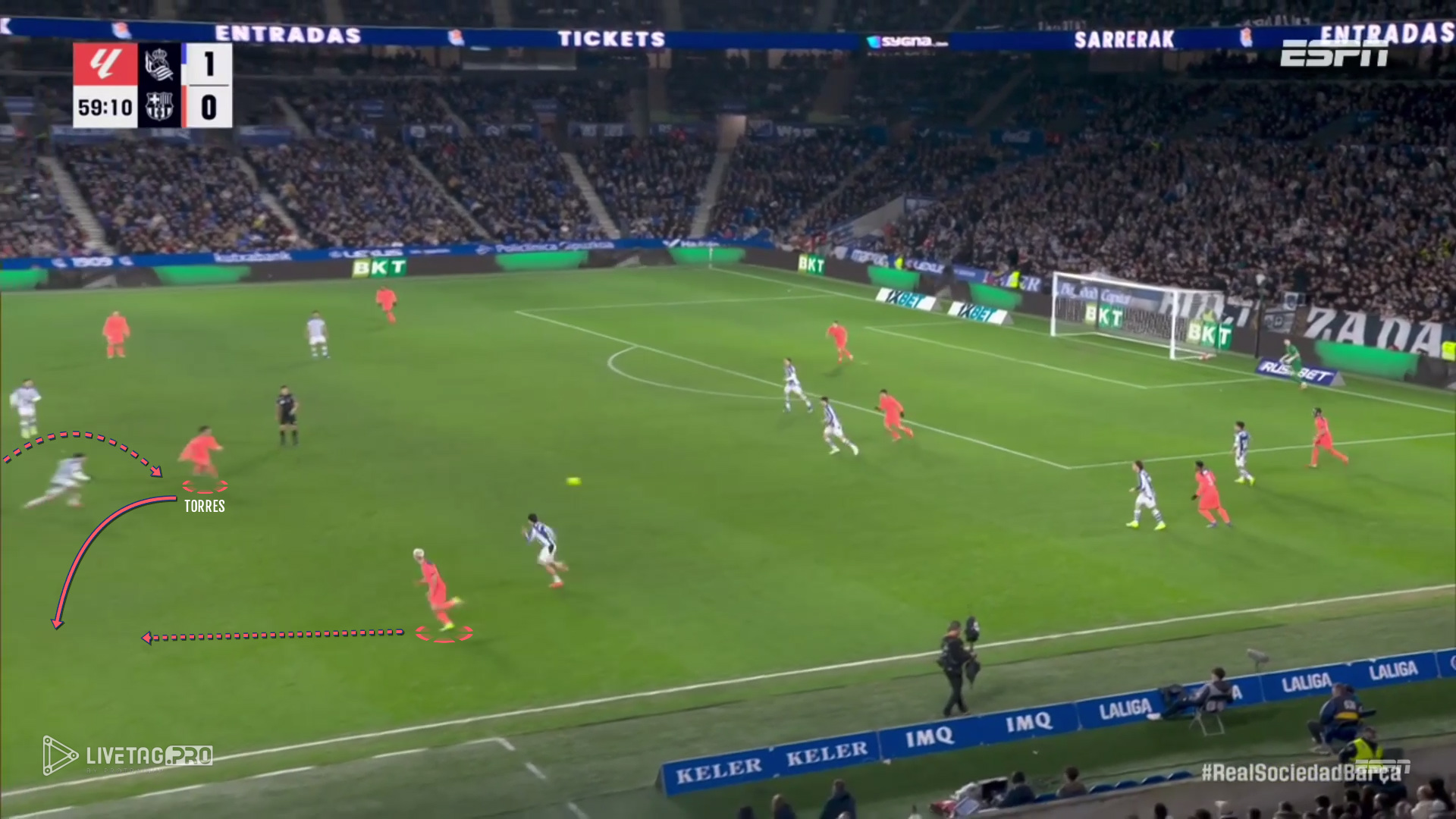
Even when Pedri and de Jong began to push into higher zones to force longer movements within the opposition block, the cracks created were more potential than effective.
Lamine Yamal As A Generator Of Relational Advantages
Within this context, Barcelona’s main source of imbalance was Lamine Yamal.
Throughout the match, and especially across both halves, the winger confirmed that he operates on a superior creative level, capable of generating solutions even when the collective context encountered clear limitations.
His impact was not limited to dribbling or isolated 1-v-1 situations, but extended to his ability to fix defenders, attract pressure and activate the runs of nearby teammates.
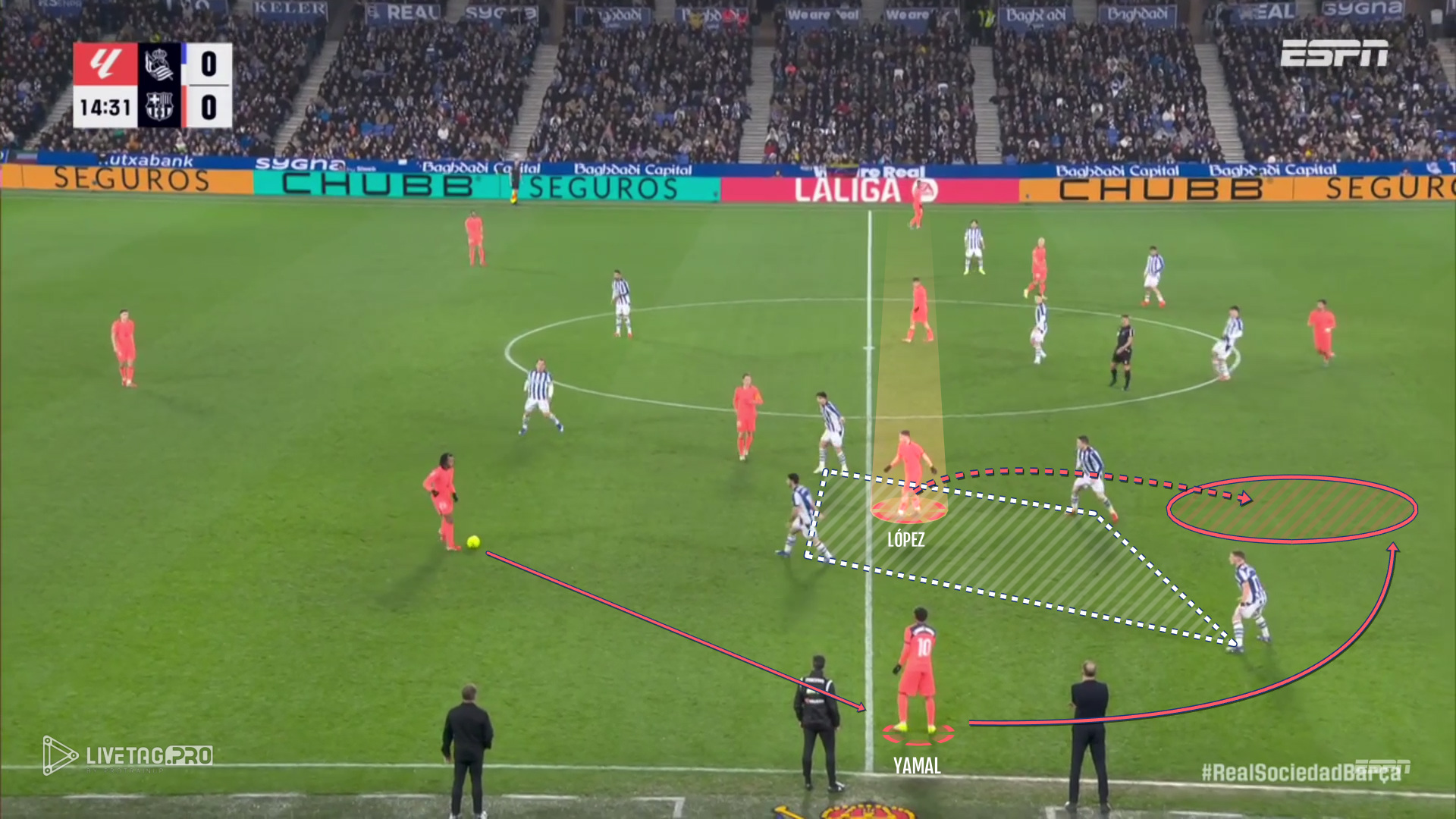
From wide areas, Yamal used his fixation to free both the interior lane and the deep wide channel, frequently finding Jules Koundé on surprise overlaps.
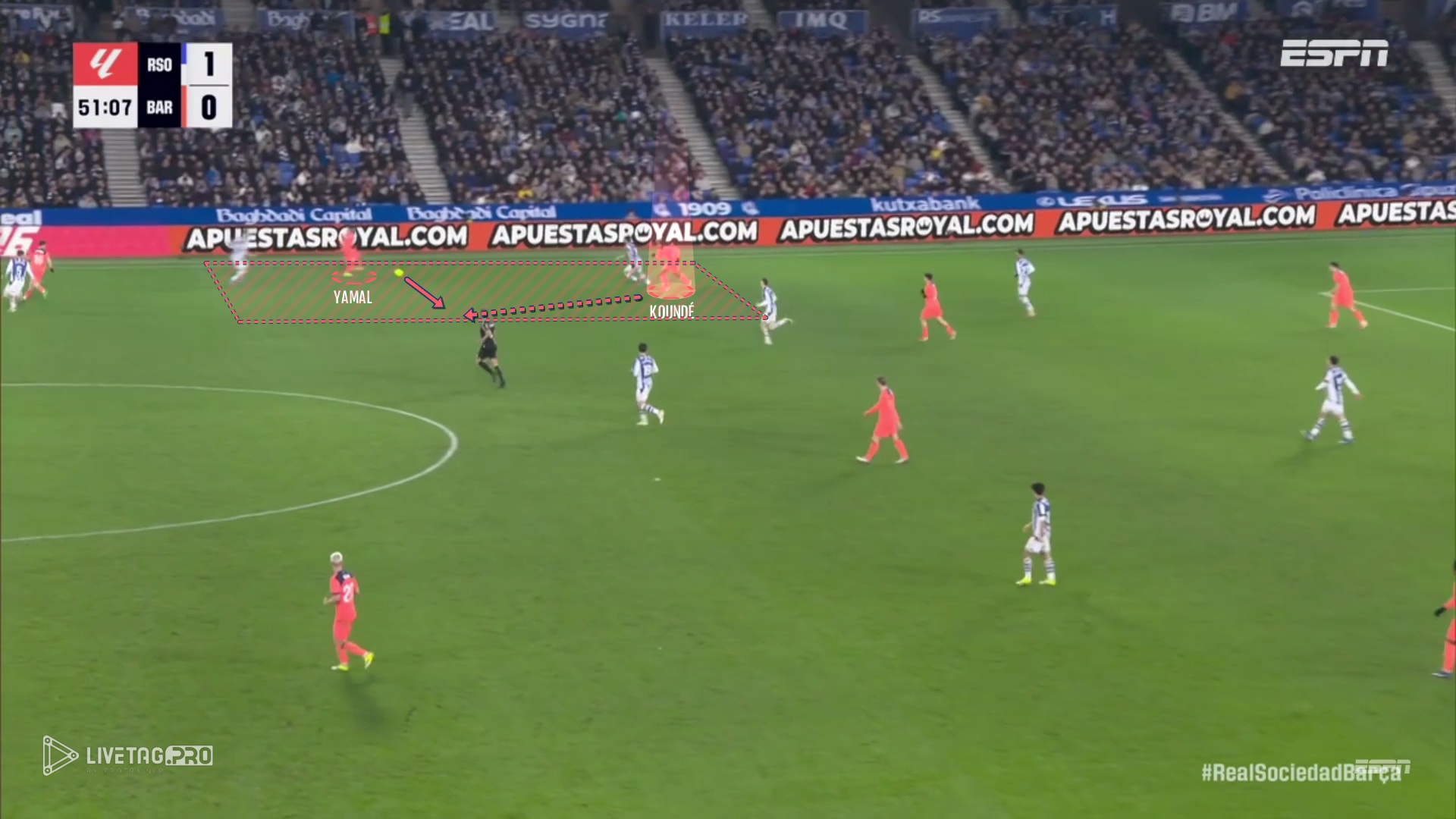
These supports and lay-offs generated a “positive collective chaos” for Barcelona, temporarily breaking Real Sociedad’s pressing structures and forcing constant readjustments.
Unlike the “ghost” of Messi, more closely associated with centralised gravitational attraction, Yamal operates through a more expansive logic, stretching the pitch, creating disorder from width, and facilitating the emergence of relational advantages around him.
Real Sociedad Game State Management
Despite Barcelona’s territorial dominance and higher attacking volume, Real Sociedad were more effective in decisive moments.
In the first half, Mikel Oyarzabal’s goal reinforced the home side’s defensive plan and punished Barcelona’s inability to translate control into a lead, in a context also marked by two disallowed goals and a penalty not awarded due to a prior offside.
In the second half, following the initial positive impact of Flick’s substitutions, with Marcus Rashford providing depth and João Cancelo adding technical and associative quality, and the English forward’s goal, Real Sociedad responded immediately through Gonçalo Guedes’ strike.
From that moment on, the home side made a clear decision: to drop their block even deeper, protect the advantage, and exploit Barcelona’s growing desperation.
In the final phase, Real Sociedad settled into a very dense low block, further reducing interior spaces and forcing the FCB into rushed and predictable attacks.
Flick’s side’s anxiety played into the hosts’ hands, as they defended with order, accumulated numbers behind the ball, and managed the game tempo intelligently.
In doing so, Real Sociedad upheld their initial plan, withstood periods of opposition dominance, and sealed a strong result through tactical coherence and efficiency in key moments.
Conclusion
Real Sociedad built their victory on the coherence and continuity of their tactical plan, successfully disrupting Barcelona both in the first build-up phase and during more settled attacking situations.
The relational pressure on Pedri and de Jong was crucial in limiting the FCB’s structural fluency, while the ability to alternate between high and low blocks without losing compactness allowed them to protect the central lane and reduce inter-line spaces.
This defensive solidity was reinforced by intelligent game-state management and high efficiency in attacking moments.
For Barcelona, the match once again highlighted the difficulty of converting territorial dominance into a scoreboard advantage.
Lamine Yamal emerged as the primary source of imbalance, not only through one-versus-one actions but also through a relational, creative logic that activated teammates and disordered the opposition.
However, the lack of collective continuity and mounting anxiety in the final stages ultimately tilted the match in favour of the txuri-urdin.
