
The most interesting tactical battle between coaches took place once again at the Etihad Stadium on Sunday evening, as Manchester City hosted Liverpool in the Premier League. The battle between Guardiola and Klopp is by no means a new one, nor is it an unfamiliar one, and these games have often followed a tactical pattern through the years; however this most recent game included a tactical change which led to an even more interesting match. The match ultimately came down to the pressing of both sides, and this had the most impact on the game on a general level, and both sides performed well in this regard to see the match end in a draw. In this tactical analysis, we will discuss the change in tactics employed by Jürgen Klopp and how this impacted the game, as well as looking at how Manchester City looked to exploit this and limit it through their own pressing.
Lineups
The big talking point when the lineups came out was Liverpool’s inclusion of both Diogo Jota and Roberto Firmino alongside Mohamed Salah and Sadio Mané. This left the question of would these players line up in a 4-2-3-1 or a 4-4-2, and as we can see below Klopp opted for a 4-4-2, which is a formation he has rarely used at Liverpool but one that he often used at Borussia Dortmund. Manchester City lined up in a 4-2-3-1, with Gabriel Jesus available to start up front.

Liverpool’s pressing controls City’s build-up
The use of this 4-4-2 by Liverpool proved to be very effective in the game, particularly in the first half, where their pressing scheme was able to limit City’s build-up and cause their positional play to stagnate. We can see the structure of both team’s below, with City dropping into a 4-3-3 while Liverpool use their 4-4-2. We can see the roles and responsibilities of each player clearly also.
The two strikers aimed to press the centre-backs while cutting access to the pivot(s) using their cover shadows. While City were in a single pivot, the role would fall mainly to Roberto Firmino to cut access into Rodri, and so he would apply only light pressure to his nearest centre-back and instead would consistently scan for Rodri in order to keep him covered. The wingers pressed the Man City full-backs, and would initially protect the half-space before doing so. The ball-near midfielder, in this case, Gini Wijnaldum, was responsible for covering the half-space, and so they would consistently move from side to side in order to occupy this lane and prevent the ball going through it. The far midfielder (Henderson here) was tasked with the responsibility of maintaining central compactness, and so again he would shuffle from side to side repetitively and prevent a pass going through the two midfielders where possible.

We can see a similar example below where the roles remain the same once again, with Wijnaldum covering the half-space, Firmino covering the pivot, and Henderson shuffling across. The reason for having Firmino cut access to the pivot is simple, as it provides protection for the far midfielder (Henderson). If we imagine Firmino presses here and allows access to the pivot, Jordan Henderson has to engage with this deeper midfielder. If he does, this opens up the central passing lane and makes him more susceptible to being overloaded. By Firmino cutting access to the pivot, it prevents Henderson from having to engage in a press, and so Henderson just has to get side to side and cover this central lane, a job which is very physically demanding. We can see in this example, he is maybe a few yards over here, and so Joe Gomez steps forward to cover this space temporarily.
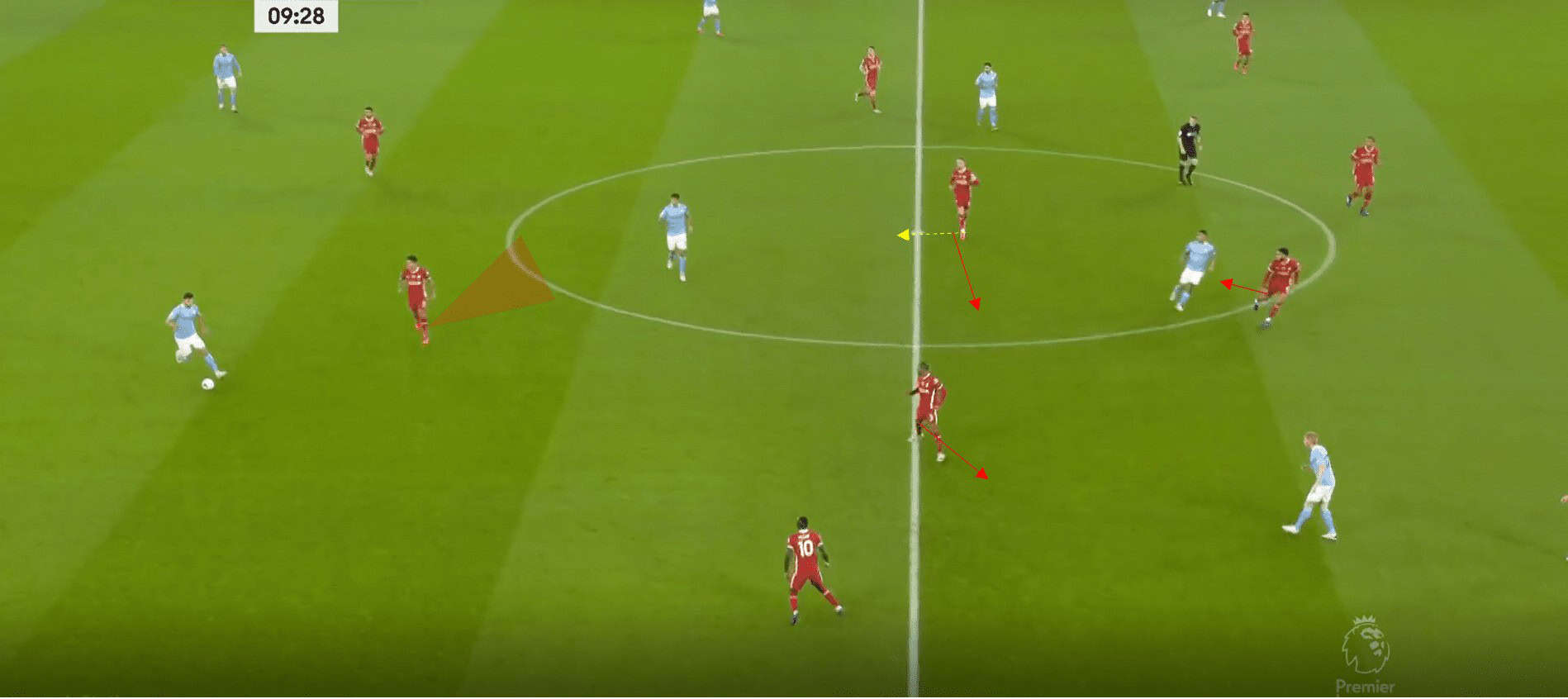
This sequence of play sums up the roles of Firmino and Salah when against a single pivot, which is what City used early on. We see Firmino has a scan for Rodri and arcs his run to keep him in his cover shadow. Firmino wouldn’t apply intense pressure on the centre back, as this would risk losing Rodri, and so instead he prioritised Rodri over pressure on the ball, leading to Liverpool not employing their usual very high press. We see the winger cuts access to the half-space and remains close to the winger, and so City go the other way.
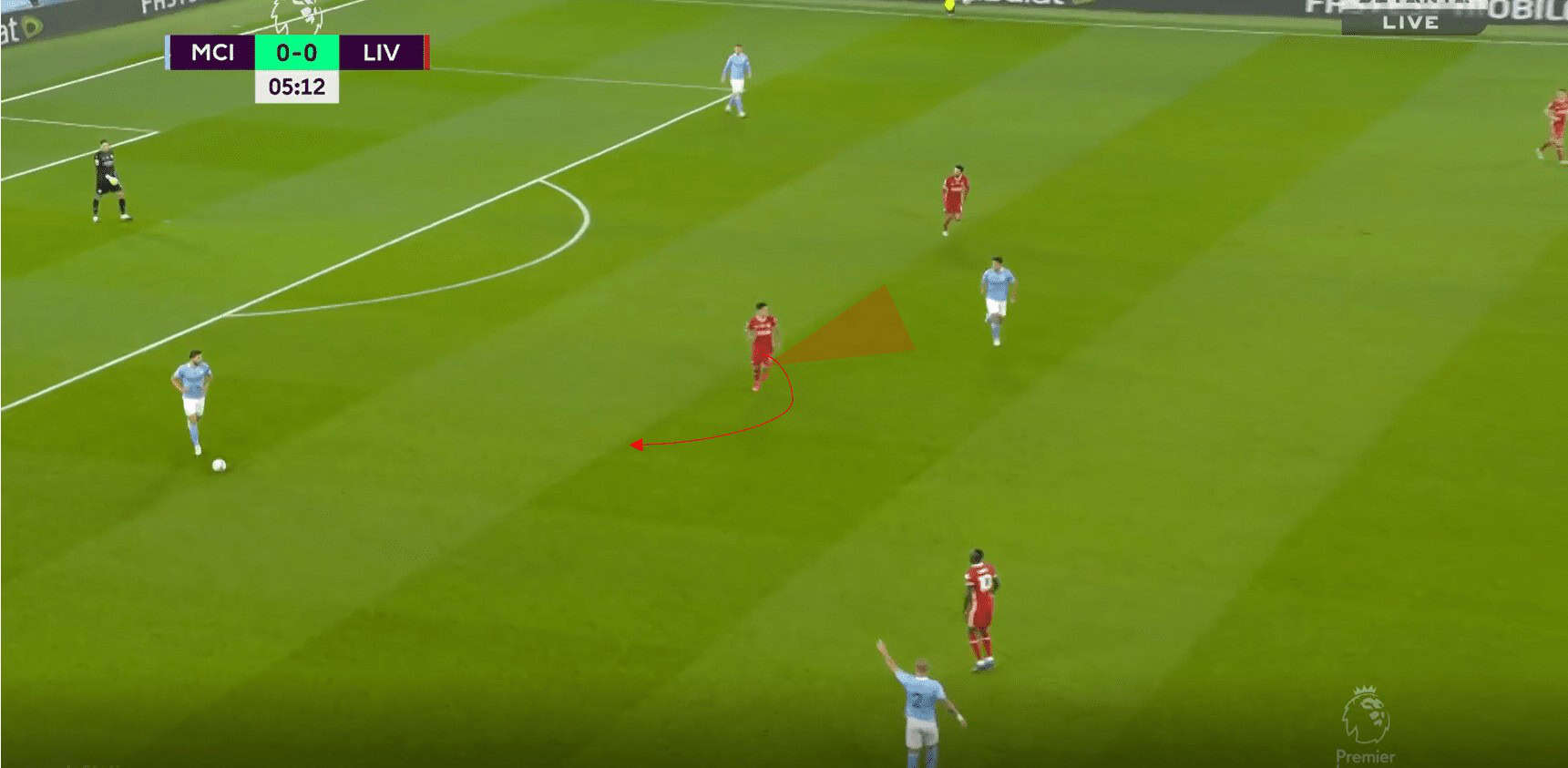
When the ball was worked across to the other side, Firmino would follow Rodri and prevent him from receiving the ball on the other side. Mohamed Salah would also be wary of the pivot, but he seemed more aggressive in his pressing and applied more pressure to the centre backs, which was allowed in parts due to Firmino taking up positions like this.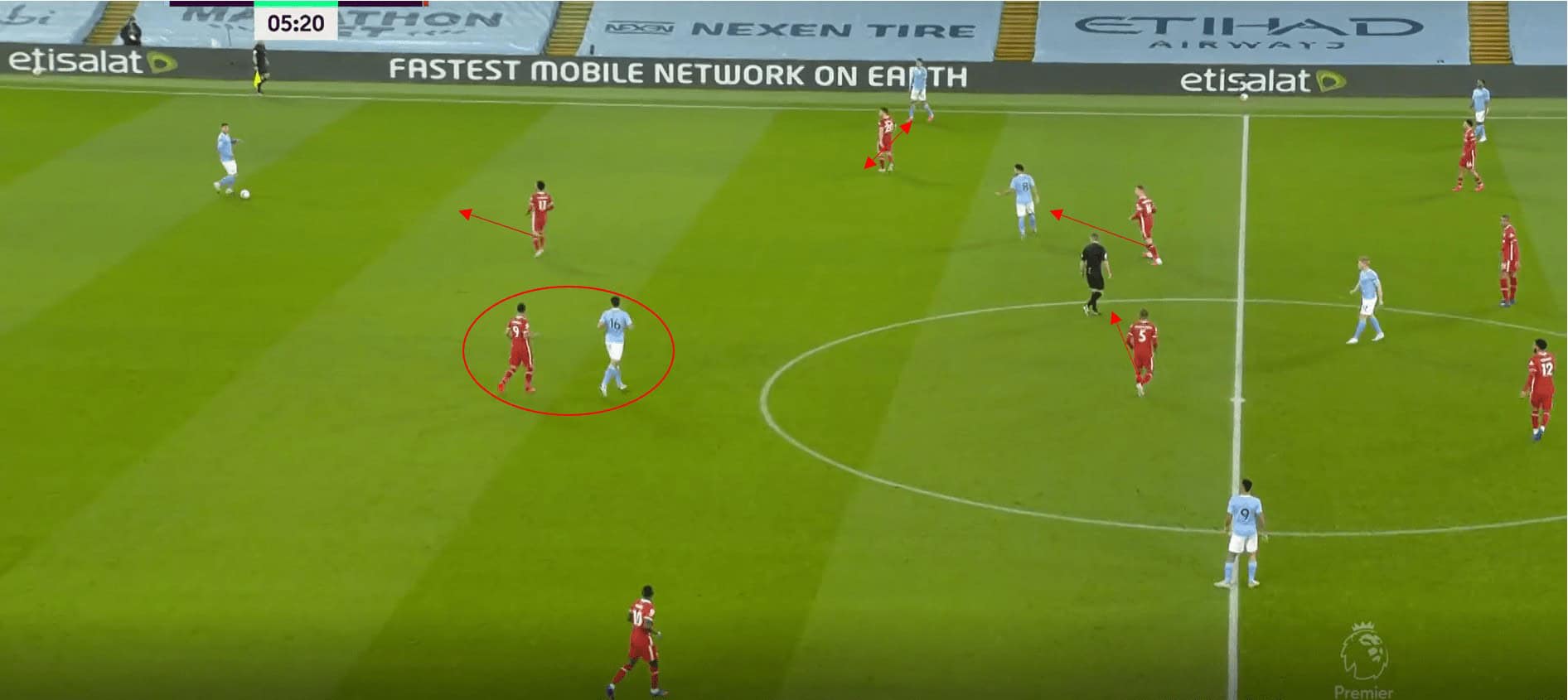
As we will discuss in more detail in the next section, City tried to use a variety of different build-up structures, but Liverpool were prepared and adapted well to each new problem City posed. We can see that when City sat in a double pivot, Salah and Firmino had to concentrate on keeping these players in their cover shadows, in order to still allow some coverage of the half-space and prevent City exploiting them in that area. Salah’s role was particularly altered, as he now had to be more passive and focus on the pivot behind him. As a result, City were under less pressure, and Liverpool generally sat a bit deeper.
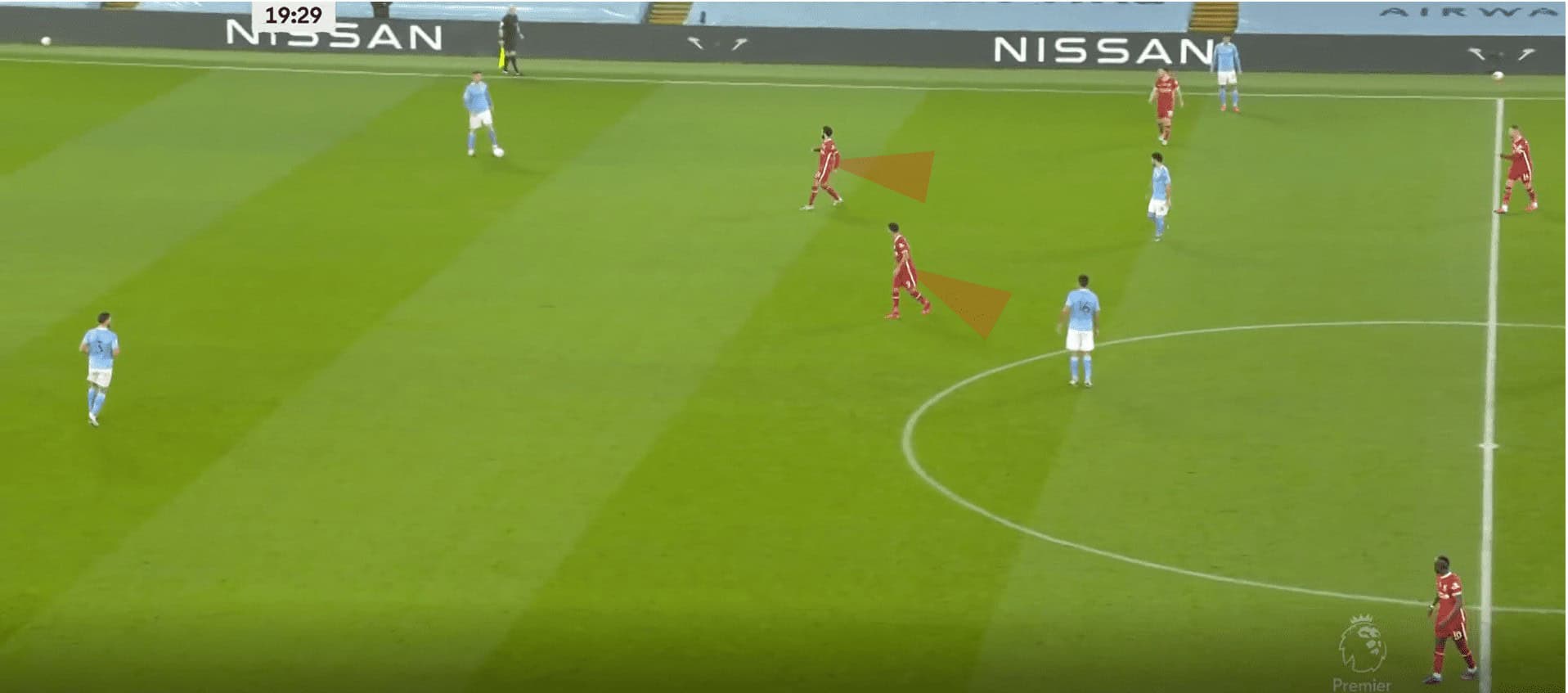
When City adopted a back three, Liverpool would still look to cut access to the pivot, and so less pressure was applied on the centre backs again as Liverpool were outnumbered. In situations like these, Liverpool’s wingers would often prioritise cutting the lane to the wing-back, and would then leave the half-space to be covered by the ball near midfielder.
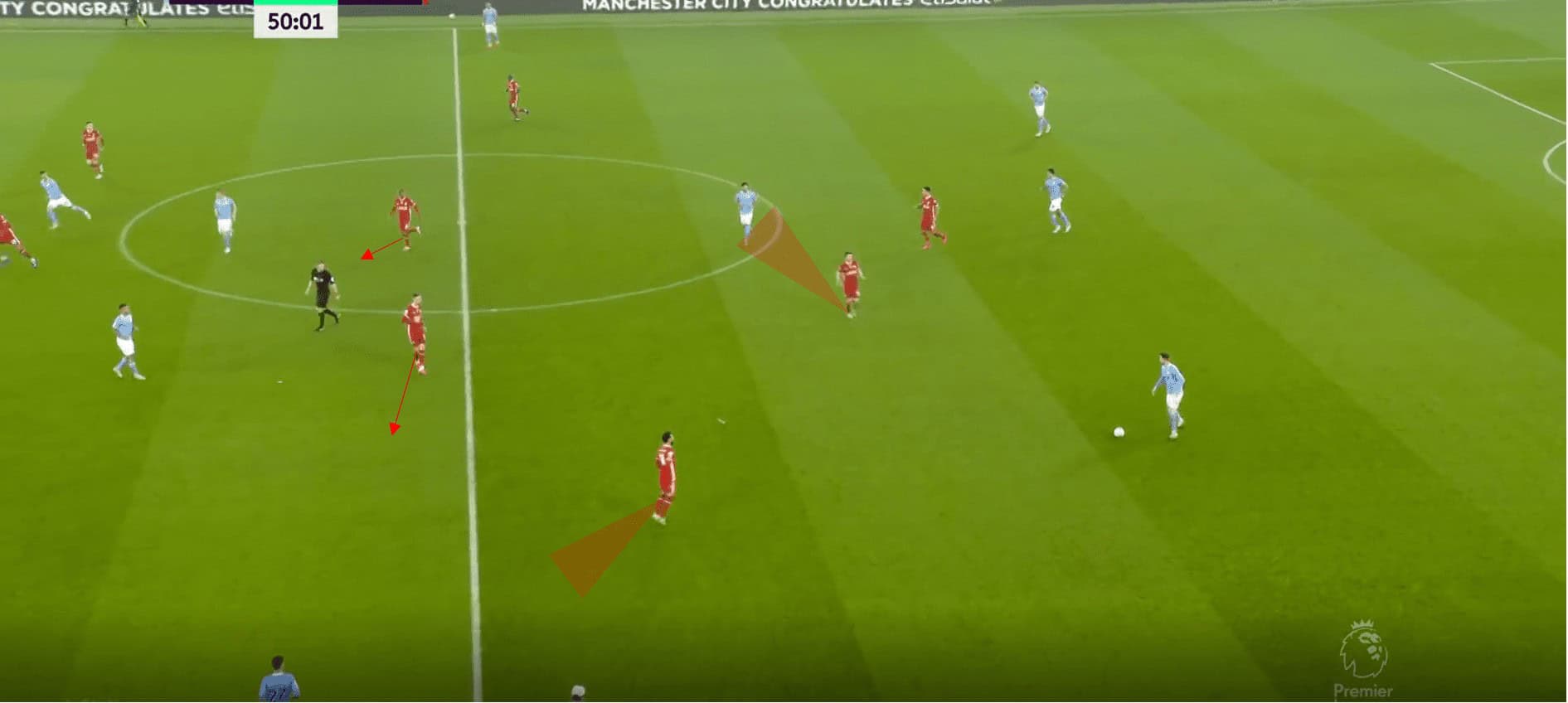
As a result of all this, Liverpool were generally in a stable structure throughout the game, and we can see an example of this stable structure again below. City struggled to find ways through the Liverpool press, but on occasions offered glimpses and ideas into how to penetrate.
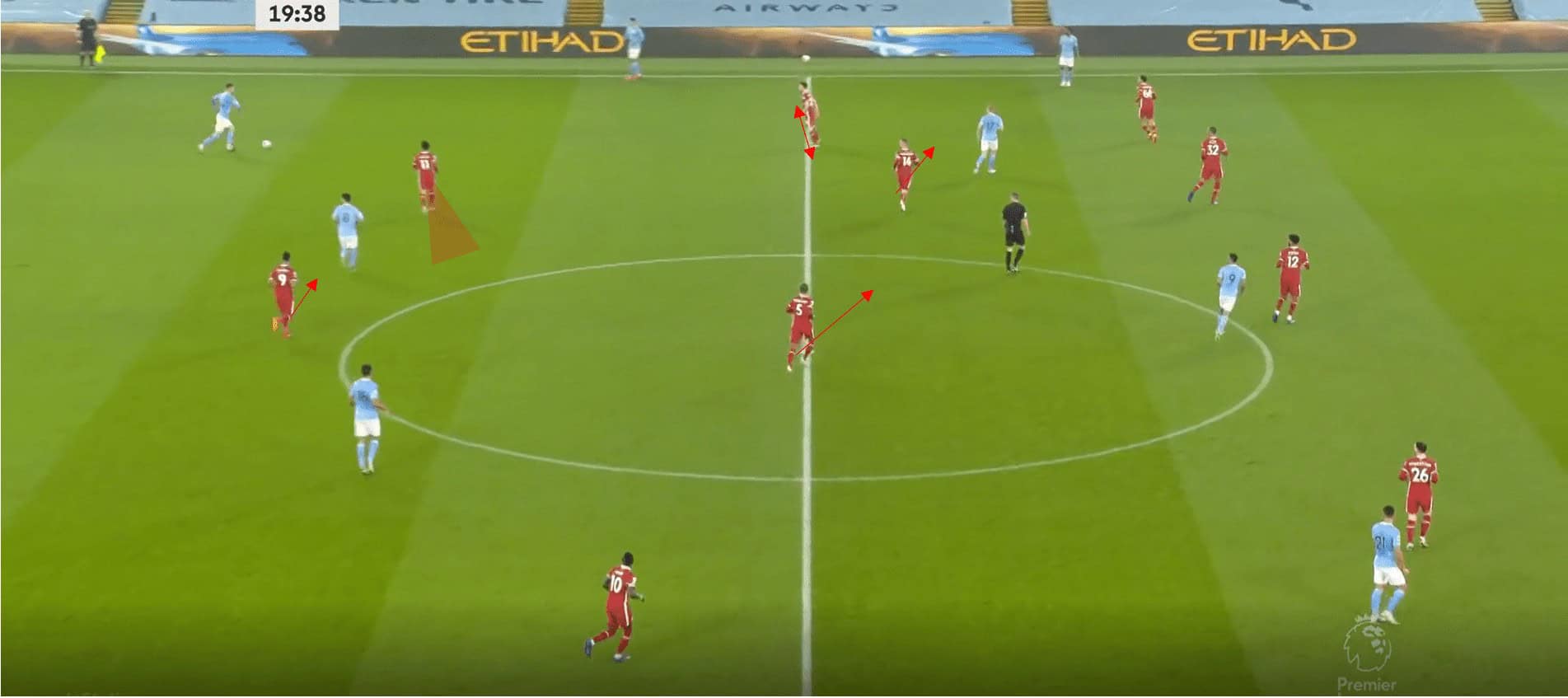
City’s positional play
With Liverpool in this stable structure, City struggled to build through, and in situations like the one below, they struggled to come up with a solution to the problem presented by Liverpool’s shape.
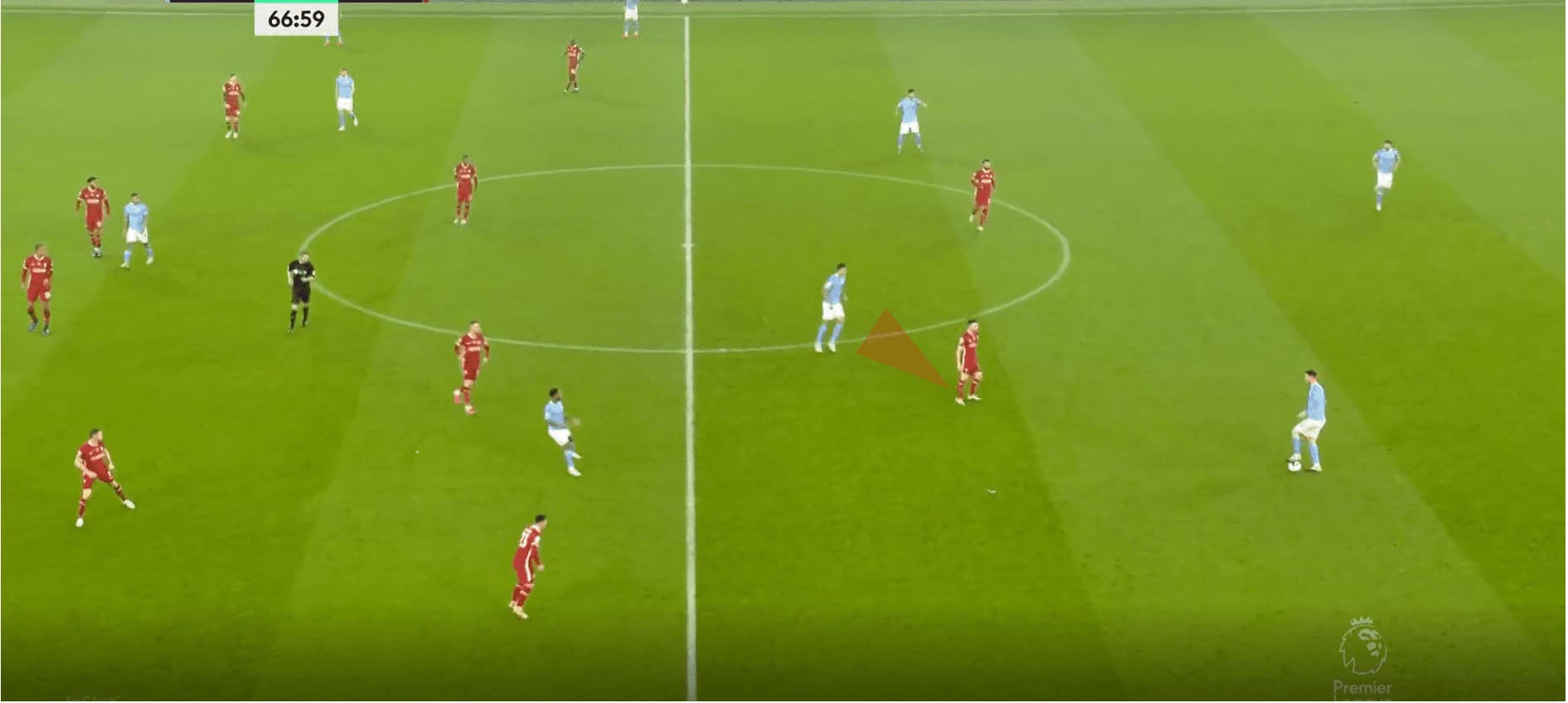
One of the most vital areas for City’s positional play was quick switching of play from side to side in order to open the half-space and central lanes, as so much of Liverpool’s compactness was dependent on the shuffling movements of Henderson and Wijnaldum. We can see a good example here where they are able to open up the central lane to find Gabriel Jesus. They drop into a double pivot, and the ball starts on the left, where City must engage Henderson to act to cover the half-space or act as wide as possible. They can then switch the ball to the far side, where another player must wait in the half-space to engage Gini Wijnaldum. Henderson, therefore, can’t cover this central lane if City play the ball quickly enough, and so play can be progressed.
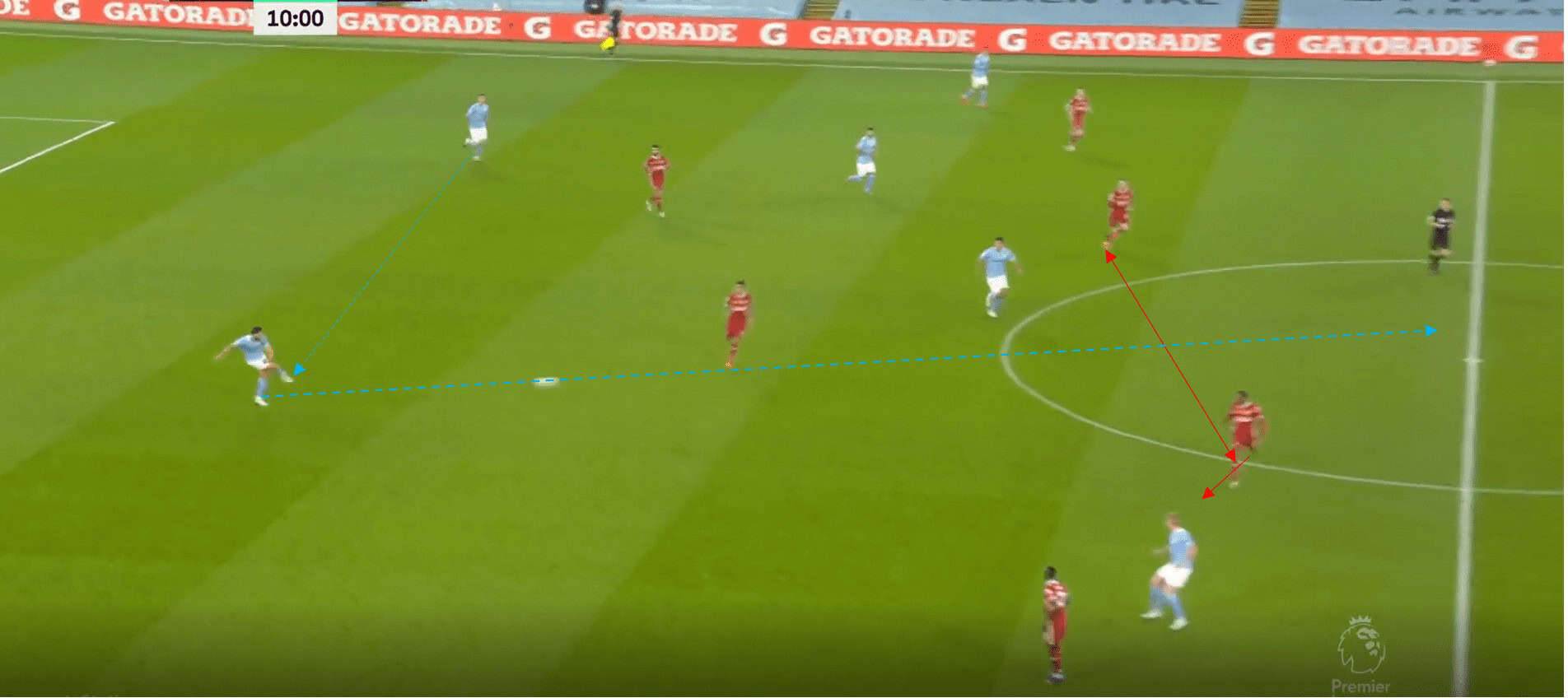
We can see the intention behind this central overload here, as a 3v2 can be created in central midfield by a dropping striker. Here, City don’t move the ball quickly, and so Henderson is able to stay narrow before acting in the half-space, while Wijnladum is compact enough to shuffle across. The space between the two players is optimal, and so if the ball is switched back again, they are in a position to deal with the pass.
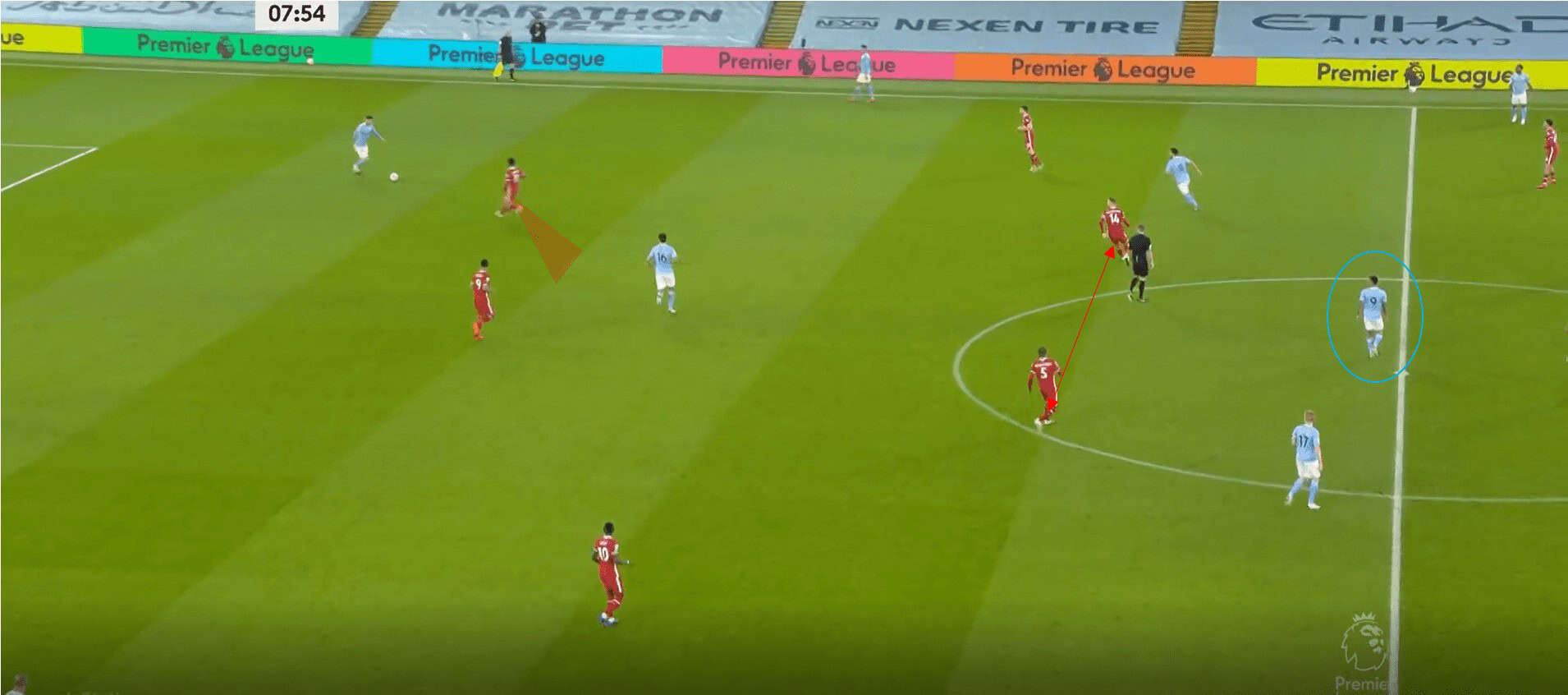
We can see another example where this central overload is created, and after a quick switch in play, City are able to access it. Here, City drop into a back three. This enables their backline to spread wider, which benefits them in switching play, and as I mentioned, generally reduces pressure on the ball. This helps City to therefore access this central area, however despite being in a fairly good offensive structure with a half-space player and a plus one (overloader), Liverpool are still in a decent structure defensively, and Gomez follows Jesus while Henderson does just enough to get back in and nick the ball. Liverpool can then counter-attack from a nice central position, which increases their passing options.
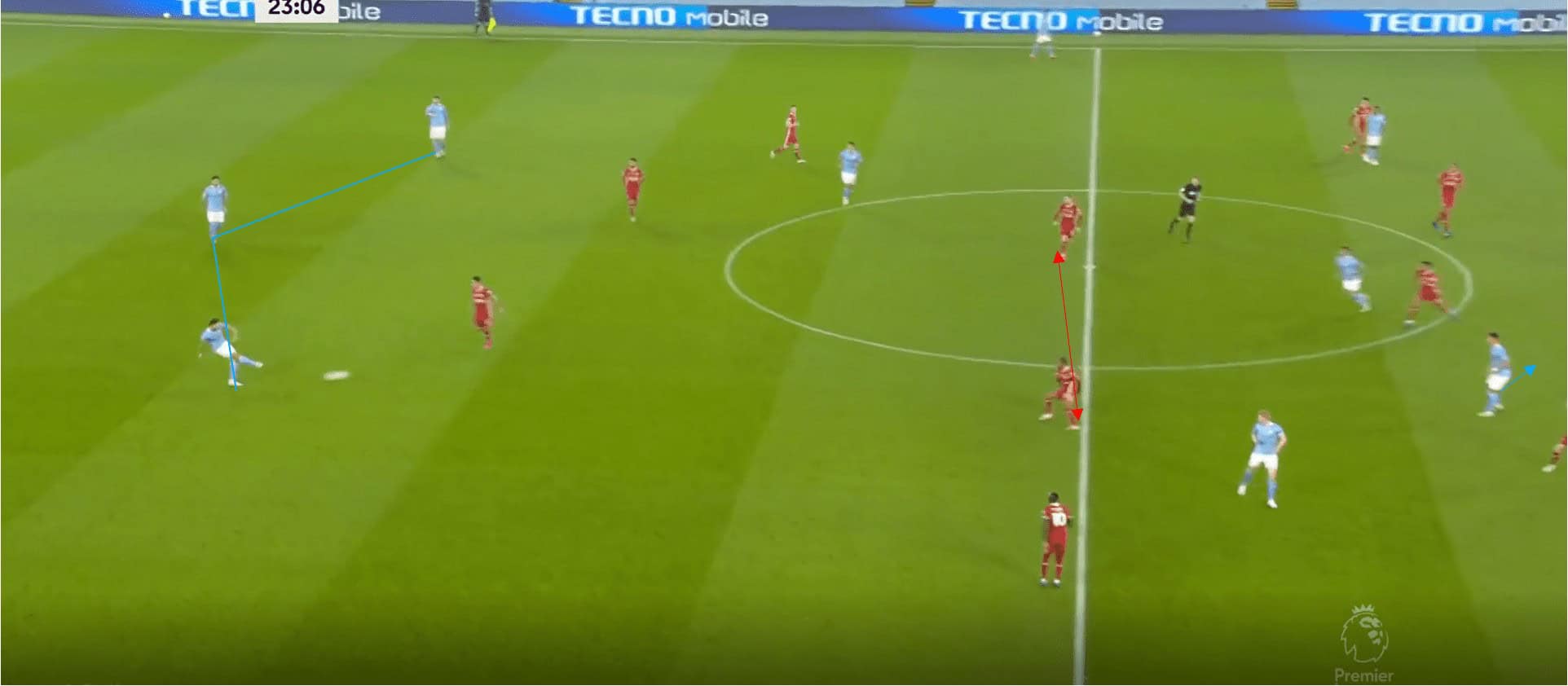
Here, while again forming a back three, City switch play quick enough to force Diogo Jota to move narrower to cut access to the half-space, which in turn leaves the wide lane open. Once the ball is worked into this area though, despite forcing Alexander Arnold to press wide, City are unable to progress the ball, as Liverpool’s backline simply shuffle across and pick up the next player. City desperately miss a spare player here to drop deeper or move higher to create an overload on the defenders, as here Liverpool are in a 3v3.
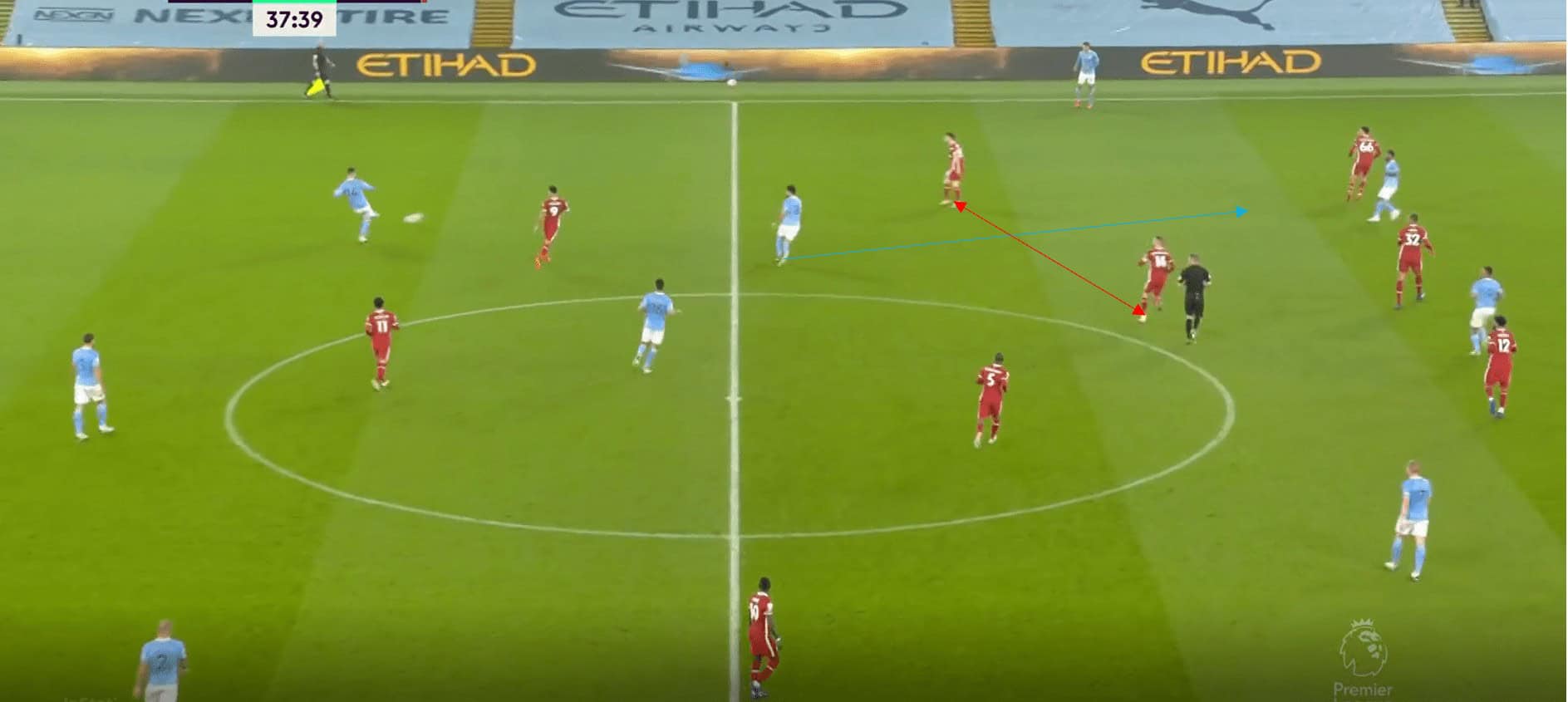
Here with City in a back three, Xherdan Shaqiri presses to cut the wide lane, and so leaves the half-space slightly open, forcing the full-back to cover this area and for a striker to go up against Matip. Again though, Liverpool are able to control this space once the ball is played in, and City desperately miss another player on the same line as De Bruyne for him to play a sideways pass into, which could create a 2v1 on Matip. Alternatively, the wing-back could make a movement down the line to receive from De Bruyne.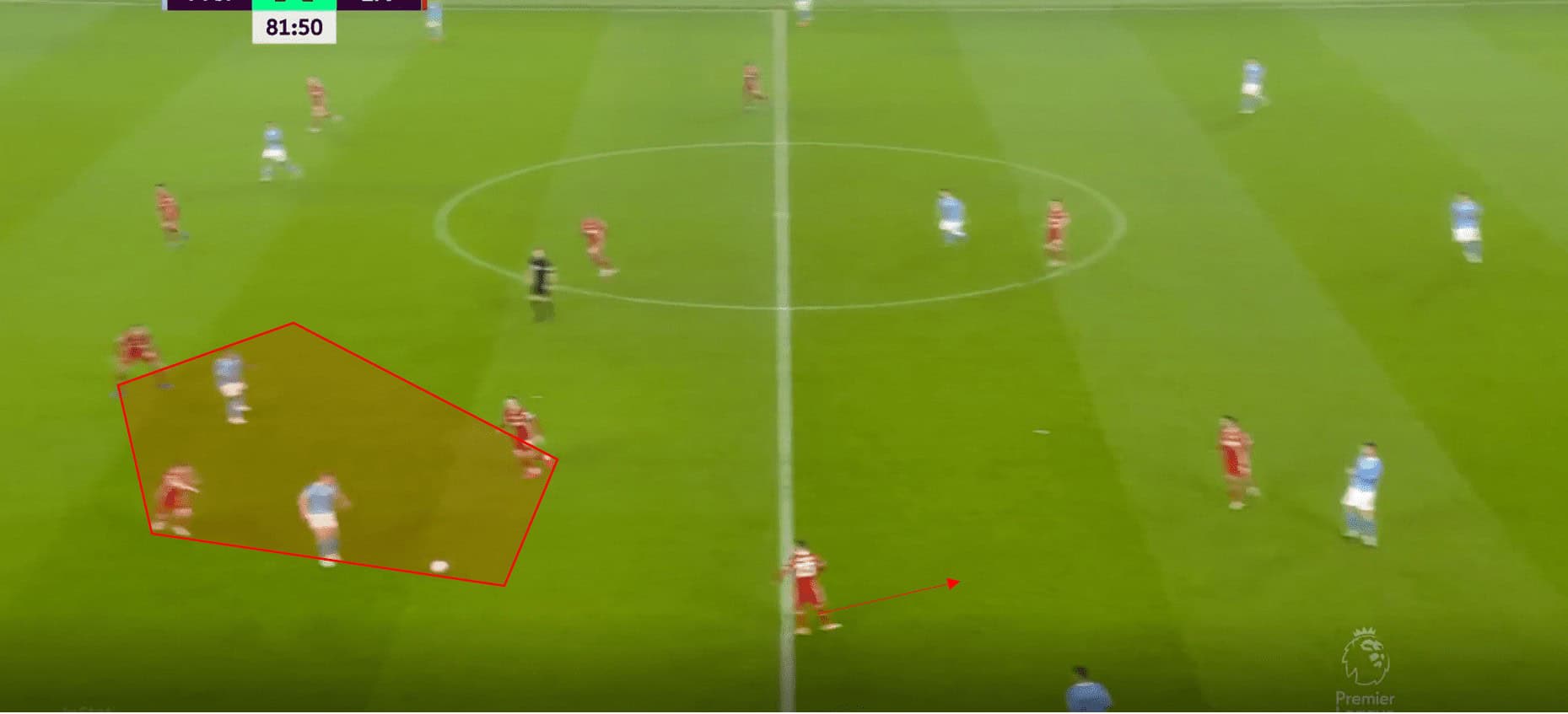
City tried different ideas but ultimately struggled against Liverpool’s defensive system, with the Citizens only generating 0.53 non-penalty xG according to Wyscout. The back three particularly seemed to help them progress the ball, but this required more players back, especially when they dropped into a back three with a double pivot, and so it became difficult to create an overload without upsetting their rest defence.
Liverpool’s failed trap costs them a goal
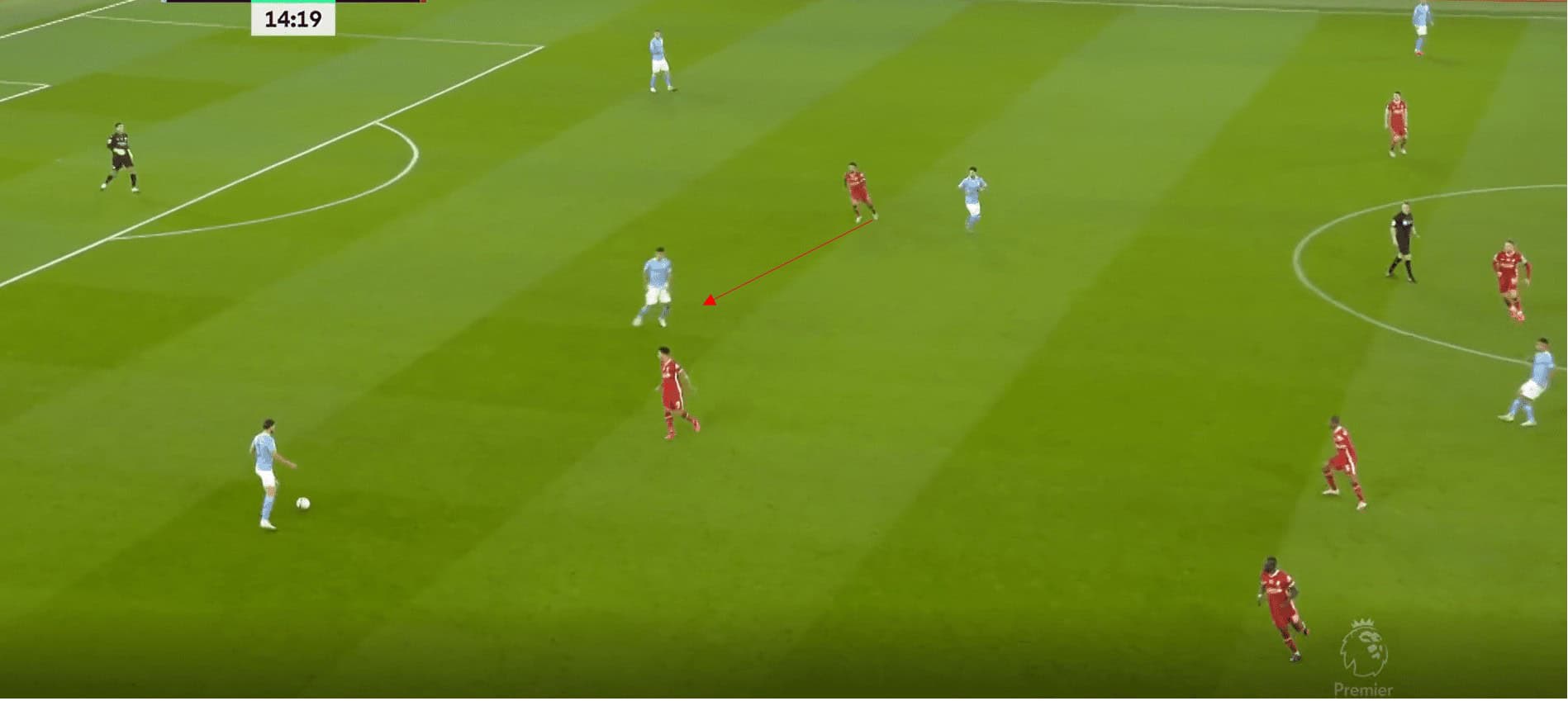
City did get their breakthrough in the first half, and it came as a result of a poorly executed trap by Liverpool, which they actually used more than once in the game. The trap involved Mo Salah and was triggered by City dropping a pivot into the back three in order to escape a striker’s cover shadow. We can see an example below where Rodri is initially covered behind Firmino, so he drops to form a back three and create a lane for himself to receive. Liverpool seemingly prepared for this, as whenever it happened, Salah would aggressively press this player at an angle to prevent them switching the ball. City avoid the trap here and go back to the keeper.
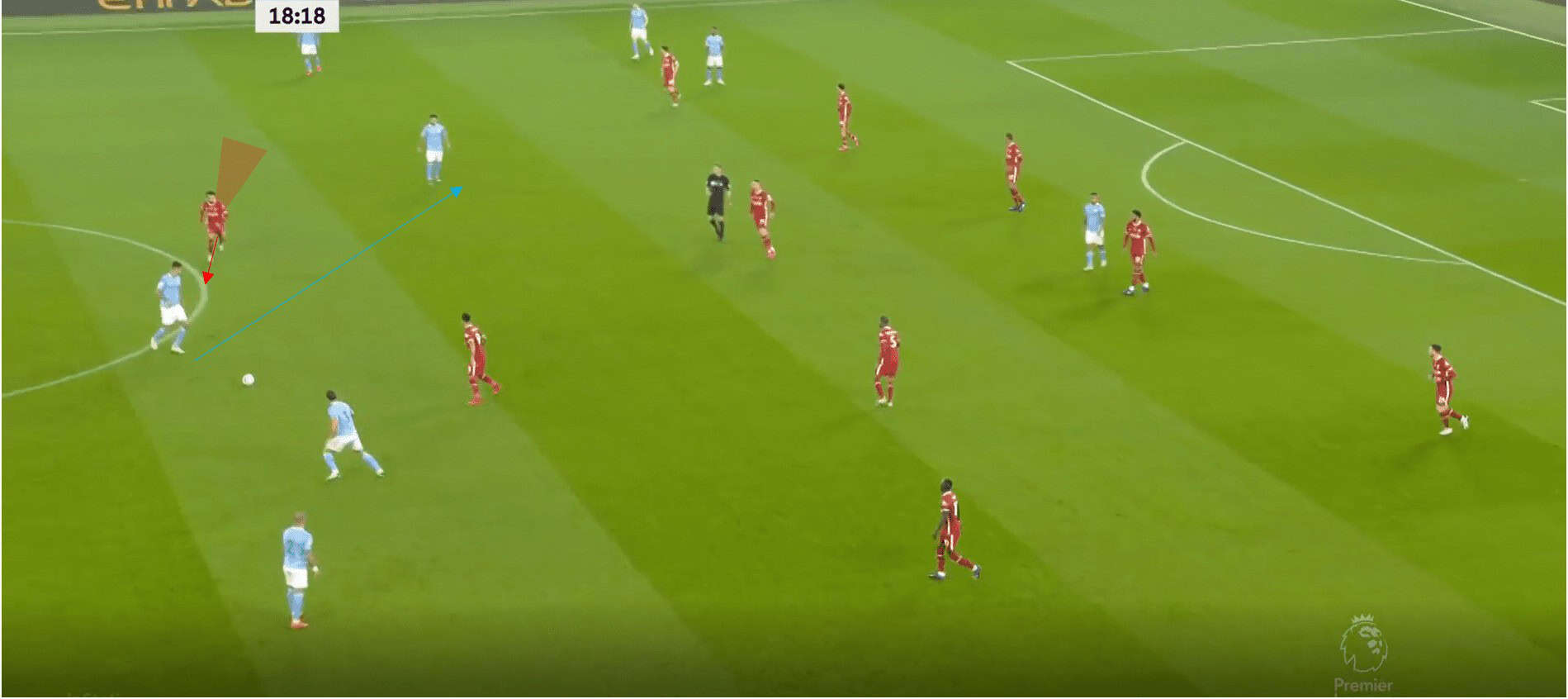
We can see another example of this trap below, where Rodri receives out of Firmino’s shadow, and so Salah presses in from an angle to prevent a switch. Salah gets his run slightly wrong though, and doesn’t cover the switch in play, and so City can progress play well.
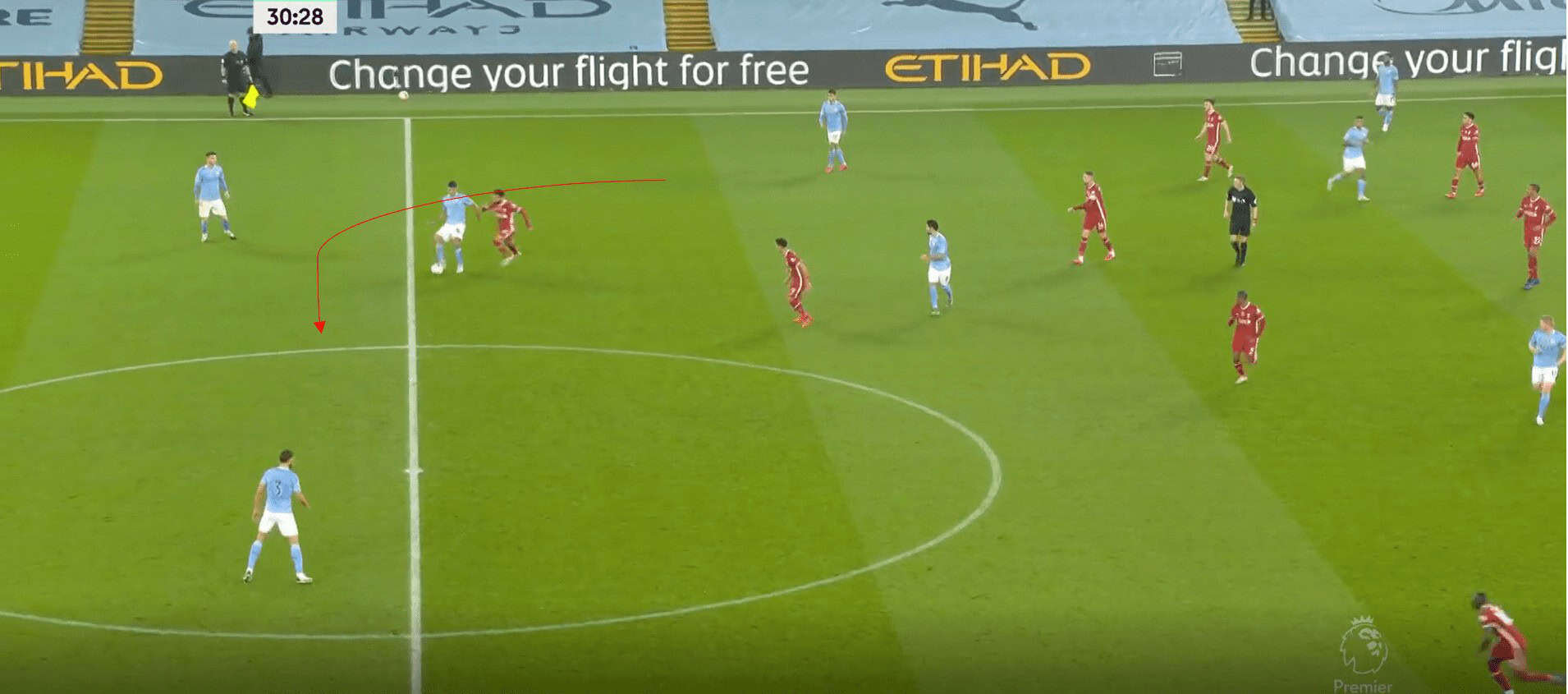
For the goal, Rodri receives the ball and Salah makes this same run to cut off one side of the pitch, The problem here though, is that he continues this pressing run slightly, and so he runs too far and acts as if he is going to cut the lane to the wider player. Mané seems to respond to the pressing run of Salah, who makes play predictable along with Firmino.
Salah continuing his run means that the lane back to Rodri is left wide open, and so City have an easy way out of the trap. Mané leaves the space behind him with his pressing run, but he only seems to respond to the run Salah makes, and if Salah cuts the lane to the pivot here as he did all the game, Liverpool have cut off most nearby options and have a decent chance of winning the ball or forcing Man City deep. Instead though, City exploit the space well and score.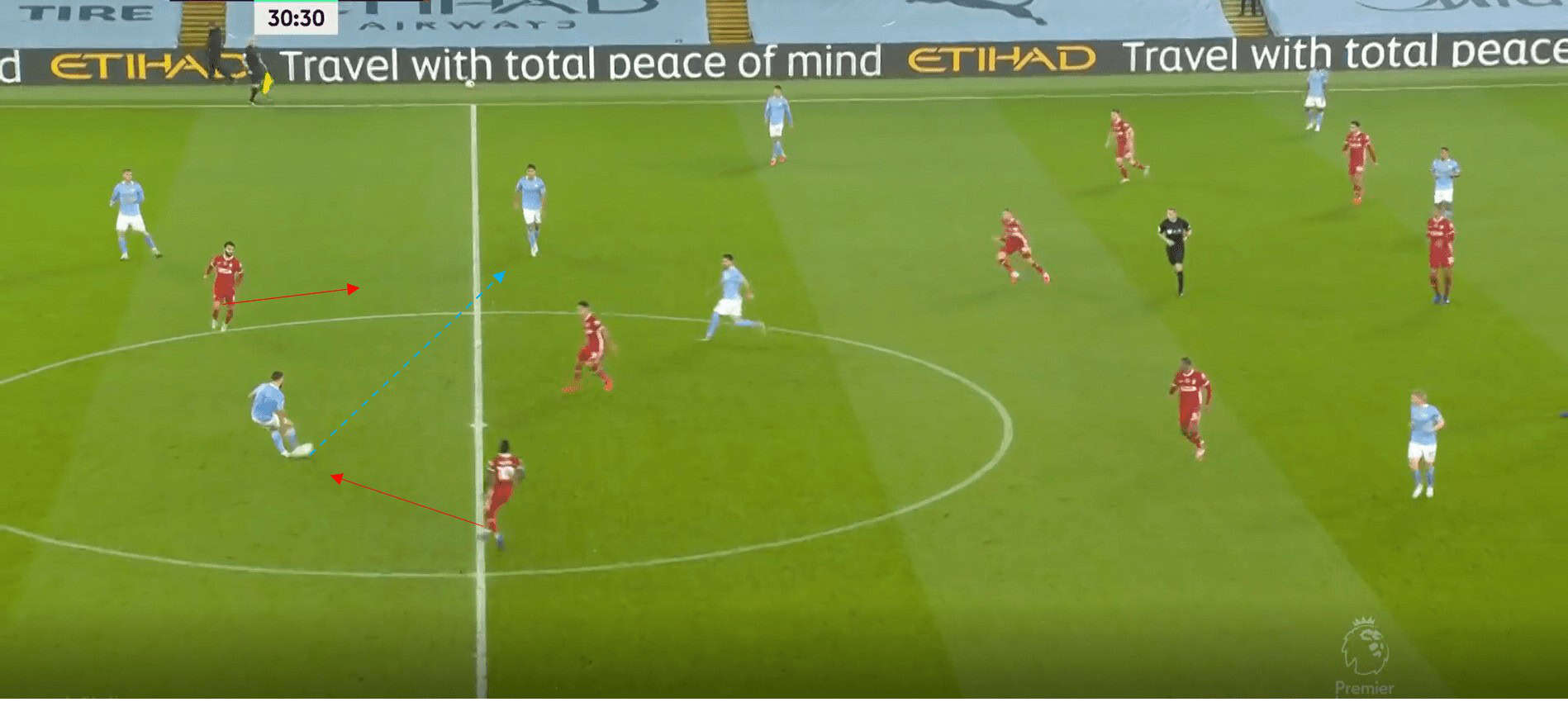
City press against Liverpool’s build-up
Liverpool’s pressing structure has been praised heavily, but City’s pressing structure also deserves the same praise, as Liverpool were often unable to play through City and resorted to trying to play over them often. We can see City’s pressing scheme below, which often mirrored Liverpool’s in its 4-4-2 shape. Players often had the same roles as seen in the Liverpool press too, with the ball near central midfielder in the half-space here while the striker cuts access to a pivot. Sterling is able to intercept the ball here thanks to his good positioning between the wide zone and half-space.
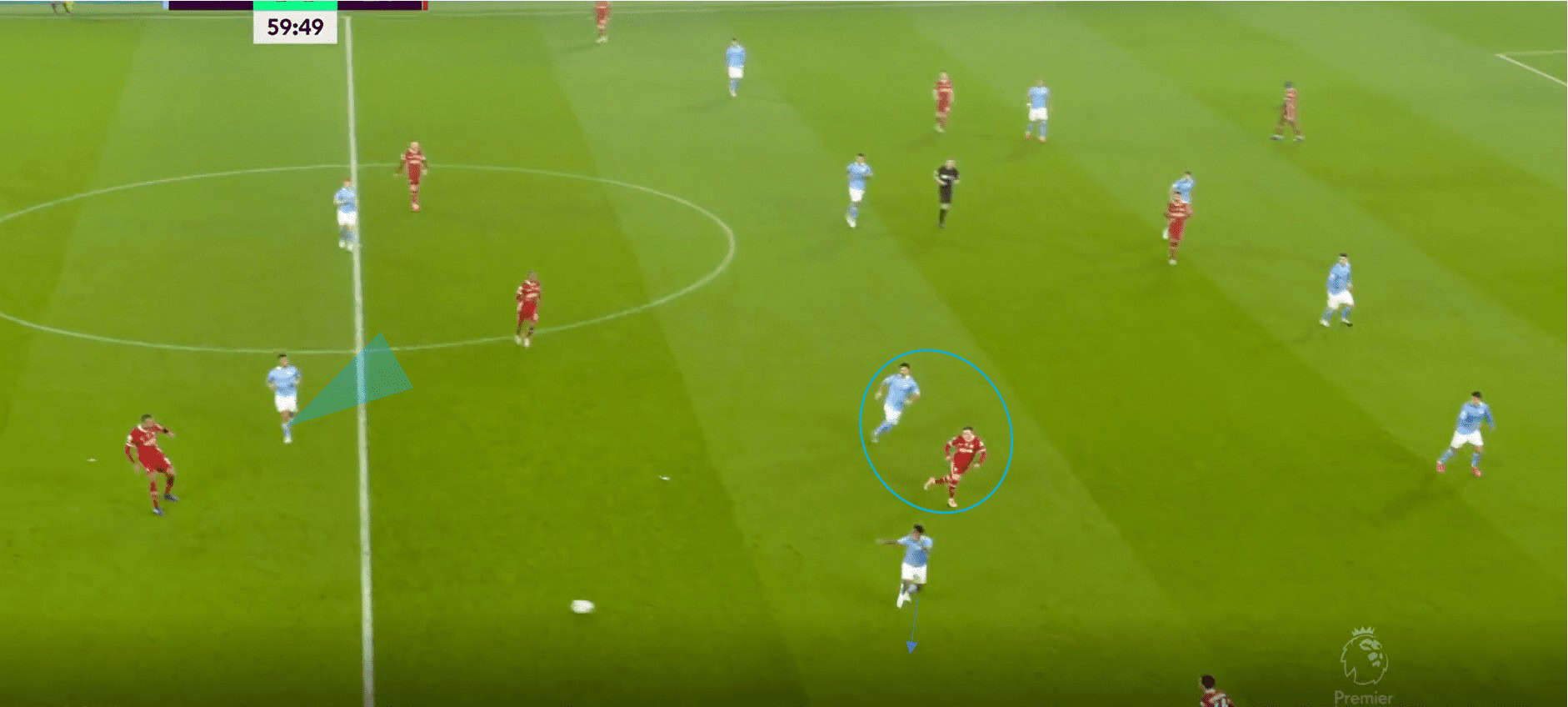
The main difference in terms of the presses was probably the intensity of both teams, with City pressing more intensely and higher up in the game generally. PPDA reflects this, with Liverpool allowing 16.76 compared to City’s 11.63. Liverpool struggled to build through the press throughout the game, and we can see an example below where they create no free options for Alexander Arnold, and so instead they decide to go long, something they did often.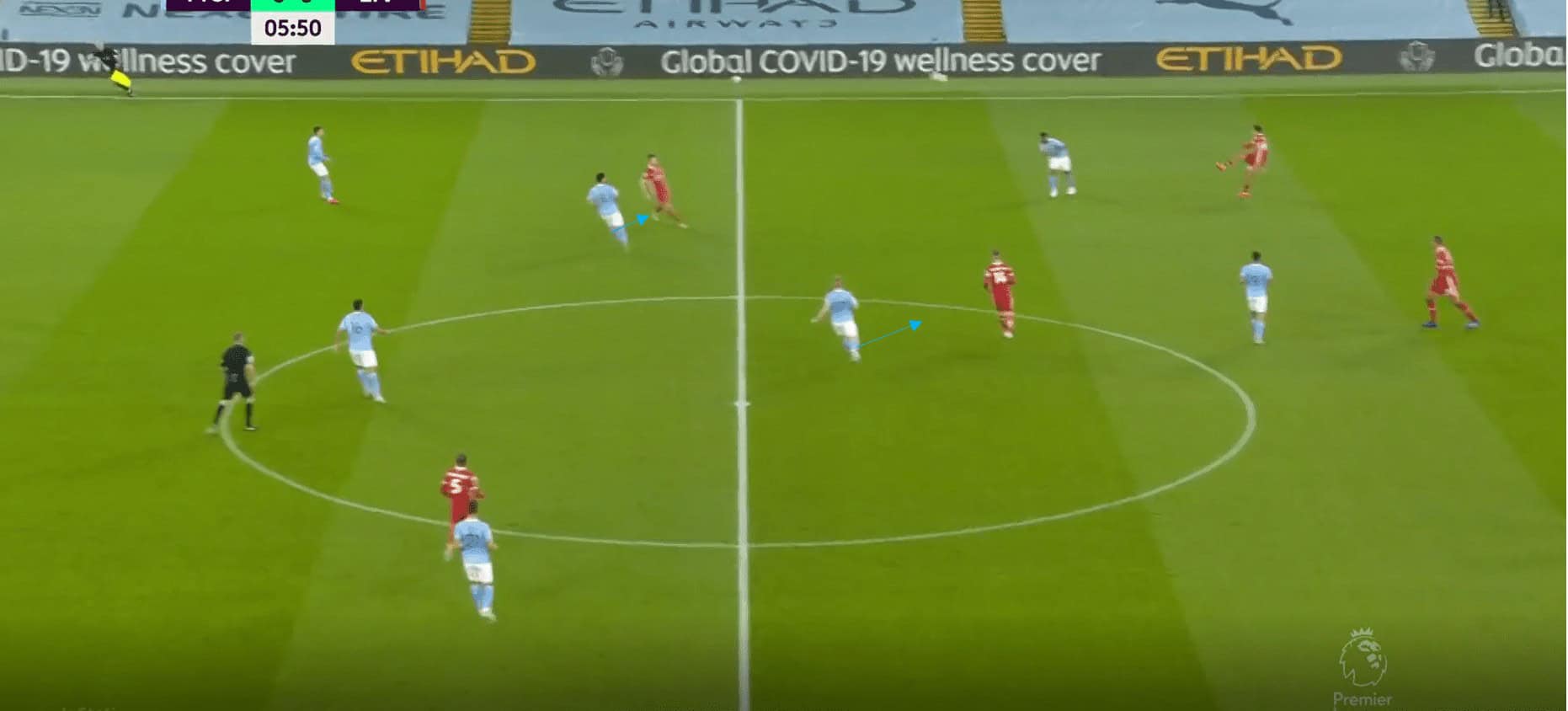
Liverpool also tried their own variations at trying to break the press, and one such example was their use of a back three to access the half-space. Alexander Arnold and Wijnaldum pin the opponents just enough to open the lane to Salah, who can then use Jota who is positioned slightly deeper. Liverpool would often go into this 4-2-3-1 structure, with the movement between the forwards fairly fluid.
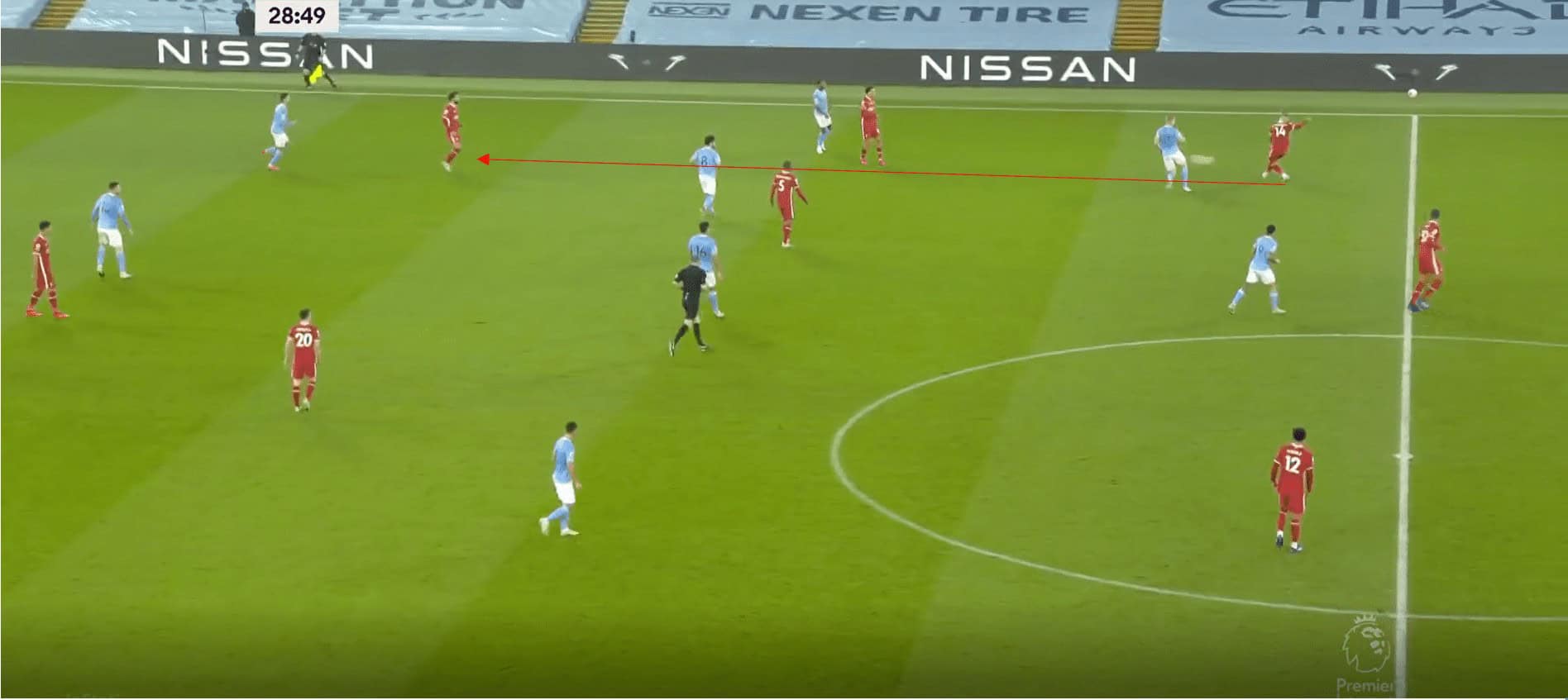
One common problem City found was that they were not vertically compact enough between the defence and midfield, and so Liverpool would often drop deeper to receive the ball both in transition and in the build-up. We can see an example below where this hurts them, with Matip able to access Jota with an excellent pass. City didn’t seem to want to follow Liverpool’s dropping forwards, which is in credit to the threat in behind of Liverpool’s forward line, but Guardiola seemed to fix this later on.
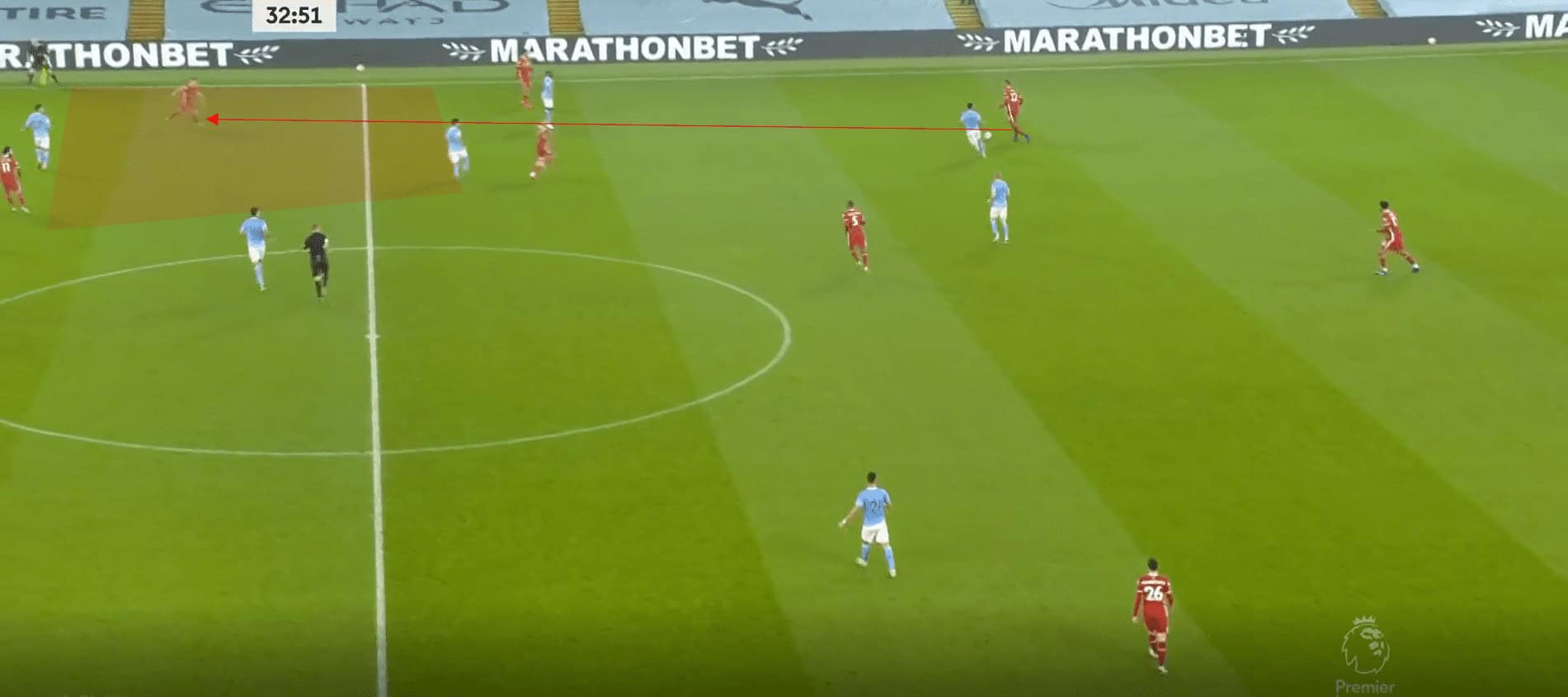
We can see an example of Liverpool in transition here below, where Salah and Firmino would often drop deeper to receive, while the two wingers would then move forward to stretch play. Liverpool were excellent at filling lanes while counter-attacking, and they relied heavily on the forward movements of their central midfielders.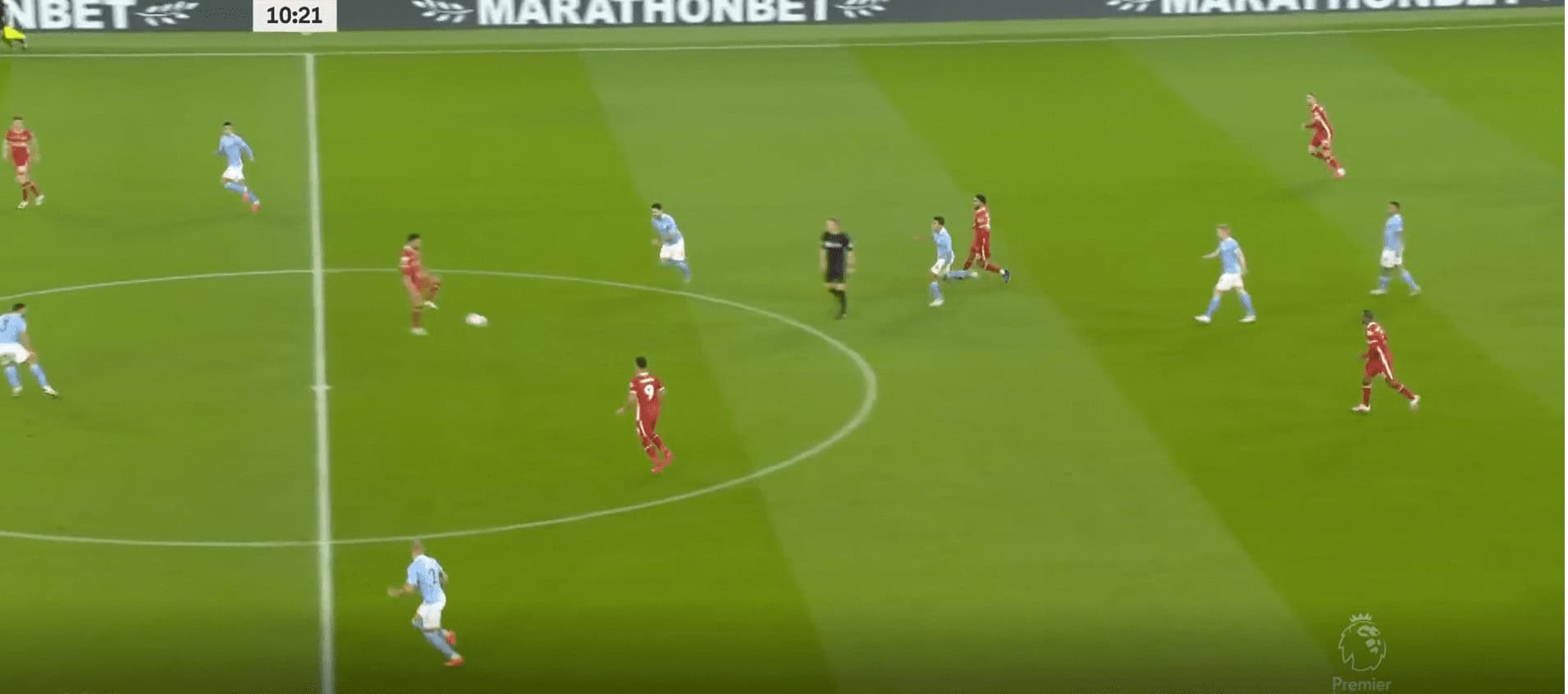
We can see again here, Frimino drops between the lines to receive pass, while Salah’s forward run helps to pin back the City defence.
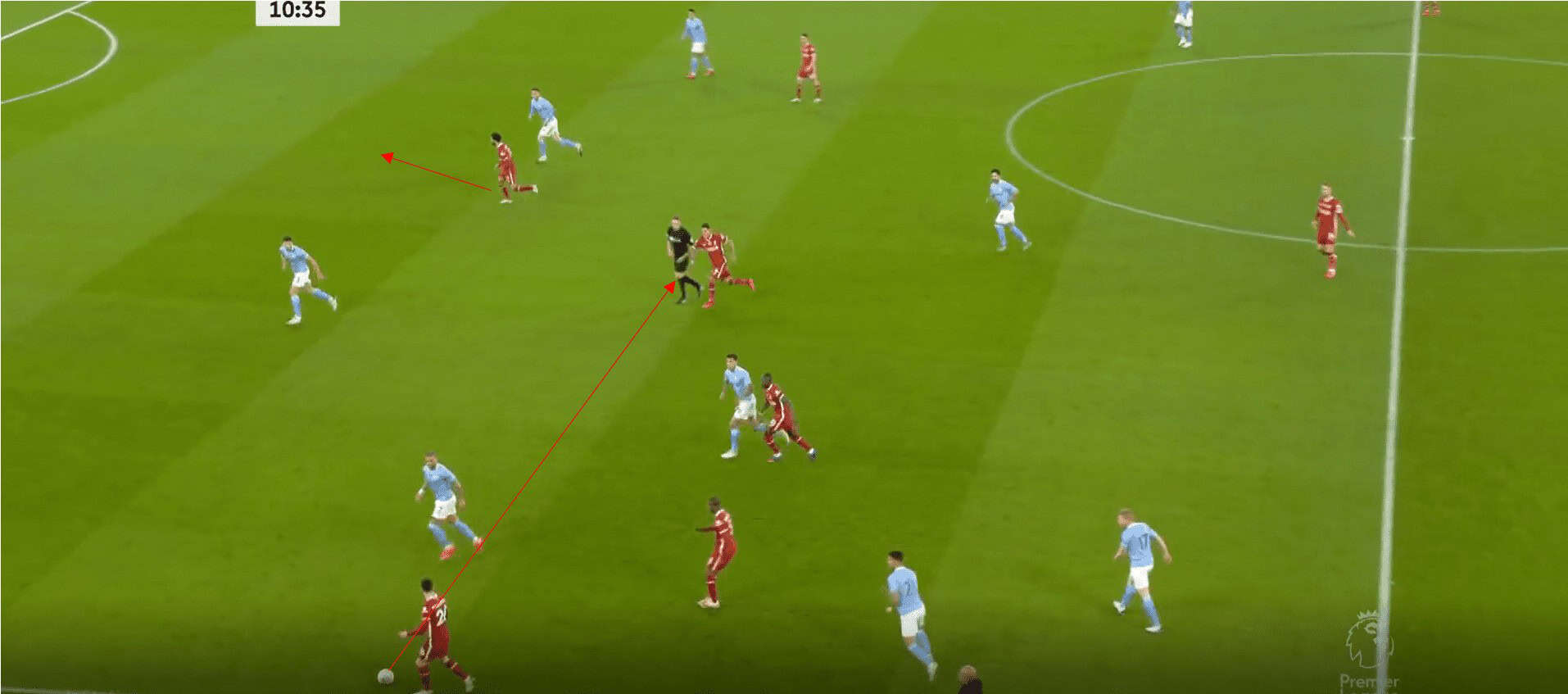
Liverpool relied on forward movements by their central midfielders once they had passed the ball, both in transition and build-up, and we can see an example of this below with Henderson. Liverpool would often play direct down the line to then look to access a central midfielder, who would start from deep unmarked (but covered by striker’s cover shadow) and then receive higher. Liverpool could then play through to the forwards, with City’s midfield allowing the ball through from these areas.
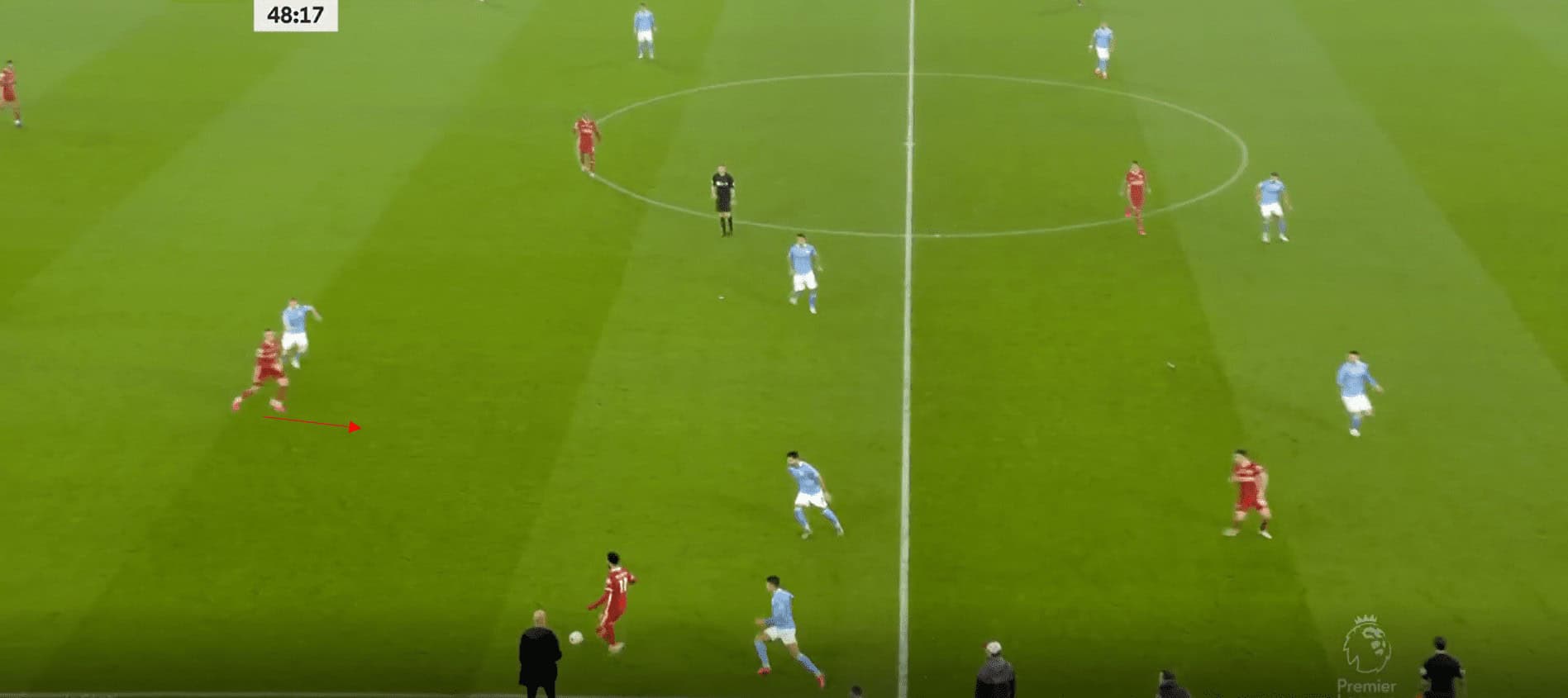
Liverpool, on the whole, were better at creating overloads than Man City I felt, but at times they failed to utilise them effectively. We can see an example below where they utilise the overload well, forming almost a box midfield to break City’s 4-4-2 press, with a 2v1 overload placed on City’s right central midfielder here.
On a few occasions, Liverpool just didn’t seem to recognise the situation and understand that they had created an overload to use. We can see an example here where Liverpool from a back three and have access to the pivot, with a switch in play to a far midfielder available. If the ball had been moved quicker, Salah could perhaps have created a central overload and received a pass.
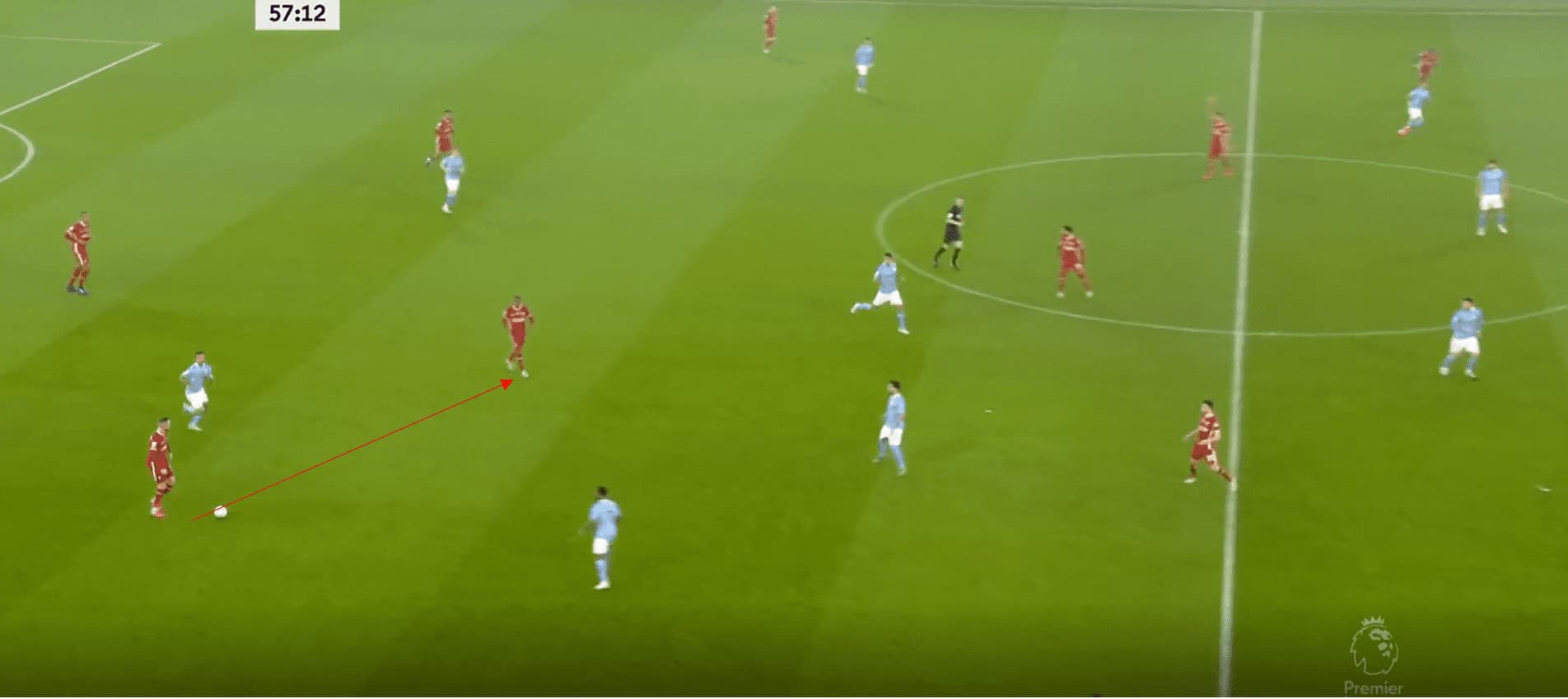
The same applies to this situation here, as with the half-space player able to receive here, why not use him to access the pivot. If they are able to work this pass to the pivot, Henderson has a large central space to play through as well as a potential to switch play. Liverpool became a bit too dependent on going over Man City, and Matip’s decision making here is poor. He had an excellent first half, but his passing and decision making seemed to dwindle as the game went on.
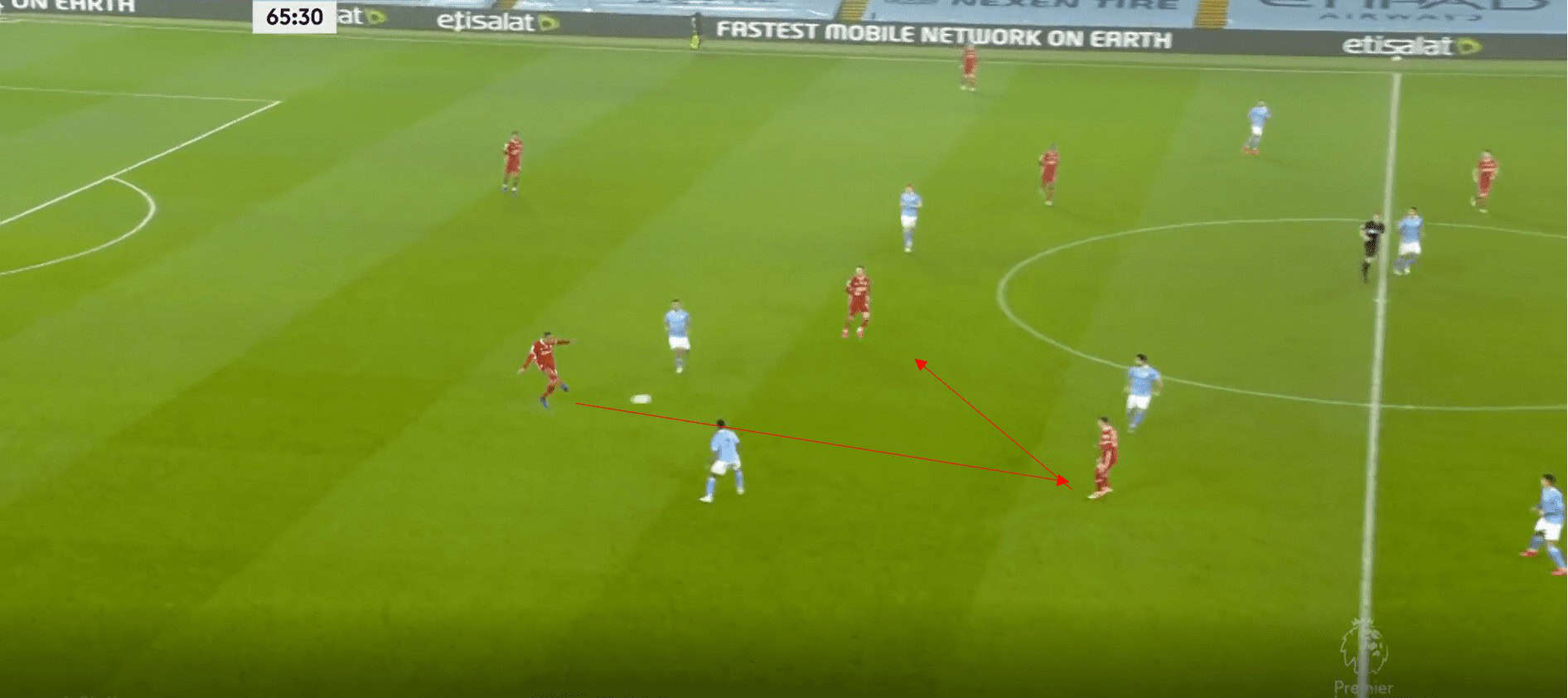
We can see in this example that the structure is again there, with Liverpool in a back three to increase access to the half-space. Wijnaldum is given space by City and Salah works the ball to him, but Liverpool don’t complete the final step, with Shaqiri perhaps too close to City’s second line.
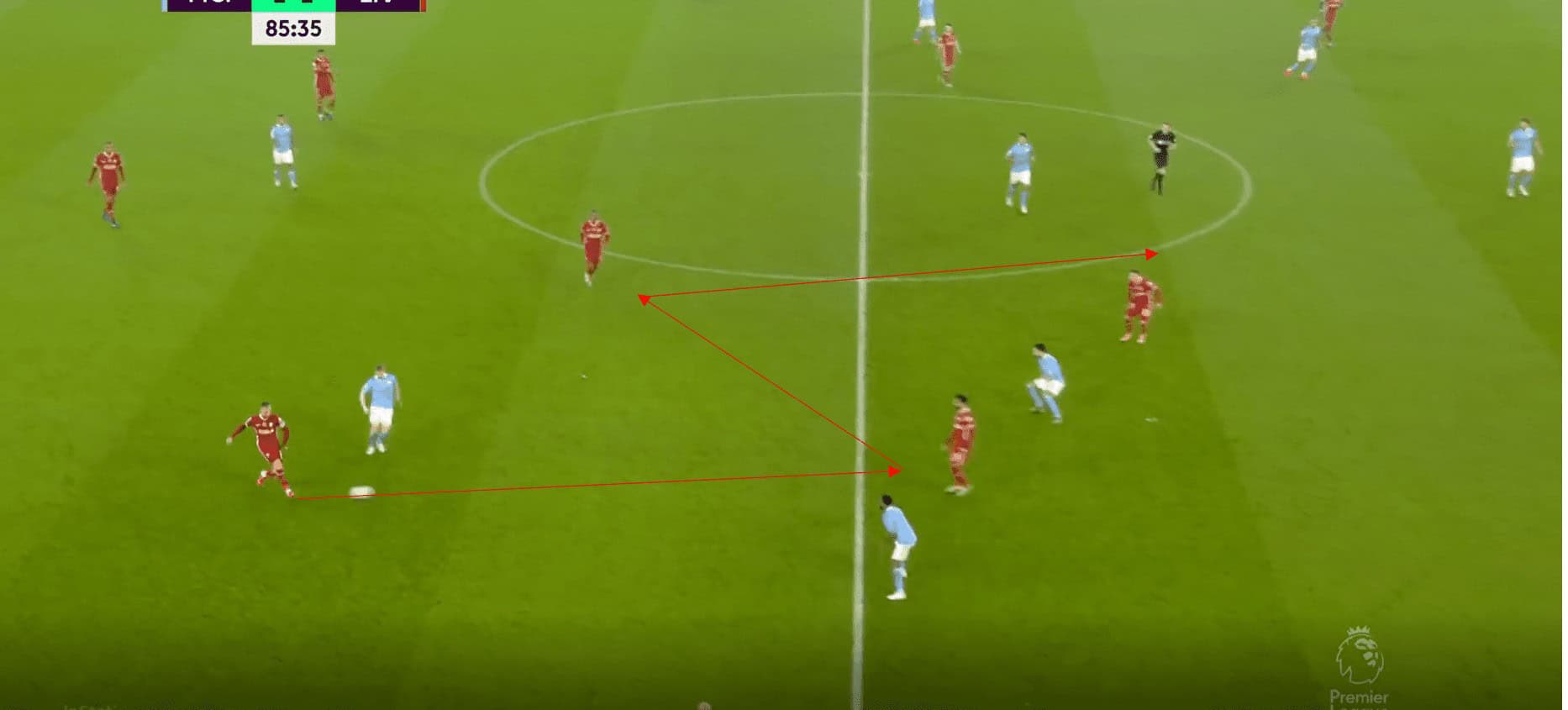
Here Liverpool threaten that central overload we discussed around Man City, with two forwards dropping in here to create a 3v2 overload, but again they are unable to find Shaqiri through the centre, which is in some part credit to City’s pressing doing enough to put them off.
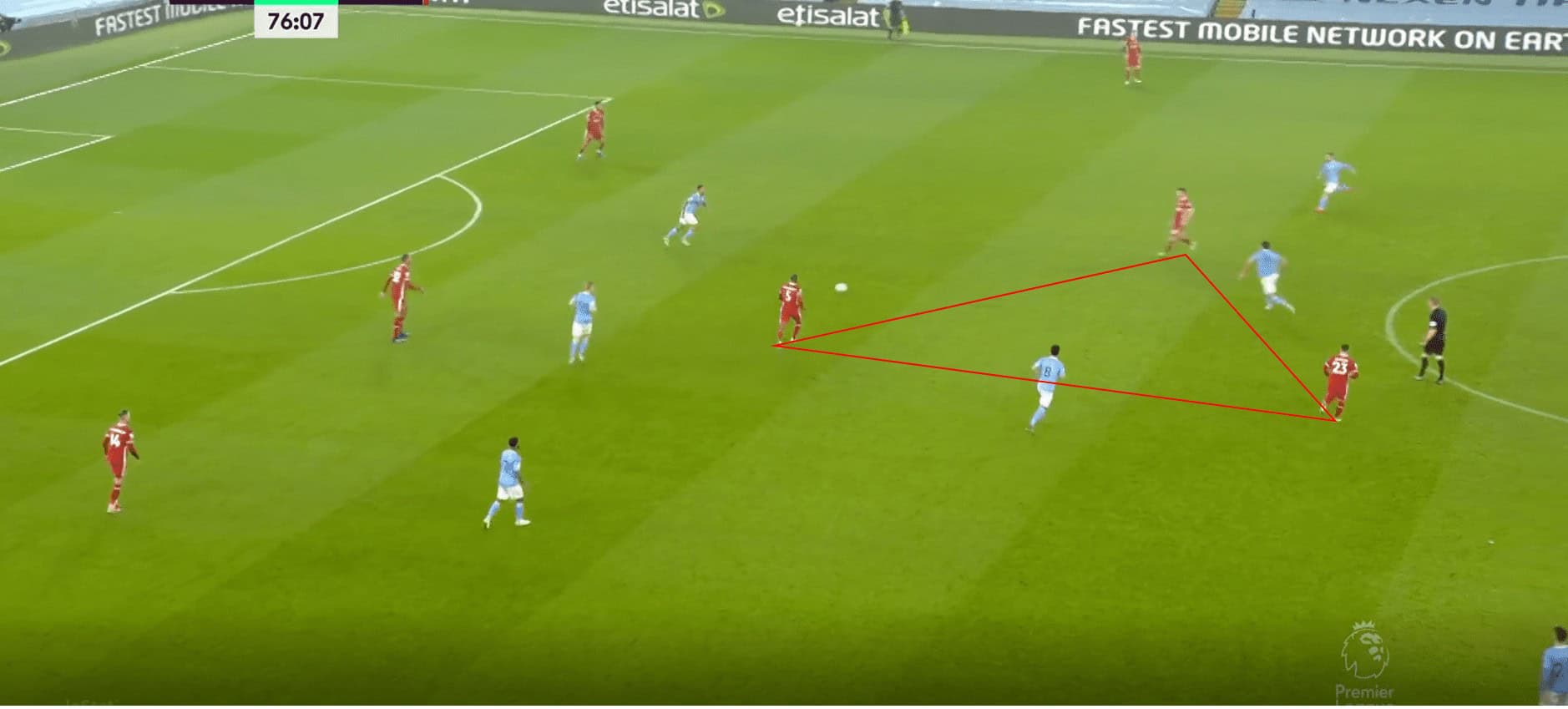
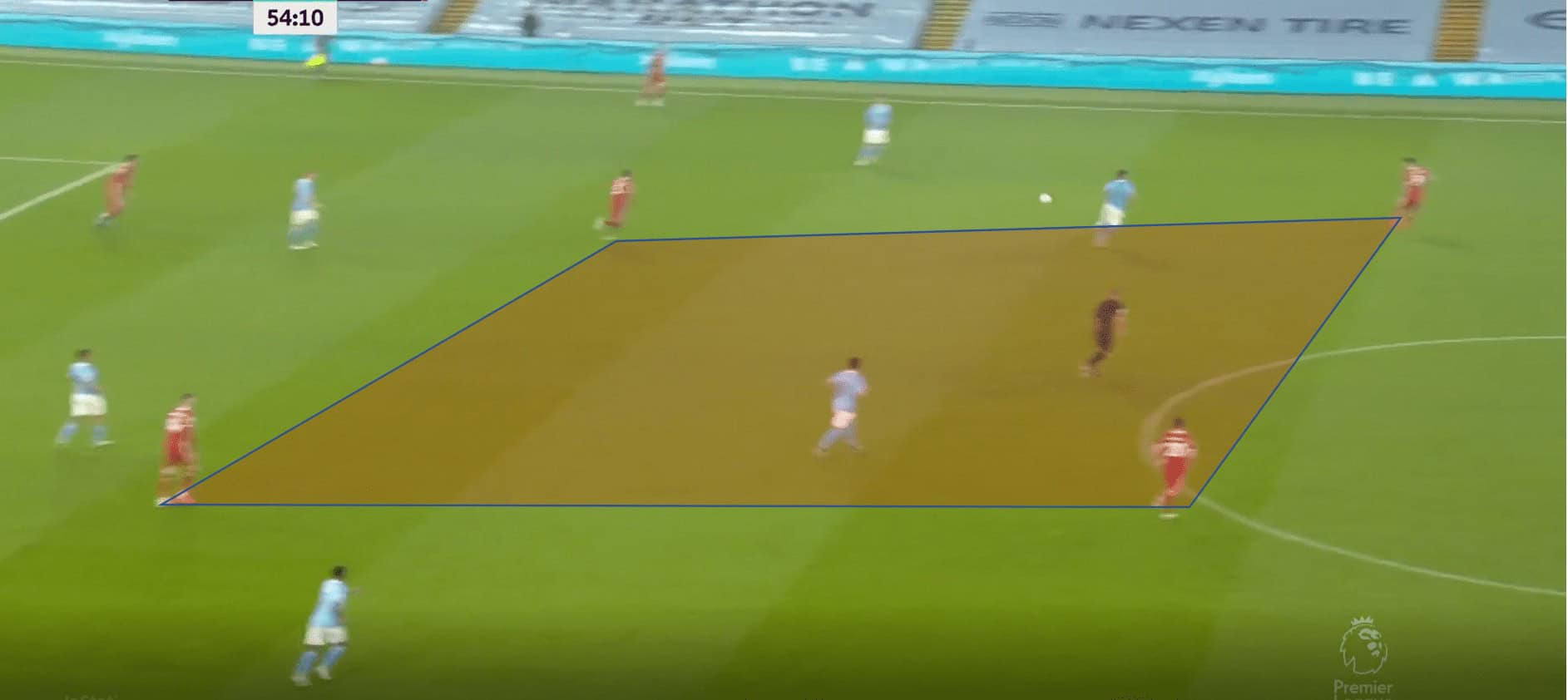
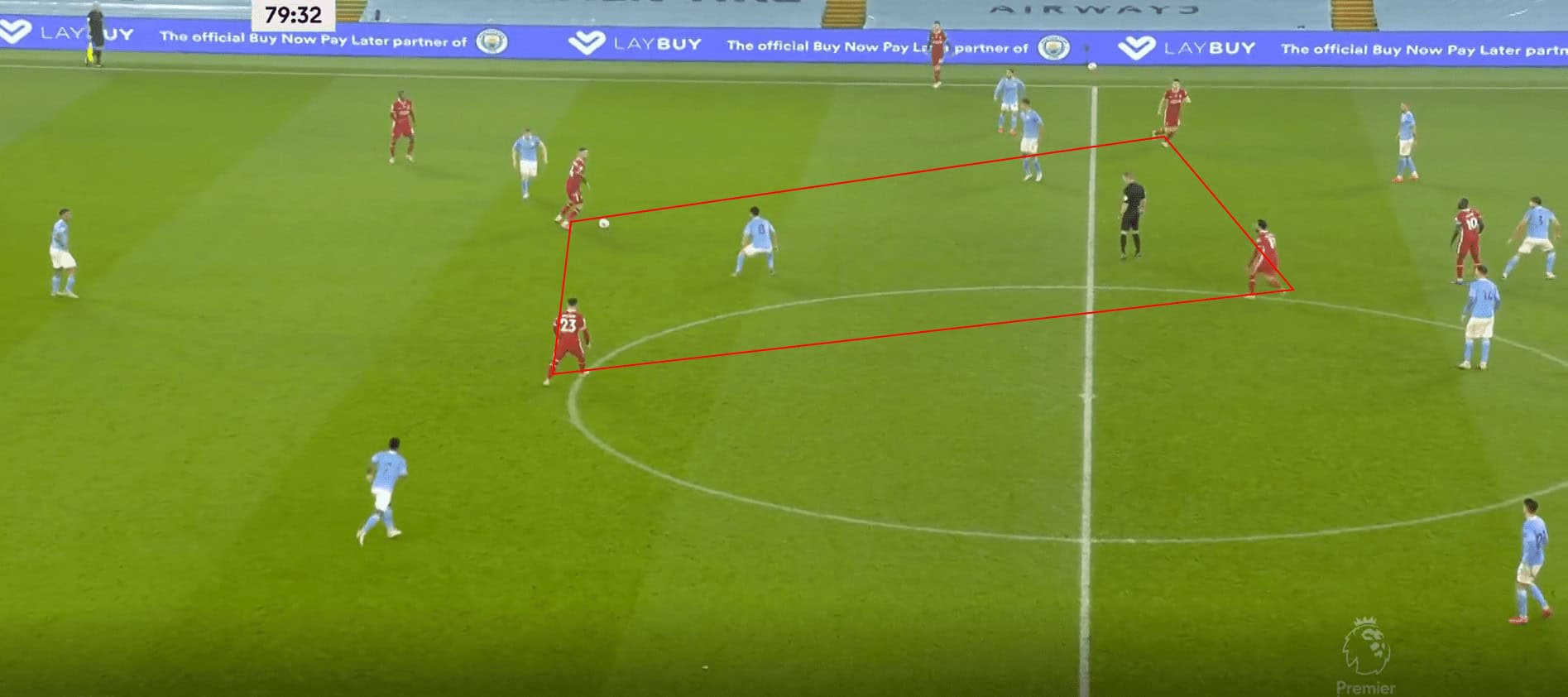
Liverpool create a 4v2 overload here to progress the ball forward, with them threatening an almost diamond-like formation, with the players on the left and right pinning the central players well. If we look at the timestamps for these images, we can see most potential overloads happened in the second half, and Liverpool’s seemingly poor build-up in the second half can be accredited to not utilising these overloads effectively, and also to City’s pressing.
Conclusion
After their excellent first-half performance, Liverpool will be disappointed they couldn’t collect all three points at the Etihad, however considering the City penalty miss and Liverpool’s absentees, I don’t think they can be too annoyed at themselves. Both sides pressed excellently and limited each other’s build-up, and the difference in the first half was Liverpool’s excellent transitions, which were underpinned by their pressing structure. As this analysis has shown, City grew into the game as they got accustomed to Liverpool’s structure, but I think of the two managers, Klopp will be most pleased with his team’s performance.
