
The FIFA World Cup 2006 final in Berlin was one of most dramatic finals in World Cup history. The tournament itself was the last time we saw many of the greats like Raul, Figo, Beckham, Totti, Del Piero, Ronaldo and Zidane play the game at an international stage. It also set the launch for the new batch of talents like Fernando Torres, David Villa, Lionel Messi and Frank Ribery.
The defending champions from Korea-Japan 2002, Brazil came in with their golden generation as one of the favourites to win again but were eliminated by France in the quarter-finals. Italy, who struggled through the group stages, saw off strong contenders to the title and host of the tournament, Germany, in Dortmund to face France at the Olympiastadion in Berlin.
Both teams scored early in the first half and held each other at 1-1 going into extra-time and the winner ended up being decided in a penalty shootout that Italy won. However, it was the infamous head-butt incident between the goal scorers that the Berlin final is remembered for even today.
The iconic head-butt memory quite possibly overshadowed the tactical battle that took place for 120 minutes in Berlin. A beautiful article by Michael Cox for The Blizzard parallels Marcelo Lippi’s tactics with Italy to a game of chess. In this tactical analysis, we shall analyse the tactics played by both teams to counter each other, and how this tactical tale of the FIFA World Cup 2006 final was quite the chess game after all!
Lineups
Italy: Gianluigi Buffon, Marco Materazzi, Fabio Cannavaro, Gianluca Zambrotta, Fabio Grosso, Francesco Totti, Gennaro Gattuso, Andrea Pirlo, Simone Perrotta, Mauro Camoranesi, Luca Toni
Subs: Daniele De Rossi, Vincenzo Iaquinta, Alessandro Del Piero, Angelo Peruzzi, Marco Amelia, Alessandro Nesta, Massimo Oddo, Cristian Zaccardo, Andrea Barzagli, Simone Barone, Filippo Inzaghi, Alberto Gilardino
France: Fabien Barthez, William Gallas, Eric Abidal, Willy Sagnol, Lilian Thuram, Patrick Vieira, Florent Malouda, Zinedine Zidane, Claude Makelele, Thierry Henry, Franck Ribéry
Subs: Alou Diarra, Sylvain Wiltord, David Trezeguet, Mickaël Landreau, Gregory Coupet, Mikael Silvestre, Jean Alain Boumsong, Gael Givet, Pascal Chimbonda, Vikash Dhorasoo, Sidney Govou
“To this day I am not convinced I took the technically best players to Germany,” Lippi told Glenn Moore of The Independent in 2008. “But I was firmly convinced I called the ones that could create a team.” In his autobiography, I Think Therefore I Play, Pirlo recollects how Lippi expressed his frustration with the Italian camp in the middle of the tournament after their shocking draw to USA. But Lippi successfully managed to bring the right spirit back into the squad as the 14 goals in the tournament were scored by 12 different players.
France, on the other hand, looked like a squad straight out of the Expendables from Hollywood. They were one of the oldest teams with an average age of a just under 30 and had members from the team that won the 1998 FIFA World Cup. Most of all it was a team led by the same captain who lifted the trophy eight years ago, Zidane. The coach Raymond Domenech convinced 34-year-old Zidane to come out of retirement after a year to lead this side as he felt it lacked leadership despite technical potential.

Domenech used a 4-4-2 with Zidane playing as a second striker behind Henry. They defended with a back four at most times, with two robust central midfielders, Viera and Makelele defending the backline. It was Malouda and Ribery who would provide pace to the attack, and with Zidane in the centre to pull the strings of the formation for Les Blues.
The Azzurri played with a 4-2-3-1 with Pirlo conducting the orchestra from deep and Gattuso defending him in front. Camoranesi and Perrotta would invert inside and their job was to defend and protect the inside corridors more than to create. Toni played as the traditional target-man with Totti behind him. The key to this system was releasing the fullbacks Grosso and Zambrotta who looked to advance at every opportunity down the wings. Both teams arguably boasted the defensively best two sides of the tournament.
France’s direct attacking strategy
Being the older side in terms of average age, the game plan was simple: Hit the opposition quick and early and then defend. This is exactly what Zidane’s men did as they won an early penalty off Malouda being fouled which Zidane converted with a mystical panenka to give France the lead.
How the penalty came France’s way was rooted in their tactics. Even in the games against Spain, Brazil and Portugal, Domenech’s tactics was to play direct and vertical without wasting too much time in the buildup. Once the ball was played to Viera or Zidane, Malouda would begin running early at the defence for them to feed a penetrating pass into the space behind the defensive line.

Using the pace of Malouda and Ribery allowed France to hold their shape defensively while progressing up. It also forced Italy’s fullbacks to stay behind. Italy’s fullbacks were key to their attacking organisation and we’ll see why.
Italy’s attacking organisation
Once France gained the early lead, Italy needed to make the most of when they had the ball. The game against Germany saw a lot of shades of how this regrouped squad of underperforming players could play beautiful football using short passes and exploiting width.
Pirlo was the deep-lying playmaker and the architect of the system. He would often drop below the first line of pressure alongside the two centre-halves, Cannavaro and Materazzi to initiate the attack. Gattuso would be positioned ahead of the first line of pressure for an immediate option to break a pass-through and the fullbacks Grosso and Zambrotta would push high up along the wide channels into the attacking half.
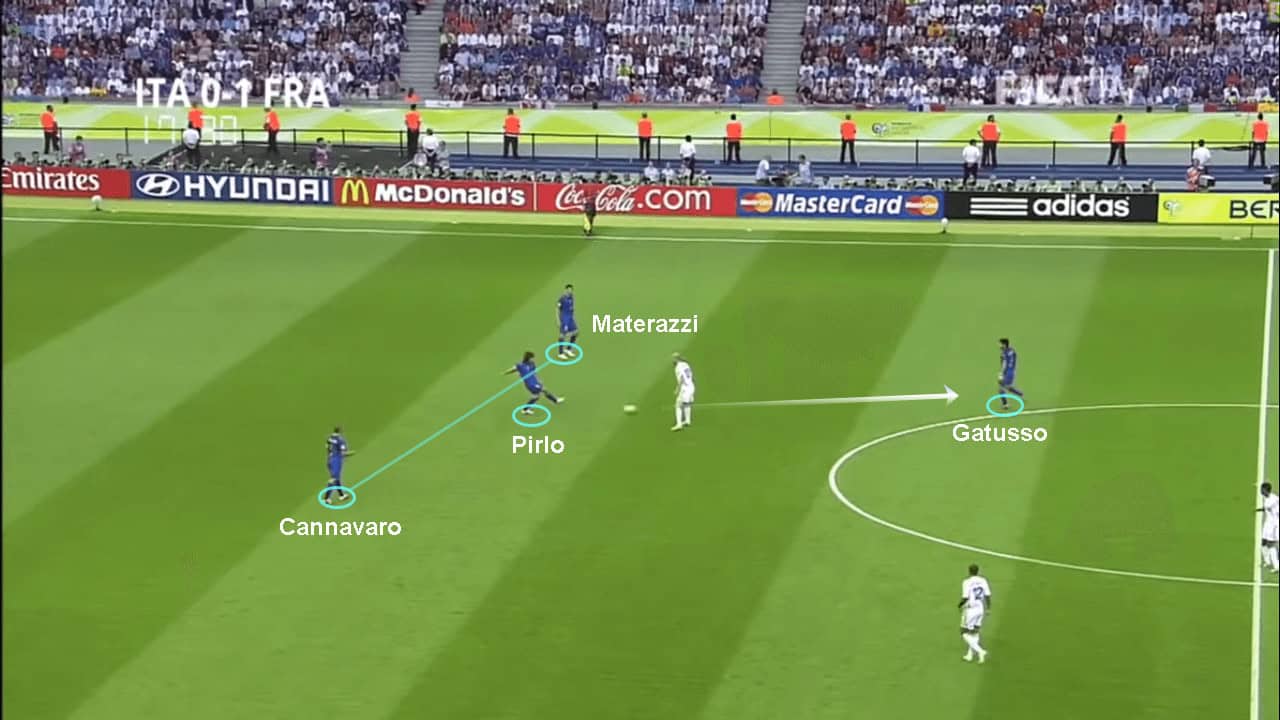
Italy did not have the most technical of attacks. Totti had a quiet tournament and usually played just behind the striker occupying a central midfielder to mark him. Toni was neither great with the ball at his feet but was excellent at holding up the ball, especially in counter-attacking situations where he could draw a foul allowing the whole team to move up the pitch.
Perrotta and Camoranesi weren’t great dribblers of the ball but were hard-working and their role was to move inside from the wide channels allowing the fullbacks behind them to overlap and provide width. When the fullbacks were high up the pitch, it was the job of Perrotta and Camoranesi to defend and apply pressure immediately if possession was lost.

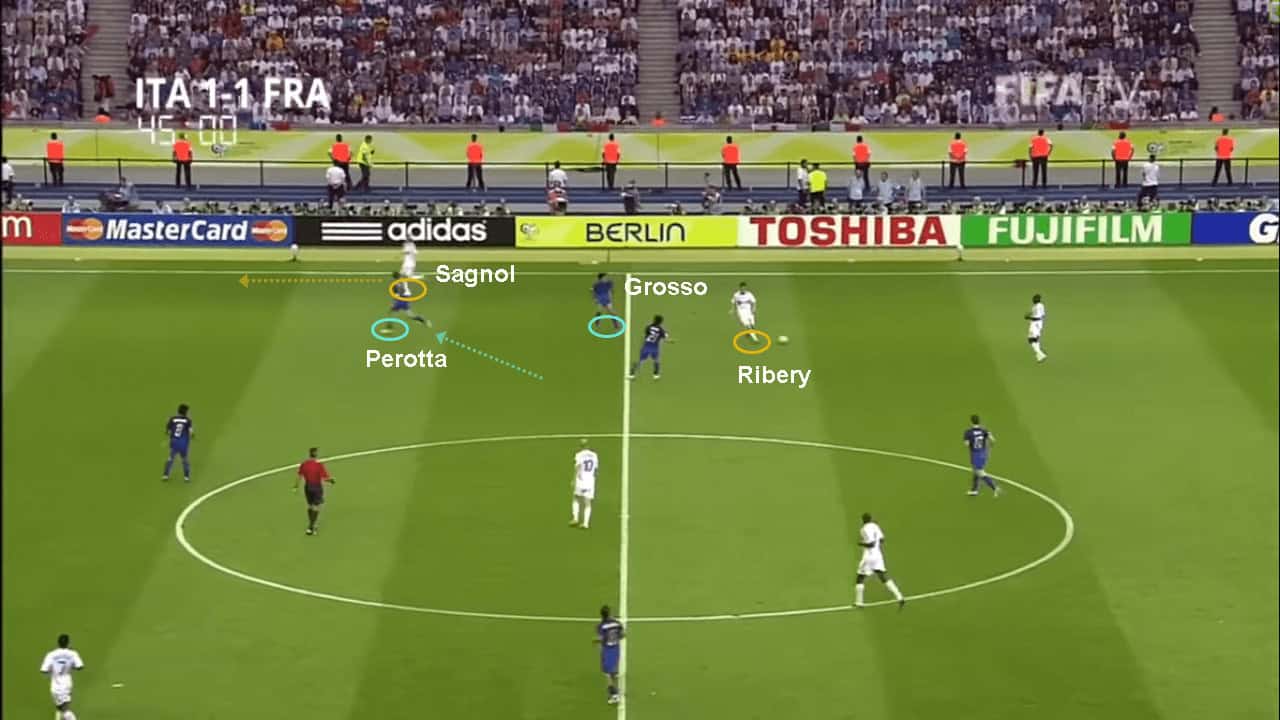
Italy did manage a lot of success from set-pieces, especially corners which brought them the equaliser. They also managed two more headers on target from corners and Toni almost scored a header from a free-kick in the second half which was called offside. However, they did not manage a single shot from open play since France were defending well with a back four plus two.
Playmaker versus Playmaker
Zidane and Pirlo were pivotal to France’s and Italy’s success in the tournament until the final clash. They created plays in the system but in different ways. Zidane played higher as an offensive playmaker creating plays in the opposition half. Pirlo played deeper as a defensive playmaker from behind. But the systems that the two teams employed brought the best player of both teams in each other’s space and thus neutralised them in a way. Italy were very aggressive in cutting out Zidane using Gattuso and the two central defenders with Cannavaro putting up a defensive clinic by single-handedly intercepting from all sides. Domenech thus needed a way to incorporate Zidane more in France’s game in the second half.
He pulled Henry down as a false-nine into the hole where Zidane was originally positioned, leaving Malouda and Ribery higher up to pin Italy’s fullbacks. Henry’s technical ability allowed him to receive the ball and dribble right at the defenders and we immediately saw France on the offensive in the second half with Henry registering shots after dribbles.

What this did was it gave Zidane the freedom to pull out of the offensive position and roam freely in the spaces that Makelele and Viera guarded to find pockets of space to create plays. This gave Abidal the confidence to push up in the left-wing keeping Zambrotta quiet in the second half. With both teams pushing for a lead, Lippi also felt the need to bring Pirlo out into higher positions to create a threat in France’s half.
Lippi responds by replacing Totti with De Rossi
De Rossi wasn’t a full established midfielder back in 2006 and had just come back from a suspension after receiving a red card for a bloody incident against USA. Replacing the attacking prowess of Totti with a box-to-box machine-like De Rossi was unexpected from Lippi but necessary, as this allowed Pirlo to move forward with De Rossi and Gattuso staying back.
Having two pivots was also necessary for the fullbacks to flourish per Italy’s attacking game model, but Abidal was starting to cause problems down the right for Italy keeping Zambrotta held back. Lippi thus sacrificed the hard-working Perrotta for a forward, Iaquinta. Iaquinta was tasked at staying high and wide on the right forcing Abidal to stay behind. This move gave Pirlo options when he received the ball and looked for a diagonal pass.
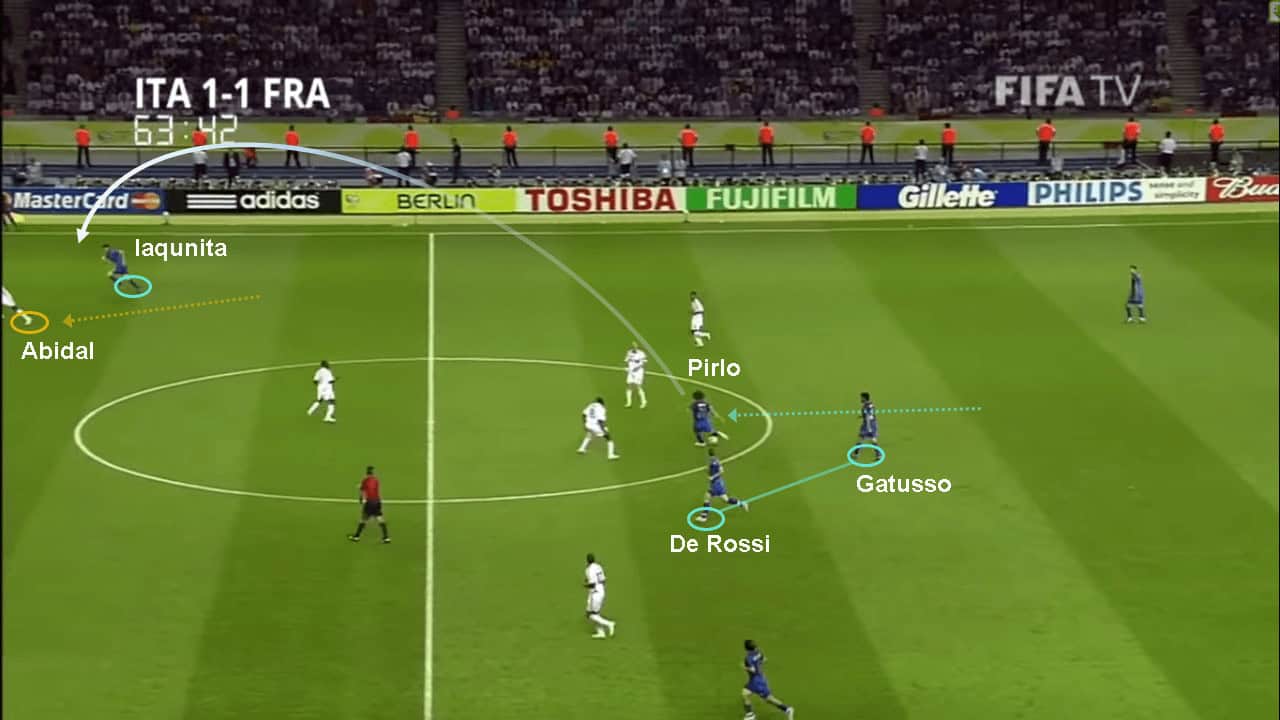
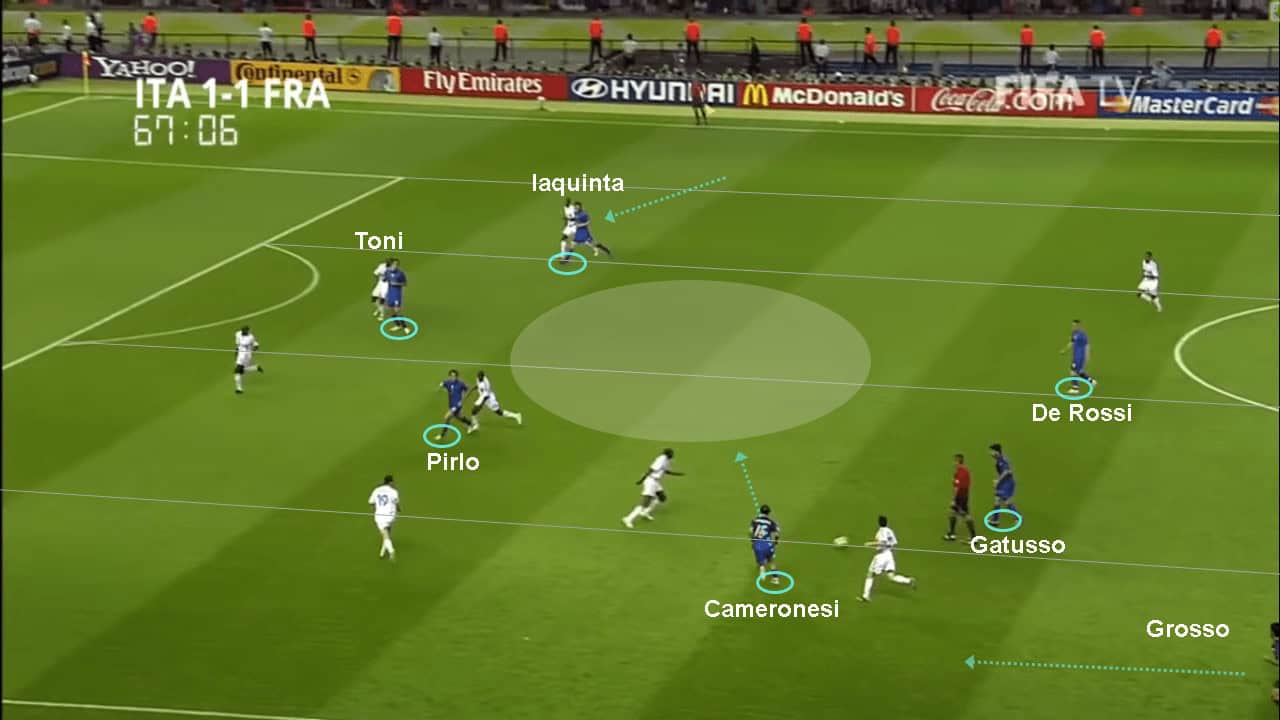
Camoranesi would not leave the show yet but switched to the other flank, and being technical could dribble inside from the wide left, leaving room for Grosso to overlap. The French defence was too strong to overcome despite the changes, and the bigger problem now was the hole left by removing Totti which had to be filled in by Pirlo or Camoranesi.
Bringing Ribery into the game
In the early days of Pep Guardiola at Bayern, Martí Perarnau writes in Pep Confidential about how Guardiola tried hard to convert Frank Ribery into a false-nine to utilise him in the same way Guardiola utilised Messi in the false-nine role at FC Barcelona earlier. The analysis of this game closely reveals that Domenech had already experimented with this idea with Ribery in the second half in Berlin.
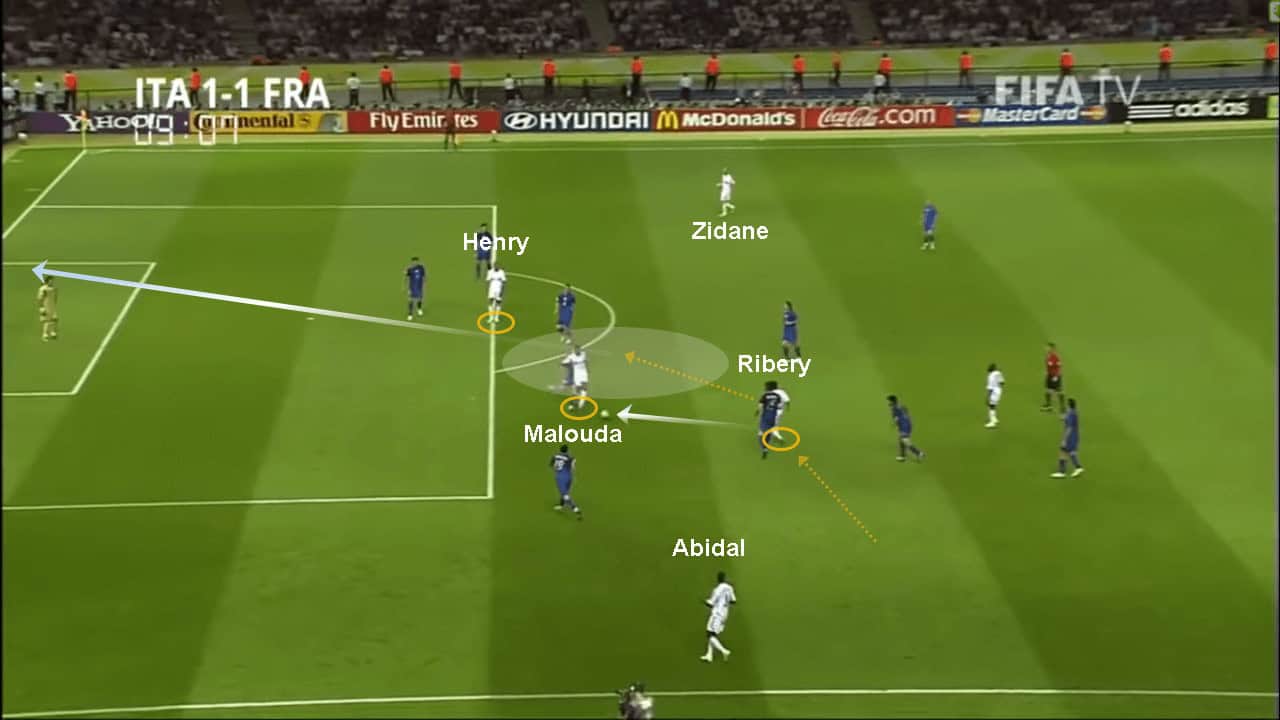
Domenech brought Ribery to play in the hole below Henry and Malouda with the three forming a technical triangle. The three technical players could play quick passes off each other or dribble into spaces overwhelming the defensive duo of Cannavaro and Materazzi. This also gave Zidane the liberty to continue free roaming around the pitch wherever the game demanded.

Ribery almost managed to score in extra-time in this move where he received the ball in the left half-space and played a quick give-and-go with Malouda to find space for a shot that drifted just wide off Buffon’s far post. By the time the game moved into extra-time, an exhausted Ribery had missed his chance to shine and had to be brought off for David Trezeguet.
Extra-time tactics
France’s initial system of 4-4-2 with Zidane as a second striker was not the best formation to keep long periods of possession, but it was the best formation to threaten Italy with counter-attacks utilizing the pace of the wingers and overlapping fullbacks. However, with all of Domenech’s tactical changes, we saw France dominating possession with Zidane’s free role and the fullbacks with complete license to attack.
Italy were running out of steam and Lippi soon realised the hole left by Totti needed to be filled as France continued to threaten them with the ball. He eventually changed Camoranesi for Del Piero who had sealed the win for the Azzurri against the Germans in Dortmund in extra-time bringing them here. But Del Piero’s role was nothing more than a defensive presser from the top as the fullbacks had run out of gas and weren’t overlapping so vigorously as before. Without their fullbacks, Lippi’s Azzurri were non-existent in the attack.

France used Trezeguet as the new target man in place of Henry, who could now play behind Trezeguet along with Malouda. Italy’s centre-halves were now pinned back with Trezeguet and Malouda with Henry and Zidane free-roaming. France were much fitter physically and capable of running the duration of the extra-time than Italy, who looked to hold the scoreline and see the game into penalties where they hoped their 1.92m keeper Buffon would outperform the 1.8m Barthez.
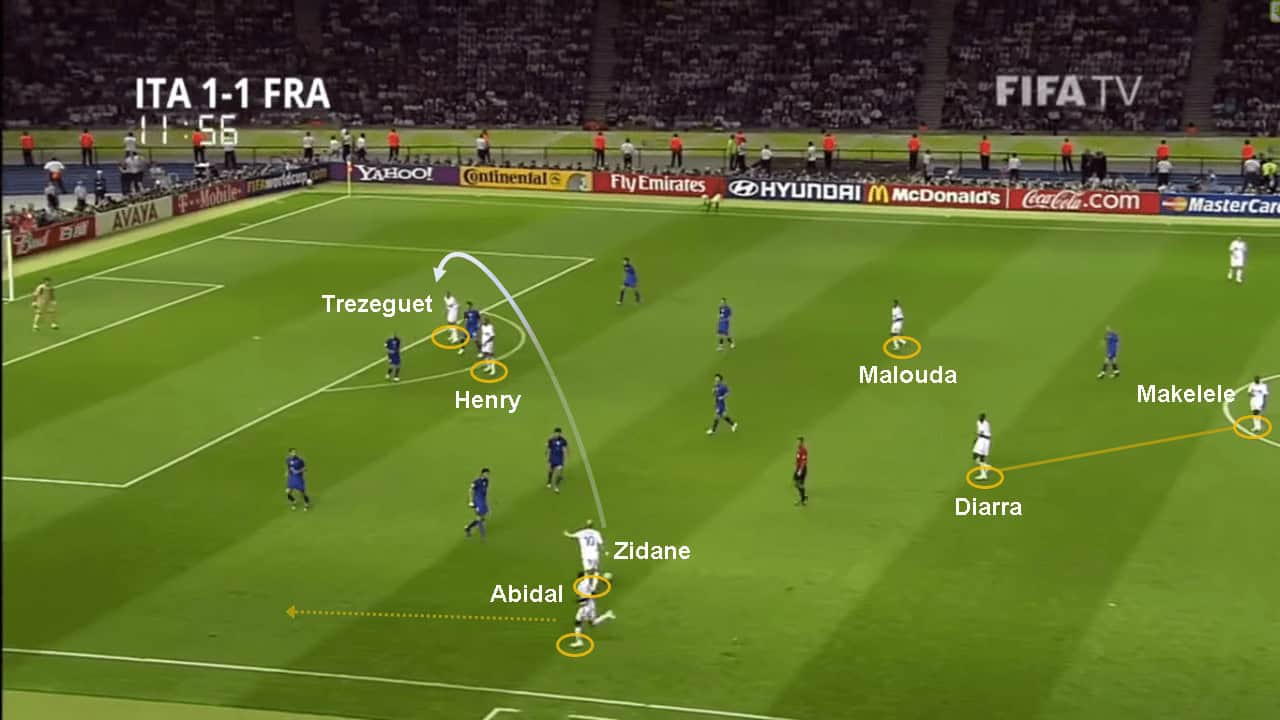
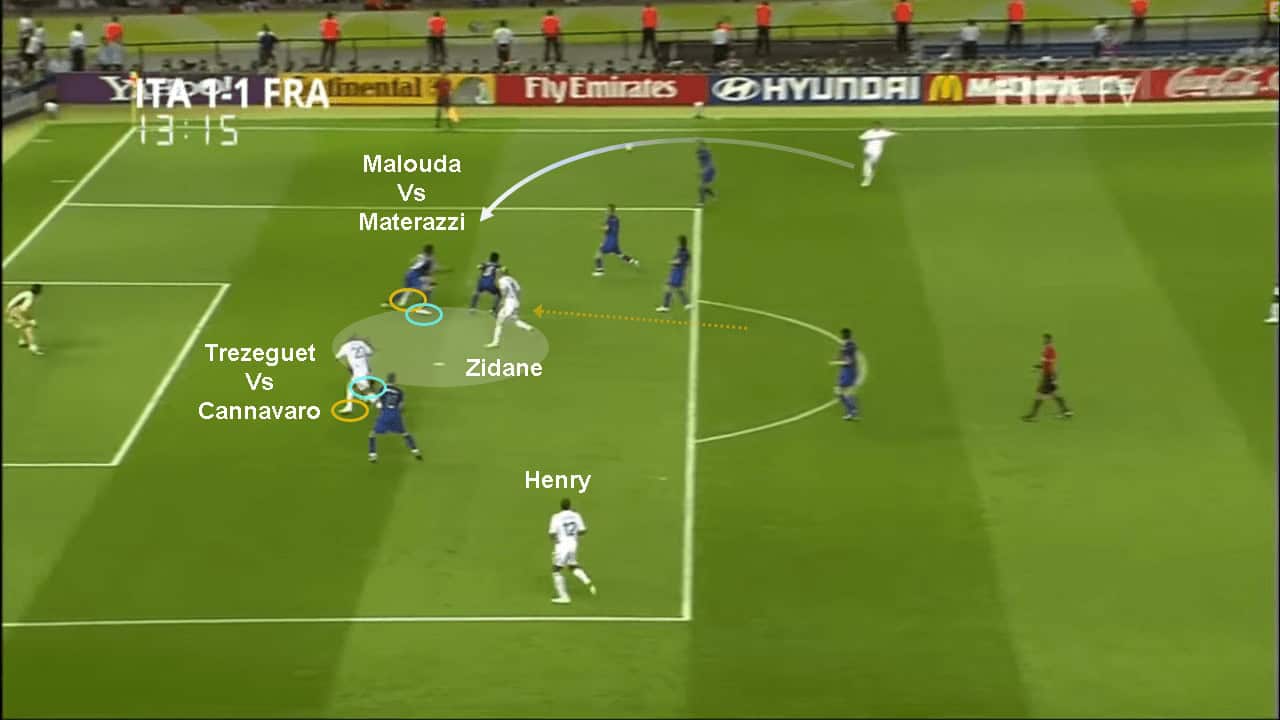
Having Trezeguet at that stage of the game when Italy looked to sit in the low block was a game-changer as it helped keep the resilient centrebacks, Cannavaro and Materrazi engaged while extending Zidane’s free-roaming license. Zidane came chillingly close to seal the win for France in dramatic fashion as he found a free header in the penalty box off Sagnol’s cross to rattle Buffon’s crossbar. Zidane managed to drift into the box unmarked because of Trezeguet and Malouda. The rattling crossbar echoed of the French captain’s nostalgic headers against Brazil that secured the win for Les Blues eight years ago and this was how close they came, once again.
The stalemate and Domenech’s final move
In the second period of extra-time, nothing could still separate the two sides. Domenech decided to play his final card. He brought off Henry for Sylvain Wiltord to play on the wide left. What were the implications of this tactic? Immediately after the change we saw Malouda moving to the wide right and Zidane moving back into this forward role alongside Trezeguet.
With this substitution, Domenech returned back to his original 4-4-2 that he started off the game. Having tried all the tactics and systems, his final move was to get back to the basics that brought France all the way here to Berlin. But Italy were all over the place and could no longer respond the way they started the game. There was no Totti, Pirlo was playing higher and instead, it was Gattuso and De Rossi holding, and they couldn’t rely on Perrotta or Camoranesi to work the half-spaces.

Materazzi, in a recent interview, recalled the events leading to the head-butting incident. As Zidane moved up into his space, Gattuso gave him the wink and told him that Zidane was his man. We can’t anticipate how this tactic could’ve played out for France as what followed immediately was Zidane’s red card. Nevertheless, it was a dramatic twist to the tactical tale between the two teams that were on the verge of a stalemate.
Conclusion
Zidane’s red card overshadowed much of the tactical intricacies that played out in Berlin that evening. Marcello Lippi admitted during the tournament that Zidane was the best player there had been in the last 20 years and had spearheaded the French side to meet his Italy. Lippi recently recollected moments from this game recently watching all the games from the FIFA World Cup 2006 at home during lockdown reminiscing the tactical battles. The two held a deep admiration for each other and Zidane followed the footsteps of the former coach at Juventus, as a manager guiding Real Madrid to three consecutive world cup finals.
The game ended with Trezeguet missing his penalty, and Grosso scoring his, the final goal of the tournament to clinch the title for the Azzurri. Lippi recollected on a video call during self-isolation to Rai Radio 1:
“I chose Grosso for the final penalty because the best spot-kick specialists had already been assigned and I remembered Grosso had earned the last-gasp penalty against Australia, scored against Germany in stoppages. “I told him: ‘You are the last-minute man, so you take the fifth penalty’. He couldn’t believe it.”
This final match highlighted the role of intuition in a coach’s decision making as we saw throughout the game. It also marked the last of many tactical milestones in the FIFA World Cup, such as the use of a single playmaker by both teams, a role that has since become extinct or not proven as successful. The sight of a genius like Zidane retiring past the World Cup trophy into the dressing rooms marked the end of an era in the beautiful game.
