
The duel at the Riyadh Air Metropolitano between Atlético Madrid and Barcelona represented a collision of two distinct tactical universes that have begun to converge under the modern constraints of the 2026 season.
Hans-Dieter Flick’s Barcelona arrived with a clear intent to impose a high-tempo positional game, while Diego Simeone’s Atlético, despite their evolving identity, remained rooted in the principles of defensive resilience and explosive transitions.
The match carried enormous weight for the La Liga title race, particularly after Real Madrid’s stumble in Mallorca earlier in the weekend.
What unfolded was a game of three acts: a balanced initial exchange, a period of tactical opportunism from the hosts, and a final phase defined by the asymmetrical pressure of a numerical advantage.
Barcelona’s 2-1 victory was not merely a result of individual brilliance but a consequence of structural persistence.
Flick has instilled a level of physical robustness in this squad that allows them to sustain pressure even in the most hostile environments.
Atlético, on the other hand, displayed the tactical flexibility that has characterised their season, shifting between a mid-block and a desperate low block after the dismissal of Nico González.
The game was won on the fine margins of spatial occupation and the Catalans’ ability to manipulate the width to draw a disciplined defensive unit out of its comfort zone.
It was a masterclass in modern game management from the league leaders, who showed that they could absorb the emotional volatility of a Metropolitano night and emerge with a result that places one hand firmly on the trophy.
In this Atletico vs Barca tactical analysis and post-match analysis, we will examine both teams’ initial ideas in the first half and how Flick and Simeone battled it out in the second half after Atlético’s red card.
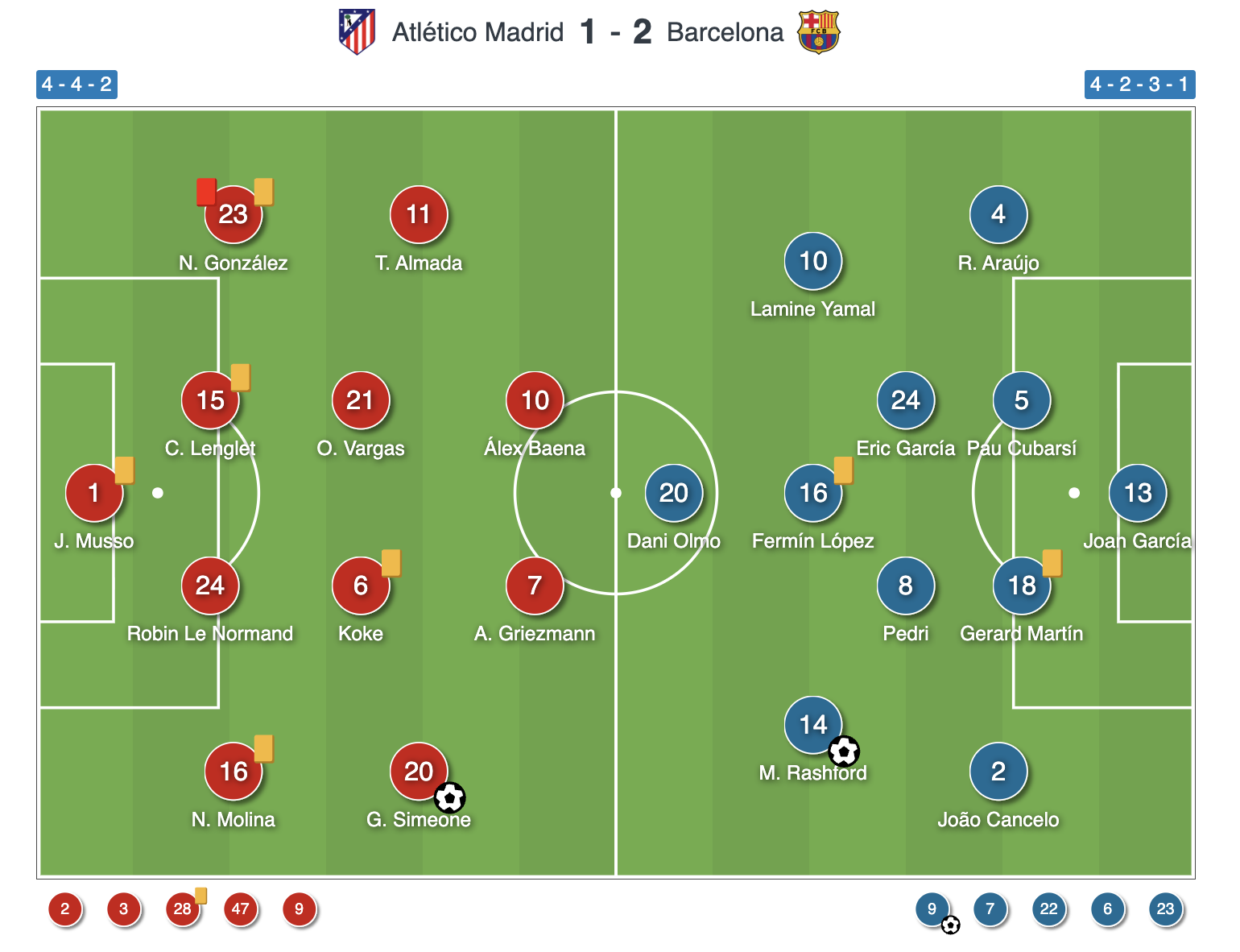
Atlético Madrid Vs Barcelona Lineups & Formations
Diego Simeone opted for a structured 4-4-2 that frequently morphed into a 5-3-2 or 4-5-1 depending on the phase of play.
Juan Musso started in goal behind a back four consisting of Nahuel Molina, Robin Le Normand, Clément Lenglet, and Nico González.
The midfield was anchored by the veteran Koke alongside the energetic Obed Vargas, with Giuliano Simeone and Álex Baena providing the width.
Up front, Antoine Griezmann was paired with Thiago Almada, a duo designed to offer both creative link-up play and the ability to exploit space behind the opposition.
This setup prioritised horizontal compactness, aiming to deny Barcelona central access while maintaining enough numbers to launch rapid counter-attacks through the Simeone–Griezmann–Almada axis.
Hans-Dieter Flick countered with his preferred 4-2-3-1, a formation that emphasises high-line aggression and rotational fluidity in the final third.
Joan García took his place between the posts, protected by a defensive line of João Cancelo, Ronald Araújo, Pau Cubarsí, and Gerard Martin.
The double pivot featured Eric García and Pedri, providing a blend of defensive screening and progressive passing.
Dani Olmo was the creative hub in the number ’10’ role, flanked by Lamine Yamal on the right and Marcus Rashford on the left.
Fermín López provided the initial energy in the attacking midfield before the game shifted.
Rashford led the line with his pace, though the introduction of Robert Lewandowski in the second half would ultimately prove decisive.
This structural blueprint allowed Barcelona to dominate possession, controlling 67% of the ball and forcing Atlético into a reactive stance from the opening whistle.
The Isolated Spark: Exploiting Lamine Yamal On The Right
A core tenet of FC Barcelona’s attacking strategy was the deliberate isolation of Lamine Yamal against Nico González on the right flank.
Flick’s side utilised a lop-sided build-up, often overloading the left and central corridors to draw Atlético’s defensive block toward the ball.
Once the opposition had shifted their collective focus, the Catalans would utilise rapid cross-field switches, primarily through the vision of Pedri and Pau Cubarsí, to find Yamal in 1v1 situations.
This isolation is a tactical nightmare for any defender, particularly when facing a player with Yamal’s specific dribbling mechanics and low centre of gravity.
![Atletico Madrid – FC Barcelona [1 - 2] La Liga 2025/26 Post-Match Analysis: Lamine Yamal and Joao Cancelo deciding the title race?](https://totalfootballanalysis.com/wp-content/uploads/2026/04/Bild-1-1.png)
By keeping Yamal pinned to the touchline, Barcelona ensured the pitch was as wide as possible, stretching the gap between Atlético’s left-back and left-centre-back.
Yamal’s role was not just to cross but to penetrate.
When he received the ball in space, his first touch was consistently aggressive, driving inside to force Lenglet to commit.
This movement created a dilemma for Simeone’s defensive unit: if González stayed tight, Yamal would use a drop of the shoulder to beat him on the outside; if González dropped off, Yamal would cut inside to his favoured left foot to thread passes into the half-space for Dani Olmo or a charging Fermín López.
![Atletico Madrid – FC Barcelona [1 - 2] La Liga 2025/26 Post-Match Analysis: Lamine Yamal and Joao Cancelo deciding the title race?](https://totalfootballanalysis.com/wp-content/uploads/2026/04/Bild-2-1.png)
The gravity Yamal exerted on the pitch was palpable, as it forced Koke to drift toward the left to provide cover, which in turn opened up central passing lanes for Eric García.
Even when Atlético tried to double-team him, Yamal’s technical security allowed him to retain possession under duress, resetting the attack and maintaining the territorial pressure that eventually wore down the Madrid defence.
![Atletico Madrid – FC Barcelona [1 - 2] La Liga 2025/26 Post-Match Analysis: Lamine Yamal and Joao Cancelo deciding the title race?](https://totalfootballanalysis.com/wp-content/uploads/2026/04/Bild-3-1.png)
This strategy bore fruit in the psychological battle as well.
Nico González found himself under constant scrutiny, eventually leading to the frustration that resulted in his yellow card and subsequent dismissal.
The constant threat of 1v1 humiliation forces defenders to lung at challenges, and Yamal exploited this throughout the first half.
By the time the game transitioned into the second period, the damage had been done.
![Atletico Madrid – FC Barcelona [1 - 2] La Liga 2025/26 Post-Match Analysis: Lamine Yamal and Joao Cancelo deciding the title race?](https://totalfootballanalysis.com/wp-content/uploads/2026/04/Bild-4-1.png)
The right wing was a constant source of anxiety for Atlético, and the constant need to compensate for Yamal’s presence meant they could never fully commit their resources to the offensive transitions they desired.
It was a masterclass in using individual superiority within a collective structural framework to dismantle a high-level defensive system.
Hunting The Void: Atlético’s Abuse Of The Barcelona High Line
Despite Barcelona’s dominance of the ball, Atlético Madrid were far from passive.
Diego Simeone’s primary offensive weapon was the exploitation of Barcelona’s notoriously high defensive line.
Flick’s insistence on squeezing the play into the middle third leaves a vast expanse of green grass behind Ronald Araujo and Pau Cubarsí, an area Atlético targeted with ruthless intent.
![Atletico Madrid – FC Barcelona [1 - 2] La Liga 2025/26 Post-Match Analysis: Lamine Yamal and Joao Cancelo deciding the title race?](https://totalfootballanalysis.com/wp-content/uploads/2026/04/Bild-5-1.png)
The triggers for these runs were often Barcelona’s turnovers in the final third.
As soon as Koke or Obed Vargas regained possession, the first look was always vertical.
Giuliano Simeone and Antoine Griezmann were instructed to make diagonal runs into the channels, timing their sprints to coincide with the moment the ball-carrier looked up.
This approach led directly to the opening goal in the 39th minute.
Clément Lenglet, acting as an auxiliary playmaker from the back, spotted a gap in the Barcelona press and lofted a perfectly weighted ball into the path of Giuliano Simeone.
![Atletico Madrid – FC Barcelona [1 - 2] La Liga 2025/26 Post-Match Analysis: Lamine Yamal and Joao Cancelo deciding the title race?](https://totalfootballanalysis.com/wp-content/uploads/2026/04/Bild-6-1.png)
The young attacker had positioned himself on the shoulder of Gerard Martín, utilising a burst of pace to get behind the line before Araújo could recover his positioning.
The finish was a testament to the effectiveness of the strategy, as Simeone broke into space and beat Joan García to send the home crowd into a frenzy.
This was not an isolated incident; Atlético repeatedly forced Araújo and Cubarsí into high-speed recovery runs, which served to tire the central defenders and create a sense of instability in the Barcelona backline.
The tactical battle in these moments was one of timing and triggers.
![Atletico Madrid – FC Barcelona [1 - 2] La Liga 2025/26 Post-Match Analysis: Lamine Yamal and Joao Cancelo deciding the title race?](https://totalfootballanalysis.com/wp-content/uploads/2026/04/Bild-7-1.png)
Atlético used Thiago Almada as a decoy, often having him drop deep to pull a Barcelona midfielder out of position, which then cleared a passing lane for a direct ball over the top.
The high line is a high-reward strategy that allows Barca to sustain attacks, but against a team with the transition quality of Atlético, it is a high-risk gamble.
For much of the first sixty minutes, the game felt like a tug-of-war between Barcelona’s possession and Atlético’s verticality.
Simeone’s men showed that they did not need the ball to be dangerous; they only needed the space that Barcelona’s ambition provided.
This dynamic kept the match on a knife-edge, proving that even a dominant possession side can be made to look vulnerable if the opponent has the discipline and the speed to attack the void.
But it also needs to be said that Atletico was not as good in exploiting the positional play of the Barcelona backline as they were a couple of weeks back in the Copa del Rey.
Numerical Superiority: Deep Blocks & Full-Back Width
The texture of the match changed irrevocably after the red card to Nico González in the seventh minute of first-half stoppage time.
Facing a ten-man Atlético, Barcelona entered the second half with a clear numerical and tactical advantage.
Simeone responded by retreating into a deep 4-4-1 block, prioritising central density and effectively conceding the flanks.
![Atletico Madrid – FC Barcelona [1 - 2] La Liga 2025/26 Post-Match Analysis: Lamine Yamal and Joao Cancelo deciding the title race?](https://totalfootballanalysis.com/wp-content/uploads/2026/04/Bild-8-1.png)
This was a classic defensive bunker, with Lenglet and Le Normand heading away everything that came into the box.
To break this down, Flick instructed his full-backs, João Cancelo and the young Gerard Martín, to maintain extremely high and wide positions, effectively acting as auxiliary wingers.
This allowed Yamal and Rashford to tuck inside, creating a front five that forced Atletico’s midfield four to stay extremely narrow.
The use of fullback width was the key to unlocking the deep block.
By having Cancelo and Koundé provide the width, Barcelona forced Atletico’s wide midfielders, Baena and Morcillo, to drop into the defensive line, creating a temporary back six.
![Atletico Madrid – FC Barcelona [1 - 2] La Liga 2025/26 Post-Match Analysis: Lamine Yamal and Joao Cancelo deciding the title race?](https://totalfootballanalysis.com/wp-content/uploads/2026/04/Bild-9-1.png)
This excessive deepness meant that even when Atlético won the ball, they had no outlets for a counterattack, as Griezmann was often thirty yards away from his nearest teammate.
Barcelona circulated the ball with patience, moving it from one touchline to the other to tire the Madrid players.
The goal was to wait for the moment where a full-back could receive the ball with enough time to deliver a quality cross or a low cut-back into the crowded penalty area.
The persistence finally paid off in the 87th minute.
João Cancelo, who had spent the entire second half camped in the final third, drifted from the left to the right to provide an overload.
![Atletico Madrid – FC Barcelona [1 - 2] La Liga 2025/26 Post-Match Analysis: Lamine Yamal and Joao Cancelo deciding the title race?](https://totalfootballanalysis.com/wp-content/uploads/2026/04/Bild-10-1.png)
His presence on the periphery of the box allowed him to receive a pass from Pedri and fire a low, driven effort toward goal.
While Musso managed a parry, the sheer volume of bodies Barcelona had pushed into the box created chaos.
The rebound fell to the substitute Robert Lewandowski, whose instinctive touch sent the ball into the net.
This goal was the logical conclusion of Barça’s strategy: use the width to stretch the block, sustain the pressure until the opponent physically fails, and capitalise on the resulting scramble.
It was a victory for the patience of positional play over the resilience of a deep block, and also a victory of the individual brilliance of João Cancelo, who has been stellar ever since his return to Camp Nou from Saudi Arabia.
Conclusion
In the final assessment, Barcelona’s victory at the Riyadh Air Metropolitano was a triumph of structural evolution over reactive grit.
While Atlético Madrid showed glimpses of their transition-based brilliance, particularly through the clever exploitation of the high line, they ultimately fell victim to the relentless pressure of a Barcelona side that has mastered the art of spatial manipulation.
The isolation of Lamine Yamal in the first half set the tone, creating the individual matchups that eventually forced the hosts into the errors that led to the dismissal of Nico González.
Without the full complement of 11 players, Simeone’s side was unable to sustain the offensive output required to keep Barcelona honest.
The second half was a demonstration of how a top-tier side should handle a numerical advantage.
By trusting in the width provided by their full-backs and maintaining a patient circulation of the ball, Barcelona ensured that the winning goal was a matter of when, not if.
Robert Lewandowski’s late strike was the crowning moment of a performance that combined technical flair with tactical discipline.
For Hans-Dieter Flick, this result is a massive validation of his high-intensity philosophy, showing that his team can go to the hardest stadiums in the league and dictate terms.
For Simeone, it is a reminder that in the modern game, defensive organisation can only take a team so far if they cannot find a way to relieve the pressure.
Barcelona now look like champions-elect, while Atlético must regroup for the looming Champions League battles that will define their season.
