
The Bundesliga, in its infinite capacity for narrative swings, rarely offers a more poignant contrast than the one witnessed in the clash between Borussia Dortmund and Hamburger SV.
The 3-2 victory for BVB was not merely a game of two halves; it was a profound tactical autopsy of a team caught between two distinct structural identities, eventually saved by the sheer geometric weight of its in-game adjustments.
Niko Kovač’s Dortmund entered the match looking to solidify their grip on the upper echelon of the table, yet for 45 minutes, they were systematically dismantled by a rejuvenated HSV side that arrived with a blueprint of startling efficiency.
Merlin Polzin, the architect of this modern HSV iteration, orchestrated a first-half display that exposed every lingering fracture in Dortmund’s defensive transition and pressing mechanics.
By the interval, the 0-2 scoreline felt less like an anomaly and more like a logical conclusion to Dortmund’s positional paralysis.
Kovač’s initial 3-3-2-2, intended to provide central density and wing-back progression, instead produced a hollow midfield where the verticality of Hamburg consistently bypassed the primary pressing triggers.
The Signal Iduna Park, usually a cauldron of noise, hummed with the nervous energy of a fanbase watching their tactical consistency dissolve against a team fighting for mid-table security.
The first half was a masterclass in exploiting a high defensive line that lacked the necessary pressure on the ball, leaving the Dortmund back three exposed to the raw pace of the Hamburg frontline and the technical elegance of their midfield conductors.
However, the second half provided a masterclass in tactical calibration and the importance of squad gravity.
The introduction of Serhou Guirassy and Ramy Bensebaini shifted the geometric balance of the pitch, transforming BVB from a side of lateral spectators into a vertical juggernaut.
This tactical analysis and post-match analysis will dissect the tactical revelations of this five-goal thriller: the failure of Dortmund’s initial structural squeeze, the impact of the final-third gravity introduced by the bench, and the fundamental breakdown of HSV’s deep block under the weight of Dortmund’s overloads.
It was a match won not by a pre-ordained system, but by the courageous, real-time correction of one.
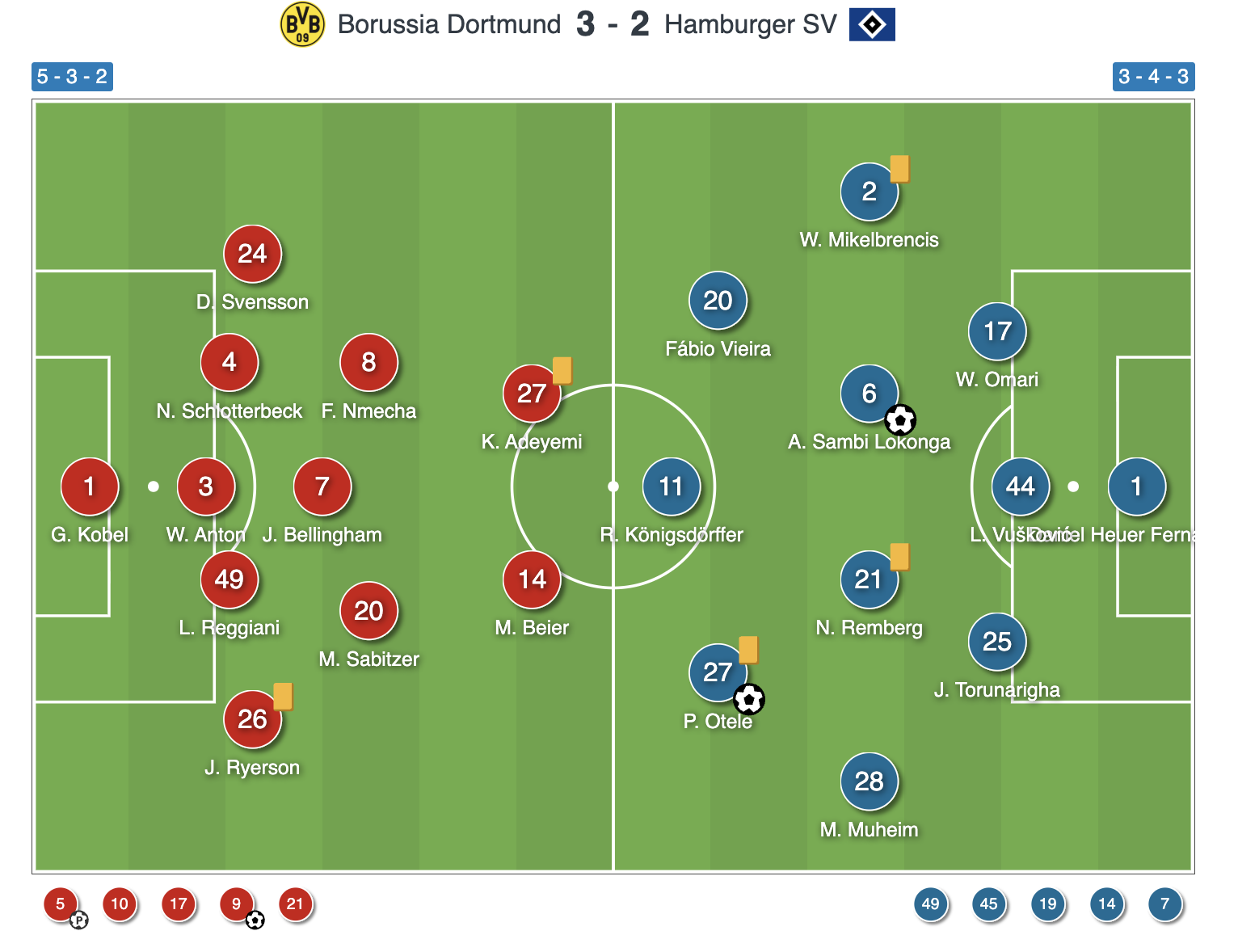
Borussia Dortmund Vs Hamburger SV Lineups & Formations
Niko Kovač’s Borussia Dortmund lined up in a 5-3-2/3-3-2-2 formation featuring Gregor Kobel in goal, supported by a back three of Luca Reggiani, Waldemar Anton, and Nico Schlotterbeck.
The midfield unit was composed of Julian Ryerson and Daniel Svensson as wing-backs flanking a central trio of Jobe Bellingham, Felix Nmecha, and Marcel Sabitzer.
Leading the line were the mobile duo of Maximilian Beier and Karim Adeyemi.
Conversely, Merlin Polzin’s Hamburger SV utilised a flexible 3-4-3 (shifting to a 5-4-1 deep block), with Daniel Heuer Fernandes protected by Warmed Omari, Luka Vuskovic, and Jordan Torunarigha.
The midfield featured William Mikelbrencis and Miro Muheim wide, with Albert Sambi Lokonga and Nicolai Remberg central, while Fábio Vieira and Philip Otele supported the lone striker Ransford Königsdörffer.
Structural Anarchy: The Disconnection Of The Dortmund Press
The first half was a case study in how a poorly synchronised press can become a team’s greatest tactical liability.
Niko Kovač’s side attempted to implement a high-intensity squeeze, pushing the three-man backline high toward the halfway line to compress the pitch.
The intent was to trap HSV in their own third, utilising the energy of the forward line as the primary triggers.
![Borussia Dortmund – Hamburger SV Bundesliga 2025/26 [3 - 2]: Kovac and his adjustments winning the game](https://totalfootballanalysis.com/wp-content/uploads/2026/03/Bild-1-5.png)
On paper, this 3-3-2-2 should have allowed the wing-backs to lock onto HSV’s wide outlets while the midfield trio suffocated the centre.
However, the distances between the units were catastrophic, creating a vacuum that Merlin Polzin’s side exploited with surgical precision.
This disconnection is a classic symptom of a team trying to play modern football without the requisite horizontal compactness.
When the first line of Dortmund’s pressure was triggered, the midfield line was often three to five meters too deep.
This lack of vertical compactness meant that Hamburg, led by their technically composed double-pivot, could bypass the initial press with simple, grounded vertical passes.
Instead of being trapped, HSV used their goalkeeper as a plus-one in the build-up, drawing Dortmund’s forwards into futile, energy-sapping sprints before playing through the vacated central corridors.
![Borussia Dortmund – Hamburger SV Bundesliga 2025/26 [3 - 2]: Kovac and his adjustments winning the game](https://totalfootballanalysis.com/wp-content/uploads/2026/03/Bild-2-5.png)
The lack of a cohesive second line of pressure meant that every time BVB lost the ball in the middle third, they were facing a three-on-three or four-on-four counterattack with 50 yards of green grass behind them.
This is the ultimate nightmare for a back three: defending in isolated, large-space 1v1s.
This structural anarchy was compounded by a lack of horizontal communication in the defensive handover.
As the wing-backs pushed high to join the press, the centre-backs were forced to cover immense lateral distances to track wide runners.
![Borussia Dortmund – Hamburger SV Bundesliga 2025/26 [3 - 2]: Kovac and his adjustments winning the game](https://totalfootballanalysis.com/wp-content/uploads/2026/03/Bild-3-5.png)
Hamburg’s attackers utilised intelligent diagonal runs to pull the Dortmund defenders out of their zonal slots, creating seams in the back three that were consistently exploited.
The lack of ball-oriented pressure meant that the HSV playmakers had the time and line of sight to pick out passes into these gaps at will.
Dortmund were playing a high line in theory, but failing to execute the high press in practice, essentially handing HSV the keys to their own defensive third.
![Borussia Dortmund – Hamburger SV Bundesliga 2025/26 [3 - 2]: Kovac and his adjustments winning the game](https://totalfootballanalysis.com/wp-content/uploads/2026/03/Bild-4-5.png)
The first half was a tactical indictment of a system that possessed the aggression of a top-tier side but lacked the discipline to maintain the necessary functional distances between its tactical units.
Furthermore, the U-shaped possession that plagued Dortmund during the opening 45 minutes was a direct result of this disconnection.
Because the central corridors were blocked by a well-organised Hamburg mid-block and Dortmund’s own midfielders were dropping too deep to receive the ball, the circulation became purely lateral.
The ball moved from centre-back to wing-back and back again, never penetrating the heart of the opposition.
This type of possession is safe but sterile, allowing the defensive side to shift their block with minimal exertion.
Without a player capable of receiving between the lines or pinning the opposition centre-backs, Dortmund’s 3-3-2-2 was effectively playing into Hamburg’s hands, allowing the visitors to dictate the defensive tempo while posing a constant threat on the break.
The Pivot Toward Gravity: Second-Half Geometric Realignment
The complexion of the match changed the moment Niko Kovač acknowledged his structural error at the break.
The double substitution was not just a personnel swap but a complete realignment of Dortmund’s geometric approach to the game.
By shifting to a system that functioned more like a 3-4-1-2 in possession, Kovac provided BVB with the central focal point they had desperately lacked.
![Borussia Dortmund – Hamburger SV Bundesliga 2025/26 [3 - 2]: Kovac and his adjustments winning the game](https://totalfootballanalysis.com/wp-content/uploads/2026/03/Bild-5-5.png)
The inclusion of a traditional nine introduced gravity to the final third; his ability to physically pin the HSV centre-backs forced the opponent’s defensive line to drop five yards deeper to protect the space behind them or step up to defend Guirassy as a target man in midfield.
This, in turn, created the pocket that the creative midfielders needed to operate between the lines, finally.
This change altered the passing lanes of the entire team.
![Borussia Dortmund – Hamburger SV Bundesliga 2025/26 [3 - 2]: Kovac and his adjustments winning the game](https://totalfootballanalysis.com/wp-content/uploads/2026/03/Bild-6-5.png)
In the first half, Dortmund’s forwards often made overlapping runs into the same vertical corridors, making them easy for a compact, five-man defence to track.
The new structure, however, stayed central and occupied the blind side of the defenders, forcing HSV to narrow their defensive shape to prevent central penetration.
This magnetic effect opened up the wide channels for the wing-backs to operate as true auxiliary playmakers rather than just outlets.
The U-shaped possession was replaced by an up-back-and-through rhythm that consistently broke Hamburg’s midfield screen.
The ball would go into the striker, who would hold it and lay it back to a facing midfielder, who then had the vision to thread a pass to a third-man runner.
The impact of this realignment was statistically staggering.
Dortmund’s dominance in the second half was a direct result of achieving positional superiority in the middle third.
By keeping a focal point high and central, Dortmund could finally utilise the half-spaces effectively.
![Borussia Dortmund – Hamburger SV Bundesliga 2025/26 [3 - 2]: Kovac and his adjustments winning the game](https://totalfootballanalysis.com/wp-content/uploads/2026/03/Bild-8-5.png)
The team was no longer chasing the ball in a state of transition; they were manipulating the opponent’s block through superior positioning.
The structural shift allowed the more technical players to move from deep-lying roles to more advanced, creative positions where their quality could shine.
Kovac effectively turned a disjointed, lateral attack into a methodical, vertical siege.
This transition highlights a key principle of modern tactics: if you cannot play through a team, you must find a way to stretch them, and that stretch starts with occupying the central defenders.
Moreover, the introduction of more vertical profiles allowed Dortmund to bypass the Hamburg press that had been so effective in the first half.
Instead of trying to play through the congested midfield every time, Dortmund utilised the long diagonal to the wing-backs, who now had space because the HSV wingers were forced to track back deeper to support their overworked full-backs.
This created a series of 2v1 overloads on the flanks.
The geometric change wasn’t just about scoring; it was about regaining control of the pitch.
By occupying the correct heights and widths, Dortmund forced Hamburg into a reactive state from which they never truly recovered.
It was a masterclass in how a single substitution can ripple through the entire tactical fabric of a match.
The Collapse Of The Deep Block: HSV’s Horizontal Fragility
As the game entered its final twenty minutes, the tactical battle shifted from a contest of transitions to a test of HSV’s deep-block endurance.
Merlin Polzin reacted to Dortmund’s mounting pressure by withdrawing his side into a 5-4-1 defensive stance, attempting to saturate the central areas and force BVB back to the wings.
However, the sheer volume of Dortmund’s wide overloads, facilitated by the constant underlapping runs of the central midfielders, began to fray the edges of Hamburg’s horizontal compactness.
When a defensive block has no way to relieve pressure through a counterattacking outlet, it becomes a game of when, not if, the structure will fail.
Hamburg’s fundamental problem was the stretching of its midfield line.
![Borussia Dortmund – Hamburger SV Bundesliga 2025/26 [3 - 2]: Kovac and his adjustments winning the game](https://totalfootballanalysis.com/wp-content/uploads/2026/03/Bild-9-5.png)
Because Dortmund were committing five players to the last line of attack, the HSV wingers were forced to drop so deep that they were effectively playing as additional full-backs.
This created a scenario where the visitors could no longer protect the edge of their own penalty area.
Dortmund’s ability to sustain pressure meant that their ball-playing centre-backs could step ten yards into the attacking half as auxiliary playmakers, recycling possession and ensuring the ball never left the HSV third.
The positional fatigue became evident as Hamburg’s defenders began to lose their zonal orientation, gravitating toward the ball and leaving the far-post runners completely unmarked.
This ball-watching is the first sign of a collapsing deep block.
The three penalties awarded to Dortmund were the logical culmination of this positional and physical collapse.
![Borussia Dortmund – Hamburger SV Bundesliga 2025/26 [3 - 2]: Kovac and his adjustments winning the game](https://totalfootballanalysis.com/wp-content/uploads/2026/03/Bild-10-5.png)
In each instance, the foul was a result of a defender being pulled out of their natural slot by a clever rotation or a wide overload.
When a defence is under constant bombardment, individual decision-making eventually falters.
The horizontal fragility of HSV was exposed because they could not find the balance between guarding the centre against the new attacking threat and tracking the wide runners on the periphery.
Polzin’s side played with immense heart, but in the face of Dortmund’s tactical volume, their structure simply buckled.
![Borussia Dortmund – Hamburger SV Bundesliga 2025/26 [3 - 2]: Kovac and his adjustments winning the game](https://totalfootballanalysis.com/wp-content/uploads/2026/03/Bild-11-4.png)
The match proved that even the most organised deep block cannot survive ninety minutes of total territorial dominance if it loses the ability to contest the second balls and the wide spaces simultaneously.
The tactical lesson here is the concept of structural fatigue.
A deep block is like a dam; it can hold back a significant amount of water, but if the pressure is constant and the water (the ball) is allowed to probe every crack (the half-spaces), a breach is inevitable.
![Borussia Dortmund – Hamburger SV Bundesliga 2025/26 [3 - 2]: Kovac and his adjustments winning the game](https://totalfootballanalysis.com/wp-content/uploads/2026/03/Bild-12-4.png)
By the 80th minute, Hamburg were no longer defending a system; they were defending a lead with desperate, uncoordinated movements.
The distances between their midfield four and defensive five had vanished, leaving no room to breathe and no way to exit their own half.
This led to Dortmund’s second-ball dominance.
Every time Hamburg cleared the ball, a Dortmund player was there to collect it and restart the cycle.
This relentless recycling ultimately broke the spirit and structure of the Hamburg side, turning a potential upset into a statement of Dortmund’s resilience.
Conclusion
The 3-2 comeback is a result that will reverberate differently for both clubs as the Bundesliga season enters its most critical phase.
For Borussia Dortmund, the match served as a stern warning: the Kovač system remains highly vulnerable to well-organised vertical transitions if the pressing units are not perfectly synchronised.
However, the ability to pivot and dominate via squad depth, specifically by introducing players who provide tactical gravity, is what keeps them as the primary challengers at the top of the table.
Kovac has proven he can fix a broken game through bold substitutions, but his challenge now is to ensure the first-half structural anarchy does not become a recurring theme against the league’s elite.
For Hamburger SV, despite the heartbreak of the defeat, the performance is a blueprint for survival and growth.
Merlin Polzin has instilled a level of tactical bravery and technical composure that should see them comfortably clear of the relegation zone by the season’s end.
Their ability to manipulate a high-pressing side like Dortmund for sixty minutes suggests that against mid-table opposition, they will be the ones dictating the tempo and the territory.
The goal for Die Rothosen now is to translate those flashes of structural brilliance into a consistent 90-minute identity.
They were twenty minutes away from one of the season’s biggest upsets; the foundation is there, provided they can address the horizontal fragility that plagues their deep block when under sustained pressure.
Ultimately, this match was a reminder that football is a game of shifting geometries.
Systems are not static; they are living organisms that must adapt to the gravity and space provided by the opponent.
Dortmund’s resurrection was not a fluke, but the result of a deliberate tactical shift that corrected a failed press and replaced it with a dominant, focal-point-led attack.
As both teams move forward, the lessons of the Signal-Iduna Park will likely define their tactical approach for the remainder of the 2026 campaign.
