
If, at the start of the season, you had told Wolves fans that they would be closer to the European places than relegation by the time the New Year came around, they may not have believed you.
The Molineux faithful endured a difficult summer period, marked by the departure of former manager Julen Lopetegui three days before the start of the season, and the club captain, Rúben Neves, leaving for the Saudi Pro League.
Fresh from a shock dismissal by league rivals Bournemouth, Gary O’Neil was appointed and tasked with leading a club that was in the midst of a significant transition.
Although O’Neil had done an excellent job on the South Coast in keeping the Cherries in England’s top tier, there were question marks as to whether he would be the right man to take the reins at Wolves during a difficult period for the club.
However, the former Portsmouth midfielder has certainly proved any doubters wrong as Wolverhampton Wanderers currently sit 11th, having won three consecutive matches over the festive break.
They could arguably be higher up the league if it weren’t for some contentious officiating decisions.
This Gary O’Neil tactical analysis and scout report will particularly focus on the Wolves attack.
We will provide an analysis of O’Neil’s tactics to examine how he has transformed last season’s lowest Premier League scorers, who averaged 0.82 goals per match, into a side currently averaging 1.5 goals per league match.
Gary O’Neil Managerial Style
Gary O’Neil’s coaching philosophy for his side upon gaining possession is “Can we score?”.
The young English manager’s approach is refreshing, as he would rather his side be proactive with the ball than be conservative in keeping possession solely for the sake of it.
Wolves are certainly reaping the rewards of this philosophy at present.

The line graph shows that after 20 league games last season, Wolves had scored 12 goals, which is 18 fewer than they have scored at the same stage this current season.
Furthermore, the graph shows that it was not uncommon for Wolves to go consecutive matches without finding the back of the net last campaign.
This is in stark contrast to this season, where they have only failed to score in two matches.
Moreover, the Wolves already have 30 goals in the league, which is just one shy of their total goal tally for the entire season in the Premier League’s last campaign.
O’Neil is flexible in his tactical approach to matches, fluctuating between a back three or a back four.
Regardless of how his side is set up, though, their style of play going forward is direct.
They look to attack the opposition at speed, averaging 1.64 meters per second as they rank sixth in the division for direct attacks this season.
Out of possession, Wolves are compact in their shape and look to utilise their pace on the break.
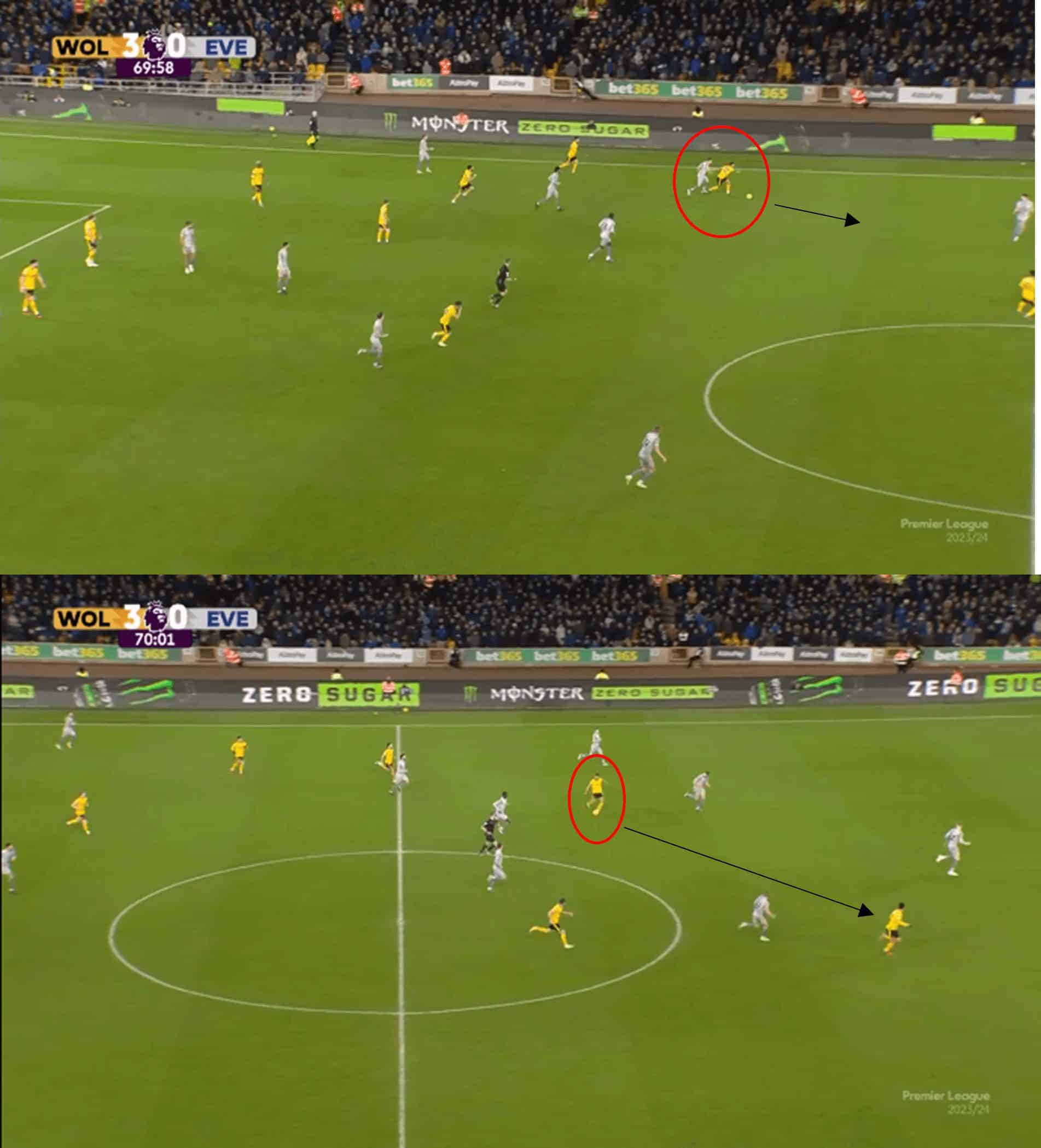
As Wolves win the ball in their defensive third, it lands to Matheus Cunha, who dribbles forward before releasing a pass towards Hwang Hee-Chan, whose shot is well saved by Jordan Pickford.
Wolves are one of the division’s top tacklers this season, successfully winning possession in 226 tackles.
Moreover, O’Neil’s side is second to Nottingham Forest for tackles won in the defensive third.
With such a strong defensive structure, the West Midlands side is then able to utilize the pace at their disposal in their forward line, as seen in the above example, to shift the pressure onto the opposition.
Not only does their pace in their attacking line-up aid in their transitions though, but also the technical close ball control of their forward line players.

Pedro Neto and Cunha are very strong carriers of the ball in the Wolves squad, as seen in the above graphic.
Cunha, in particular, has been very adept at driving forward deep from within his own half.
Neto tops the league for average carry distance at 15.67m; Cunha ranks fourth in the league with an average carry distance of 14.70m.
Before sustaining an injury in October, Neto was a key catalyst in the Wolves attack.
The Portuguese international has registered seven assists despite a two-month injury absence.
Only Aston Villa‘s Ollie Watkins and Liverpool‘s Mo Salah have assisted more.
However, Neto has assisted 0.70 per 90, the highest of all players in the league who have featured for at least five 90-minute games this season.
It was undoubtedly a blow for O’Neil to lose Neto, who is Wolves’ most natural winger.
However, in his absence, Wolves have adapted well, mainly adopting a 3-4-3 formation with wing-backs to provide width in attack.
Moreover, Pablo Sarabia has stepped up into the front three and has averaged 0.67 assists per 90.
Therefore, he is only marginally trailing behind Neto in this department.
While O’Neil is utilising the strengths of the players he has at his disposal, the 40-year-old is also guiding his team tactically in terms of movement and positioning.
One player who is thriving from such guidance at present is forward Hwang.
A well-drilled side
Hwang has scored 10 league goals so far this campaign, bettered by only five other players in the division.
To put Hwang’s current form into context, he has scored more goals this season than in his past three seasons combined.

The graphic shows that, as well as more goals in this campaign, the South Korean has had more opportunities in front of the goal compared to last season.
It is noticeable from the above that Hwang’s shots are not just hopeful punts from outside the area but opportunities with fairly high expected goal values, mostly in the penalty area.
However, these opportunities do not necessarily arise by chance and are as much a product of intelligent movement in the final third.

As Neto takes possession, his instinct is to take on the opposing defender either along the channels or towards the penalty area.
Hwang anticipates when Neto will cross into the area and so times his run to get a shot at goal and score.
The South Korean’s positioning and movement ensure his side takes the lead.
This is an example of how O’Neil has guided an individual in movement and positioning in the attacking phase.
Still, the former midfielder is also well-versed in drilling attacking routines throughout his team.
This was evident in the recent fixture against Everton.
Before Everton visited Molineux, Sean Dyche‘s side visited Burnley and ran out 2-0 winners.
Everton lined up in a 5-4-1 formation that day.
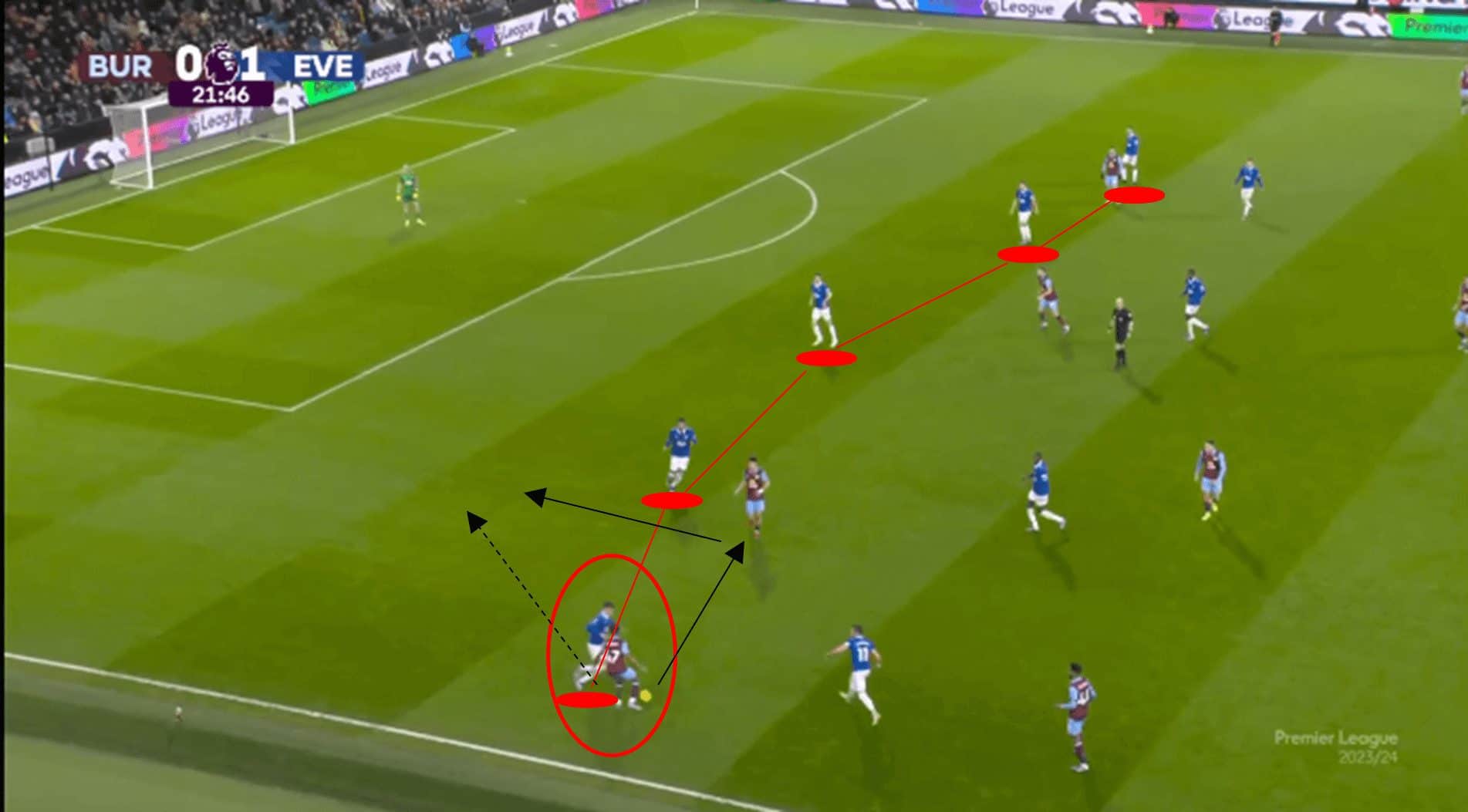
The match still shows that Burnley has possession on the wing with Wilson Odobert.
As Odobert’s teammate drifts towards him, Everton’s Ben Godfrey follows.
Odobert plays a one-two combination to exploit the space on the inside channel.

However, as the cross reaches Jay Rodriguez, Everton has strength in numbers with the remainder of the back five, and the ball is eventually blocked and cleared.
A few weeks before Everton’s victory over Burnley, Wolves ran out 1-0 winners over Vincent Kompany‘s side in a cagey match.
Similar to the Burnley encounter, Everton opted to set up in a 5-4-1 formation at Molineux, looking to frustrate Wolves’ direct play.
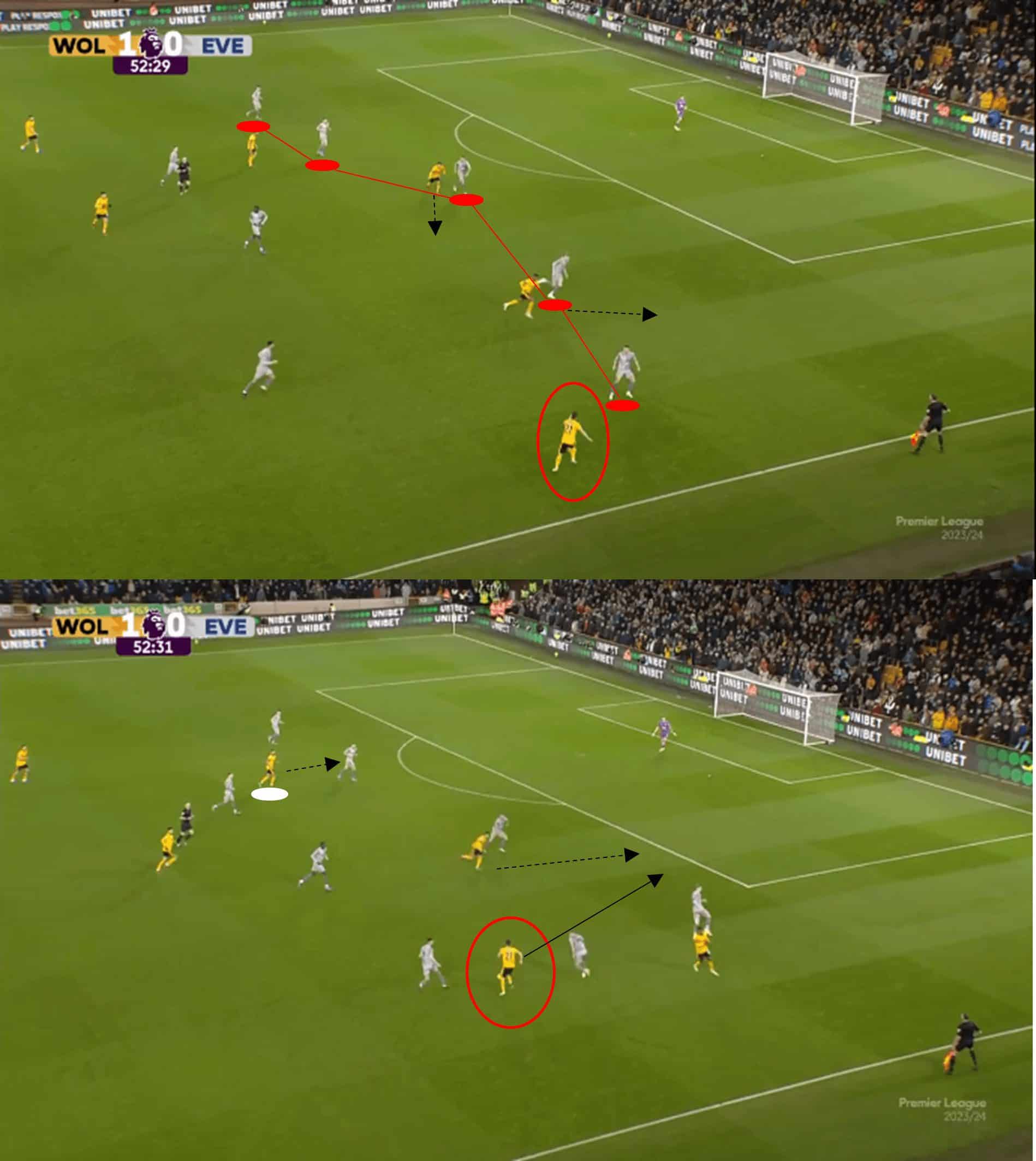
As seen previously, the ball is played out to Sarabia on the wing in a similar position to Burnley’s Odobert, but on the opposite flank.
The Everton left-back, Vitaliy Mykolenko, tracks Sarabia, while Jarrad Branthwaite marks Nélson Semedo, who drifts to the right-hand channel.
As Hwang sees Sarabia move inside, he starts to run towards his teammate, knowing that Michael Keane will follow to track his run.
However, the South Korean then purposely exploits the space left between Keane and Branthwaite by accelerating into this area in anticipation that Sarabia will pick out a pass.
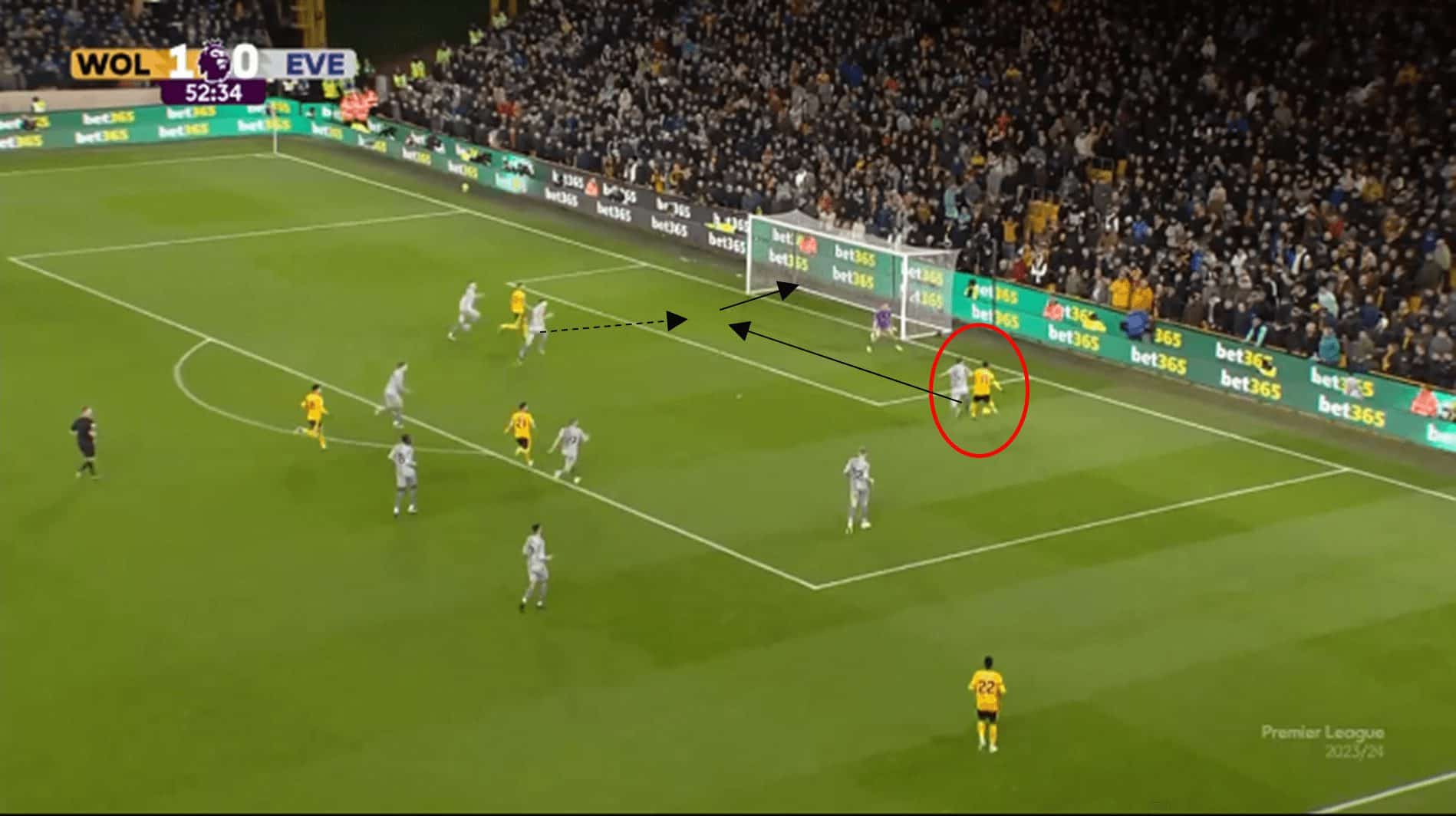
Sarabia is able to do just that, and Hwang drives forward before providing a low cross towards the advancing Cunha, who has accelerated towards the six-yard box.
Although this goal required the skill of those involved in the play, it is an example of a well-worked drill, most probably worked on at the training ground, in anticipation of how Everton would react to off-the-ball movements.
Adapting to the opposition
O’Neil is often realistic with his tactics and adjusts them depending on the opposition.
For example, O’Neil knows that his side isn’t expected to dominate against Manchester City, so he opted to stay compact on one side of the pitch before launching counterattacks against the Champions.
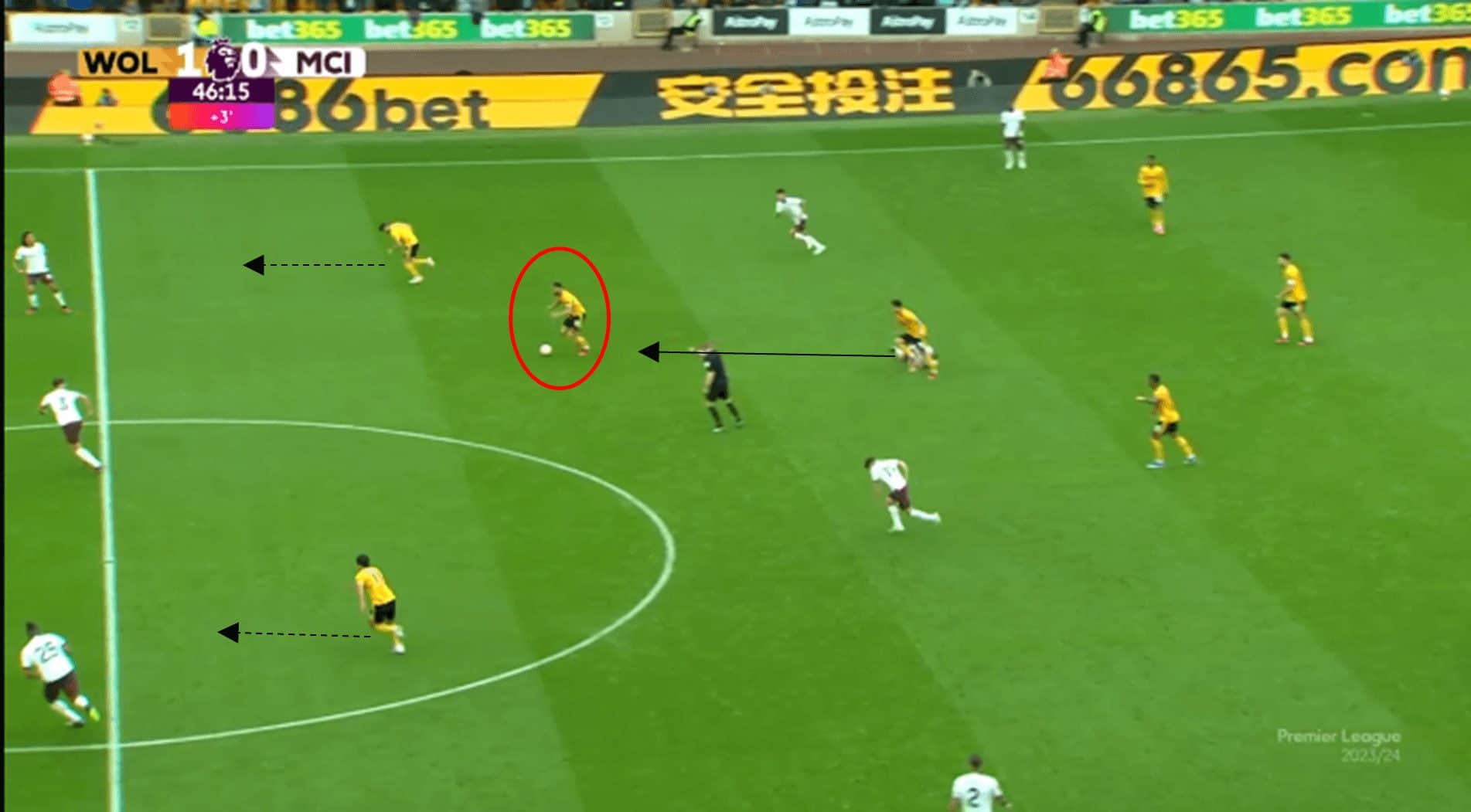
The above image shows Wolves on the counter.
Although there is a numerical match player for player in this situation, O’Neil’s side will look to provide overloads to give them an edge in the attacking phases.
As Wolves looked to hurt Man City on the counter, they were much more strategic with their pressing.
In contrast, O’Neil’s side has been much more aggressive in adopting a high press against teams around them in the league, such as Brentford.

The graphic shows that Wolves completed more than twice as many high regains and almost twice as many counter-pressing recoveries against Brentford than they did against City.
Furthermore, the West Midlands side completed five times more dangerous recoveries against Thomas Frank’s side than Pep Guardiola’s outfit.
Despite the different approaches to the respective matches, Wolves ultimately emerged victorious in both games.
This further suggests they are intensely drilled and can execute differing match plans depending on the opponent.
O’Neil’s side are currently joint top of the league, thanks to goals scored from high turnovers, with six goals.
However, they only rank tenth in the league for total high turnovers, further demonstrating their varying strategic approaches to matches.
When they attempt to apply high pressure, they do it well.
The high press was particularly effective against Brentford as the Bees look to play the ball out from the back, starting with the goalkeeper.
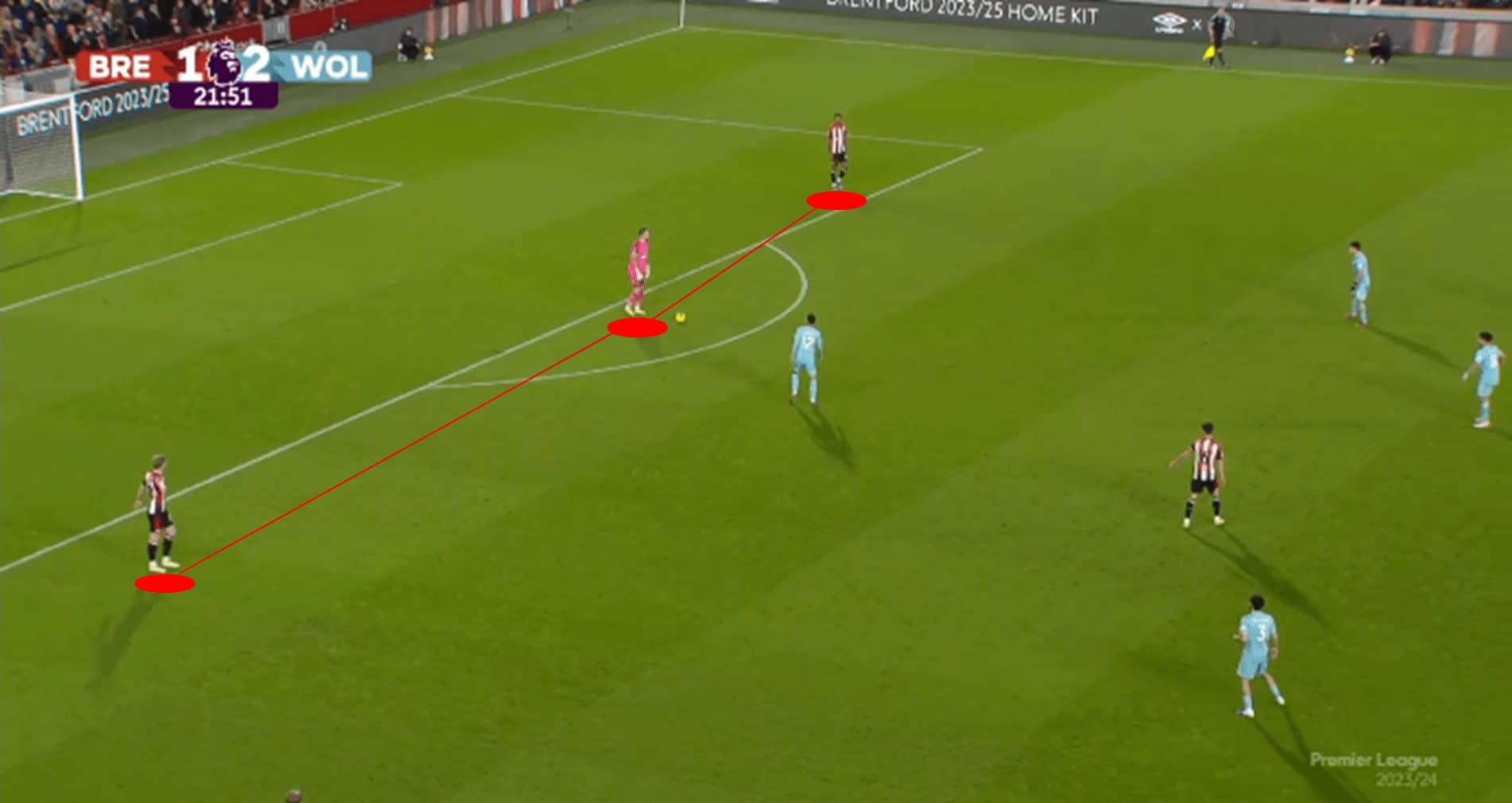
Goalkeeper Mark Flekken looks to join the two centre-backs in the Brentford back four to allow their full-backs to push further up the pitch.
Flekken then forms an effective back three, as shown in the above example.
In anticipation of this, Wolves applied a high press, forcing Brentford’s Nathan Collins into playing the ball long.
Toti Gomes intercepted Collins’ pass.
The above image illustrates how compact Wolves are when out of possession, with six Wolves players congested on the left side of the pitch.
Gomes’ header fell to the advanced Hwang, who was unmarked.
Hwang still had to show composure and skill to dispatch his effort, but nevertheless, his positioning from the initial press enabled Wolves to be a threat up front, and he doubled his side’s lead.
It is shown that Wolves are not one-dimensional in their attacking play, despite their generally direct approach, as they adapt on a game-by-game basis, depending on their opposition.
Conclusion
In this tactical analysis and scout report, we have demonstrated that O’Neil is maximizing the potential of his current squad by utilizing their pace and dribbling strengths to advance play forward effectively.
We have demonstrated that their compact shape, without the ball, facilitates their counterattacking play; players’ positioning and movement are crucial to their future goalscoring success.
Furthermore, this analysis has shown that their approach to matches will differ depending on their opposition.
By studying the fortunes of other teams against upcoming opponents, O’Neil is able to craft training routines that translate onto the pitch on matchdays.
Of course, it is up to the players to replicate these routines each week, and they are doing so to good effect.
There is no doubting that Wolves are on an upward trajectory at the moment, and a young English manager is at the heart of it.