
Over the last couple of years, one of the most interesting leagues in world football in terms of the improvement on a tactical and competitive level has been the Australian A-League.
The quality of domestic players has grown and when combined with some interesting recruitment from other markets we are starting to see some really interesting matchups from a tactical and technical perspective.
One of the most fascinating teams in the league this season are Newcastle Jets who have been impressing with a relatively small budget under the coaching of the 41-year-old Australian coach Arthur Papas.
At the time of writing, Newcastle are sitting 9th in the table but with a disrupted schedule so far they have games in hand on some of the teams around them having only managed to play 5 matches.
They are a side who have an interesting and clearly defined game model and tactical structure and as such they deserve further study.
In this article we will break down their season so far using a combination of data and tactical analysis to try to explain exactly what Newcastle are trying to do in and out of possession this season.
Newcastle Jets build-up phase
Domestically this season Newcastle are one of the most possession dominant sides in the league.
Indeed, in a recent league match against Macarthur we saw Newcastle with 71.68% of the ball.
Their style in terms of their build-up is very much based on playing out from the back and on creating superiorities in terms of progressing the ball safely and securely through the thirds.
The fullbacks tend to stay wide and on the same line as the deepest midfielder and in doing so they create a structure that allows them to outplay the first line of pressure from the opposition forwards.

As you can see from this data visualisation Newcastle are comfortably the team who average the most passes per 90 in the Australian A-League.
They are averaging 551.2 passes per 90 compared with second place Sydney who have an average of 465.1 passes per 90.
They build-up and create the attack through measured passes that allow them to move forward with a compact shape that creates passing angles and options across the width of the pitch, as we will see in more detail later in this piece, but the key thing is that they maintain a compact structure through shorter passes.

This is further shown by the fact that only 5.4% of passes played be Newcastle so far this season are classified as being ‘long’ passes.
There is a definite design in the fact that Papas coaches his side to maintain possession and not to make longer passes that have a higher chance of being inaccurate and to leading to turnovers in possession.

Once again, when we assess the percentage of passes played by Newcastle that are considered to be progressive we see that there is a clear preference for Newcastle to play shorter passing as only 13.29% of their total passes per 90 are progressive.
To give a little more context Wyscout categorise a pass as progressive if it meets the following criteria;
A pass is considered progressive if the distance between the starting point and the next touch is:
- at least 30 meters closer to the opponent’s goal if the starting and finishing points are within a team’s own half
- at least 15 meters closer to the opponent’s goal if the starting and finishing points are in different halves
- at least 10 meters closer to the opponent’s goal if the starting and finishing points are in the opponent’s half
This does not mean that Newcastle do not play line breaking passes but it does mean that they have a tendency to play passes that break the next line of pressure as opposed to looking for longer passes to bypass a higher number of opposition.
players.
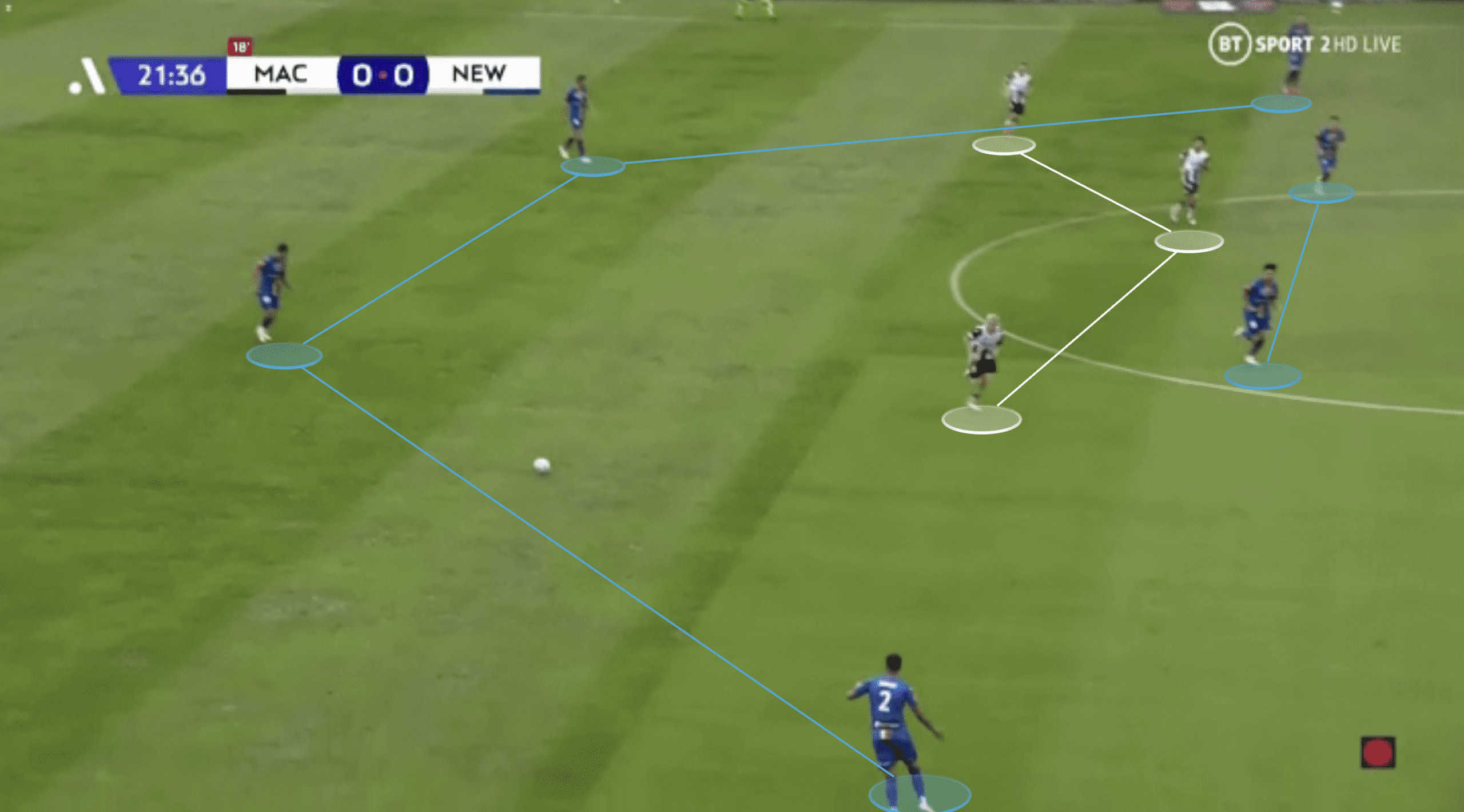
In this image we start to see the build-up structure from Newcastle as discussed above.
They primarily play in a four at the back system, although rotations in the build-up phase can see central midfeidlers drop to the first-line to enable ball progression, and the central defenders are encouraged to look to take possession and play to the space in the first instance as they look to move the opposition defenders around and to create passing lanes that will allow them to play into the midfield.
The midfield structure can differ with either one pivot or two players in a double pivot who can create passing options and superiorities behind the first line of pressure.
Typically the first pass will be to a fullback or, when a CM drops in front of the pressure, to the CM and then out to the FB.
From that point if there is no open passing option into the middle third the ball will be reset and moved to the opposite side in order to look for similar superiorities on that side.

Newcastle will typically be compact and well spaced around the ball with the central midfielders acting as pivot players who will move towards the ball and create triangles and angles to allow the ball to be shifted and played through spaces safely and securely.
Newcastle Jets attacking phase
In the more established attacking phase Newcastle create goal scoring opportunties well with good movement and space occupation in the final third.
They make use of half-space occupation from the CMs, wingers and forwards to create positional superiority over their opposition players and to find angles that allow them to effectively access the penalty area through deep crosses or periods of combination play around the penalty area.
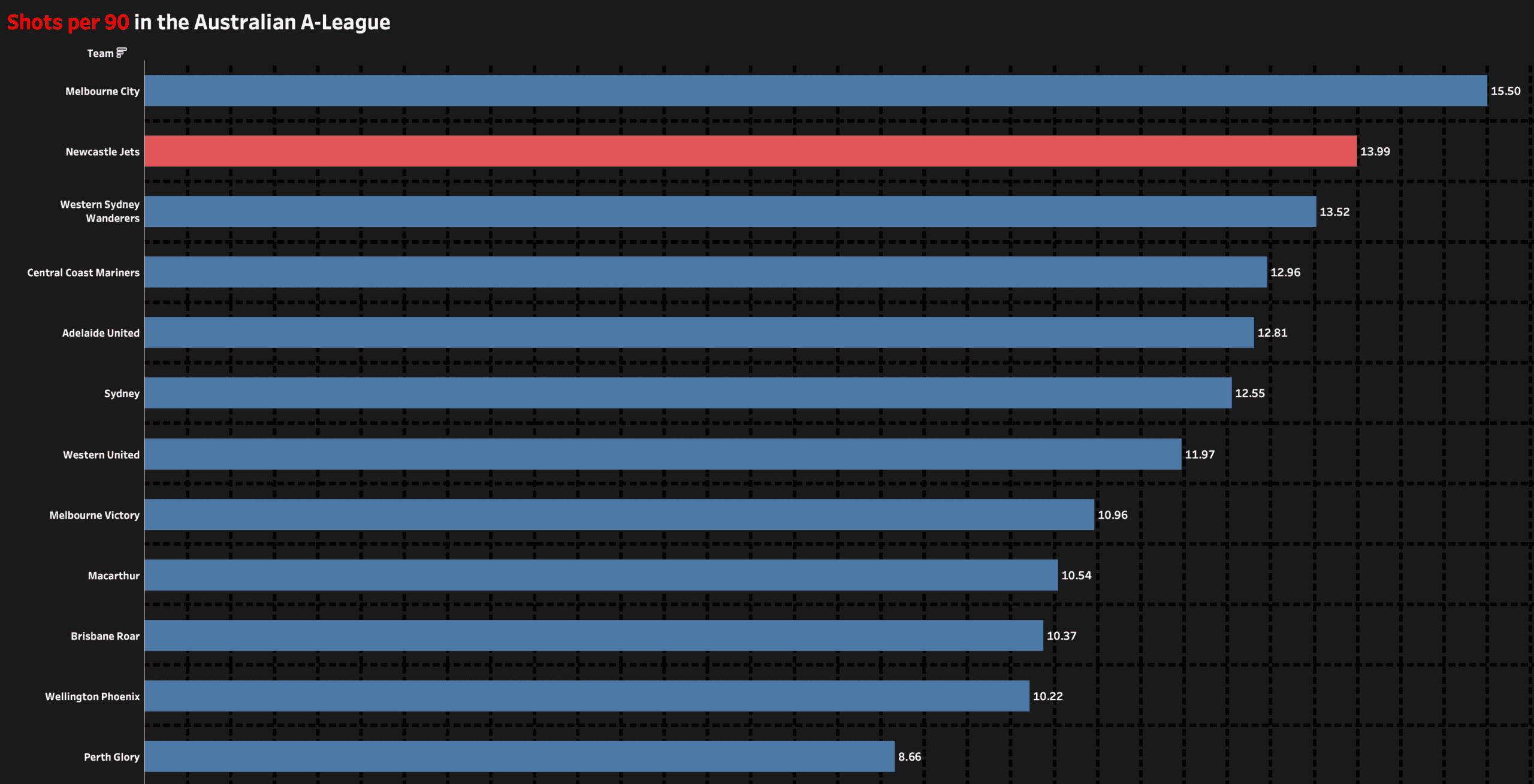
So far this season Newcastle are averaging 13.99 shots per 90 and although they have a relatively low sample size their attacking outputs are very impressive.
They create goalscoring opportunities through positional play and combinations as they move the ball into the final third and access the penalty area effectively.

The measured attacking approach that we see from Newcastle can be further shown through the quality of shooting opportunties that they are able to create in the attacking phase and 38.2% of the shots that they have taken so far this season have been on target.
Often, when a side is possession based they can resort to shooting from longer distanes but Newcastle are getting good penetration in the final third and they are creating good opportunties for shots.

Again, we can use data to show how effective Newcastle have been so far this season in the attacking phase as 13.16% of the shots that they have taken have resulted in goals.
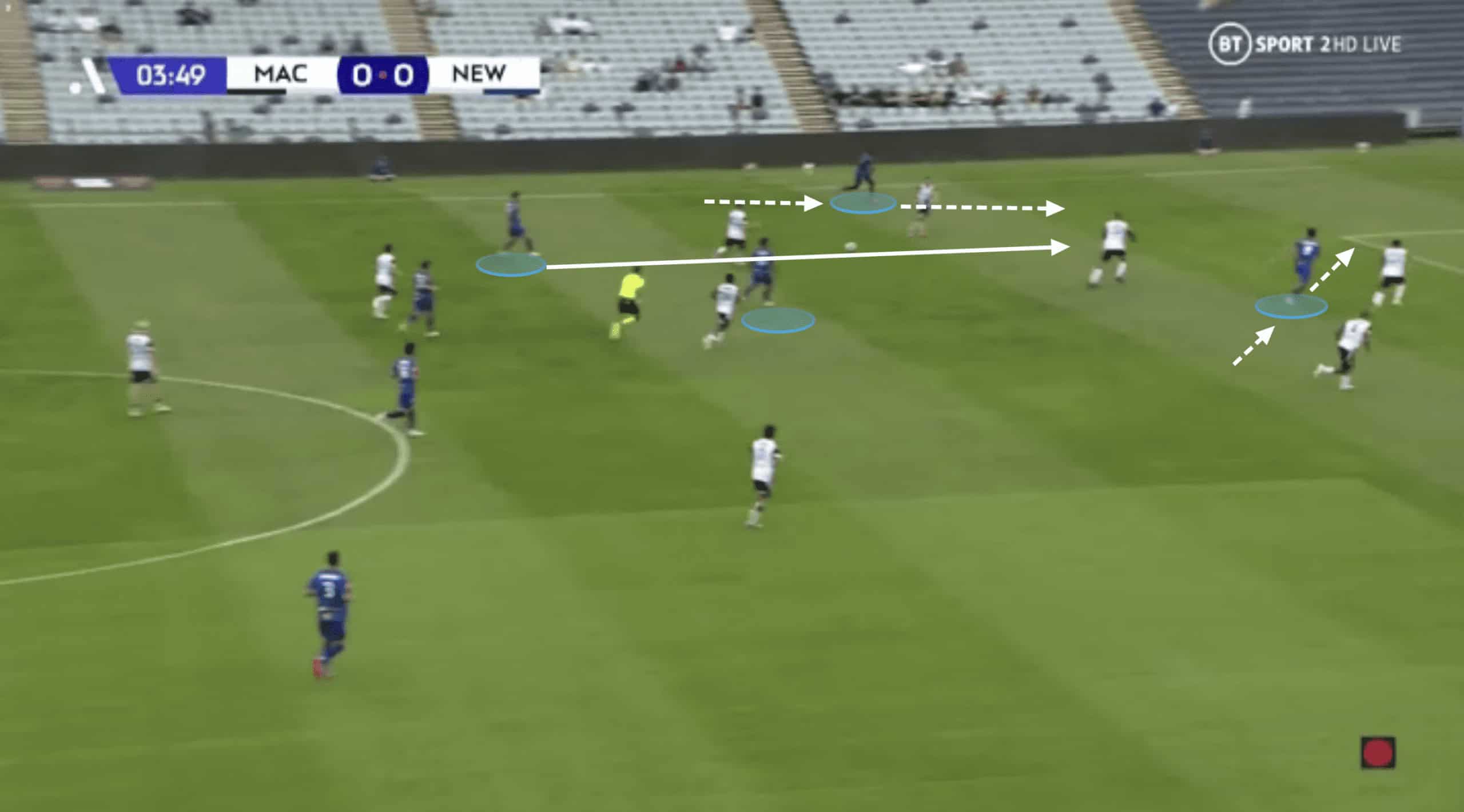
The key thing for Newcastle as they enter into the final third are the runs made by the wide forwards and central player as they typically look to find spaces that they can occupy in the ball-side half-space.
These runs allow the ball to be played into dangerous spaces before it is moved into the pentalty area.
We see this in this example with the left-sided attacker and the central attacker making moves that stretch the opposition defence and attack space in and around the defensive line.
Once again the key in this situation is that they are are to make these passes and runs securely because the ball is played forward in a measured and compact fashion.
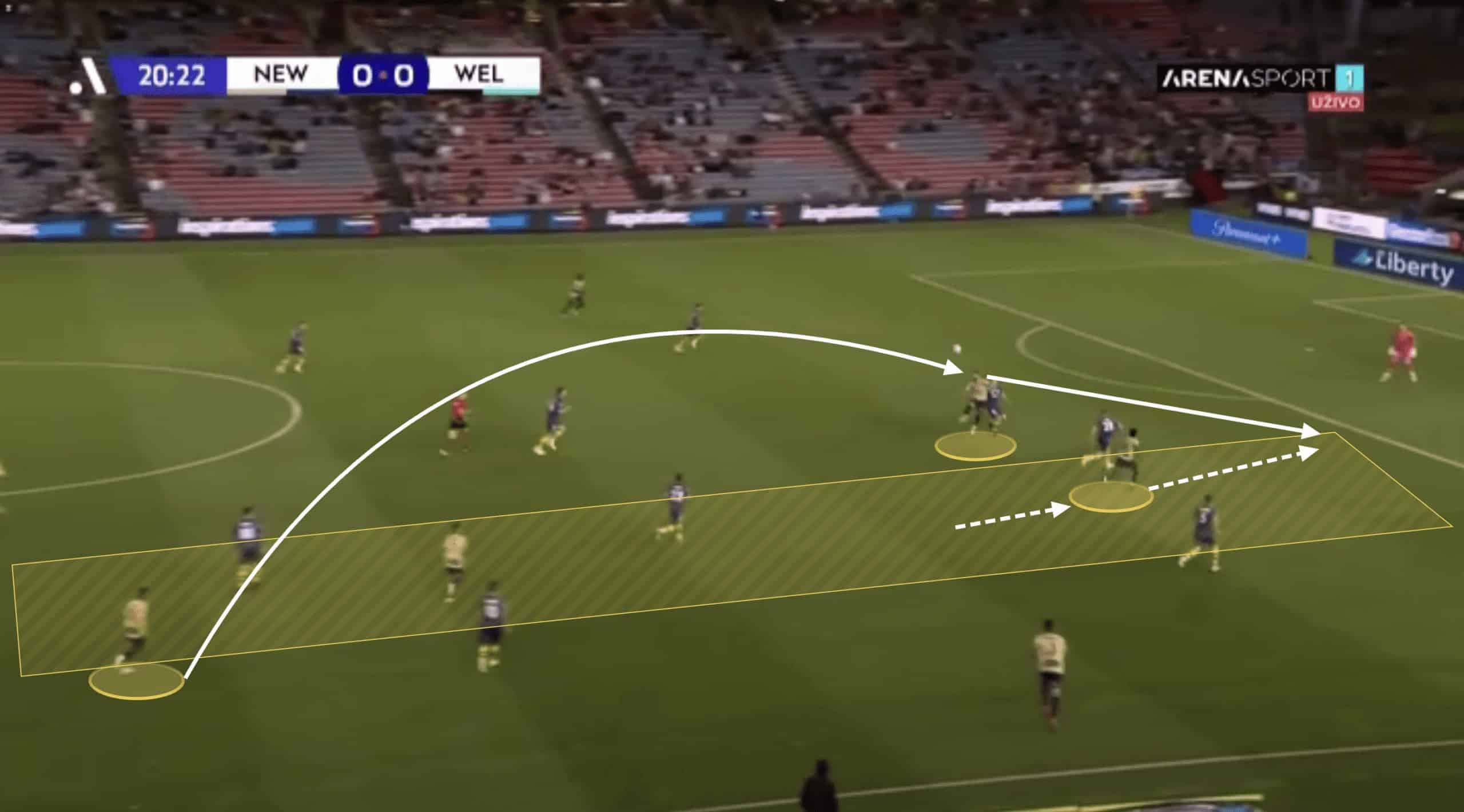
When they do go longer in order to find and access the striker more qucikly the key to their success is that they get support around the ball quickly and once again the key lies in the occupation and use of the half-spaces on the ball side of the pitch.
We see an example of this here as the ball is clipped to the central striker who wins the aerial duel against the opposition defender.
The wide forward on the right-side of the pitch is attacking through the half-space and his off-ball movement allows him to break the defensive line to get on to the end of the flick on from the striker.
Newcastle Jets pressing
Out of possession Newcastle are extremely aggressive but once again this is a result of the fact that when they are in the build-up and attacking phase of the game they tend to be so compact in their shape and structure.
This means that when they do lose the ball they are positioned to quickly press and engage the ball as they counter press and prevent the opposition from securely building their attack.

So far this season Newcastle have a passes per defensive action (PPDA) of 7.08 which is the lowest in the A-League.
PPDA measures the amount of passes a team allows their opposition to have before engaging in a defensive action.
The lower the value of PPDA the more aggressive the press.
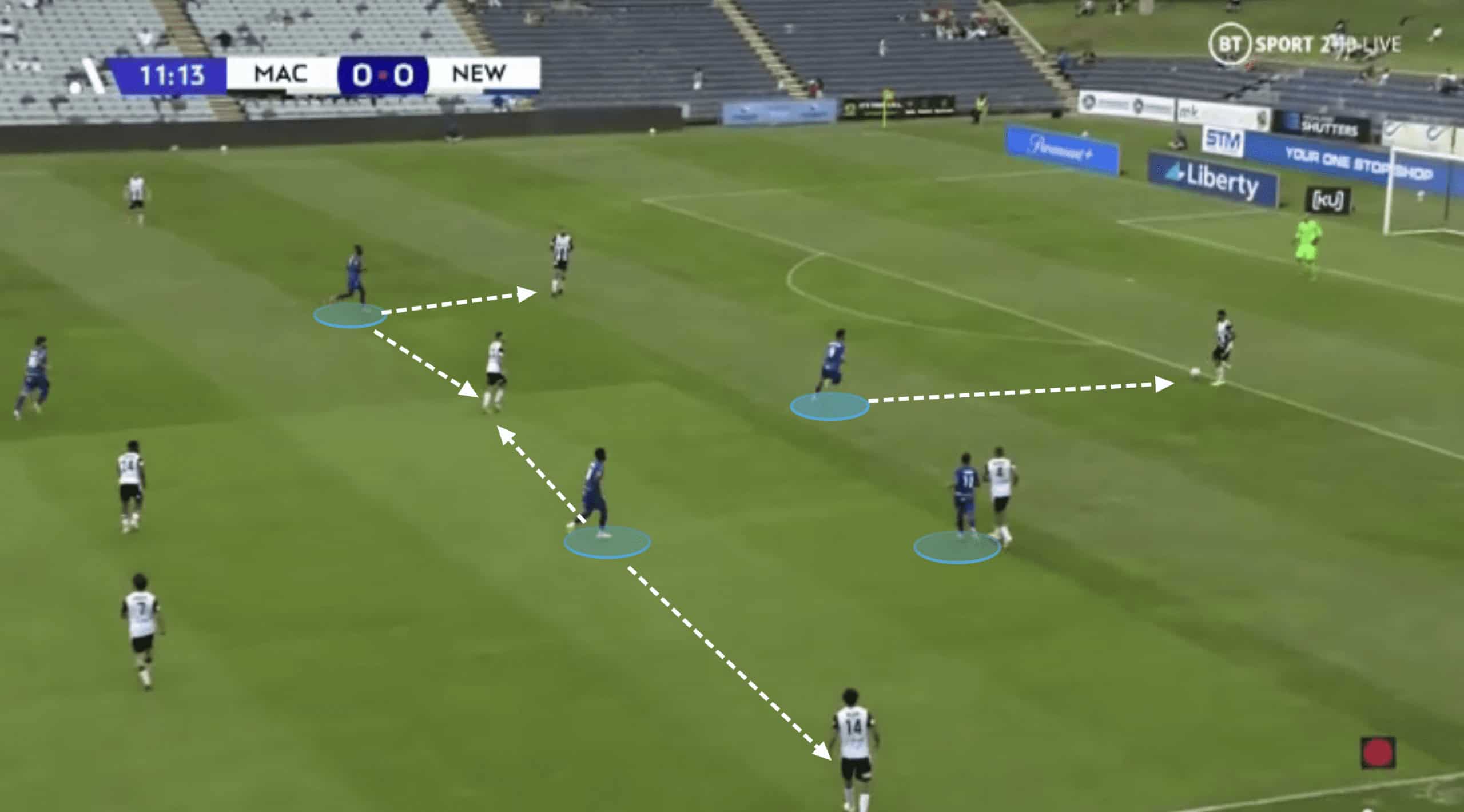
Typically Newcastle will use a mix of close man marking when the opposition are in transtition combined with good spacing, which is an important part of their defensive effectiveness, to allow players to cover and press more than one of the opposition players.
In this example we see that the forward is moving to engage the opposition player who is in possession on the edge of his own box.
There are three more Newcastle players who are positioned in the final third, with one more moving to support, and they are positioned to prevent the opposition from being able to safely and securely play out.
Typically this will mean that the opposition are forced to play into trouble or to play longer passes that can be turned over.
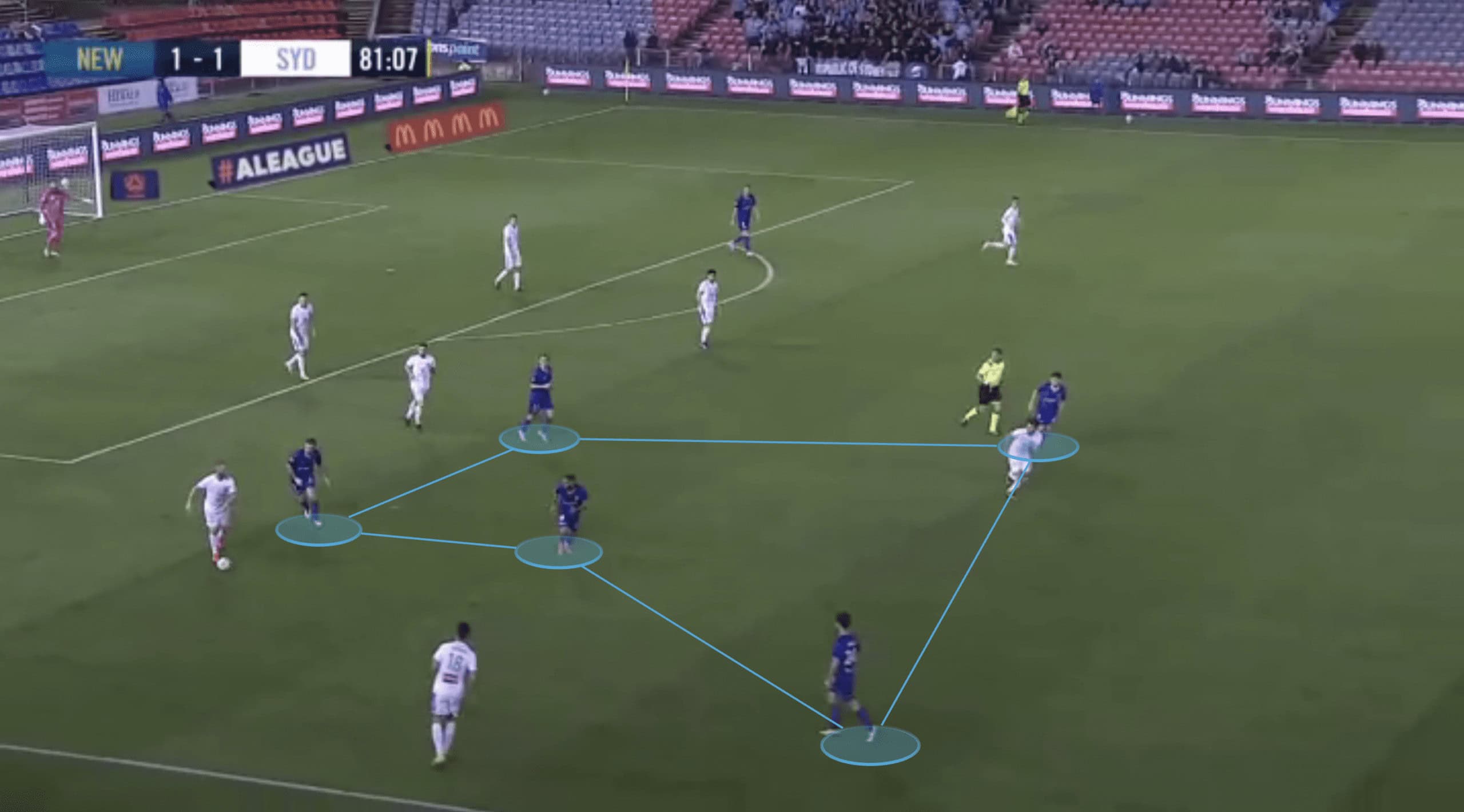
Again here we see a moment of transition from attack to defence for Newcastle and they are quick to overload the ball side of the pitch, because they are closely connected when the ball is turned over, and there is no easy passing option for the player in possession of the ball.
Instead the ball will be played longer and into areas in which Newcastle can look to win the ball back.
Newcastle Jets defensive phase
While Newcastle are extremely aggressive defensively in the way that they press and delay the immediate transition from opposition players they also show the ability to drop into a low to medium defensive block with good spacing that denies the opposition space in which to play.

So far this season Newcastle are giving up the third most shots on the league with an average of 13.8 per 90.
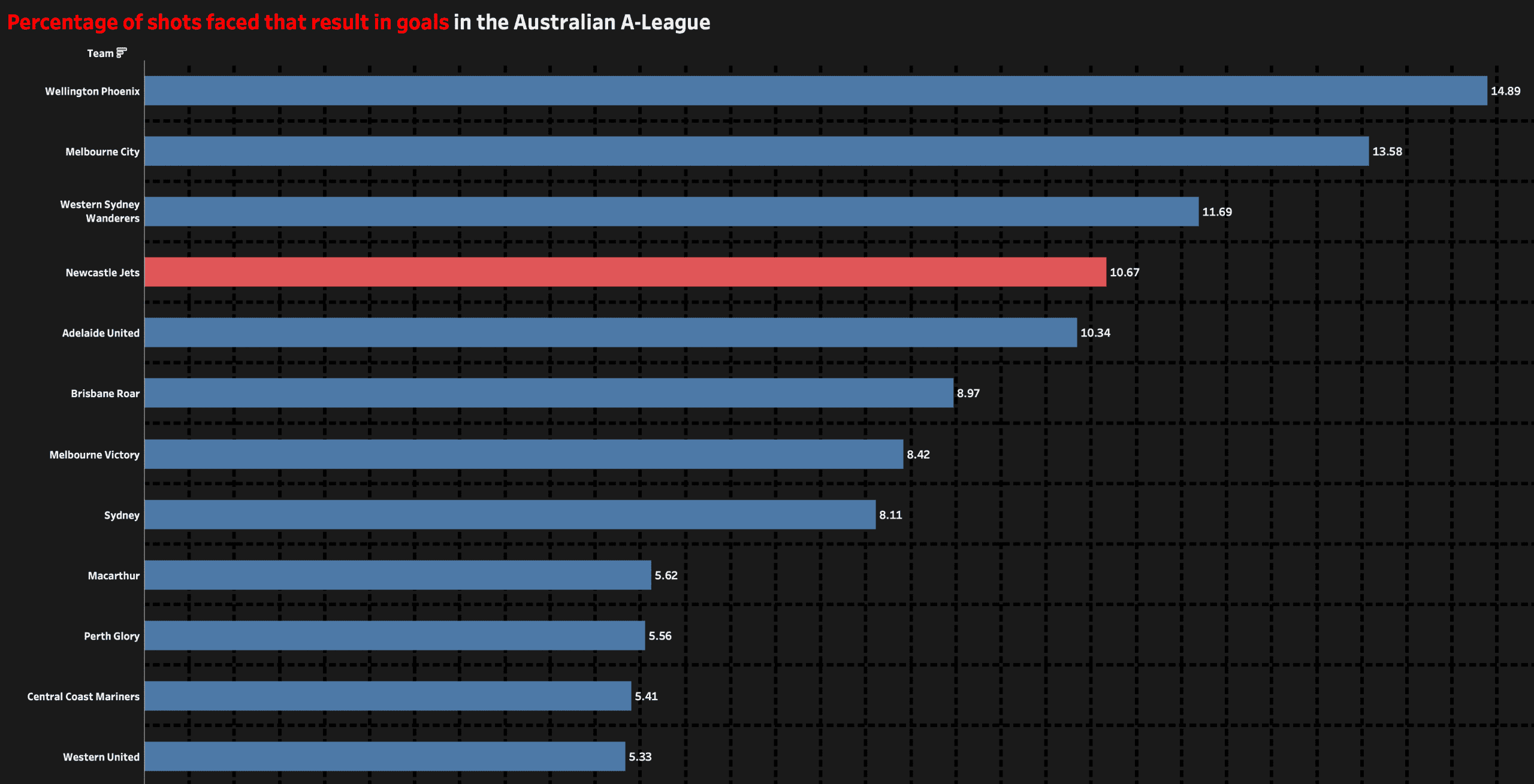
They also have the fourth highest percentage of shots faced that result in goals with 10.67%

Interestingly, however, they are only allowing an average of 0.11 xG per shot faced.
This means that a proportion of the goals conceded so far this season have been from longer range as they are not allowing the opposition easy access to the penalty area.
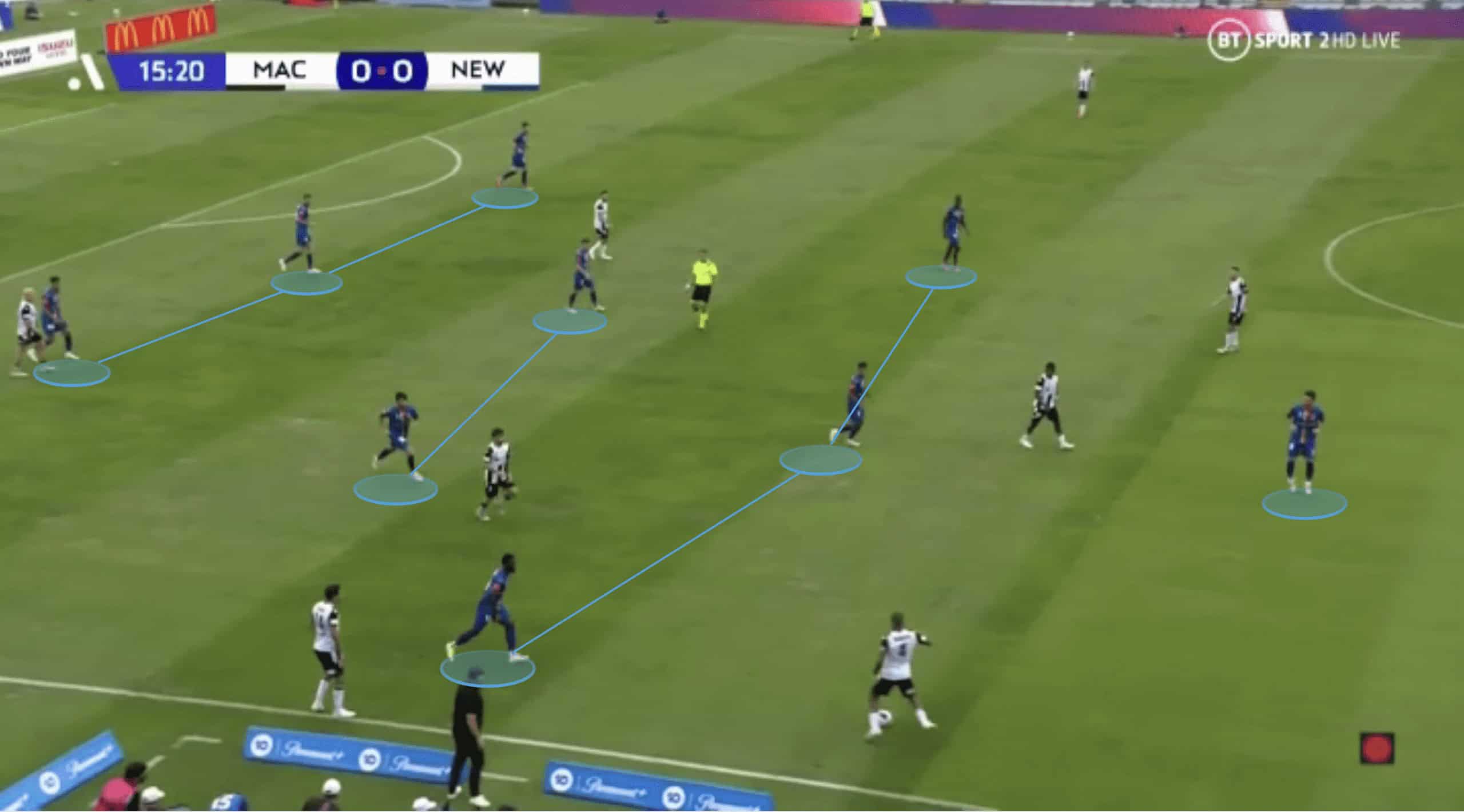
The spacing in the defensive phase is key as Newcastle drop into a medium block they are balanced in their shape and they leave little space in terms of passing lanes and angles for the opposition to break the lines with passing combinations.
They will press individually and be aggressive when the ball is played into their zone but typically they will remain disciplined in their defensive shape.
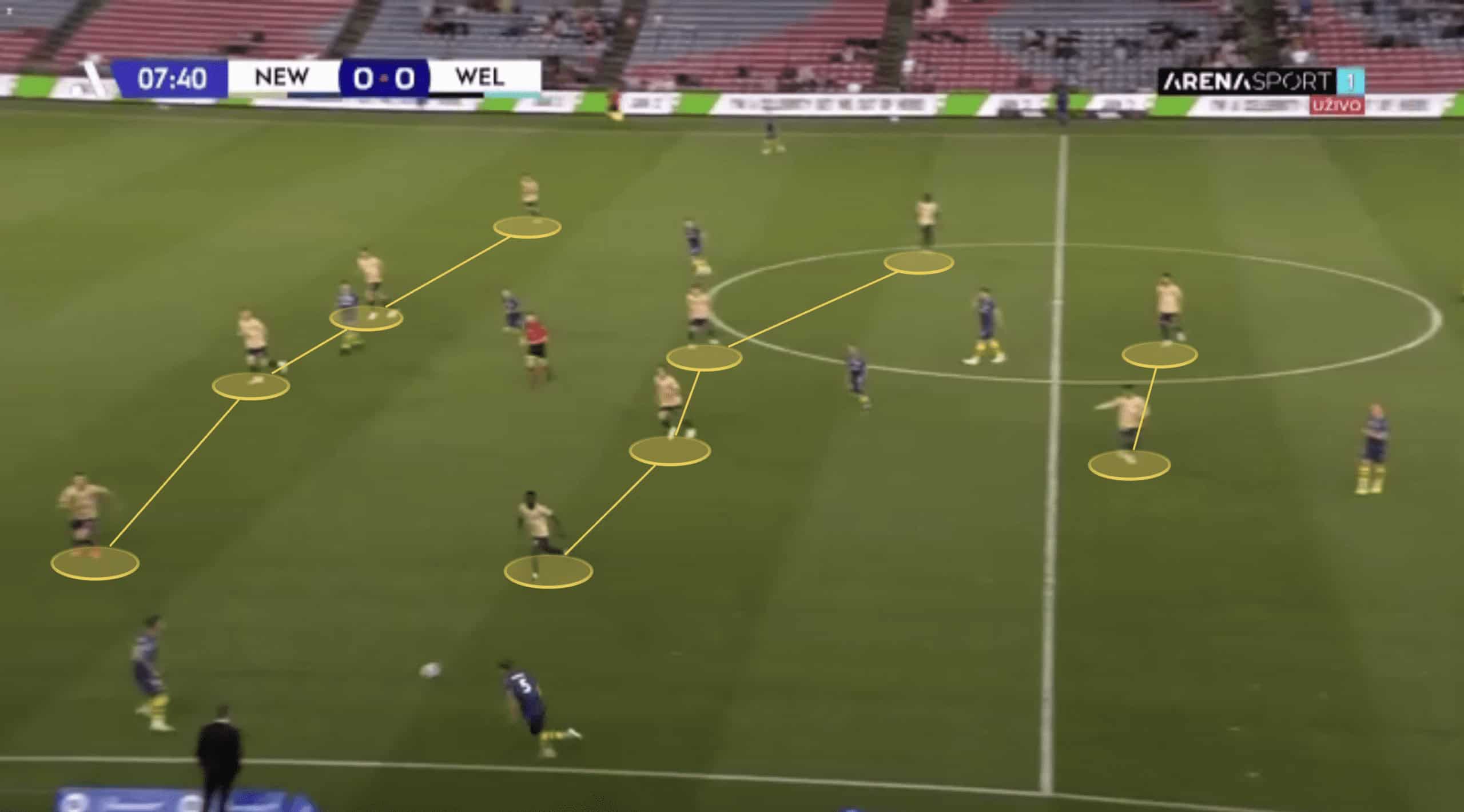
This time we see Newcastle being more stretched and defending in a 4-4-2 shape but as the ball is played into the wide areas they are quick to shift across and close the space that is available for the opposition to attack down the wide areas.
The spacing and balance of the defensive block is key as the opposition cannot take advantage of space through quick switches or passes that can be played between the lines.
Conclusion
Arthur Papas is developing an interesting reputation as a young coach with a defined and well thought out tactical approach to the game.
Over the course of the season, as a result of the underlying data, I would expect to see Newcastle continue to impress from an attacking point of view, with their chance creation looking stable, while improving defensively if they can maintain a low xG per shot allowed.
One thing is for sure, however, Newcastle will continue to play in an exciting, interesting, and well implemented game model.
