
The majority of Europe’s leagues have come to a dramatic conclusion over the past week, with some even drawing to a close this very weekend.
One of those leagues wrapping up over the coming few days is the Danish Superliga.
Denmark’s top flight has been a breeding ground for some of the finest talents on the continent, as well as a handful of superb coaches, including Brentford’s Thomas Frank and the Danish national team’s head coach, Kasper Hjulmand.
It may seem like an elementary statement, given their historical success in Denmark.
Still, FC Copenhagen are the best side in the Superliga right now, sitting top of the table and on course to retain their title.
The managerial change that occurred early in the season made this even more impressive.
Having been assistant manager to Jess Thorup in the previous campaign, 35-year-old Jacob Neestrup is the man leading the Danish giants to glory this time around after Thorup was dismissed following a rough start to the campaign.
But there is much more to The Lions’ success than having excellent players and a lovely blend of youth and experience.
Neestrup’s tactical flexibility this season has made for enjoyable viewing, especially for tactics nerds like us.
This tactical analysis piece will deconstruct the most intriguing elements of Jacob Neestrup style of play, as employed by the fourteen-time champions, to understand why they are on course for back-to-back titles.
As a disclaimer, it’s worth noting that F.C. København have been massively successful from set-pieces this season, but this was dissected in-depth in a recent set-piece analysis on the TFA site.
We will, therefore, focus solely on their tactics, both in and out of possession, for this one.
Jacob Neestrup pressing Tactics
Before taking a look at Jacob Neestrup tactics this season, it’s important to note Neestrup’s formation choice in games.
During his stint as Thorup’s number two in the previous campaign, Copenhagen rotated through various formations.
The most prominent structures were the 4-4-2 and the 4-2-3-1, which are essentially the same.

However, Thorup had no qualms about using a shape the team wasn’t overly familiar with in games, whether it was a 3-5-2 or even a 4-2-2-2.
Under Neestrup, there has been a little more consistency in the formation selection.
The 35-year-old prefers the 4-3-3, which has been deployed in 80 percent of the Danish giant’s games this season across all competitions – this figure includes the 4-1-4-1 and 4-5-1.

Interestingly, the back three formations are also more prominent under the latest head coach.
The signing of centre-back David Vavro from Lazio was perhaps the most significant reason behind this, alongside Kevin Diks’ versatility as a fullback and central defender, offering the boss flexibility to switch between a four and a three at the back.
Nevertheless, formations only provide coaches and players with pages to work within; they don’t write the story for them.
One of the most interesting elements of Copenhagen’s tactical set-up under Neestrup is their pressing.
There isn’t anything unconventional about how Copenhagen presses.
This isn’t Leeds United circa 2020, but their press is still highly effective and aggressive.
This season, Copenhagen boasts the fourth-lowest PPDA in the Danish Superliga at 11.09 and the fourth-highest challenge intensity at 5.7.
These numbers may not seem impressive, but the metrics don’t tell the whole story.
The Lions’ press is very aggressive, but the PPDA is relatively high compared to some of Europe’s most intense pressing teams, such as Bayern, Barcelona, and Brighton.
Why?
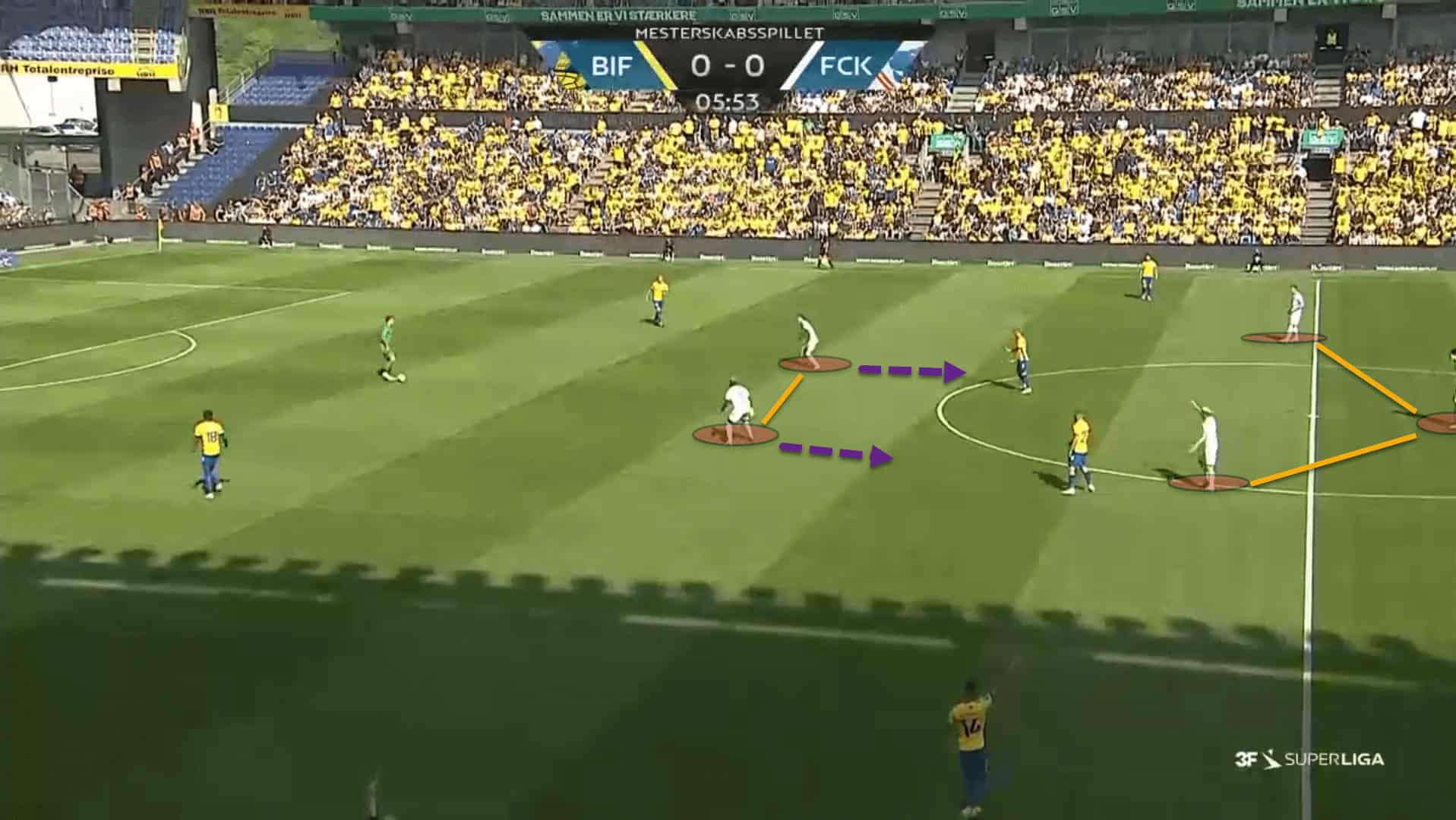
Copenhagen are instructed to drop off initially.
The team defends in a mid-to-high block instead of a high block.
The difference between the two is that, with the former, the first line of pressure practically skips the opposition’s build-up phase, positioning themselves to start the press roughly around the very start of the final third.
As seen in the previous example against Brøndby, Copenhagen’s first line of pressure sat off the backline rather than pressing, blocking the passing lane into the Brøndby double-pivot.
This allowed the attacking side’s goalkeeper to advance well up the pitch, creating a 3v2 against Copenhagen’s front two.
FC Copenhagen Defensive Territory
By comparing the average height of Copenhagen’s defensive line during Neestrup’s reign at Parken with the average line of engagement of Hákon Arnar Haraldsson – who has played as the frontman more than any other player over the last 10 games – we can get quite a clear picture of the compactness of the team’s block and roughly where the press begins.
The objective of the press is to force a backward pass.
This is a trigger for Copenhagen to bring the lines up and move into a full high press.
The first line of pressure normally initiates this backwards pass, or it can also be forced by a player from midfield.
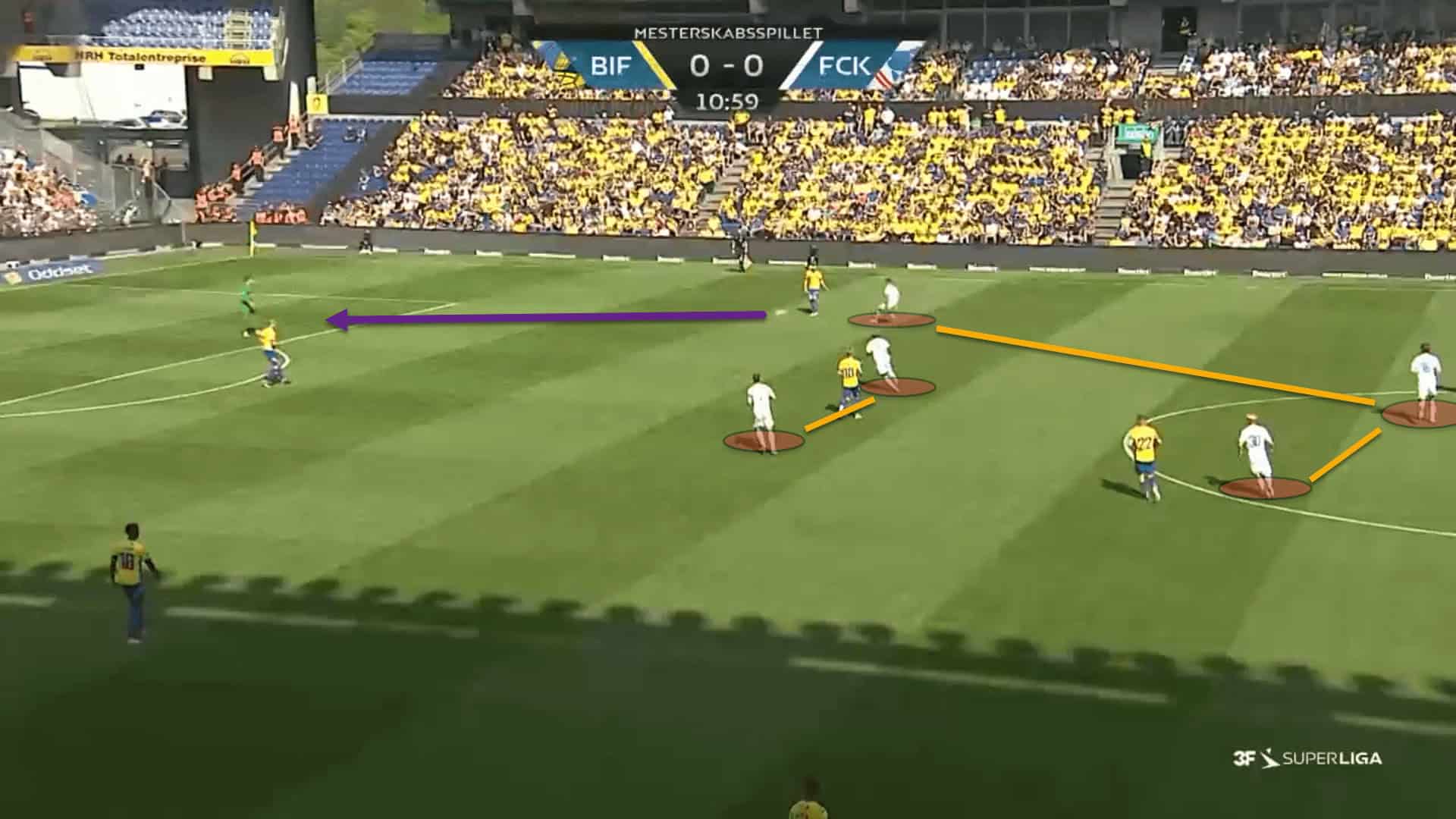
For instance, in this game against Brøndby, the Danish champions were defending in a 5-3-2 shape.
As the front two were closing the passing lanes to the opponent’s double-pivot, Copenhagen’s wide central midfielders would press the backline from out to in.
As the central passing lanes were cut off and the ball carrier couldn’t play wide because of the pressing player’s run, he had to move it back to the keeper.
Job done!
Using the wide central midfielder in a 5-3-2 to press the backline has sometimes caused problems for Copenhagen when Neestrup has deployed this structure, especially if the single pivot is unable to cover for them in time.
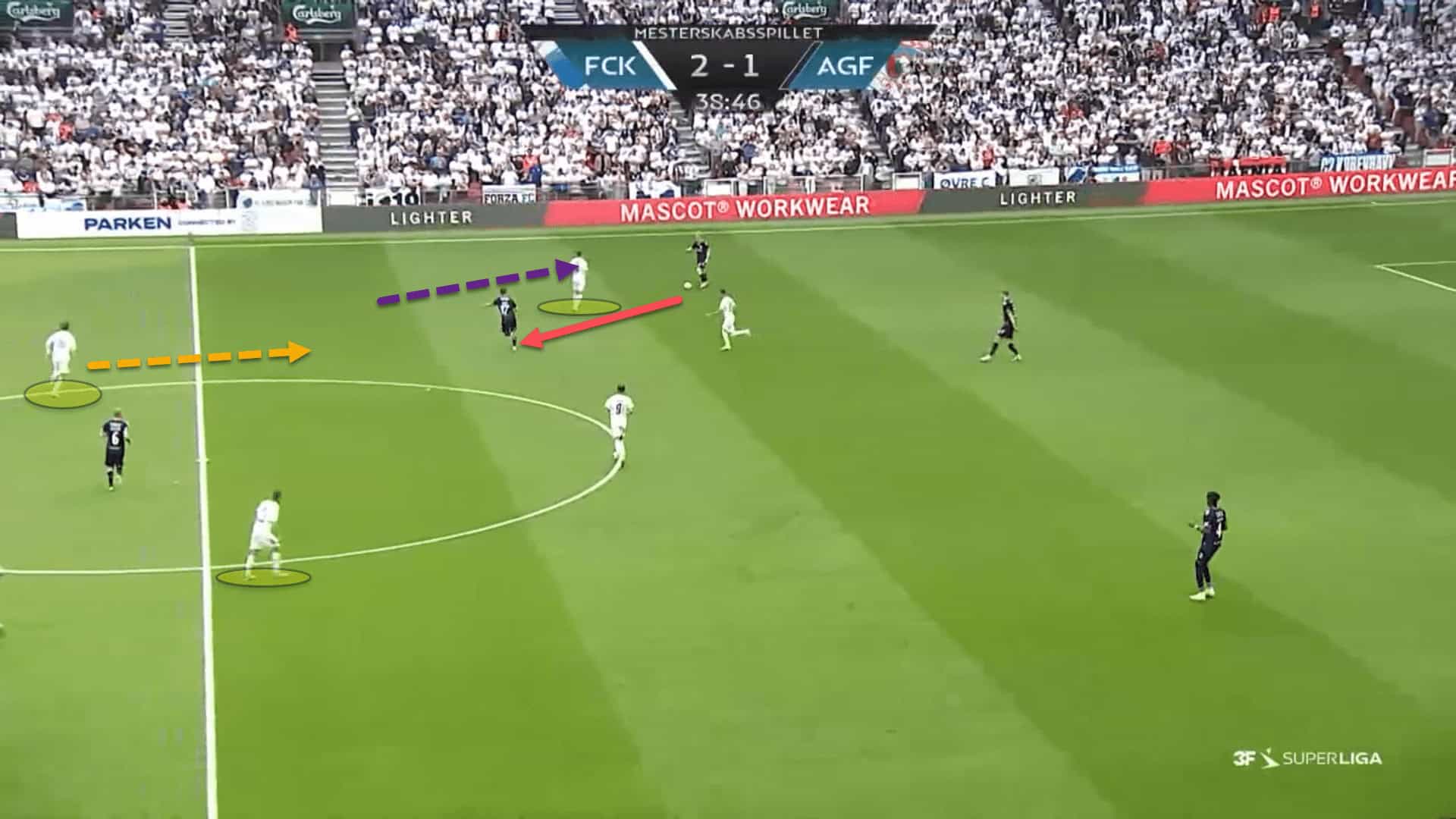
For instance, here, the left central midfielder, Ísak Bergmann Jóhannesson, had stepped up to press the opposition’s ball carrier in the backline.
The number ‘6’ tried to get across in time to cover for him, but couldn’t, which allowed for easy progression by the attacking side.
Nonetheless, once the mid-to-high block is successful and the ball is played backwards, Copenhagen steps up as a unit and begins to press intensely, looking to regain possession as high up the pitch as possible.
Neestrup instructs his players to cut off any access through the centre of the pitch for the opposition and force them to play wide into an uncomfortable area.
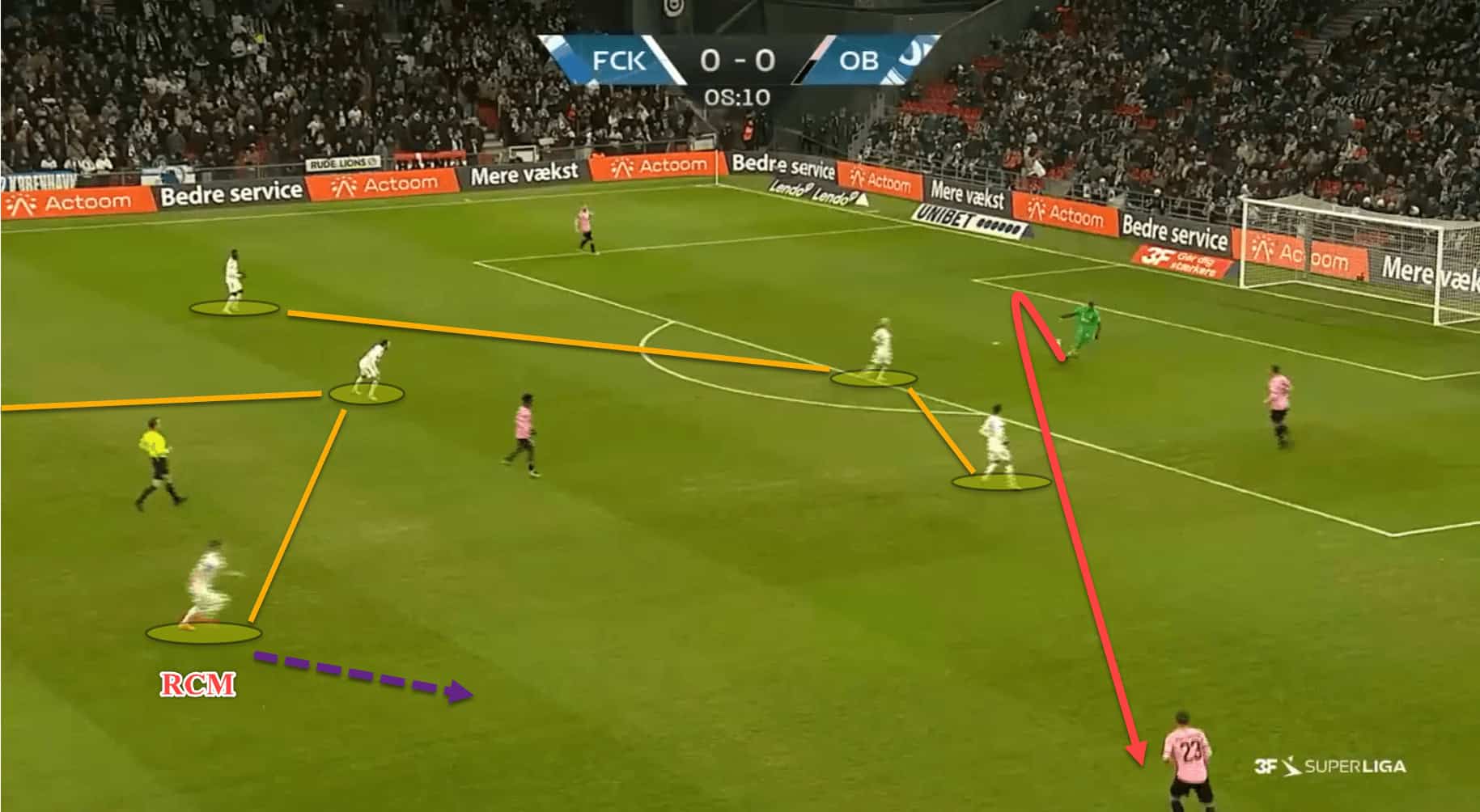
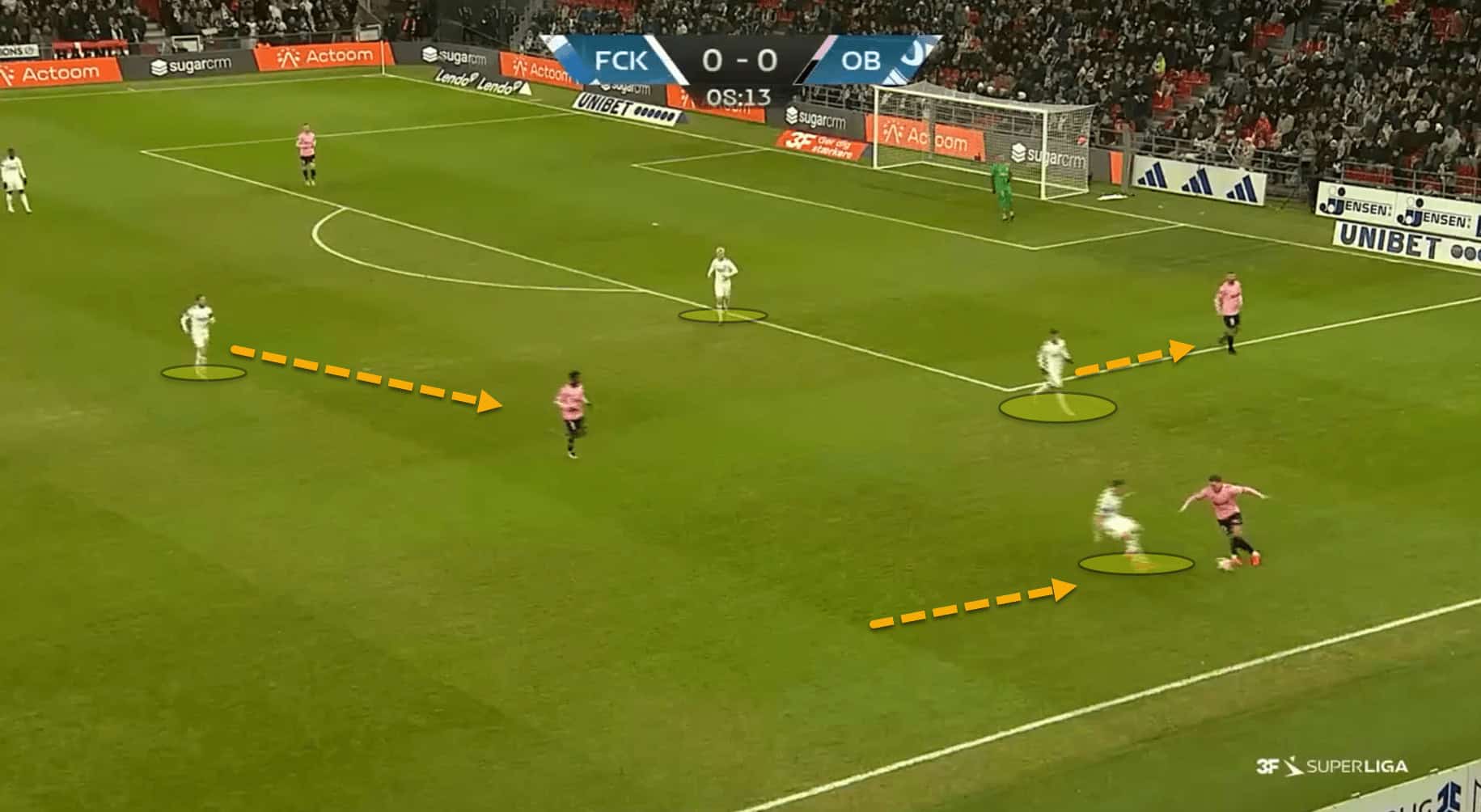
There is no sideways passing option for the OB goalkeeper, who is under pressure from Copenhagen’s centre-forward.
The wingers are pushed up onto the centre-backs, while the three central midfielders are man-marking in the middle of the pitch, leaving only the fullbacks free.
However, it’s essential to note the positioning of Copenhagen’s right central midfielder.
He is preparing to run out to close down the fullback, as he knows that this is the pass that the goalkeeper would choose.
This is all part of Neestrup’s trap.
Once the ball is moved to the flanks, Copenhagen goes man-for-man and aggressively presses the opposition in such a tight area to regain possession.
Going back to a point earlier in this section, Copenhagen’s PPDA is still relatively high because they allow the opposition to play numerous passes, circulating around the back.
Still, once the backward pass is made, the Lions hunt their prey.
This pressing has been the killer this season and is incredibly difficult to break out of, as it lures the attacking team into a false sense of security before causing panic in the blink of an eye.
This is a credit to the head coach, his staff, and the players.
Playing direct through the press
Copenhagen’s build-up play is incredibly vertical.
This doesn’t mean that Neestrup instructs his backline and goalkeeper to kick it long.
In fact, Copenhagen have registered the second-lowest number of long balls per 90 in the Danish Superliga this season with 40.88, behind Silkeborg.
However, the champions are excellent at baiting the opposition into pressing them in the final third, then playing through the pressure rather than around or over it.
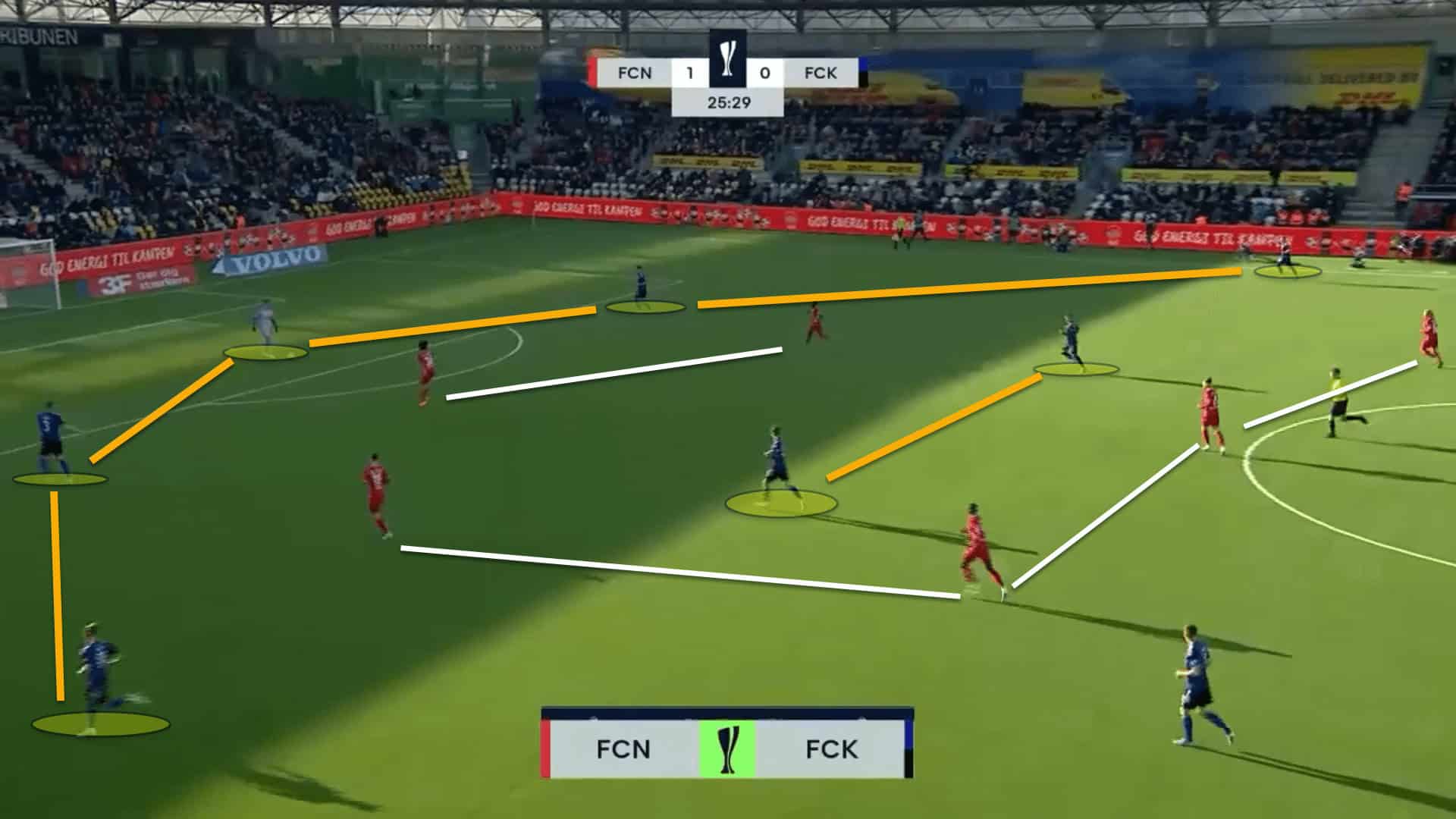
Normally, six outfield players will position themselves in the first third of the pitch.
In most cases, the opposition will match these, especially when using a 4-4-2 formation to press, as shown in the previous screenshot.
But by using the goalkeeper as an extra man in the build-up, Copenhagen have 7v6 in this phase, or numerical superiority as the cool kids call it.
This creates a 4v4 situation against the opposition’s defensive line.
This is quite similar to Brighton’s setup under Roberto De Zerbi.

There is no stalling on the ball, though.
In this sense, they differ from Roberto De Zerbi’s Brighton.
However, Copenhagen waits until a passing lane opens up behind the opposition’s midfield line to try to reach the four players positioned highest on the pitch.
This is where personnel come into play.
Firstly, the goalkeeper needs to be comfortable in possession.
Kamil Grabara has been the man trusted with protecting the net and starting Copenhagen’s attacks under Jacob Neestrup coaching style.
The former Liverpool player boasts a passing accuracy of just under 85 percent this season and even makes 1.7 passes to the final third per 90.
When the right time comes, and the passing lane is open, Grabara’s job is to split the opposition’s midfield and frontline, playing directly to the feet of the front four.
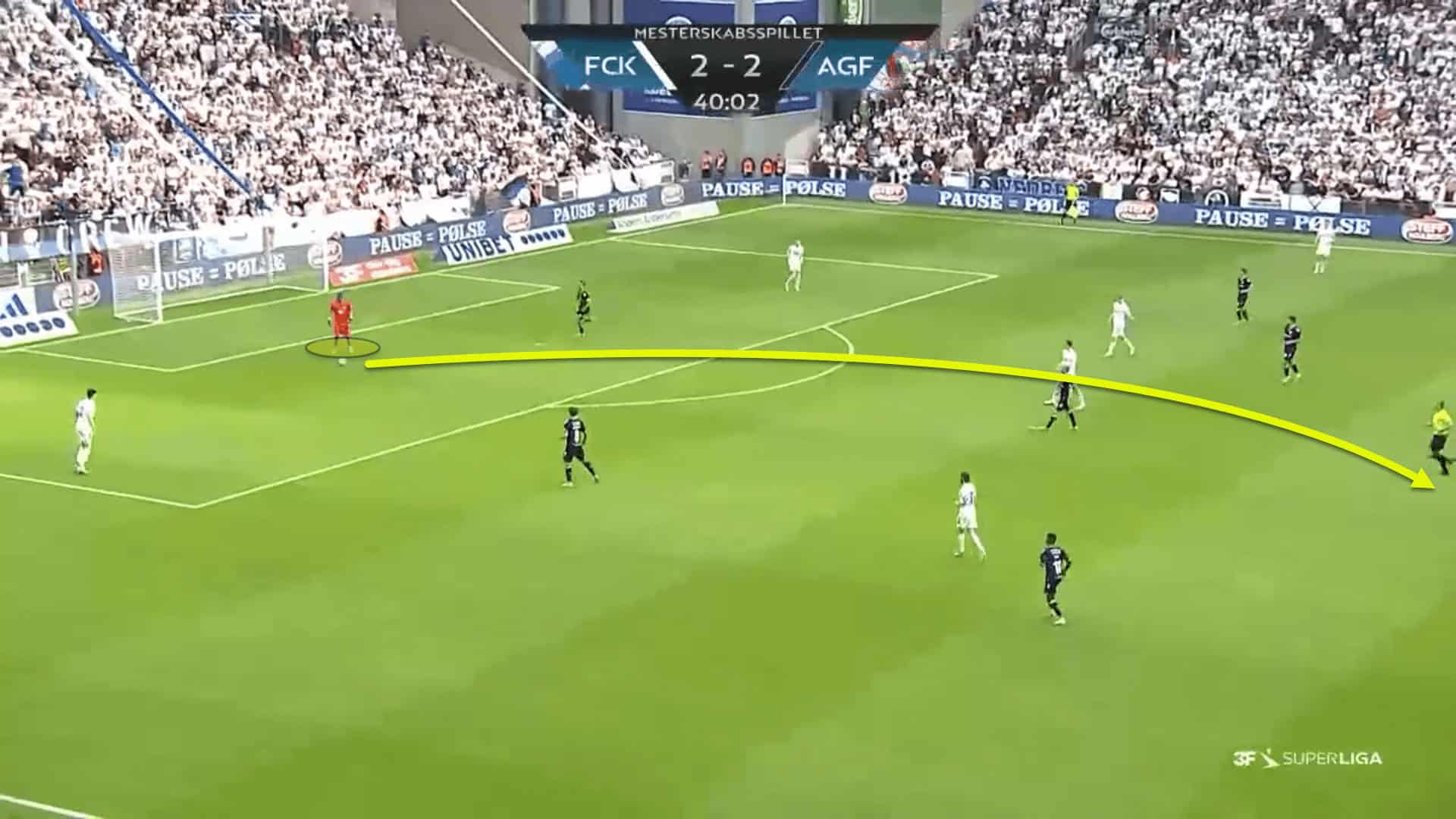
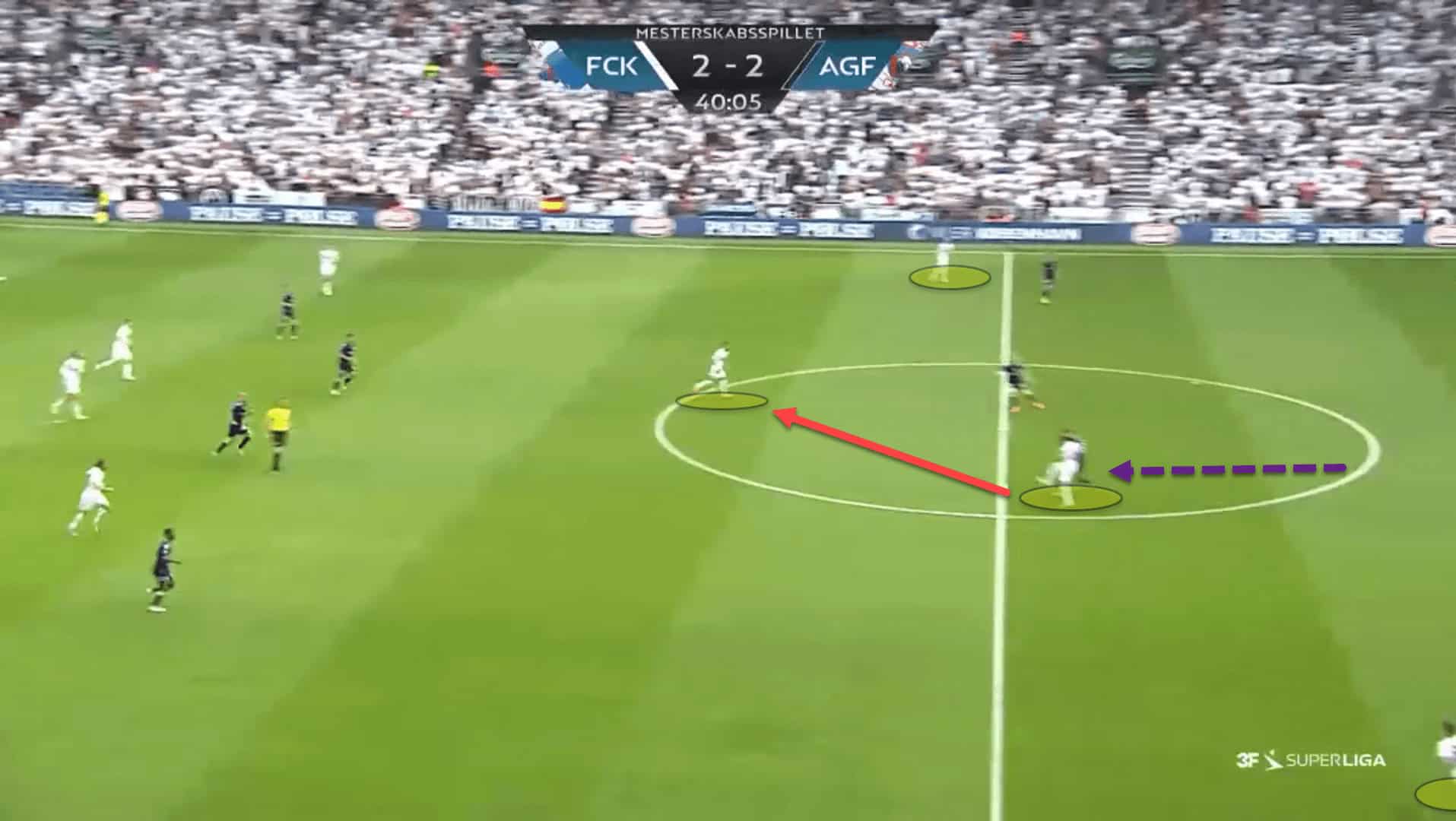
These two screenshots were perfect examples of times this has worked well for Copenhagen.
The ball was played directly to the receiver’s feet, bypassing six pressing players in the process.
This season, the Lions have boasted 70.73 progressive passes per 90, which is the fifth-most in Denmark’s top-flight division.
This can also be helped by having a false ‘9’ up front, a choice Neestrup has made quite regularly with Haraldsson.
The Icelandic international is naturally a central midfielder.
Still, it has been used at the tip of Copenhagen’s 4-3-3 a lot throughout the 2022/23 campaign, rotating the position with the likes of Andreas Cornelius, Jordan Larsson, Diogo Gonçalves, and even Viktor Claesson.
Having Haraldsson as a false ‘9’ dropping short allows the goalkeeper and the backline to know that he is comfortable receiving under pressure and can use runners around him to take advantage of the 4v4 situation against the backline, or even turn on the ball and drive forward.
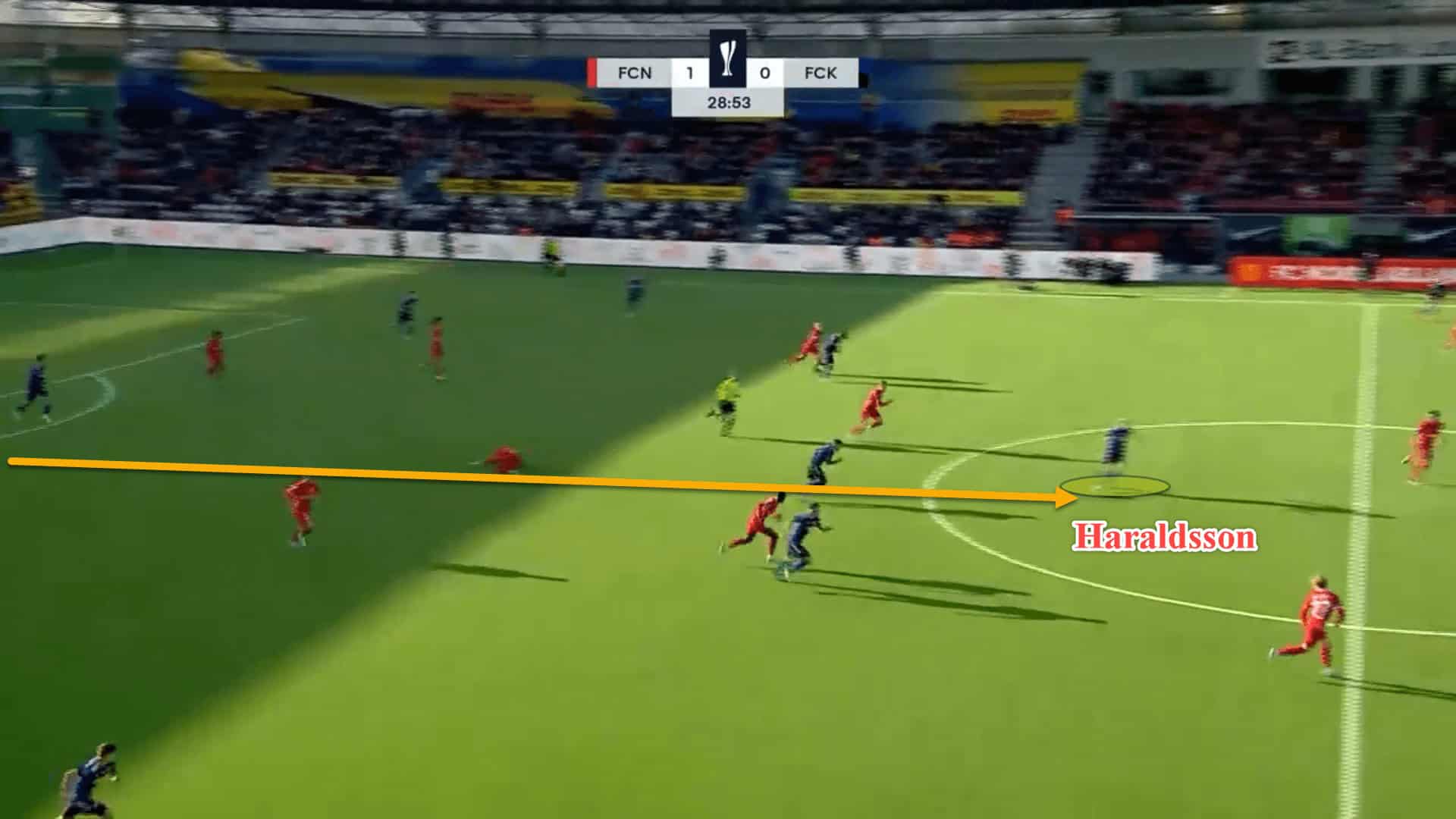
In this instance, Haraldsson realised that there was nobody around him and turned, running forward before eventually slipping in a faster, more clinical player to try and convert the opportunity.
But it’s not just in the build-up phase that Copenhagen look to create a numerical battle against the opposition’s defence, or even use a false ‘9’.
Plus one up top
When looking to break down an opposition defensive block, Neestrup wants numerical superiority against the backline, with at least three players between the lines, occupying each channel of the opponent’s defence.
Typically, there are five players on the last line to generate a 5v4 numerical overload, with three positioned centrally.
The other two are holding the width on the flanks to stretch the defence.
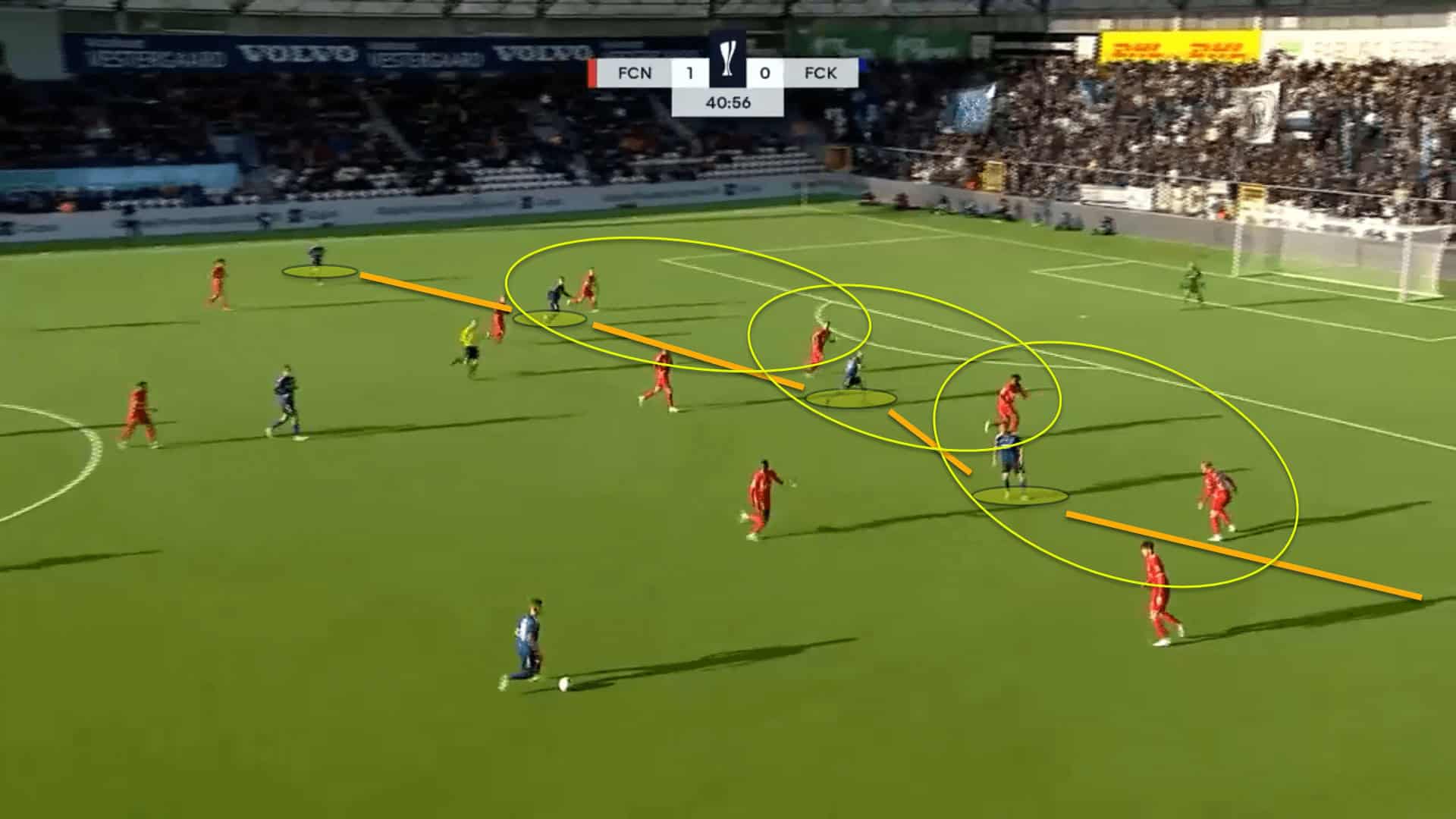
In this sense, Copenhagen adheres to the principles of positional play by having at least one player in the five horizontal channels across the pitch.
The composition of this line of five isn’t fixed.
Sometimes, both fullbacks will get forward, allowing the wingers to invert next to the centre-forward to create the frontline, but one of the central midfielders can also push into the halfspace while a fullback stays back, creating a back three with the other two central defenders.
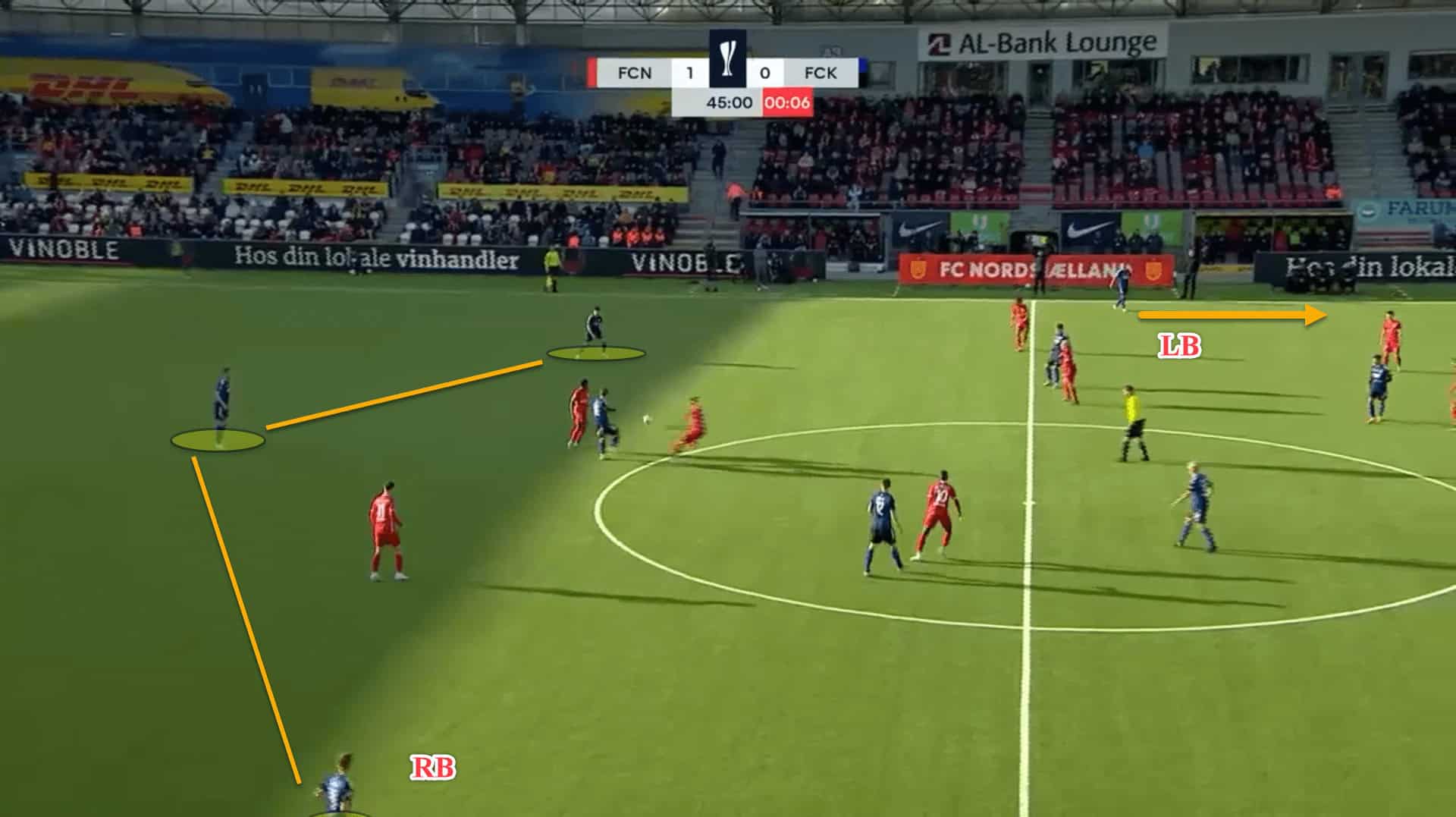
Here, the right-back has tucked inside, forming a back three with the central defenders, but the left-back has advanced forward on the far side.
As a result, the left-back and right winger hold the width, while the left winger, striker, and central midfielder are positioned between the lines.
Copenhagen doesn’t really look to cross the ball all that much.
Despite averaging more possession than any other side in Denmark’s top-flight with 56.2 percent per game, the champions don’t cross the ball a whole lot.
This season, Copenhagen have averaged merely 13.66 crosses per 90, which is the fourth-lowest rate in the Superliga.
Crosses are still an option for Copenhagen to break down a defence, but one that they don’t rely on, as crosses, particularly high crosses, are normally low percentage chances.
Instead, Neestrup likes to play between the lines, using the overload of the backline to the team’s advantage.

More commonly, the use of Haraldsson as the false ‘9’ allows the team to pull defenders out of position.
Here, the centre-backs are in a tricky position, unsure whether to step out to Haraldsson or stay in position and risk the Icelandic attacker receiving the ball in space, which could potentially have more dire repercussions.
This is called ‘gravity’ in basketball – when a lone player has the ability to attract two or more defenders through their sheer presence alone.
Haraldsson’s deeper positioning as the false ‘9’ poses numerous questions for the opposition’s backline and can draw defenders out of position, allowing the wingers to make inverted runs in behind.
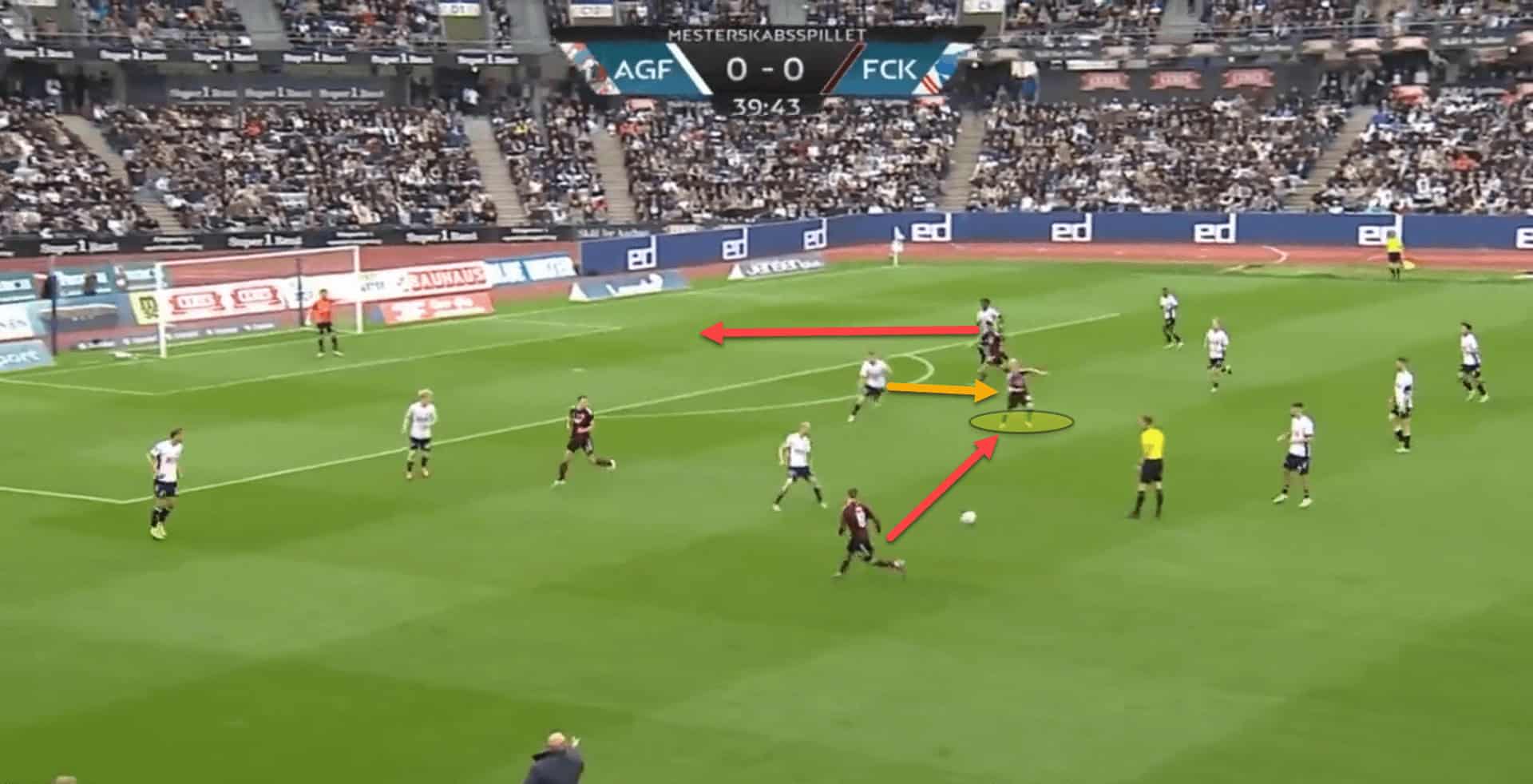
Copenhagen’s keenness to break down the opposition in the central areas, including from the esteemed Zone 14, is admirable and makes them incredibly fun to watch.
Conclusion
Numerous aspects of FC København’s game model make the Danish giants so successful, but this article would have gone on forever had we analysed every facet of their tactics.
However, we’ve picked out three aspects of Neestrup’s setup that are the most interesting – to us, at least.
Having a false ‘9’ in your team is, and always will be, one of the most fun components of any side, whether it be Roberto Firmino at Liverpool, Lionel Messi at FC Barcelona, or Haraldsson at FCK.
At the same time, the young head coach has also drawn inspiration from De Zerbi and Pep Guardiola along the way.
It will be fascinating to see how the 35-year-old evolves the team tactically next season, as well as during their potential European campaign.
