
St. Pauli fans lived a brief dream under Timo Schultz.
The 2021/22 season was off to a flying start, and by January, they were sitting at the top of the 2. Bundesliga.
Without German first-division football in over a decade, the prospect of finally competing among the elite again drove the dream forward.
Coming back from the winter break, St. Pauli overcame UEFA Champions League regulars Borussia Dortmund in the DFB Pokal with an unforgettable 2-1 victory.
It was at that point, when St. Pauli fans felt at the top of the world, that the dream began to die.
The second half of the season felt like a hangover from their early success, and Schultz’s men were unable to maintain their form.
They finished in fifth place without any sniff of promotion.
The hangover continued into this season, and until the World Cup, St. Pauli fans couldn’t wake up from a nightmare.
Enough was enough, and Schultz was relieved of his duties.
Fabian Hürzeler, who had been Schultz’s assistant for over two years, took over as the interim, and a few weeks later, he was appointed as the official head coach.
At the time, the American’s young age raised some alarm bells.
Seven games into his reign, the alarm bells are now going off for different reasons.
At the time of writing, St. Pauli have yet to lose a game under Hürzeler.
Already extremely familiar with the players, the now 30-year-old quickly organised the side back to winning ways.
Having played in Bayern Munich’s academy up until the second team, Fabian Hürzeler claims it’s in his DNA to dominate possession and dictate the game.
However, after years in Germany’s lower divisions, the American appreciates the importance of other phases and styles of play.
In this successful start, some of the key ideas behind Hürzeler’s tactics are becoming clear.
In this Fabian Hurzeler tactical analysis, we will take a look at some early trends in St. Pauli’s tactics under Fabian Hürzeler’s style of play.
With only seven games in charge, this analysis will explore how the 30-year-old has been able to guide St. Pauli back to winning ways instantly.
Fabian Hürzeler Style Of Play – Roles Over Shapes
The first significant change made by Hürzeler was in the structure.
Schultz went back and forth between a 4-1-3-2 and a 4-4-2 in the first few months of the season.
With wins becoming rare, a 5-3-2 was introduced.
The American manager had something else in mind, something more innovative.
St. Pauli have been playing with hybrid formations under Fabian.
In the seven matches so far, Wyscout has attached various formations to Hürzeler’s approach.
A 4-3-3 was named once, and other formations like 5-4-1, 3-4-2-1, 3-4-3, and even a 3-3-3-1 were also in the mix.
However, St. Pauli have been playing the exact same way in all of these matches.
Of course, there is an initial shape, two in fact.
However, the roles of each player have priority over maintaining any said shape.
The structure then becomes a system of roles and their movements rather than a defined shape.
As their possession develops, the structure remains, just not in a fixed shape; let’s break this down!
This initial shape, which can be thought of as a starting reference for the players, is a hybrid 4-3-3/3-4-3.
In the example below, we can clearly identify a 4-3-3.
The two centre-backs sit alongside each other while the fullbacks are out wide.
There is a defensive midfielder sitting behind two central midfielders and a clear front three.

However, in another instance identified below, we can clearly identify a 3-4-3.
This change in shape naturally happens throughout the match with the same players.
To do this, the defensive midfielder, Eric Smith, tends to drop in between the centre-backs to form a back three.
The fullbacks push up as wing-backs, and the central midfielders become the two lone midfielders.
The transition is simple and very frequent.
In the example below, we can also begin to identify some trends in individual roles.
The right fullback is sitting deeper than the left fullback, as they have very opposing roles.
The two central midfielders also have very distinct characteristics and consequently roles, highlighted by the arrows.
The front three remain very narrow, often going all to one side of the pitch at a time.

In this 3-4-3, there is one clear characteristic.
The midfield pair, Jackson Irvine and Marcel Hartel, are not particularly deep-lying midfielders despite being the only two players in that sector.
With Smith dropping back to form a back three, the midfield can become almost unoccupied at times.
Consequently, in the earlier phases of possession, there tends to be a focus on the wide areas.
However, the role of Leart Paqarada, the left fullback, can often counteract this.
Paqarada plays as an inverted fullback, and forming the back three gives him more freedom to venture either forward or into the midfield.
As identified below, with Smith dropping, there is space for Paqarada to get involved and find holes and routes to progress.
St. Pauli’s structure is best identified through a system of roles rather than a shape.
The 4-3-3/3-4-3 hybrid provides initial references, but these shapes often tend to lose significance as possession develops.
This structure has some clear characteristics.
It can be very wing-focused, with little midfield occupation when the 3-4-3 formation is launched; however, they do have the option to focus on the midfield and easily commit players there.
With such a balanced nature, Hürzeler’s tactics in possession are extremely dynamic.
Fabian Hürzeler Progression
With the structure in possession now clear, we can begin to identify how St. Pauli would like to progress in possession.
Having confessed his love for dominating possession, Hürzeler also understands the importance of being able to adapt and find other ways to be efficient with the ball.
Perhaps in the long run, there will be an increase in possession – they had 58.06% possession in their most recent match against Greuther Fürth.
Nonetheless, these first few matches have not shown an immediate willingness to dominate and retain possession excessively.
Regardless of the extent to which they retain the ball, their progression with the ball already has some clear ideas.
These can be viewed as a result of multiple factors.
Most notably, Hürzeler’s game model, the structure currently adopted, and the characteristics of the players.
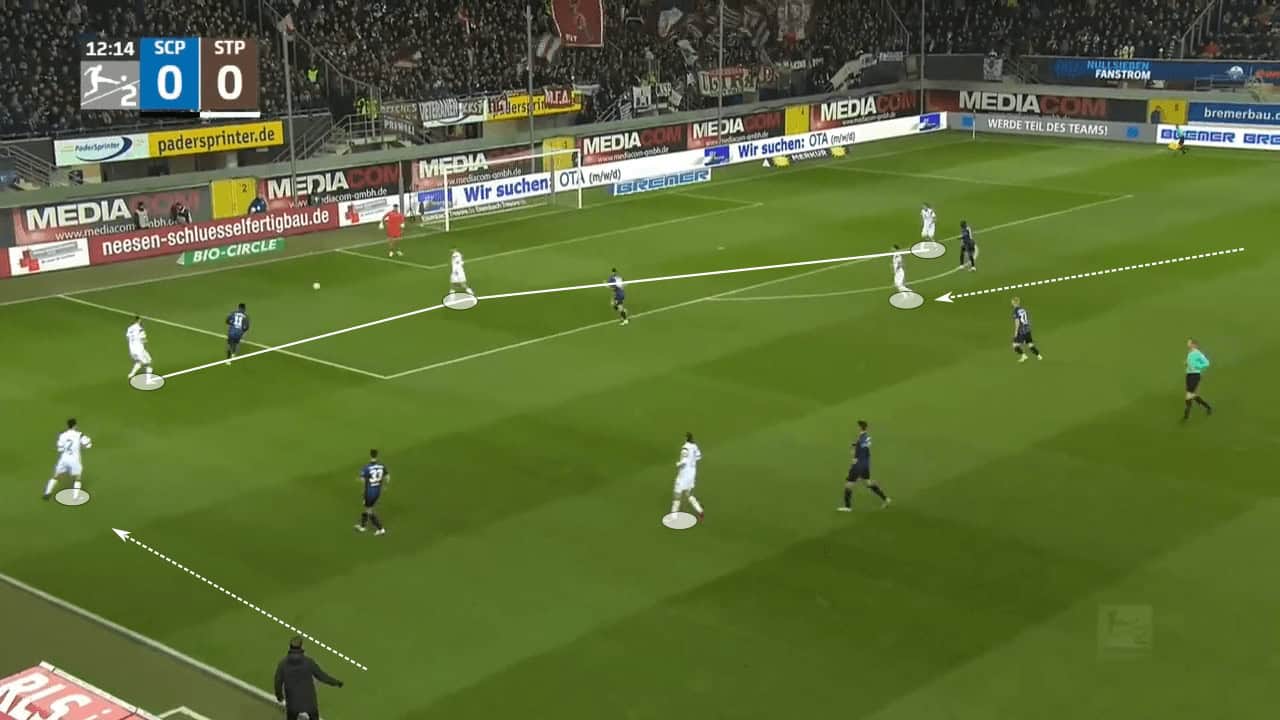
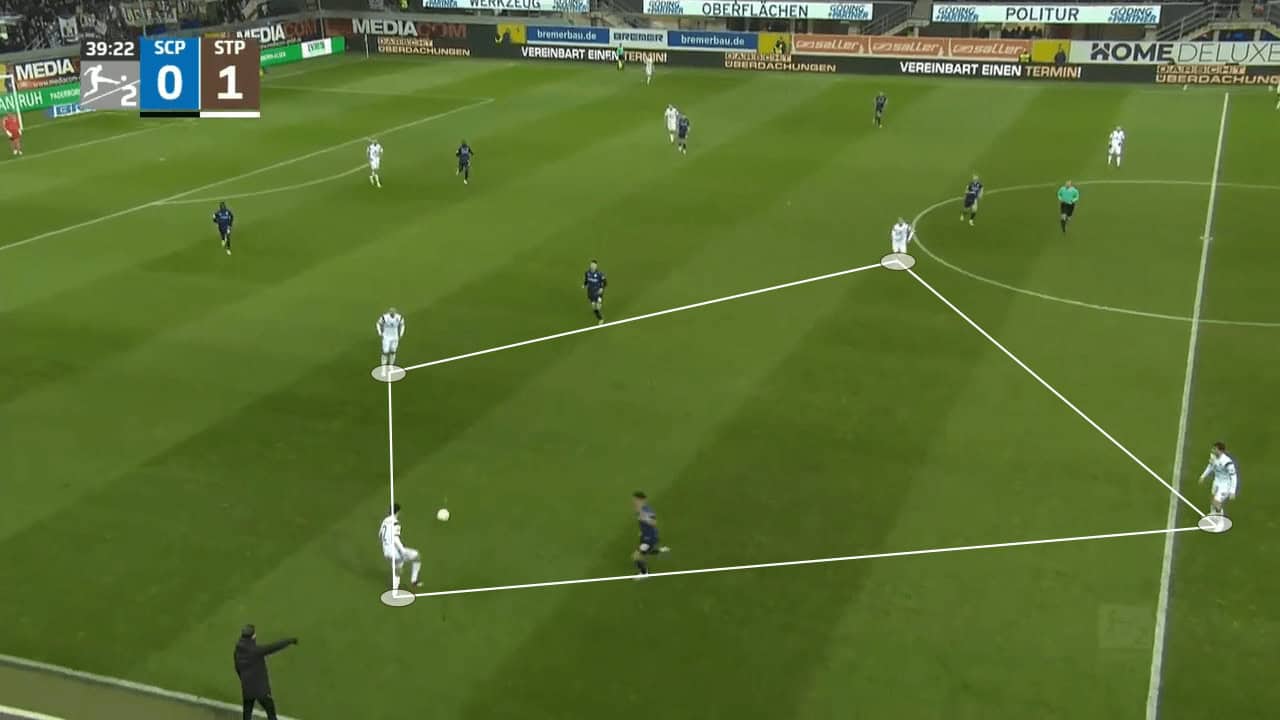
Building a line of three at the back provides the wide centre-backs with the freedom to get involved in the wide areas, as seen in the example below.
The right wide centre-back advances to support the wing-back.
Meanwhile, Irvine supports from the midfield, while the right inside forward supports from the top.
The structure, especially on the right flank, creates very optimal scenarios to progress out wide.
Again, through the right flank, St. Pauli demonstrates another method of progressing.
This time, possession is in a more advanced stage than the last one, with more organisation.
As the centre-back has the ball, in a back two this time, four players make an effort to provide options in the central lanes.
A diversion, this completely frees up the right fullback.
While the four players move to occupy the central lanes, the centre forward and the opposite inside forward make diagonal runs into the space left behind, as identified below.
The right fullback, after receiving the ball, plays it down the line to the centre-forward.
The play goes back inside in the final third for a goalscoring opportunity.
This is a very interesting ball progression in itself, but it demonstrates some tendencies in possession, especially a focus on the wide areas.
Through the left with Paqarada, St. Pauli are also very dangerous.
The inverted fullback likes to roam into the central areas, especially when the back three is in action.
This movement can be without the ball to find gaps and provide options or with the ball in the form of inverted runs.
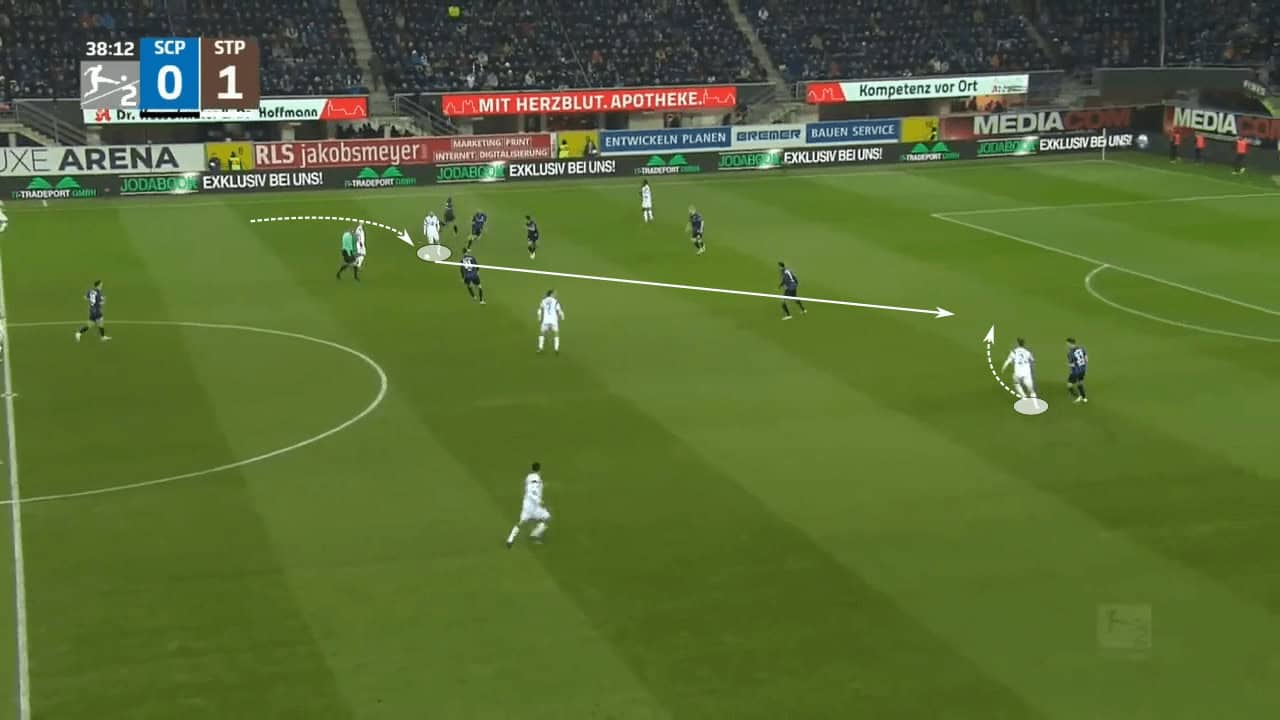
Below, the 28-year-old drives inside from the wide channel.
As he begins entering the central lanes, the left inside forward moves out into the wide channel.
This movement serves to stretch the backline and keep that area from becoming congested.
Paqarada finds a dangerous ball to cut the defence open and put the right inside forward through on goal.
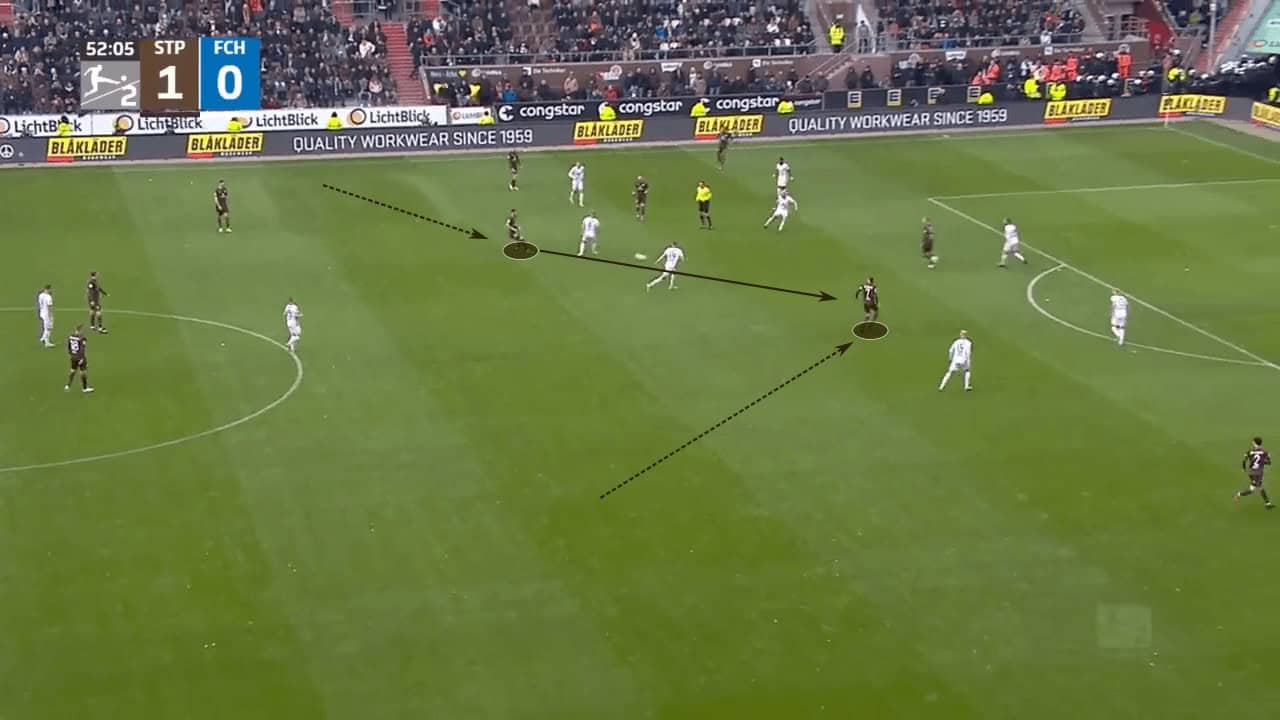
A similar behaviour happened in a different match, with a different scenario.
With the back three below, there is a hole in the deep-lying midfield area.
On the other hand, there is a clear focus on the left flank, with a significant group of players there.
As the play develops, Paqarada eventually drives inside to find a diagonal pass to Irvine, who is making a run into the final third.
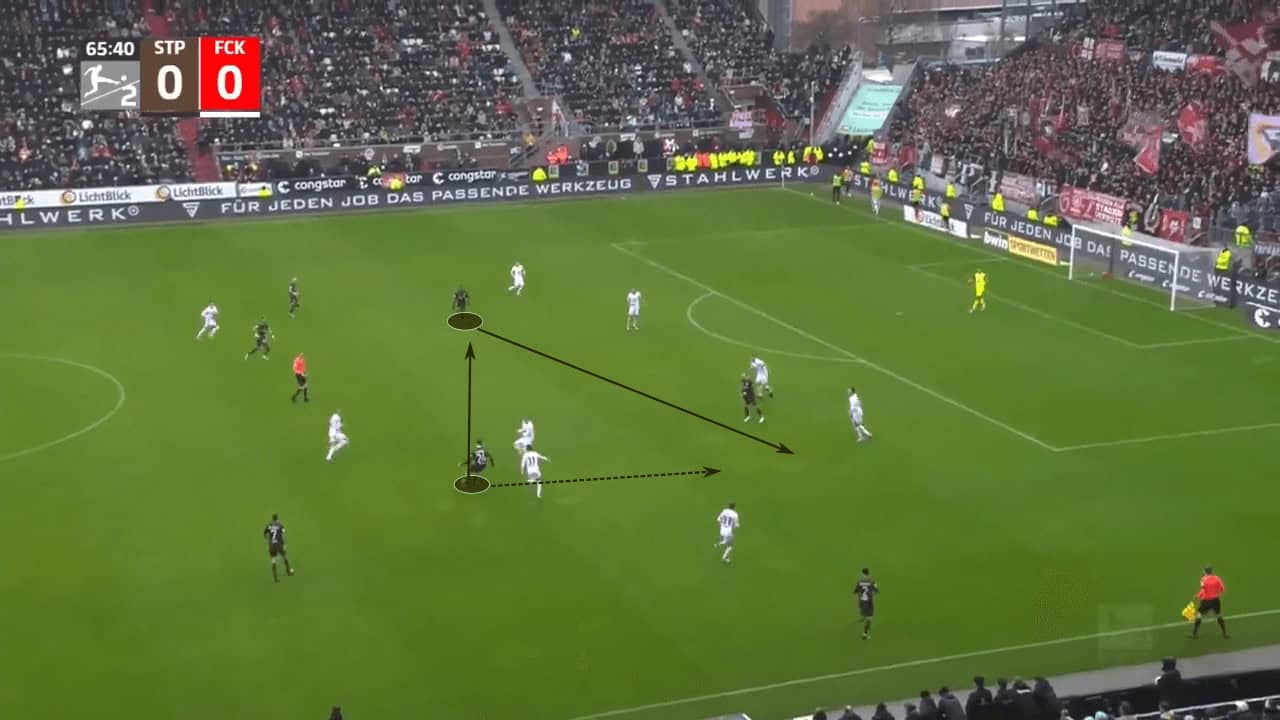
Finally, the inside forwards also play a key role in their progression with the ball.
As identified earlier, the front three like to work together and remain in close proximity.
With such behaviour, they tend to combine and relate more with the ball, like below.
The right inside forward makes a pass from the right half-space to the opposite half-space, where the left inside forward is.
After receiving, he takes a few touches before playing it back, now into the final third.
There is a clear tendency to progress through wide areas, and a significant portion of this can be attributed to the structure.
Nonetheless, it is clear this approach agrees with the players’ characteristics, as they are already playing extremely well together.
Overall, Hürzeler has adopted a more proactive possession system, looking to impose his ideas and his will on the game.
It has instantly provided results, with around 1.57 goals per 90 so far.
Fabian Hürzeler Defensive Approach
The American coach stressed the importance of introducing some defensive security, first and foremost.
He has been successful so far, with 0.43 goals conceded per 90.
They are currently overperforming their xGA, which currently stands at 1.15.
Nonetheless, St. Pauli have certainly been much more secure defensively.
With 9.45 PPDA, Hürzeler has not immediately gone for a high press.
Similar to possession, they had a PPDA of 5.85 in their last match, so a trend in this way could be possible in the long term.
Regardless, in this initial stage, St. Pauli have gone for a slightly lower engagement line, usually beginning in a mid to high block.
This allows them to be more compact, limiting the opposition’s progression while still having the opportunity to jump into a high press in some cases.
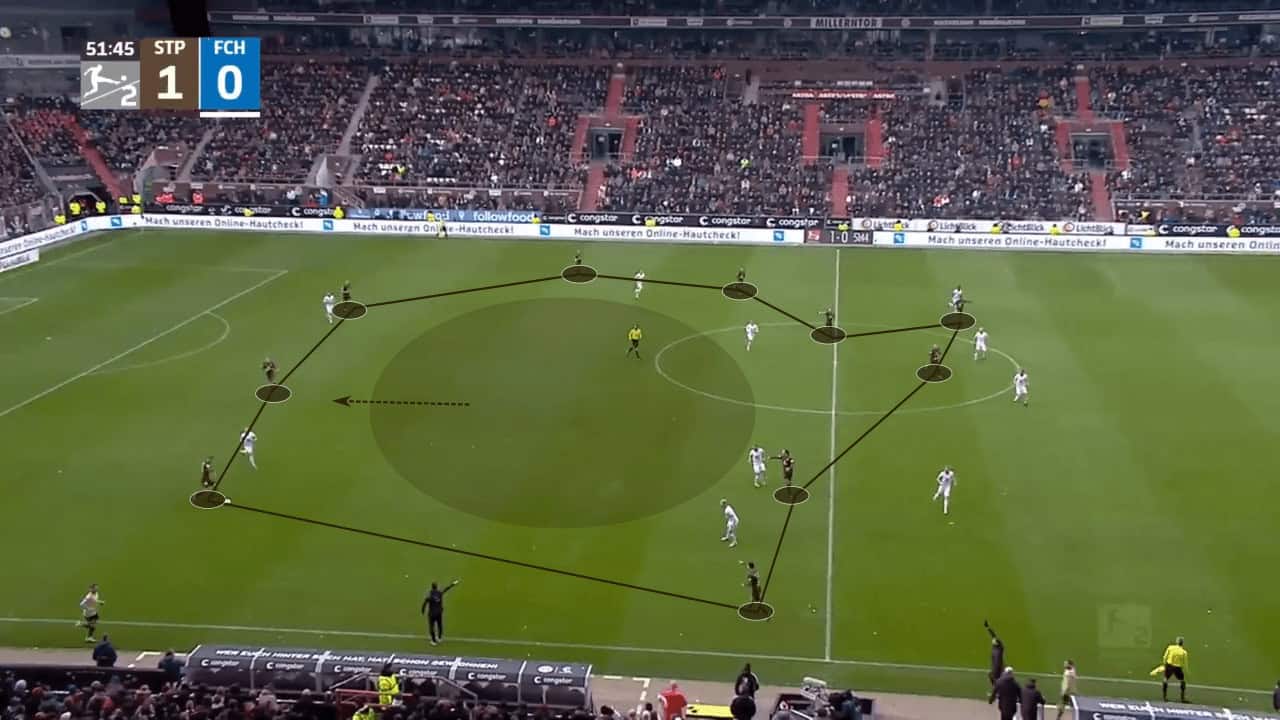
The defensive system is very much zonal, usually structured in a fixed 5-2-3 or 5-4-1, depending on the height.
The front three leads the line, usually sitting at the same height as the opposition’s midfield.
The midfield two will sit just behind the three, forming a sort of pentagon shape.
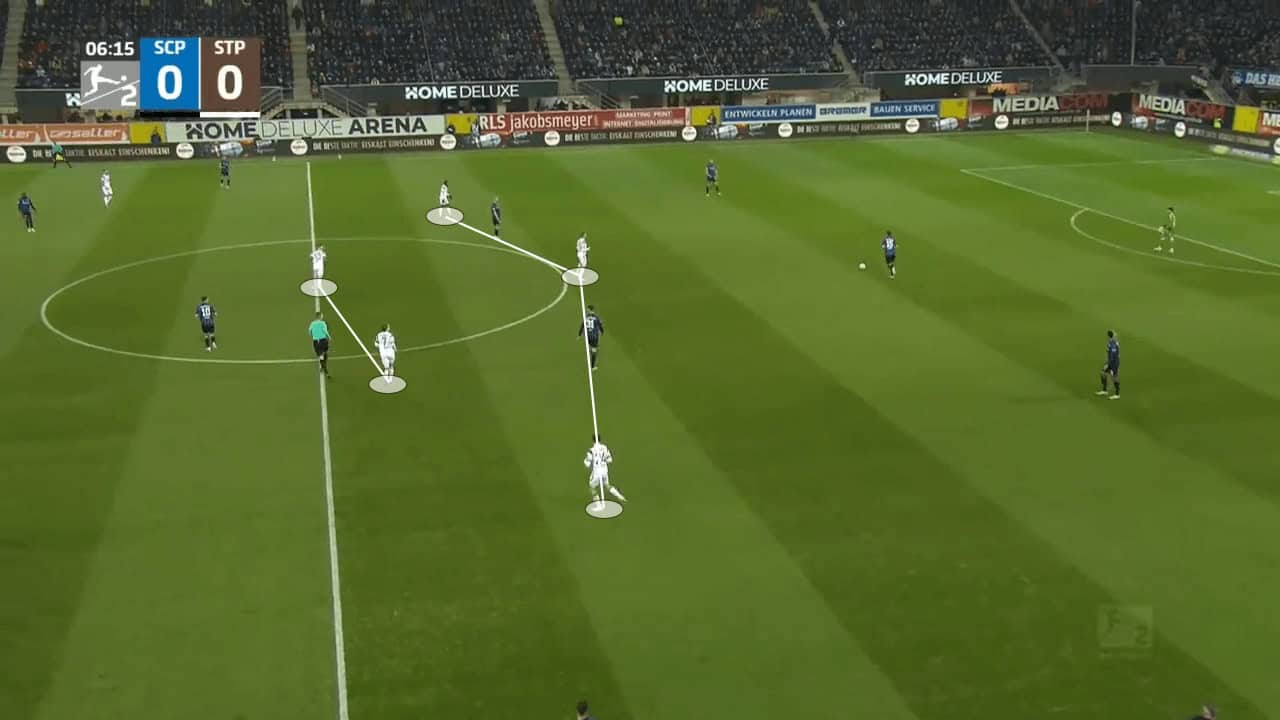
The front five remain very compact, especially as the opposition focuses on the wide areas.
This can be identified below, without much space between the five players.
It is clear that there is no strong man-marking orientation, with the structure remaining superior.
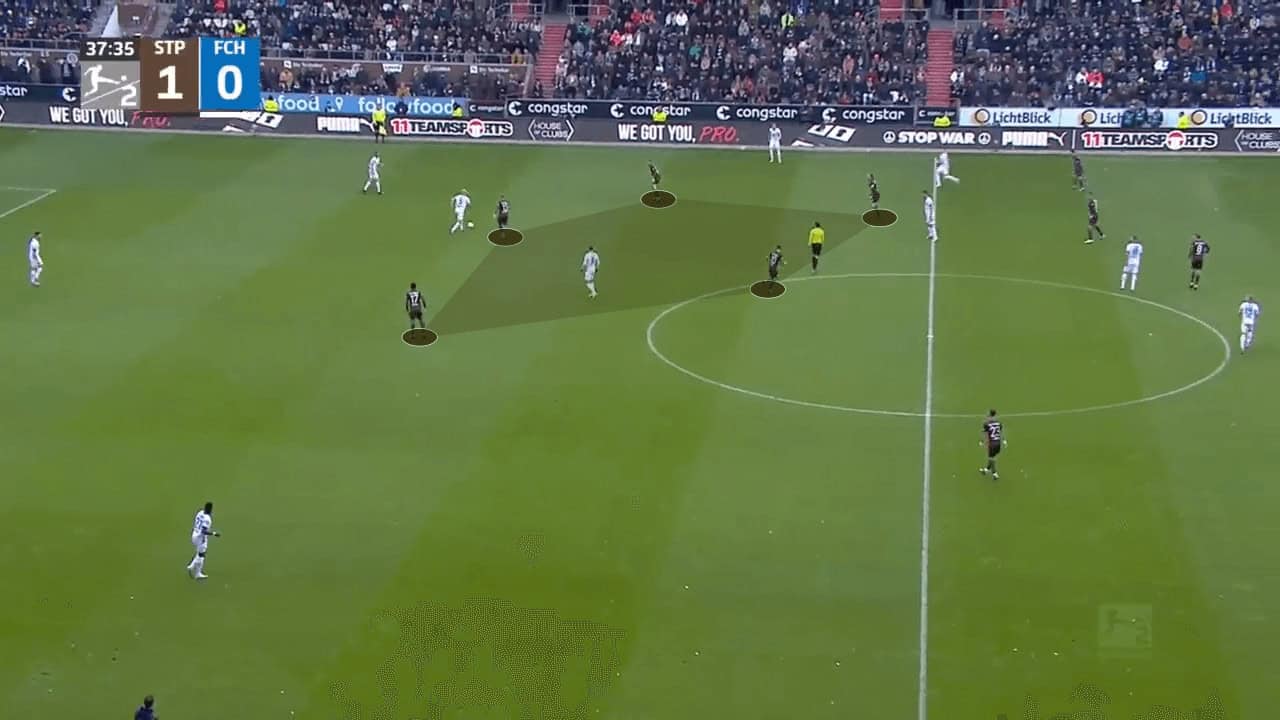
The behaviour of the five is very curious in these first five matches.
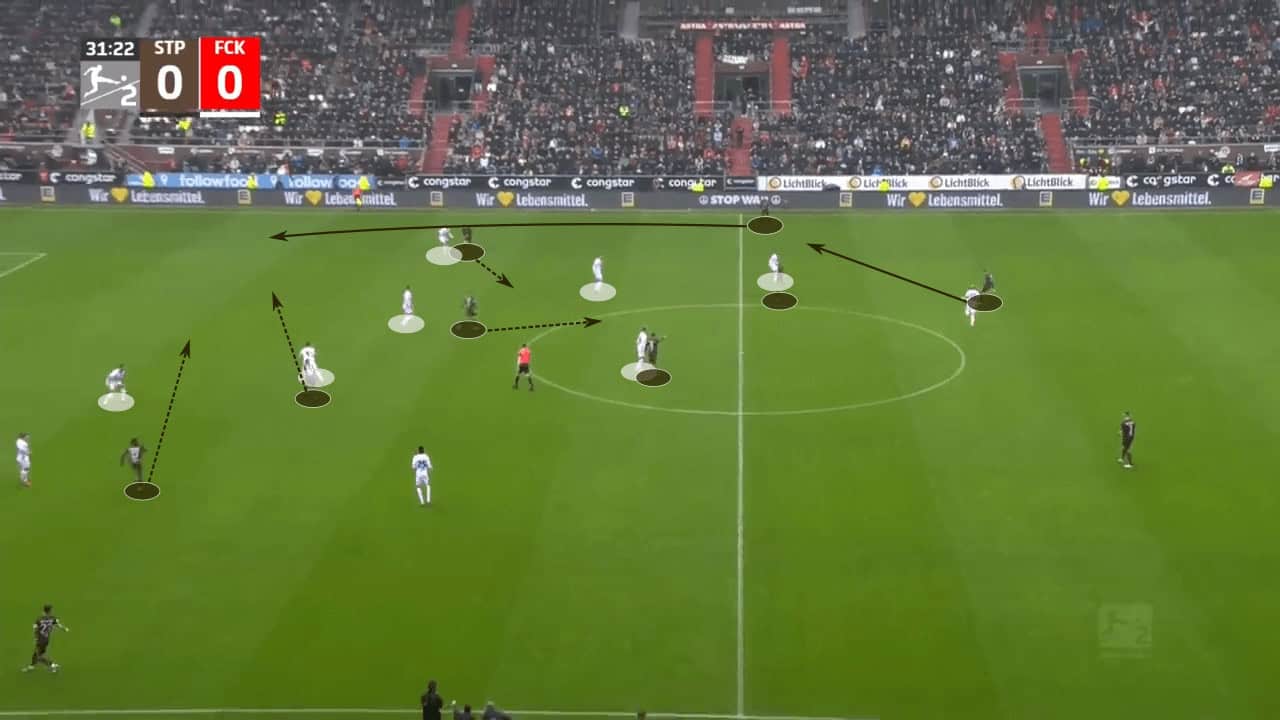
Rather than jumping to press the centre-backs or even the midfielders, if they drop deep, they remain compact and limit the options to progress into the midfield.
Below, the opposition’s midfielder drops deep to receive the ball.
Rather than jumping to press, the players remain in the midfield third.
As the midfielder looks to play it forward, Hürzeler’s men then jump to the receiver and force him into an error.
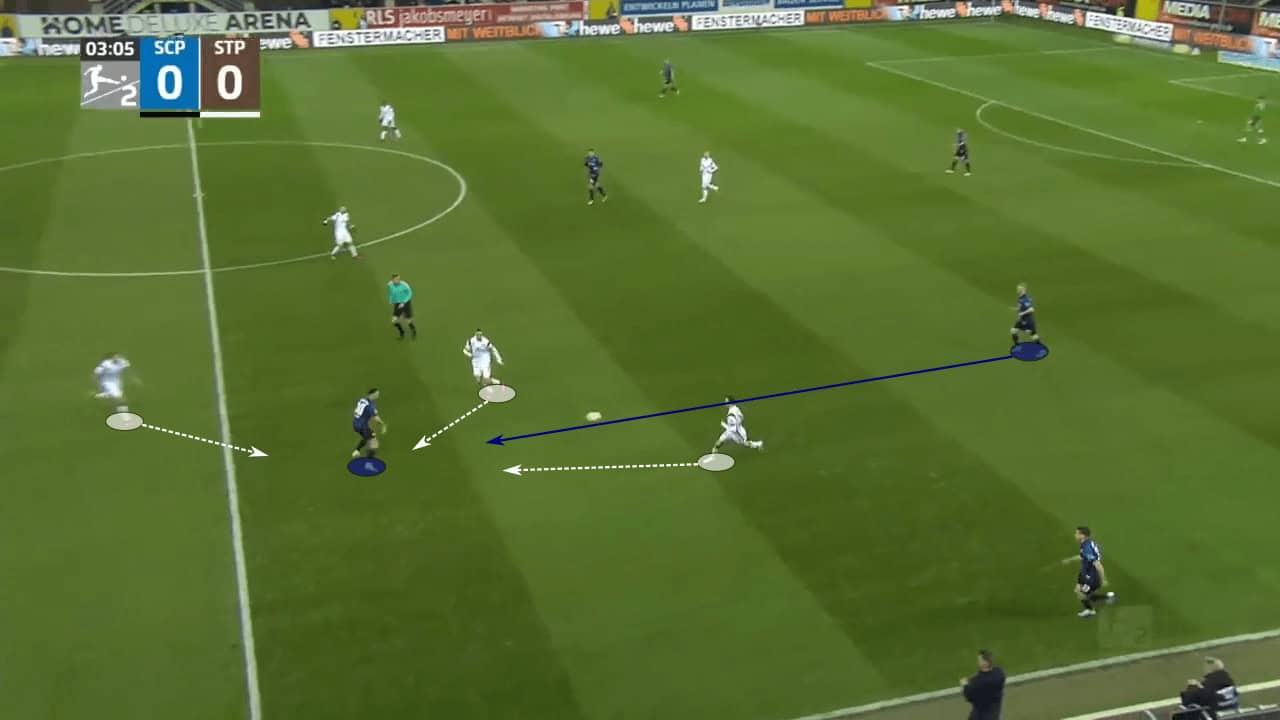
They have looked to press high in some instances, and perhaps, with time, we will see this more frequently.
They do so in a similar structure, albeit naturally more stretched.
The front three once again lead the line.
The nearest fullback jumps to help the press in their respective side, while the nearest midfielder does the same.
We can identify this pattern below, as the opposition looks to build out of the right side, St. Pauli’s left.
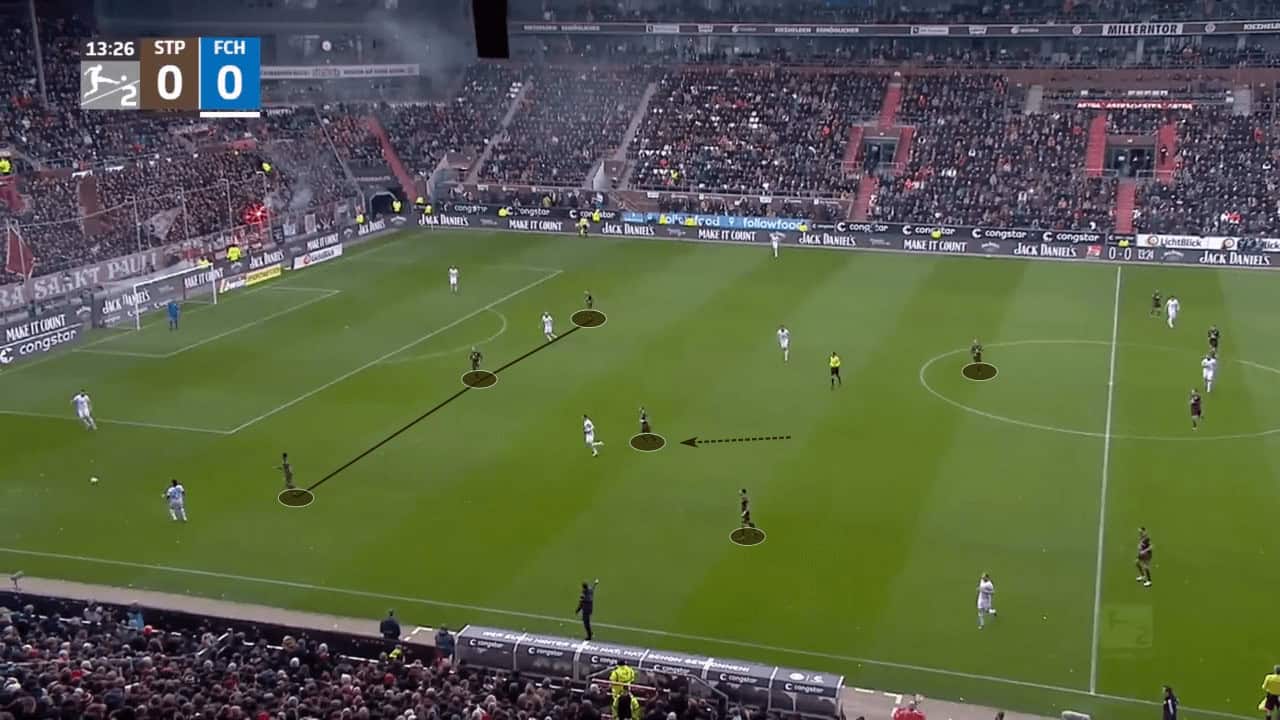
Now, on St. Pauli’s right, the very same trend can be observed.
The nearest midfielder jumps while the other tucks in behind to provide cover.
The ball-side fullback also advances forward to help the press and limit the options going forward.
Again, it is much more about occupying the right spaces and blocking passing angles rather than marking the opposition man for man.
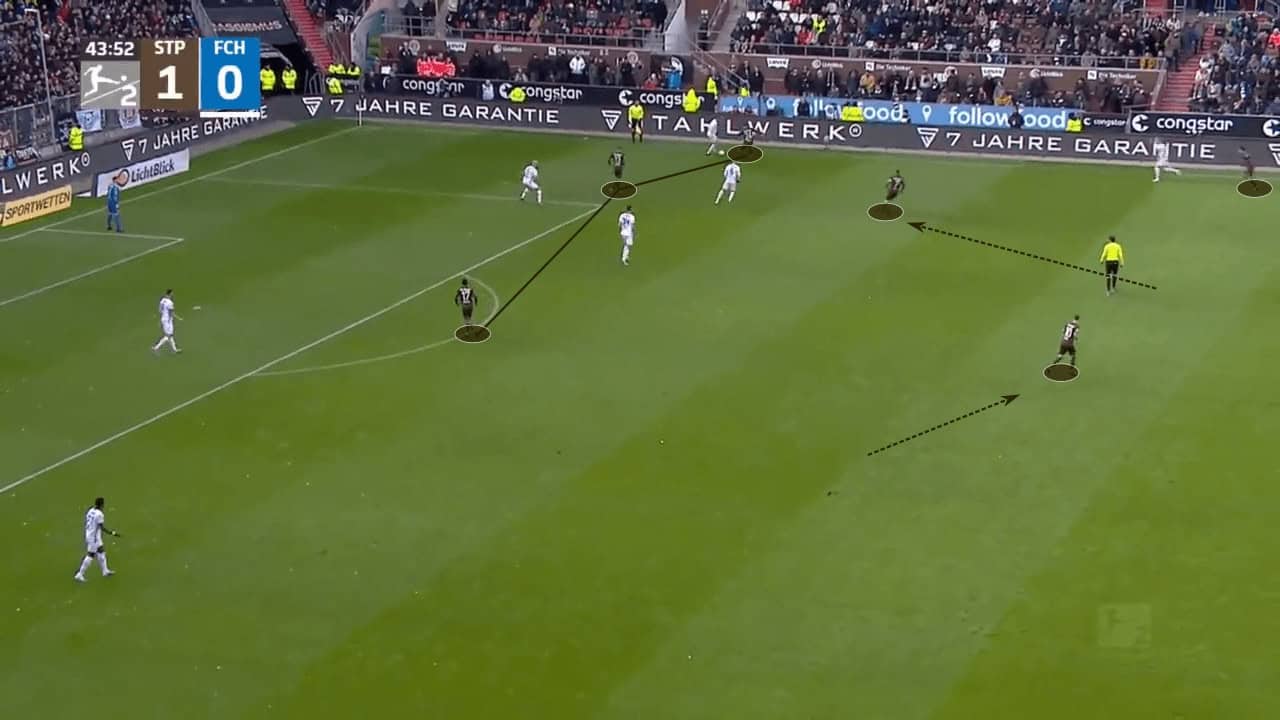
Conclusion
Fabian Hürzeler has had a strong start to his managerial career, with seven wins in his first seven matches.
In these early days, we can already begin to identify some interesting ideas in St. Pauli’s tactics.
More notably, he has been able to restore success and security.
While addressing urgent areas, Hürzeler’s tactics have put St. Pauli in charge of their own destiny once again.
With time, the American’s ideas will become stronger, perhaps towards a more dominating side – more possession, more defensive intensity.
Most important of all, however, St. Pauli fans can dream again.
