
Tottenham have just introduced their fourth manager in the matter of three years Antonio Conte and while the Italian’s style if very distinguished and recognizable, his future tactics at Spurs are a highly anticipated topic.
The London team have struggled to get back to their best form after Mauricio Pochettino left in 2019 and neither José Mourinho, Ryan Mason nor Nuno Espírito Santo have managed to enhance their strategy to the Pochettino levels.
Santo was the last one to try, coming in in the summer, but with his team being highly inefficient in attack and vulnerable defensively, the Portuguese was sacked and immediately replaced by Conte.
The team currently sit ninth in the Premier League with one of the worst displays in attack, scoring only nine goals in 10 games and having an unsatisfying defensive record of 16 conceded goals.
Spurs also participate in the group stage of the UEFA Europa Conference League where things don’t look much better. They currently sit third in their group with only four points, while Vitesse and Stade Rennais are fighting for the leading spot.
They are lacking explosiveness in attack with their talisman Harry Kane being out of form and lacking motivation after a failed exit in the summer. They don’t have defensive stability either, being vulnerable on a counter and failing to defend against set-pieces.
Conte didn’t find the team in their best shape and his first task would be improving the discipline and achieving consistent performance. This tactical analysis will explain how he could transform Tottenham tactically in an effort to increase their efficiency.
How could Spurs look in a back-three?
It is expected that the Italian manager will try to transform Spurs’ tactics starting from the back. Implementing his back three strategy, though, might not be that easy as he might face some deficiencies in certain positions.
Conte didn’t hesitate to experiment and set the team up in a 3-4-3 formation in his first game in charge against Vitesse in the Conference League. His three-man defensive line consisted of Ben Davies, Cristian Romero and Eric Dier. But are these players the best option for his strategy?
The Italian usually requires his centre backs to be confident on the ball and with strong spatial awareness. Not only they should be able to bypass the opposing pressing structures, but they also need to confidently circulate the ball at the back and combine with the goalkeeper in efforts to retain possession and open the passing lanes. They should be able to advance the ball and move into a more advanced position when in possession, pushing the opposition in their own half.
That is something that both Dier and Romero have experience in and could build on. They both have a high pass completion rates and are often responsible for delivering the ball further. It is expected that Romero would be most beneficial for the team, due to his experience in a similar set-up with Atalanta last season. The Argentine is used to playing in a back three and knows how to split his responsibilities in and out of possession.

Employing Dier, Romero and Japhet Tanganga next to each other could grow into a solid foundation. They might be able to achieve balance as the additional defensive support from the wing-backs will give them better coverge at the back, but with they would also be able to get the ball out into more advanced positions. Tanganga’s dribbling abilities and passing often find him advancing on the flank, which could be beneficial for their build-up from the back. His movement could also allow the right wing-back more freedom to move forward. There is a downside of using him, though, as he is unstable when it comes to direct defensive actions and often fails in his duels.
In terms of defensive coverage, Conte usually heavily relies on press intensity and on his teams to recover the ball in their own half. He likes to have players with different skillsets in his backline so they can balance off each other out of possession. Their positional awareness is very important as well as their measured actions in direct challenges. Romero excels in his defensive duels as he is constantly trying to win the ball back and not let the opposition closer to the goal. That has resulted in averaging 11.04 defensive duels per 90 with 84.75% success rate.
Spurs now have difficulties defending the wings, but switching to a back three, respectively a 5-3-2/5-4-1 out of possession could be beneficial in that matter. With Emerson Royal’s support from the right wing-back position, it could be either the RCB or one of the other midfielders to close out space on the flanks. This way they will have better coverage, but should the centre back engage, the midfielders need to have increased awareness and cover depth.
Midfield set-up
It is expected that Conte will rely on Reguilon and Emerson as wing-backs. As per his tactics, their role is crucial in ball progression and in providing width in attack. The Spurs players can efficiently do that as they both stroll forward and try to support the attacking actions. They average 3.32 and 2.99 crosses per game and these numbers are expected to increase under Conte.

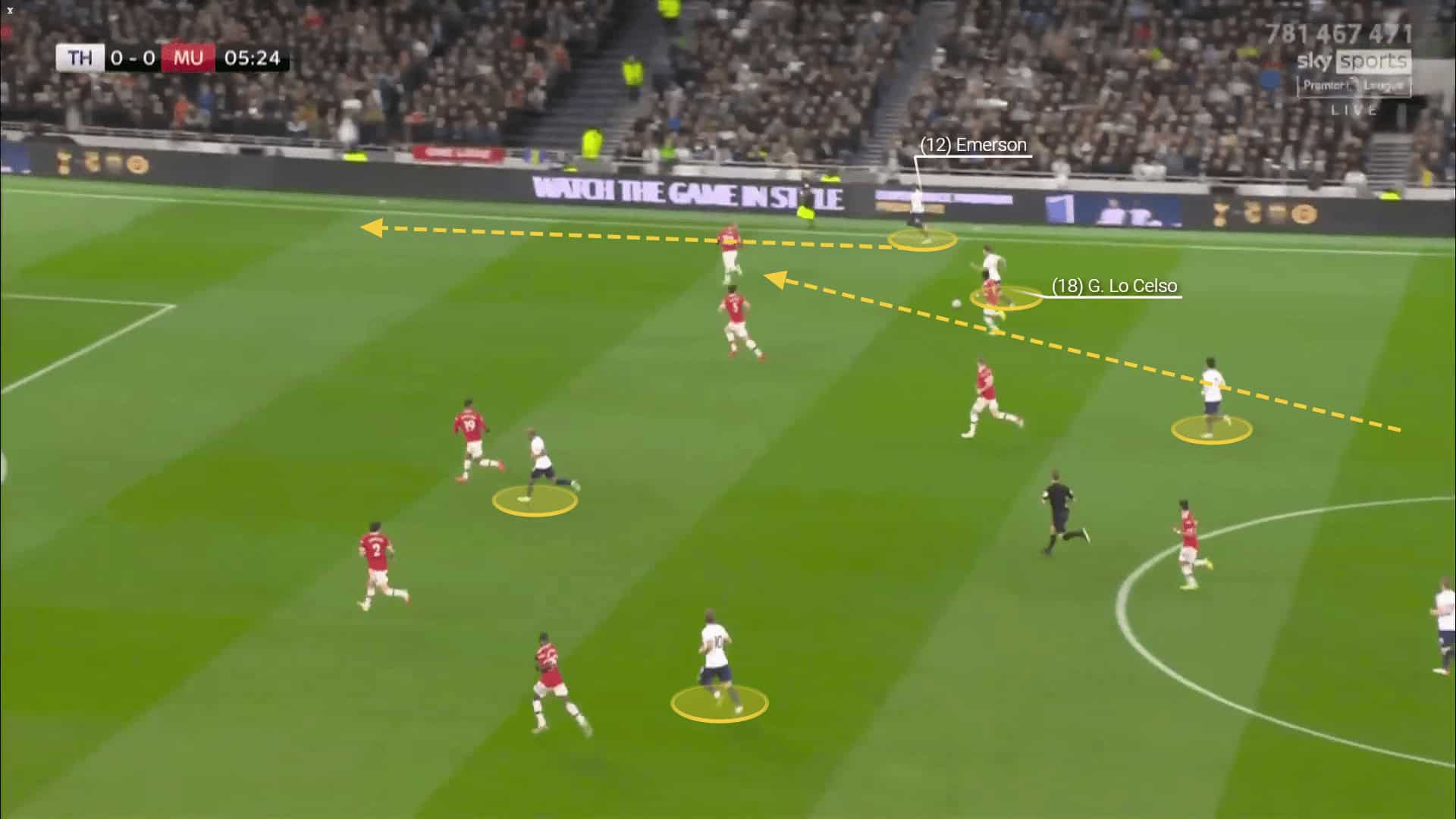
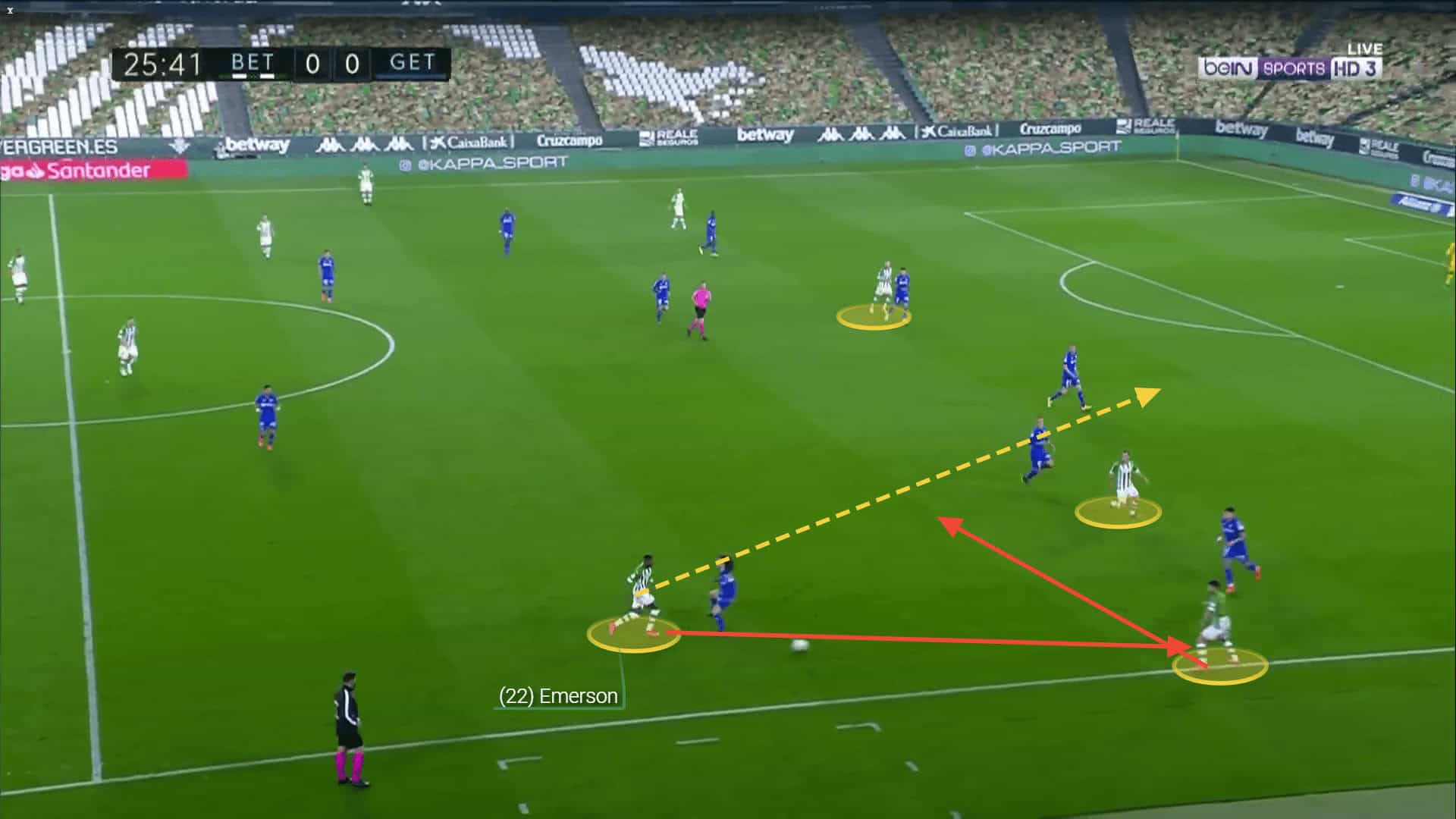
Emerson gained experience in having a more attack-minded role from his former club Real Betis.
His cross accuracy, though, is very low, meaning he can be more valuable for engaging defenders and cutting inside, instead of crossing. His dribbling adds to his ability to progress the ball and he could easily take on opposing players. At Real Betis, he could often be seen doing underlapping runs and combining with the wingers.
It is early to say if Conte would prefer the 3-5-2 or the 3-4-3 scheme. In his first game he went for the latter with Pierre-Emile Højbjerg and Oliver Skipp in central midfield and it is expected that Højbjerg will be a regular starter and have a pivotal role in his team.
The Dane now singlehandedly pulls the strings in the team and is one of the main reasons for them to remain in the top half of the table. His passing ability is key for the team’s ball progression.
Højbjerg currently plays a pivotal role in their build up as he covers huge areas and not only opens the passing lanes with his movement but also uses his passing to bypass the press and deliver to the attackers.
The Dane is efficient in everything that he does, from breaking lines with his passes to blocking the opposition’s attacks through his pressing and challenges. He can play both a CMF and DMF which is ideal for Conte who is used to having a deep-lying playmaker at his disposal, who can orchestrate the game and be the connection between the lines.

Conte needs a player that reads the game well and has flair for a good pass. Højbjerg has both and often sets the attackers up in goalscoring positions with his long chipped passes behind the defence.
Having a partner in centre midfield who can support his movement forward and can combine with him will bring his qualities out.
In his first game in charge, the Italian paired him with Oliver Skipp which didn’t offer much in terms of attacking threat and in retaining possession.
Looking at their strengths, Giovanni Lo Celso looks like the better option in the centre as he is able to hold on to the ball well and also provide defensive support.
Attacking ventures
Many would expect that Conte would have the same influence on Harry Kane as he had on Romelu Lukaku at Inter.
Kane’s form has dropped noticeably this season and he lacks the efficiency in front of the goal but also lacks motivation.
He has scored only one goal in 10 Premier League games so far and while the whole attacking line is underperforming, Kane’s inability to move into goalscoring positions and score is the most noticeable.
The ex-Chelsea manager’s man-management is very impressive and he might really get the best out of Kane and also use him as the main figure in the team’s counterattacking actions. Spurs now average 3.3 counters per 90 and this is something that Conte would definitely try to improve and use to expose their opponents. With Højbjerg’s long balls behind the defence and Kane’s attacking flair, this might be Tottenham’s new weapon.
The manager shouldn’t only rely on their counter-attacking actions, though. He has a player lime Heung-Min son, whom he can use in efforts to increase the efficiency in front of the goal. Son is currently the team’s top goalscorer but if he combines with his teammates more, his movement and runs could free up spaces for them to exploit, especially being surrounded by Kane and eventually Lucas Moura.

Conclusion
Conte would need to build on this team and have at least one transfer window to attract players in order to boost their performance and fight for better positioning.
As our analysis showed, he has a decent base, though, and with his man-management and ability to get the best out of the players, it is expected that there will be an immediate improvement both in and out of possession.
