
RB Salzburg has had a very impressive start to the season, with only one defeat in all competitions, which came on Tuesday night away at Wolfsburg in the Champions League.
Salzburg is led by 33-year-old Matthias Jaissle, the German coach who has had big shoes to fill, replacing Jesse Marsch, who has moved on to pastures new in the Bundesliga. However, the man being dubbed the new Julian Nagelsmann has had an impressive start to life in Austria.
Salzburg is at the top of the Austrian Bundesliga with 35 points from a possible 39 and is 12 points clear of the nearest challenger, Sturm Graz.
They also sit at the top of their UEFA Champions League group with seven points.
This tactical analysis aims to provide a scout report and analysis of RB Salzburg, exploring the tactics that have contributed to an impressive start to the season.
Like all Red Bull teams, Salzburg has a clear identity in how it wants to play, which has been heavily influenced by Ralph Rangnick and his tactical principles.
Salzburg also has an abundance of young talent, some of which will be very hard for Salzburg to retain in the long run.
Salzburg’s dominance in the Austrian Bundesliga is shown below.
They lead the way in both XG and XA totals.

Formation / Line up
Salzburg has often used a 4-3-1-2 system this season.
Although the media sometimes shows it as a 4-4-2, it plays as a 4-3-1-2.
The back four has mainly consisted of Kristensen, Onguene, Wobler, and Ulmer, with Kohn in between the sticks.
The midfield typically consists of Camara as a single pivot, Siewald on the left, Sucic on the right, and Aaronson in the 10 role.
However, the midfield options are versatile.
Capaldo has also featured this season, usually replacing Sucic; however, Capaldo will play on the left, and Siewald will go to the right.
The front two have mainly been made up of Okafor and Adeyemi.

Direct and vertical passing
A key feature of Salzburg’s attacking play is their use of direct and vertical passing.
Within modern football, the idea of being direct with your passing is something you associate with old-fashioned managers playing long balls into a target man; however, it is quite the opposite. Salzburg look to use the pace of Adeyemi and Okafor to get in behind teams.
In possession, Salzburg likes to push their full-backs high and wide, with the outside midfielders going wide also to create an overload in the wide area, as shown below, where Siewald has drifted left to allow Ulmer to get even higher.
Salzburg is looking to progress the ball through three options.
One to the full-back, two to Aaronson and three over the top to one of the strikers.
This makes life very hard for the defence, as if they drop deep to combat the ball over the top it leaves Aaronson in a dangerous pocket of space, if they drop the midfield block deep and combat it means they can progress the ball via the fullbacks.
This is an excellent example of Salzburg wanting to manipulate space.
Here is Salzburg in their usual shape in possession
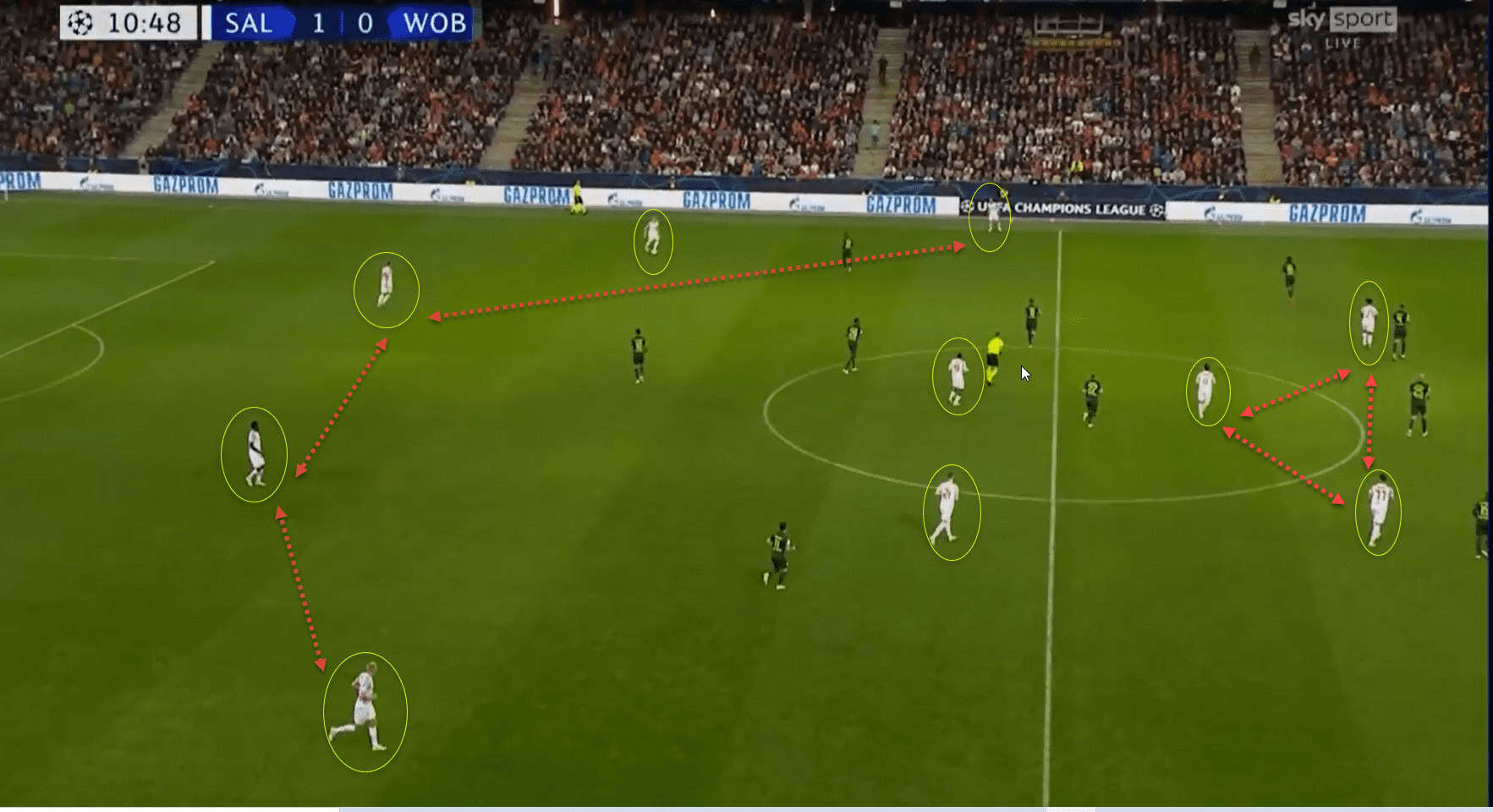
As Salzburg have worked the ball right now back left Wobler is looking to step in.
As Siewald has dropped almost into the left-back slot it has drawn Baku out of position and high.
This then creates an opportunity for Adeyemi to drop into the pocket of space highlighted, as he does this Aaronson rotates in for him.
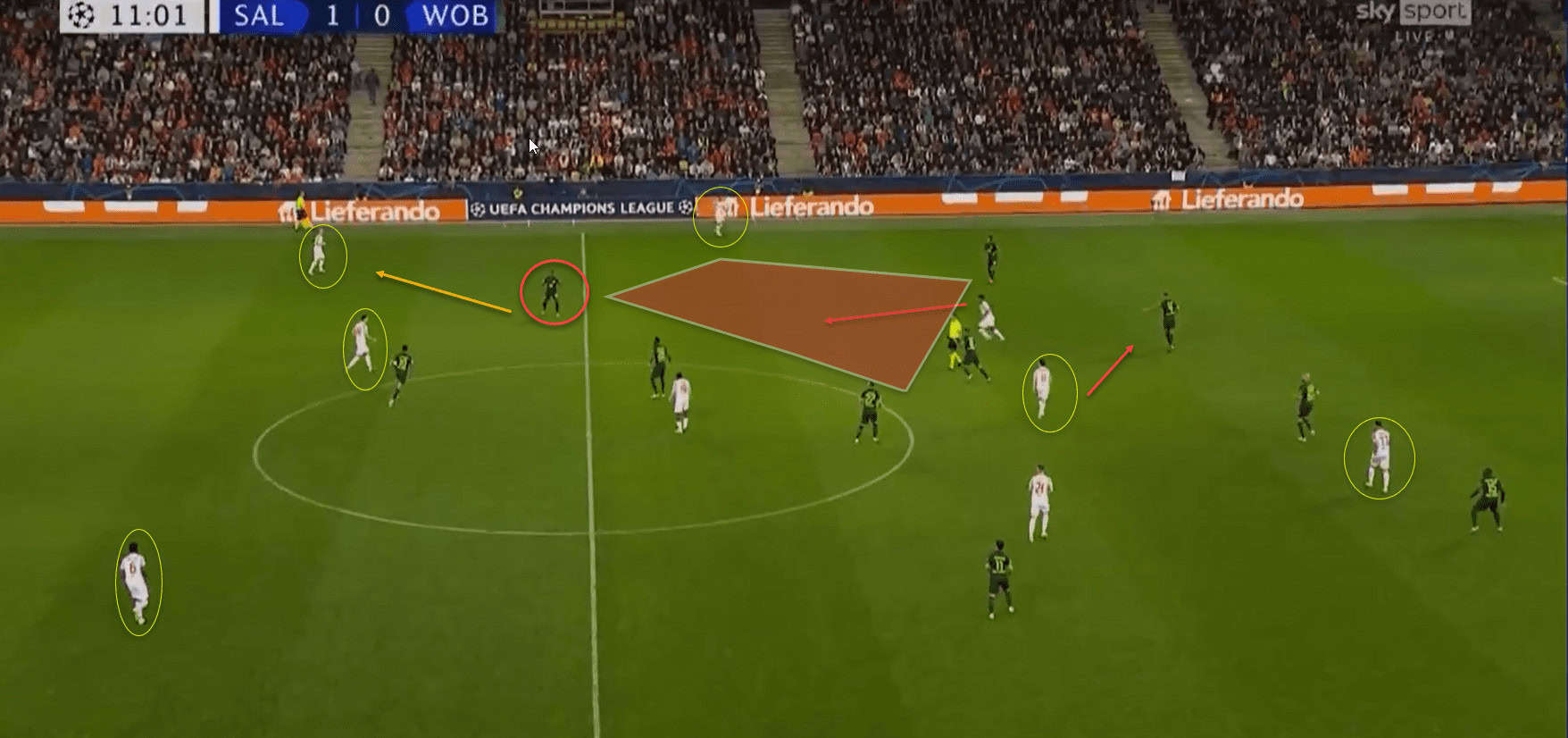
Below is the final picture.
You can see how Salzburg has managed to disjoint the Wolfsburg backline, with the right back pressing up to close down Ulmer, the right-sided Centre back closing down Aaronson, which leaves a big space for Siewald to play the ball into for Okafor.
He manages to get hold of the long ball and rattles the crossbar with effort, but brilliantly shows us Salzburg’s attacking shape and use of direct passing.

Counterattack / quick transition
Another strong feature of RB Salzburg’s game is their ability to transition quickly and efficiently.
They display a great ability to move from defence to attack in seconds using both direct passing and quick runners.
From the moment of turnover, Salzburg looks to move the ball forward in the quickest means possible.
If this involves playing the ball forward, they will do so; if this consists in carrying it forward, they will do so.
This is also partnered with the commitment of many bodies forward to making the most of the opposition.
When a team has just lost the ball, it is in its most vulnerable defensive position, as everyone is positioned with attacking in mind.
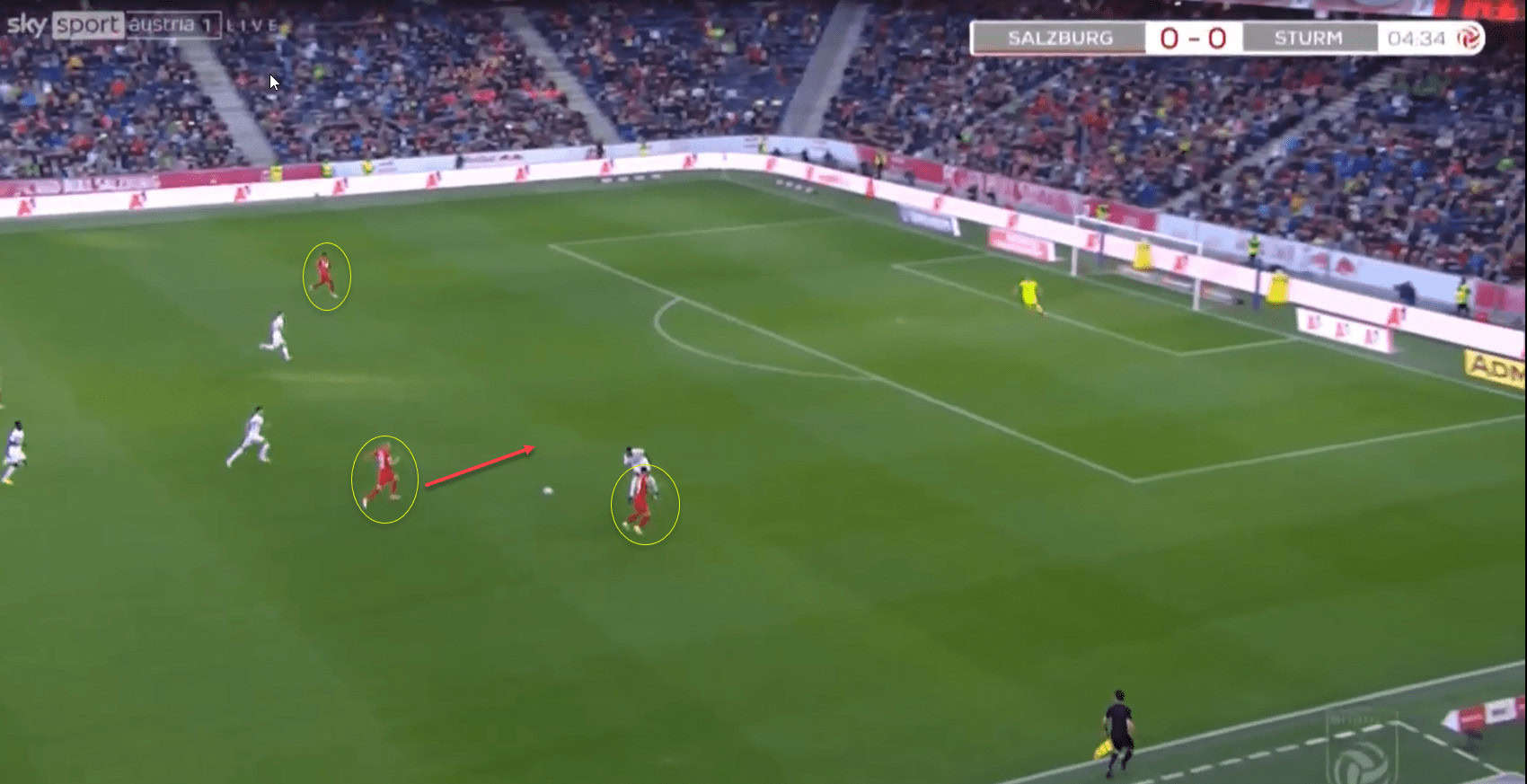
Below is an example of Salzburg recovering the ball after a loose Sturm Graz pass.
Salzburg is deep in its own half, and with Strum Graz having a player near all available passing options, Siewald chooses to play it long.
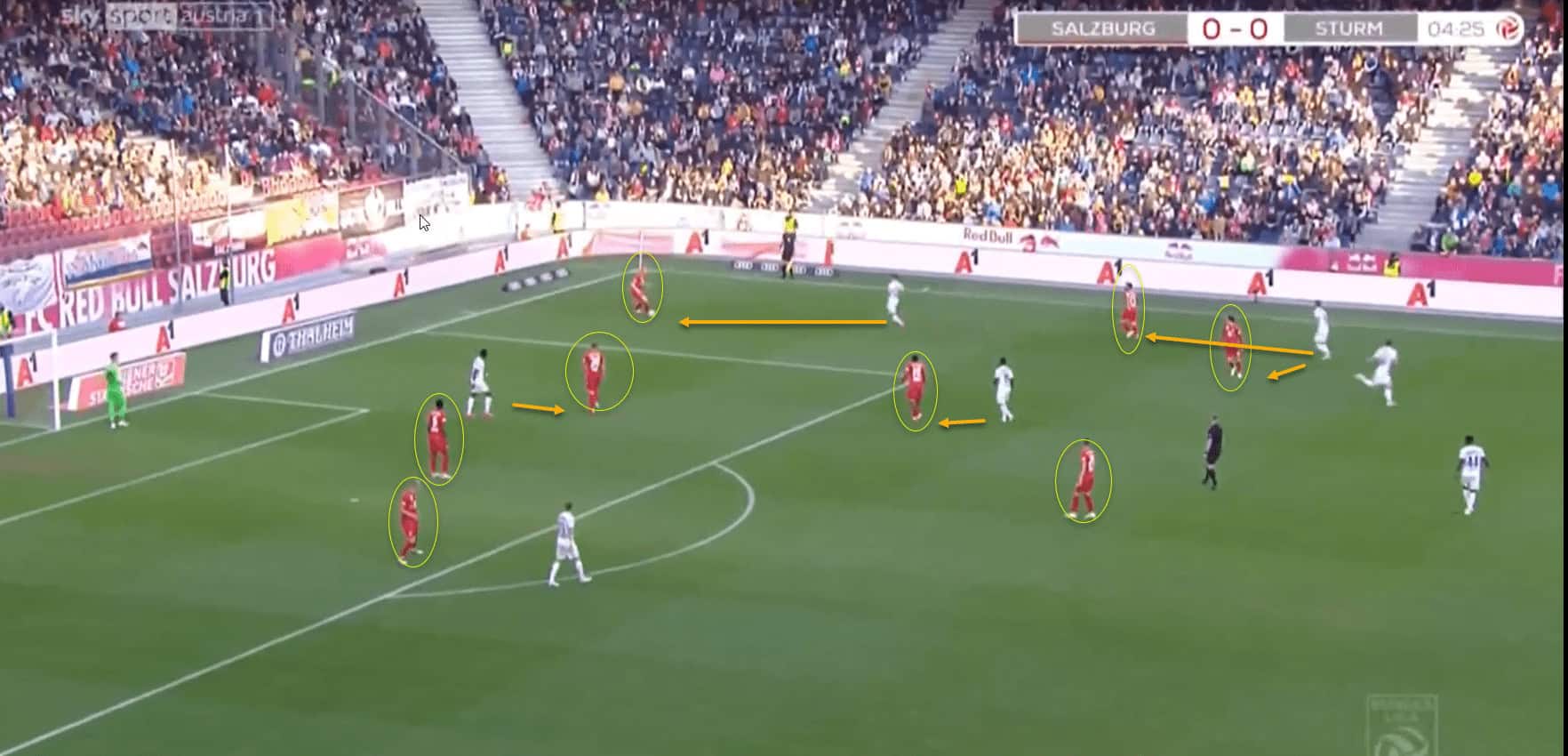
Siewald manages to find Okafor, who has cushioned the ball for Sucic.
Now, Salzburg has transitioned the ball into an area of danger for the opposition, as Adeyemi, Okafor, and Kristensen are harrying forward.
Sucic plays the ball into the space highlighted and finds Okafor who has spun around his man into the space
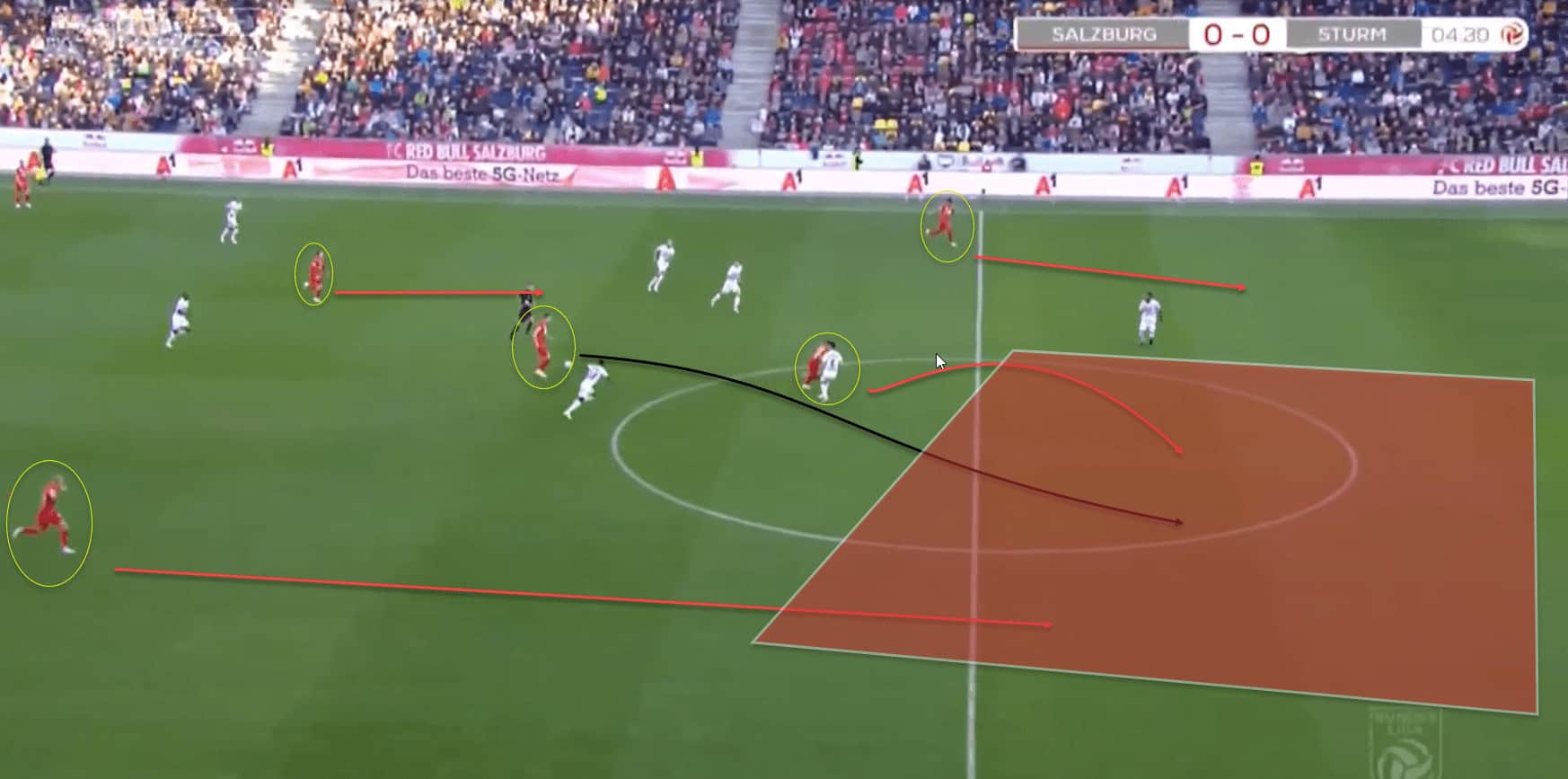
Okafor manages to gather the ball and play a wonderful backheel to Kristensen.
Who has acres of space to carry the ball into and eventually slots past the keeper.
From the moment Siewald gathered the ball to the moment the ball hit the back of the net, it took 13 seconds, showing brilliant use of direct passing and willing runners.
Excellent Pressing
Salzburg employs two types of pressing: a high press, where they attempt to press the opposition high when looking to play the ball out from the back, and a counter-press, where they lose possession and seek to regain it immediately.
This is what we typically see from Red Bull teams, as they are so heavily influenced by Ralf Rangnick.
Rangnick’s ideas are influenced by data they discovered back in 2006.
They found that the greatest chance of scoring is within 10 seconds of losing possession, and the greatest chance of regaining possession is within 8 seconds of losing it.
Both help us understand the importance of counter-pressing.
When Salzburg lose the ball, we usually see a highly aggressive counter-press.
I aim to surround the man/ball with as many bodies as possible, forcing the opposition into a turnover.
There are two benefits to this approach: first, the opposition doesn’t have the ball, and second, it often leads to turnovers in dangerous areas of the pitch, which can then be used to create dangerous chances for Salzburg.
Below, the graph shows PPDA and challenge intensity. Passes per defensive action (PPDA) show how many passes the opposition makes before a defensive action is taken.
The lower the PPDA, the more a team presses the opposition.
From the graph, we can see that Salzburg is one of the best pressers in the Champions League, along with only Liverpool, Chelsea, and Sevilla.
Challenge intensity measures the amount of Duels, tackles, and interceptions per minute of opponent possession.
Again, this highlights a team tendency to press.
RB Salzburg leads the Champions League in terms of challenging intensity.

When pressing the opposition high, usually from goal kicks, Salzburg split Okafor and Adeyemi to go and press the two centre backs and goalkeeper.
This is then followed by the outside midfielders going to press the fullbacks.
Aaronson will press and occupy the sitting midfielder.
The aim is to turn the ball over by either winning a duel or intercepting.
Below is an excellent example of how Salzburg will look to press, Adeyemi and Okafor will start relatively narrow and press outwards.
Here, the keeper has played the ball to the left centre-back, and now Okafor is going to close him down. Aaronson is looking to follow the sitting midfielder, and Sucic is looking to press the left-back.
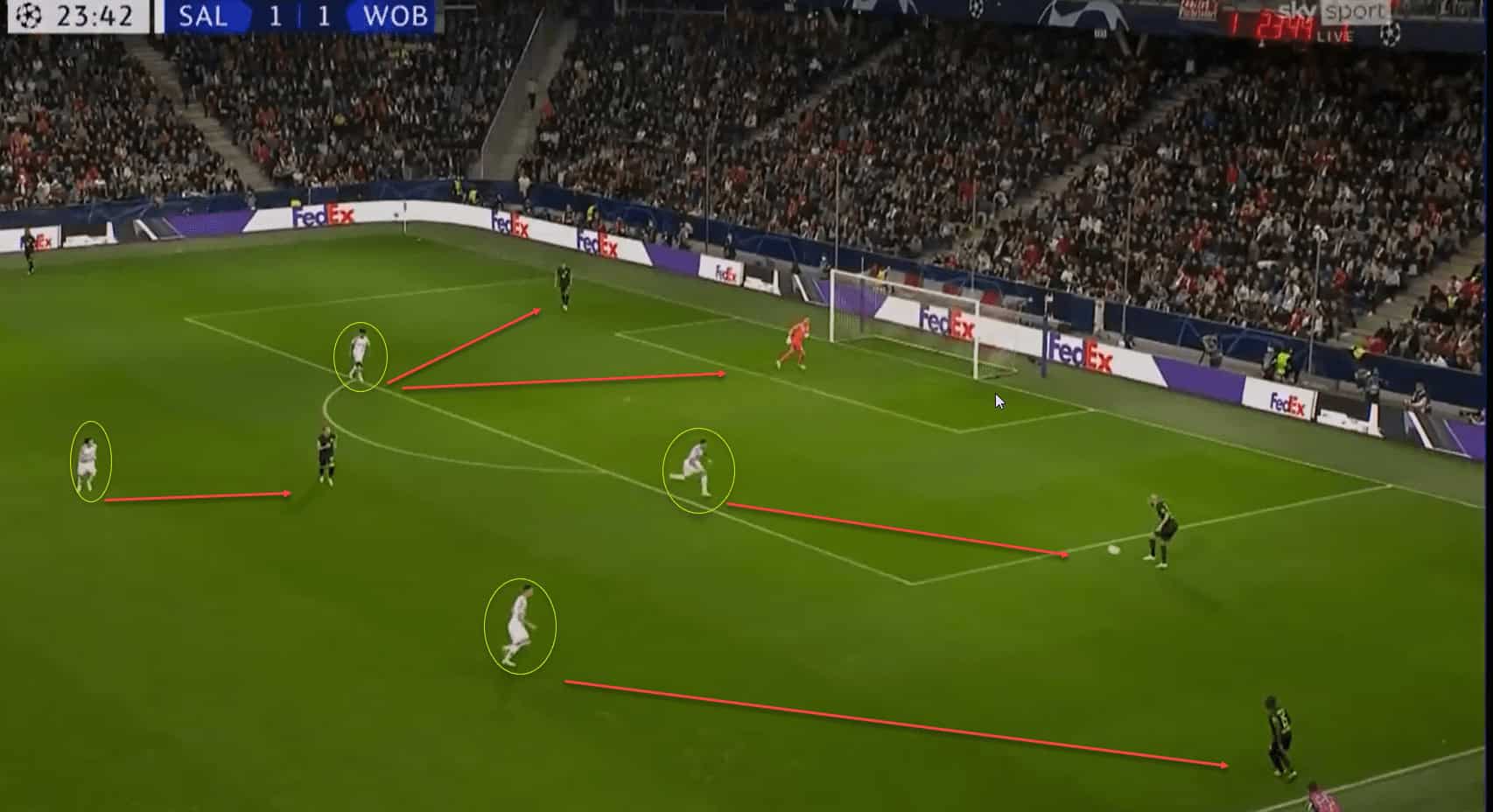
Now we can see how Salzburg has managed to take away Wolfsburg’s passing options.
This is why Okafor starts narrow, as this forces the left centre back wide, and then the team can narrow off his passing options.
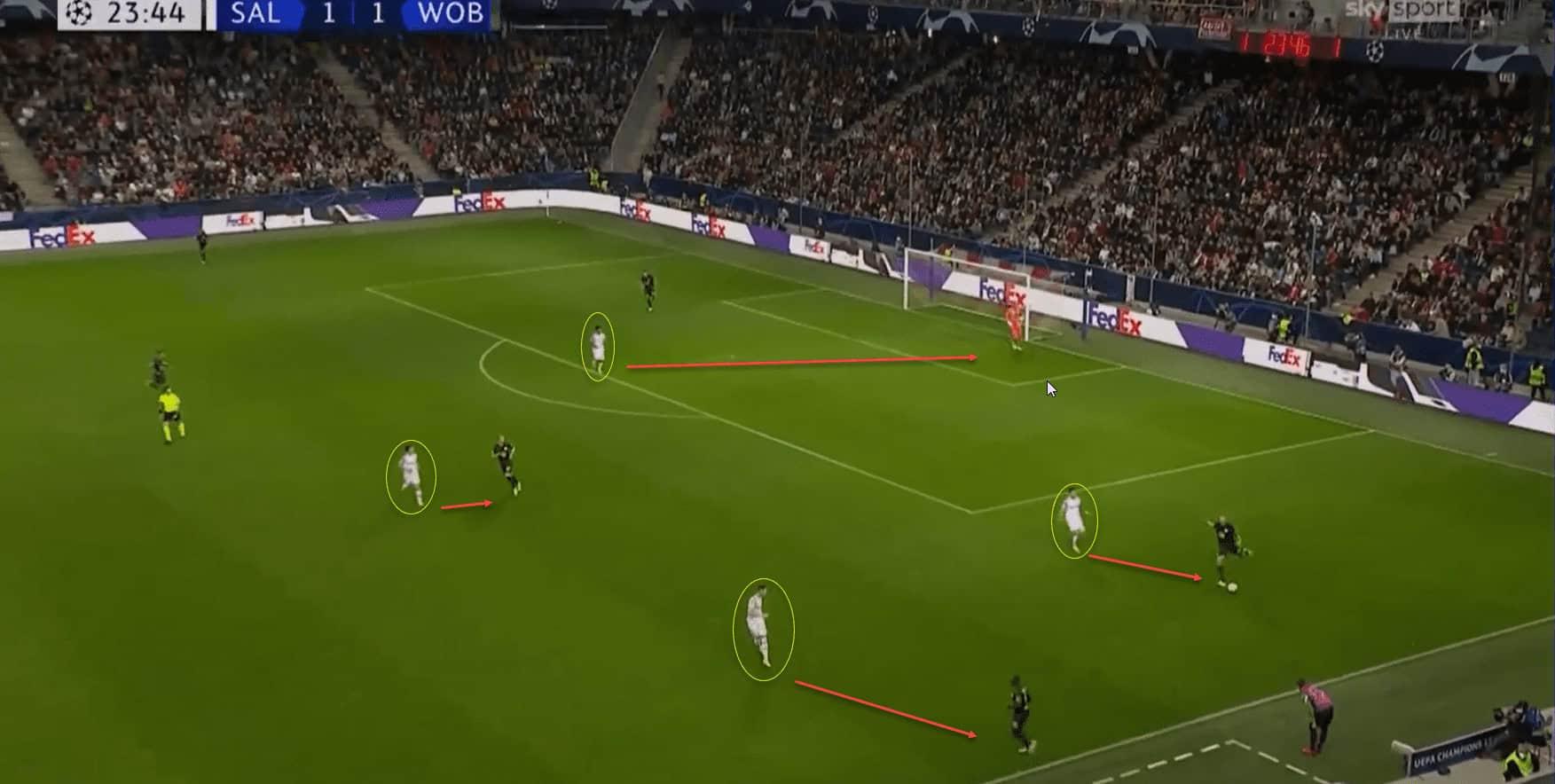
This led to the Wolfsburg player knocking the ball long for the Salzburg centre-backs to recover.
As already established, RB Salzburg is a very efficient counterpresser.
When they lose possession of the ball, they look to surround the opposition and regain possession ASAP.
Here you can see that Wolfsburg are about to regain possession after the ball has looped in the air before they even gather the ball.
Salzburg are looking to regain the ball, Kristensen and Sucic are making runs to the ball.
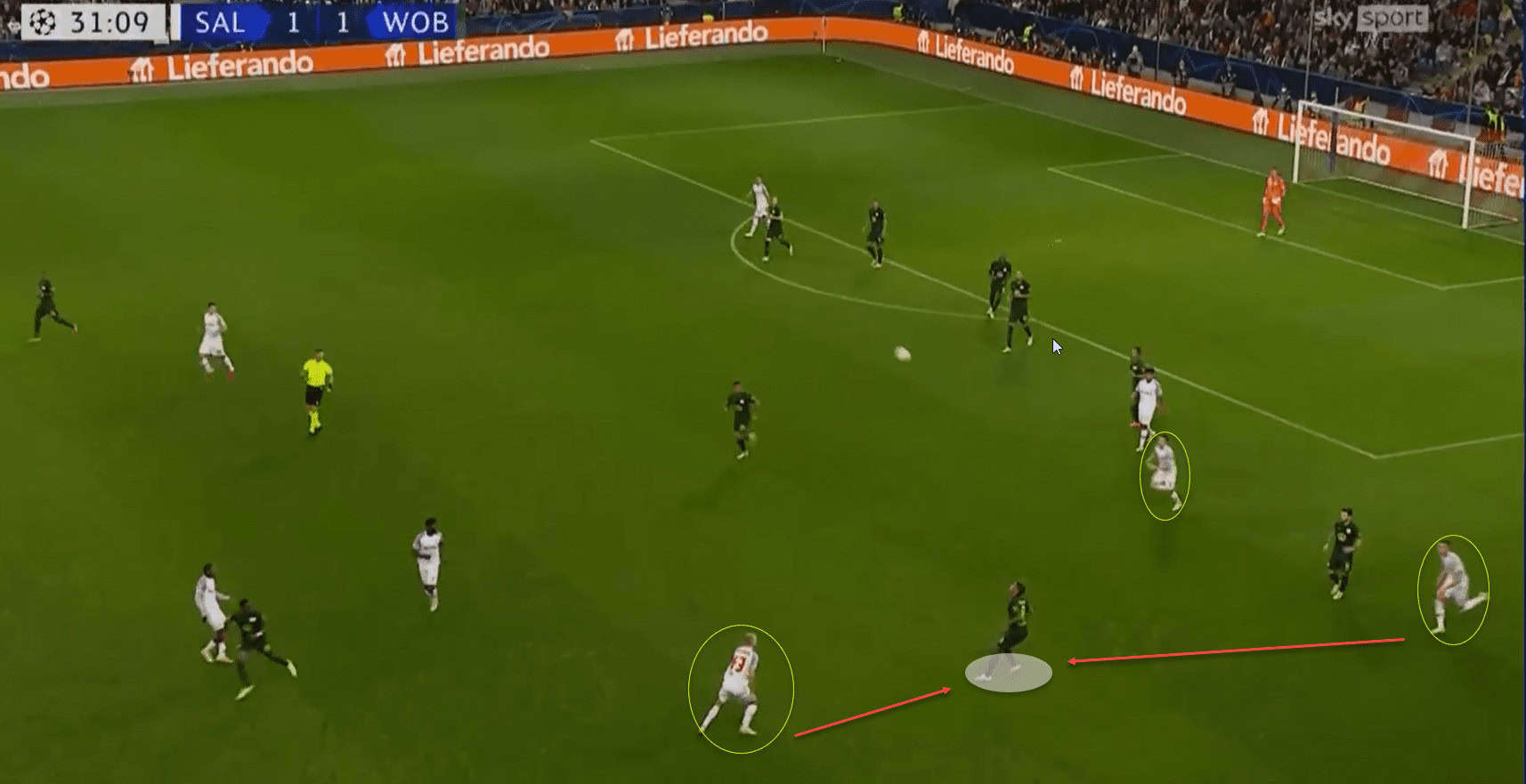
As the Wolfsburg player brings the ball down, he is surrounded by two Salzburg players who are looking to dispossess him.
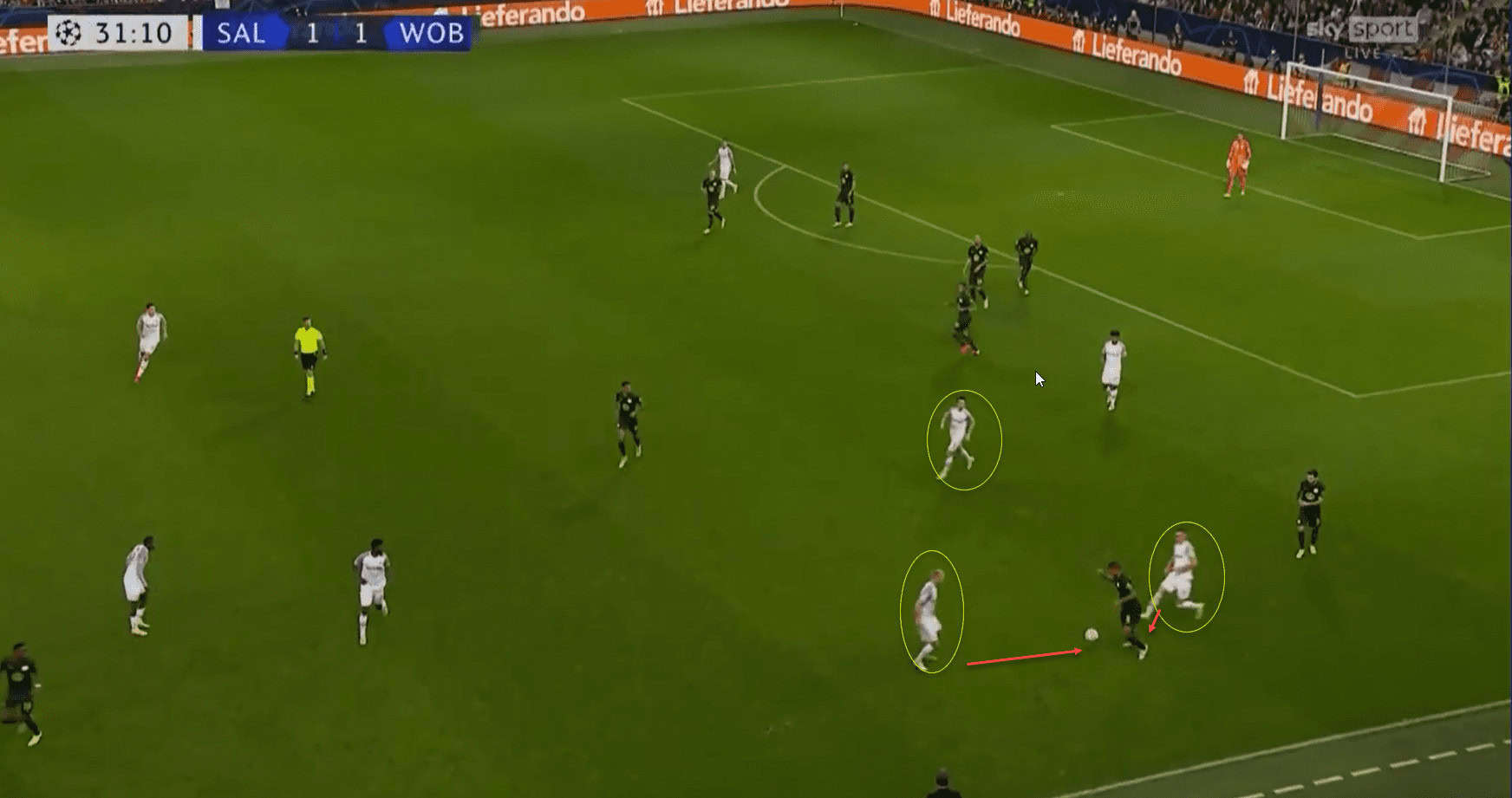
As the two Salzburg players look to win the ball back, Aaronson is now looking to press his one passing option.
Salzburg eventually forces the Wolfsburg player to play the ball out of play and force a throw-in.
This now means Salzburg have possession of the ball in the opposition’s final third.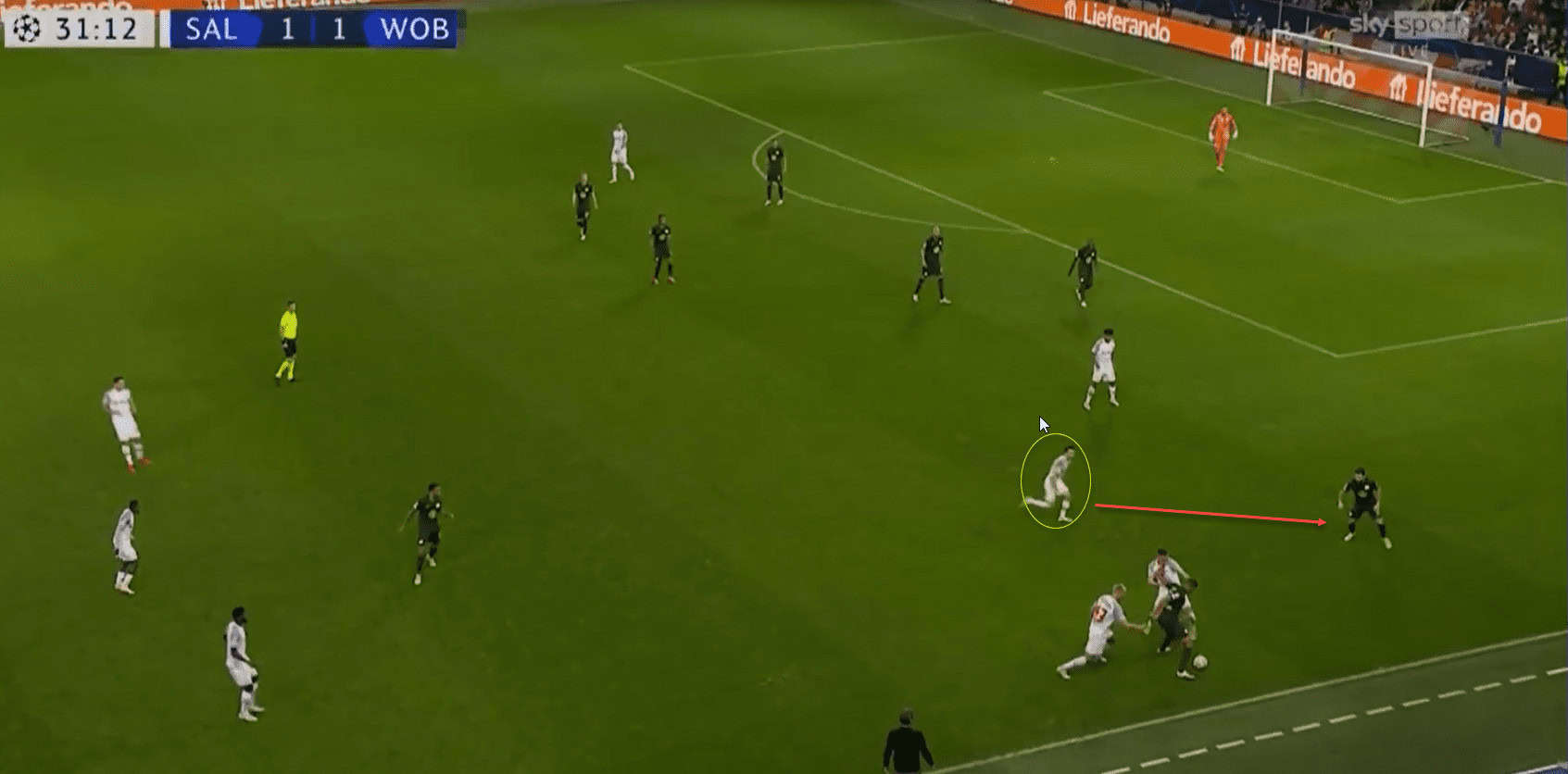
Summary
Matthias Jaissle has assembled a highly effective and tactically proficient outfit that has and may continue to surprise a few in Europe, in addition to dominating the Austrian Bundesliga.
Using a combination of direct and vertical pressing in possession, with high and aggressive pressing out of possession.
Throughout their play, they show a strong presence of Ralph Rangnick and the Red Bull principles.
Jaissle and his players are young and exciting within the footballing world and are on the path to bigger and greater things.
