One of the most highly-rated young talents in England and the entire footballing world is Liverpool’s Curtis Jones.
The 19-year-old has been with the champions for the last decade, learning the craft in their academy before making his debut for the first team in an FA Cup fixture against Wolves almost two years ago.
Last season, the English central midfielder made a total of 12 appearances in all competitions, particularly after the restart of football in June.
However, this season, he has become a regular in the Liverpool FC team, whether that be from coming off the bench or starting.
He has now matched last season’s appearance tally of 12 games already at the moment of writing.
He is also a regular starter for the England national team at the Under-23s level, earning huge plaudits from his coaches in the youth set-up, and has been touted as one of the best players at his age in the country.
Jones is currently wearing the number 17 with the Merseyside club, which is the same squad number worn by both Robbie Fowler and Steven Gerrard when they first came through the ranks at Liverpool at similar ages.
If the youngster turns out as good as those club legends, Jürgen Klopp will have a star on his hands.
This article will be an analysis in the form of a scout report of Curtis Jones in all competitions so far this season.
This will be a tactical analysis of the central midfielder’s style of play, examining how he fits into the tactics of both Jürgen Klopp’s Liverpool and Aidy Boothroyd’s England Under-23s, and utilising footage from his time in Liverpool’s academy.
Curtis Jones Style of play
Jones is a fantastic young player with a lot of tools in his arsenal.
He is certainly excellent in possession and has shown recently how much his defensive capabilities have improved with some brilliant defensive displays in the first-team.
The youngster is a right-footed player, who is very agile, but also physically strong, standing at 6’1” and weighing 75kg in total, making him a big presence when he makes runs into the box.
The 19-year-old is used as an advanced midfielder in Klopp’s 4-3-3 system, usually playing off the left but can also be used on the right.
Jones can even play on the left-wing if needed, meaning he is quite a versatile player, just the kind of footballer his German manager looks for.
His average positioning can be verified through his heat map for this season.

As can be seen from this heat map, Jones’ typical positioning is off to the left-hand side of the pitch in the half-space and even in the wide areas, but we can also see he has a very similar role on the right-hand side as well.
The reasoning for this advanced positioning on the flanks will be analysed later in the article.
The academy graduate is quite a safe player for an advanced midfielder and is very cautious in possession, which is not always a bad trait.
His composure with the ball at his feet is a massive bonus to Klopp’s side as it makes him very hard to target if the opposition is pressing him.
However, one of his best traits is his tactical and game intelligence.
Players at his age are generally only learning the game through experience, and whilst he is still learning in terms of technical skill and tactical awareness, Jones has shown a clear understanding of his manager’s system.
He knows when to press, when to cover his full-back, when to drop next to the centre-backs in possession, when to make a run into the flanks, etc, and fits right in when he starts.
Intelligence in possession
In the previous paragraph, we touched on how competent Jones is in Klopp’s gegenpressing system, so now we will delve into the exact role of the Englishman when Liverpool are in possession.
One of his roles, while Liverpool are in the established possession phase in the middle third of the pitch, is to create space for them to progress the ball further up the pitch.
He achieves this through his movement and by dropping back as a false full-back when the ball-near full-back advances up the flank.

This image is merely one example of Jones dropping to the side of the two Liverpool centre-backs to act as a false full-back.
One of the main reasons this is done is to ensure the two centre-backs are not outnumbered against the opposition’s forwards, thereby creating a 3v3 situation.
Another reason Jones drops as a false full-back is to drag out one of the midfielders on his side, creating space in behind the opposition’s midfield line to play into.
This can also be seen in the previous image.
The Leicester City winger has pushed up out of position to close down Jones, which has left space in behind him for Roberto Firmino to move into in order to progress his side through the lines.

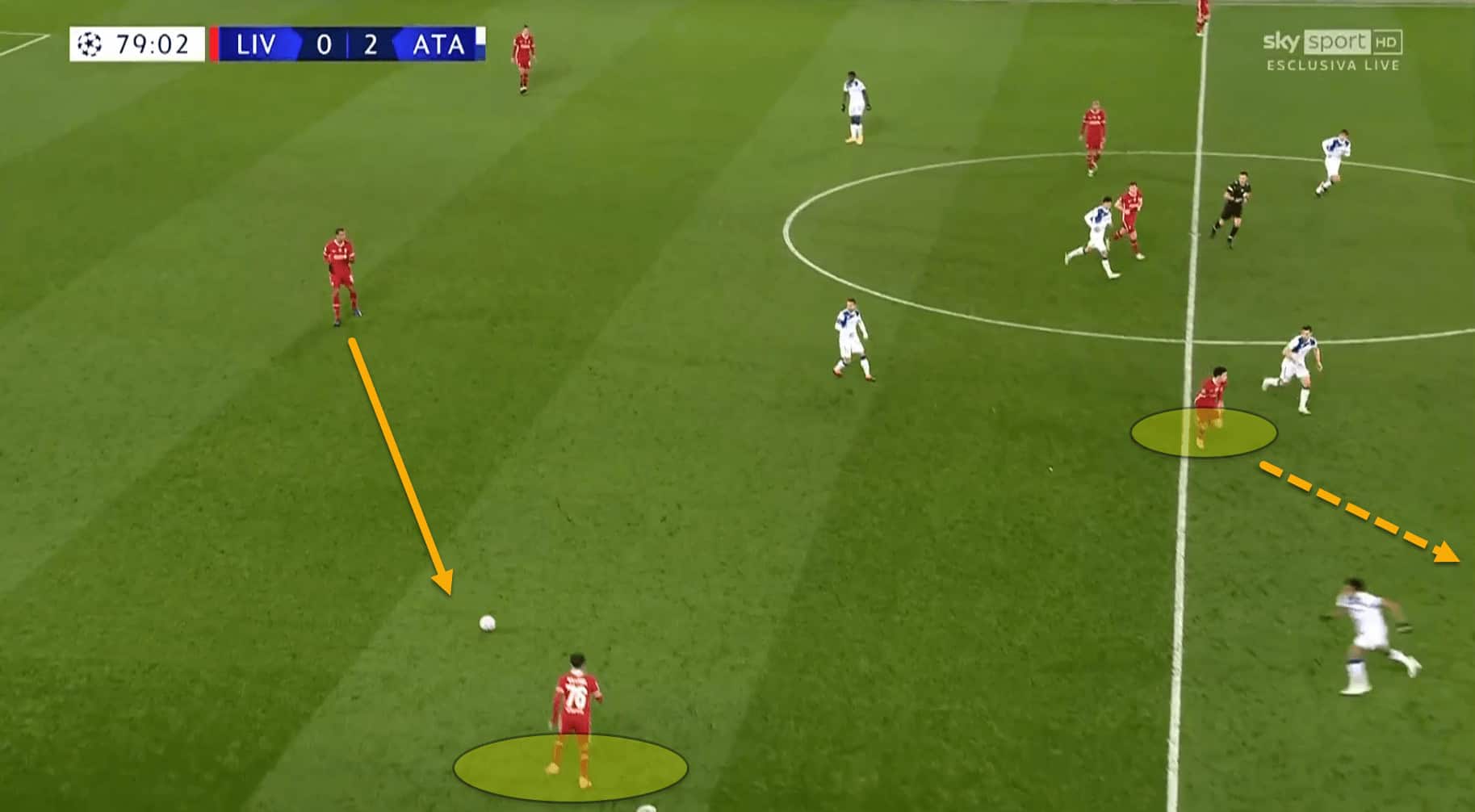
Here, we can see another example from a recent game in the UEFA Champions League against Atalanta.
By Jones dropping in as a false full-back on his side, it has dragged one of the opposition’s midfielders out to close him down, which in turn leaves space in behind the midfield line to be exploited.
With two simple passes, Liverpool can progress forward through Atalanta’s defensive block.
This is extremely intelligent play from the 19-year-old because he knows when to become the make-shift full-back and when to stay in his natural position.
If Liverpool are struggling to find gaps to play through their opponent’s defensive block, it triggers this move, but only if the ball-near full-back has advanced up the pitch.
If the full-back has not ventured forward on the flanks, then Jones tends to push up and occupy the half-spaces or even make runs into the wide channels for the full-back to play down the line to him.
The trigger for this is usually when the ball is being played into the full-back with him in a position to open out his body and play down the line.
This, of course, depends on the positioning of the ball-near winger too.
If the winger is hugging the touchline then Jones moves into the half-space and creates a triangle on the flanks.

The above image is an example of this triangle being created.
Creating this triangle with Jones allows them not only to have numerous bodies on the flanks to retain possession but also will enable them to try and break the opposition’s defensive line by using quick combinations to get in behind.
However, if the winger has moved into the half-space, which Liverpool’s wingers tend to do, as they are more like inside-forwards than actual wingers, a common tactical trend in modern football, Jones makes runs overlapping the winger on the flanks.
As stated before, however, the trigger for this is not only the movement of the ball-near winger pushing inside but also the ball-near full-back opening his body to play down the line.

Here, we can see this exact move taking place.
James Milner is not positioned particularly high up the pitch and has received the ball on the right-wing.
He touches the ball on his back foot, opening his body out, and since Jota has moved into the half-space to attract the Leicester wingback inside, Jones darts up the wing so that Milner can play the ball into space for him.
Jones has totalled 25 progressive runs so far this season despite only playing 1,025 minutes of football as of writing.
Putting this into context, he averages one progressive run every 41 minutes of play.
These subtle runs and pieces of tactical intelligence whilst in possession matter a lot for a top-level side in relation to breaking down an opponent’s defensive block, and Jones certainly has the ability to do this.
Defensive capabilities
Those who had seen Jones play at an underage level would never proclaim that the now 19-year-old’s defensive abilities were one of his better traits.
However, since he has trained more and more with Liverpool’s first team, he has become an excellent asset off the ball for Liverpool.
The English midfielder wins 60 percent of his defensive duels per 90.
Out of possession, Klopp’s teams work extremely hard, and Jones is no different.
We have spoken quite a lot throughout this scout report about his intelligence, and he demonstrates it again with his defensive displays, knowing when to press, when to sit off, and who to mark, among other things.

This is a recent example against West Ham United in the Premier League, in which Jones shows his defensive capabilities and intelligence.
Liverpool are sitting in their typical 4-3-3 high block, with both advanced midfielders, Jones and Georginio Wijnaldum, sitting off of West Ham’s double-pivot.
Once the ball is played into Declan Rice through Liverpool’s first line of press, Jones quickly closes him down on his blindside in order to prevent him from being able to turn and play forward.
The press is timed to perfection, forcing West Ham to play backwards to the original ball player.

This image here is another example of Jones’ exceptional off the ball work.
Once again, he stays off the Atalanta player until the ball is played into them before quickly pressing their blindside, which forces a turnover of possession in favour of the Reds.
One of the most notable details of the previous image is the time, which is nearing the 89th minute of play, showing that Jones’ grit and determination continue until the final whistle is blown.
Jones also portrays a hunger to hunt down the ball and win it back, which is an excellent trait to possess in Liverpool’s counter-pressing tactical system under Klopp.
An example of this counterpressing can be seen in the following image;

Liverpool have just lost possession of the ball on the left flank, and Jones has quickly moved across to double up on the ball carrier, counter-pressing with numerical superiority in order to win back possession for Liverpool.
Curtis Jones Attacking Capabilities
One of the biggest criticisms of Jones is his lack of output for an advanced midfielder in a 4-3-3.
Taking a brief look at some of his basic attacking statistics, one can decipher this without even watching him in action.
So far this season, he has registered four goals in all competitions, one of which was for England in the Under-21s, whilst another two were against Lincoln City in League One.
This is unsurprising, though, as his average expected goals (xG) is 0.1 as of writing, whilst only managing 1.3 shots per game.
He has also failed to register a single assist in all official competitions this season for club and country.
The lack of attacking output is predominantly down to the youngster’s safety in possession, as well as the safety in his positioning.
Jones makes advancing runs down the flanks but does not tend to make advancing runs into the box.
When he does, due to his physicality and game intelligence, the midfielder can be quite a handful.
The following two images will be almost identical examples of Jones making an advanced run into the box to score at the back post.

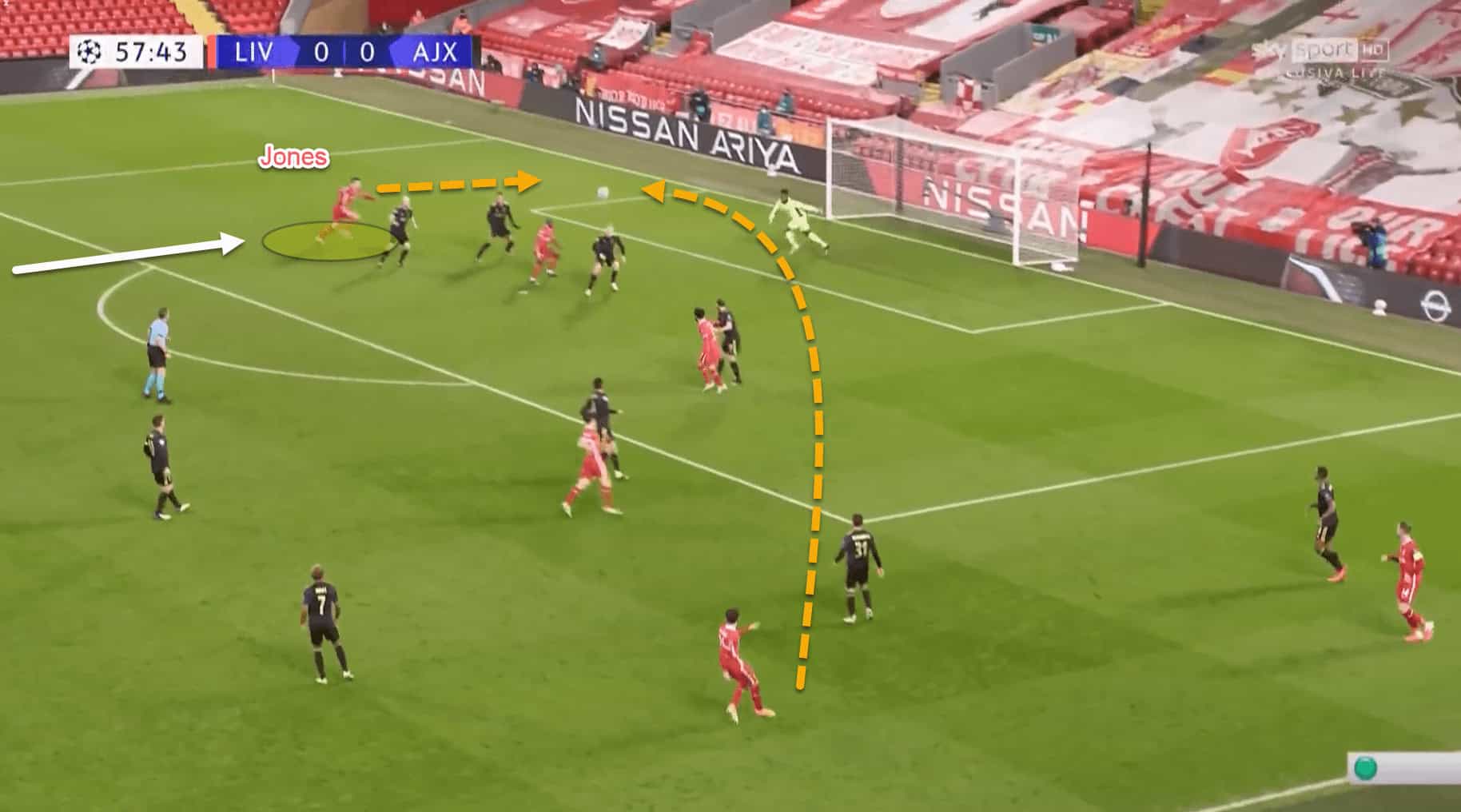
On both occasions, Jones has used his brain to make two excellent runs from deep on the blindside of the opposition’s full-back, before scoring very similar goals.
When he makes these types of runs into the box, Jones looks deadly, but they are not made often enough.
One would expect his attacking output, in terms of goals and expected goals, to improve significantly in the future if he makes more of these advanced runs from deep.
This would also give Liverpool another goal-scoring dynamic, particularly in a midfield that lacks goal-scoring prowess.
Jones is quite possibly his most dangerous in the final third when he receives the ball at the edge of the box.
In a very Philippe Coutinho-like fashion, the youngster has a knack for cutting inside on his right foot from the edge of the box to either score or force a brilliant save from the goalkeeper and has done so since his time in Liverpool’s academy, which can be seen from the following examples.


These are two slightly different positions taken up by the young prodigy, but two excellently taken goals from his right foot at the edge of the box.
In their most recent games, the 19-year-old has taken up excellent positions at the edge of the box, but he has been unable to convert.
Still, that is not to say he won’t do so in future games, so teams will need to catch onto this attacking trait very soon or else he will punish them as he did with the two sides above.
Conclusion
Curtis Jones, no doubt, has the ability to go on to be a top-level player for Liverpool as well as the England national team in the future.
There are some frailties in his style of play, which were discussed in the article relating to his attacking output.
However, at 19 years of age, there are far more positives in his game.
Jones looks to be one of the best young players in the world at the moment and is unquestionably one of the finest young English talents.
His tactical intelligence in possession and out of possession is by far one of his best traits, as he understands very clearly what is expected of him in Klopp’s system, which is undoubtedly one of the reasons that the German manager has been rewarding Jones with so much game-time recently.
If Jones manages to fulfil his potential at Anfield, he could become one of the best midfielders in the country, if not in Europe.
Watching his development over the coming seasons will be extremely exciting from the perspective of Liverpool, as well as neutral football fans.


![Burnley Vs Manchester United [2–2] – Premier League 2025/2026: The Red Devils New Ideas And Potential Tactical Changes – Tactical Analysis](https://totalfootballanalysis.com/wp-content/uploads/2026/01/Burnley-2-2-Manchester-United-tactical-analysis-350x250.png "Burnley Vs Manchester United [2–2] – Premier League 2025/2026: The First Steps Of The Post-Rúben Amorim Era – Tactical Analysis 17")