After Sporting Portugal suffered a 5-0 shellacking at Benfica’s hands in the Portuguese Super Cup, the club made a slew changes. In fact, this Sporting looks very little like that side.
Marcel Keizer was replaced just five games into the season, eventually leading to the hiring of Silas. Bas Dost now dons an Eintracht Frankfurt kit, promising Alcochete graduate Thierry Correia was sold to Valencia and Raphina earned a €20m move to Rennes. In their place, Sporting signed Yannick Bolasie and Jesé on loan.
For Benfica, the Portuguese Super Cup win was just the start of a brilliant first-half. Through 16 games, Bruno Lage’s side sits atop the Liga NOS table, four points ahead of Porto. With 15 league wins and just one defeat, the only real disappointment is the failure to qualify for the UEFA Champions League knockout stage despite a generous draw.
In this tactical analysis, we’ll preview the Derby de Lisboa. In this analysis, we’ll look at the tactics that will most influence the matchup, including Benfica’s build-up versus Sporting’s middle block, how Benfica will look to attack from the half-spaces and the tactical vulnerability that Sporting will look to attack.
Benfica’s build-up vs Sporting’s middle block
Benfica’s build-up
Benfica lead Portugal’s Liga NOS with 40 goals in just 16 games. That’s an average of 2.50 goals per game off an xG per 90 minutes of 1.82, so the Portuguese leaders are remarkably efficient in front of goal. That said, Benfica attacks in such a way that it limits the opposition’s chances, holding opponents at 0.38 goals per game, which is below the xGA 0.71 a match. Given the strength of its squad relative to the league, Benfica’s quality forces the opposition to play more conservatively, often dropping all or all but one player behind the ball.
In its typical 1-4-4-2, Benfica operates through short passes in an overloaded central part of the field. As the opposition overcommit to the middle, Benfica looks to play wide. Álex Grimaldo is the typical beneficiary of Benfica’s central dominance. The Spanish left-back has channelled his playmaking abilities into six assists. According to WhoScored, Grimaldo leads the team with 2.1 crosses per game and trails only Pizzi in the key passes category, contributing 2.3 per match.
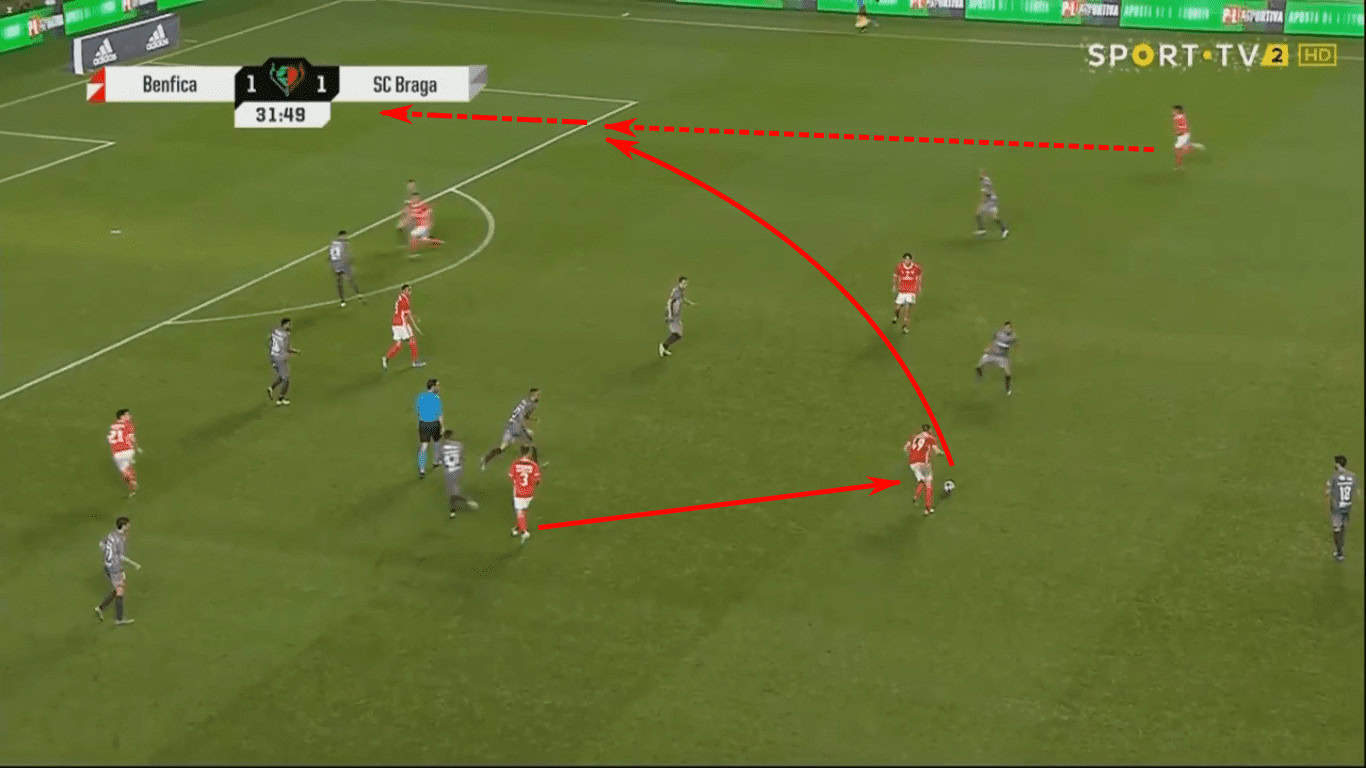
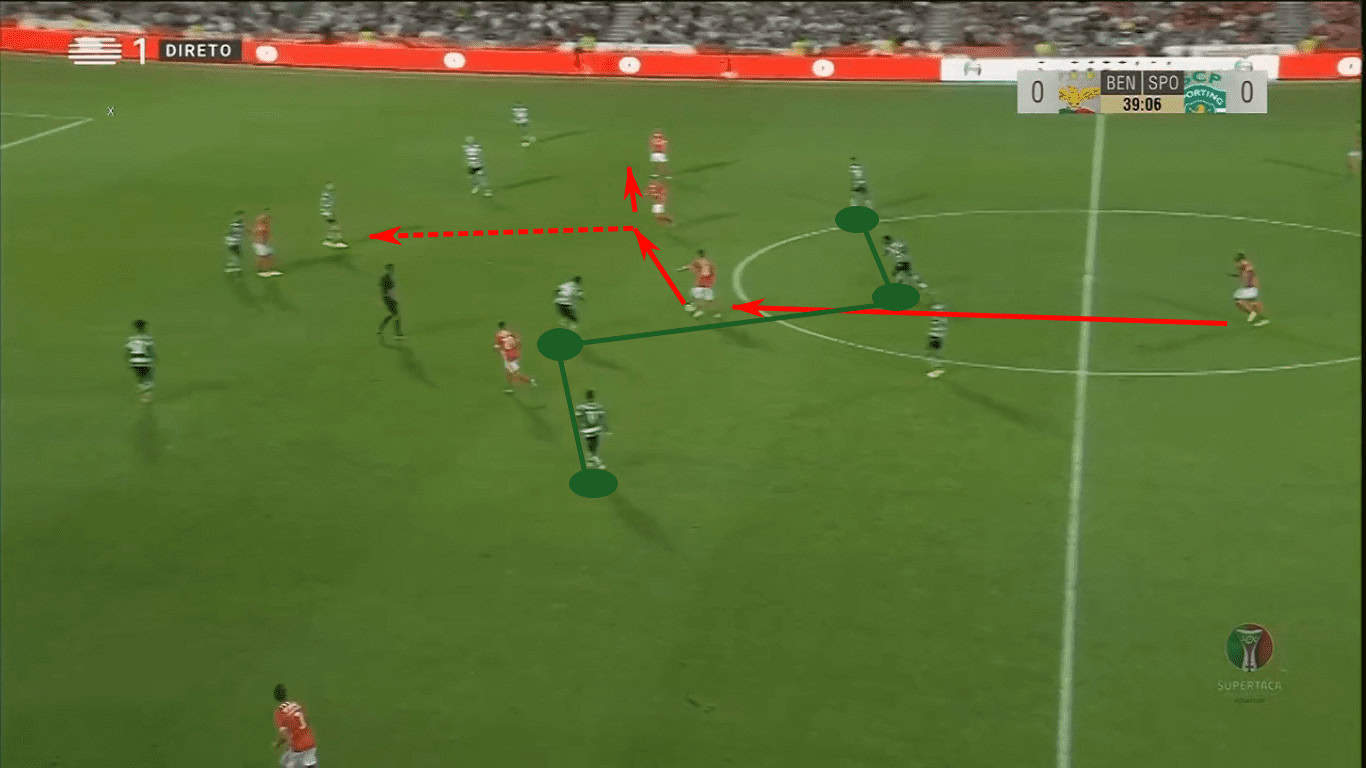
Look for Benfica to possess centrally and along the backline to give Grimaldo time to start higher up the pitch. From there, watch Benfica’s forwards and two wide midfielders attack the Sporting with runs in behind the defence. Sporting will have to respect the runs, but also show an understanding that Benfica uses decoy runs to draw its opposition away from the middle, allowing Pizzi or one of the holding mids to attack open space and get the ball into the box.

In this instance, Benfica has just completed a switch of play. You can see Grimaldo isolated on the left-wing with runners arriving in support. Deciding against the wide route, Grimaldo let his teammates continue their runs deep into the half-space and wing.