
Poor early season defending and lack of initiative in attack had demoralised the Sporting Portugal fans and players. When Os Leões fired Marcel Keizer just four games into the season, rumours of José Mourinho, Leonardo Jardim and Marco Silva set the Portuguese football world ablaze.
All three coaches turned down the offer, leaving Jorge Manuel Rebelo Fernandes, who goes by the name ofSilas, to step into the role. Before Silas’ appointment, Sporting had a 2-2-2 record in league play and was winless in five games (one draw and four losses with three home losses to Portuguese competition). To make matters worse, they were blitzed 5-0 by Benfica in the Super Cup and in the midst of a 10 game run without a clean sheet, their worst mark in 60 years.
Like Keizer, Silas was fired after the fourth game of the season, leaving Belenenses SAD without a goal and just two points. A creative playmaker back in his day, Silas acknowledged he wasn’t first choice for the post, but promised to play with attacking intent. Silas’ appointment has reversed those trends and re-established the Verde e Brancos attacking identity.
In this tactical analysis, we’ll take a look at how Sporting’s tactics under Silas have improved their defending and led to higher quality possessions with better scoring opportunities, all while maintaining Keizer’s 1-4-2-3-1. In this article, the stat comparisons between Keizer and Silas feature numbers from the four league games Keizer coached this season and the last four games Silas has coached against Portuguese competition. Looking closely at Silas’ last four games gives us an idea of the coaching philosophy he’s implemented and paint a picture of what’s to come.
Defending quickly and higher
Over the first four games of the season, Sporting had two underwhelming wins, a draw and a loss. While claiming the seven points, they managed to outscore their opponents eight to six, though that doesn’t include the 5-0 thrashing at the hands of Benfica in the Portuguese Super Cup. Seven points in four games and a +2 goal differential might not sound bad, but there are higher expectations for the Big Three in Portugal. Also, the point total masked the shockingly poor play. In those first four games, Sporting’s xG trailed behind their opponents by a total of 4.25 to 6.84.
When Silas claimed the head coach’s role at Sporting, he went straight to work correcting their defensive structure, ending the 10 games clean sheet drought in his first game. In his 16 games at the helm, Sporting has recorded eight clean sheets, four in the league and four in their various cup competitions.
Among the immediately noticeable differences he brought to the team is the adjustment to their defensive shape. Keizer’s Sporting averaged starting points of 50 metres width by 36.75 metres from top to bottom. In contrast, Silas altered the shape by about six metres in width and height, averaging 46 by 42.25 metres. Early in the season, Sporting’s width and vertical compactness possessed issues in defensive transition, as opponents effectively pressed in a 36 by 36 metre area. As opponents recovered the ball, they used their numerical advantage to quickly attack the Sporting goal.
Now, with Sporting starting with a narrower attack and more verticality, they’re able to stretch the opponent while maintaining numbers near the ball in case of a turnover. Silas emphasises the central positioning of his centre-backs and two holding mids to protect against the counterattack and complicate the opponent’s path to goal. Comparing Keizer’s four 2019-20 league games against Silas’ previous four games against Portuguese opposition, Sporting’s Passes Per Defensive Action, which help indicate tempo, improved from 8.7 to 8.2. If you take away the defensive anomaly against Santa Clara, Sporting’s PPDA was 6.67 from the other three matches.
That quick recovery is happening in a better area of the field too. In Keizer’s four games, 42 of Sporting’s 307 recoveries took place high up the pitch. That equates to 13.7% of their recoveries coming in the attacking third. In contrast, Silas’ last four games against Portuguese opposition included 59 out of 319 recoveries high up the pitch, improving the final third recovery percentage to 18.5%. Through better defensive shape, Sporting are now recovering the ball sooner and in more dangerous areas of the pitch.

In this instance, Luiz Phellype made a blind turn and Santa Clara gained possession. Due to the congestion in the middle of the field, they’re unable to break the pressure. Notice Ukra at the top right with his arm extended. He wants the ball, but the path to him is blocked.
Wendel is near the other outlet, Lincoln, leaving Santa Clara to fight off the counterpress of Phellype, Luciano Vietto and Bruno Fernandes. Notice the left-back, Marcos Acuña, holding his ground high and wide. He sees that Sporting are pressing well and have coverage if Santa Clara manage to break the pressure.
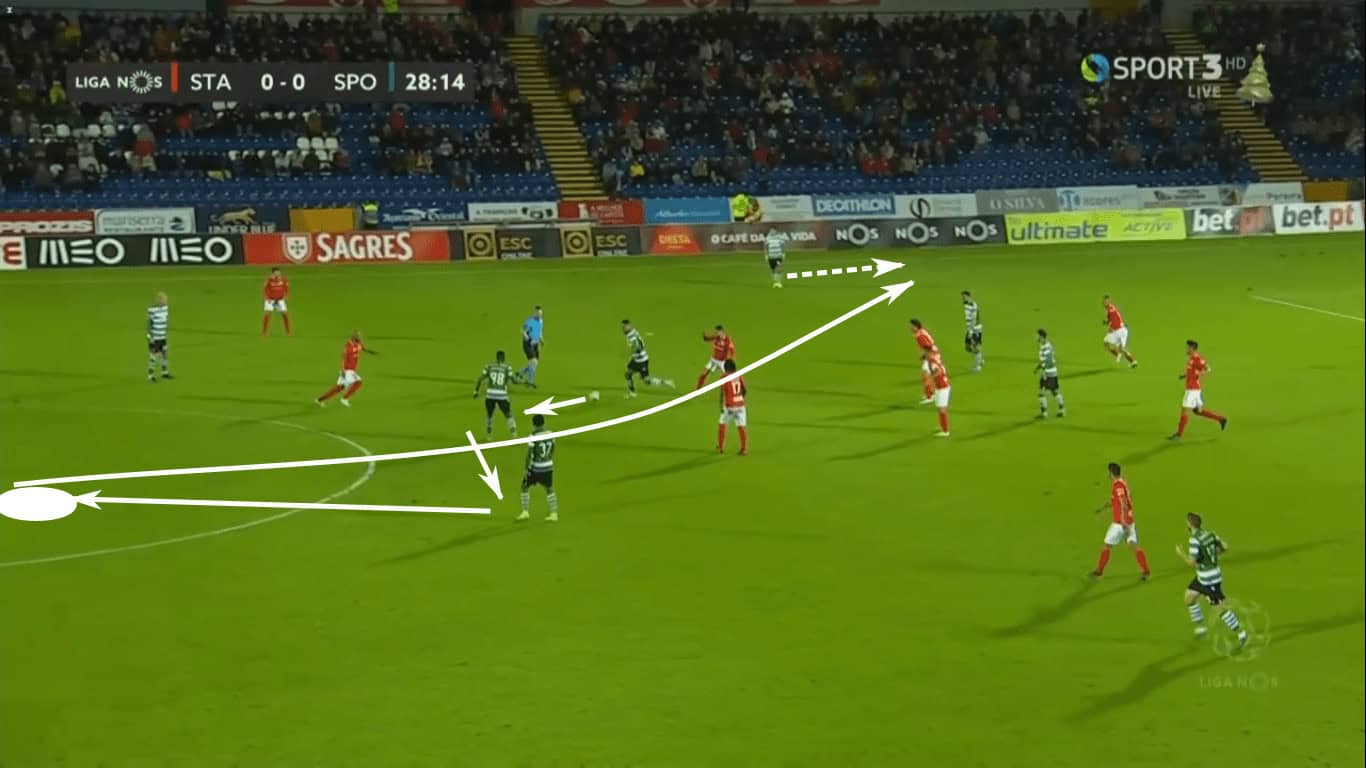
Phellype rights his wrong, regaining possession of the ball, dropping for Idrissa Doumbia. The next pass went to Wendel, then to Sebastián Coates, who plays long to Acuña, igniting another Sporting attack. Between the counterpress and the holding mids and centre-backs anchoring the middle of the pitch, Santa Clara didn’t have a chance to play out.
Possession with purpose
At the end of last season and the beginning of the current campaign, Sporting’s attacking tactics failed to secure a significant advantage in possession or chances created. Starting with possession, Silas has greatly improved the quality and quantity of ball circulation.
At his introductory interview, Silas promised his Sporting side would embrace an attacking brand: “We are daring because we are ambitious. We believe in our abilities. We know how we want to play, which involves risks, but that’s what we believe in. We also know that our style of play will give pleasure to the players and the fans.” That promise has translated to enjoyable attacking football and statistical improvements across the board.
Going back to the four games of Keizer and the four latest games for Silas, possession percentage has improved from 51% to 60%. Passing percentage has also improved, increasing from 83% to 86%, and Sporting is really focused on using passes to disorganise the defence. Passes attempted and succeeded per game have jumped from averages of 426 and 355 respectively. Over Sporting’s previous four games, those averages have spiked to 520 passes attempted and 447 successful. In terms of pure possession time, Keizer’s team average 24:27 to Silas’ 30:56 per game.
One of the keys is the increased involvement of the back-line and holding midfielders. Since Sporting have increased their vertical starting points, with the forward and three attacking midfielders playing higher and more centrally, they’re pulling defenders back with them. That leaves width for the outside-backs and depth for the centre-backs and holding mids. Furthermore, with the team increasing their verticality and pushing the outside-backs higher up the pitch, Sporting are attempting more long passes per game.

Interested in the discrepancies in attacking statistics, I compiled a list of player statistics among the centre-backs, holding mids, and two outside-backs. The objective was to see which players are more involved in directing the attack and who’s playing at a higher level under Silas’ tutelage. As you can the number of actions and passes per game, as well as each player’s success rate, has improved under Silas. Perhaps the two greatest beneficiaries in the change of system are former Barcelona player Jérémy Mathieu and Doumbia.
Former Liverpool man Coates had typically handled long ball duties under Keizer. Wendel would push higher into the midfield while Doumbia offered an outlet if necessary. Now Mathieu plays an integral role in the build-up with Doumbia and Wendel triangulating with the centre-backs to draw the opponent higher up the pitch before playing a long diagonal behind them.

Here we see Doumbia and Wendel linking up in the midfield, helping support the defenders as Sporting look to launch their attack on the opponent. Notice the overload at the top of the image. Sporting’s attack is compact, allowing for the counterpress if the ball is lost.
As Moreirense overcommit to their left, Wendel sent the ball to Mathieu, who had nothing but space in front of him. He drove into the half-space, giving his forwards and attacking mids a chance to get into the box.
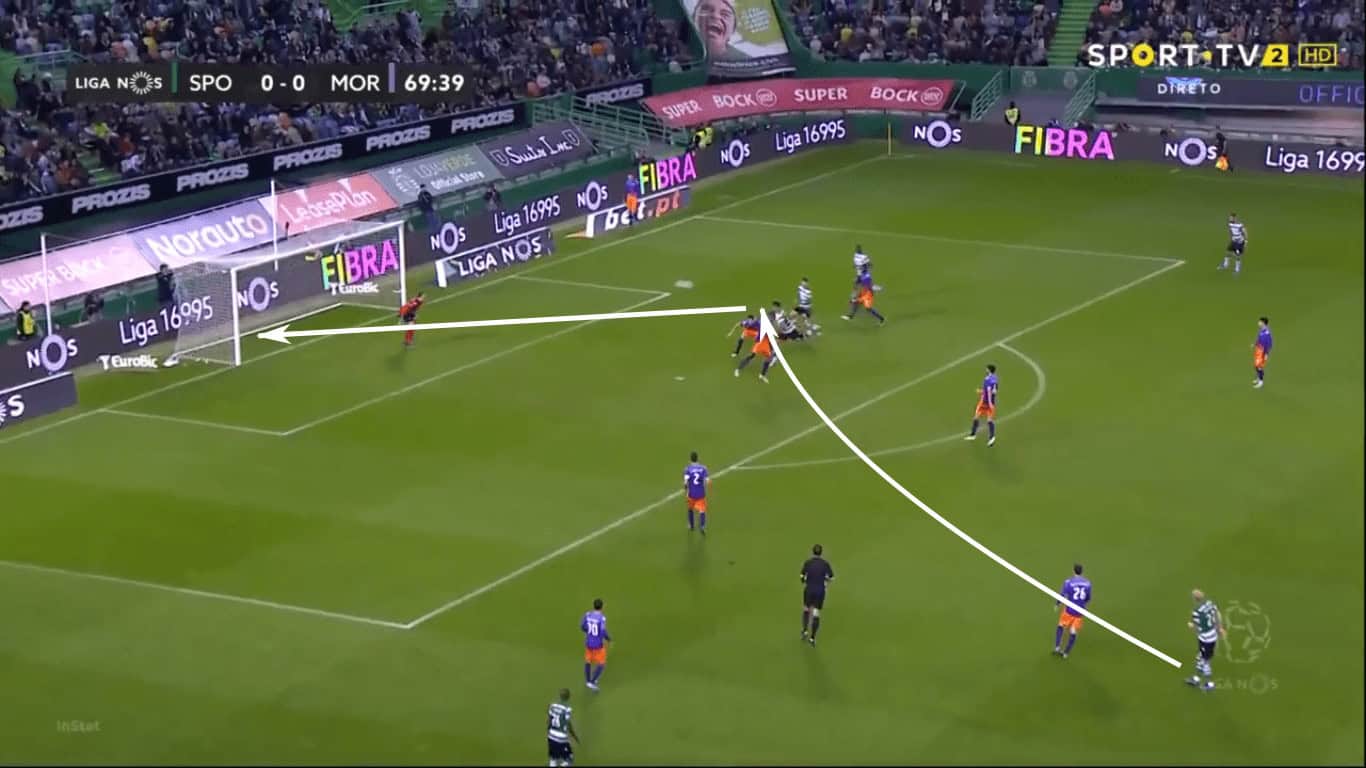
Mathieu delivered the ball about 14 metres out but managed to give Phellype enough space to run onto the ball and generate enough power to send it into the net.
Attacking in the final third
As mentioned, Sporting’s xG in their first four games of the season trailed their opponents by a total of 4.25 to 6.84. Over the last four games under Silas, Sporting’s numbers have improved dramatically. Their xG has jumped to 10.59 while they’ve managed to hold opponents to just 4.47, 2.51 of that total coming against Portimonense as Sporting played a man down the entire second half. In those first four games of the season, the Keizer-led team recorded a high of 1.4 xG against Portimonense and lost the xG battle in three of those four games. In Silas’ last four games against Portuguese opposition, Sporting’s xG output has ranged from 2.25 to 3.17 and, other than the Portimonense game, have held opponents to 0.82 xG or less.
Looking again at some of the significant attacking stats, Sporting are attempting more dangerous passes per game and experiencing more success when they send their passes. For example, Sporting completed just 28 key passes in the first four games of the season, averaging to seven per game. Silas’ tactics have produced a massive jump in this category, with Sporting completing 60 key passes over the past four games, good for an average of 15 per match.
The team has seen a negligible increase in the success of their Smart Passes (which Wyscout defines as “a pass that develops the attack of the team in a creative way), but it’s the success of the through balls that has really helped them. From 11 for 40 (28%) to start the year, Sporting have completed 23 of 59 through balls in the last four games, which results in a 39% success rate.
But why have they seen such marked improvements across the board?
Part of the reason is Silas’ high and narrow positioning of his two wide attacking midfielders. Vietto and Everton loanee Yannick Bolasie typically fill those roles with youngster Raphael Camacho, recently returned from Liverpool, also filling in, though typically from a wider area. Vietto fits the mould of a second striker, whereas Bolasie in closer to an out-and-out winger. Bolasie has adapted well of late, using his strength to outmuscle defenders in the half-space and play dangerous balls into the box.
With the striker and three attacking midfielders playing high and narrow, the outside-backs have experienced more involvement and success on the wings. With the high players pinning the defence deep, the outside-backs have more time and space for a successful action. With the opposing outside-back starting further away, Sporting’s outside-backs are running at the back-line, forcing them into numerical equality or worse, even closer to the goal.
As the outside-backs reduce the opposition to a state of chaos, Sporting’s four highest players work off of each other to attack the goal and create space for penetration. If you read my article in the Total Football Analysis December issue, you know that Fernandes moves extraordinarily well around the box, plus he has a phenomenal shot. Vietto is another player who looks to run in behind while striker Phellype sniffs out opportunities to poach a goal from the centre.
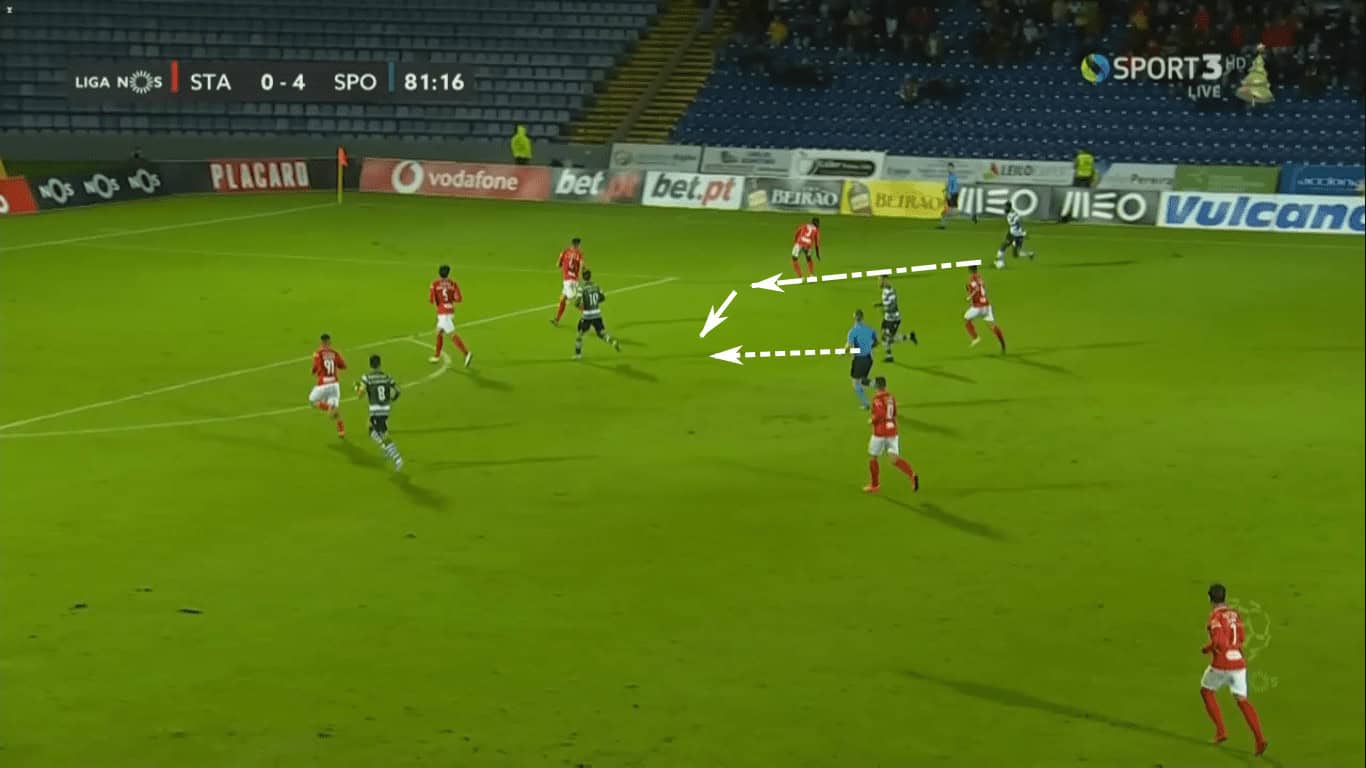
Again against Santa Clara, Bolasie received the ball on the right-wing and dribbled at his defender. That gave his teammates time to attack the box.
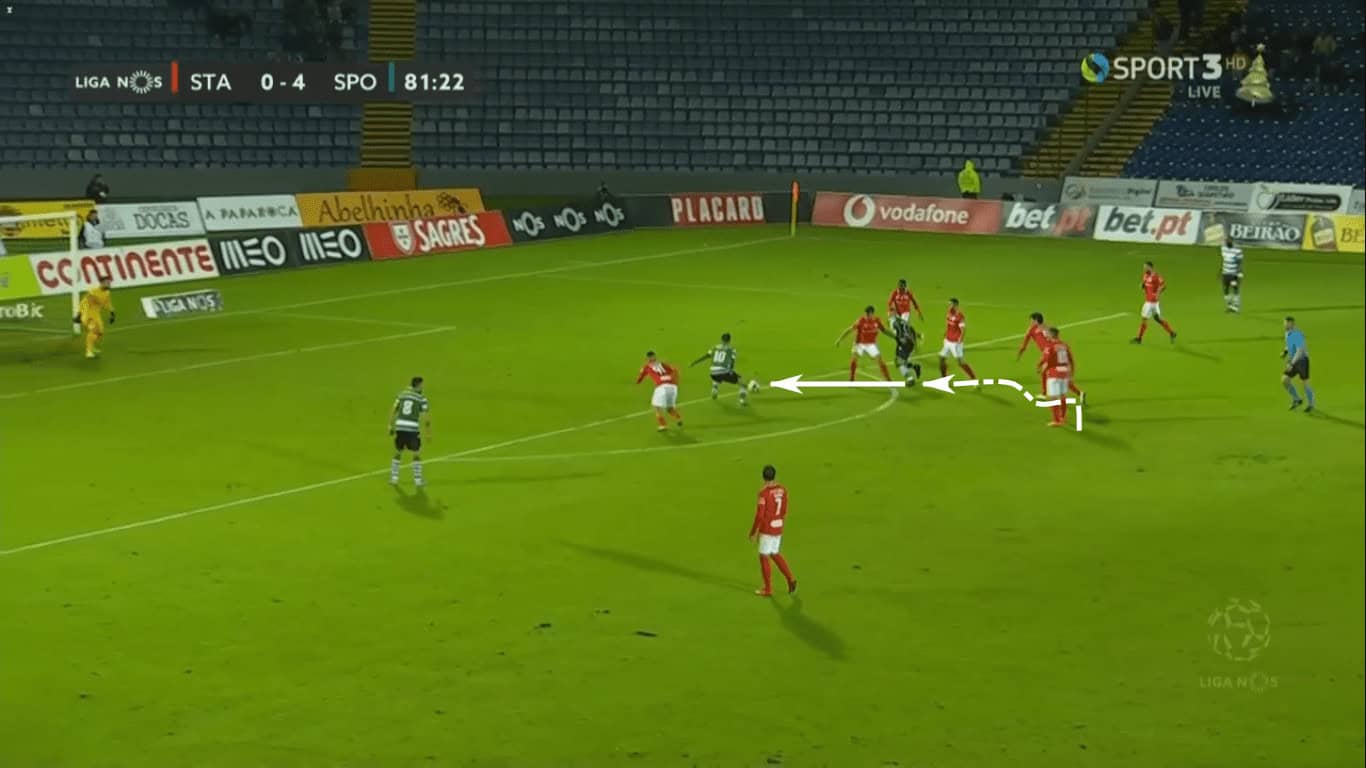
Bolasie laid it off to Jese, who somehow managed to finagle his way past three defenders. He slipped Vietto in, but the forward put his contested effort over the bar.
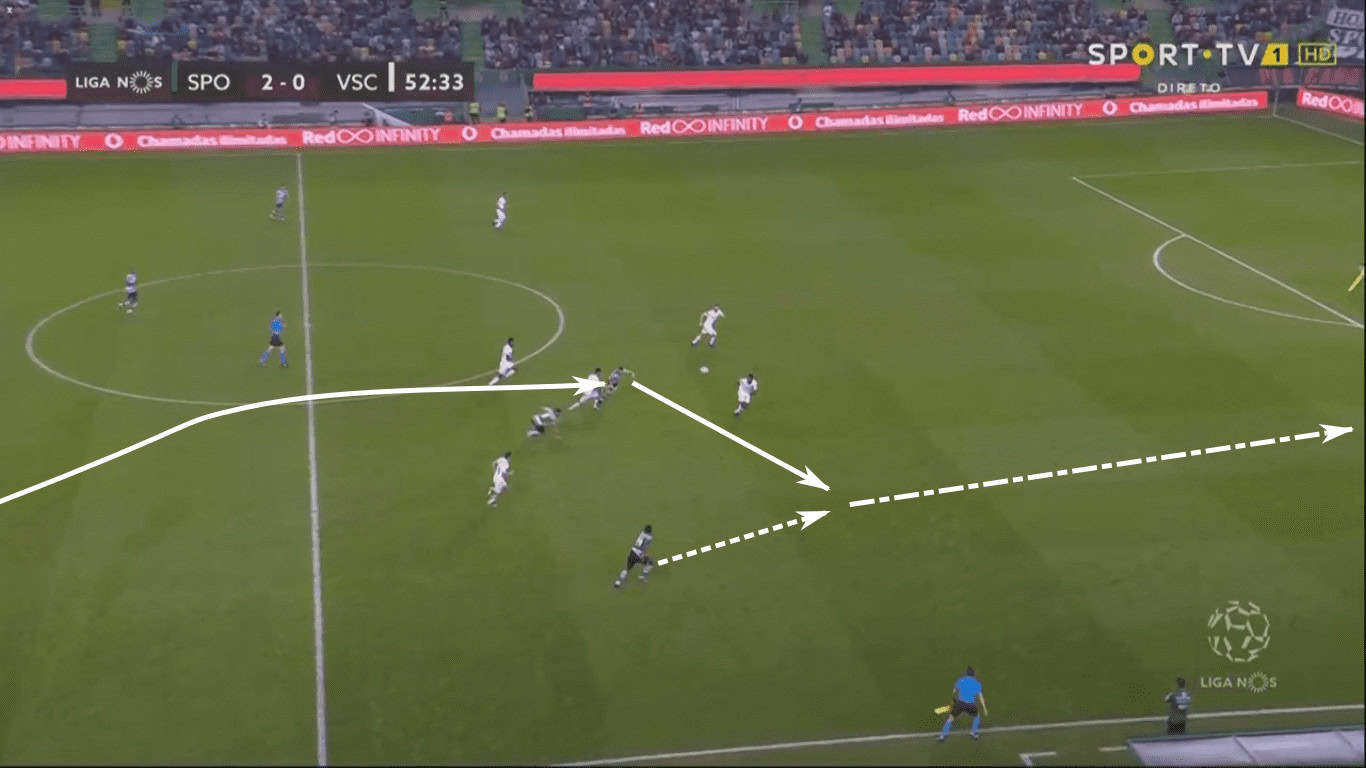
Against Vitória de Guimarães, Coates played long to Vietto and Fernandes. The ball was played onto the run of Bolasie, who progressed into the half space and outmuscled his opponent to the endline.
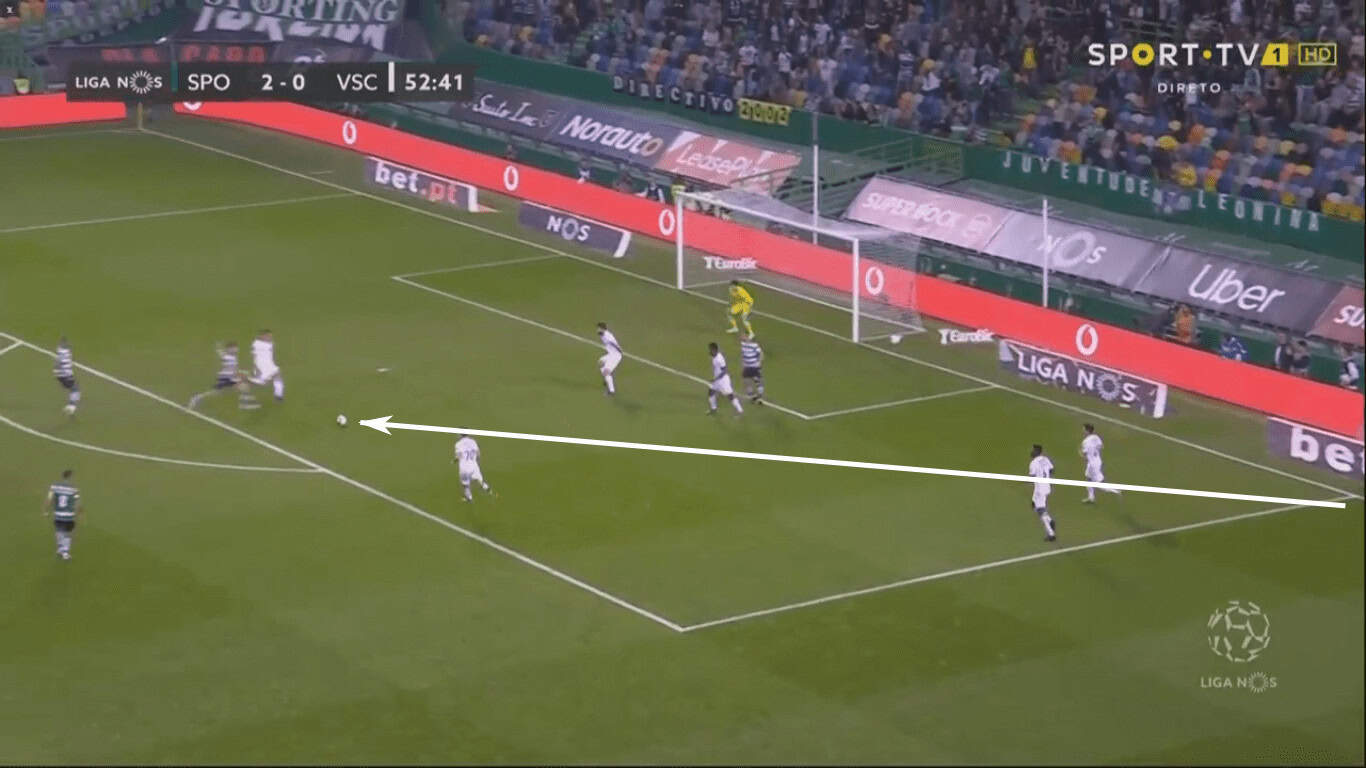
His negative cross found the foot of Vietto, but the shot was blocked. Still, Sporting progressed quickly, attacked the box in numbers and nearly put the shot in the back of the net.
Conclusion
After a traumatic start to the season, Sporting Portugal is headed in the right direction. The product on the field is starting to match Silas’ early promises and the club has laid claim to the third spot in the Primeira Liga. Catching Benfica and Porto this season is highly unlikely, but the framework is there for next season. Silas is working under a one year contract with an option for a second year, so Sporting will surely use the coming months to evaluate the team’s progress under their former academy star.
In fact, these next five weeks will likely hold the greatest sway in Sporting’s decision. Tomorrow evening, Sporting host second-place Porto. Two weeks later, they host Benfica in the Derby de Lisboa, followed by two games against Braga. That’s all before Sporting take on Istanbul Basaksehir in Europa League action. They’ll have to cut back on defensive miscues, primarily poor 1v1 defending in their defensive third. If they can do that and continue their set piece success, Silas could earn his renewal sooner rather than later.
Sporting’s schedule has been kind, saving matchups against the other two members of Os Três Grandes until after the New Year. Silas has an opportunity to show his quality during this crucial stretch. He promised to play attacking football, but he might need a more pragmatic approach to get results out of Porto and Benfica. He might also have to adjust to Fernandes’ departure, as the transfer rumours continue to link him to Tottenham and Manchester United. Whatever the conditions, Silas is showing that he can keep getting the most out of his squad. His side is building momentum and developing a cohesive style of play just in time for the showcase games of the season.

If you love tactical analysis, then you’ll love the digital magazines from totalfootballanalysis.com – a guaranteed 100+ pages of pure tactical analysis covering topics from the Premier League, Serie A, La Liga, Bundesliga and many, many more. Buy your copy of the December issue for just ₤4.99 here
