


In modern football analysis, set-pieces are often framed as marginal gains and supplementary opportunities rather than primary attacking mechanisms.
Espanyol under Manolo González challenge this assumption.
Throughout the 2025/2026 season, corners have emerged not as occasional advantages but as a central component of their attacking identity.
RCD Espanyol de Barcelona focus on creating high-quality scoring opportunities from organised set-plays, such as corners, instead of prioritising ball possession or taking numerous shots during regular gameplay.
The team’s success in this area, especially with centre-back Leandro Cabrera, demonstrates a well-coordinated system that relies on precise timing and space control rather than on chance.
In this RCD Espanyol set-piece analysis, we look at how Espanyol have transformed corner-kicks into a repeatable attacking weapon, focusing on their structural organisation, movement patterns, use of blocking and second phases, and why these mechanisms consistently destabilise defensive structures.
Manipulating Space Before The Delivery
RCD Espanyol’s threat from corners is established well before the kick is even taken.
They set up in the box with a specific formation designed to confuse defenders, disrupt their marking assignments, and make it harder for them to react quickly to the play.
Rather than immediately positioning their main aerial threats on the defensive line, Espanyol frequently place them deeper, closer to the edge of the box or the penalty spot.
This structural choice was clearly evident in Espanyol’s match against Deportivo Alavés, despite the absence of a goal.
 Kike García positions himself closest to the near post, while the other five players start from deeper zones.
Meanwhile, the player stationed behind Cabrera actively engages and nudges the defender inside the six-yard box, creating space for the primary run.
 As the delivery was prepared, defenders were forced to constantly check their shoulders, unsure whether to hold their line or track runners attacking space from behind.
The resulting defensive hesitation fragmented the marking structure, with gaps opening centrally as players reacted at different moments, even though the final action did not result in a goal.
A consistent feature of Espanyol’s structure is the use of a near-post occupant who functions primarily as a decoy.
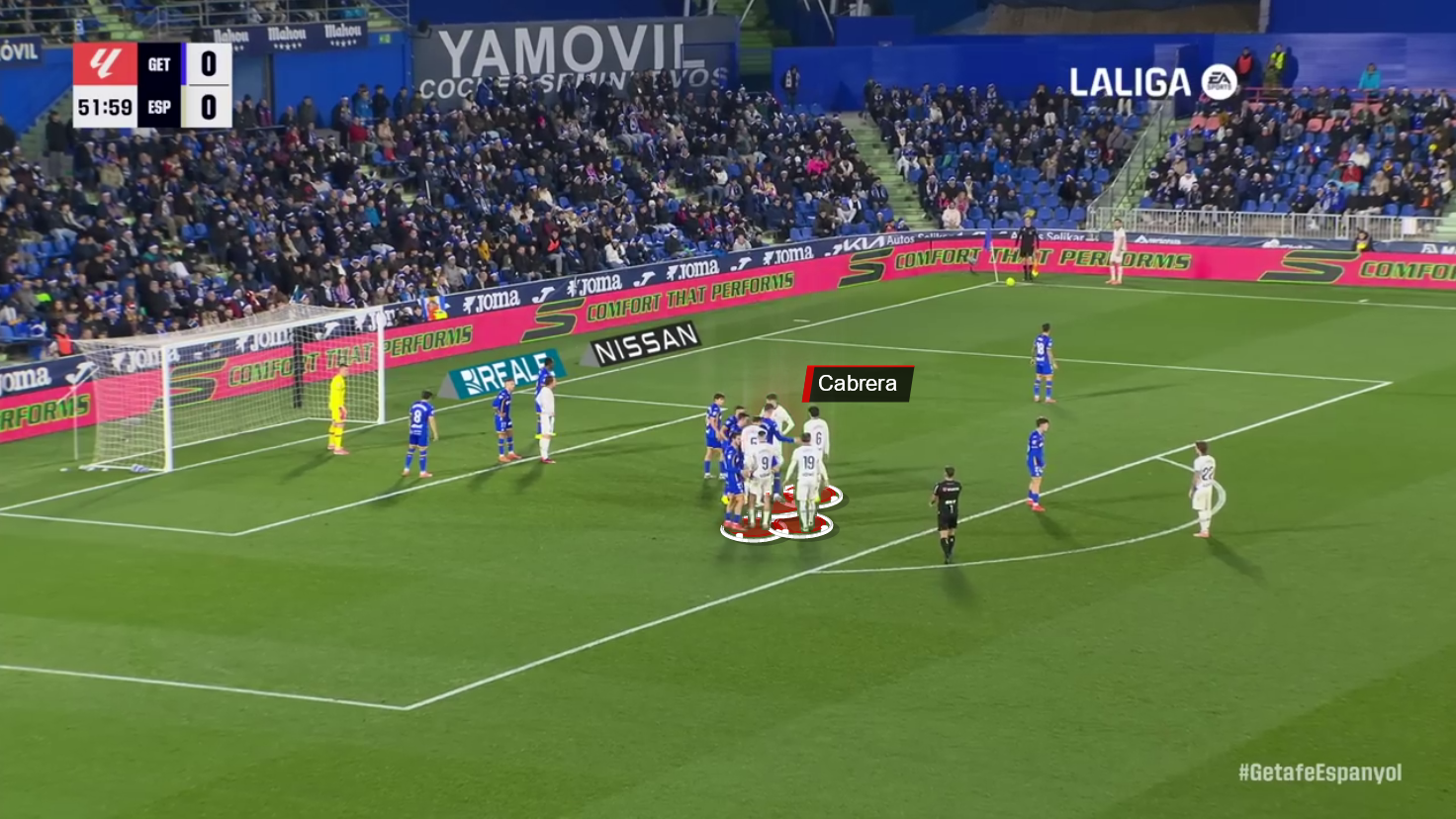
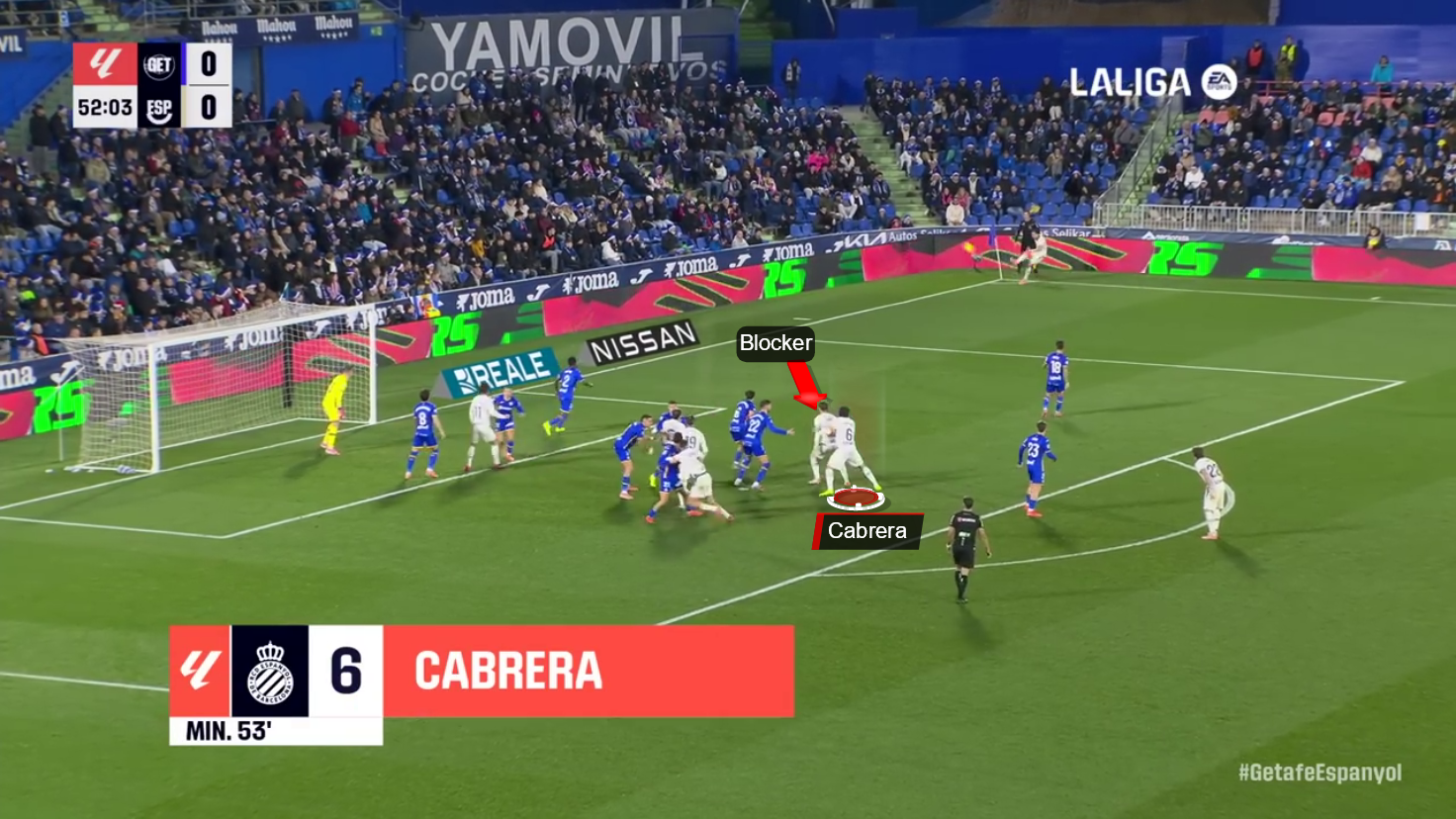
One player is positioned on the edge of the six-yard box, with five others occupying central zones inside the penalty area.
This player pinned the first zonal defender, narrowing the defensive line and preventing lateral adjustment.
This movement did not aim to receive the ball; instead, it compressed the defensive unit and opened a channel between the penalty spot and the six-yard box, the zone Espanyol most frequently targets.
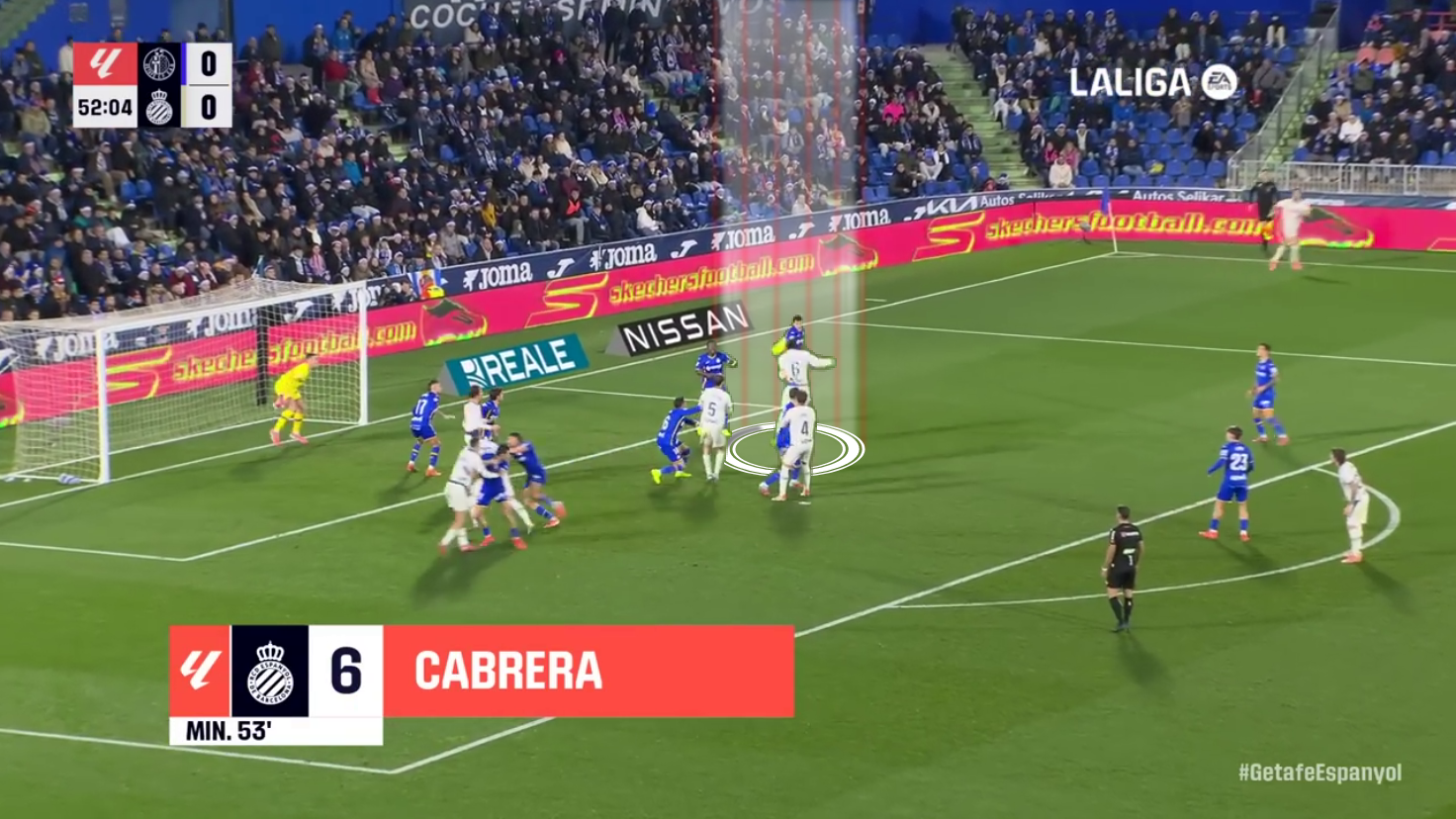
By prioritising space manipulation over immediate ball attack, Espanyol force defenders to defend movement rather than territory, increasing the likelihood of hesitation and miscommunication, which ultimately led to a goal.
Movement Patterns & The Role Of Leandro Cabrera
While Cabrera’s physical profile naturally attracts attention, Espanyol’s use of him from corners highlights the importance of timing over height.
Rather than attacking the first contact aggressively, Cabrera often delays his run, arriving in the central zone just after the initial wave of movement.
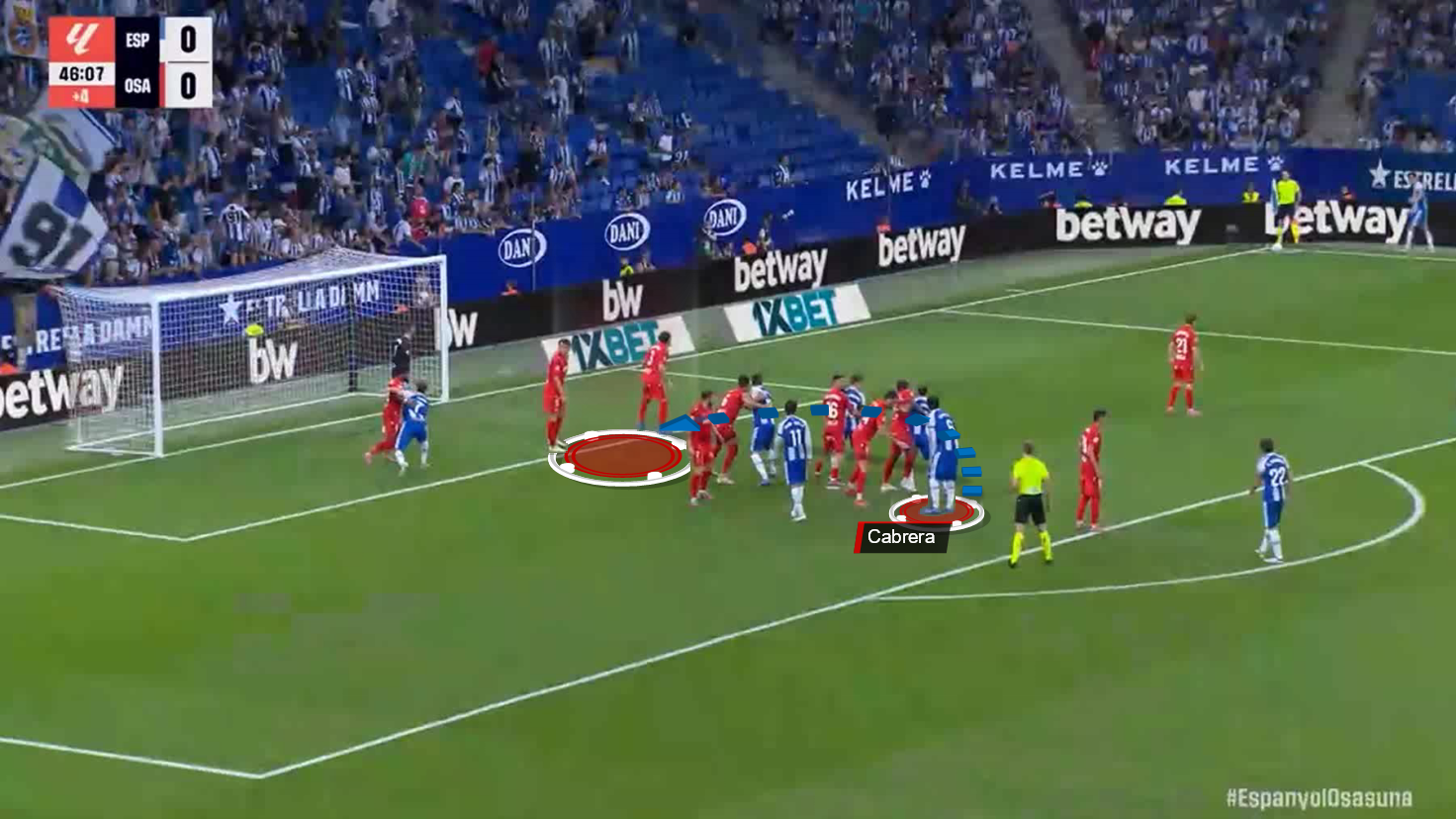
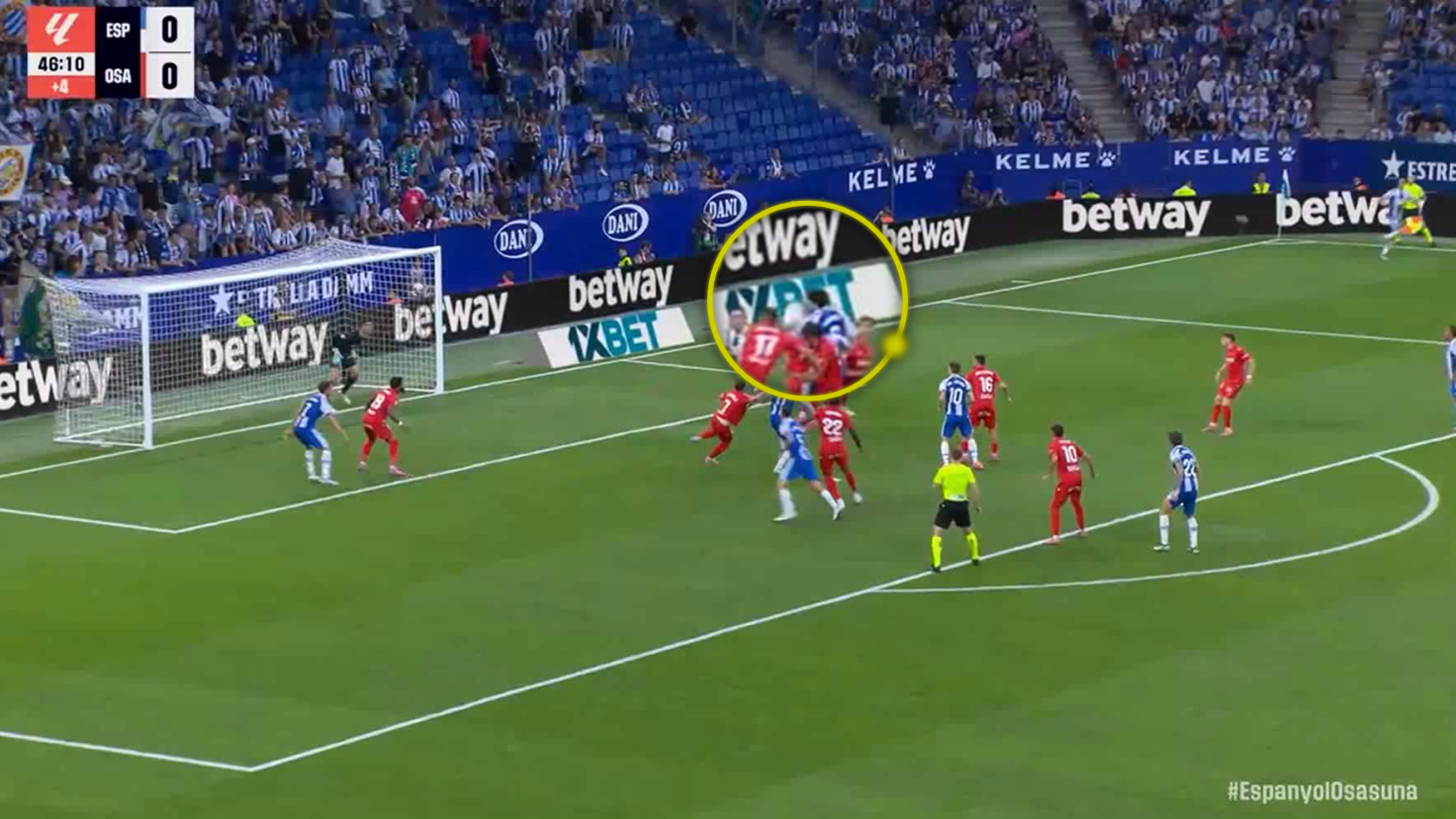 This specific offensive pattern was vividly illustrated in the fixture against Ouasuna.
Cabrera’s goal was a testament to timing and movement, achieved not through an uncontested aerial challenge, but by a calculated, delayed arrival into the six-yard area.
Espanyol’s initial attacking wave focused on the near post, which successfully manipulated the defence into committing early and stepping forward.
Starting from a deeper position, Cabrera exploited the resulting space, generating forward momentum to meet the dropping ball precisely in the central corridor.
The same timing principle translated directly into a goal against Valencia.
In this instance, Cabrera again started from a deeper position, allowing Espanyol’s first wave of runners to engage Valencia’s zonal line.
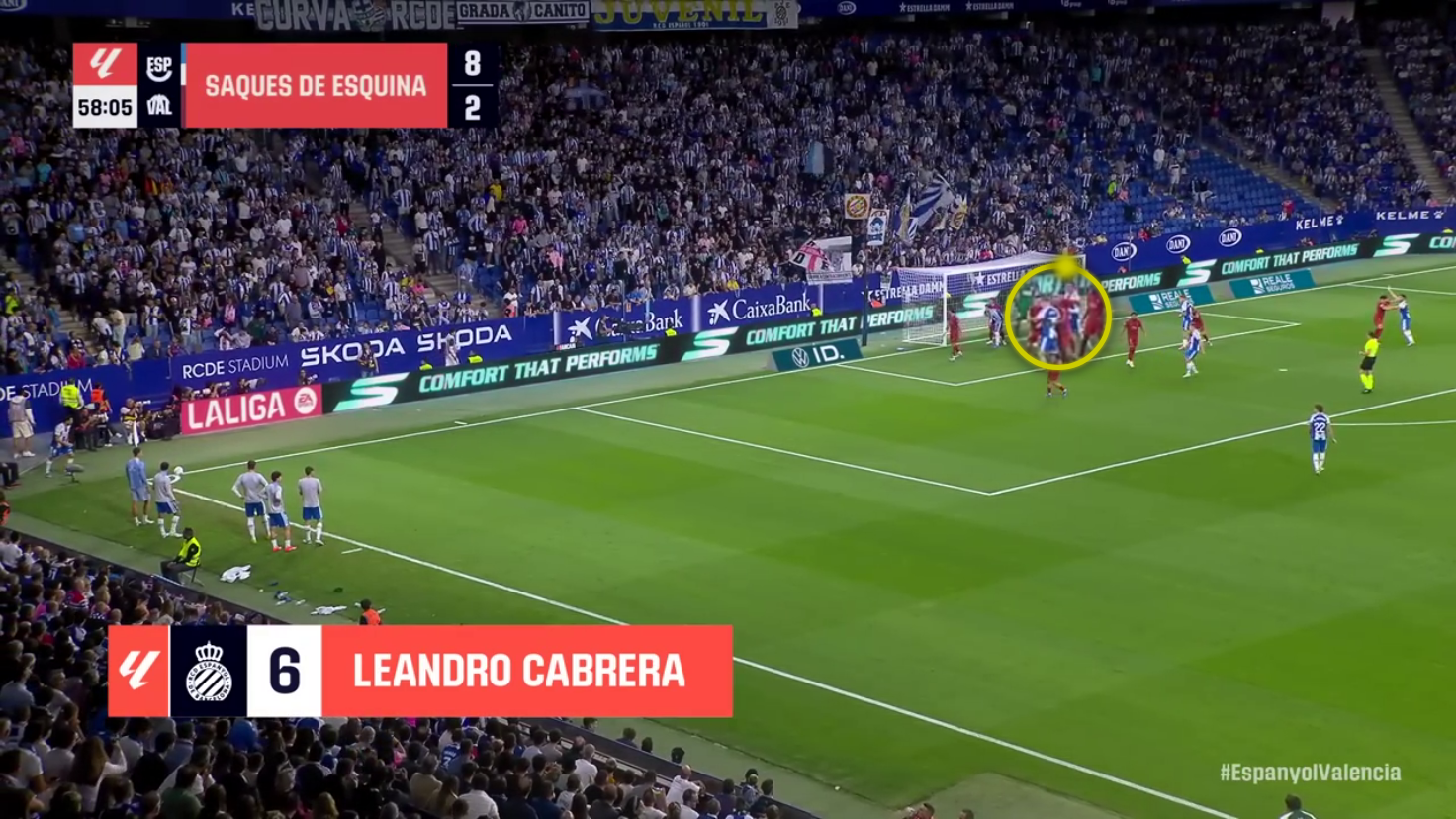
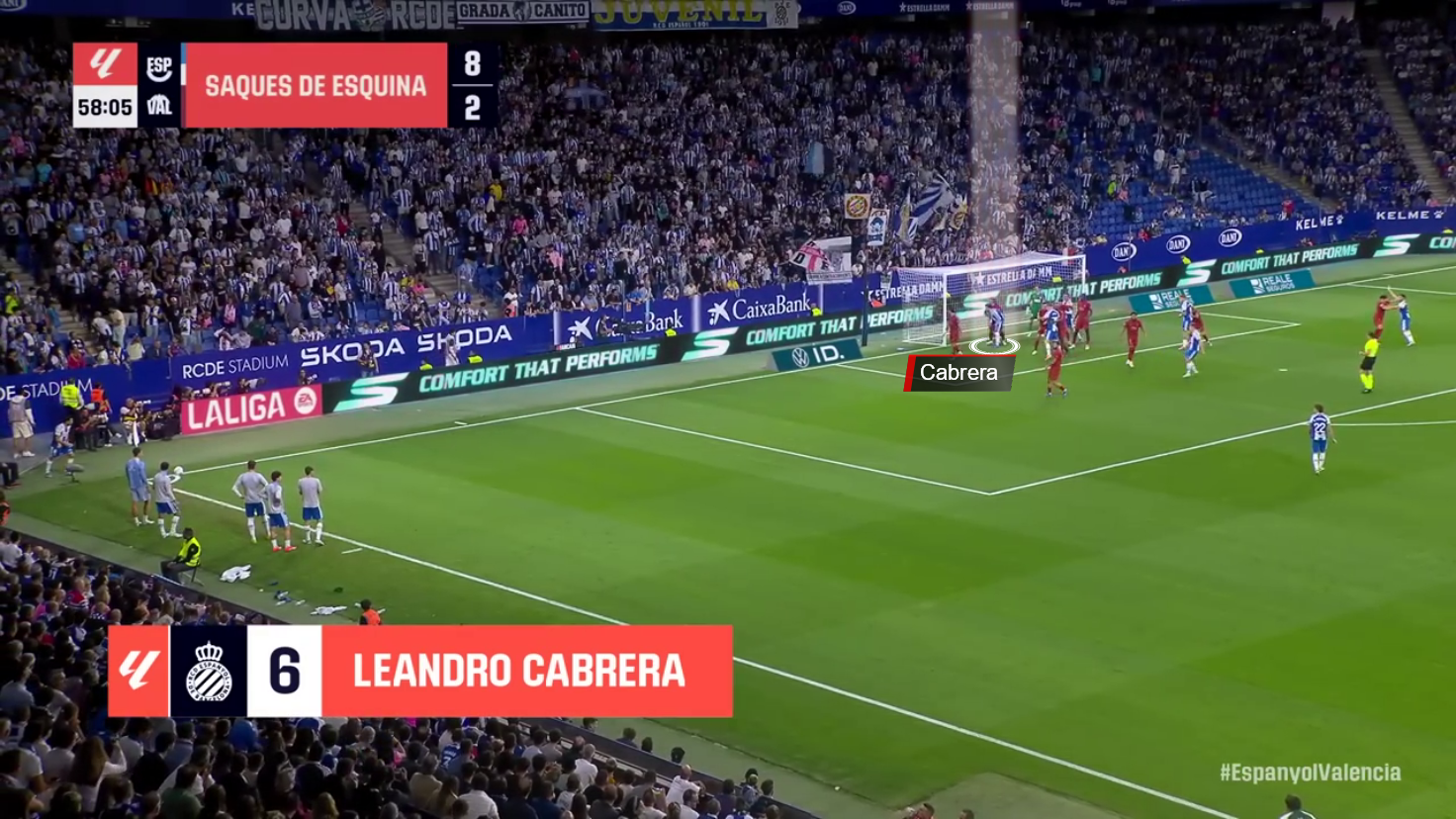 The blockers restrict Valencia’s defenders from reacting, while Cabrera holds his position at the near post, positioned between the goalkeeper and the post.
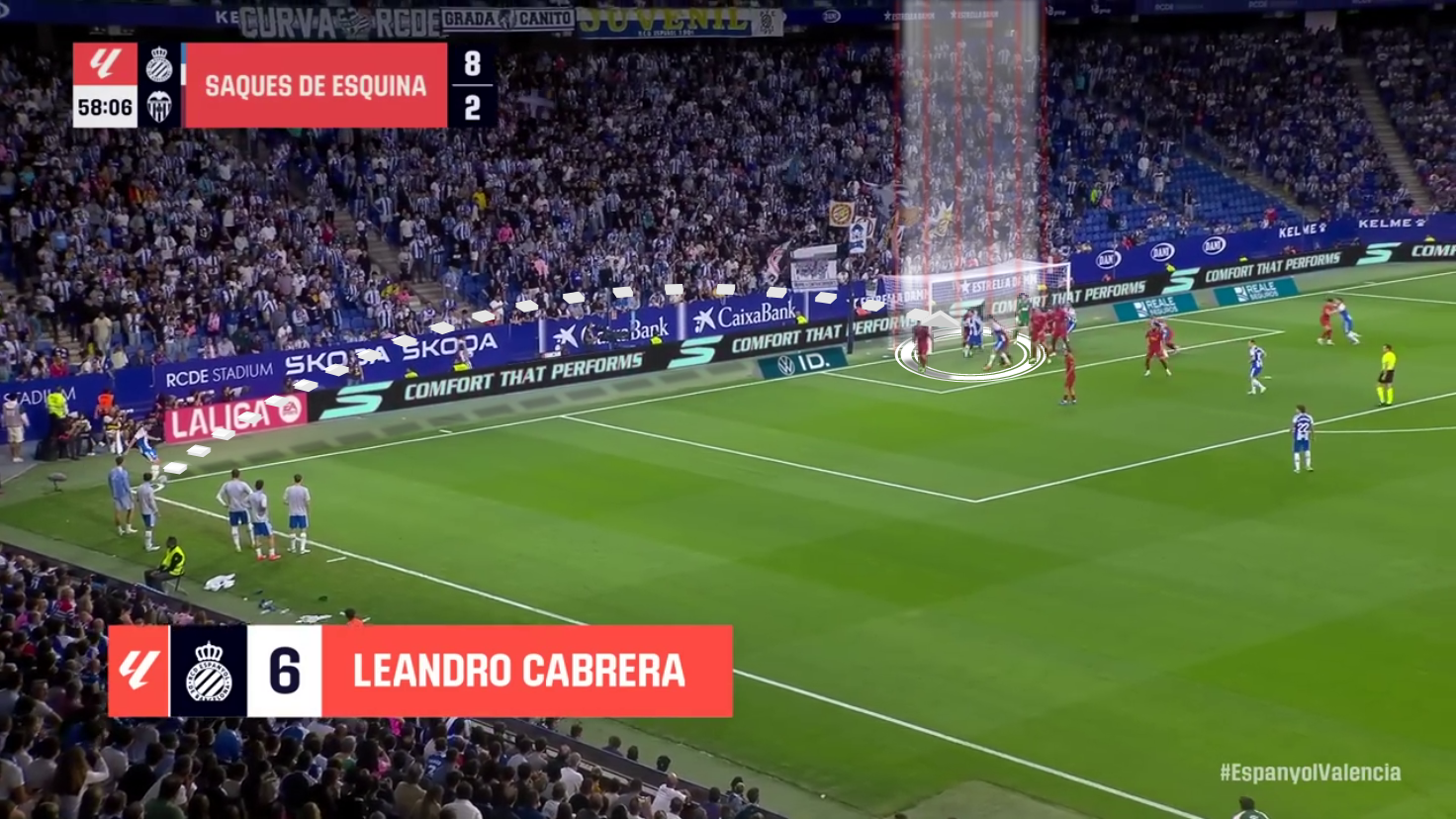 The ball, delivered into the corridor between the goalkeeper and the defensive line, dropped into his path, enabling him to finish from close range.
The goal highlighted how Espanyol’s corner success relies less on uncontested aerial dominance and more on synchronised movement and delayed arrival into high-value zones.
Blocking Actions & Second-Phase Dominance
A key feature of Espanyol’s corner-kick strategy is the sophisticated use of blocking and screening manoeuvres.
These actions are executed with subtlety and within the rules, prioritising positional intelligence over direct physical engagement.
Espanyol’s forwards expertly obstruct defenders’ running paths, effectively delaying their reaction time and preventing them from jumping or advancing to challenge the ball at the critical moment of the cross.
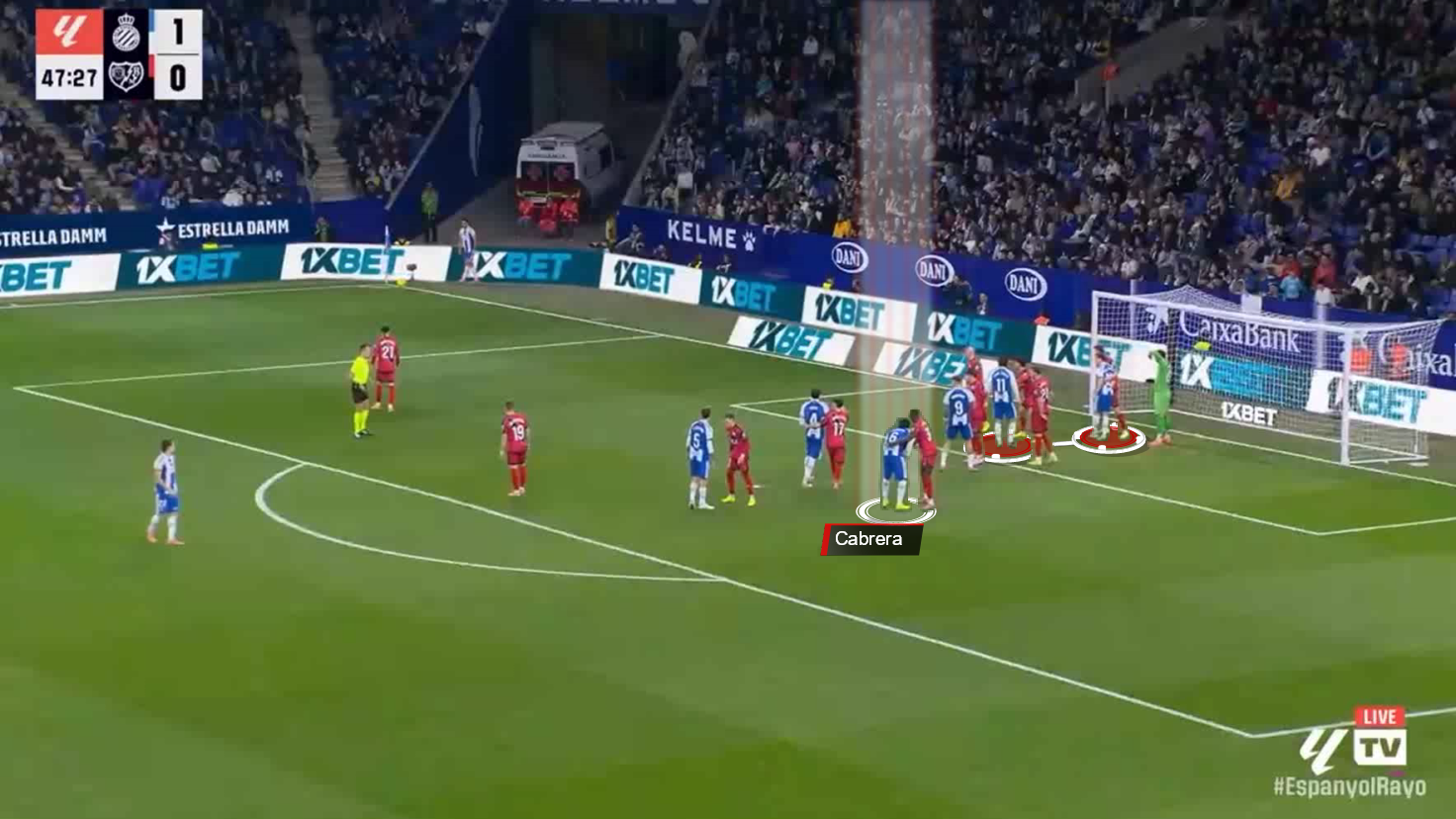
An even clearer illustration came against Rayo Vallecano.
From the corner, Espanyol once again targeted the central corridor, but the decisive detail lay away from the ball.
Two Espanyol attackers occupied Rayo’s zonal markers around the penalty spot, subtly screening their forward movement as the delivery arrived.
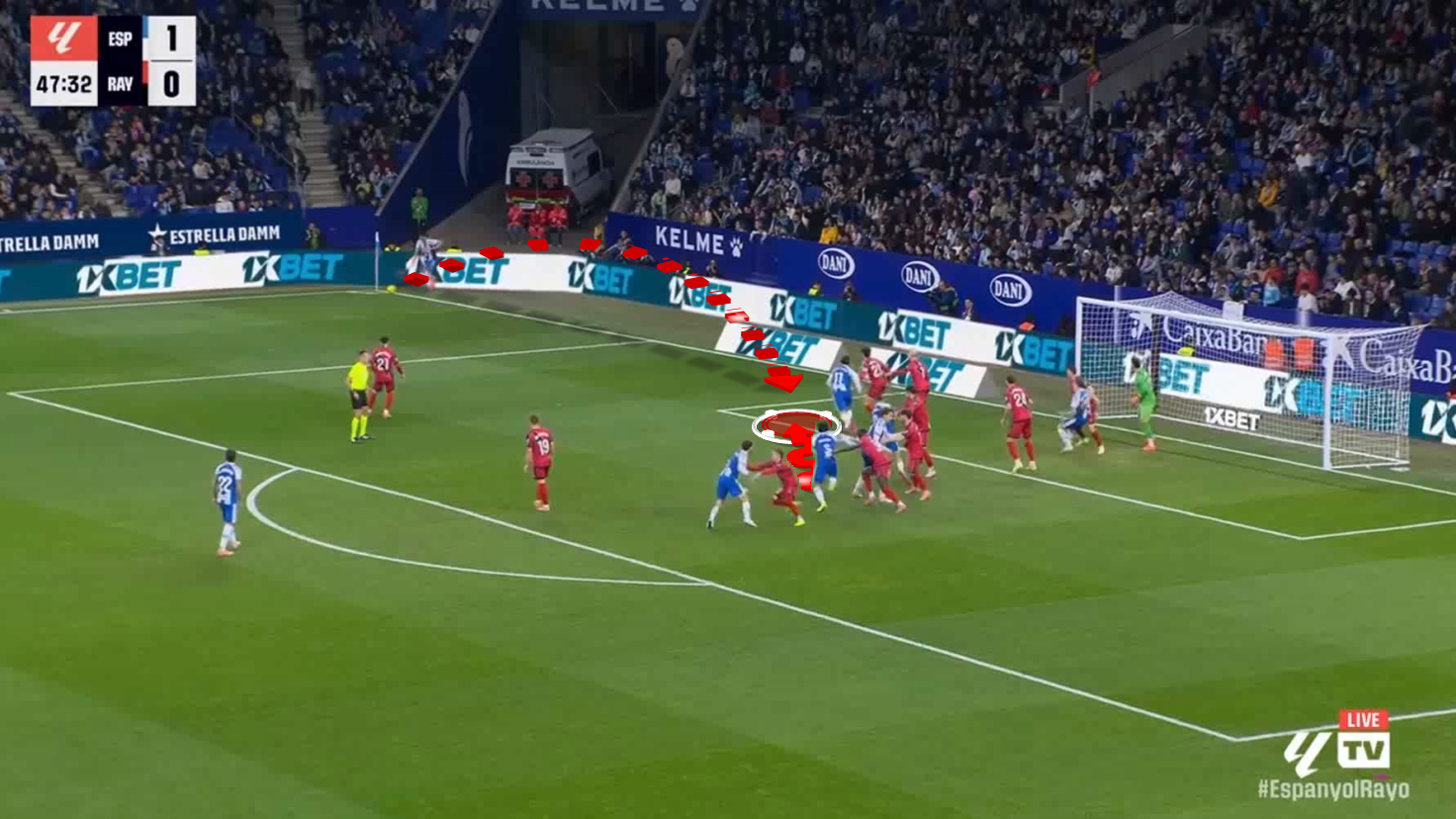 Cabrera, starting from a deeper position, attacked the space created behind the screen, meeting the ball inside the six-yard area.
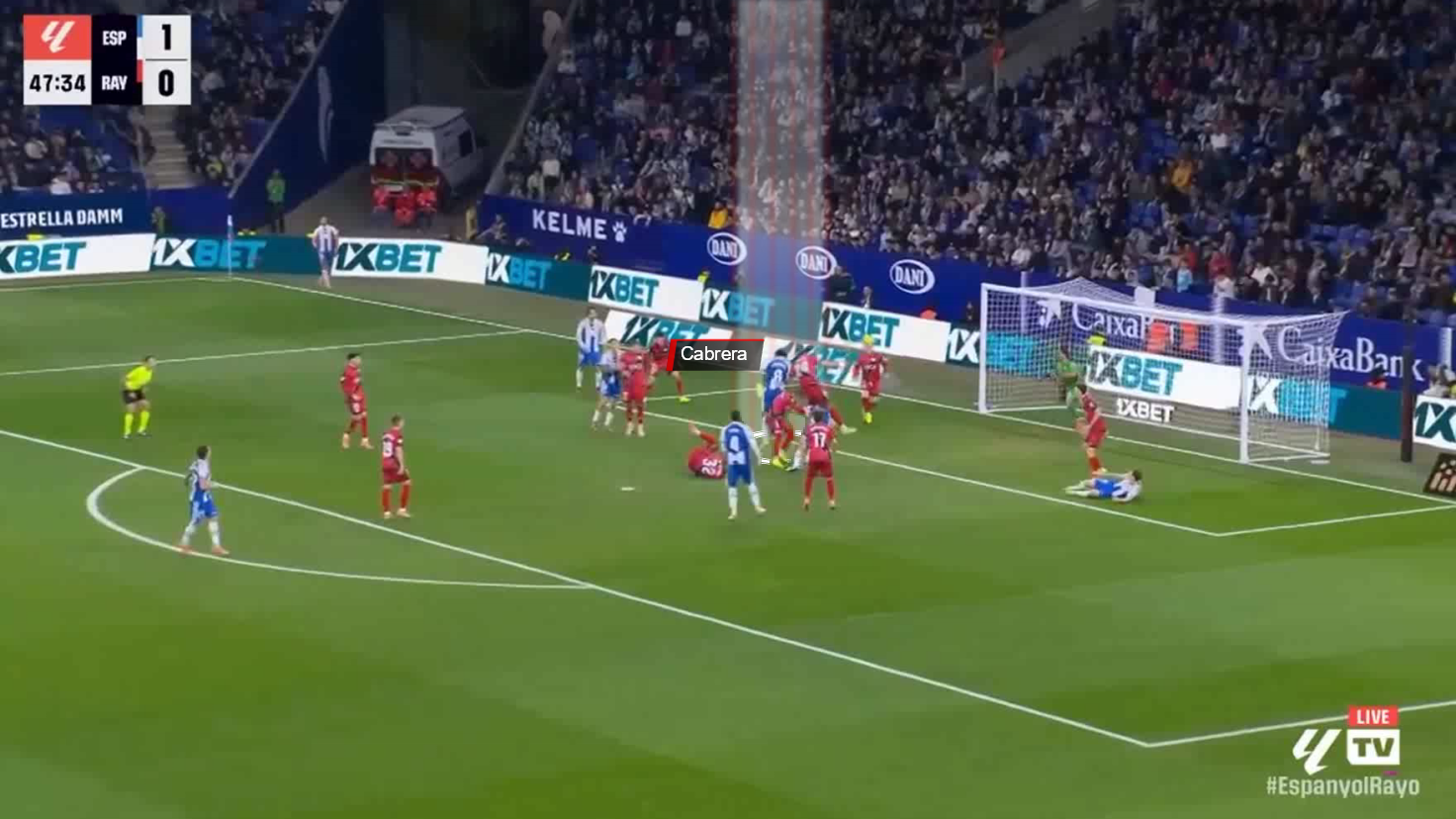 His close-range header did not result in a goal, but the action perfectly encapsulated Espanyol’s blocking logic: delay the defenders, create a free central lane, and allow the main runner to attack the ball with momentum.
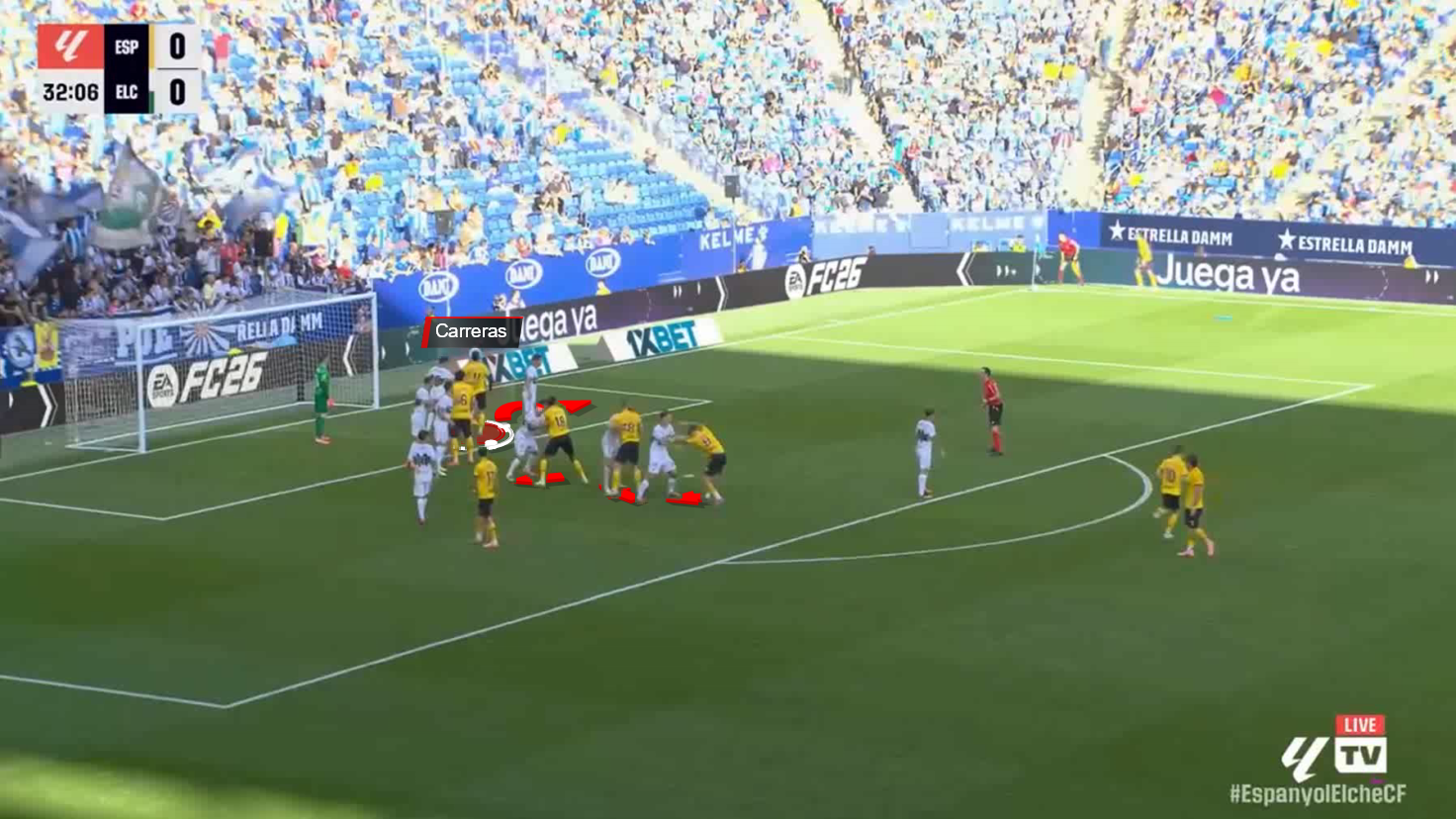 Jofre Carreras moves toward the edge of the six-yard box to attack the near-post delivery.
At the same time, a vertical line of Espanyol players works to delay and disrupt Elche’s defensive movements.
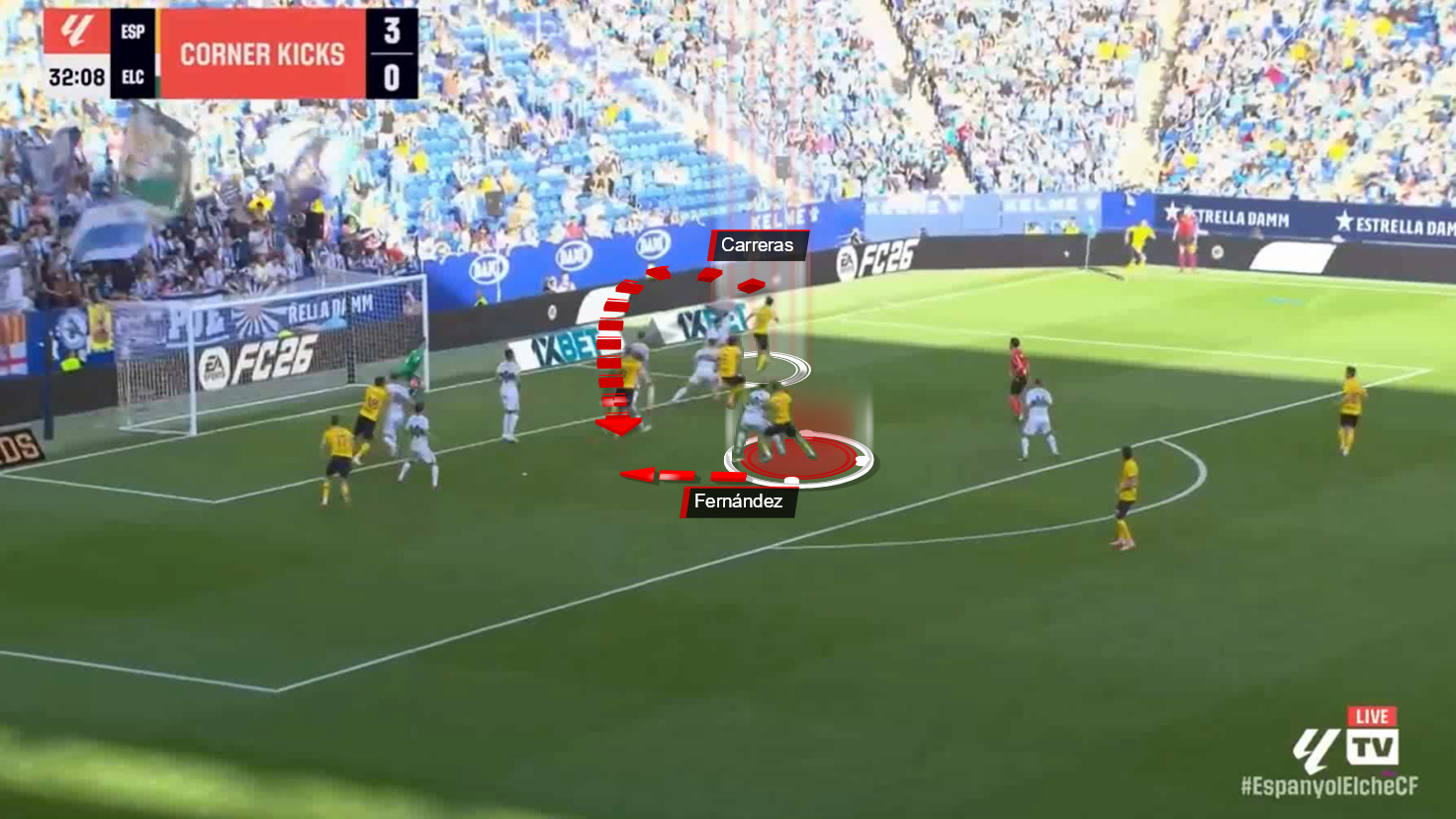 Carreras makes contact with the ball to redirect it into the gap created by Espanyol’s horizontal movements.
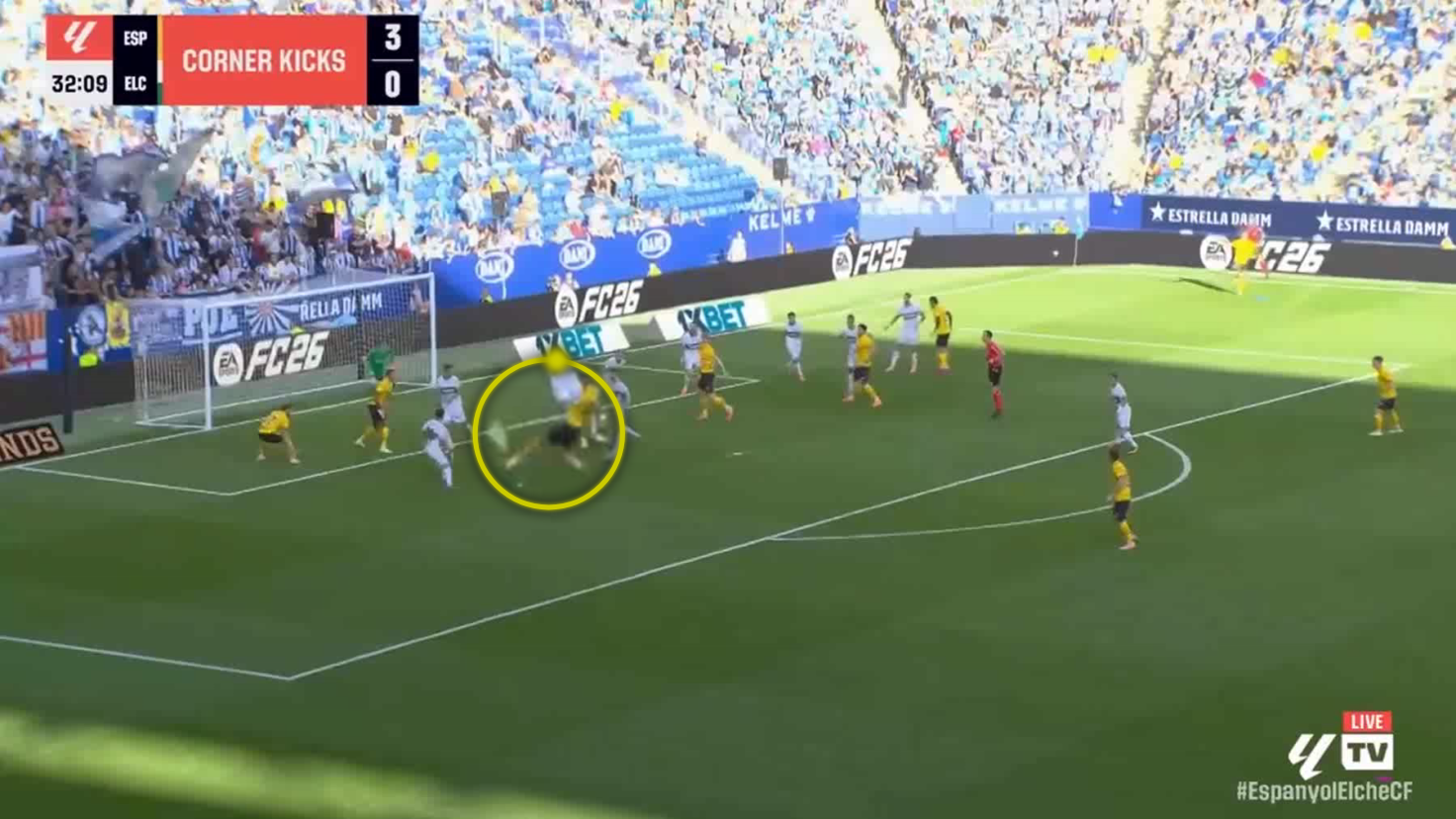 Roberto Fernández breaks free from his marker and attempts a shot under pressure; although the ball didn’t come perfectly, the tactical intention was evident.
This approach transforms corners from single actions into extended attacking sequences.
Even when the first contact is successfully defended, Espanyol maintain territorial and positional superiority, increasing the cumulative threat posed by each set-piece.
RCD Espanyol Indirect Free-Kicks
Espanyol’s indirect free-kicks mirror their corner philosophy.
Rather than immediate shots, these situations are used to recreate corner-like scenarios, with delayed deliveries and clustered runs.
Players positioned on the edge of the box are not passive observers.
They are actively tasked with attacking clearances, ensuring Espanyol maintain territorial pressure even if the first ball is defended.
Espanyol’s indirect free-kicks are designed to create space away from the ball rather than force immediate central contact.
This was clearly illustrated by the goal Rubio scored against Atlético Madrid.
From a wide indirect free-kick, the delivery was directed toward the far-post zone rather than the initial cluster of runners.
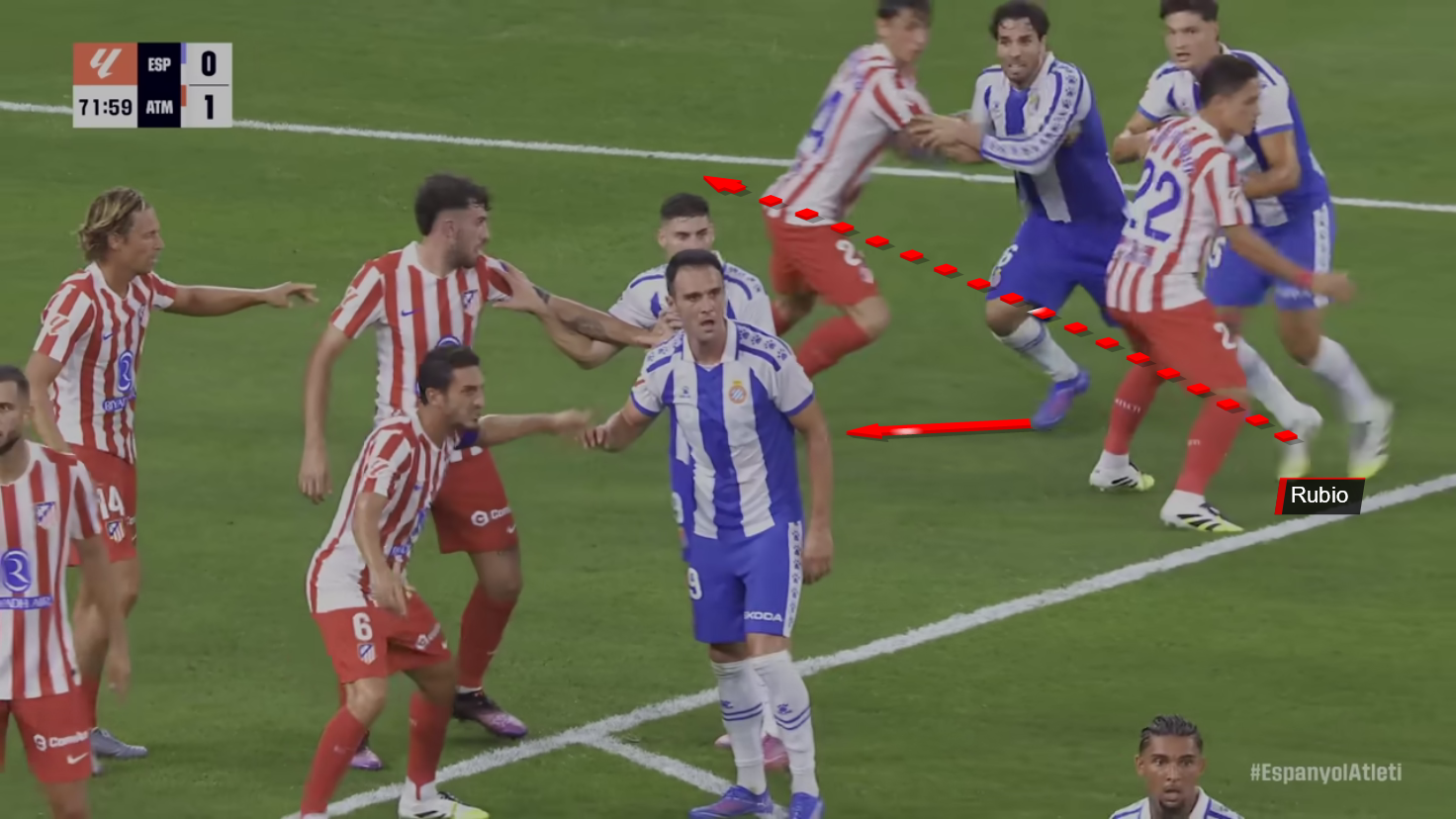
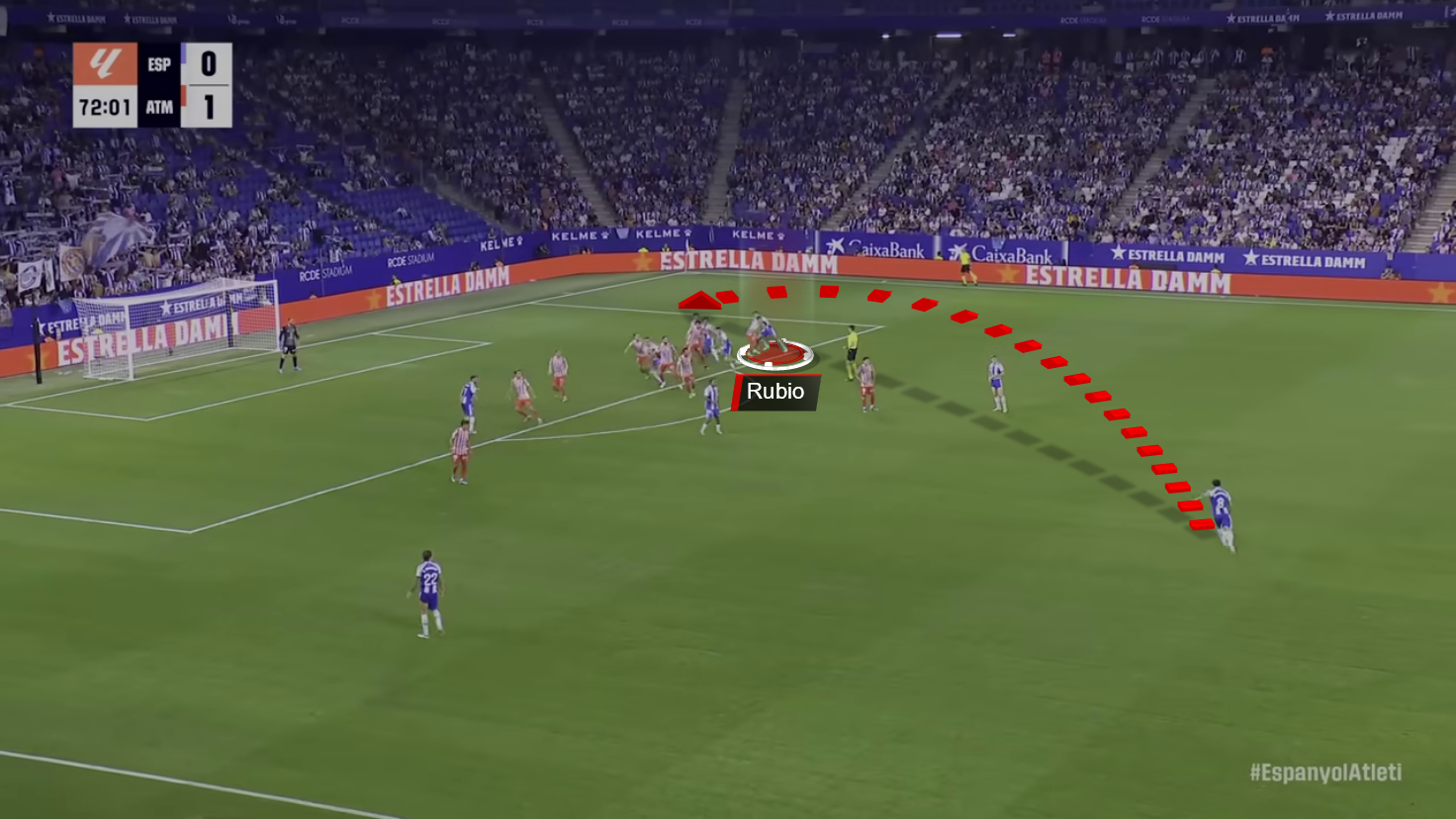 While the ball travelled, Cabrera made a decisive movement across Atlético’s defensive line, physically engaging his marker and subtly pushing him away from the far-post space.
This action disrupted Atlético’s zonal structure, creating a free channel behind the defensive line.
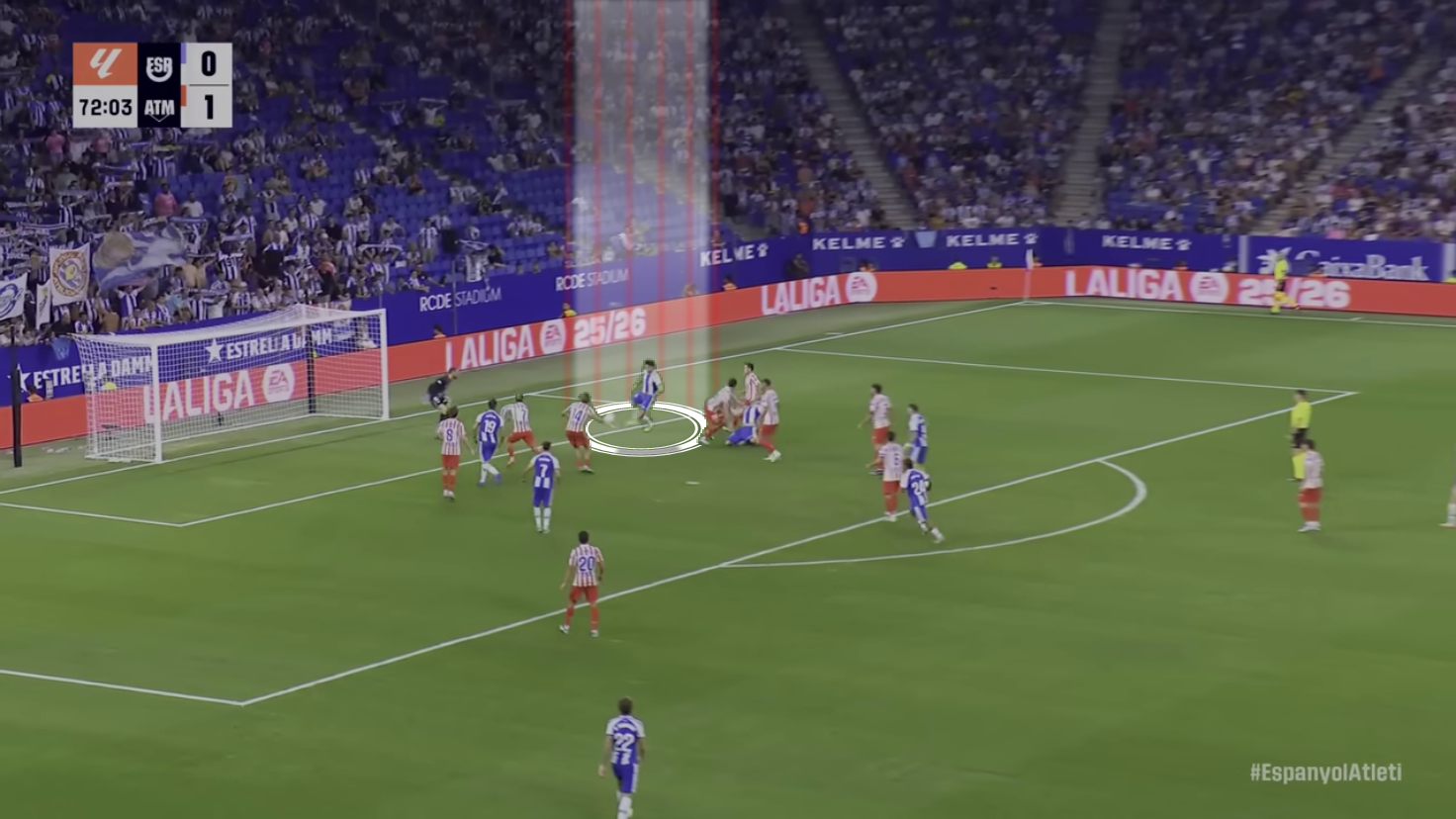 As a result, Rubio was able to arrive unmarked at the far post and finish from close range.
The sequence highlighted how Espanyol use indirect free-kicks to manipulate defensive spacing, with Cabrera’s off-ball action playing a key role in creating scoring opportunities for others.
Conclusion
Espanyol’s success from corner-kicks under Manolo González is the product of deliberate tactical design rather than coincidence.
Through structured starting positions, staggered movement patterns, subtle blocking actions, and aggressive second-phase positioning, corners have become one of the most reliable attacking mechanisms in their game model.
In a tactical landscape increasingly dominated by open-play automatisms, Espanyol provide a compelling reminder that set pieces remain a decisive phase of the game when treated with clarity and intent.
Under González, corners are not moments of chance, but moments of structure.
They have become a defining feature of Espanyol’s attacking identity.

