


While most of the attention in the Bundesliga fell onto “Der Klassiker“ between FC Bayern and Borussia Dortmund this Saturday, a couple of exciting other games were taking place earlier.
One of those games happened in Heidenheim, where the home team 1. FC Heidenheim faced off against Werder Bremen in the Voith Arena.
The season for Heidenheim started rather badly, with only three points out of the first six games, and the club found itself in last place in the Bundesliga coming into the matchday.
On the other hand, Werder Bremen also had a poor start to the season, but after winning against FC St. Pauli before the international break, Werder managed to climb up to seventh place in the table.
For Heidenheim, this game could decide the way their season unfolds from now on.
The team was in desperate need of a spark to ignite their season, and Frank Schmidt’s men looked like the worst Bundesliga side out there, with only one rather lucky win against FC Augsburg.
On the other hand, Horst Steffen and his team were searching for consistency in the young season.
Due to unfortunate circumstances, including a late transfer window and numerous injuries to their defenders, the team’s form fluctuated throughout the first couple of games, and now it needs to settle into the season.
In the end, the 2-2 draw on Saturday did not significantly help either team, but the managers will have very different takeaways from the game.
In this tactical analysis and match report, we will examine how the game unfolded, what ideas Schmidt and Steffen brought into the game, and which team can be happier about their performance in the end.
FC Heidenheim Vs Werder Bremen Lineups & Formations
The home team made a significant change in their formation.
Instead of the 5-2-3 formation Frank Schmidt used to start the season, the longest-tenured manager in professional football decided to return to the 4-4-2 formation that had helped them get promoted to the Bundesliga a couple of years earlier.
In goal, Diant Ramaj got the start, with skipper Patrick Mainka and Tim Siersleben playing as the two centre-halves.
Omar Traoré started as the right-back, with Jonas Föhrenbach playing as the left-back on the other side.
In midfield, Niklas Dorsch and Jan Schöppner formed the double-pivot for Heidenheim, with Adrian Beck and Arijon Ibrahimovic playing on the wings.
Budu Zivzivadze and Mikkel Kaufmann played up front for Schmid, rounding out their new formation.
The formation remained the same for Horst Steffen, but he made some personnel changes.
Mio Backhaus came back into the starting lineup as the goalkeeper, replacing Arsenal loanee Karl Hein.
The back four consisted of captain Marco Friedl, who moved from the centre to the left side, Karim Coulibaly, Amos Pieper, and Yukinara Sugawara on the right side.
Jens Stage and Cameron Puertas played as a double pivot, with Patrice Covic playing as the attacking midfielder. Samuel Mbangula, on the left, and Marco Grüll, on the right, flanked them.
In attack, Romano Schmid started out as a false nine, playing as the lone striker in a 4-2-3-1 formation.
FC Heidenheim Man Orientation
We discussed formations in the last paragraph, but honestly, with Heidenheim, they really don’t matter all that much.
Frank Schmidt’s team is probably the team that cares the least about formations overall in the Bundesliga over the last couple of years, especially against the ball.
In the first half of the game, Heidenheim completely dominated Werder and should have gone up by multiple goals, but failed to capitalize on their opportunities and were stopped by a great performance from Backhaus in goal.
 Upon examining how they did it, it was actually rather simple.
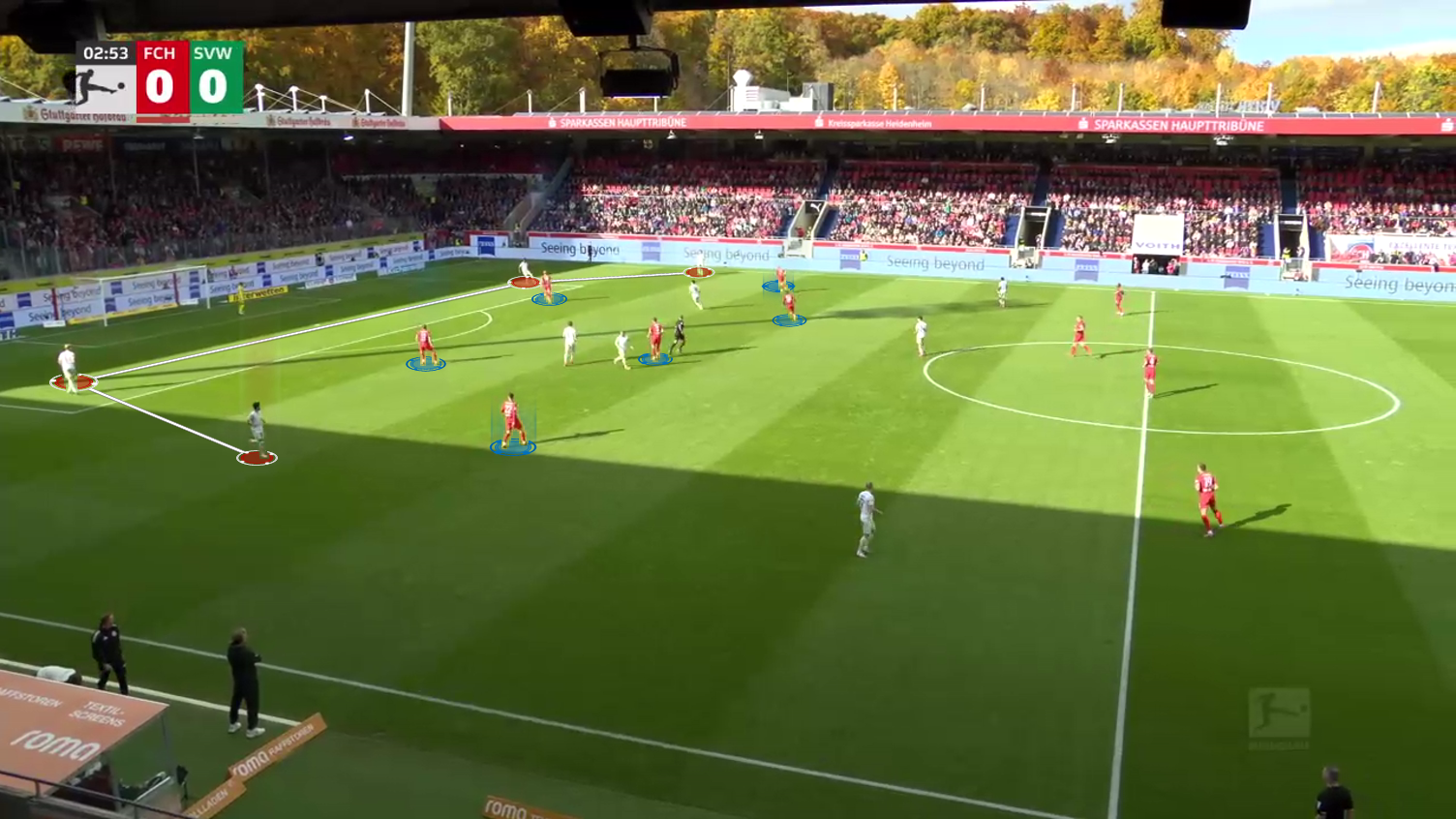
Since Steffen took over, Werder have always tried to play out from the back, so Schmidt knew that they had to press high up the field; their first line of press needed to be right at the edge of the box.
Werder always build out of a 4-2-3-1 structure in the first line.
The full-backs stay relatively close to the centre-backs and are expected to receive the ball, then play it diagonally into midfield, where a narrow double-pivot tries to use shadow movements to create passing lanes.
Often, Werder let their near-sided midfielder make a vertical run to drag away one defender and then switch play through the far-sided midfielder.
Heidenheim knew that and actively tried to prevent the most prevalent pattern of play for their opponent.
They did not care at all about structure against the ball; they simply played man-to-man all over the pitch.
The midfielders stepped up really high to cover the double pivot, and Dorsch especially often moved in front of the two central midfielders to prevent the diagonal pass to the far-sided half-space.
Another huge problem for Werder was how they triggered their play; they often were too impatient and started to build up without every player in their position, causing a lot of chaos in their positional play.
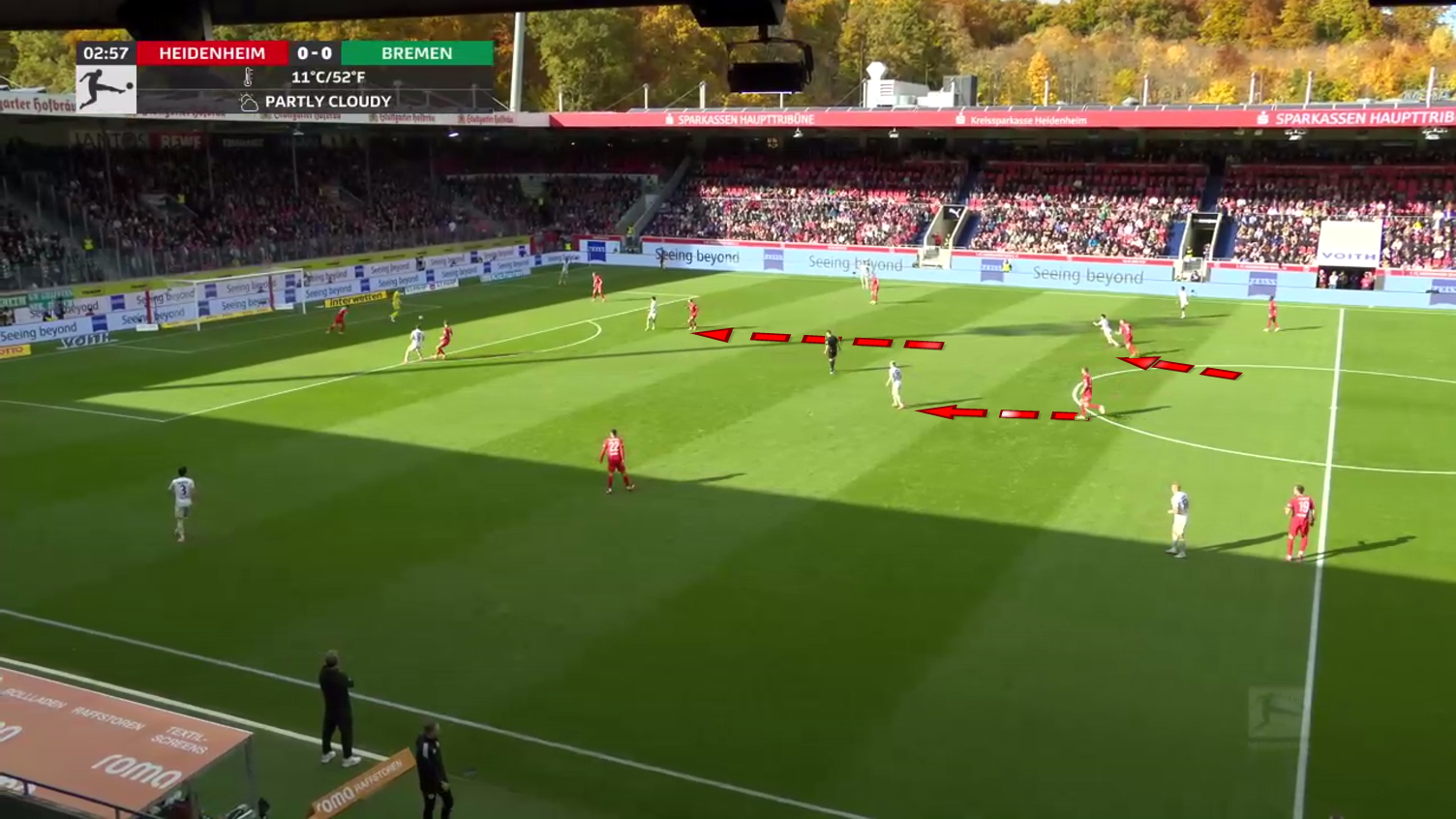
Steffen had the idea to use Heidenheim’s man marking against them, playing with Schmid as a false nine and dropping out of the attacking line often.
This caused a relatively simple reaction; the defenders simply stepped up with him, with no regard for their position.
The centre-backs pressed high into the midfield, and the midfielders pressed at Werder’s box.
Heidenheim had no clear formation anymore, but coverage all over the field.
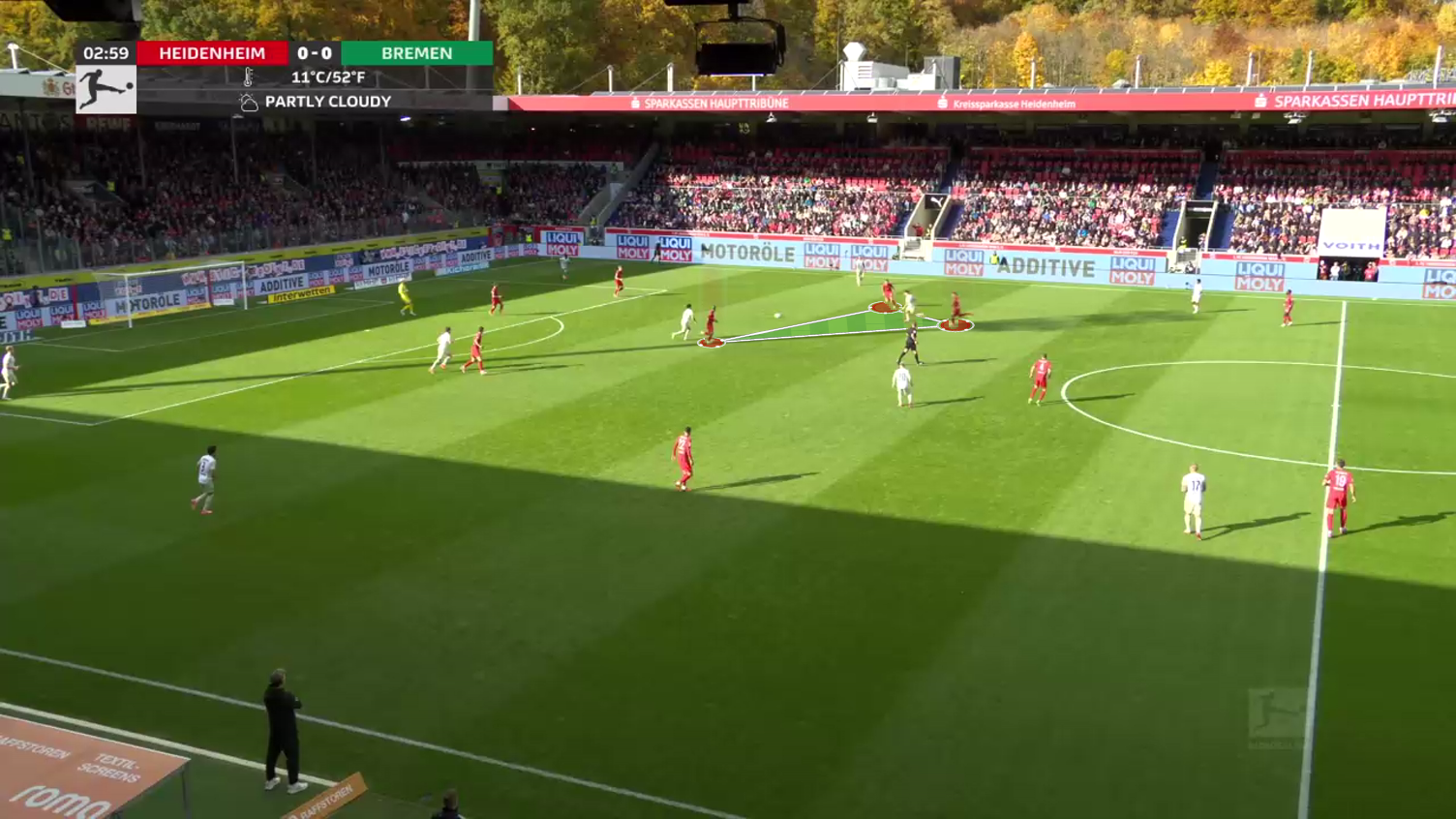
Werder really struggled with that and were unable to find many solutions in their backline.
Schmidt’s way of taking away diagonal passes by using the shadow of Dorsch and Schöppner really caused a lot of trouble for Werder’s defenders.
They now had two options left: vertical passes in the channel and long balls.
For the vertical passes in the channel, they are easy to defend forward.
Because the defenders pushed up the field so aggressively, Werder’s attackers always had to hold up play against a physical defence, causing them to lose control of the ball often.
The long balls were simply inefficient because Steffen played without a real striker.
Schmid is only 1.68m in height; he stood no chance in the aerial duels against the tall centre-backs of Heidenheim.
For those reasons, Werder were not able to establish any form of controlled possession in the game and spiralled into chaos during the first half.
Werder Bremen Defensive Struggles
In the end, Heidenheim had 31 shots and 3 expected goals, which is much more than in any other game they have had so far this season.
Ultimately, they didn’t even do anything special; Werder just really struggled with defending once again.
Steffen currently manages the second-to-worst defence in the Bundesliga after seven games, with 16 goals conceded in those games, and even having the worst defence, looking at expected goals allowed per game.
Werder made it hard for themselves with their problems keeping possession.
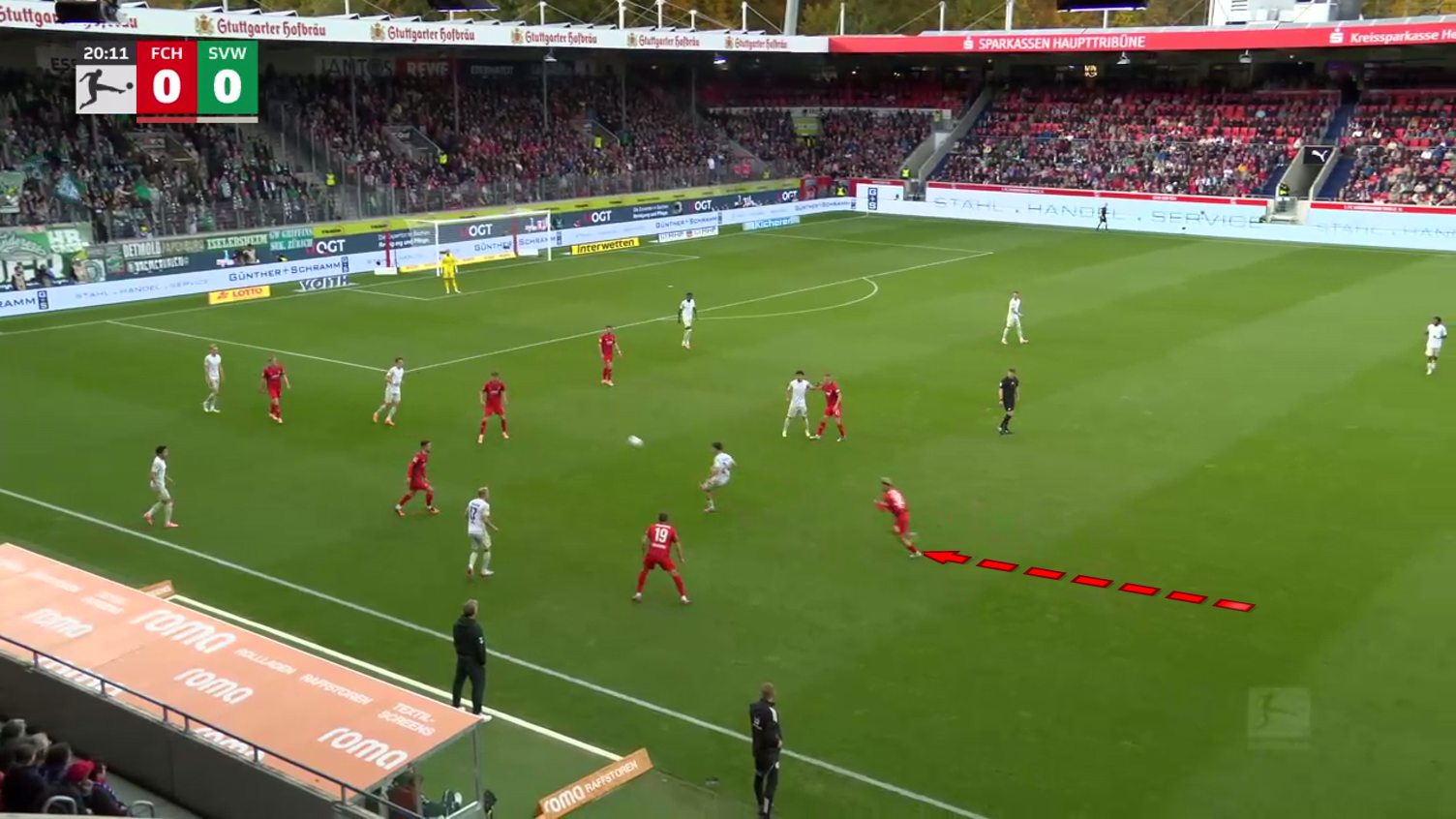
Here we can see a throw-in, where Werder tries to play forward, but once again, Dorsch runs forward to press Covic before he is even able to control the ball.
The young midfielder now plays a horrible lay-off back to Sugawara, who is under immediate pressure and has to play a long ball forward.
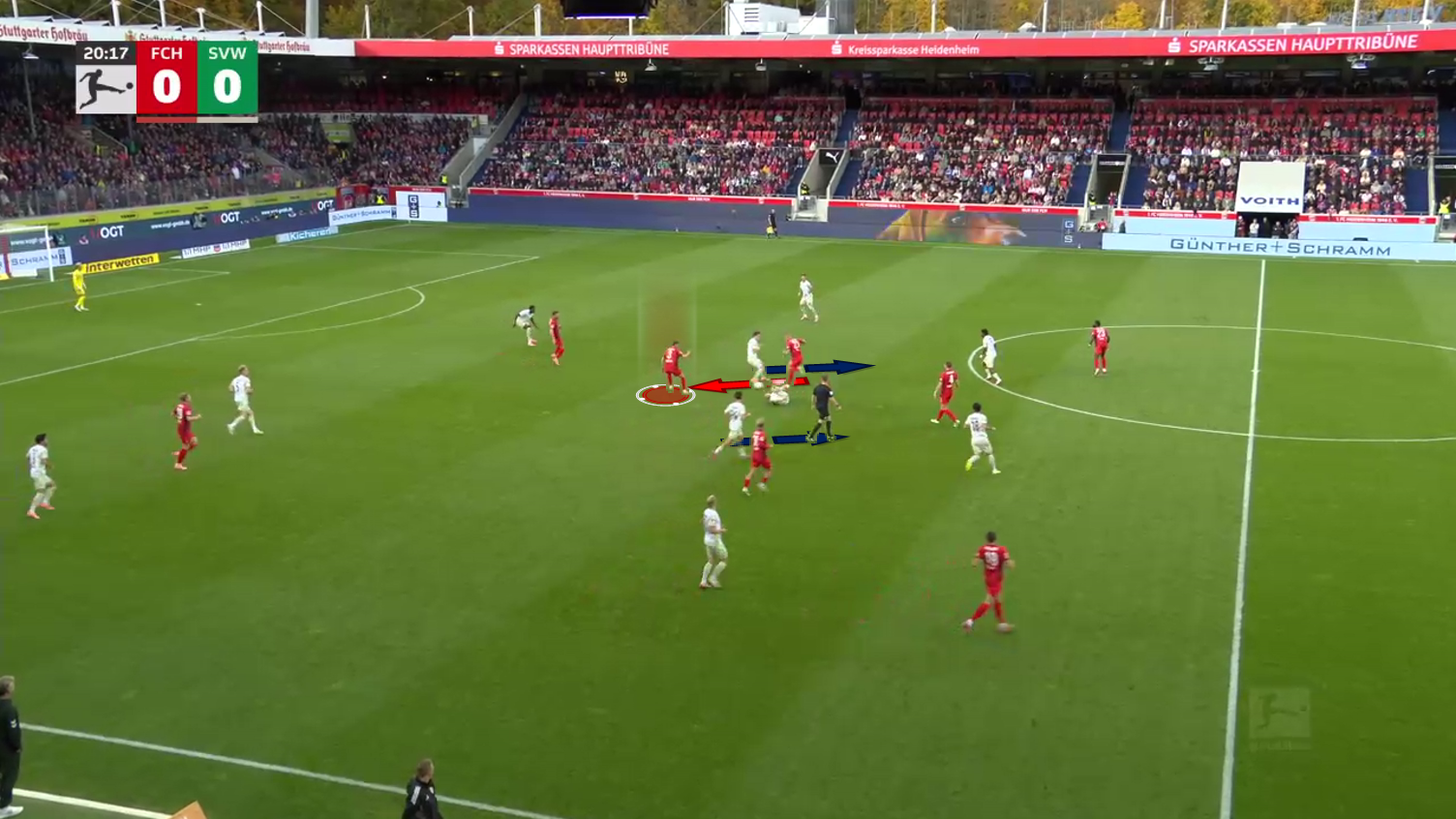
As established in the last paragraph, Schmid is not a great target man up front, and he loses out in the physical duel in this situation again, just like he did for most of the first half.
When Werder play these balls into their attacking centre, both midfielders often make vertical runs to offer options for lay-offs or win second balls.
The problem is that now no player covers the space right in front of the backline.
Schmidt specifically positioned one of his two strikers right in the space behind Werder’s double pivot, allowing his team to head the ball forward.
With just one pass, they were able to gain possession in a dangerous area.
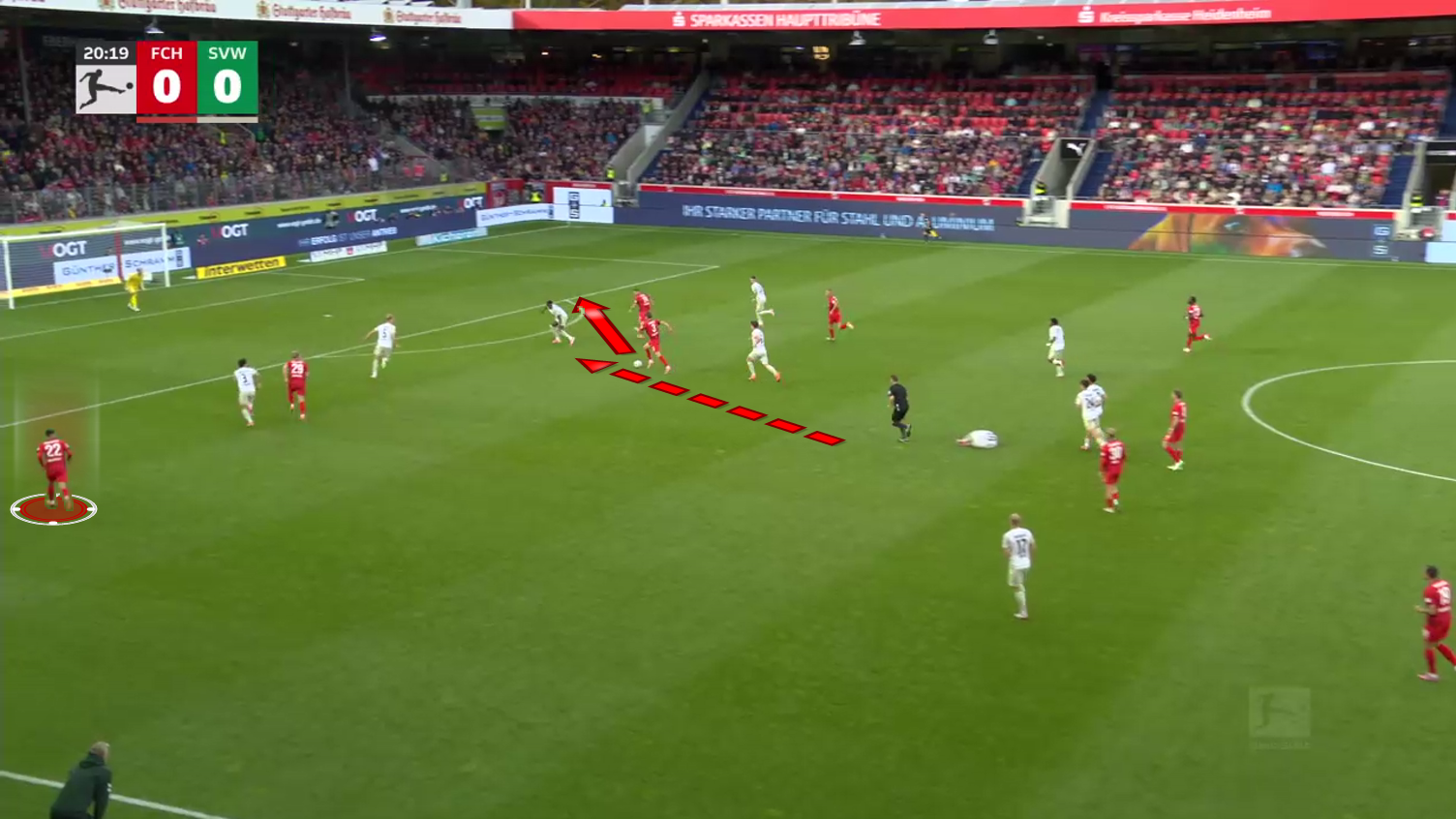
Often, Kaufmann or Zivzivadze were able to collect the ball, turn towards the goal, and now make a run directed at one of the two centre-halves; in this case, it was Coulibaly.
With the full-backs in a more advanced position, Heidenheim now had the option of diagonal runs behind the defensive line and often found a player behind one of the two centre-backs with rather simple passes.
In this case, they managed to get a shot off, but Coulibaly was able to save it before it crossed the line.
Another very interesting thing was how asymmetrical Schmidt lined up his men in possession.
Föhrenback on the left side was always pushing high up the field, with Traoré staying back, forming a back-three at times.
This caused a 5-v-4 overload in Heidenheim’s attacking line, and Sugawara often found himself covering two players.
Schöppner was also very free-roaming and hard to grasp for Werder.
This caused Heidenheim to have many open players around the box, and they managed to create a couple of good opportunities; however, in the end, they failed to capitalize on them.
A Change Of Pace
At half-time, Steffen made a couple of adjustments that instantly worked out for his team.
He pushed Marco Grüll into the attacker position, playing with an actual striker instead of a false nine in the second half.
Patrice Covic dropped back way deeper against the ball, at times even falling into the backline to cover the runs of Föhrenbach and Schöppner.
In the end, it quickly worked out for Steffen with Grüll getting Werder into the lead, but Heidenheim managed to finally score a goal quickly after, equalising the game again.
Steffen now doubled down on the way the game went with the long balls and an actual striker and subbed on Victor Boniface as a clear target-man.
Quickly, it became very obvious that Werder need that type of player in their attack.
Now, the full-backs finally had a target to play their long balls to.
With his clever movements, the Nigerian international also finally enabled Werder to play the diagonal passes that made them one of the better teams in possession in the Bundesliga so far this season.
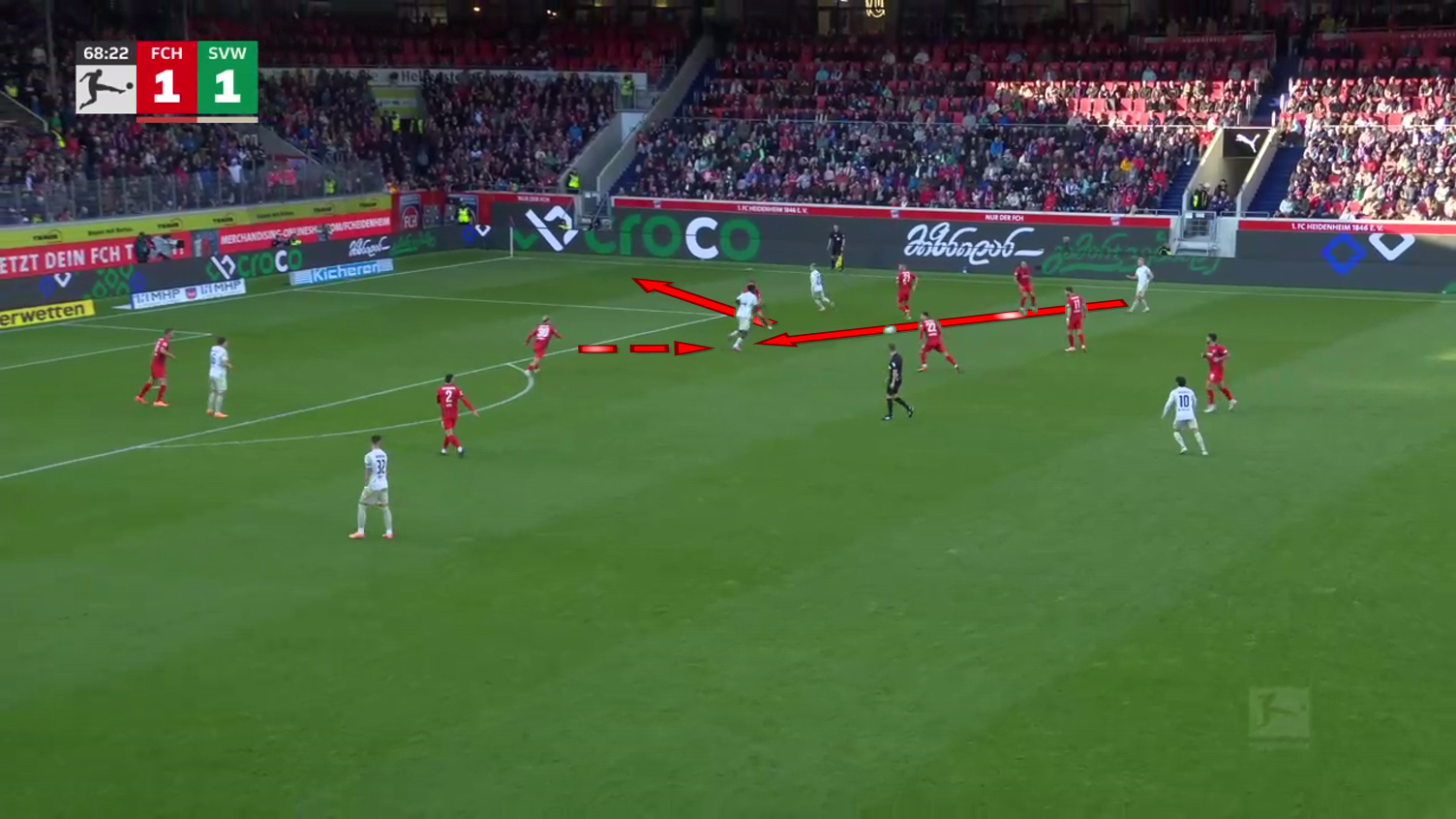
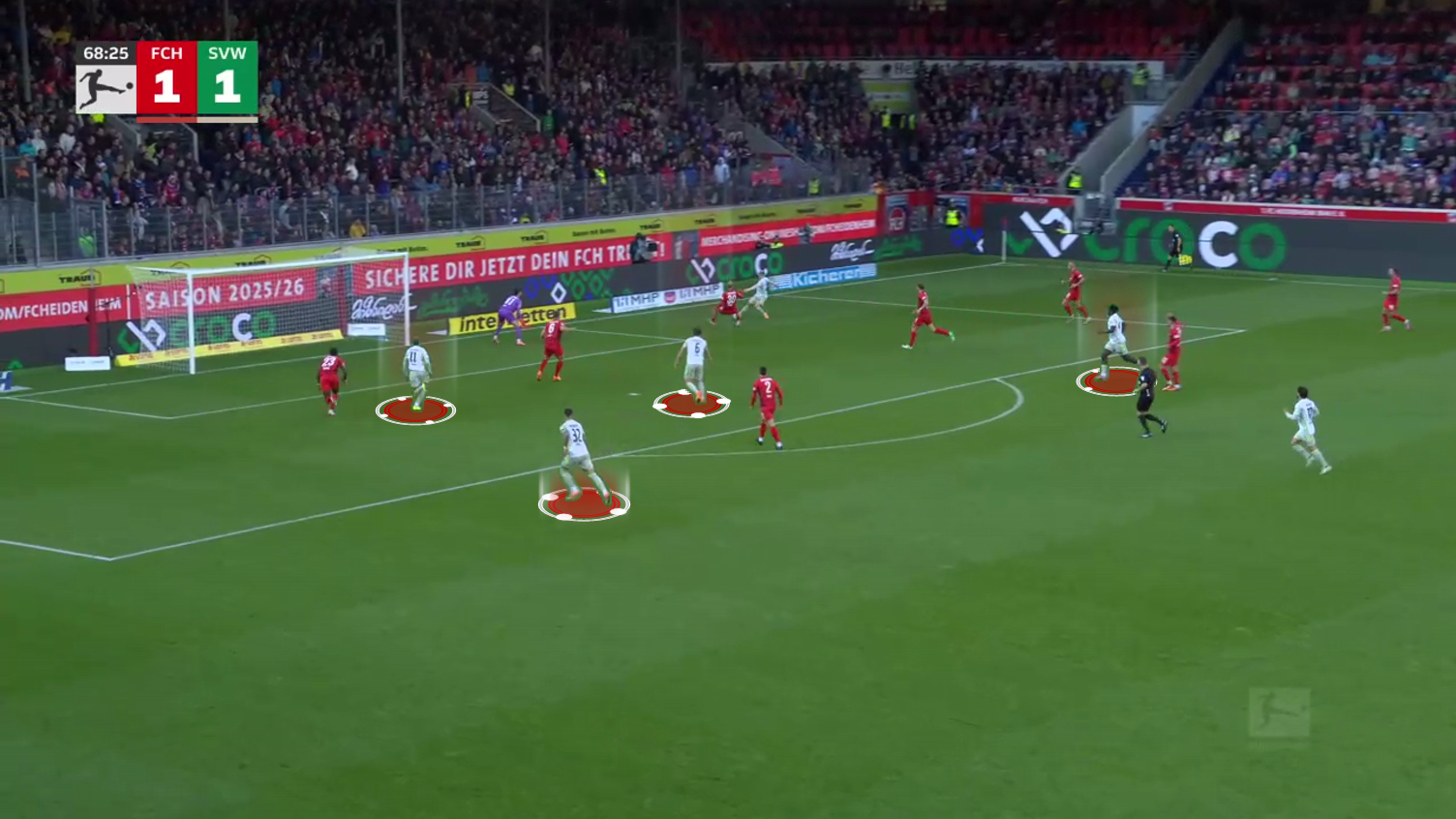
In the picture above, Schmid once again drew a centre-back out of his position.
Boniface recognised the situation, moved horizontally into the gap, and then dropped out of the attacking line and into the open space to receive the ball.
Sugawara plays the diagonal pass into the ladder, Schmid sells the dummy, and Boniface is able to find Schmid again for the deep-deep combination after the Austrian international continues his run well behind the backline.
With that, Werder beautifully create a breakthrough.
From then on, Werder had a good presence in the box.
Heidenheim’s man marking backfired, and multiple Werder players were now in good position in and around the box.
In the end, Schmid played the cut-back to Stage, who finished off the opportunity, getting Werder back into the lead after a decent start to the second half.
After that, Werder became too passive, however.
Schmid now decided to play with a back-three in a 3-4-3 formation, and Heidenheim started to force their way forward with long balls and substitute tall players.
Werder really struggled to defend against the physicality.
In the end, Coulibaly lost the aerial after a long ball, and Föhrenbach was able to finish the headed ball to draw the game.
Conclusion
For Heidenheim and Frank Schmidt, this game should give them a lot of hope.
The result is not ideal and less than they deserved out of this game for sure, but it was a clear step in the right direction in terms of performance.
Their adjustment and match plan worked out perfectly.
The team looked prepared, and they finally managed to regain their physicality on the pitch.
For Werder, I have a lot of question marks.
They looked good in possession throughout the first couple of games, but I was baffled by Steffen’s decision to play with a false nine.
Yes, I understand the idea of breaking apart the backline through man-oriented marking, but in the end, Werder just forced themselves to play a lot of long balls into nowhere for no reason at all.
Boniface proved that they need a target man up front, not just for the long balls but also because it helps them create ladders and find solutions, enabling their diagonal passing game, which has been the best part of their game.
Considering this, it is really questionable to refuse to play their talented striker Keke Topp up front.
Yes, they have many injuries in terms of their defensive performance, but once again, their preparation looked sloppy.
Heidenheim only had to push up one full-back to create a lot of chaos in the backline.
In the end, Heidenheim climbed out of last place, while Werder really needs to examine how they managed to play so badly against such an opponent.
![AC Milan Vs Fiorentina [2–1] Serie A 2025/2026: Massimiliano Allegri In-Game Changes And The Intelligent Exploitation And Management Of Rafael Leão And Luka Modrić – Tactical Analysis](https://totalfootballanalysis.com/wp-content/uploads/2025/10/Milan-Vs-Fiorentina-20252026-min-75x75.png "AC Milan Vs Fiorentina [2–1] - Serie A 2025/2026: Max Allegri Comeback Masterclass Secures Top Spot – Tactical Analysis 10")
