


In today’s tactical era of football, achieving equilibrium between defensive solidity and attacking flair is no longer a luxury—it is a necessity for elite clubs like Real Madrid.
The 2025 season has offered a complex portrait of a team blessed with individual brilliance yet often struggling to find structural coherence, particularly in the transition phases.
This Real Madrid data analysis sets out to assess how effectively Real Madrid balance their defensive and offensive responsibilities, with a particular focus on data-driven insights that capture the evolving demands on players across all positions.
By dissecting key performance metrics—such as defensive actions from attackers and progressive play from defenders—we uncover the tactical patterns that underpin the team’s performance.
The aim is to reveal not only statistical trends but also meaningful conclusions that can guide future tactical refinements for Carlo Ancelotti‘s men.
Relationship between Tackles & Interceptions among Real Madrid Forwards
A closer examination of the defensive contributions of Real Madrid’s attacking trio during the 2025 season reveals some telling differences in how each player engages off the ball—particularly in terms of tackles and interceptions.
While attackers are not traditionally expected to take on significant defensive responsibilities, the demands of modern football, especially within high-pressing systems, increasingly call for greater involvement from the front line in disrupting the opposition’s build-up.

Kylian Mbappé, the club’s marquee signing, registered eight tackles and three interceptions across 2,420 minutes.
This indicates a greater tendency to engage in direct duels rather than position himself to intercept passes.
Vinícius Júnior followed a similar pattern with 18 tackles and five interceptions in 1,849 minutes, showing a comparable approach.
Rodrygo, on the other hand, demonstrated a more balanced profile with 32 tackles and 13 interceptions over 1,772 minutes, hinting at a slightly broader defensive involvement.
Despite these individual nuances, the collective defensive output from this trio remains relatively modest, especially considering their significant game time.
Their limited off-the-ball engagement places additional pressure on the midfield and often disrupts the team’s structural integrity during transitional phases and counter-pressing situations.
In contrast, Brahim Díaz offered a notably different contribution.
With only 1,161 minutes played, he managed 21 tackles and 13 interceptions, highlighting a stronger defensive awareness or a tactical role that allowed him to operate in more favourable positions to regain possession.
These variations reflect both personal tendencies and distinct tactical instructions.
While Mbappé and Vinícius were likely granted more freedom to focus on attacking duties, Brahim may have been tasked with deeper positioning or additional defensive responsibilities.
Ultimately, the disparity in defensive engagement across the frontline poses a tactical challenge for the coaching staff, especially when facing disciplined and well-structured opposition.
Defensive Third Tackles Made by Real Madrid Attacking Players
When evaluating defensive output in the final third of the pitch, particularly the number of tackles completed by attacking players in their own defensive third, the data reveals a noticeable deficiency among Real Madrid’s front line.
This aspect is vital in modern football, particularly in high-pressing systems, where attackers are expected to actively contribute to defensive recoveries.
Across the 2025 campaign, Kylian Mbappé, Vinícius Júnior, and Rodrygo each displayed minimal involvement in this area.
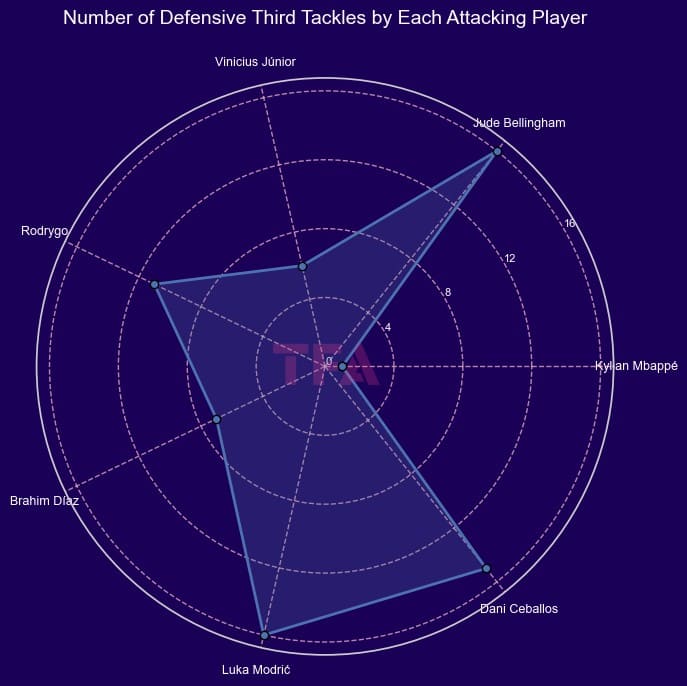
Mbappé registered just one tackle in the defensive third across nearly 2,420 minutes (26.9 full 90s), which translates to approximately 0.04 tackles per 90 minutes.
Rodrygo and Vinícius each fared slightly better, but still underwhelmingly so, recording five and six defensive third tackles respectively, with averages of 0.25 and 0.29 tackles per 90 minutes.
In comparison, even a more attack-minded midfielder like Jude Bellingham managed 16 tackles in the defensive third.
In contrast, Brahim Díaz, who featured for significantly fewer minutes, also managed to match Mbappé’s output.
Federico Valverde, a player operating in a hybrid role, produced a far superior figure with 15 defensive third tackles, demonstrating a more balanced contribution between attack and defence.
The lack of defensive third interventions from the attacking trio starkly highlights a structural imbalance.
With such negligible support in regaining possession deeper on the pitch, Real Madrid’s defensive line and midfield are burdened with absorbing pressure, leading to greater vulnerability in transitional phases.
This imbalance becomes particularly pronounced against teams that exploit wide areas or rely on quick counters, where tracking back from forwards is crucial.
For a side aspiring to dominate both domestically and in Europe, this limited defensive work from attackers can become a tactical liability, necessitating either structural adjustments or a clearer commitment to defensive duties from the attacking unit.
Total Tackles Recorded by Real Madrid Attacking Players
The trend in total tackles made by Real Madrid’s attacking trio—Vinícius Júnior, Kylian Mbappé, and Rodrygo—throughout the 2025 campaign reveals a glaring deficiency in their defensive engagement.
When ranked by overall defensive contribution, the numbers speak for themselves.
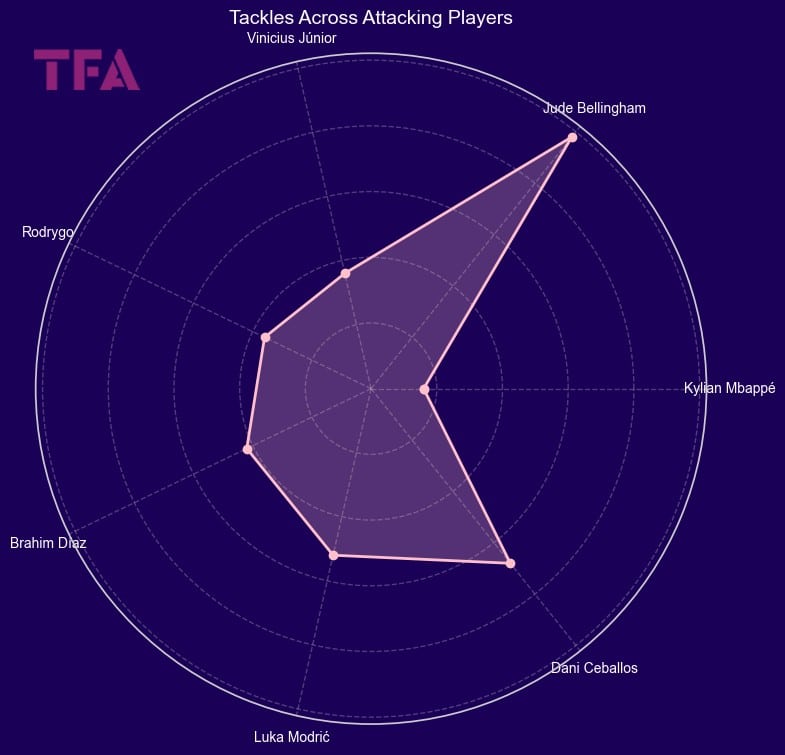
Rodrygo leads the group with 19 tackles over the course of the season, followed by Vinícius with 15, and Mbappé trailing significantly with just nine.
Compared to other attacking players in La Liga, who average between 25 and 35 tackles per season, these figures are strikingly low.
This lack of defensive effort has direct implications for team balance.
Carlo Ancelotti’s system often relies on high pressing from the front to disrupt build-up play.
Yet, the trio’s limited contribution in this area leaves the midfield exposed and puts additional pressure on the defensive line.
Matches against teams with ball-playing centre-backs, such as Girona and Barcelona, showed how easily Real Madrid’s press was bypassed, often due to the lack of initial pressure from the forwards.
Moreover, the average tackle success rate among the trio sits at 42%, which is below the league average for attacking players (55%).
This statistical weakness indicates not only a lack of defensive intent but also inefficiency when they do attempt to engage.
Such trends make it clear that Real Madrid’s front line is not pulling its weight defensively, a fact that has ripple effects across the pitch and undermines the collective defensive structure.
For a team with ambitions of European dominance, such imbalances must be addressed—either through tactical adjustments or personnel changes.
Real Madrid Tackles vs Successful Tackles
A comparative look at the number of tackles attempted versus those successfully completed by Real Madrid’s front three further illustrates their underwhelming defensive contribution.
The data visualisation, which uses bubble size to denote the number of tackle attempts in the attacking third, shows small and sparsely populated bubbles for all three attackers, indicative of both a low frequency of attempts and limited success.
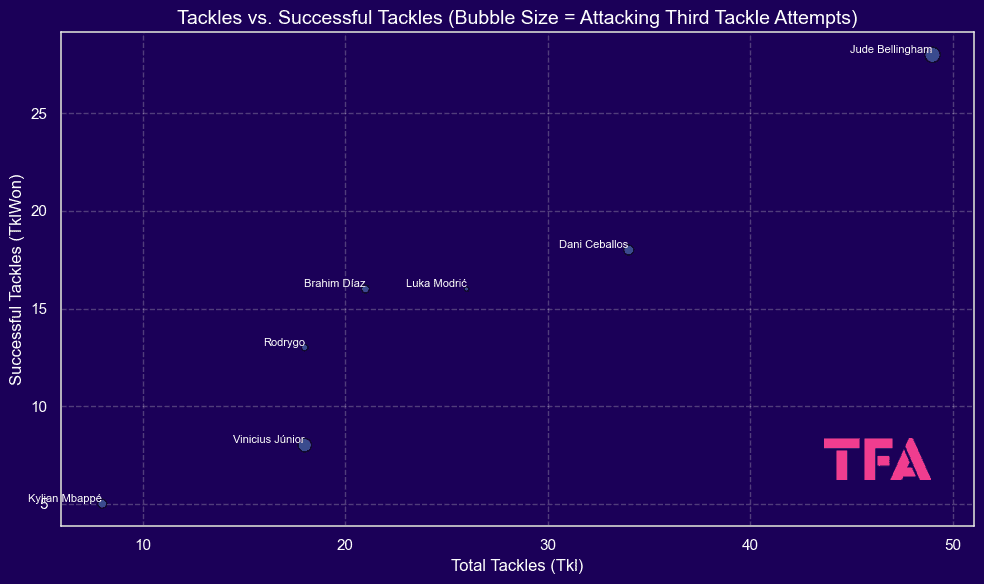
Vinícius attempted 36 tackles throughout the season but succeeded in only 15 (41.6%).
Rodrygo registered 40 attempts with 19 successful (47.5%), while Mbappé’s output was the least effective: 24 tackles attempted, nine completed (37.5%).
These numbers not only lag behind top-performing wingers in the league—such as Nico Williams or Raphinha, who both averaged over 30 successful tackles—but they also demonstrate a worrying reluctance to defend high up the pitch.
Bubble sizes concentrated mostly outside the attacking third further underscore the absence of forward pressing.
Only 28% of all tackle attempts by the trio occurred in the final third—far below the 45–50% observed among elite high-pressing teams.
This absence of pressure in advanced areas allows opposing full-backs and deep-lying midfielders ample time and space to build attacks, which has repeatedly disrupted Real Madrid’s intended shape and rhythm.
When such deficiencies are paired with a midfield that already juggles creative and defensive duties, the entire tactical framework suffers.
The imbalance exposes the double pivot and often forces defenders to step out prematurely.
Thus, the low tackle count and success rate of the attacking line are not trivial statistics—they are structural liabilities.
Shot Blocks & Pass Blocks by Each Attacking Player
When evaluating defensive commitment among attacking players, metrics such as shot blocks and pass blocks serve as critical indicators.
A stacked comparison of these stats among Vinícius, Rodrygo, and Mbappé reveals limited involvement across the board.
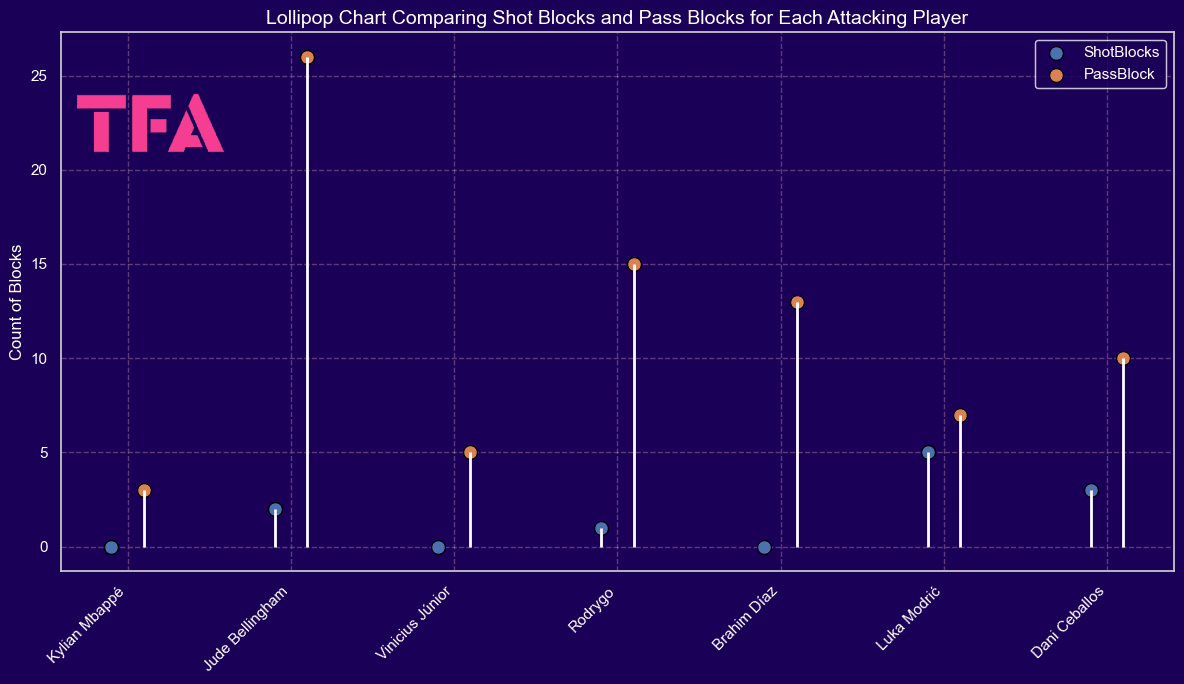 Over the 2025 season, Rodrygo led with a combined 14 blocks (nine pass blocks, five shot blocks), followed by Vinícius (11 total: seven pass blocks, four shot blocks), while Mbappé again featured the lowest with only six total blocks (four pass, two shot).
These figures reflect a deeper issue: a lack of anticipation and positional awareness when out of possession.
The team’s defensive transitions often start with delayed reactions from the front line, which limits opportunities to intercept or block passing lanes.
Compared to elite attackers like Antoine Griezmann or Ferran Torres, who routinely post 20–25 combined blocks over a season, contributing significantly to their teams’ defensive shape.
The consequences of these low numbers ripple across the pitch.
When attacking players fail to apply passive or active pressure, the opposition is free to recycle possession and probe spaces unchallenged.
This forces Real Madrid’s midfielders—particularly Federico Valverde and Eduardo Camavinga—to cover more ground defensively, which increases their physical load and reduces their attacking output.
It also inflates the number of direct duels faced by the backline.
Ultimately, the trio’s underwhelming blocking metrics reflect a systemic imbalance.
They highlight the need for either a more collective defensive ethic or the strategic use of pressing traps that account for their limitations.
Without such adaptations, the team’s structural integrity remains vulnerable in high-stakes fixtures.
Interceptions by Real Madrid Attacking Players
Interceptions serve as a strong indicator of a player’s ability to read the game defensively.
Yet among Real Madrid’s attacking trio, the 2025 season saw a remarkably low distribution of these actions.
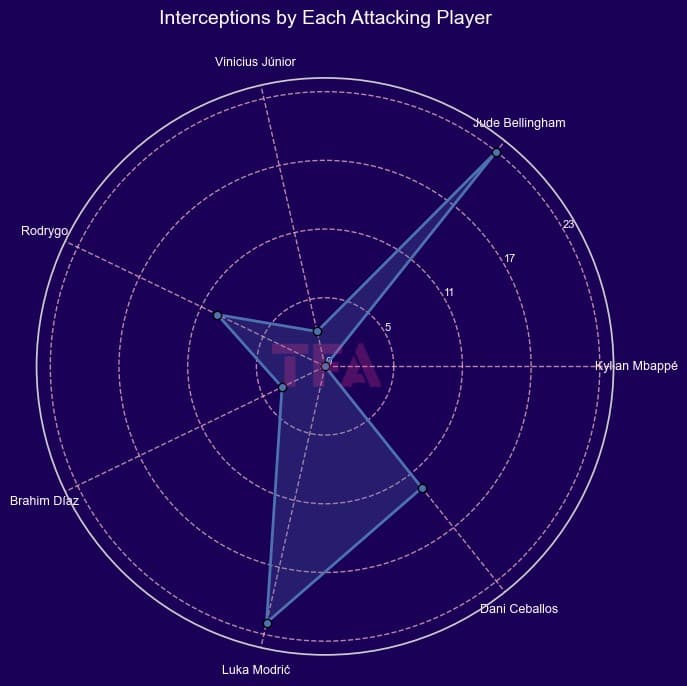 Mbappé recorded only three interceptions, Vinícius added five, and Rodrygo topped the group with eight.
For context, attackers with high defensive involvement typically register double these numbers, often exceeding 15 interceptions per campaign.
This statistical shortfall signals a broader issue of defensive disengagement.
Interceptions are generally a product of anticipation and positional awareness, traits not prominently displayed by Madrid’s front three.
Instead, their defensive stance remains reactive rather than proactive, often allowing the opposition to build up play unimpeded.
Notably, the majority of the trio’s interceptions occurred in central areas just past the halfway line, as opposed to higher positions or wide zones where forwards typically operate in pressing systems.
This positional data implies a lack of coordinated pressing strategy, leaving the opposition with more space and time during transition phases.
The knock-on effect is again felt by Real Madrid’s midfield and defence, who are repeatedly drawn into compensating for the attacking line’s deficiencies.
In high-intensity matches—such as those against Atletico Madrid or Manchester City—this creates an imbalance that opponents are quick to exploit, often with numerical overloads in the central third.
Unless interception numbers improve through tactical adjustment or player motivation, Madrid will continue to suffer from a top-heavy structure.
While their attacking prowess remains unquestionable, the inability to contribute defensively limits the team’s ability to dominate possession and territory against stronger opponents.
Progressive Passes by Real Madrid Defenders
Progressive passing from the back has become a cornerstone of modern build-up play, and Real Madrid’s defenders have been central to this strategy throughout the 2025 season.
However, a detailed analysis of their output reveals mixed levels of involvement.
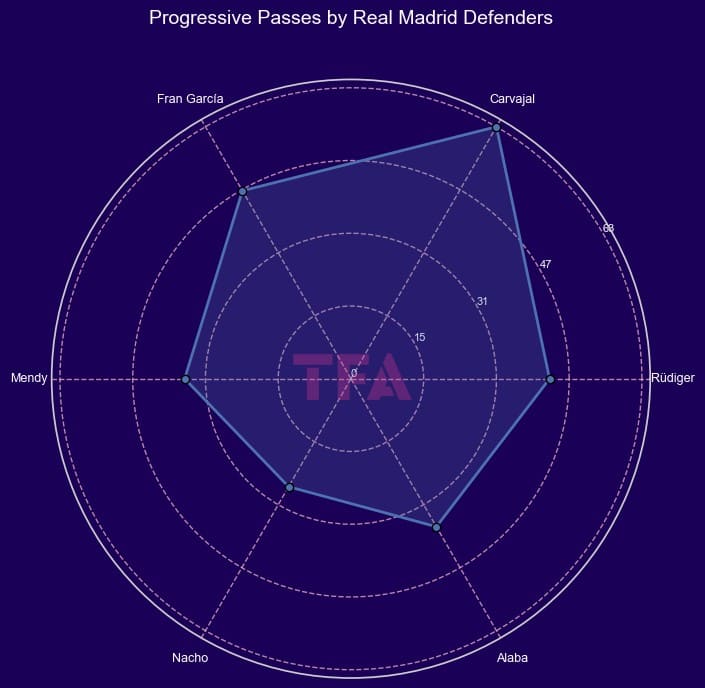
Antonio Rüdiger leads the defenders with 142 progressive passes, followed by David Alaba with 128, and Éder Militão contributing 103.
Fran García, operating primarily from left-back, added 76, while Dani Carvajal completed 88.
Despite these figures appearing decent in isolation, they fall short when benchmarked against top-tier teams employing similar systems.
For example, Manchester City’s John Stones recorded 176 progressive passes in fewer minutes, and even Napoli’s Amir Rrahmani outperformed both Eder Militão and David Alaba.
This relative underperformance becomes more significant when we consider that Real Madrid’s midfield duo—Camavinga and Valverde—often drop deep to compensate, reducing their forward presence.
The lack of consistent vertical progression from the back increases the burden on the midfield and impedes fluid transitions.
Moreover, many of these passes from Madrid’s defenders are lateral rather than line-breaking.
Only 31% of Rüdiger’s progressive passes entered the middle or attacking third, and Alaba’s figure is similar at 34%.
This lack of verticality delays the ball reaching Madrid’s creative players in advanced zones, allowing opponents time to reorganise defensively.
This issue is further exacerbated by the weak defensive involvement of the front line.
Without pressure from the attackers to regain possession high, the defenders are often forced into long build-ups, exposing structural vulnerabilities.
Thus, while Real Madrid’s defenders are capable ball-players, the collective build-up strategy remains limited by both insufficient risk-taking in progressive distribution and the lack of support from their attacking counterparts.
Passes into Final Third by Real Madrid Defenders
The ability of defenders to advance the ball into the final third is crucial for maintaining attacking pressure and establishing territorial dominance.
However, Real Madrid’s defenders have struggled to match the required standard in this regard.
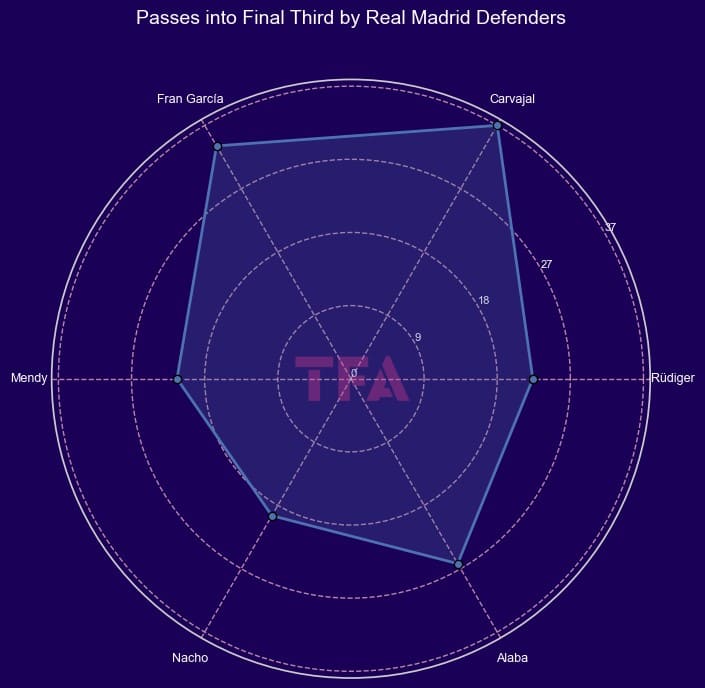
Over the course of the 2025 season, Rüdiger completed 64 passes into the final third, Alaba managed 59, and Carvajal—who often joins midfield transitions—delivered 52.
Fran García contributed 41, while Militão trailed with just 37.
By comparison, elite defenders like Ronald Araújo or Alessandro Bastoni consistently deliver 75–90 such passes per season.
Madrid’s numbers suggest a lack of precision and intent when it comes to bypassing opposition lines and feeding the midfield or wide attackers in advantageous positions.
The issue is not purely technical—many of Madrid’s defenders possess the range—but tactical, often opting for safe recycling rather than penetrative progression.
This hesitancy places a disproportionate creative load on midfielders, particularly Jude Bellingham and Valverde, who are then tasked with both ball progression and final-third invention.
It also affects the attacking trio’s positioning.
When final third entries are delayed or inconsistent, wide forwards like Vinícius and Rodrygo are forced to drop deeper, which limits their threat in the box and reduces offensive verticality.
Compounding this is the limited pressing and defensive contribution of the forwards, which leads to longer build-up sequences and reduced transitional opportunities.
With forwards not tracking back effectively, defenders face more pressure in possession and are often forced to retreat or circulate the ball rather than taking risks.
The net effect is a sluggish offensive rhythm and vulnerability to counter-pressing, outcomes that have been costly in key fixtures, particularly in Europe.
Shot-Creating Actions by Real Madrid Defenders
Shot-creating actions (SCA) are a valuable metric for assessing how defenders contribute to offensive phases, particularly in modern systems where full-backs and centre-backs often act as playmakers.
In Real Madrid’s case, the 2025 season shows a modest output from their defensive line.
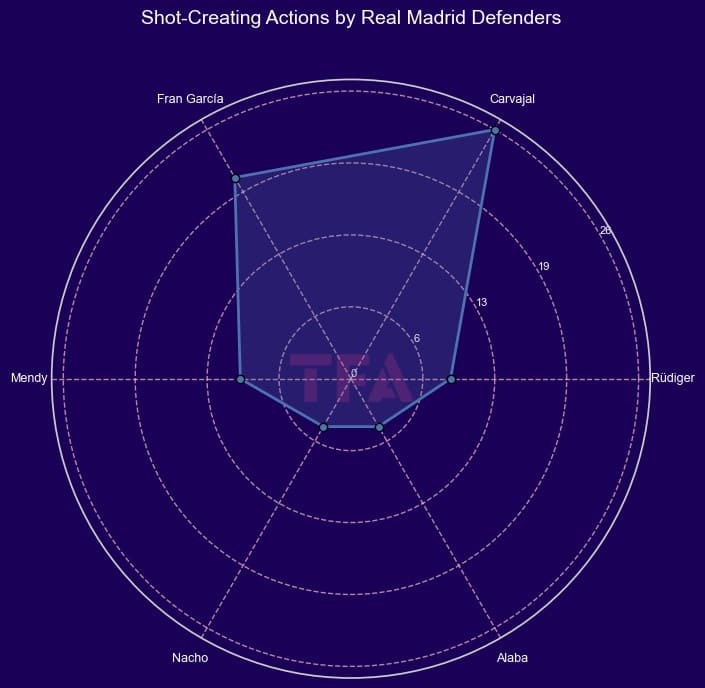
Dani Carvajal tops the chart among defenders with 38 SCAs, followed by Alaba with 33, Fran García with 29, Rüdiger with 22, and Militão with just 17.
This level of involvement is relatively low when compared to defenders in similar tactical roles.
Madrid’s reliance on overlapping full-backs has been inconsistent, largely due to tactical variability and injury-related rotations throughout the campaign.
Furthermore, their SCAs are predominantly based on secondary passes rather than direct key passes or carries that lead to shots.
Interestingly, only 27% of these actions originated from open play situations in the final third, highlighting a tendency for defenders to influence the attack from deeper positions rather than penetrating zones close to the goal.
This spatial limitation narrows Real Madrid’s attacking options and puts more creative weight on central figures like Bellingham and Vinícius.
Moreover, the low defensive contribution from the attacking trio forces defenders to remain more conservative in their positioning.
Without trust that the front three will help recover possession or delay counter-attacks, full-backs are less willing to advance, thereby reducing their involvement in shot creation.
In sum, Real Madrid’s defenders offer a limited creative return, both in volume and quality.
For a team aspiring to maintain dominance across multiple competitions, increased offensive output from the back line, paired with a more balanced defensive effort from the front, could significantly enhance their tactical flexibility and attacking unpredictability.
Conclusion
The data presented throughout this report paints a clear picture of Real Madrid’s current tactical imbalance.
While the squad possesses undoubted attacking firepower, the limited defensive output from the front line consistently places added pressure on the midfield and back line, leading to vulnerabilities in transitional moments.
Simultaneously, the defenders—tasked not only with maintaining solidity but also initiating attacking sequences—have offered modest contributions in terms of vertical progression and creativity.
If Real Madrid is to compete at the highest level, it must develop a more cohesive approach that encourages collective responsibility across all phases of play.
This may involve redefining roles, adjusting pressing triggers, or demanding greater defensive discipline from attacking players.
Equally, more assertive involvement from defenders in offensive build-up is vital.
Ultimately, tactical success will depend on achieving a better balance between defence and attack, where each player, regardless of role, contributes meaningfully to both ends of the pitch.
Only then can the team’s potential be fully realised.

