



The departure of Trent Alexander-Arnold from Liverpool will be a seismic shift for the club tactically.
From academy graduate to generational talent, Alexander-Arnold embodies Liverpool’s identity.
A local lad and a Scouser, he has redefined the full-back role in modern football.
His ability to dictate games from deep areas, passing range, and creative influence have been instrumental to Liverpool’s success under Jürgen Klopp and now Arne Slot.
His right foot has become synonymous with dismantling the lowest of low blocks, and he will forever be remembered for one of the greatest high football IQ moments in Champions League football.
Yet, evolution is both necessary and inevitable in football.
Alexander-Arnold’s role transcended traditional positional definitions.
As a “quarterback” in Klopp’s system, he orchestrated play from deep, bypassing opposition midfield and enabling Liverpool to dominate transitions.
His hybrid role as a full-back and deep-lying playmaker was central to Liverpool’s identity and reshaped perceptions of the position across the footballing world.
Pep Guardiola once remarked, “Alexander-Arnold is the best passer in world football today, not just at right-back but everywhere.”
The move to Real Madrid looks imminent, and now Liverpool faces a defining moment in their modern history.
The task at hand is not to fill a positional void but to reconstruct the team’s creative framework.
This piece will explore specific structural and stylistic adjustments that Liverpool can implement to compensate for the loss of their most creative player.
Can Trent Alexander-Arlond Be Replaced At Liverpool?
A like-for-like replacement for Alexander-Arnold is virtually impossible.
Players of his calibre, available to move and possess his skillset, are nowhere to be found.
Instead, Liverpool must adapt by redistributing the creative and progressive responsibilities he carried.
Alexander-Arnold’s departure means a shift in Liverpool’s build-up play, transitional phases, and chance creation.
This approach will require intricate changes to Liverpool’s positional structures, player instructions, and attacking patterns.
The first area Liverpool must address is their build-up phase.
Alexander-Arnold’s ability to drop into midfield zones and act as an additional playmaker has been useful in Liverpool’s ability to bypass opposition presses.
Without him, Liverpool can adopt a two-pronged solution: a creative defensive midfielder (DM) who can dictate play from deep, a pass-first type of player who can adjust the full-back positioning to maintain width and progression.
A player like Angelo Stiller fits this profile.
In addition, the Liverpool team’s ability to run between the lines needs to be improved.
This was increasingly evident during the PSG vs Liverpool tie, where PSG had many players who could receive and make something in these areas.
That is why Xavi Simons could also fill the creative void with his close control and ability to drive into spaces between the lines.
On the right, Liverpool could integrate academy graduate Conor Bradley as a more traditional full-back.
Bradley’s athleticism and ability to overlap or underlap make him an ideal candidate for a more touchline-hugging role.
Rather than functioning as an auxiliary midfielder like Alexander-Arnold, Bradley would focus on providing width, stretching opposition defences, and a source of vertical progression through wide areas.
This shift would require Liverpool to place greater emphasis on combinations in the half-spaces, with the right central midfielder (e.g., Dominik Szoboszlai) stepping into more advanced positions to support Bradley and create overloads.
Alexander-Arnold’s departure is a chance for Liverpool to evolve.
This piece will also look at how Liverpool can rebuild its future, focusing on the tactical and structural adjustments required to sustain success.
Specifically, it will explore how players like Angelo Stiller and Xavi Simons can be essential players in Liverpool’s next chapter.
Angelo Stiller Scout Report At Stuttgart 2024/2025
Angelo Stiller’s style of play suits Liverpool’s need to restructure their creativity in midfield.
Stiller is a deep-lying playmaker with exceptional composure under pressure.
He is able to manipulate opposition blocks due to his high technical base level and spatial awareness.
His 8.93 progressive passes per 90 (96th percentile in top five leagues compared to positional peers) and 8.58 passes into the final third per 90 (97th percentile) shows an elite capacity to advance possession through congested central areas, enabling Liverpool to sustain their high-possession, high-block model.
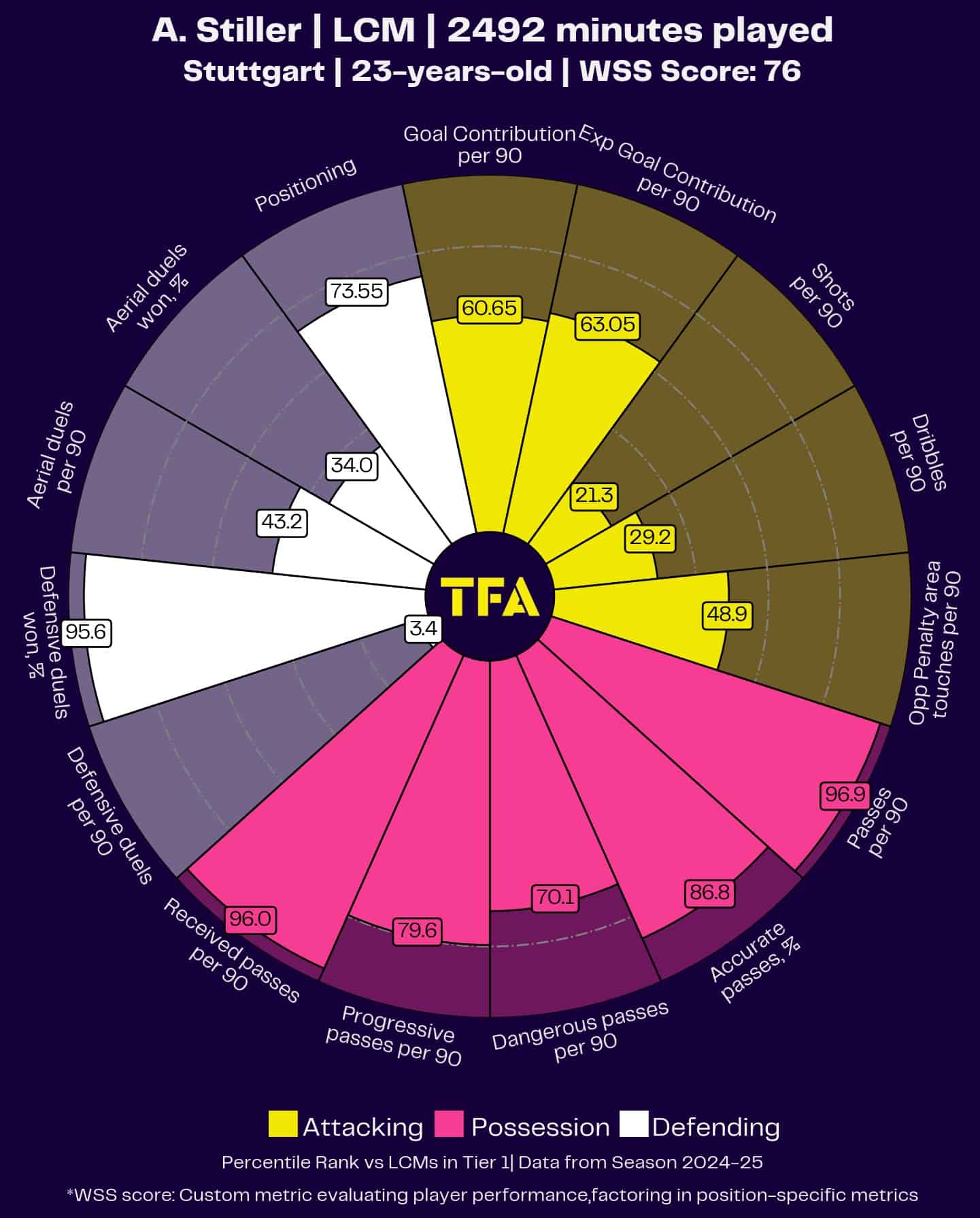
This profile summarises Angelo Stiller’s performance for Stuttgart in the 2024/25 season based on percentile rankings, comparing him to other midfielders in his league and position.
Stiller is successful in possession-based metrics, particularly with his passing and progression skills.
As a distributor, he is reliable in terms of volume.
His 79.6th percentile in progressive passes per 90 and 70.1st percentile in dangerous passes per 90 highlight his ability to move the ball forward.
Additionally, his 96th percentile in received passes per 90 shows his high involvement in linking thirds to maintain control.
Angelo Stiller Radar Chart At VfB Stuttgart
In Liverpool’s build-up phase, Stiller could act as the first receiver, dropping into the defensive midfield line to either attract opposition pressure or exploit underloaded zones.
By creating and operating within pressing traps, he can use his body orientation and feints to evade markers and turn pressure into opportunities for vertical progression.
Stiller’s role within a Liverpool midfield that consists of Alexis Mac Allister and Ryan Gravenberch would focus on balancing positional structure while providing unpredictability and combinations.
In the first phase of build-up, he could position himself between the centre-backs or slightly to the left of the pivot line, forming a situational 2-3 shape when the full-backs push higher.
This structure is similar to the hybrid roles Alexander-Arnold performed in previous seasons, albeit with Stiller’s emphasis on ball circulation rather than direct final-third penetration.
His ability to play between the lines, evidenced by his 3.65 shot-creating actions per 90, ensures that Liverpool can consistently access advanced zones, even against compact mid-to-low blocks.
Furthermore, his passing range and ability to disguise his intentions allow him to execute diagonal switches to wide players such as Luis Díaz or Mohamed Salah, stretching the pitch horizontally and creating isolation opportunities in wide channels.
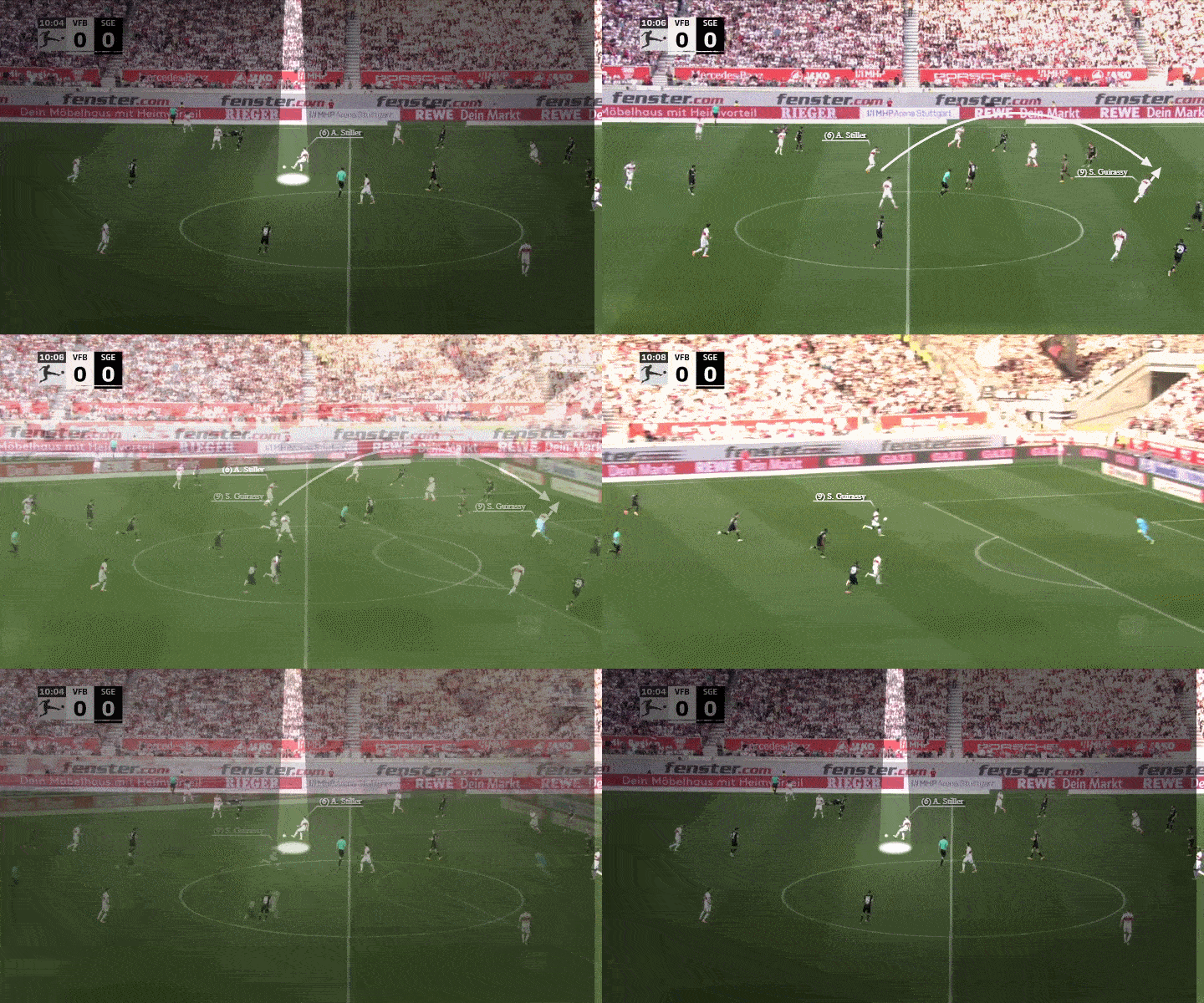
In a match against Eintracht Frankfurt, Stiller receives a pass on his back foot and delivers a perfectly weighted clipped ball into space for Serhou Guirassy.
The pass slices through Frankfurt’s two defensive banks of four and gives Guirassy time and space to run through on goal.
A fundamental element of Stiller’s game is his manipulation of pressing systems.
When receiving the ball under pressure, his low miscontrol rate of 0.63 per game (91st percentile) shows his technical precision in tight spaces.
Stiller’s ability to receive on the back foot, coupled with subtle body feints, allows him to shift opposition compactness by pulling out individual pressers, creating space for teammates in central or half-space zones.
Against organised pressing sides, Stiller’s composure allows Liverpool to retain numerical superiority in deeper areas while progressing the ball cleanly into the midfield.
This ability to attract pressure, combined with his vertical pass selection, would allow Mac Allister and Gravenberch to exploit higher zones, especially when the opposition’s second line is forced to step out of position.
In possession, Stiller’s role would differ from that of Alexander-Arnold but would achieve similar outcomes through alternative mechanisms.
While Alexander-Arnold often occupied hybrid roles in midfield and wide zones, Stiller is more of a metronomic presence in central areas, dictating the tempo and breaking lines.
His passing patterns complement Liverpool’s attacking trio—Mohamed Salah, Luis Díaz, and Darwin Núñez—all of whom excel at attacking space.
Stiller’s progressive passing enables Liverpool to engage in vertical combination play, where Salah or Díaz receive in wide areas before quickly recycling possession into central zones.
Stiller’s ability to shift the point of attack from central to wide regions would also improve Liverpool’s ability to dismantle blocks.

In the UEFA Champions League group stage against Slovan Bratislava, Stiller receives the ball under pressure with his back to play.
Using a clever feint, he creates space to move forward and delivers a through ball that bypasses the opposition’s right-back, who is caught too square.
This allows Maximilian Mittelstädt to exploit the wide area and deliver a dangerous cross across goal.
Stiller’s inclusion would allow Liverpool to adopt a more symmetrical midfield structure, redistributing creativity across multiple zones rather than channelling it through a single player.
His ability to manipulate defensive blocks, attract pressure, and execute vertical passes makes him an ideal candidate to anchor a midfield three with Mac Allister and Gravenberch.
This would allow Mac Allister to operate as a free-roaming advanced playmaker in the left half-space, while Gravenberch’s ball-carrying ability provides progression through central corridors.
Stiller’s positional discipline and progressive passing would provide the foundation for this system and provide Liverpool the platform to sustain attacking sequences and dominate possession phases.
In conclusion, Angelo Stiller offers Liverpool a tactical solution rooted in structure and progression.
His ability to manipulate opposition and play high-risk passes into the final third makes him an ideal candidate for redistributing creative responsibilities.
While his role differs in execution, the outcomes suit Liverpool’s roots with a blend of Arne Slot’s tactical ideals: fluidity, verticality, and control.
Xavi Simons Scout Report At RB Leipzig 2024/2025
Xavi Simons is the modern wing/10 hybrid – a player who mixes wide-channel explosiveness with central creativity.
In an era defined by positional fluidity and high-intensity systems, Simons is perfect for this role.
He can play both in wide areas and in the half-spaces and has the technical base, pressing intensity, and spatial intelligence to take on a creative responsibility at Liverpool.
Simons creates 4.88 shot-creating actions per 90 (82nd percentile among positional peers in Europe’s top five leagues) and 37.19 carries per 90 (80th percentile), an enticing dynamic attacking outlet for Liverpool.
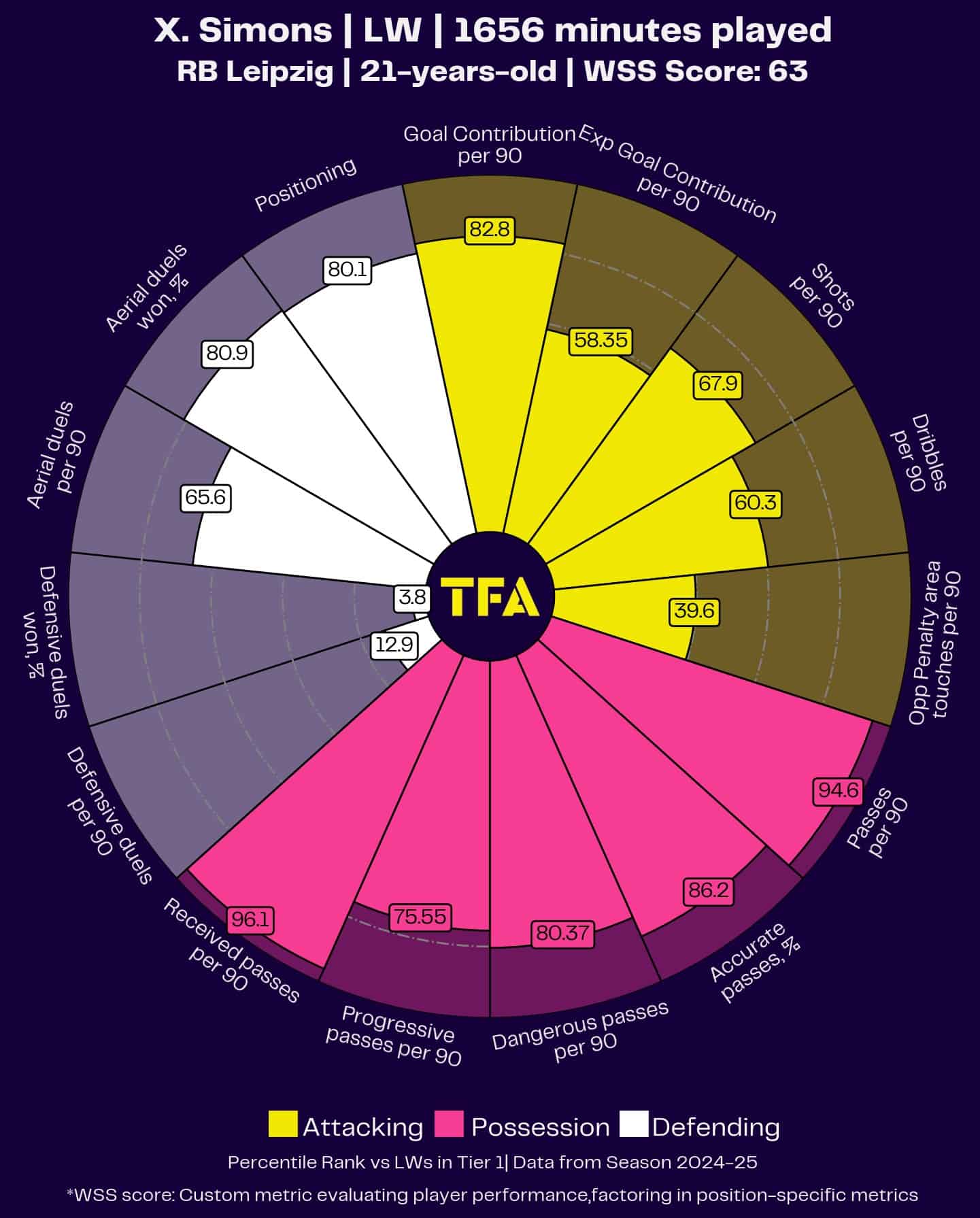
The radar chart data highlights Xavi Simons’ creative impact as a left-winger.
His ability to receive between the lines, progress the ball with his passing (96.1th percentile for progressive passes), and penetrate defences through courageous dribbling (67.9th percentile) makes him an all-around playmaker.
Simons thrives at cutting inside to link play or create chances in the final third (82.8th percentile for goal contributions).
Xavi Simmons Radar Chart At RB Leipzig
Simons’ development in the Bundesliga, where high-intensity pressing, tight spaces, and quick transitions are commonplace, has enabled him to perform in environments that mirror Liverpool’s demands.
In a league known for its emphasis on verticality and defending with compactness, Simons has had success in finding and exploiting space in crowded areas.
His technical control and quick decision-making under pressure are qualities essential for players operating between the lines.
Liverpool’s reliance on structured build-up and positional rotations in wide areas would make Simons an invaluable asset.
By positioning himself in advanced zones, he forces defenders to make difficult decisions: step up to engage him, leaving space in behind for Robertson’s overlapping runs or Darwin Núñez’s central runs, or stay compact and allow Simons to dictate possession from dangerous areas.
His 3.38 passes into the final third per 90 (82nd percentile) highlight his ability to turn positional advantages into progression, ensuring Liverpool retains attacking momentum in the final third.
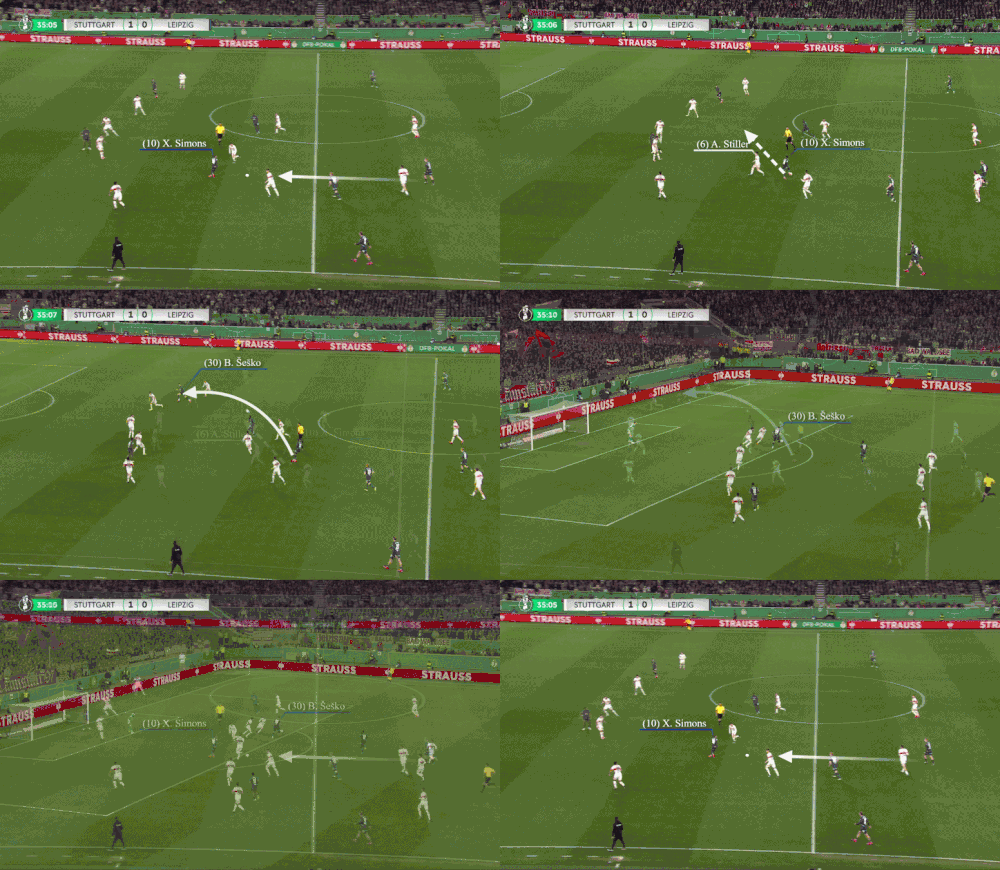 In a competitive fixture against VfB Stuttgart, Xavi Simons demonstrated his intelligence and technical ability by drifting deeper to receive the ball.
He deceived Angelo Stiller into expecting a return pass but instead spun and delivered a lofted pass to Benjamin Šeško in an advanced position.
Simons’ ability to receive under pressure is needed in between opposition blocks.
By using body feints, quick directional changes, and his explosive acceleration, Simons can unbalance defenders and create separation, opening opportunities to combine with teammates or carry the ball directly into the penalty area.
This complements Liverpool’s attacking patterns, which can involve breaking through compact central areas to create high-quality chances.
Simons’ dribbling and ball-carrying ability make him ideally suited to Liverpool’s left side, where his explosiveness can thrive in both wide and central zones.
His 37.19 carries per 90 (80th percentile) reflect his ability to drive possession forward, particularly in scenarios where he isolates opposition full-backs in 1v1 situations.
As an inverted winger, Simons would frequently cut inside from the left, creating opportunities for Robertson to overlap and stretch the defensive line.
This type of positional interplay allows Liverpool to create overloads on the left while maintaining a central threat through Simons’ passing, dribbling, and ball-striking.
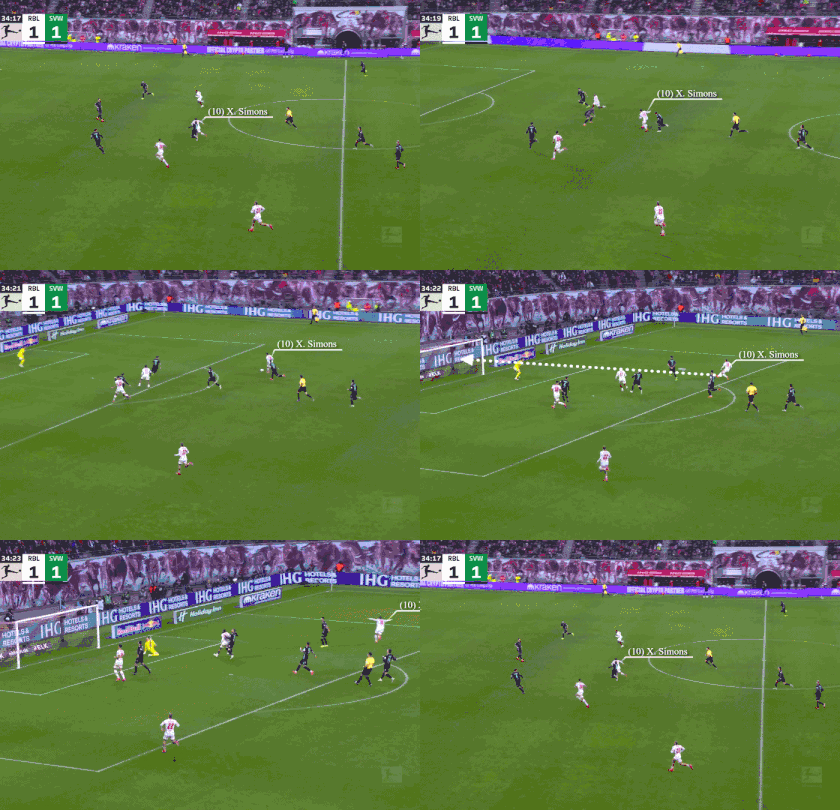 In a match against Werder Bremen, Xavi Simons shows his confidence, balance, and ball mastery to pick up the ball from a deeper starting position and beat defenders by forcing them to tackle or engage.
This leads to a goal-scoring opportunity, which he scores.
Simons’s position as a left-winger allows Liverpool to redistribute creativity in a way that evolves their tactical framework.
While Alexander-Arnold’s contributions originated from deeper areas and wide right zones, Simons offers advanced creativity from the left half-space and final third.
With Simons, there is wide-channel explosiveness with advanced central creativity.
His ability to receive between the lines addresses some of the creative void left by Alexander-Arnold and introduces a layer of unpredictability in all phases of play.
Conclusion
The departure of Trent Alexander-Arnold signals a pivotal moment for Liverpool, requiring a reimagining of their creative structure.
Players like Angelo Stiller and Xavi Simons offer solutions that can keep Liverpool ticking and provide a source of reliable chance creation.
Together, they represent a shift toward a more multifaceted and adaptable Liverpool, capable of creating post-Alexander-Arnold.

