


Walid Jarmouni (188cm/6’2”, 82kg/181lbs) is a 21-year-old left-footed attacker on loan at Championnat National 1 side FC Sète 34 from FC Sochaux, where he has played since 2018 when he joined the Ligue 2 side from Le Crès FC. Sochaux have been custodians of some players who would go on to become major names in world football over the years, including current Inter winger Ivan Perišić and former Barcelona centre-back Jérémy Mathieu — both of whom went on to become UEFA Champions League winners after spending a portion of their early career at Sochaux.
Jarmouni hopes to become the latest player to walk through the halls of Sochaux’s training ground and develop into something great. Though his ceiling is unlikely to be as high as that of Perišić and Mathieu, I do think that the 21-year-old Sète loanee has been one of the most noteworthy players to grace France’s third tier, National 1, in 2021/22.
The tall, Montpellier-born attacker, who is primarily a centre-forward but has also been occasionally used as a right-winger this term, hasn’t enjoyed as much game time as other players we’ve provided some analysis of in recent weeks as part of this series scouting France’s third tier but he’s utilised the game time he has received well enough to warrant being part of our list and we hope that this scout report and tactical analysis piece sheds plenty of light on why we are so excited about this particular player and believe, depending on the team’s tactics and Jarmouni’s specified role within those tactics, he could have plenty to offer at a higher level than National 1.
Off the ball movement
Jarmouni has scored five goals this season for Sète while generating 5.2 xG. For me, the 21-year-old has been a little bit of a victim of his own versatility and playing style during his loan spell in National 1, as we’ll discuss in greater detail later on in this tactical analysis piece, simply due to the way he’s often been used within his team’s tactics. Jarmouni hasn’t always been the main focal point of his team’s attack this term, sometimes getting shoved out onto the right instead of the centre and while he’s performed this role quite well, we believe that the Sochaux man is ultimately set to end up as a centre-forward; this is where he’s at his best, specifically due to his excellent off-the-ball movement.
The attacker possesses excellent ability to find ways of ending up in optimal goalscoring positions to give teammates a good option or to ensure he is best positioned to get onto the end of a rebound. This has benefitted Jarmouni and Sète a lot when he’s been deployed as a centre-forward as the 21-year-old has been able to showcase his attacking off-the-ball movement as much as possible to benefit his team by occupying good goalscoring positions frequently, ultimately helping his team to find the back of the net.
Overall, this season, Jarmouni has only taken 1.87 shots per 90 in National 1 — a relatively average number, when compared with other strikers in France’s third tier — which I’d say, is a direct result of 1. The fact he’s not had consistent game time throughout the season and 2. The fact that he’s not always been used as a main striker in the team, often being shoved out onto the wing where Jarmouni’s knack of getting into the right positions via his off-the-ball movement is more difficult to capitalise on than when his role is to play as the furthest forward central player, closest to the opposition’s goal.

In figures 1-3, however, we see an example of Jarmouni playing as a centre-forward and helping his side to score. This passage of play provides a great example of the 21-year-old’s impressive off-the-ball movement, as this element of his game was crucial for creating the goal we see at the end of the attack. Firstly, in figure 1, Sète have just started a counter-attack after regaining possession inside their third. As the ball-carrier breaks away on the left side of central midfield, we see Jarmouni making his run into space behind the defence and on the blindside of where they’re currently focusing.
One noteworthy thing about Jarmouni’s run here and other runs he’s made when breaking away into space is how frequently and exactly at what moments he chooses to scan. We see an example of the attacker looking away from the ball carrier and into the space in front of him in figure 1 and he took this opportunity to scan at the absolutely perfect time, as it was in between the ball-carrier’s heavy touches. It’s better to scan when the ball is not at the feet of the teammate who could completely change the attack with a specific movement at any given moment, meaning it’s better to have one’s eye on the ball at those moments. However, scanning in between touches or when the pass is in transit towards you, for example, is a great idea as it allows Jarmouni to give himself a better idea of how the pitch is laid out ahead of him in terms of players’ positioning and where to find space, for example. This can improve the player’s decision-making.
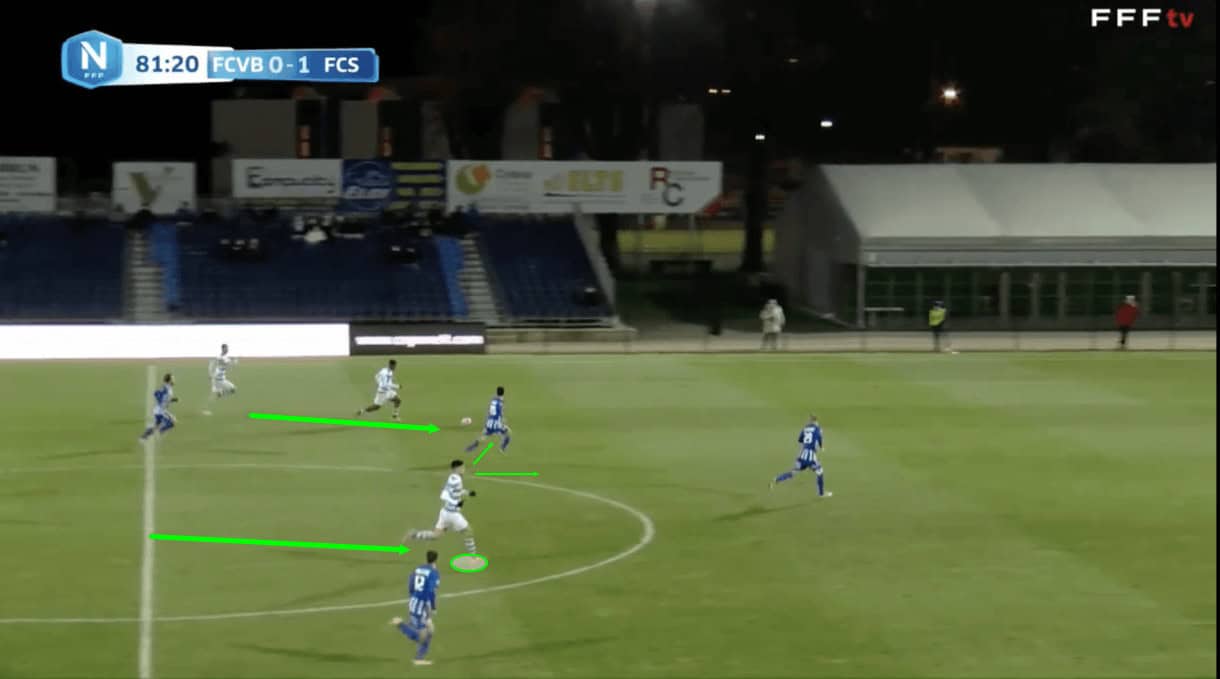
Jarmouni frequently performs these scans at just the right moments in this passage of play, doing so again a few seconds later after the ball carrier took another heavy touch. This time, we see that Sète have now progressed all the way into the opposition’s half, while Jarmouni is in-line with the ball carrier, looking to continue his run on the blindside of the defenders to make it more difficult for these players to mark him.

Moving on into figure 3, we see how the opposition eventually progressed all the way into the penalty area with this counter-attack and now, Jarmouni has managed to get himself into a great goalscoring position relatively free by ghosting into the area on the blindside of the defender. This kind of run will not always be rewarded with even a shot, let alone a goal, but on this occasion, it was. The ball made its way across the face of goal and the unmarked Jarmouni was best placed to knock it into the net, scoring an important goal for his side at this point in the game.
Again, this movement won’t always be rewarded but it doesn’t need to be. Jarmouni just needs to demonstrate the ability to get into these high-value positions a lot and he’s done that this term when played as a striker and given the chance to do so. It’s evident from his xG and goals record that Jarmouni is finishing his chances at about the rate you’d expect and we feel if given more opportunities to play as a striker he’d be generating a lot more good goalscoring opportunities via his movement. As a result, we back him to perform as a lethal forward when properly put in the position to do that with a large reason for that being his excellent off-the-ball movement, as we’ve analysed in this section.
Hold-up play
At 188cm and 82kg, Jarmouni provides his team with a significant physical presence spearheading the attack; his team uses this physical presence as an outlet for long balls to the front when necessary and for the purpose of hold-up play. Jarmouni is good at making himself available for balls into feet with his back to goal and helping his team to gain ground as he holds up the ball and backs into the opposition challenging him.
Jarmouni doesn’t actually make a lot of passes for a National 1 striker, though he typically performs well with his back to goal — perhaps his team should look to exploit this area of his game more often given his obvious physical but also technical qualities that suit such a role.
I must stress that Jarmouni isn’t much in the way of being a playmaker from the forward position as he lacks the creative passing ability to perform this role but holding up the ball with his back to goal and playing simpler passes to teammates in space who can then create a goalscoring opportunity themselves is something he thrives at. So, while Jarmouni doesn’t directly contribute a lot in terms of key passes or assists, he can still play a key role in the build-up for his team by helping the side to advance to the point where they can create a good goalscoring opportunity.
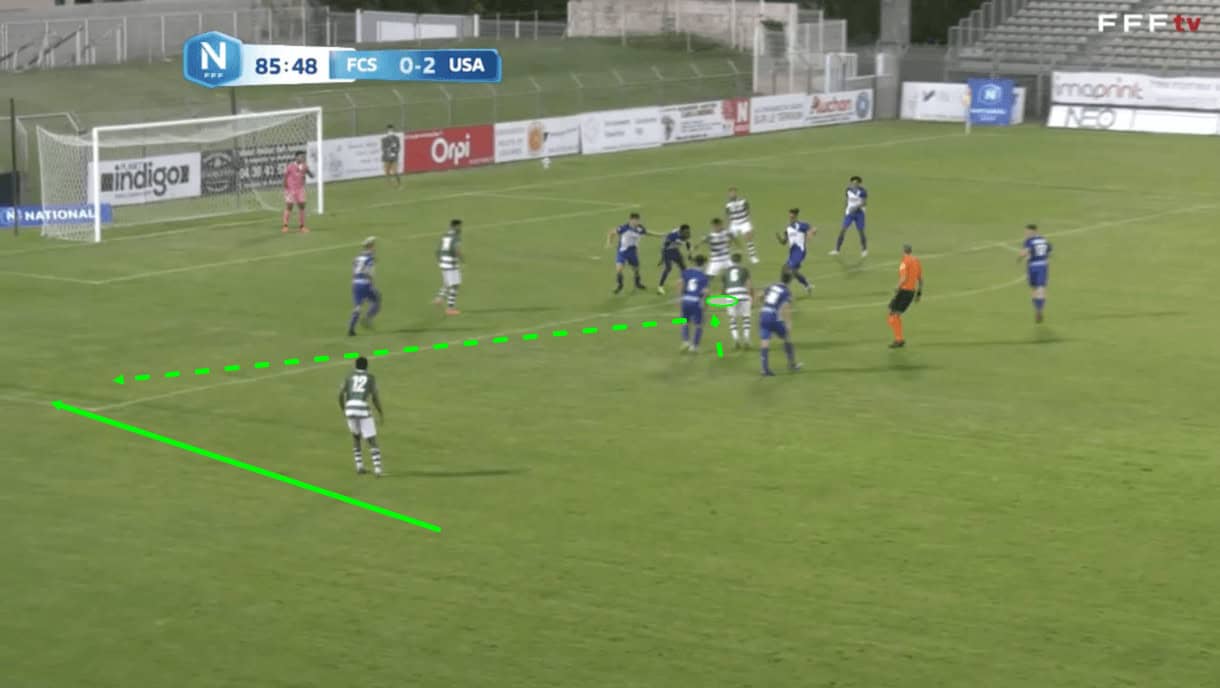
We see an example of Sète using Jarmouni’s ability to hold up the play and help his side advance deep into the final third in figures 4-5. Just before figure 4, above, the ball was fired into Jarmouni’s feet as the attacker dropped slightly deeper to make himself available to link up with his deeper teammate on the ball. The forward has a great ability to trap the ball as it’s played into his feet in tight areas with his back to goal and surrounded by opposition shirts, which was the case here; this helps the 21-year-old to avoid getting dispossessed cheaply at a crucial stage of the attack. This ability to retain possession under pressure in central areas is a great perk of utilising Jarmouni as a centre-forward — he’s very valuable occupying these valuable central areas, as we see in figure 4.
After getting the ball under control, opposition players started closing in on Jarmouni from all angles, which figure 4 also depicts. The attacker remained calm, used his size and strength to back into the nearest defenders and keep them away from the ball, before then playing a through ball out to the wide man on the left wing who was now enjoying more space thanks to Jarmouni forcing the opposition’s shape to contract. We see the opposition’s right-back in the process of moving narrower in figure 4 as just an example of how Jarmouni’s hold-up play created more space for his team in the final third.
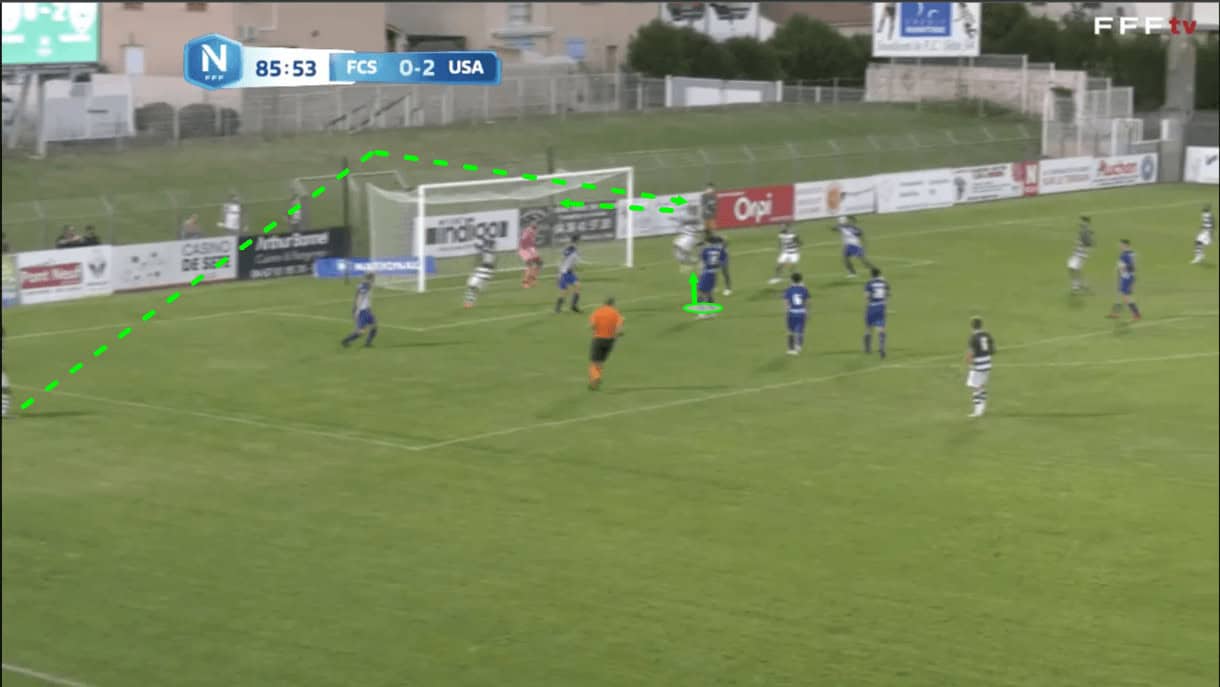
As play moves on into figure 5, we see that the left-winger, enjoying a lot of space, opts to send a high cross into the box from a fairly advanced position on the left wing. After he released his pass out to the wing, Jarmouni’s attention turned back to off-the-ball movement and by sending the ball out wide, the striker diverted attention from himself to the new direct threat — the wide ball-carrier. This relieved Jarmouni of some of the pressure on him and allowed him to move into a great position in the middle of the box pretty much unmarked.
The 21-year-old was able to get onto the end of his teammate’s cross thanks to this movement which allowed him space to launch himself up into the air and connect with the high ball, converting it into the net. So, as well as playing a crucial role in the build-up for this move via his hold-up play, Jarmouni was able to finish this move off as well thanks to the 188cm attacker’s excellent physical traits as well as intelligent movement and good enough technical ability for the specific tasks at hand here. This is the kind of role Jarmouni needs to play — he’s a good hold-up man and a great attacker for finding space in valuable areas, which can make him a solid one-touch finisher to get onto the end of crosses like this one, for example.
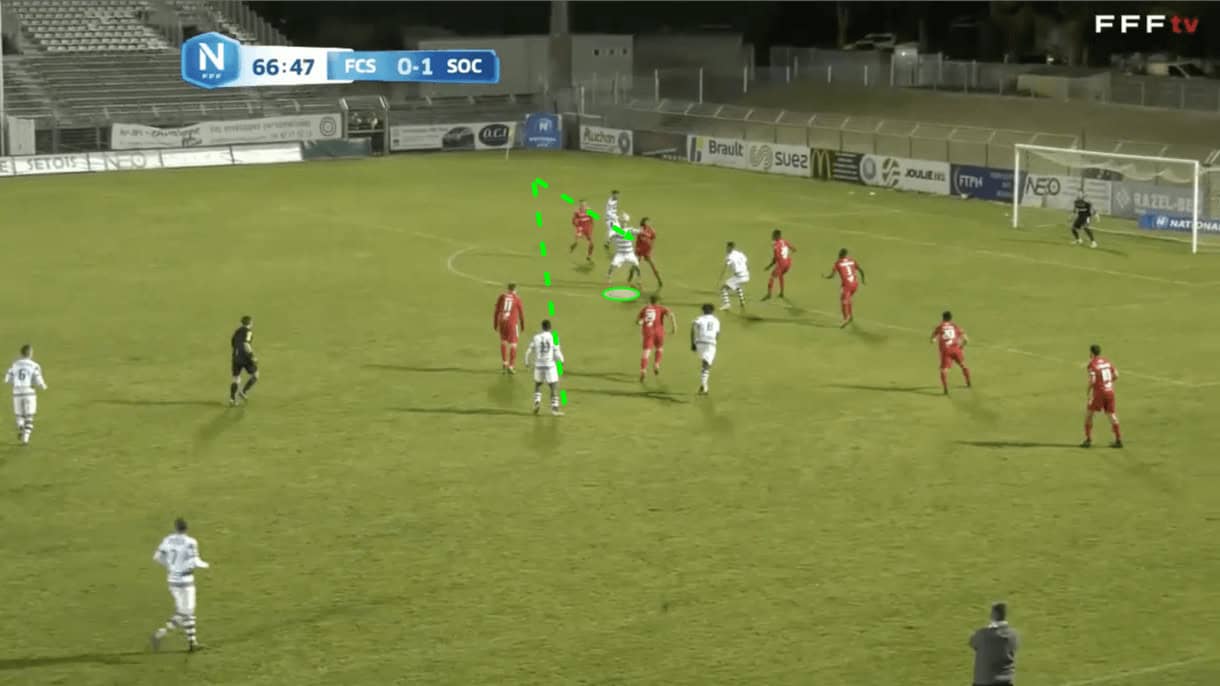
As well as being well capable of trapping balls fired into his feet with his back to goal, Jarmouni has very solid chest control and his team has used this ability quite often when the 21-year-old has been utilised as a striker this season. It’s a useful and unique trait that can be very difficult for the opposition to defend against, firstly because of the striker’s technical proficiency with this skill but also, secondly, because of his size and strength which makes it difficult for even centre-backs to move him when he’s the target of balls like the one we see in figure 6.
Jarmouni’s movement before the pass is played is, again, crucial in this situation. It’s imperative that when he plays as the hold-up man for his side, he’s always dropping, finding space and creating the necessary angles to be a good option for the passer. His skill at controlling the ball with his chest means that he doesn’t just need to create opportunities for the team to pass to his feet, he can also create opportunities for the team to fire it a bit higher into his chest, which can be more difficult for the opposition to cut off. As a result, this is a really useful skill. We’ve seen it used at the highest levels of the game, with former Everton and Manchester United player Marouane Fellaini once crowned the king of this particular skill. It presents a unique challenge to opposing defences when a player is particularly skilled with this ability and Jarmouni has proven quite effective when controlling with his chest in tight spaces on the edge of the box as we see in figure 6 this term, so this is another important skill of the 21-year-old Sochaux man’s for his team to consider in the future when thinking about his tactical role.
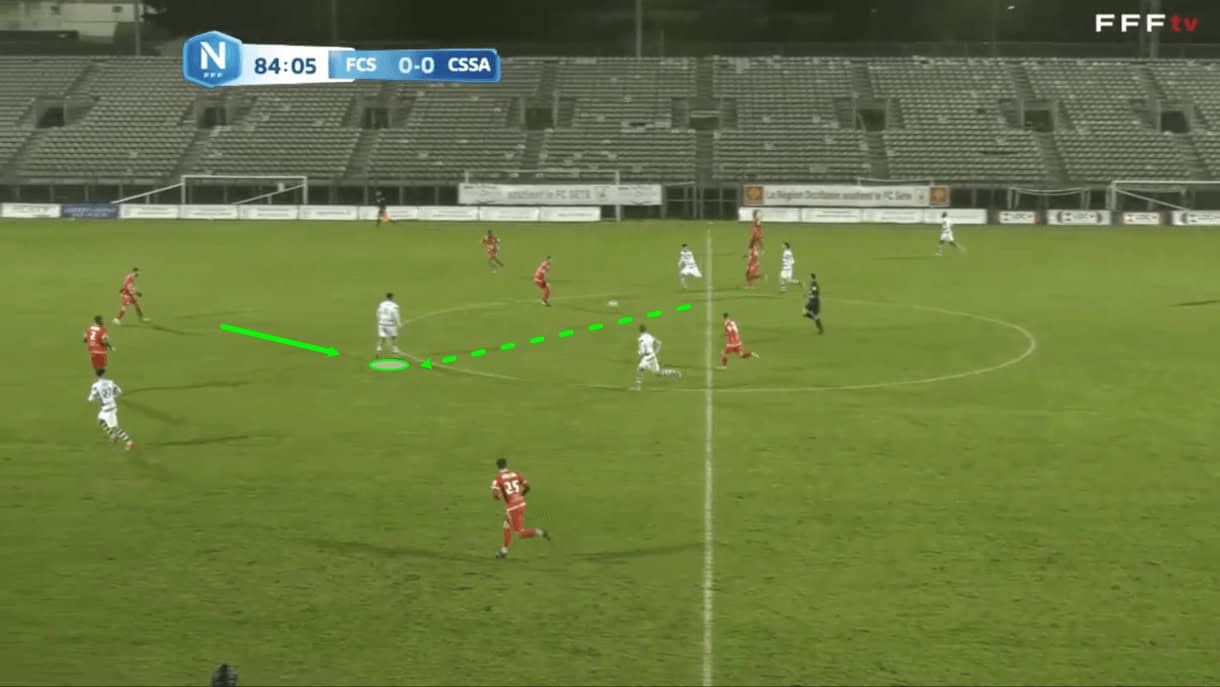
One of the positives we’ve mentioned concerning Jarmouni’s ability on the ball can also be negative in some ways, though not in the exact same situations. Figures 7-8 will help us to shed some light on one area in which the 21-year-old attacker can improve in terms of his on-the-ball ability as a centre-forward: Receiving passes.
Yes, we did say Jarmouni: “has a great ability to trap the ball as it’s played into his feet in tight areas with his back to goal and surrounded by opposition shirts” and I stand by that — he does. However, it’s a very different thing receiving the ball with your back to goal and not surrounded by opposition shirts. For example, figure 7 shows Sète on the counter-attack aiming to exploit the opposition’s weakened backline. At this moment, Jarmouni dropped off from the centre-backs into some space behind the midfield to make himself available for a teammate’s pass, again demonstrating great movement and awareness of his surroundings. It’s common to see Jarmouni drop off in situations like this to allow another teammate to be the runner in behind. However, I’m not convinced that this is necessarily the way things should work in his strike partnership.
Here, with space behind him to turn into, Jarmouni should not kill the ball, rather he should ideally take it on the half-turn or at least keep momentum on it by moving it in some direction to keep the pace of the attack up. Yes, there are times when it’s important to slow the pace of the attack but this isn’t one of them.
A good first touch for Jarmouni here would keep the ball moving, keep pace on the counter-attack, keep the opposition’s backline under pressure and allow him to subsequently play the ball quickly. As we move on into figure 8, we see that this doesn’t happen.

Jarmouni took pace out of the ball with his touch and killed it for a moment or two. This led to the ball getting a little bit stuck under his feet which again cost his team a couple of precious seconds. Eventually, he did manage to play the through ball to the strike partner to his left but by this point, the opposition were more settled than they were when Jarmouni initially received the ball, thus better prepared to defend the attack.
Jarmouni can improve his ability to receive the ball on the half-turn in the correct situations or at least receive the ball while keeping pace and momentum in the attack when necessary. Again, I think his ability to control the ball when under serious pressure, as we saw in figures 4 and 6, is fantastic but there are situations when he shouldn’t take his first touch in this way as it’s counterproductive.
An alternative, however, would be to allow Jarmouni to spend more time playing on the shoulder of the opposition defence and having a different player dropping in between the lines altogether. I really back Jarmouni’s off-the-ball movement and ability to find space for himself in high-value positions and feel that the priority for him should be to optimise his goalscoring opportunities. He doesn’t take enough shots at present not because he can’t get into shooting positions but because of his role in the squad. I feel this is a little bit of a waste at times, especially in a situation like this, on the counter-attack, where Jarmouni doesn’t always thrive receiving the ball to feet but could thrive via his off-the-ball movement and pace.
Dribbling
One of the most impressive things about Jarmouni is that as well as being a man of significant stature leading the line for his side and offering a good aerial presence (5.89 aerial duels per 90 with 41.27% success rate this season — decent when compared with other National 1 strikers), the 21-year-old is a very good dribbler. This is one of the reasons he’s been deployed on the wing at times this season — the striker loves to get isolated 1v1, which happens more easily on the wing with the full-back getting dragged out wide, and take on a player. He’s deceptively pacey for a player of his size and has very quick feet with a tendency to pull off a lot of stepovers and ball rolls. The Sochaux man is really comfortable with the ball at his feet, making him an excellent asset for his side in 1v1 scenarios.
When compared with other National 1 strikers, Jarmouni has engaged in a high number of dribbles this season (4.4 per 90) and has achieved a high success rate with those dribble attempts (55.32%). The striker is very good with the ball at his feet and is brave in taking on players. He’s particularly good in 1v1s, as mentioned, and opposing teams need to try and prevent the big 21-year-old from creating such situations by doubling up on him. However, in doing so, this can then create extra space for his teammates elsewhere.
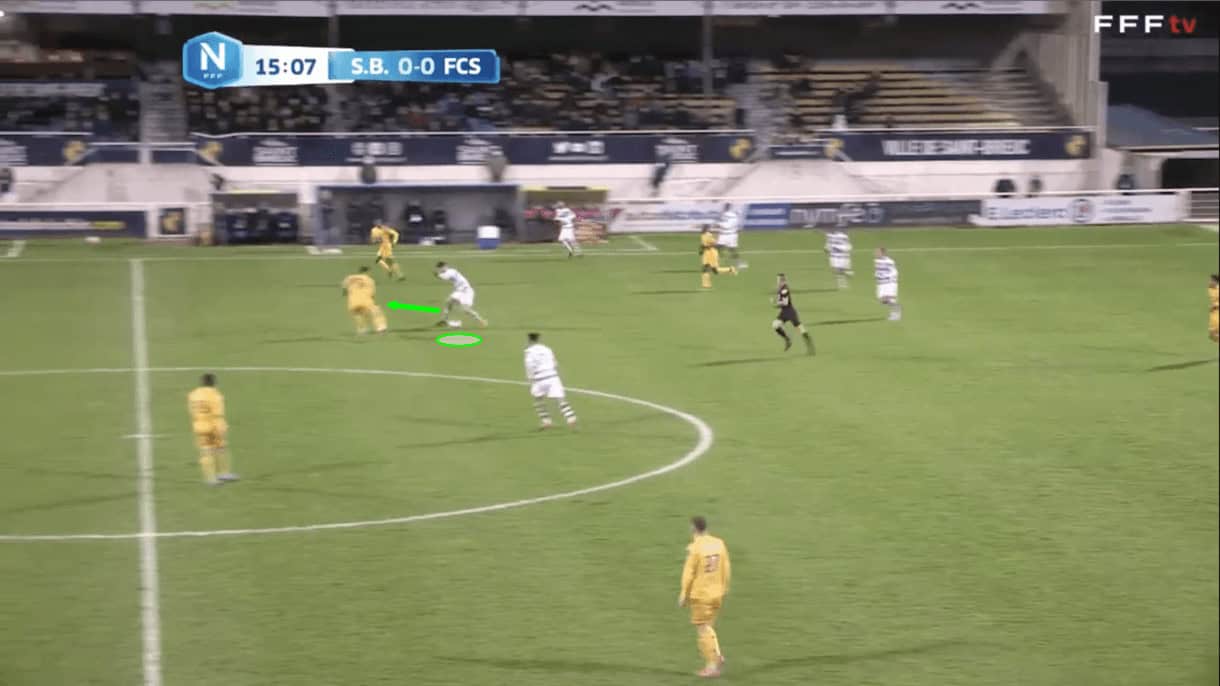
Figures 9-10 show an example of Jarmouni displaying his dribbling ability after dropping deep and picking up the ball in a rather central area of the pitch. Here, the attacker has just carried the ball a couple of steps forward and feinted to the right while moving at pace. This little movement influenced the defender challenging him to commit to covering that side, and Jarmouni subsequently displayed his impressive agility by breaking away to the left quicker than the defender could turn to account for this.

Progressing into figure 10, we see that now, as a result of this little feint and impressive display of agility (as well as his deceptive pace) the 188cm forward has broken away through the centre of the pitch, leaving the defender who had been protecting the space in front of him in his tracks.
This is just one example of Jarmouni’s dribbling quality on display but we’ve seen plenty of examples like this at Sète this season. The specific traits we’ve mentioned that were key to this particular example, however, such as pace, agility and quick footwork are always evident in his 1v1 duels, making them significant contributors to his dribble success in 2021/22.
Defensive contribution
For the final section of this scout report, we’ll spend some time analysing Jarmouni’s defensive efforts. Simply put, the Sète loanee has been one of the best defensive forwards in France’s third tier in 2021/22. This is evident from the numbers as well as in-game analysis of Jarmouni’s performances for Sète this term.
Firstly, Jarmouni has achieved an extremely high number of successful defensive actions per 90 in 2021/22 (5.43) when compared with National 1’s other centre-forwards. Additionally, the 21-year-old has made a very high number of interceptions per 90 (2.62) when compared with other strikers from France’s third tier. Jarmouni’s relentless defensive work rate combines with solid technical defensive quality to make him a very valuable asset for his team in defensive phases. This is another major reason why he’s occasionally been deployed on the right-wing this season, as he is always working back to help out his full-back, making him a valuable asset on the wing. This, combined with his dribbling quality, makes Jarmouni a useful asset on the wing. Still, we feel you’ll get the best out of this player in a centre-forward role. That said, it’s valuable to know that the player was willing to sacrifice his individual success for the betterment of the team as a whole with Sète. This could lead to the player getting overlooked in some aspects.
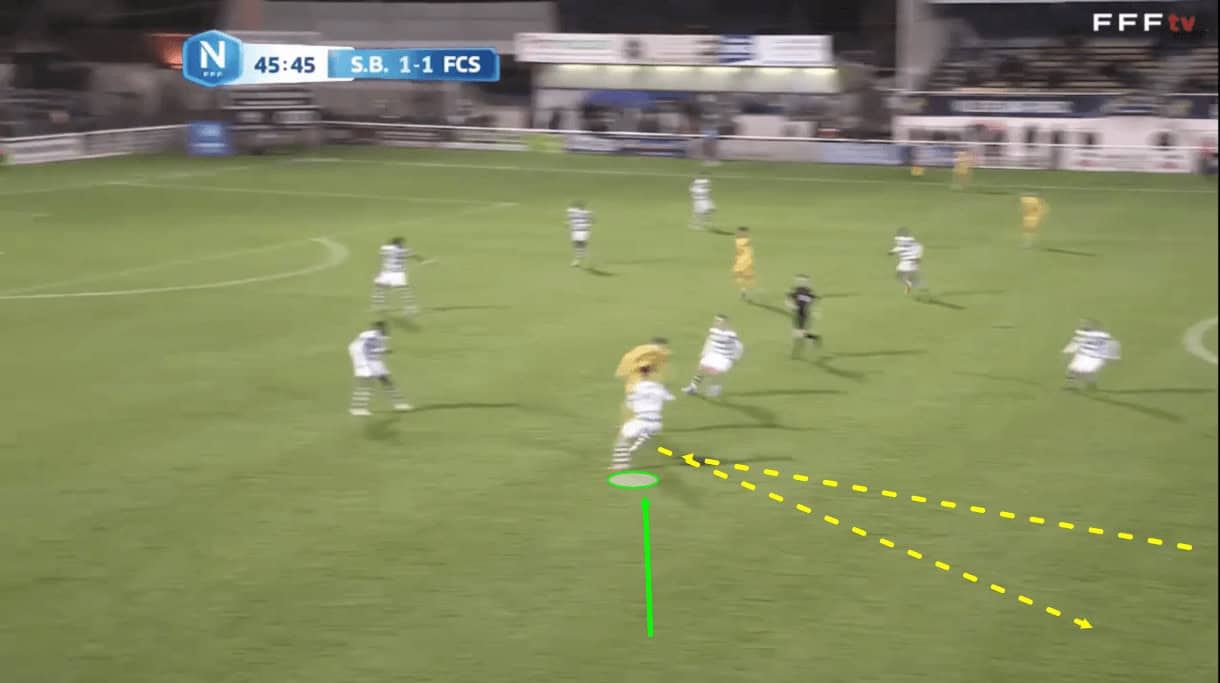
We see an example of Jarmouni’s solid defensive work rate and technical defensive quality in figures 11-12. Firstly, figure 11 shows an opposition player receiving the ball in midfield from a deeper teammate and as the pass was played, Jarmouni, coming from the right-wing, sprinted to close him down and prevent the player from turning to run at Sète’s defensive line. This effective pressing led to the receiver being forced to send the ball back to the defence. This is just a typical in-game example of Jarmouni’s defensive efforts and how they can benefit his team in stalling the opposition’s progression before eventually forcing a riskier pass, which can create a turnover and counter-attack for Sète.
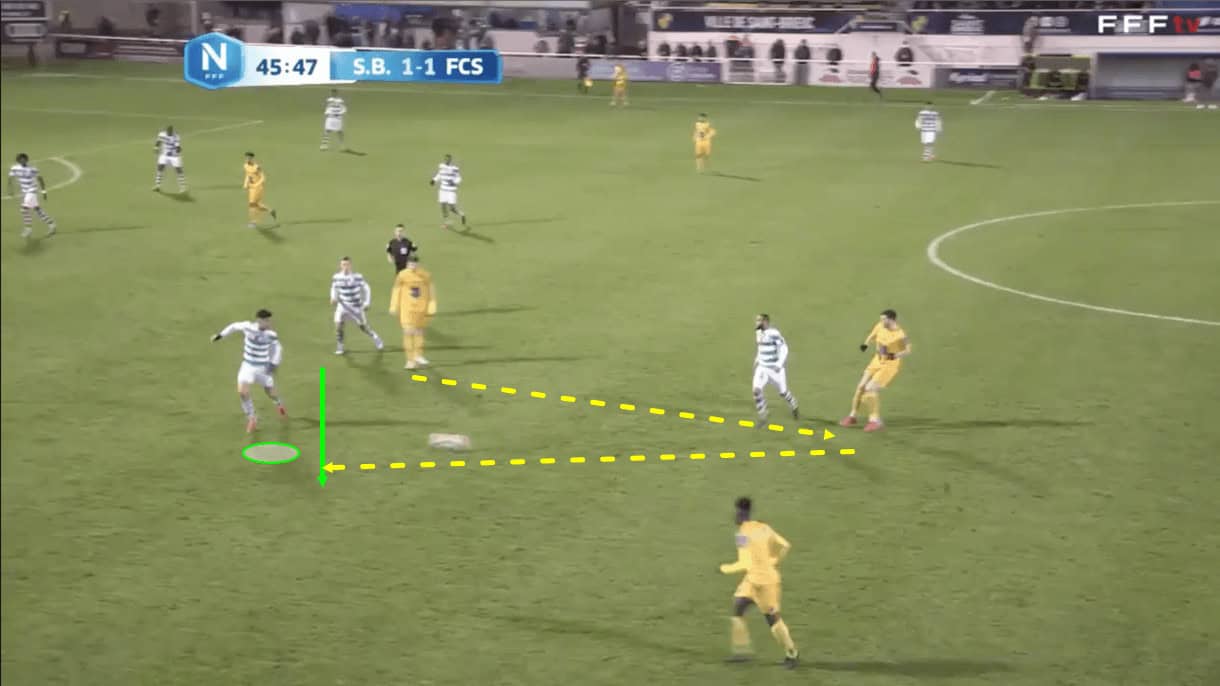
After the ball was sent deeper, another Sète player closed down the passer and this time, the player was rushed into a pass directed towards a more advanced player than the receiver in figure 11. The passer attempted to bypass Jarmouni by firing a crisp ball towards the winger further upfield but thanks to his deceptive pace and relentless work rate off the ball, the 21-year-old was able to cut the passing lane, intercept the pass and kickstart a counter-attack for his side, as we discussed being a benefit of his defensive effort. Again, this is just one example of this but it highlights something that’s been prominent in Jarmouni’s game throughout his loan spell in National 1, which has made him a great asset for his side.
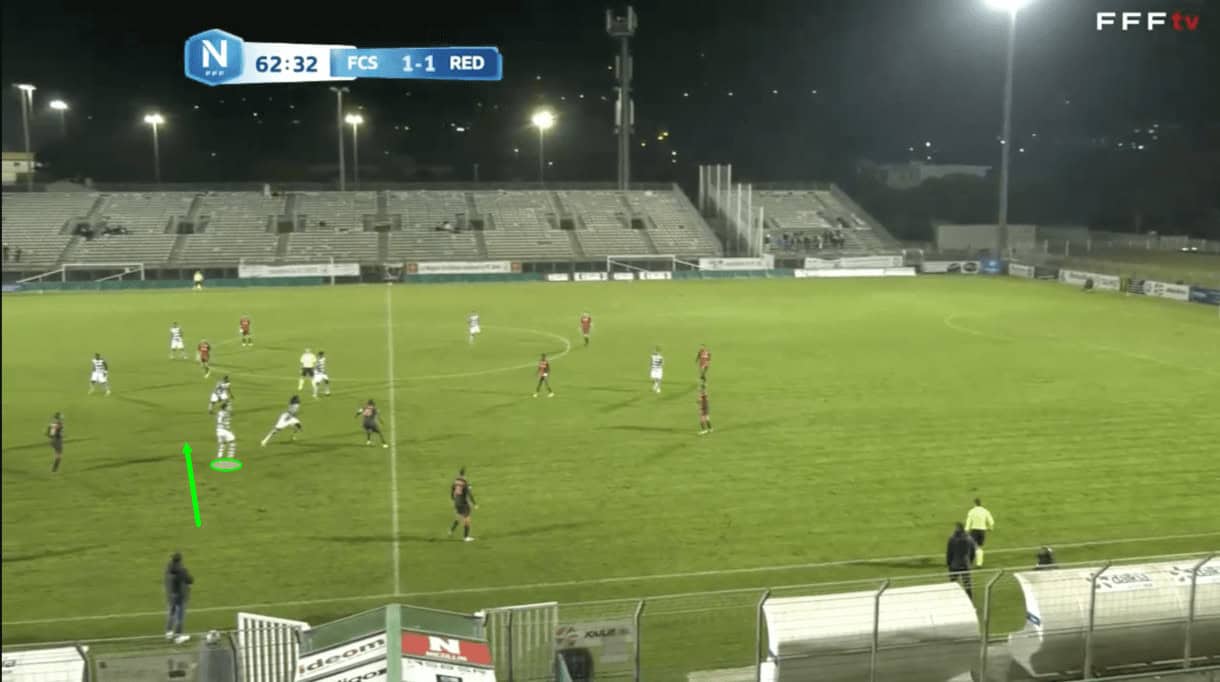
Figures 13-14 show another example of the player’s defensive work rate. Here in figure 13, we see that the opposition have played the ball into midfield, leading to a central midfielder getting drawn out of position. Jarmouni tucks in centrally to cover this player, displaying good spatial awareness and basic football intelligence that is an asset to his team in defensive phases.
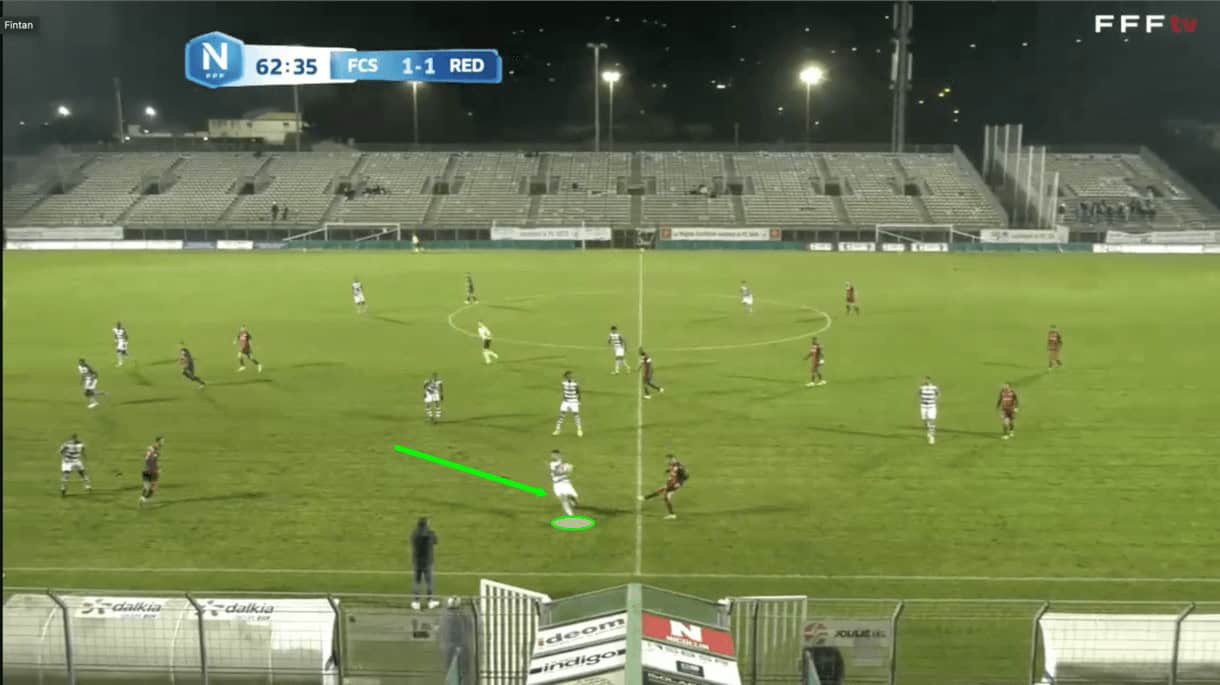
The ball ended up getting played back after entering midfield due to the pressure from Sète’s midfielders (including Jarmouni) but then the opposition attempted to exploit the fact Jarmouni’s wing was vacated as a result of the winger covering the centre by playing the ball to the full-back on that wing. However, as figure 14 highlights, the 21-year-old managed to get back into position in time to block the next play, preventing the opposition from progressing again. The fact he was able to recover here despite being caught out of position is a testament to his defensive work rate and his pace, which helps immensely in such situations.
All in all, as far as forwards go, Jarmouni is an excellent asset without the ball which is an extremely important trait for a forward, maybe more than ever in 2022.
Conclusion
To conclude this tactical analysis and scout report, we like Jarmouni a lot and believe that he’s got the ability to be an asset in Ligue 2, perhaps with his parent club Sochaux. Jarmouni’s unique physical combination of size, strength, pace and agility can make him a very difficult player to defend against in several different situations, and we think the 21-year-old has got great ability in terms of off-the-ball movement to arrive in high-value goalscoring positions at high frequency, hold-up play, aerial quality, dribbling ability and defensive work-rate.
Jarmouni is not a creative passer, however, and this is a clear area of weakness in his game, while the Sochaux man also needs to work on his ability to receive passes with space to drive into, as discussed above.

