
The EFL has been the platform for many of the current Premier League and European stars to start their careers.
Of Gareth Southgate’s England EURO 2020 squad, 22 players had played in the EFL at some point in their careers, usually at the start of their careers.
That is a remarkable statistic and demonstrates how strong the lower tiers of English football are.
Last week we conducted an analysis of current EFL Championship player Brennan Johnson and how he is bound for the Premier League after an impressive season.
Another young player who has had an impressive season in the EFL is Scott Twine of MK Dons in the EFL League One.
The 22-year-old Englishman recently won EFL League One Player of the Season and is heavily rumoured to be moving to Nottingham Forest this summer, but Premier League clubs like West Ham United have also been mentioned.
In the last game of the season Twine scored four goals and has a reputation for his dead ball and long-range goals but he offers much more than that which we will delve into in this analysis.
This tactical analysis and scout report will provide a deeper look into his performances and the key attributes that have allowed him to be so converted but also identify any areas that may need to improve in order to take the next step.
Scott Twine Position
Twine is a versatile attacker with the ability to play as an inside forward, striker and number 10.
Under Liam Manning tactics, MK Dons have been a tactically flexible team but usually deploy a 3-4-3 or 3-4-2-1 tactic, where Twine will usually play on the left of Troy Parrott the Tottenham Hotspur loanee.
Below is Twine’s heat map from this season, which shows him spending the majority of his time wide left and in the left half-space.

Twine is a technical player who thrives on getting between the lines, making passes behind the opposition defence, and making the attacking play tick.
If Twine is going to take the next step he will probably be used as an inside forward on the left with the ability to play as a number 10 if this is tactically available.
It makes sense that he has been heavily linked with Nottingham Forest.
He would fit in their 3-4-1-2 system and can play up front as a second striker or as a number 10.
Scott Twine Data analysis
As always with these scout reports, we will look at some of the metrics that the player is performing well in, with the hope of measuring their performance against similar players in the league and understanding more about their key attributes and playing style.
The graphs below show Twine against fellow EFL league One attackers with over 1500 minutes for their club this season.
When analysing Scott Twine, the first place to start is goal contributions (goals per 90 + assists per 90) and expected goal contributions (XG per 90 and XA per 90).
Below shows that Twine makes 0.64 goal contributions per 90 from an expected goal contribution of 0.44.

Twine outperforms both his XG per 90 and XA per 90.
This season he has managed 0.23 assists from an XA per 90 of 0.17, in addition to 0.41 goals per 90 from and XG per 90 of 0.27.
Twine significantly outperforms his XG which can largely be attributed to his free-kick and long-range shooting ability.
Below shows Twine’s shot map of his last 75 attempts on target.

As you can see Twine has scored three goals from outside the box in his last 75 shots, which is impressive with one being from around 30 yards out.
This has been consistent all season with Twine and explains why he is one of the biggest outperformers of their expected contributions, shown below.

As we alluded to earlier, Twine is a player who likes to get between the lines and create chances for teammates.
Below shows a couple of metrics which reinforce this.
The graph shows key passes per 90, which are passes that directly lead to a goal-scoring chance for their team, and smart passes per 90, which are passes that attempt to break the opposition’s defensive line.

As you can see above, Twine is one of the league’s top performers.
This can be reaffirmed by looking at passes to the penalty area and through balls per 90, which also measures a player’s creative contribution.

Again, Twine is amongst the top performers in the league.
The final data metrics we will look at are ball progression in the form of progressive passes per 90 and progressive runs per 90.
Strikers and attackers don’t usually excel at this; however, Twine is slightly different due to his role in the MK Dons’ build-up.

Twine uses a combination of progressive passes with 4.7 per 90 and progressive runs with 1.78 per 90.
Both are above the average for attackers in League One and highlight how Twine can effectively help his team advance up the pitch and closer to goal.
In this data analysis section, we have briefly discussed Twine’s performance in some attacking metrics, with a particular focus on his goal contribution.
As well as establishing that he is one of the best attackers in the league.
Scott Twine Getting between the lines
One of Scott Twine’s greatest attributes is his ability to get between lines and help orchestrate the attacking play.
This is something he does when either playing on the left or drifting inside into the left half-spaces. When playing as a second striker, he will drop into a number 10 role when MK Dons are in possession.
Below we will demonstrate a couple of examples of Twine doing this.
This first example comes against Accrington Stanley, and as you can see, Twine is dropping into his own half to get on the ball.
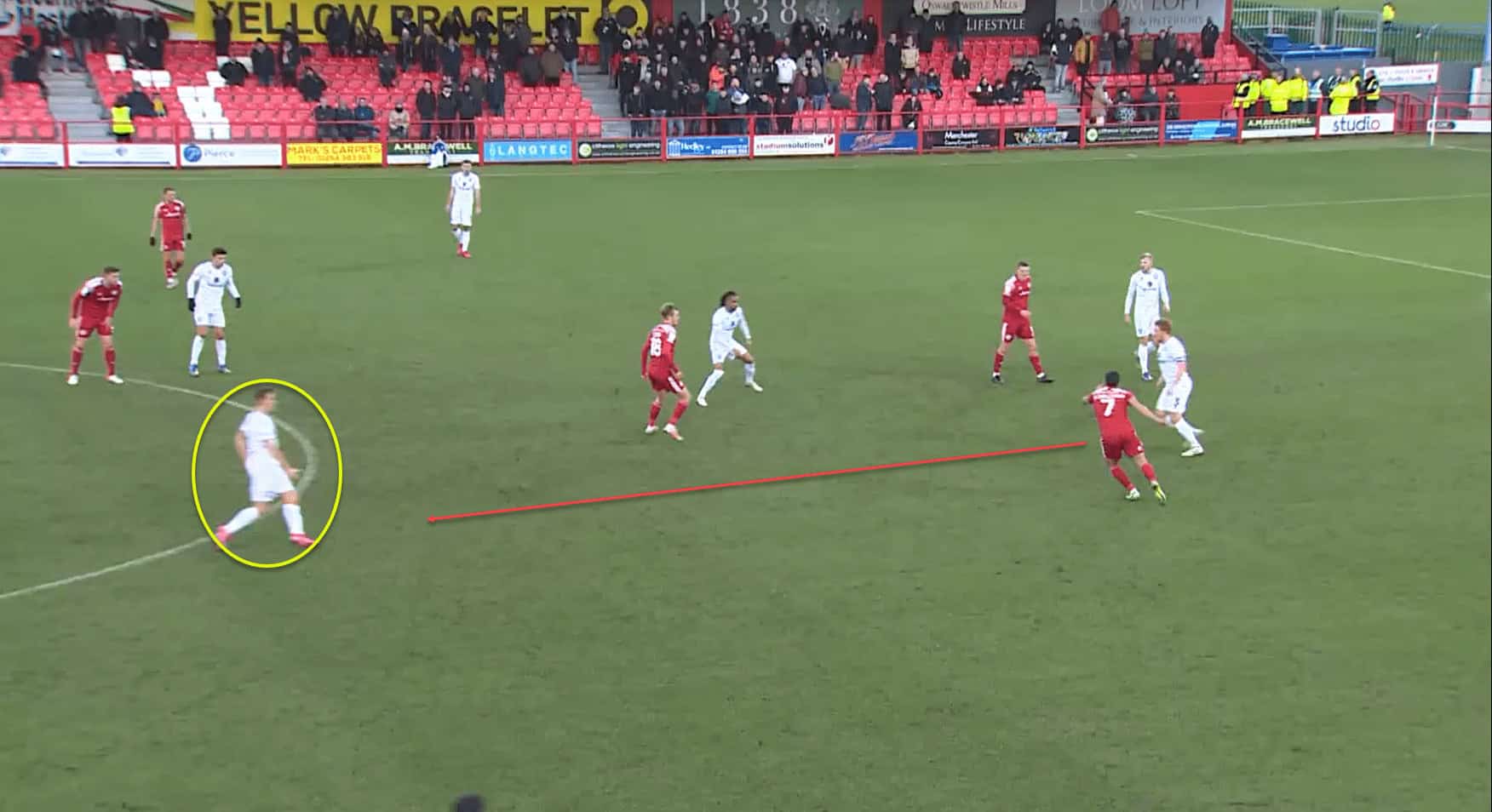
Twine has received the ball and anticipates the opposition defender and rolls him into the highlighted space.
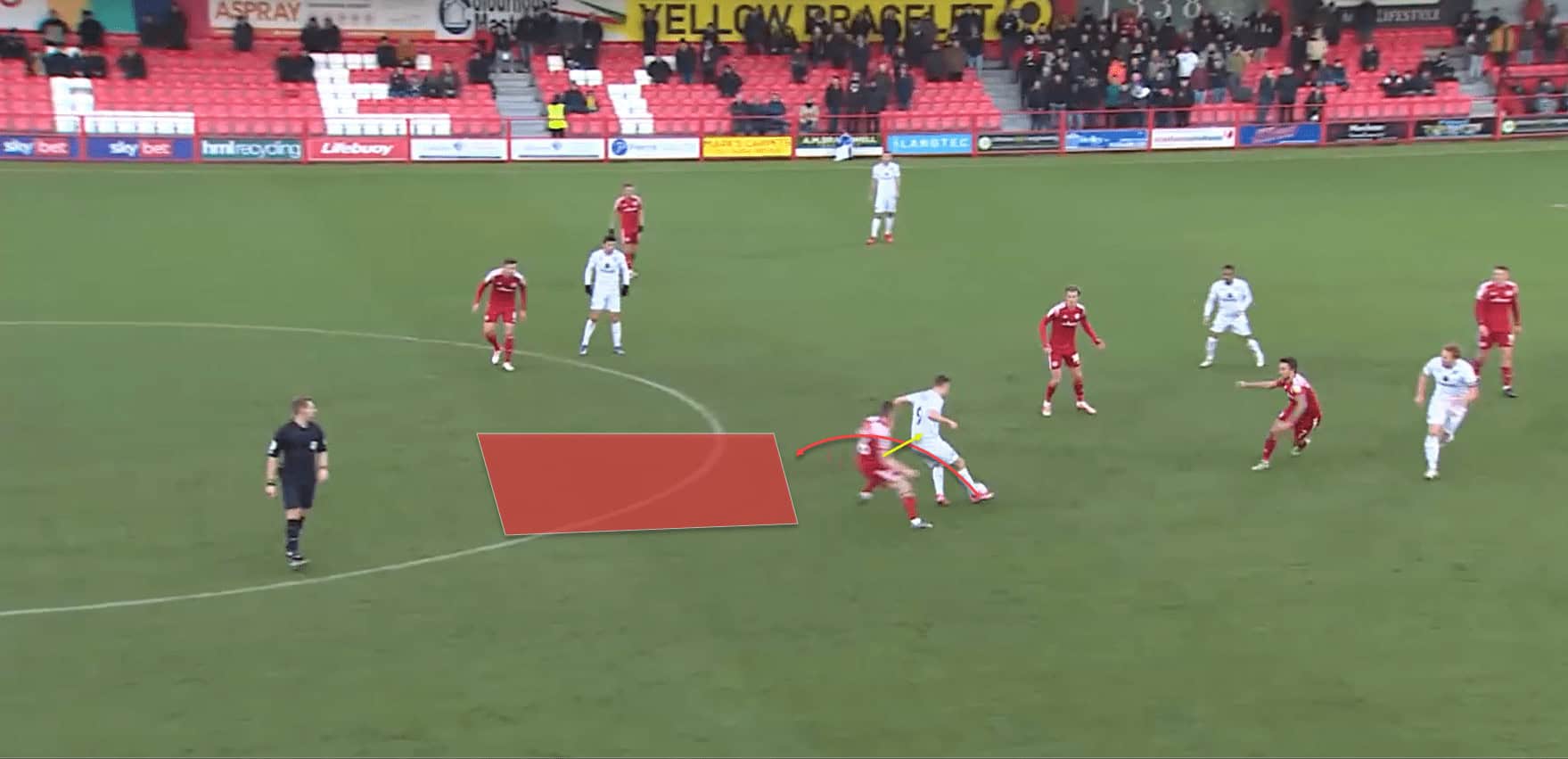
After turning the Accrington Player, Twine immediately releases a pass for one of his fellow attackers, who runs in on goal.
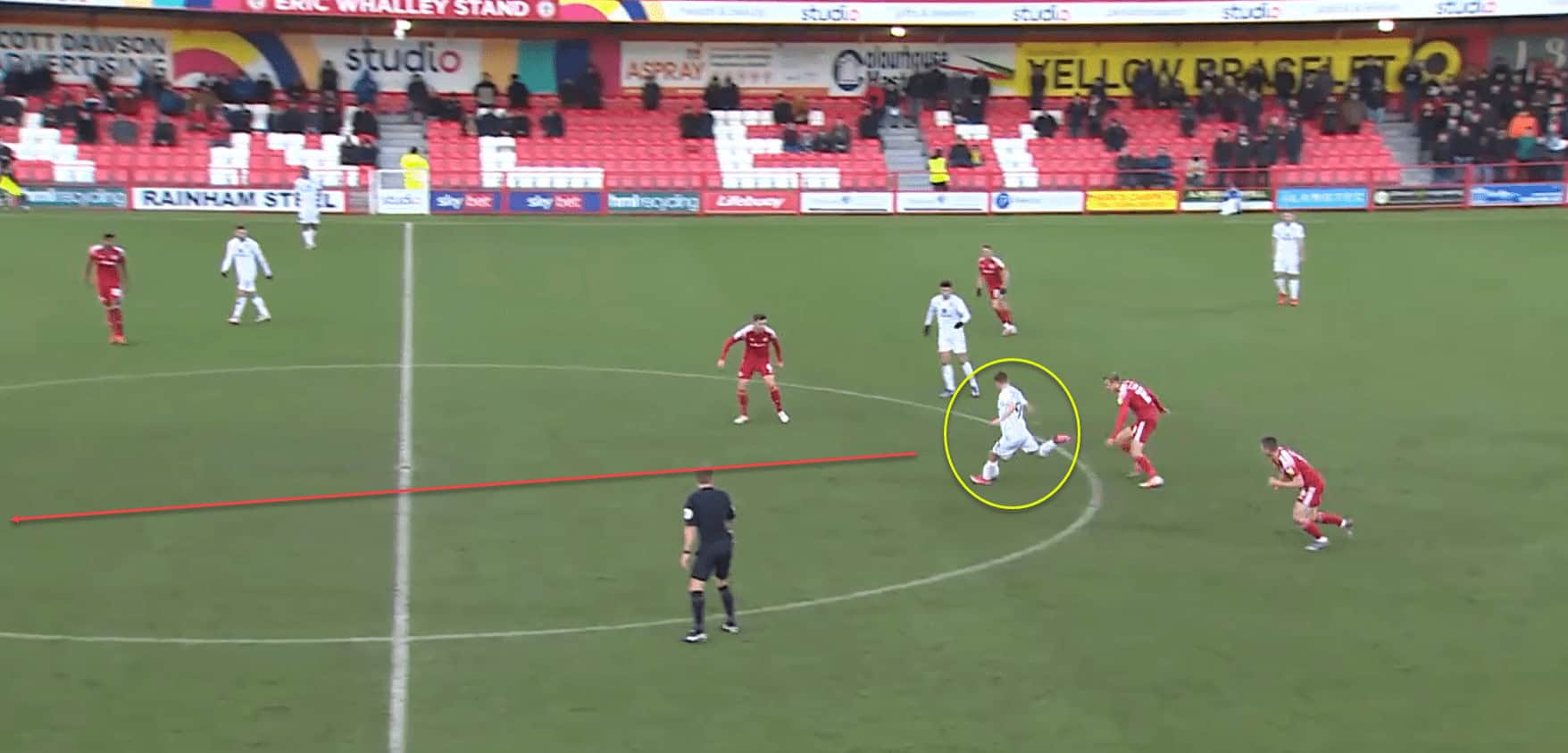
The next example shows Twine doing this but in the more advanced stage of the attack.
As you can see Twine is getting between the Plymouth defensive line and midfield block.
The MK Dons left wingback is going to play a pass into Twine’s feet.
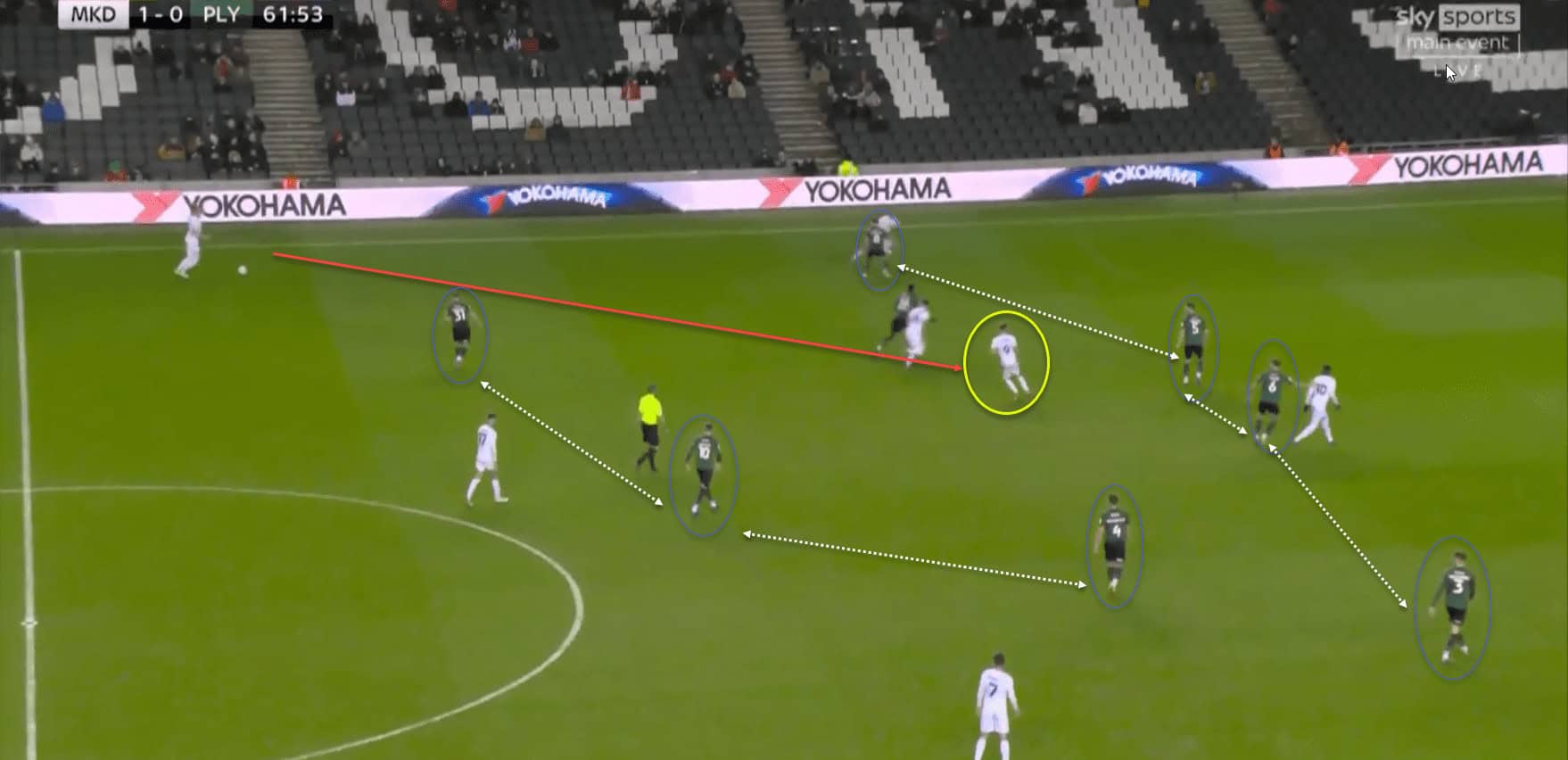
When the ball comes to Twine he receives pressure from one of the Plymouth defenders.
He cleverly uses this to his advantage and plays a brilliant first-time pass over the defensive line into the space left by the defender.

The pass isn’t gathered by the Mk Dons attackers but also shows Twine’s quality and his ability to manipulate space.
Hopefully, both of these examples show how Twine uses the space between defensive lines and his role in the MK Dons’ build-up play.
Scott Twine Finding space in congested areas
Another aspect of Twine’s game that is important to his play but also allows him to be so effective is his ability to find space in tight areas, especially in the box.
Twine excellently identifies and moves into pockets of space in and around the box, using this to create chances or score goals.
The following example shows Twine finding pockets of space to score goals.
Below shows MK Dons on the attack and Shrewsbury Town is defending deep in their own box.
As you can see, the MK Dons player on the ball is going to play a ball across the face of the goal.
So Twine identifies the space shown in the box, drops into it, and provides a cutback option for the man in the ball.
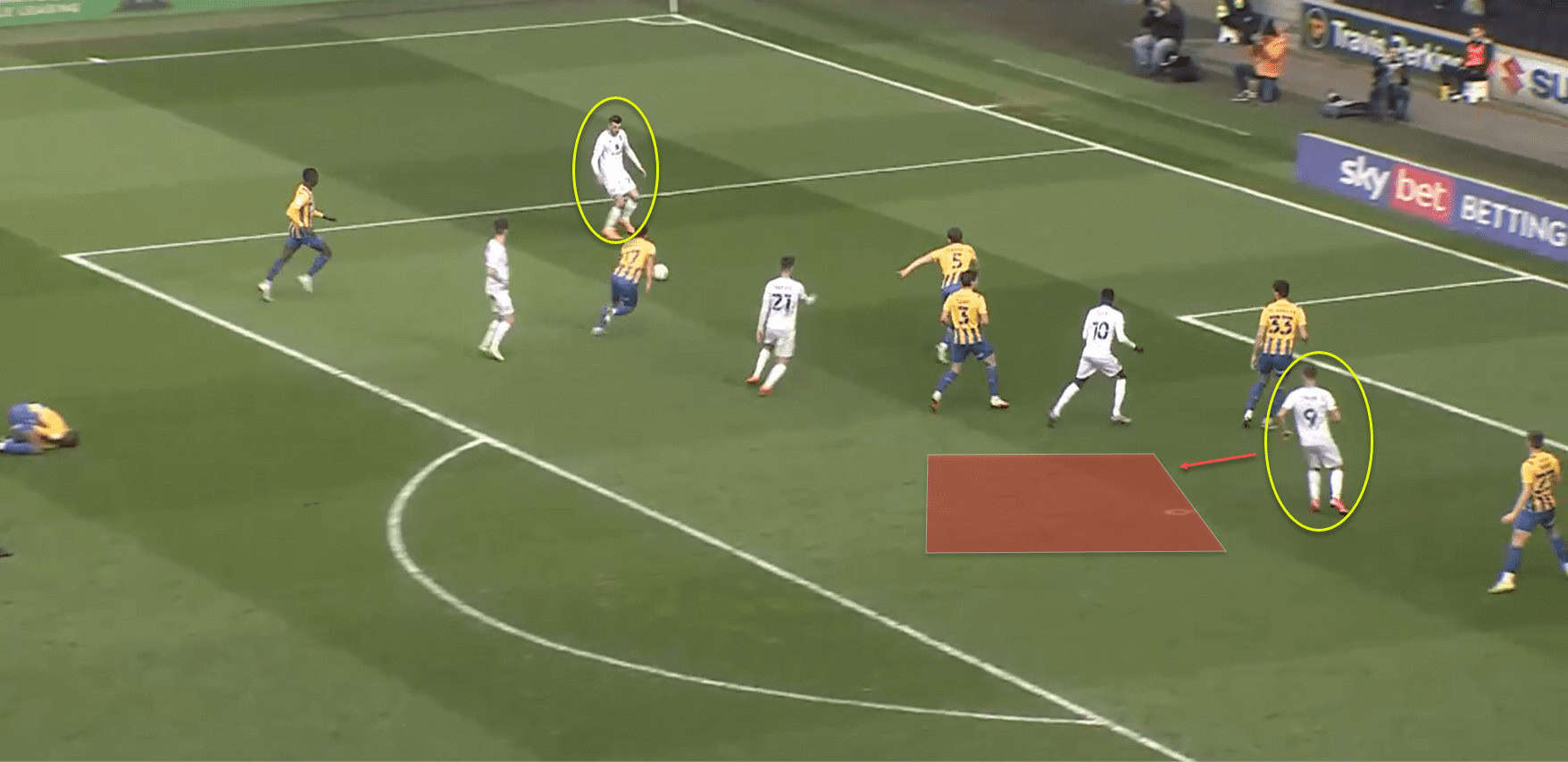
Now the man on the ball doesn’t make that pass and simply plays a pass inside to a fellow teammate.
Now Twine doesn’t wait for the ball and with the Shrewsbury defenders pressing up, he decides to drop deeper into the highlighted space.
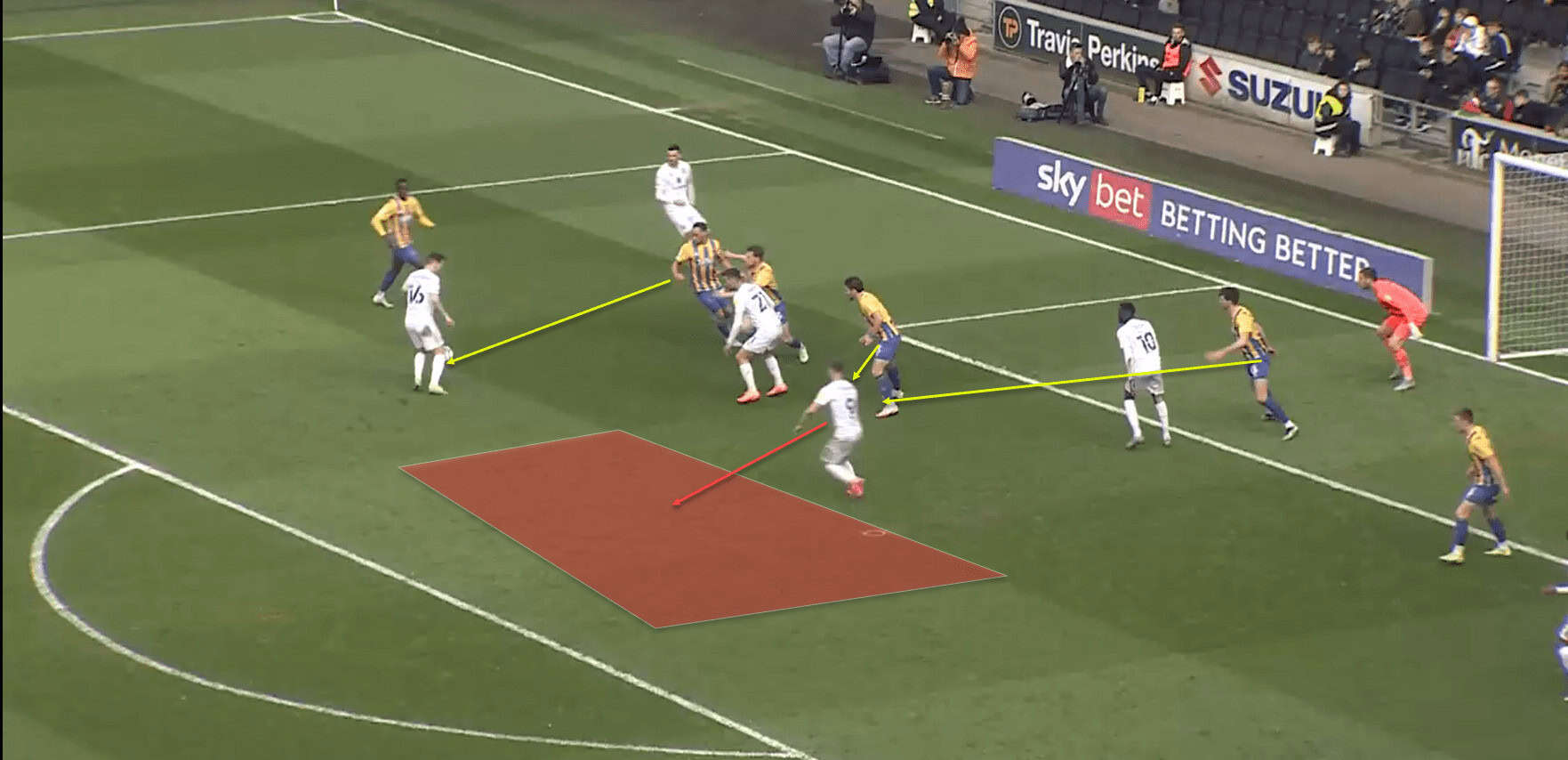
Twine manages to receive the ball and take a touch before firing a shot into the bottom corner, adding to his impressive goal-scoring record for the season.
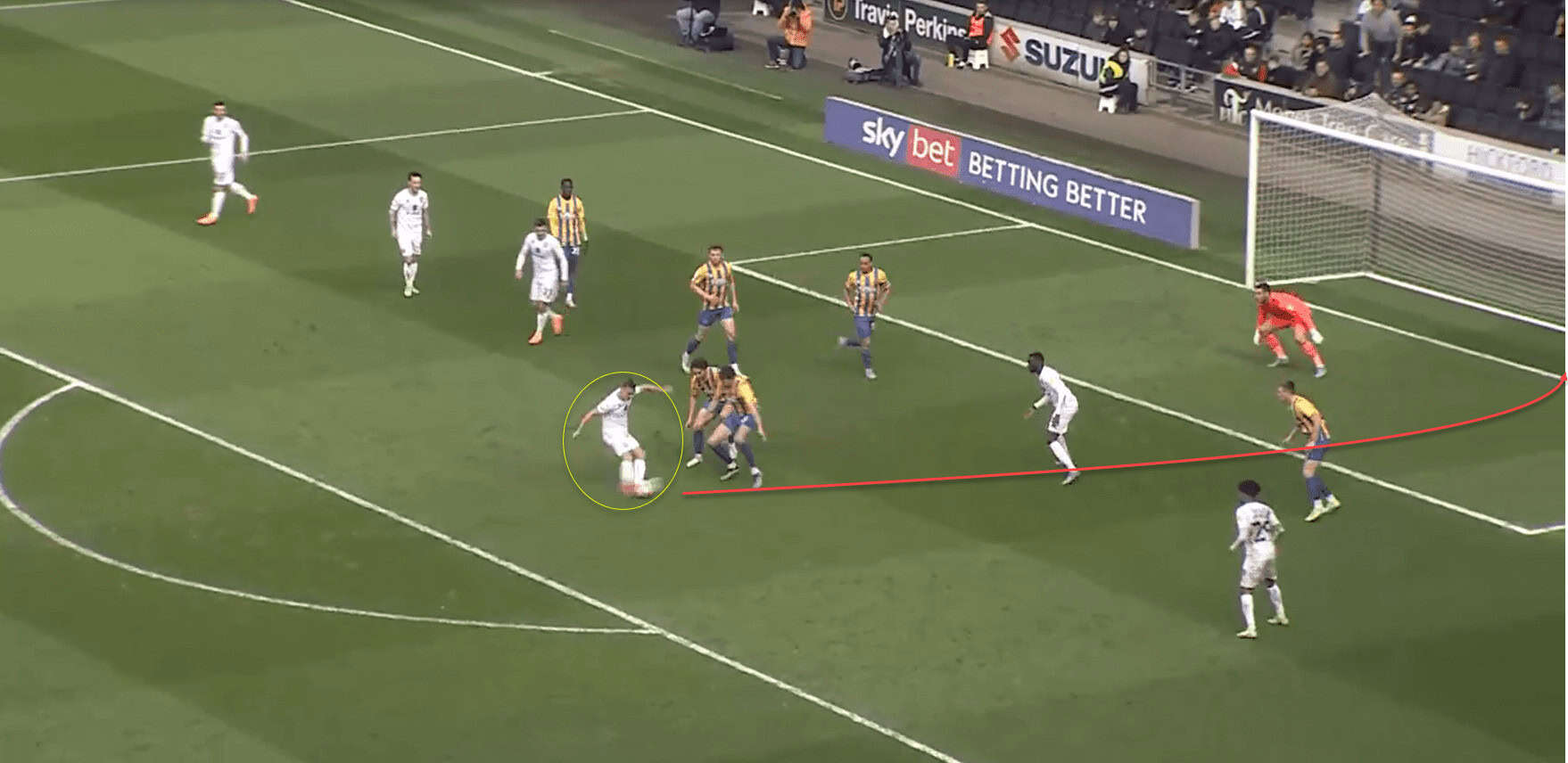
Twine’s ability to find space in tight areas is impressive but he also combines this with clever runs that also manipulate space.
Allowing him to be so effective in and around the box.
Conclusion
Hopefully, this analysis has given you a better understanding of Scott Twine, his qualities, and the attributes that allow him to be so effective.
Twine is a versatile attacker who, due to his skill set and attributes, can occupy a variety of attacking roles.
He is certainly a name you will hear more of, whether in the Premier League or the EFL Championship, as his quality will inevitably take him up the pyramid.
