


At the start of the 2020/2021 season, Ilya Zabarnyi was an unknown player in Europe who had not played a minute in a senior competitive match, but now he is well-known around Europe and is labelled as a wonderkid.
He was a starter for both Dynamo Kyiv and Ukraine, which tells us a lot about how much he impressed in his first senior matches.
Zabarnyi played all six matches (full minutes) in the group stage of the Champions League, as well as three qualifying matches.
He managed to collect 13 caps since October, and he was a vital part of the Ukrainian starting XI in the EURO 2020.
Zabarnyi’s idol is Liverpool star Virgil van Dijk, and he aspires to play alongside him.
Through this scout report, we aim to describe Zabarnyi’s abilities, highlighting his strengths and weaknesses.
This tactical analysis will help us understand why this youngster has made such rapid development in a short amount of time, becoming one of the most sought-after defenders in the game.
Chelsea showed interest in him before the EURO 2020 tournament, and it appears they contacted Dynamo Kyiv for negotiations.
Ilya Zabarnyi Player overview
Ilya Zabarnyi is an 18-year-old centre-back.
Transfermarkt values him at € 11 million, and his price growth has been rapid since October 2020, when he was valued at € 50,000.
Zabarnyi is 189cm tall, and he is right-footed.

In this image, we can see how Zabarnyi compares to centre-backs from the Ukrainian Premier League who have played at least 500 minutes this season.
His heatmap indicates that Dynamo Kyiv was dominant in most matches, given its high positioning.
Based on the data, it is clear that he didn’t have a lot of defensive work, as he is one of the players who had the least successful defensive actions, interceptions, and aerial duels (all per 90).
However, he had an above-average number of defensive duels, and he was pretty successful with a 68.12% success rate.
He didn’t make many fouls, which is praiseworthy for such a young player.
His game on the ball and passing ability are what separate Zabarnyi from the others.
We can see that he had a high number of passes per 90 (61.23), and he is the most accurate passer among the centre-backs in the Ukrainian Premier Liga, with a passing accuracy of 93.16%.
Zabarnyi also makes a good amount of progressive actions with 7.96 progressive passes per 90 and 1.52 progressive runs per 90, which, again, is the top output for centre-back.
This season, he has played mostly as a right-sided centre-back in a 4-2-3-1 formation.
He has experience playing in the three-man defence as well, meaning he is adaptable to different systems and tactics.
Ilya Zabarnyi Defending ability
Since Zabarnyi is the centre-back, we will start with evaluating his defending ability.
The first example will be his reading of the game.
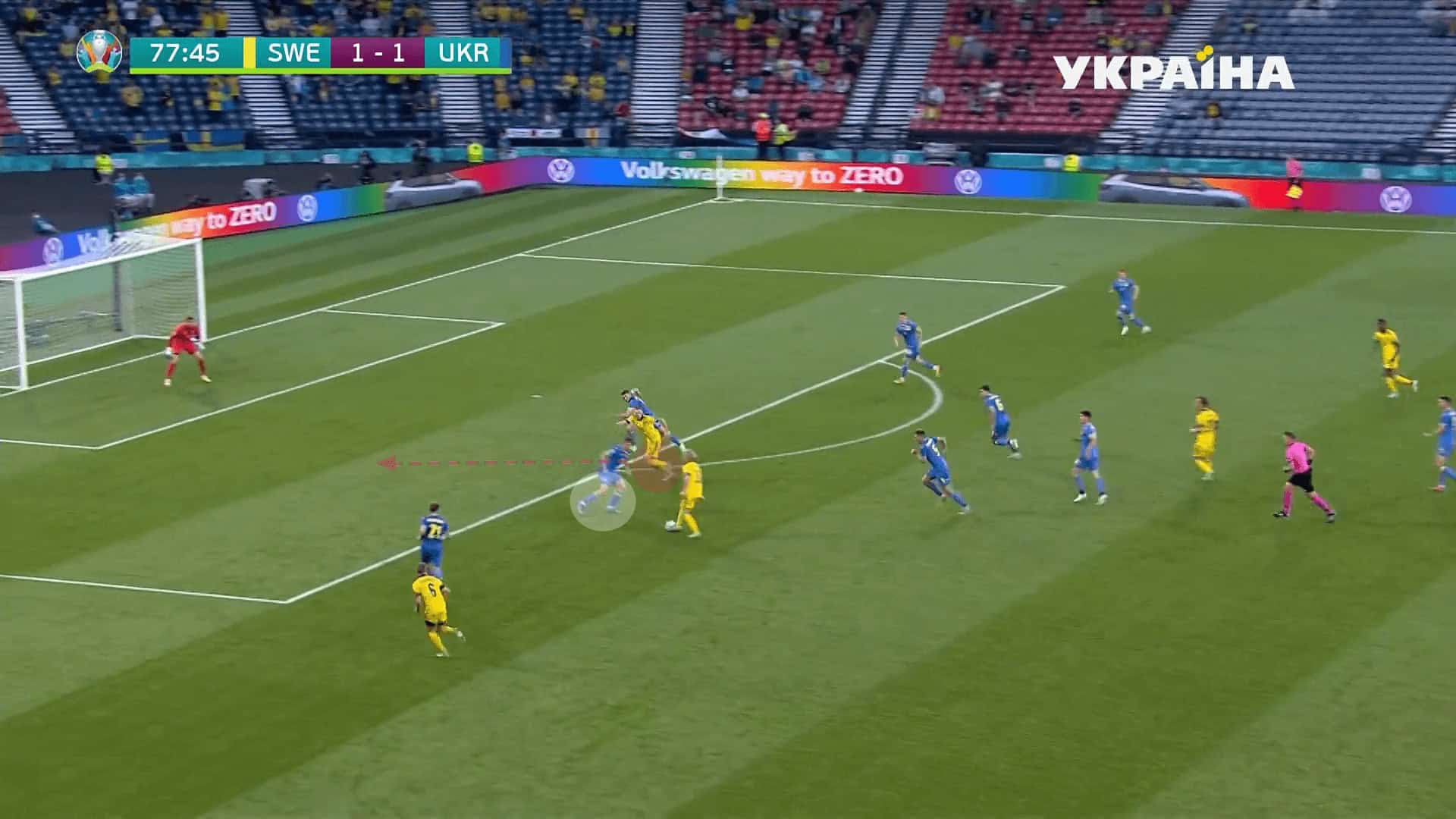
The above image is an example from a match against Sweden.
In that match, he played in a three-man defence as right centre-back.
Zabarnyi stepped out from the line to close down Emil Forsberg, who saw a run from Dejan Kuluševski in behind.
Zabarnyi positioned himself well to protect space behind him and intercept the pass towards the Kuluševski.
It is very important for his ability that he doesn’t engage too much in similar situations, which could endanger his team if he gets beaten, but instead reads the game and positions himself well.
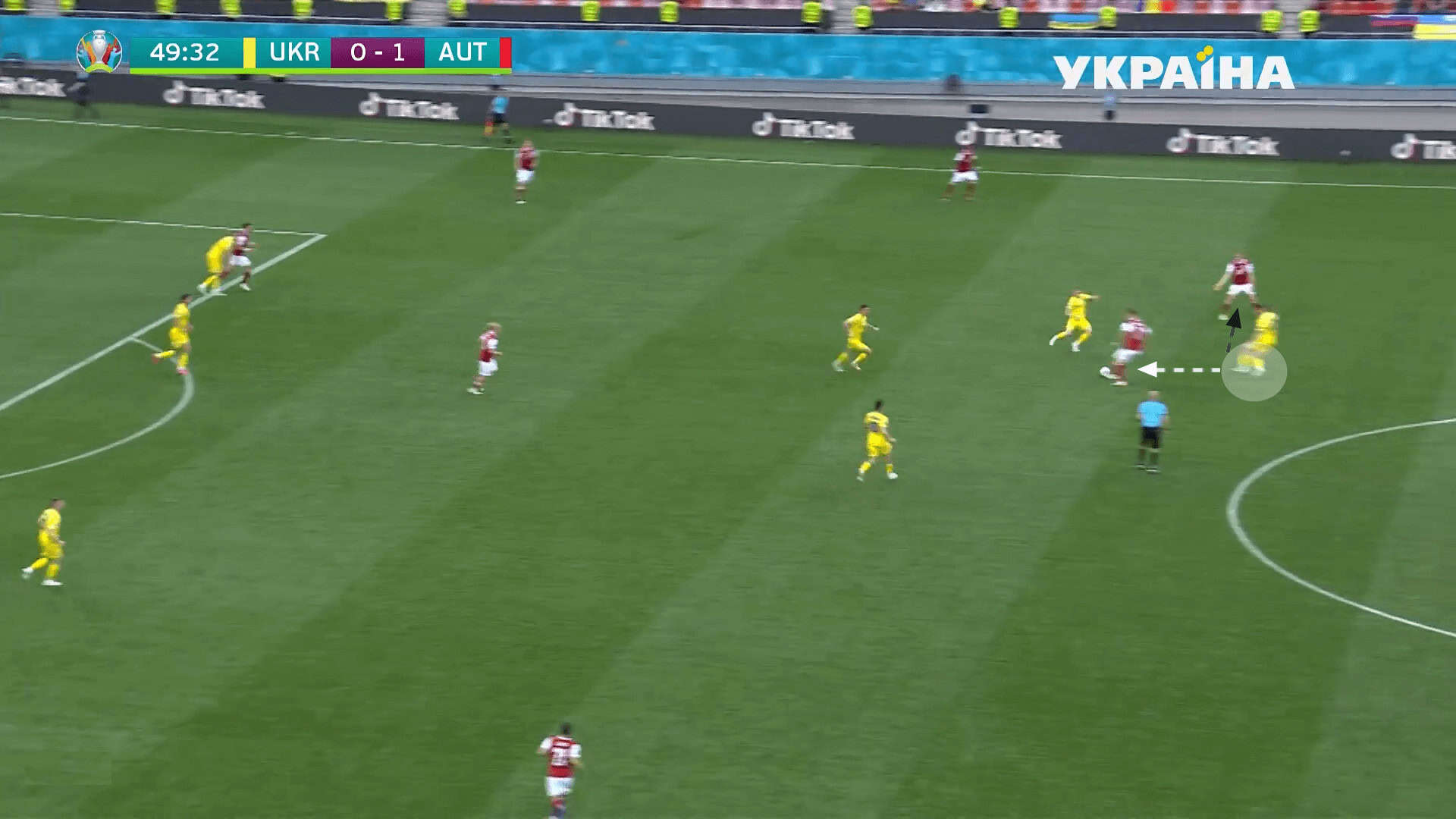
In the example below, we can see another good example of his quality reading of the game and anticipation of opponents’ actions.
As we can see, Zabarnyi followed opposition forward Marko Arnautović(white arrow), who dropped deeper to receive the ball.
At the moment when Arnautović makes the first touch, Zabarnyi reads his next move and changes the direction of his run (black arrow).
Zabarnyi’s intelligent movement is on point here because he didn’t engage too closely with Arnautović, which would have been dangerous for his team, and he read the situation well, intercepting the Arnautović lay-off towards his teammate.
This is high-quality defending by Zabarnyi.
The next image shows how Zabarnyi makes a proactive movement to prevent the opposition from advancing forward to receive the ball.
He doesn’t come into the duel from behind to close the forward and let him receive the ball, but he accelerates to come laterally, disabling the forward to shield the ball from him.
It can be risky coming into the duel around the opponent if he manages to make the first touch, but if the movement to step out is timed correctly, it mostly ends with an intercepted ball.
Zabarnyi managed to intercept the ball, and it was hard for the opposition forward to prevent Zabarnyi from jumping out in front of him.
These types of proactive movements are very important for defenders because they will have fewer opportunities to receive the ball and turn or go into 1v1 situations, which decreases the number of works for defenders by doing smart movements, which is precisely what Zabarnyi did.

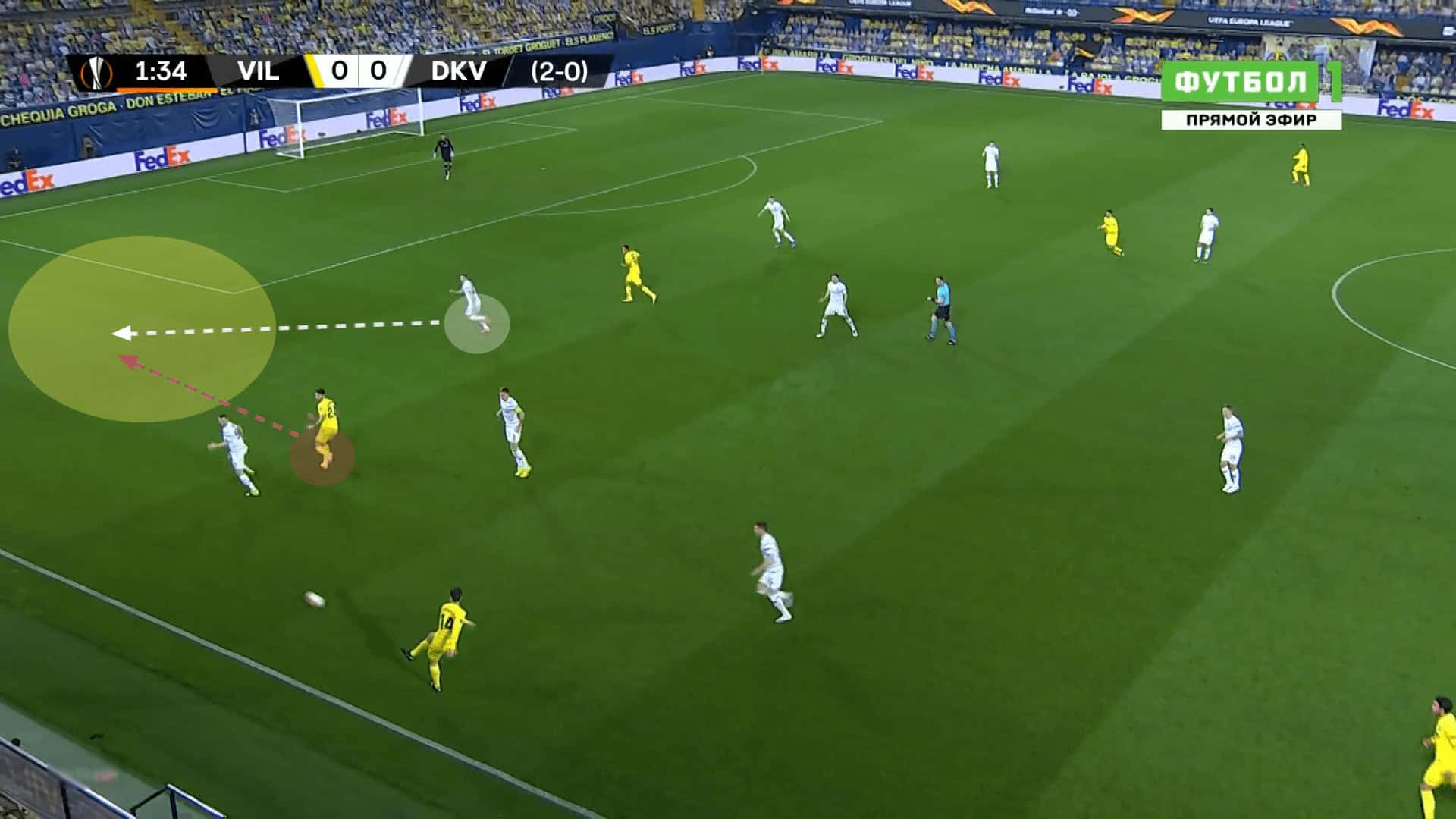
In the example below, we can see how Zabarnyi makes a covering run to close space behind the full-back.
Right-back is oriented on the ball and marks an opposition winger who is making a run to attack the space behind him.
Villarreal player Manu Trigueros (#14) makes a pass into the space behind the right-back, and a moment before the pass, Zabarnyi starts moving towards the open space(yellow area) to close down and prevent the opponent from getting the ball there.
Because of the good reading of the game, Zabarnyi got to the ball first and avoided being 1v1 on wide space with an opposition winger.
In this section, we evaluated Zabarnyi’s defending ability, which is on a very good level.
He is an intelligent central defender who positions himself well and moves proactively off the ball.
Ilya Zabarnyi Ball-playing centre-back
In this section, we will take a look at Ilya Zabarnyi’s passing ability.
Given that Dynamo Kyiv dominated possession last season in the Ukrainian Premier League, they had plenty of passes and opportunities to develop their ball progression.
In the example below, we will see one sequence from the match against the Netherlands where he showed good ball progression ability.
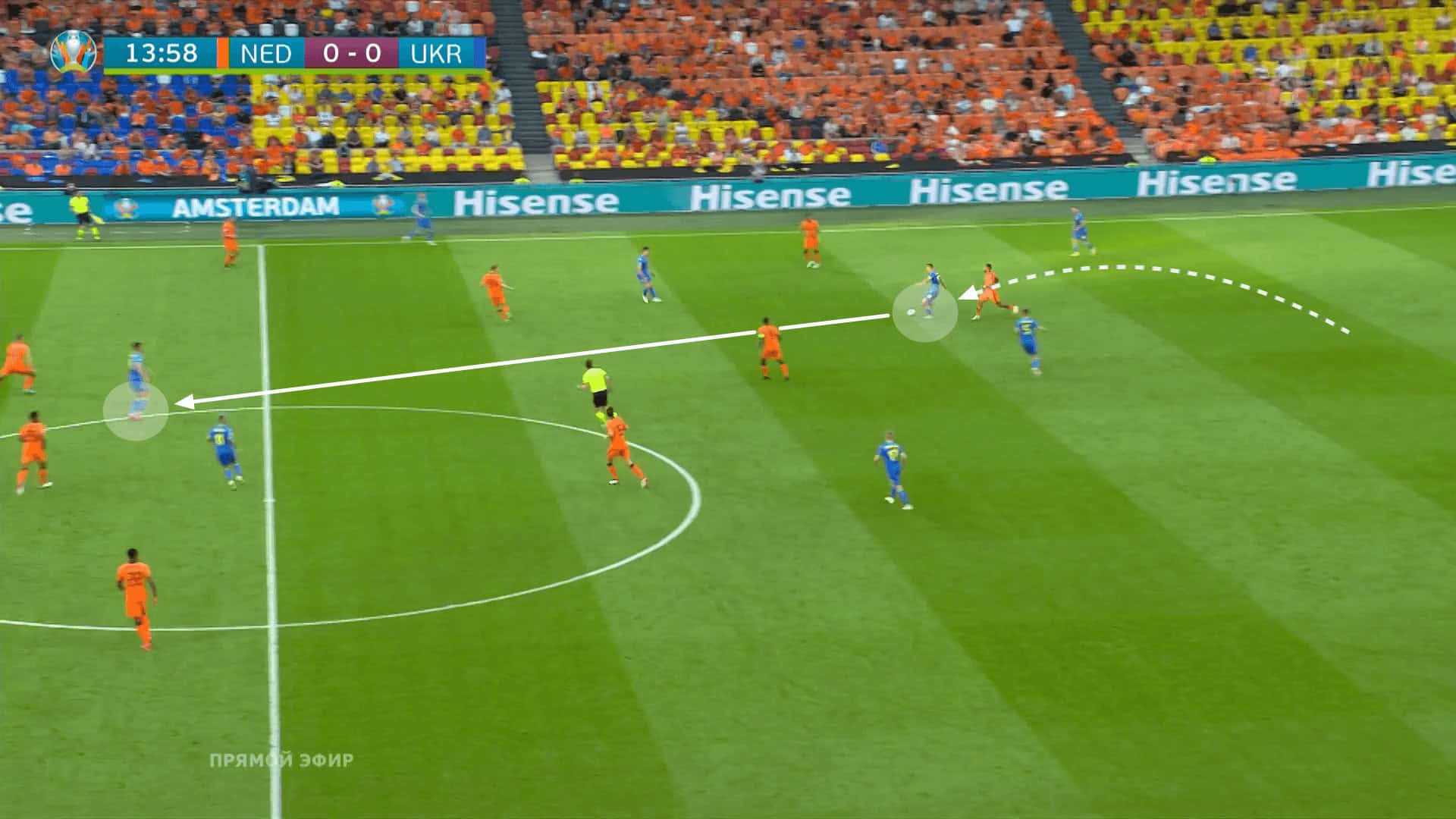
As we can see, Zabarnyi made a penetrative pass towards Roman Yaremchuk, who is in a good position to receive the ball in the opposition half.
To create this situation for himself, Zabarnyi made a run towards the open space, bypassing Memphis Depay (the closest Netherlands player), which opened the passing lane towards Yaremchuk.
Given the data presented in the first section, he is one of the best progressive central defenders in the Ukrainian Premier Liga.
As time passes, he will grow more confident and develop his ability to make progress both by running with the ball and passing it.
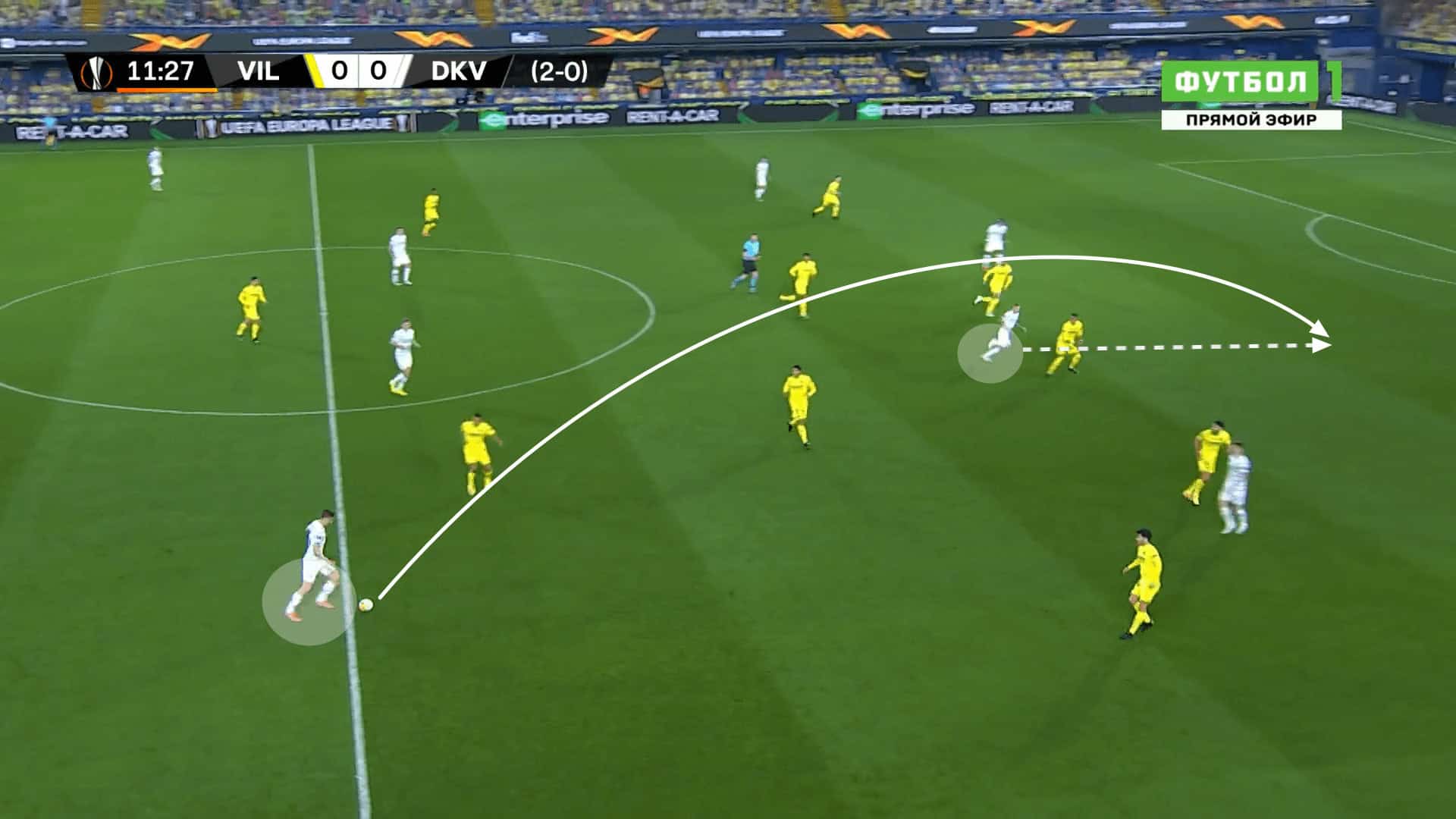
This example above shows us Zabarnyi’s ability to see runners in behind and his passing quality.
In this situation, Zabarnyi is in possession of the ball, and his teammate makes a run between the opposition centre-backs.
Zabarnyi has the vision to see that kind of movement and also has enough confidence in his passing ability to attempt a pass over the defence into the open space.
Timing is very important, and Zabarnyi demonstrates good eye-foot coordination to see his teammate and make a well-timed pass into the open space.
This is something that the football world has started to expect from centre-backs on the highest stage, and Zabarnyi surely has the quality to make these kinds of actions.
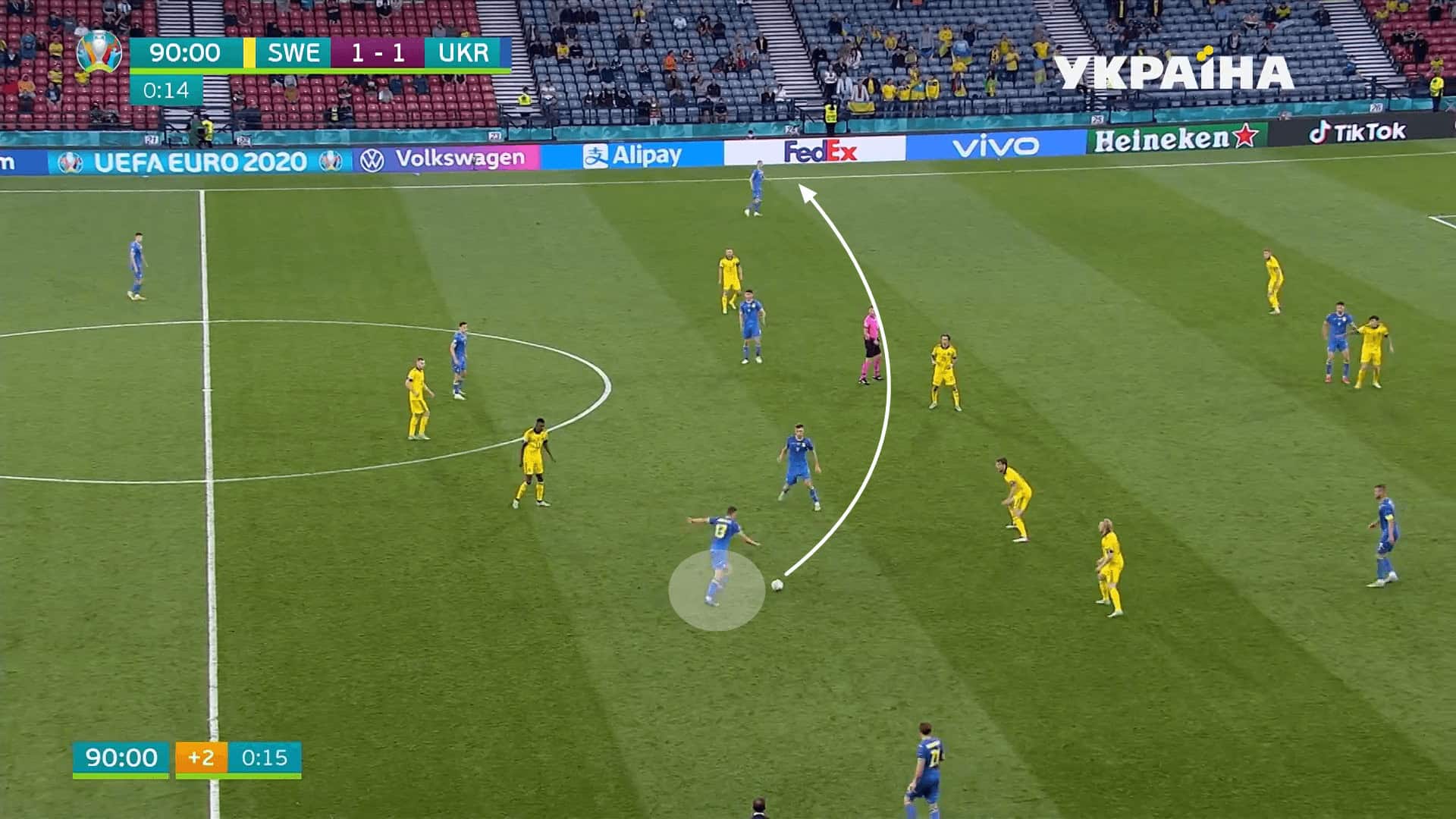
The last example in this section is a situation from the match against Sweden.
When discussing the centre-back’s progressive ability, it is essential to highlight his decision-making.
In this example, we can see that he got deep into the opposition half and he switched the play towards the left side.
The purpose of this example is that Zabarnyi didn’t force a ground pass towards his teammates, even though most of them could receive the ball.
Still, neither of them is in a good situation to receive the ball because they would be under instant pressure from at least two opposition player,s and it could lead to an opposition counter-attack.
Zabarnyi chooses to switch play towards the best option because Oleksandr Zinchenko has plenty of space in front of him and a potential crossing opportunity.
It can be said that Zabarnyi demonstrates a good balance between safe passes and risky/progressive passes due to his effective decision-making and situational awareness on the pitch.
Ilya Zabarnyi Weaknesses
About his weaknesses, we don’t have much to highlight, but if we had to, we would mention his aerial ability.
He has a tall frame, but his success rate in the aerial duels, as shown in the first image of this analysis, indicates that he is below average compared to the centre-backs in the league.
However, it is mainly connected to his adaptation to senior football, where more forwards are stronger and tougher in the air than he faced before at the youth level.
Zabarnyi makes such rapid progress, from playing against forwards at U18 level to playing against Lionel Messi, Cristiano Ronaldo, and Antoine Griezmann at Champions League level in such a short time span, and coping with them is really impressive.
He has a lot of room to improve and to develop his style of defending against different types of forwards, but it was a massive debut season for him.
Conclusion
What we can conclude is that Zabarnyi appears to be a potential top-class centre-back who will likely play on the highest stage in the next 10-15 years if his development continues in this direction.
It is not surprising that he got a chance for his country so early, having played just 7 matches at senior level.
We have to praise Ukrainian legend and head coach Andriy Shevchenko for recognising his potential and giving him a chance in the national team.

