
Despite participating only in a few of Italy’s games on Euro 2020, Matteo Pessina’s performance was very important in their road to the title. His solid displays helped the team against tough opponents and while he was benched in the final against England, he still deserves to be praised for his contribution.
The 24-year-old arrived at Atalanta in 2017 but lacked the experience to get regular playing time. The club’s plan for him was different. While they still had Alejandro Gómez in the attacking midfield position, they wanted Pessina to gain more experience which led to him being loaned both at Spezia and Verona over time.
Once he became a regular starter at Verona in 2019/20 and Gian Piero Gasperini’s relationship with Papu Gómez started to fall off, the only logical move was starting to integrate him to Atalanta’s first team and giving him the chance to prove himself.
He was regularly relied on in the 2020/21 season and helped La Dea to reach third place in Serie A and earn a Champions League spot for a second consecutive year, although his average playing time in the league was 59.17 minutes per game. Pessina fit the manager’s tactics and allowed Atalanta to employ the attack-minded and entertaining football even in the absence of their talisman Gómez.
While the Italian didn’t have the same impact in front of the goal and he wasn’t so efficient in his goal contribution, he managed to help the team in many different ways.
In this scout report in the form of tactical analysis, we will examine how important is Pessina for Atalanta and is he the right person to help them fulfil their ambitions
Matteo Pessina vs Papu Gómez – data comparison
Before explaining what Pessina adds to Atalanta’s performance, we compared his 2020/21 average data to his predecessor Gómez’s, to examine whether they had the same impact in certain areas, although the differences in their roles should be considered.

Starting with their attacking contribution, we see that the Argentine was more efficient in his forward actions than Pessina. While this could be a result of Pessina often being deployed in a deeper position, the differences are quite noticeable. Gómez’s experience in the attacking midfield position and his skills on the ball have resulted in an average of 4.65 dribble attempts per 90 and 3.51 progressive runs per 90, compared to much lower numbers for Pessina (2.88 dribbles and 0.78 progressive runs). This shows Gómez’s ability to carry the ball to the advanced areas through individual skill. Pessina on the other side contributes to ball progression better with his positioning and passing range, rather than with his control and movement with the ball. The Argentine also had more efforts on the goal but this might be a result of him sticking to a more advanced position.

When it comes to passing the two players have very similar numbers in each indicator. Their Passes per 90 and their accurate passes % are almost identical, and as shown in the graph above, they had a similar contribution to the final third actions, although Gómez provided more passes to the penalty area than Pessina. This has more to do with his tendency to occupy the wide areas and cross the ball.

Defensively, things look different. The scales are tilted in Pessina’s favour. He has been involved in the team’s defensive actions more, which is illustrated in the Defensive duels per 90 numbers as well as in their Recoveries per 90. The Italian has dived into more challenges and has been successful out of possession.
Developing into a versatile midfielder
Pessina has played in multiple positions and in different formations which has helped him to develop into a versatile midfielder with attacking flair but also defensive awareness. He was a left attacking midfielder in Hellas Verona’s 3-4-2-1 formation, while his role under Gasperini was constantly changing depending on the opposition and the tactics in each game.
Most of the time at La Dea, the 24-year-old had more defensive responsibilities compared to his previous clubs. He has played as a defensive midfielder, as both left and right midfielder and as an attacking midfielder. This is part of the reason for his lower goal contribution. He was more involved in ball progression and retention, and also in supporting the backline during transitions, rather than making runs to the box or shooting.

With the wing-backs, Robin Gosens and Hans Hateboer who constantly contribute to the attacking actions, Pessina’s position was very dependent on who is fit and who can play centrally and filling the gaps. In the absence of Marten De Roon or Remo Freuler, the Italian had to accept a more box-to-box role with more defensive responsibilities respectively. Once Gómez was sold to La Liga’s Sevilla, he had a better chance to play a role further up the pitch, although he was again dependent on Mario Pašalić and Ruslan Malinovskyi.
Although he gained confidence in his defensive actions, his movement upfront was more impressive thanks to his strong spatial awareness and smart positioning. Even though he doesn’t have Papu’s control and movement on the ball, the AMF role in Gasperini’s 3-4-1-2 and 3-4-2-1 formations is suitable for him. Atalanta have been known for their smooth transitions and fluid attacking movement and Pessina’s ability to move between the opposition lines and open passing lanes has fit that strategy well. Similarly to Gosens, who is proficient in making late runs to the penalty area and providing a direct threat in front of the goal, the Italian exploits space very efficiently and often breaks lines with his movement.

The manager tries to experiment with his set-ups last season and many times adjusted them based on their opposition’s playing style. This resulted in employing the team in back four formations on a few occasions, which is quite unusual for him.
While previously he mostly relied on playing with an AMC and a couple of strikers upfront, he was now more open to trying different combinations upfront, especially playing with a lone striker. That’s why Pessina had to quickly adjust to different roles in each game. His most suitable position is the No. 10 behind the strikers due to his aim to support the ball progression as well as the actions in the final third.
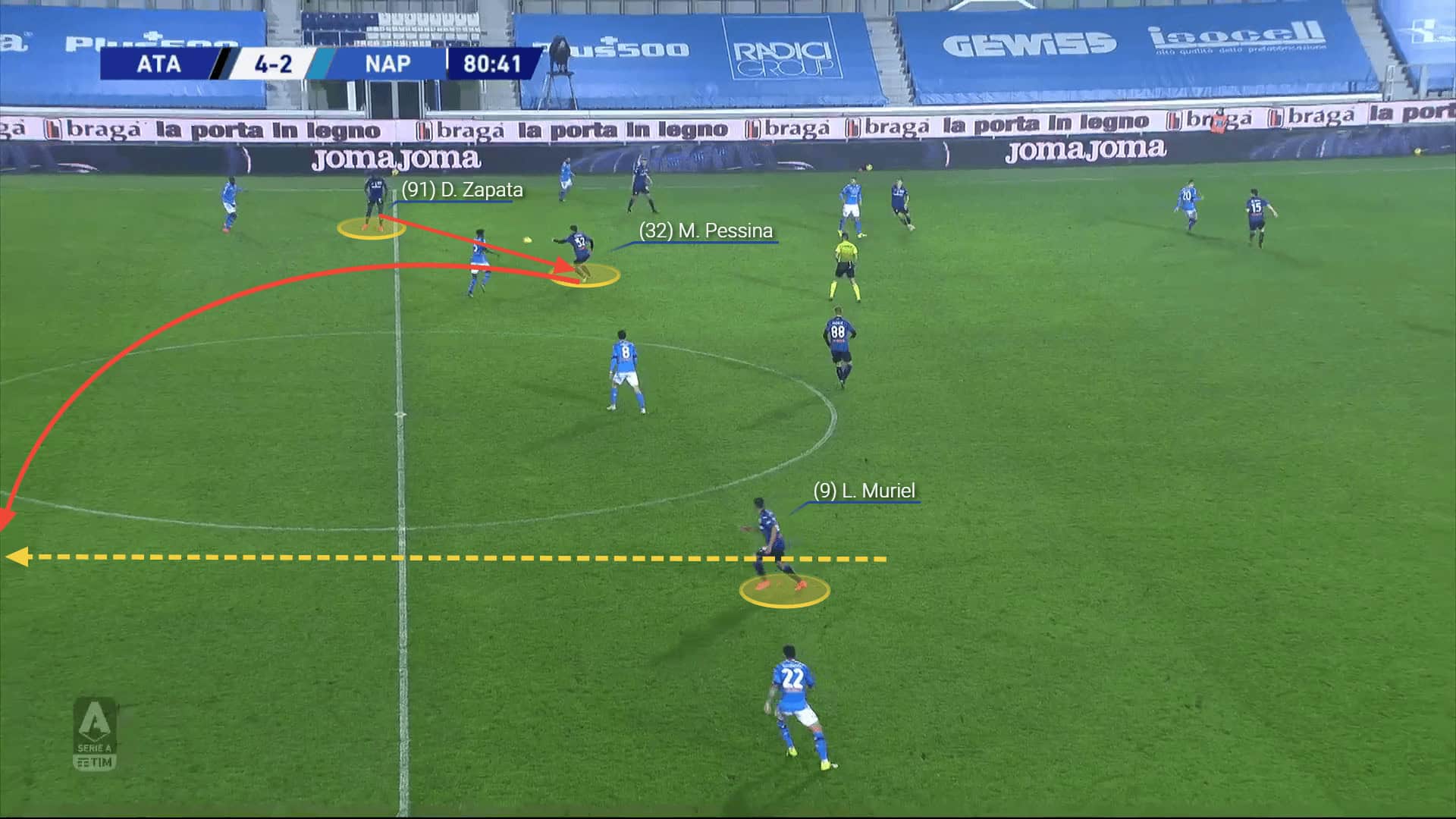
Movement and awareness
He drops between the lines to pick up the ball and then deliver it further but could also be successful in switching positions with the attackers. Atalanta didn’t stop doing positional changes with Gómez’s departure and they do often switch their roles in-game in aim to break the opposition’s pressing structures and penetrate. The European champion ticks the boxes in terms of creativity thanks to his space exploitation. He constantly seeks an opportunity to get into a more advanced position both with and without the ball and is always aware of where the ball is, where his teammates and opposing players are. This allows him to make well-informed decisions on his next move.
Combined with his passing range, his movement is extremely important in Atalanta’s build-up as it allows the team to implement the high-tempo attacking football that they outplay their opponents with. His link-up-play, hence the combination of his actions on the ball and off it, help the team in moving forward as a unit. He also often supports the actions out wide, contributing to the team’s infamous attacking triangles that aim to break through the opposite defensive structures.
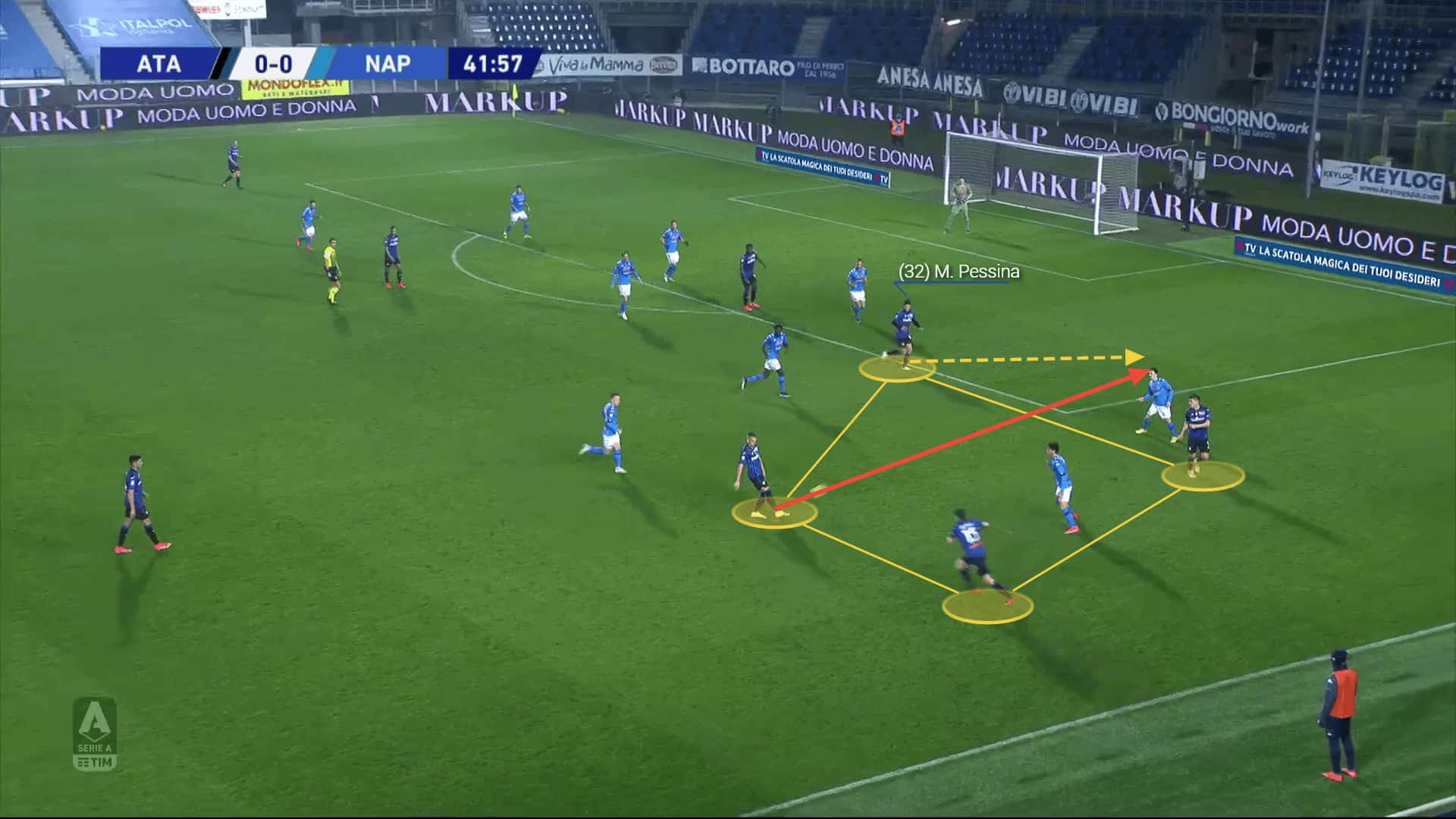
His passing abilities suit the team’s playing style well. With 86.7% of accuracy, he manages to distribute the ball well, joining the intense one-two pass combinations with his teammates. His awareness and strong decision-making are part of his passing efficiency. Aware of his surroundings, he knows when there’s enough space to aim for progressive runs and when to immediately pass the ball being pressurized by an opponent. This helps the team in retaining possession for longer periods.
Improving his defensive skills
As mentioned, Pessina’s natural position wouldn’t suggest a huge defensive involvement. Under Gasperini though, he had the chance to improve his skills out of possession and was contributing to the team’s pressing efforts and movement during transitions. He contributed with 6.38 recoveries on average per game and had a 66.7% success rate in his defensive duels. As illustrated in one of our previous sections, this is a way bigger defensive impact compared to Gomez’s, although the difference in their roles should be taken into consideration.
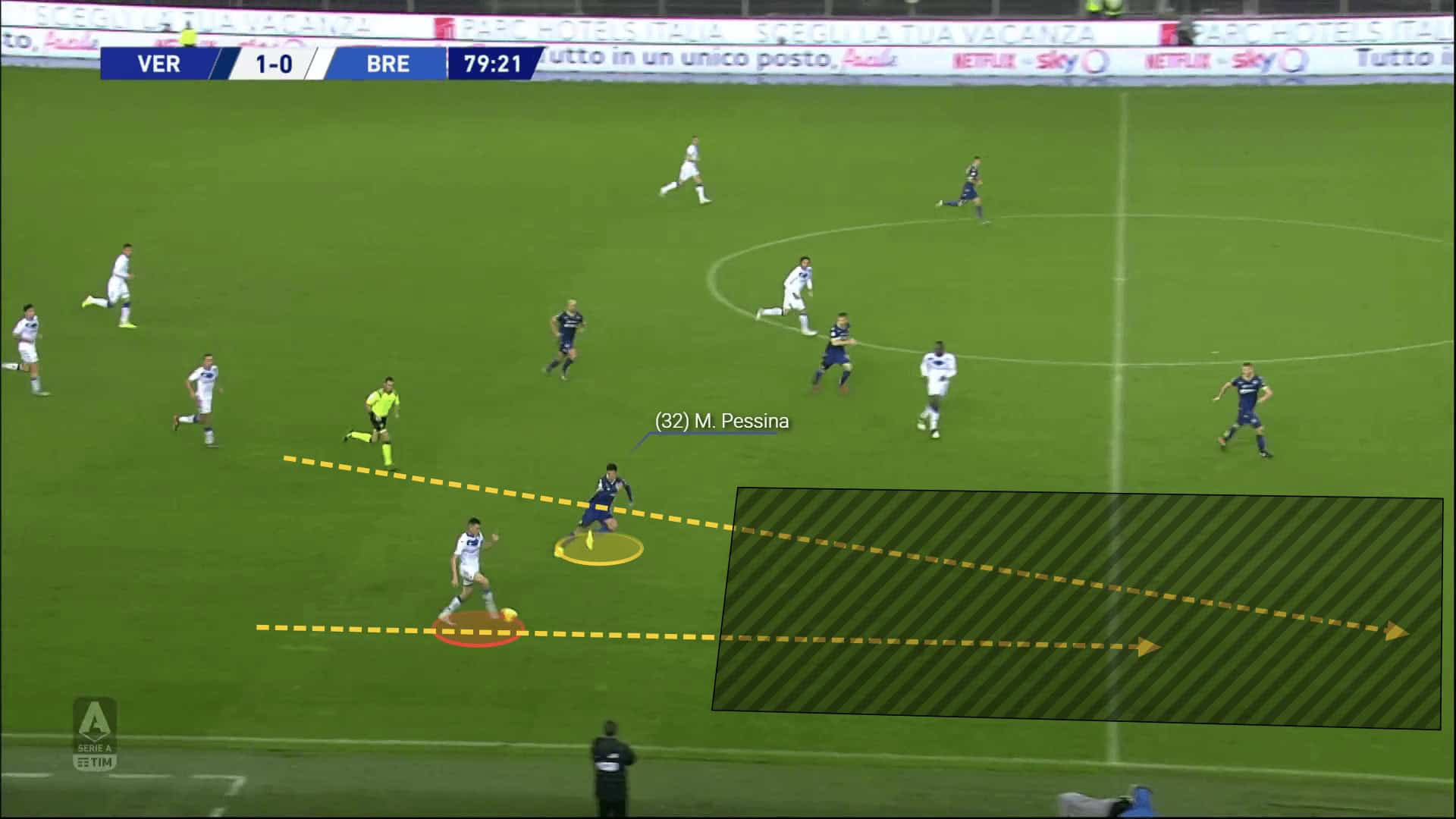
Despite his increased awareness he needs to improve his actions in Atalanta’s half and step up more in cases of quick turnovers if he is to play in a box-to-box role.
Conclusion
As our analysis shows, Matteo Pessina has a huge potential and growing confidence with the more playing time he gets. While he hasn’t been the first choice for Gasperini last season, his consistency and versatility could make him a crucial part of the team’s actions in the new season. He has been involved enough to show his qualities and with his Euro 2020 performance for Italy adding to his value, it is expected that he will become a regular for the team. It is rumoured that his displays have earned him the interest of Inter and Chelsea which is further proof of his potential.
