


Sheffield United were one of the surprises in the 2019/20 Premier League season. Just being promoted from the Championship they demonstrated impressive defensive discipline and satisfying balance in their back-three formation.
Finishing ninth was a dreamed start of their top tier journey and they definitely got under the spotlight, becoming one of the most exciting teams to watch.
The expectations for the new 2020/21 season were high, but the team didn’t look quite the same, starting off with four disappointing defeats.
While their defensive performance is still relatively satisfying they look quite lost in their attacking ventures. Their inconsistency when it comes to creating goal-scoring opportunities and their failure in taking advantage of them proved crucial in their first games of the season with their latest disappointment being a 2-1 defeat by Arsenal.
In this tactical analysis, we will look into their attacking performance and seek the reasons why they underperform in front of the goal. We will include scout report of their forward players and see are their efforts enough to get Sheffield out of the difficult situation.
The back three’s functionality
The manager Chris Wilder relies on the back-three formation in his tactics and sets the team up in a 3-5-2 on almost every occasion. By using different rotations, overlapping centre-backs and attack-minded wing-backs, who are equally involved in their defensive phase, he managed to achieve a balance between the lines last year. It looks like they have become pretty predictable for their opponents and relying on scoring a low number of goals while trying to protect the lead by using their strong defensive performance won’t work out anymore.
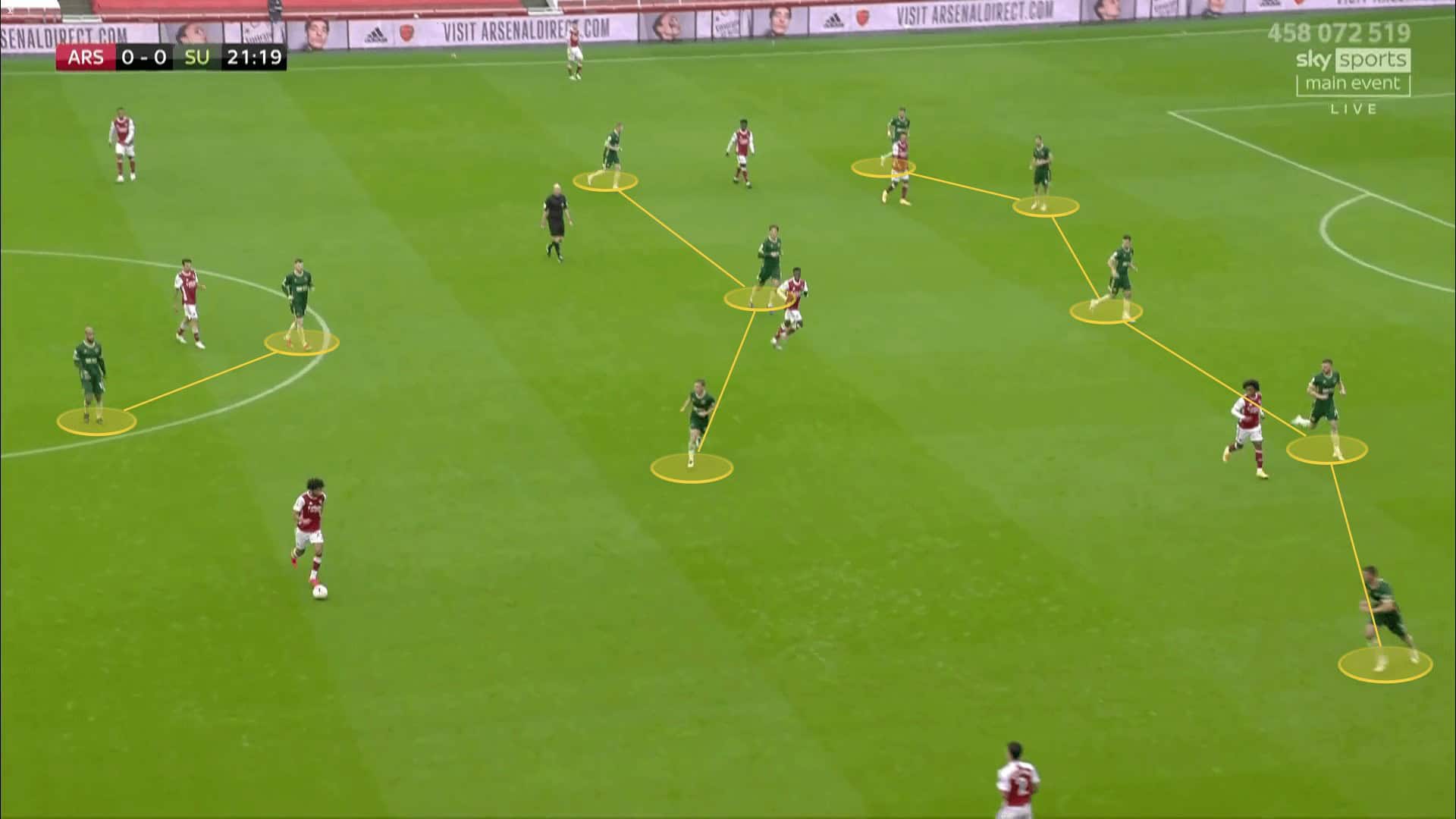
With pretty consistent back three, they try to play with width and most of their possession is exactly in the wide areas where the wing-backs Enda Stevens and George Baldock are the team’s most important figures. Most of their build-up methods include the wide areas, although they do have the support of George Norwood in the number 6 role. The other regular starters in midfield John Lundstram and John Fleck are the ones that have more advanced positions and occupy the half-spaces and the wide areas supporting the attacking actions.
Their movement allows their teammates more freedom, which helps in making positional changes and different combinations, creating spaces and engaging defenders. They also provide the needed additional support in defence during transitions.
In the absence of Lys Mousset due to injury, Wilder now relies on Oliver McBurnie and David McGoldrick to lead the attack, who are failing to convert the chances into goals and have scored only one goal in four Premier League games so far.
Upfront, the team rely on attempting a lot of crosses and also switching play whenever they are unable to break the opposition’s defences. The lack of creativity and precision is what takes off of their attacking performance, while the drop in the possession rates shows that they have started to give up the initiative and allow the opposition more time on the ball than before.
Attacking ventures
It’s worth to mention that since they joined Premier League Sheffield haven’t displayed strong and impressive attacking performance. Last season they had a few different goalscorers and were giving just enough upfront so they can control the outcome.
While there isn’t a strong individual that the team could rely on in the final third, the combined efforts of wing-backs, midfielders and attackers have helped them to not be left behind last season.
Things could look different this term. With Mousset’s unknown return date and the less time on the ball, the Blades are experiencing difficulties in creating chances against well-structured defences. In the games they did create chances the lack of precision and strong work under pressure were taking them back.
The ball-playing centre-backs still try to be involved in the ball progression and help in overloading the wide areas occasionally moving past the central line, although their opponents seem aware of their movement and allow them less time and space. Their famous exchanges in partnership with the wing-backs are still evident although they sometimes get carried away with it giving the opposition more time to structure. This often sees the attackers isolated upfront.
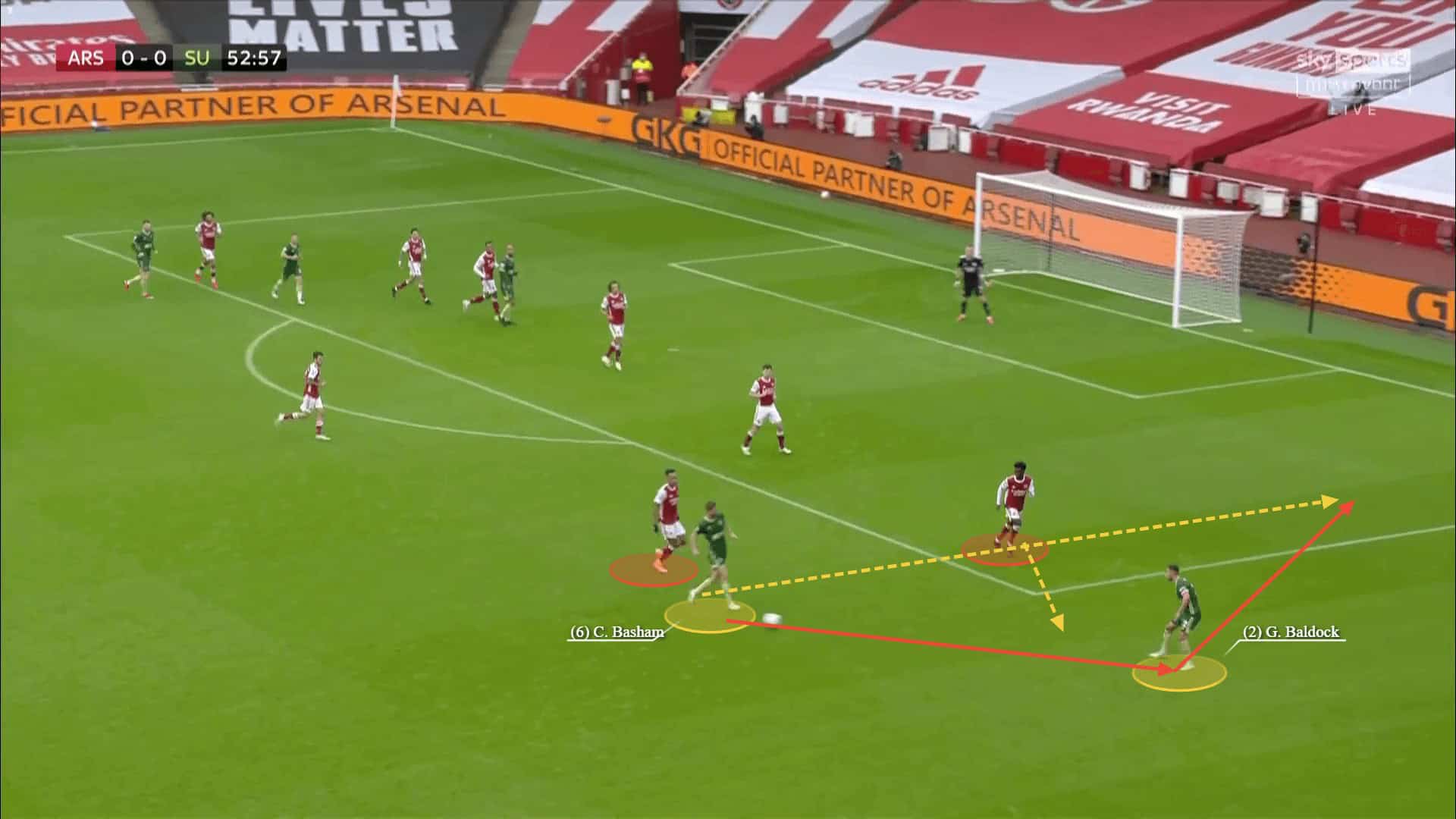
They have been using a lot of long balls, especially against teams that apply high press. That’s actually how a lot of their opportunities have come since it allows them to overload the advanced areas. Whenever they struggle in bypassing the press during the build-up, they switch play in efforts to stretch out the defences.
Crossing attempts and the wing-backs’ importance
Sheffield are a team that strongly rely on creating opportunities through crosses. Due to their focus in the wide areas, they do attempt crosses frequently. Although the numbers have dropped this term, they still send 16.2 crosses per 90 minutes. They are in the top 5 teams with most attempts in the league, but they have been struggling with their accuracy and actions in the box, hence they rarely manage to create dangerous opportunities out of their crossing efforts.
The team are more active in creating opportunities from the right thanks to Lundstram’s and Baldock’s movement and switch of position, although they aren’t nearly as successful in their efforts as Edna Stevens on the left. The lack of precision from the right doesn’t allow the team to take advantage of these opportunities. On the other side, Stevens’ 37.5% crossing accuracy hasn’t added much to the team performance as the ball is either sent to an overcrowded area or the actions in the box afterwards aren’t very convincing.

The Blades often attempt crosses from deeper positions in efforts to find their target man and pass through the last line of the defence. These actions are rarely successful since they often don’t have enough bodies in the box to be able to convert them into goal-scoring opportunities.
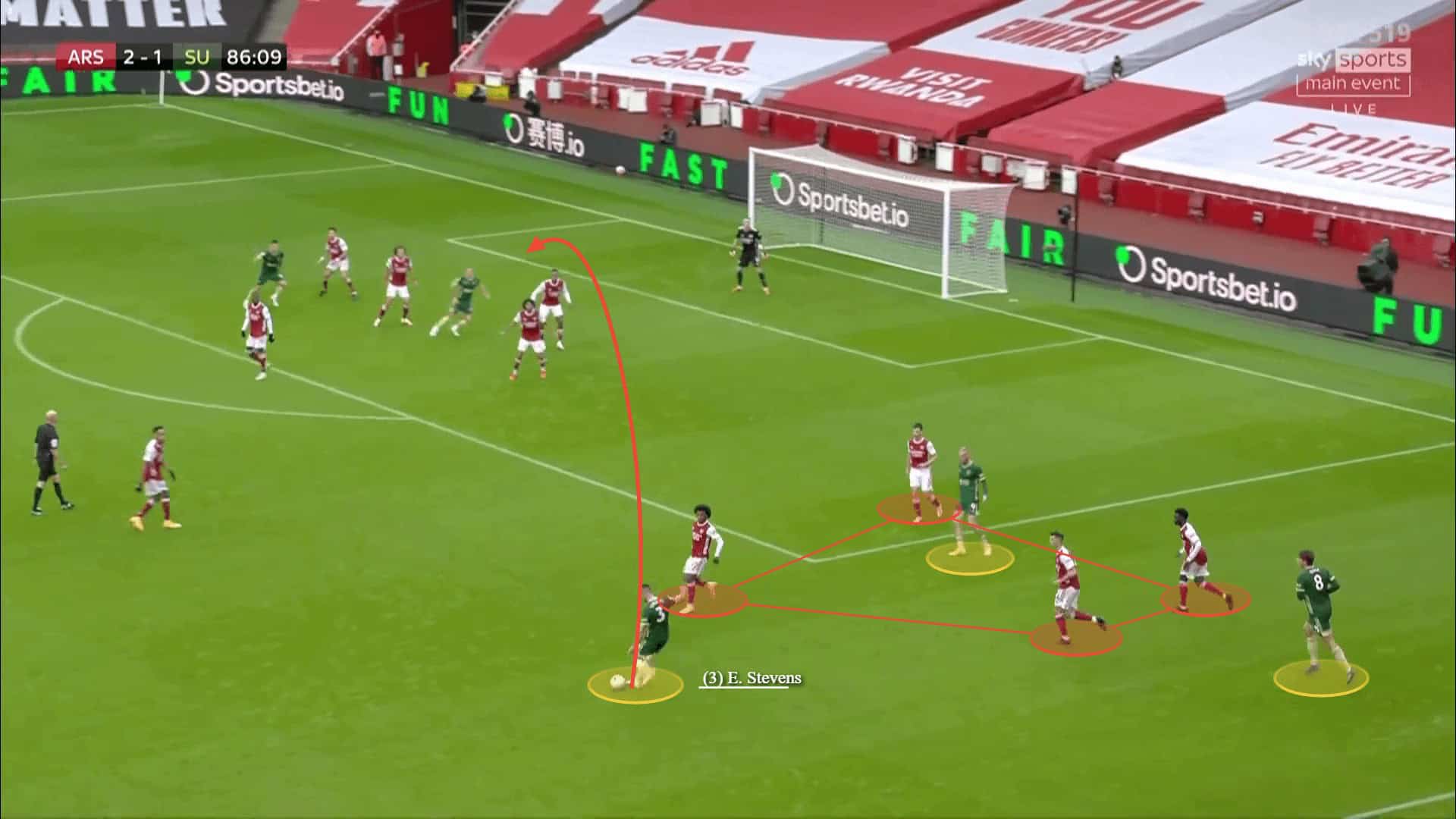
McGoldrick and Billy Sharp find themselves in front of the goal most frequently but have been struggling with ball control and decision making and have produced only two shots out of 10 received crosses combined.
The use of the half-spaces
As previously mentioned the Blades do get use of the half-spaces. Thanks to their movement there they are able to create attacking triangles and use one-touch pass combinations to advance the ball and break defences. The half-spaces are not only occupied by the attackers, who usually drop deeper between the box and the edge of the final third, but also by the central midfielders.
They tend to move in these areas and act as passing outlets to the wing-backs and the centre-backs, that, as mentioned, occasionally join the attacking actions. These positional changes that include overlapping and underlapping runs are executed with two different purposes. Their either aim to overload the wide areas allowing the team to easily switch play, leaving the other side of the pitch uncovered or use that movement to drag players out of position and exploit the spaces.
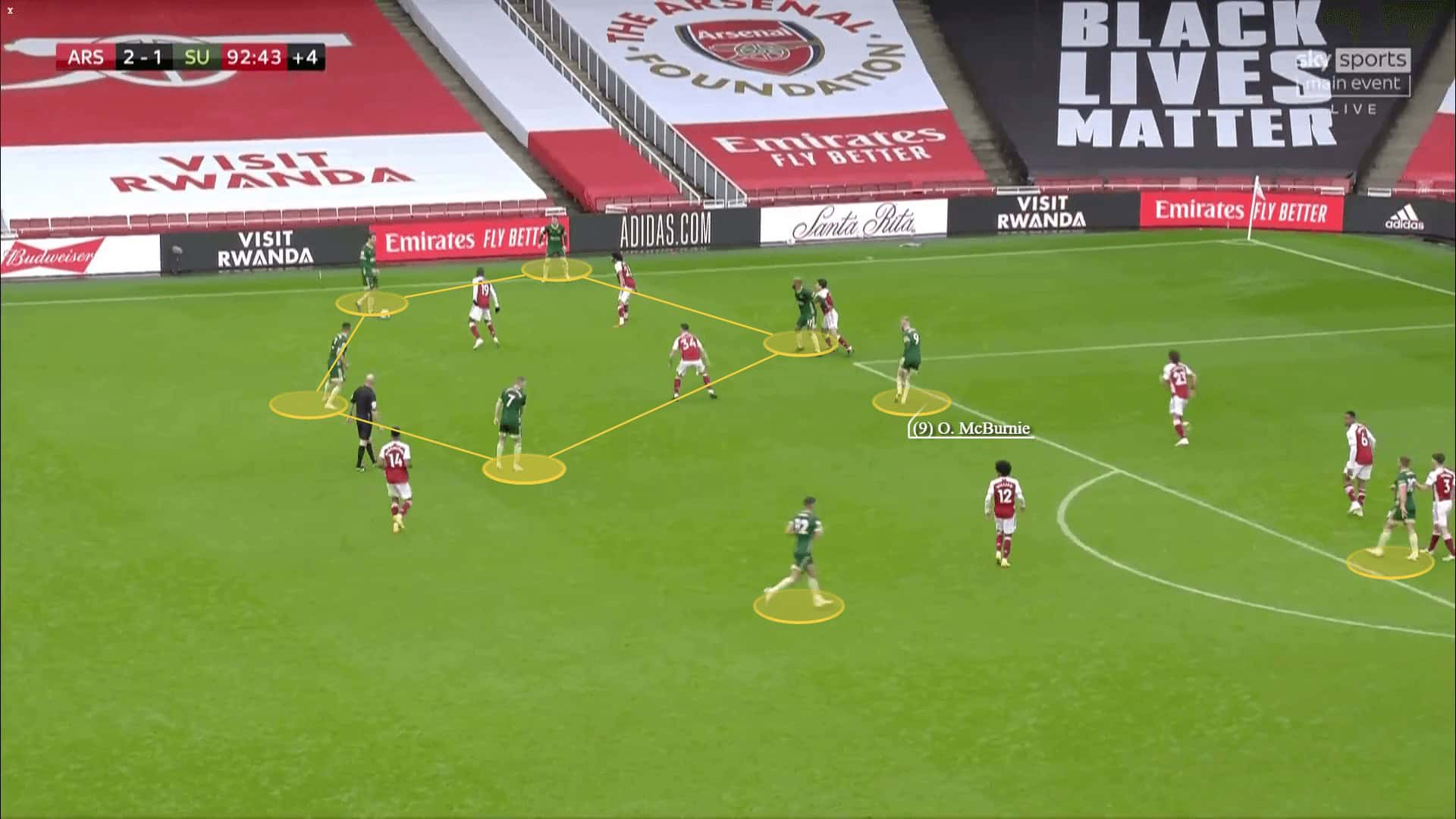
Thanks to these movements Baldock often has the freedom to drift inside and use his ball control to dribble past his opponents to create chances. This has turned out successful since 50% of his efforts have ended up with shots.
Another important presence in the half-spaces is the other wing-back Stevens, who often aims to recover the ball in the final third. Sheffield though rarely manage to keep the ball for a longer period and create quality chances out of these opportunities due to imprecise actions and lack of strong work under pressure.
Creativity and off the ball movement
Apart from the abovementioned movement, the Blades aren’t very creative in their attacking actions. They rarely rely on creating chances through smart passes and through balls. The rare use of the central areas does affect their performance in front of the goal since they often miss good opportunities due to overcommitting to the actions in the wide areas.
They could become more efficient in the final third if they use the movement on the flanks to stretch defences and then exploit centrally using through balls. The team are among the last in the league when it comes to key pass and through ball frequency. This only shows that they could explore different attacking strategies and increase their efficiency in front of the goal by increasing creativity and improving the spatial awareness to supply with more quality balls.
That’s where Norwood could become crucial. If he becomes more involved with the team’s actions in the advanced areas and attempts more through balls, Sheffield could improve their record. In combination with Lundstram’s creativity and half-space occupation, this could be a solution for a lot of their struggles upfront.
Movement in the box
Whenever they have time on the bill Sheffield try to commit a lot of bodies in the box in order to drag defenders out of position and have better chances in front of the goal. They often fall victim of an inaccurate crossing which throws their efforts to waste. As previously mentioned the delivery areas are often overcrowded with defenders and it is impossible for the attackers to receive the ball and retain possession.
Whenever the team aren’t allowed a lot of time on the ball and are intensely pressed they look to perform speedy attacks but their presence in the penalty area looks completely different. They often fail in providing enough options for a pass and end up in 4vs2 or 5vs3 situations where they rarely manage to free themselves and receive crosses and passes.
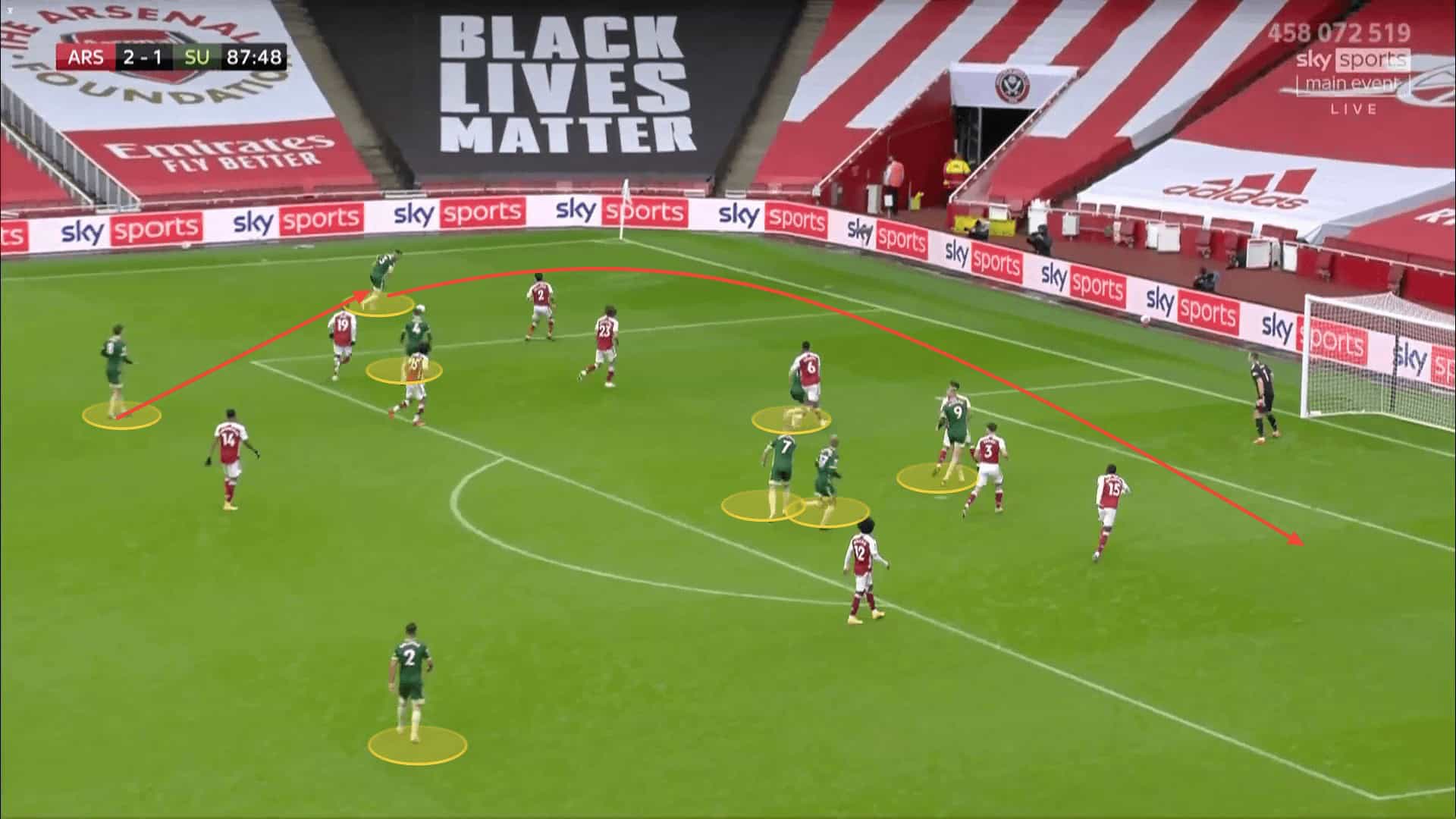

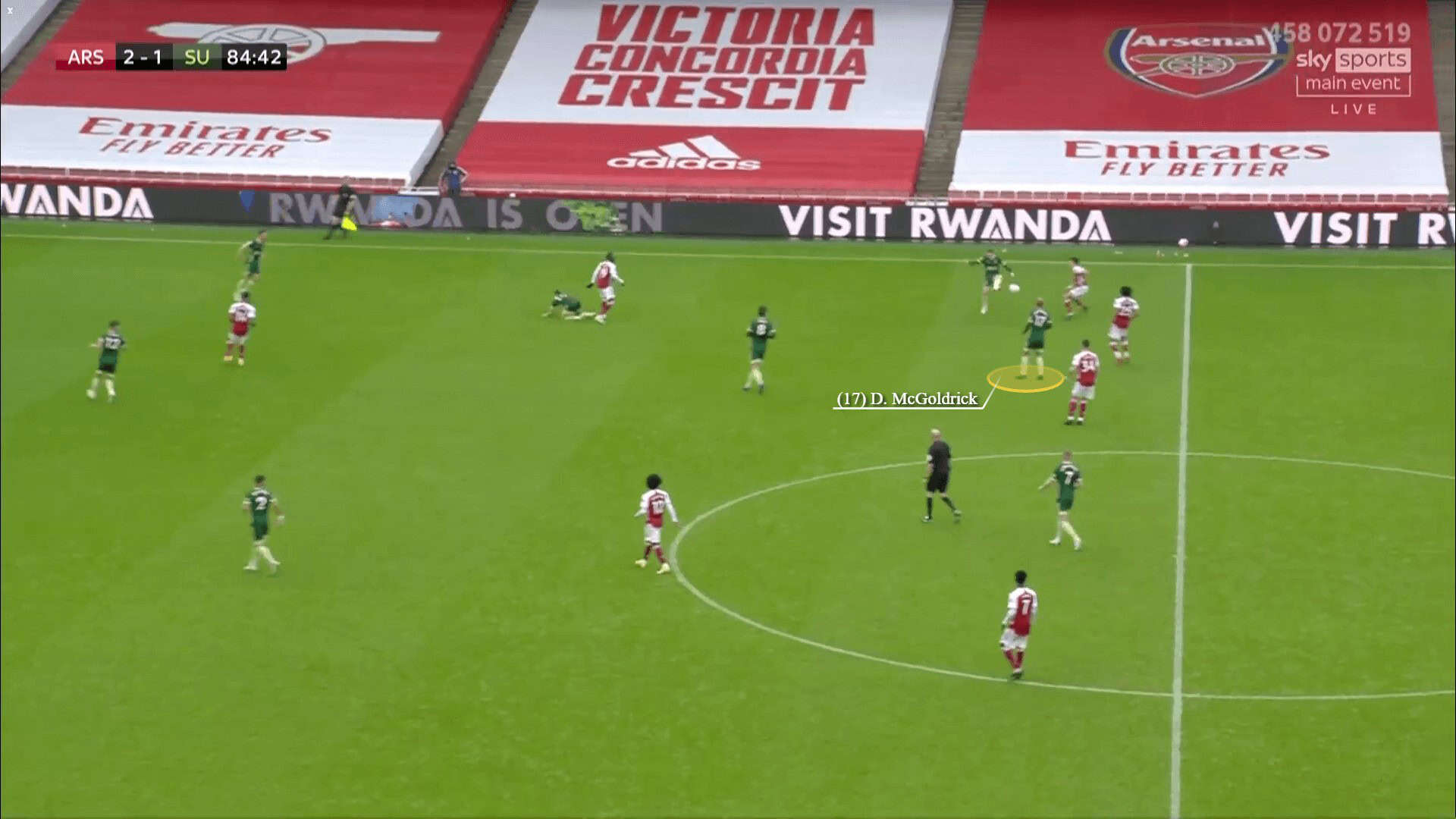
The regular starters now McGoldrick and McBurnie are both inconsistent in their attacking performance so far this term. That’s partly due to their tendency to drop deeper and help with the build-up by picking up the ball from the areas closer to the central line.
That’s where McGoldrick often moves around which is not allowing him to position well in the box and create many opportunities. Despite his control and dribbling abilities, he is often unable to carry the ball to the more advanced areas.
McBurnie on the other side seems to stay in a more advanced position and have well-timed movement which could often see him make off the ball runs to the box in efforts to break defences.
Counter-attacking efforts
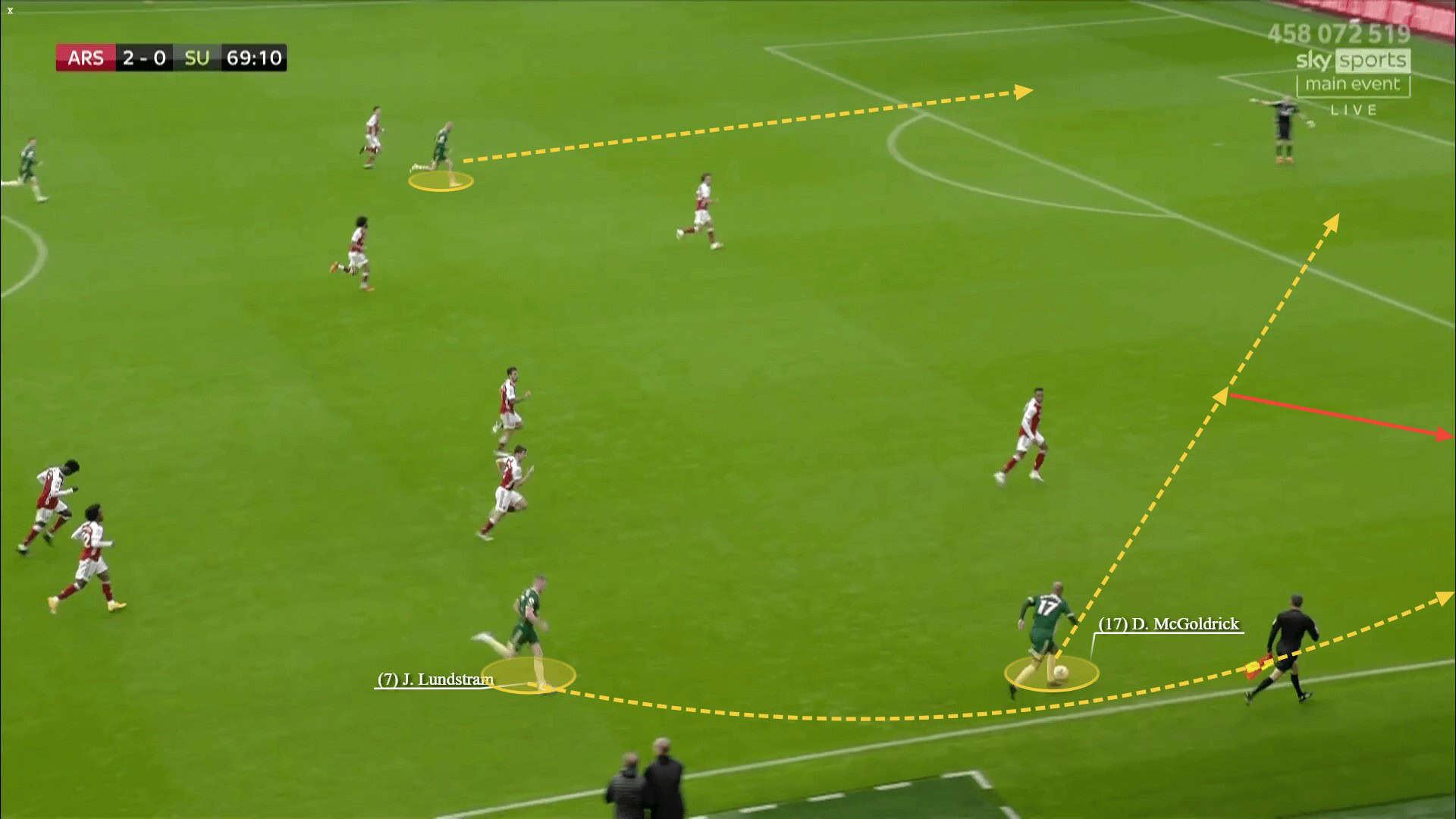
What is noticeable compared to last season is Sheffield’s increased numbers when it comes to counter-attacking. The team rely more on counter-attacking actions now, executing four counters per 90 minutes. That’s thanks to their pressing and constant aim to win the ball back. Since they have less time on the ball they have found a way to create chances immediately they gain back possession.
A lot of their counter-attacking efforts come from ball recoveries in the midfield which allows them to quickly transition and deliver the ball to the final third. They haven’t had a lot of success in their actions though due to a few different factors. The lack of control under pressure affects them in every phase, while the lack of precision is what takes off of their performance in front of the goal.
They often fail in committing enough men to these actions which doesn’t allow them to take advantage of the opportunities. They still look to spread out wide and use the wide areas during counters too, which takes off of their explosiveness. Their efficiency is decreased by the fact that they don’t use the central areas properly.
Failing to take advantage of set-pieces
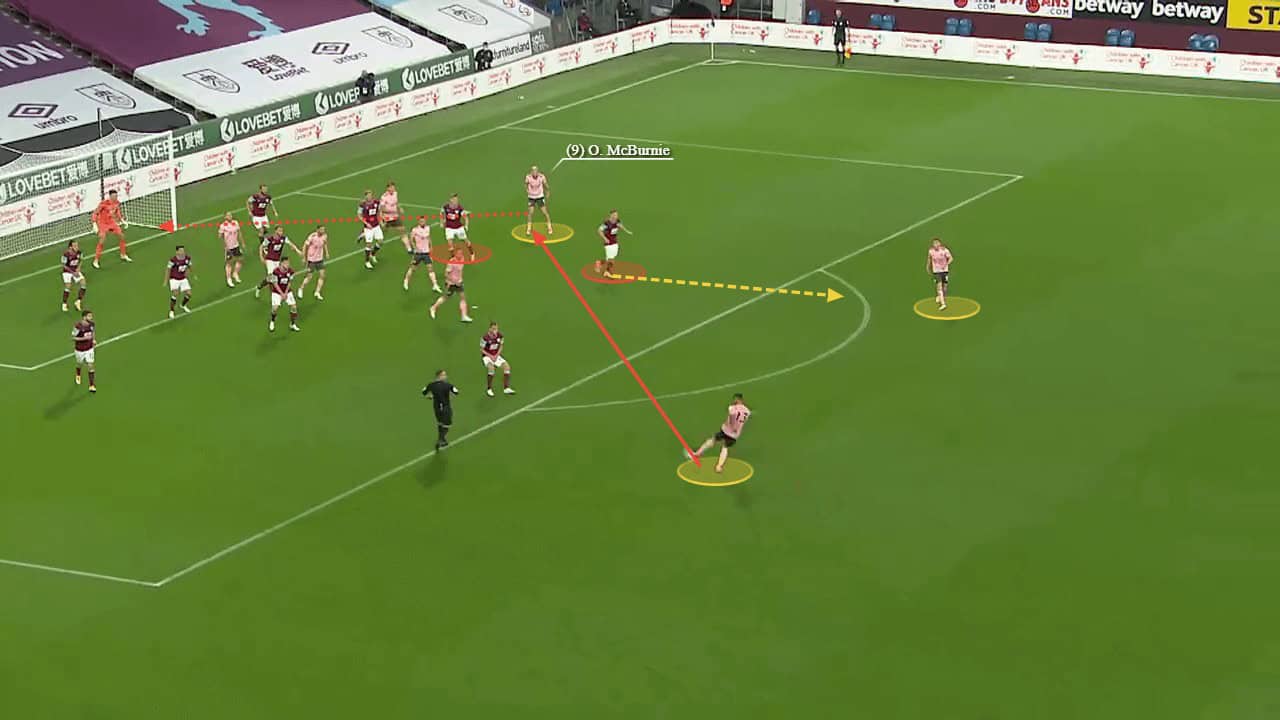
The Blades are among the teams that get a lot of set-piece opportunities this campaign. They execute 6.2 corners per 90 minutes which should be taken as an opportunity to score. Their actions when attacking set-pieces haven’t been very accurate and they have failed to utilise on these chances.
They have four different players that are responsible for taking their corners and free kicks: Norwood, Lunstram, Fleck and Osborn, which are yet to deliver an assist. The player that is most actively trying to convert these chances into goals is McBurnie who has three shots after set-piece opportunity.
If they improve on their positioning in the box and their aerial presence, they could increase their efficiency in front of the goal and take advantage of these opportunities.
Decision-making and finishing abilities
Seeing their record of one goal in their first four games you would assume that their attackers have been performing disastrously. That is not fully correct though. The main players responsible for their goalscoring are McGoldrick, Lunstram and McBurnie. Surprisingly enough it is not their decision-making that doesn’t allow them to score. It is rather their position and the delivery areas that take a hold on them.
When it comes to the attacking duo, there is a noticeable difference in their performance which is not only displayed in our explanation earlier in the analysis but also in their shots on target percentages. McGoldrick is far less successful and has only 20% of his 1.98 shots on target, while McBurnie averages 2.96 shots per 90 with the outstanding 57.1% on target.
There is a reason for this high percentage though. His decision-making and better positioning put him in a great position to score but his efforts are often reflected by the goalkeepers. What is lacking is a bit more technique in order to take on them. Lundstram has similar problems where he just directly shoots into the goalkeeper and fails to tweak the ball a little to get the most out of the opportunity.
Whenever they are unable to break through the defensive blocks they are attempting shots from distance, although they often don’t take the time to receive the ball and get control over it, but rather shoot directly which decreases the chance for shooting on target.
Conclusion
As seen in this analysis, there are different factors that stop Sheffield United from creating as many chances in front of the goal as they could. From getting more use of the central areas to taking advantage of their set-piece opportunities, it is evident that their potential is a lot higher than it shows. They could even be more successful should the frontline players improve the timing and technique in order to send more difficult balls.
The team struggle in accessing goalscoring opportunities whenever they are out of their comfort zone and are unable to use the wide areas too. They need to build different strategies in attack, otherwise, they risk throwing their defensive efforts to waste.

