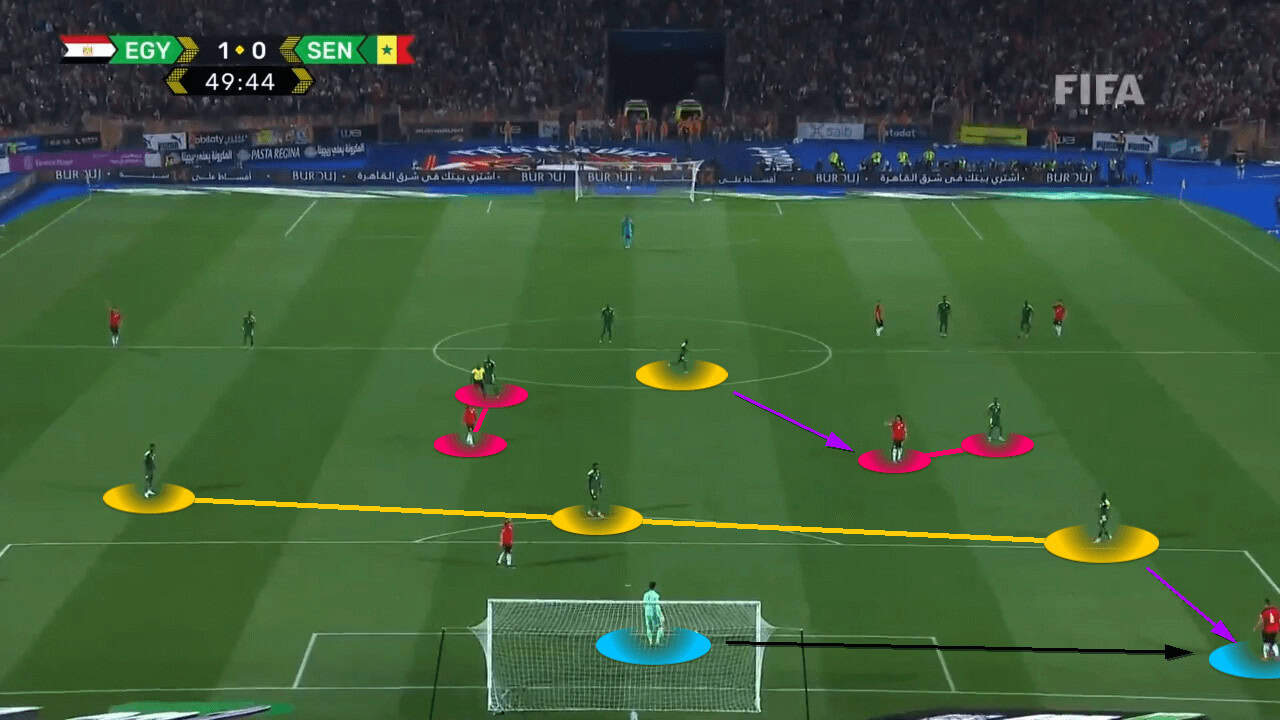
This article represents the third installment in a six-part series on coaching team defending. This is looking at group tactics, rather than the individual, so whilst individual technique or tactics can certainly be coached if necessary during these sessions, these aren’t the main outcomes of the practices shown in this analysis.
Secondly, as a caveat, these practices shown are just ideas, and may not suit every team, or every age level. However, if they can be used as a framework to generate new ideas or adjusted to make a session, then this article will have done its job. It’s not always advisable to simply “copy and paste” a session plan and apply it to your own team, given that your game model may not suit these practices, or perhaps your team’s current learning curve is not at the level required to run these, or conversely they are at a level where these practices aren’t challenging enough.
Finally, this writer doesn’t claim to be the creator of any practices, however, isn’t knowingly “copying and pasting” ideas himself either. Session ideas and individual practices are, and should be, accumulated over long periods of time, tried, tested, and adjusted, with different teams, age levels and ability levels. As coaches, we should be working collaboratively, sharing ideas and promoting a transparency and openness that helps us and our players achieve our goals. There should be no secrets and it’s so important to share, work together, and support.
Vertical compactness: The session
This set of practices, put together hypothetically as one session in this tactical analysis, looks to work on the team defending principle of vertical compactness. We are aiming to keep a tight defensive unit and prevent an opponent from being able to easily find space between our defensive lines and play through us.
Whereas last week we were looking at our team keeping horizontal compactness, staying narrow, and shifting across the pitch as a unit, this session will look to build on this, but now have our team push forward or backwards on the pitch in unison and prevent space from being found between the lines.
When working on this topic as a coach, this session can be used to focus on a specific group, eg the midfield supporting the press of the front three, or the defence mirroring the movements of their midfield, but equally it can be used as a session to focus in on the entirety of the team’s shape when out of possession.
Part 1
A positional game is an excellent way to start a practice, and if the team is familiar with such a set-up like the 4v4 + 3 shown in this example, then it reduces time needed to explain the practice.
This practice can be done where the blue and red teams transition between attack and defence and vice versa after possession is turned over, or the defending team in the middle, in this example the four reds, can be given a set time to defend. Once the ball is won, the practice can reset from the blue team.
As you can see in the following image, there are three bounce players, shown by the grey circles. These players are on whichever team attacks and therefore create a 7 v 4 for the team in possession.

Goals can be given to the possession team for 10 consecutive passes, for example. To make it more difficult for the in possession team, lateral passes along the line should be prohibited, forcing the outside players to have to at least play a pass inside the rectangle, and allow the defensive unit to not have to press flat passes along the line which will stretch them and may prevent them from gaining success.
Another goal to put in place, and one that will help bring out the key learning from the overall session is that if the central bounce player can be found and then play to the opposite side he received from, replicating a player receiving the ball between the lines and continuing to play forward, this can instantly be given as a goal.


![Lazio Vs Napoli [0–2] – Serie A 2025/2026: Maurizio Sarri Zonal Marking Weaknesses And Unsuccessful Attacking Choices – Tactical Analysis](https://totalfootballanalysis.com/wp-content/uploads/2026/01/Lazio-Vs-Napoli-tactical-analysis--350x250.png "Lazio Vs Napoli [0–2] – Serie A 2025/2026: How Antonio Conte Tactics Exploited Structural Flaws – Tactical Analysis 5")