
Saint-Étienne’s 2021/22 season hasn’t gotten off to a very positive start. Les Verts have only managed to earn four points from their first nine league games of the campaign. This low points tally combined with their bleak -10 goal difference leaves them sitting at the bottom of Ligue 1, with just under a quarter of the season’s league games having been played. They’re currently the lowest scorers in the division (8) and they’ve conceded the joint-fourth-most goals of any side (18).
Understandably, this poor start to the season for one of France’s most historic clubs (the most successful in Ligue 1 history, with 10 titles to their name) has led to pressure piling on manager Claude Puel, who spent his entire playing career at AS Monaco — playing under Arsenal legend Arsène Wenger in that time — managed Ligue 1 sides Monaco, Lille, Lyon, and Nice earlier in his career before embarking on a three-year stint in the EPL from 2016-2019 first managing Southampton — during which time he finished as the runner-up in the 2016/17 EFL Cup, losing the final to Manchester United — and then managing Leicester City before arriving at Stade Geoffroy-Guichard to replace Ghislain Printant in October 2019.
The season before Puel’s arrival at Saint-Étienne (2018/19), the Auvergne-Rhône-Alpes-based club had finished in fourth place in Ligue 1. Additionally, Saint-Étienne hadn’t finished outside of the top half of France’s top-flight since the 2010/11 campaign before, under Puel’s guidance, they ended the 2019/20 season in 17th place — narrowly avoiding relegation — and following that up with an 11th place finish last term.
With this record in mind, you could argue that Les Verts’ hierarchy has already shown plenty of patience with Puel and recent indications coming from Stade Geoffroy-Guichard suggest that the decision-makers intend to continue backing their man, with it having been reported that a board meeting on 4th October ‘during which the future of manager Claude Puel was debated’, concluded with the 60-year-old remaining as manager, although Saint-Étienne sit bottom of Ligue 1 nine games into the season with a squad value that ranks them eighth in France’s top-flight — suggesting that the quality of players available to Puel means that they’re capable of sitting far higher up the league.
In this tactical analysis, we’ll analyse Les Verts’ poor start to the season. This scout report will try to provide some answers to questions like: ‘what is going wrong for Saint-Étienne?’, ‘Have Saint-Étienne really been this bad?’, and ‘What does Puel need to do to turn things around (and secure his future at the historic club)?’
On analysing the team’s performances so far this term, I’ve recognised some positives and negatives to the 60-year-old’s tactics, which will be discussed in this piece. One major drawback to their overall performances this term has been their performance in the early possession phases of build-up and ball progression. This tactical analysis piece will highlight what Puel’s side is trying to do in these phases, why and how it’s not working, the negatives of the team’s failure in these phases, and I’ll offer some potential solutions to these issues which the manager may be considering.
Attempting and struggling to progress through wide areas
While Saint-Étienne have scored the fewest goals of any Ligue 1 side, with eight, they’ve generated the eighth-highest xG in the league — 12.58, per Wyscout. Their low scoring start to the season isn’t necessarily reflective of a broken system that’s failing to create chances altogether and if they continue to play as they have been and create similar chances at the same frequency, you’d expect them to increase their efficiency in front of goal. So, Saint-Étienne are creating chances and from analysing their performances, I don’t think it’d be fair to say that their big issues are in the final third despite their poor form in front of goal.
However, their performances in possession, in general, haven’t been particularly impressive and during the earlier phases of build-up and ball progression, they’ve struggled this season which has created arguably their biggest problems. Saint-Étienne rank 12th for average possession percentage, with an average of 48.2% to their name in the league this season. However, while possession is not everything — all going to plan, Puel would probably have his side ranking much higher in this metric. Not because it’s inherently better to have more possession, but because of his tactical setup which indicates that he does want his side keeping more of the ball than their average possession percentage would suggest.
Les Verts are flexible in build-up, sometimes playing out from the back via short passes and sometimes going long. However, they generally try to begin their attacks via short passes from the back the majority of the time. We’ll look more into the specific structures and patterns of play that they try to use to do this, but to summarise the point, in general, their goal is to ideally play out via short passes and cut through the opposition’s defensive shape while progressing upfield in an incisive yet careful manner.
So far this term, Saint-Étienne have mainly used one of either the 4-2-3-1 or 4-4-2 shapes. When playing out from the back, their centre-backs split wide, allowing the goalkeeper to advance into a ‘sweeper’ position, their full-backs push high and wide on both wings typically progressing to the midfield line, their central midfielders stagger with one dropping deeper and the other standing in a slightly higher position, while the front four (wingers and strikers/wingers, ‘10’, and striker) often tend to stand quite close together up front, which can overload the opposition’s centre-backs and put them in a decent position to win the second ball if Saint-Étienne are forced long. It’s also common to see the winger on the ball-near side pull away from the rest of the front four, however, to provide support to the team’s ball progression efforts on that wing.
This shape doesn’t offer Saint-Étienne a lot of progressive options centrally, which we’ll discuss at greater length later in this tactical analysis piece. However, the goal isn’t to progress right through the centre of the pitch, but rather through the wide areas, where Puel’s men look to form triangles with the centre-back, full-back and central midfielder or the full-back central midfielder and winger, for example, to help these players to quickly combine with short passes while moving upfield and, ideally, slicing through the opposition’s defensive shape, with Saint-Étienne hoping to have an overload in these areas and hope to have a system in place which gives them an edge in these situations where they’re trying to progress the ball out wide.

Figure 1 shows an example of Saint-Étienne’s typical shape in build-up, which shows the back-three formed by the goalkeeper and two wide centre-backs, the staggered midfielders, the high full-backs on both wings and the compact front four which overloads the opposition’s backline. We see from this image that Saint-Étienne’s shape underloads central midfield, and again, we’ll discuss that at greater length in our next section. However, we also catch a glimpse, from the positioning of the ball-near central midfielder, the centre-back on the ball, and the ball-near full-back, how they intend to create triangles out wide through which they can progress play.
However, due to the opposition’s overload in central midfield, Saint-Étienne find it impossible to play through the near central midfielder, while the opposition are then easily able to cut off the passing lane to the full-back through their pressing, while the near opposition full-back also pushes out and retains access to this player in case the pass still makes it through. This quickly cuts off the left centre-back’s short passing options and ultimately forces him to play the ball back to the goalkeeper.
Additionally, with the opposition overloading central midfield and sending their right-back out to be closer to Saint-Étienne’s left-back, they allow Les Verts to overload their backline with their front four. However, Saint-Étienne don’t have a great aerial presence up front at this moment, with 182cm (6’0”) Wahbi Khazri leading the line, supported by 180cm (5’11”) Denis Bouanga, 170cm (5’7”) Arnaud Nordin, and 177cm (5’10”) Ryan Boudebouz. While 182cm is not short, nor is 180cm, Saint-Étienne’s forwards are physically outmatched by Lyon’s centre-backs — 184cm Sinaly Diomandé and 192cm Jérôme Boateng. Additionally, none of these Saint-Étienne attackers have won many aerial duels this term and this area isn’t their greatest strength. Along with Khazri, 187cm Jean-Philippe Krasso has played a lot of minutes as Les Verts’ centre-forward this season and he’s managed to win a lot more aerial duels, as the main attacking aerial threat in the side, however, with him off the pitch at this moment, as is sometimes the case, Saint-Étienne’s aerial threat is significantly reduced.
As play moves on after the ball is sent back to the goalkeeper, the ‘keeper sends it long, seeking to bypass midfield and take advantage of Les Verts’ overload up front. However, the ball is played far too strong and allows Lyon to regain possession easily. Even if played more accurately, however, Boateng or Diomandé would be more likely to win the aerial duel despite Saint-Étienne’s overload which placed them better to win the second ball. As a result, this overload could be rendered useless with Les Verts failing to put the creative and technical forward line in the best possible situation to make use of it, with a physical advantage as opposed to a technical advantage possibly being more useful in the attacking situation that was created.
Saint-Étienne’s attackers could’ve been played in behind the Lyon backline, which could’ve been an excellent move, but this required a better ball from the ‘keeper and perhaps was asking too much of the 21-year-old aptly named: Etienne Green. This is another element of Saint-Étienne’s build-up and ball progression play that’s worth noting — the scenarios they create do sometimes just ask too much of the players available.
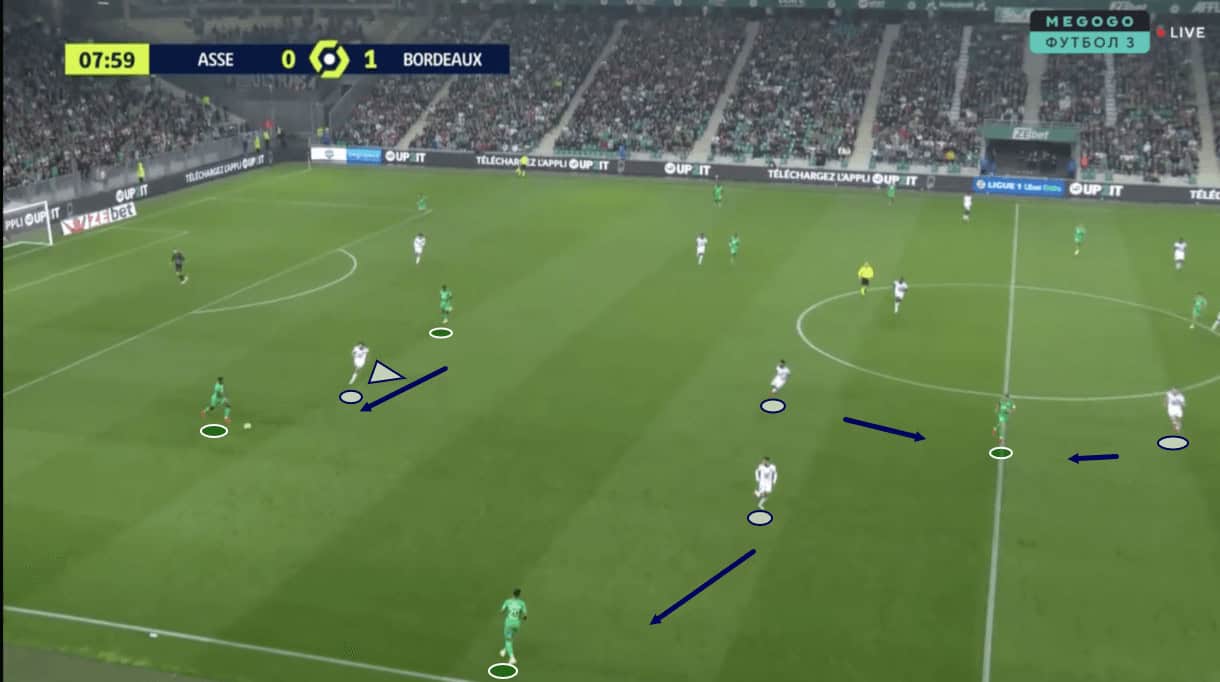
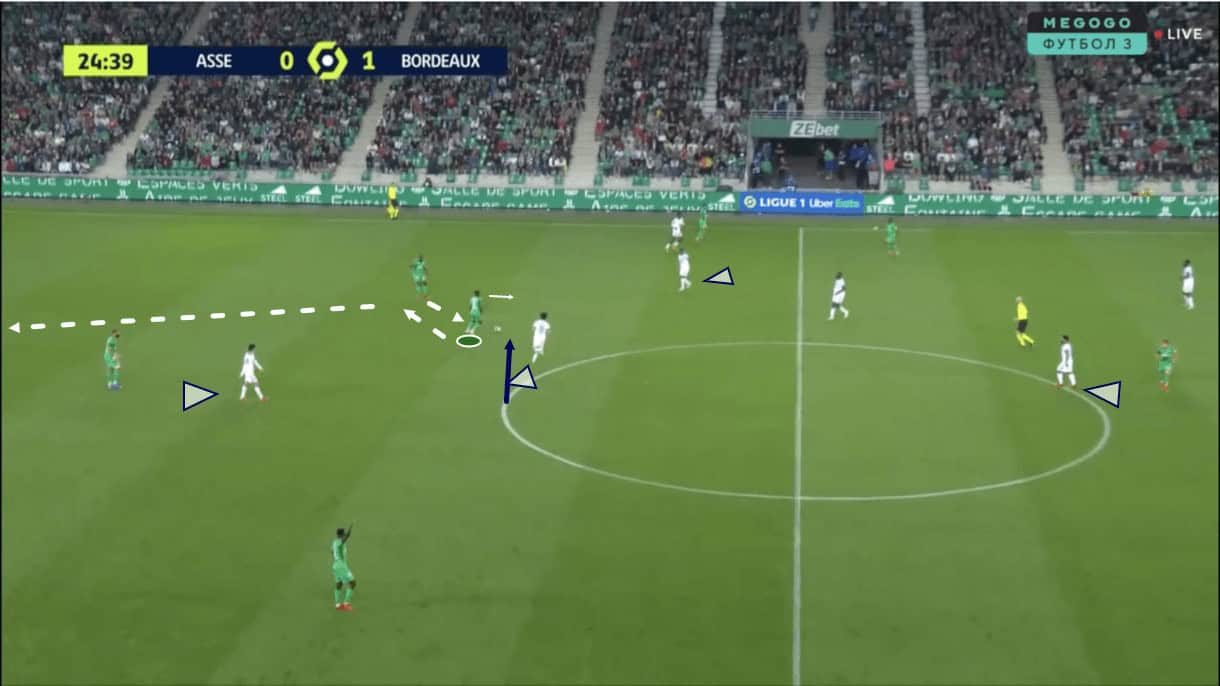
Figure 2, which is taken from Les Verts recent Ligue 1 loss to Bordeaux, shows another example of Saint-Étienne’s shape as they attempt to move from build-up to the progression phase through the centre-back — this time, the right centre-back. Again, we see the wide centre-backs, staggered midfield, and high full-backs on display. This creates a triangle with the centre-back, full-back, and central midfielder, but a diamond is also on display, with the ball-near winger dropping into the half-space to give the centre-back in possession a vertical passing option. This is a very common sight in Saint-Étienne’s game in this particular phase. When the centre-back has the ball, it’s common to see the ball-near winger offering support through movement into the half-space like this.
However, again, it’s simply too easy for the opposition to make life difficult for them by controlling the centre, pressing from there and effectively pinning Les Verts out wide. Puel’s side has a decent structural setup to play through the opposition, but they don’t seem to have lots of ideas when the opposition controls the centre and the near passing options, as we see in figure 2, via their press. Here, the centre-back’s route into central midfield is cut off via the nearest pressing player, the pass out to the full-back is dangerous because of the opposition wing-back’s near positioning, and while the winger who’s dropped into the half-space has a little bit of space, in theory, he’s effectively caged by three opposition players who could close in on him quickly if the pass was played.
This is a situation that Saint-Étienne must become better prepared for and create solutions to on the training ground. If they give up control of the centre, this kind of situation will present itself again and again. They need to prepare patterns of play that turn this into an advantage through quicker passing and movement that creates space for their players, manipulates the opposition’s positioning, and helps Les Verts to play through the opposition as they plan.
Instead of getting into this situation and becoming flustered, they need to expect this situation and learn how to deal with it better. As this passage of play moves on, the right-back doesn’t receive the ball as the centre-back doesn’t want to leave him as a sitting duck. However, if better prepared, perhaps the right-back could receive in this scenario and immediately move infield to link up with the central midfielder, who could have advanced after the pass was played to the right-back to create a progressive option that the opposition would find more difficult to defend against than what we see, which after the initial movement to create this wide diamond shape, is rather static.
As play moves on, the ball is sent forward from the centre-back to the winger in the half-space. However, the opposition’s press put the centre-back under too much pressure and the pass was misplaced. This misplaced pass led directly to a turnover in midfield, as the opposition had multiple players surrounding this winger ready to pounce on this wayward ball. Saint-Étienne can’t allow it to be that simple for their attacks to break down moving forward — turnovers, like we saw in the passage of play in figures 2 and 1, occur far too often. Their struggles in the progression phase are a big part of why they’ve lost the ball more than any other Ligue 1 side this season.
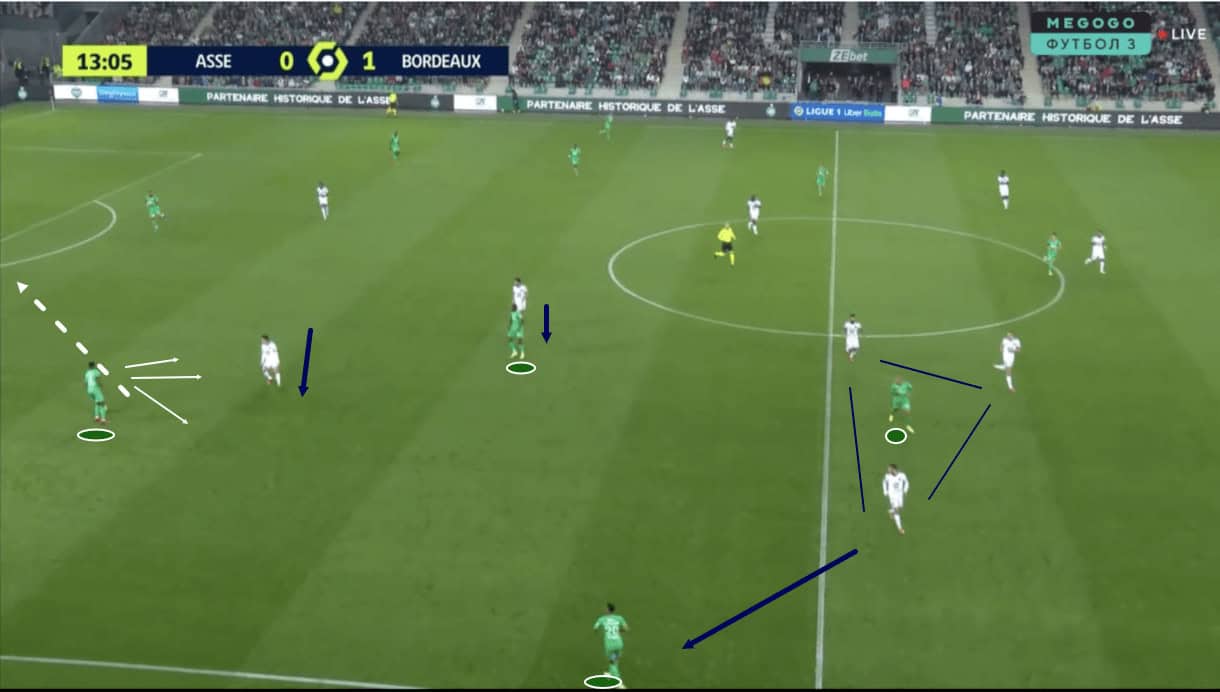
Figure 3 shows an example from this same game where a very similar scenario presented itself. This occurred slightly later in the match and the centre-back was now more hesitant and careful with his choice. After looking at the options ahead of him, instead of sending the ball to the winger in the half-space, he opted to just send the ball back to the goalkeeper to avoid giving away the ball cheaply. This highlights how Saint-Étienne’s problems in progression can influence their players’ mentality and make their play more negative, which is a big issue and another key reason why their progression problems must be addressed.
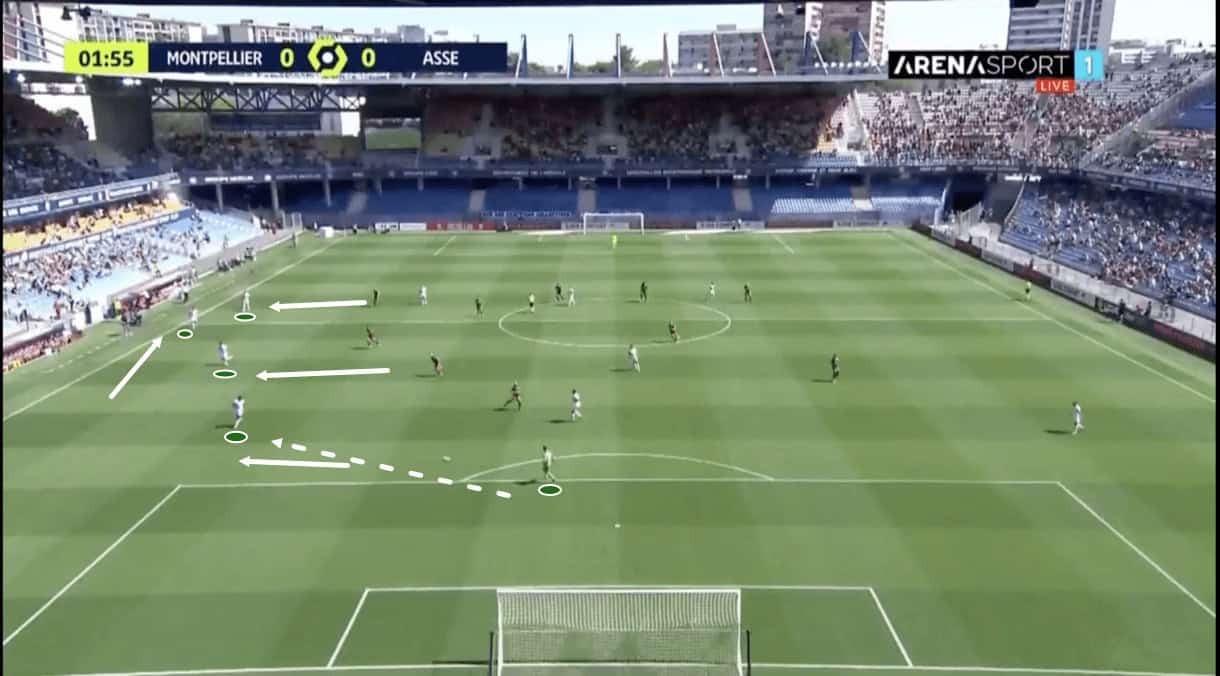
We see another example of Saint-Étienne getting pinned out wide with the opposition controlling the centre in figure 4. Here, the ball moves out to the left centre-back, who’s got options on the left-wing in the form of the near central midfielder, full-back, and winger. However, routes into the central midfielder are covered well by the opposition, who are closing them down out wide with an aggressive press.
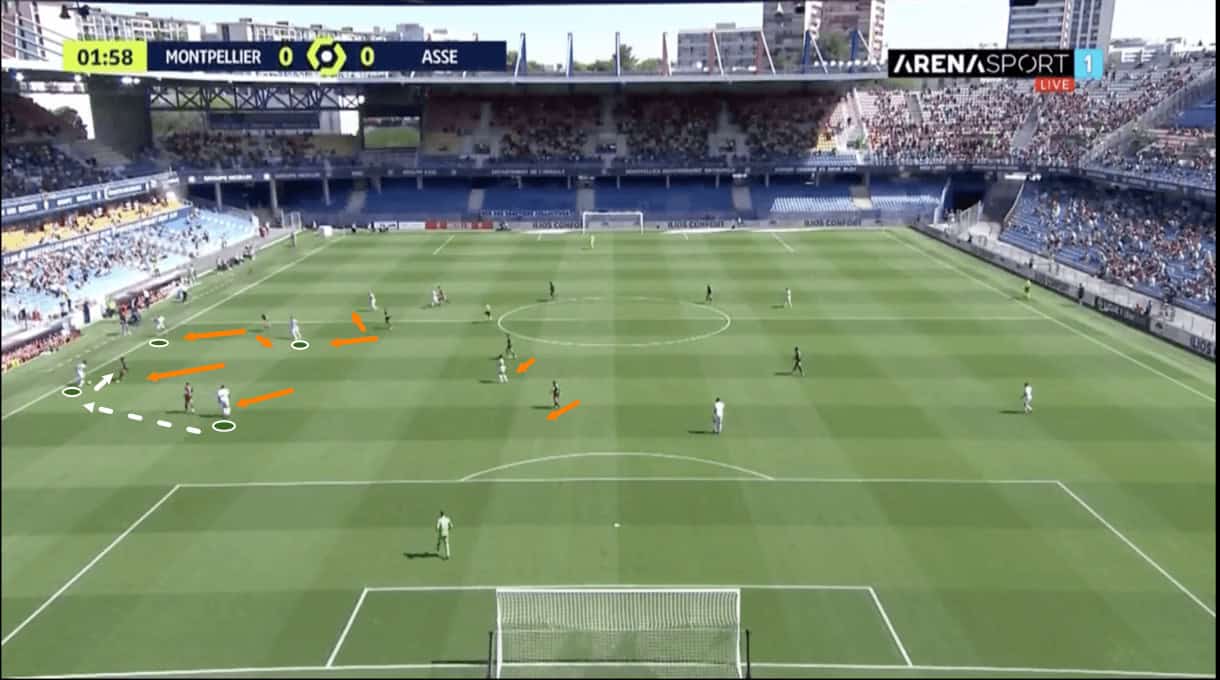
As play moves on into figure 5, we see that the centre-back opted to send the ball out to the left-back, while the opposition continued to crowd around this area of the pitch and keep Saint-Étienne pinned out wide, with even the route back to the centre-back and/or goalkeeper covered by the opposition’s press here. With nowhere to go but potentially up the wing, that’s the choice the left-back makes but Montpellier succeed in forcing the turnover as the left-back makes that move to progress. This creates a dangerous counter-attack for Montpellier, again highlighting the perils of losing possession during this delicate phase of play, as well as how Saint-Étienne’s build-up and progression structures can be exploited to create such threatening scenarios.
Central underloads
As mentioned earlier on in this tactical analysis piece, while trying to overload the wide areas and create opportunities for progression via their structure out wide, Saint-Étienne’s structure and progression tactics naturally underload central midfield and effectively deny them chances to progress through the centre of the pitch. Figures 1-5 all showed this, and in this next section of analysis, I’ll focus more on how Les Verts have struggled with this lack of bodies in central areas at times this season and the problems that this element of their play poses.
Firstly, figure 6 shows an example of an occasion where Saint-Étienne’s central midfield duo linked up, with the left central midfielder having played into the right central midfielder’s feet just before this image. However, with the forward line sticking together, high up the pitch, ready for a potential long ball, as we discussed, the right central midfielder scans his right shoulder to see absolutely no short forward passing options available to him. The passing options on the left-wing are marked out of contention for a pass by the opposition, the ‘10’ is being kept in an opposition player’s cover shadow, and passes across to the right-back/right centre-back are also blocked off. Figure 6 shows the oftentimes deserted nature of Saint-Étienne’s central midfield and why they don’t progress through this area, which is fine if that’s what they’re aiming for, but then they need to be more efficient with their attempts to progress via wide areas. Struggling with their progression via the wide areas and then having virtually no chance of progressing through the centre instead due to their structure, while often having a weak aerial presence up front, is a problem.
As play moves on from figure 6, we see the right central midfielder play the ball back to his central midfield partner, who ultimately opts to send the ball back to the goalkeeper, effectively resetting the attack. Again, Les Verts can make it too easy for the opposition to prevent them from moving through midfield in situations like this and more movement higher up the pitch to shift opposition bodies around could potentially help them to play more productively in these types of scenarios, so perhaps more work on the training ground to prepare the team to deal with these scenarios better is needed. The switch across to the right-back could potentially have been played from the left central midfielder, so that’s an option that Les Verts failed to explore here which could be a helpful yet non-risky one in these types of scenarios in the future, while greater movement from the forward line, especially the ‘10’, would undoubtedly have created a greater central presence ahead of the midfielders here to potentially help with progression.
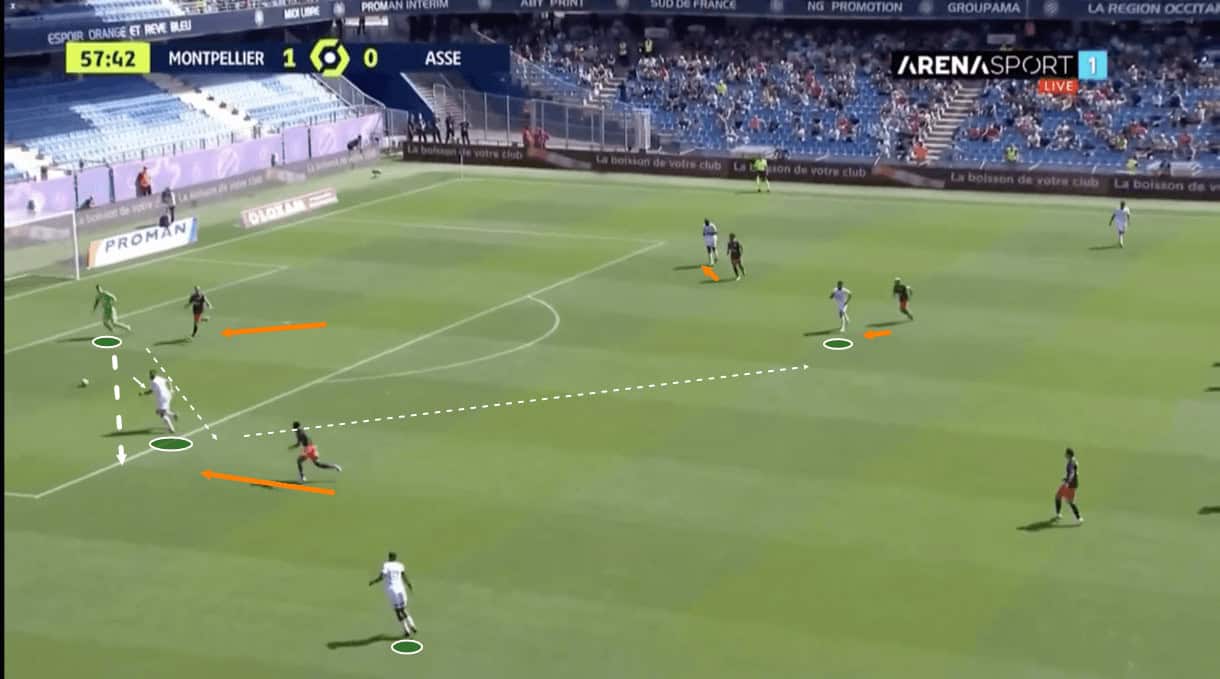
Again, as we analysed in the previous section, Saint-Étienne’s central underload and tactics that see them try to progress through the opposition via the wide areas instead can influence players’ decisions and ultimately lead to difficulties with progression or, worse, turnovers in dangerous areas. Figure 7 shows an example of Les Verts building out from the back in the typical structure that we’ve seen them use throughout this tactical analysis piece. Under pressure, the goalkeeper passes to the right centre-back — a fairly common part of Saint-Étienne’s build-up play — however, he passes to the centre-back’s left-foot, or outside, as opposed to his right-foot, or inside.
Perhaps this pass was a result of the goalkeeper being aware of his side’s underload in the centre and preference to build through the wide areas, but this also then played into the opposition’s hands of forcing Saint-Étienne out wide, pressing from the centre. Had the ball been played to the centre-back’s right-foot/inside, he could’ve played a quick pass into the central midfielder who could then pass to the right-back, or a different player if the option was on, but definitely the right-back, who we see in space on the right-wing, ready to receive.
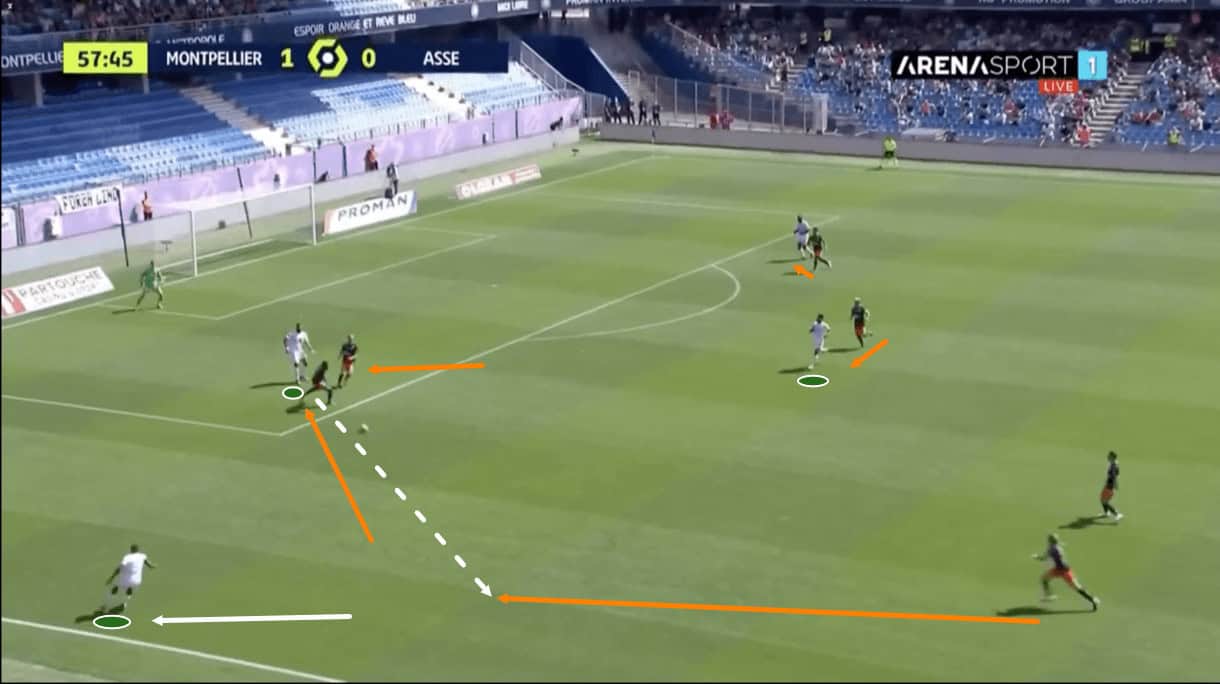
However, as play moves on, we see how the opposition player pressing the right centre-back from behind was able to cut off the immediate passing lane to the right-back, leading to the right-back continuing to push very wide to try and make an angle to receive from the centre-back, while the player who had been pressing the ‘keeper also had time to close down the centre-back while he turned. The centre-back opted to turn inside, rather than outside, to evade the opposition’s press and try to create a passing angle with the right-back where he was before as the right-back drifted wider. This leads to the error we see in figure 8, where the centre-back misplaced his attempted progressive pass to the right-back under pressure, allowing the advancing opposition left-back to regain possession for his side in this dangerous position, creating a high counter-attack for Montpellier.
Again, this highlights the importance of decision-making in build-up for Saint-Étienne’s deep-lying players, as well as how their decisions are influenced by the manager’s tactics. Had they been more comfortable with playing through the centre, perhaps this whole situation would’ve been avoided with a quick passage of play in figure 7. However, with the hesitancy to play through the inside came mistakes as a result of their play and the opposition’s pressure. Saint-Étienne must prepare better for dealing with high pressure and opposing teams’ intent of forcing them out wide in this phase and try to put together quick passages of play like the RCB-CM-RB option that was available in figure 7, which would’ve been a better one than the RCB-RB attempt that we saw fail.
While Saint-Étienne don’t have to progress through the centre, they can still use it. Saint-Étienne’s central midfielders don’t rank well for passes played per 90 among Ligue 1 central midfielders this term, which isn’t a result of their quality so much as it’s a result of Puel’s system that forces play away from them. Of course, Les Verts don’t have build through them solely, but there have been opportunities to use them when the team opted not to when it arguably would’ve been the better decision to go through them, so some more work on the training ground on specific patterns of play in build-up and progression when under aggressive pressure could result in more cohesive play in these phases that could work to the benefit of all involved.
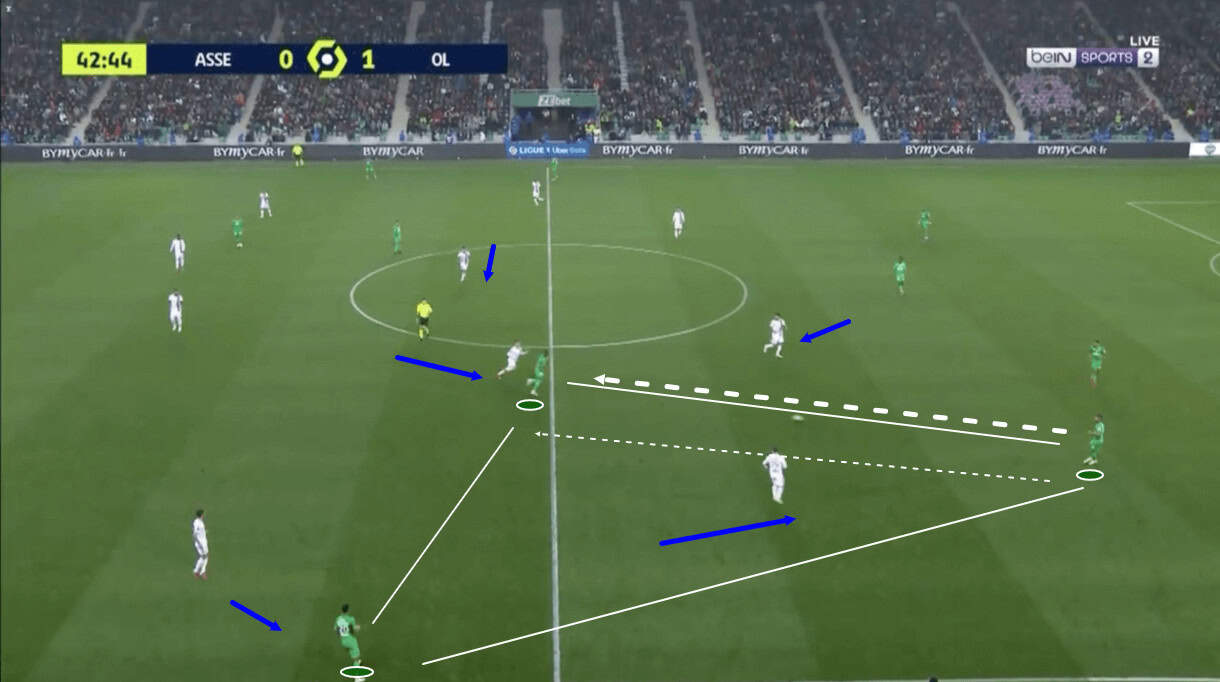
Figure 9 highlights an example of a passage of play in which the type of pass played and Saint-Étienne’s central underload combine to create a bad scenario for Les Verts. Firstly, figure 9 shows the wide triangle formed by Saint-Étienne’s left-back (deepest), central midfielder, and left-winger. The left-back attempts to play the ball into the central midfielder to progress into the forward line via the left-winger. However, the pass is played to the midfielder’s inside, as opposed to outside nearest the winger, which creates problems.
The side to which the pass is played is sometimes underlooked but can make or break the passage of play. In this instance, a pass to the right foot would allow the midfielder to turn out and either play the ball into the winger’s feet or play a through ball to him. However, especially with Saint-Étienne’s central underload, a pass to the left-foot here gives the midfielder very few options. Again, this is an issue of decision-making which is something that should be made easier for players through their work on the training ground to prepare to make the best possible choices in these scenarios. Some mistakes will inevitably occur but you want to minimise them and Saint-Étienne are making far too many at present, resulting in lots of ball losses.
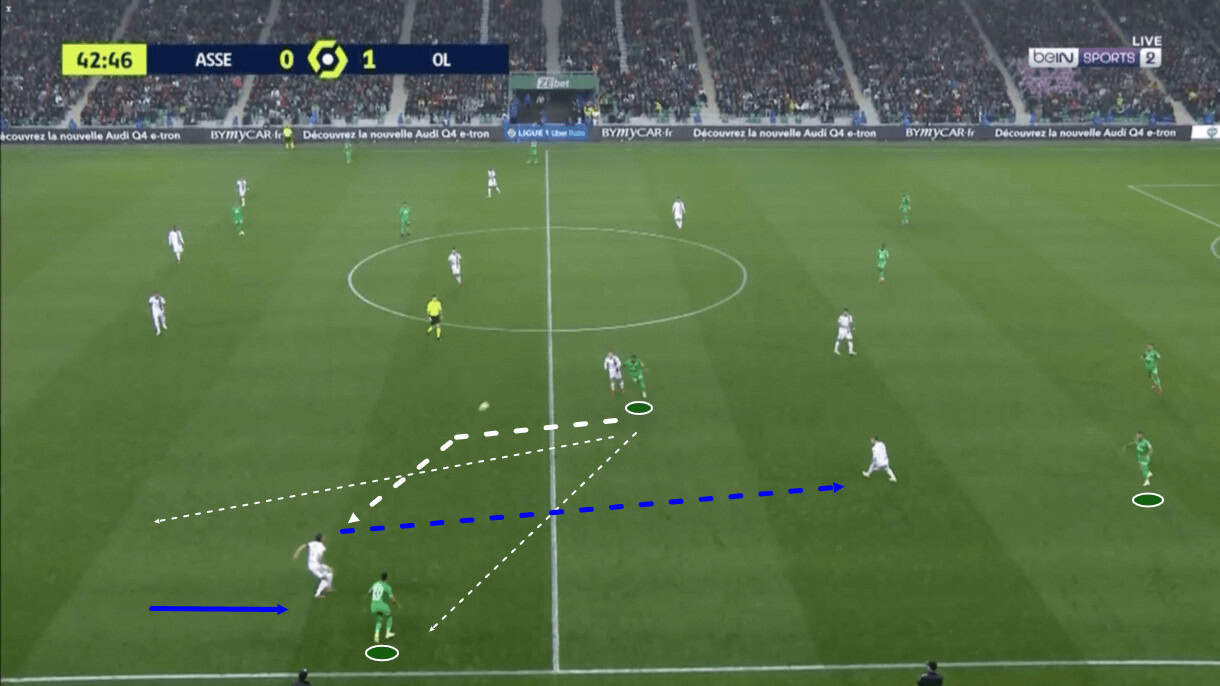
As play moves on into figure 10, we see that the midfielder attempted to save the attack and still link up with the winger. He reached out for the ball on the inside with his left foot and knocked it out towards the winger. However, the pass was far less accurate than it could’ve been if the ball was played to the midfielder’s right-foot and instead of the pass to feet or through ball for the winger to collect, the ball is lobbed towards the opposition full-back who knocks it down for his teammate on the wing to kickstart a counter-attack.
If Saint-Étienne had more of a presence in central midfield, this pass to the left-foot wouldn’t have been as disastrous as it ultimately turned out to be, but in reality, it was pretty disastrous. If Les Verts want to continue focusing their progression on the wide areas and not add more bodies to central midfield, then they’ve got to create more of an understanding between their players involved in the progression via wide areas.
Saint-Étienne must put in more work on their patterns of play in the progression phase to make their attempts to progress via the wide areas smoother, help their players to make better decisions and create the best possible opportunities for each other to shine. At the moment, incidents like this are far too common.
Progression problems lead to exposure of weakness in transition to defence
While they’ve conceded the joint-fourth-most goals of any Ligue 1 side this term, Saint-Étienne’s defensive tactics, in general, haven’t been bad. They’ve pressed very aggressively and forced lots of high turnovers as a result, while Saint-Étienne attackers Krasso and Adil Aouchiche rank fourth and fifth, respectively, for successful defensive actions among Ligue 1 wingers, attacking midfielders and strikers to have played at least 200 minutes so far this season. Saint-Étienne’s performance without the ball, in general, is one of their positives, especially their performance in the high-block, while they tend to perform well in transition to attack too, which compliments this good performance without the ball and in the high-block.
However, Les Verts have still conceded far too many goals so far this season — an average of two per game — and a big reason for that is their poor performance in the build-up and progression phases which has led to the most ball losses of any Ligue 1 side.
A couple of notable statistics regarding their performances in possession are that Saint-Étienne have currently got the second-lowest pass accuracy rate in Ligue 1 (81.2%), along with the lowest long pass accuracy rate (48.7%). Additionally, per Wyscout, Puel’s side has lost the ball more times than any other Ligue 1 side this season (97.29 per 90). These ball losses, as we’ve seen, result in opposition counter-attacks and opposing teams have done a great job of exposing Saint-Étienne’s weaknesses in transition to defence this season. This has been made easier by opposing teams enjoying more opportunities to counter against Les Verts than they get against the typical team.
Earlier in this tactical analysis piece, we observed that Saint-Étienne tend to send both full-backs high during the progression phase. Naturally, this then leaves space on the wings for the opposition to exploit on the counter after regaining possession.
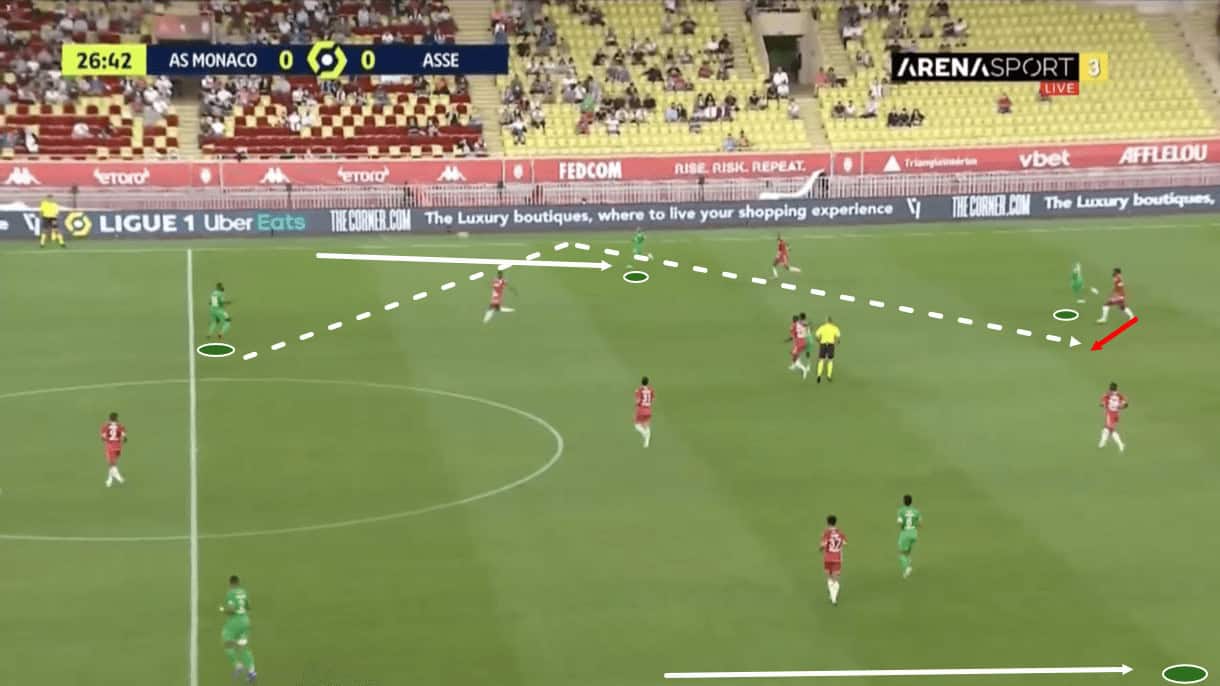
Figure 11 shows an example of a typical passage of play in which Saint-Étienne’s full-backs are both sent forward. The left centre-back on the ball attempts to find the winger who’s dropped into the half-space here, however, as the ball moves forward, it’s intercepted by Monaco’s centre-back who can start a counter-attack for his side. This was an attempt at a creative pass, which can’t be faulted, but the execution can be.
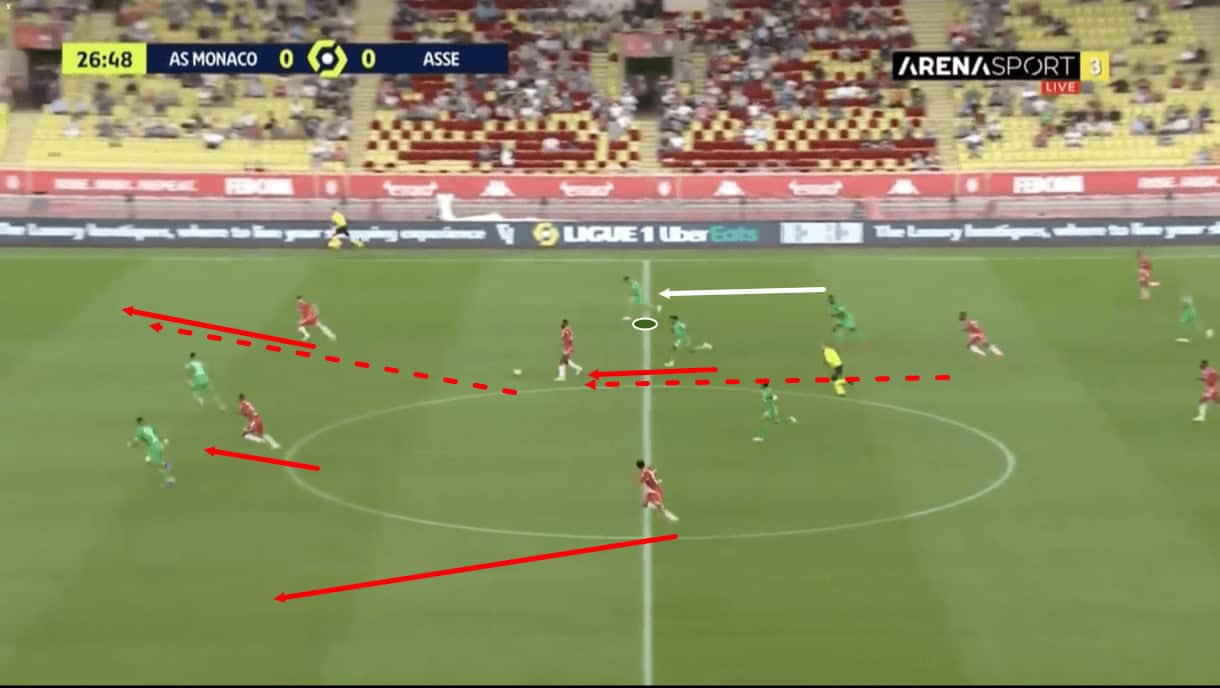
The centre-back’s pass was poorly placed and created a great opportunity for the opposition to slice through Saint-Étienne’s underloaded midfield on the counter before exploiting the wings, which is exactly what they do. As play moves on into figure 12, we can see that Monaco are driving at Saint-Étienne’s backline, having progressed through the centre, where we know Monaco would’ve had the overload here. After figure 12, we see the ball get sent through to the attacker on the right who progresses into Saint-Étienne’s box and sets a teammate up for a relatively easy goal.
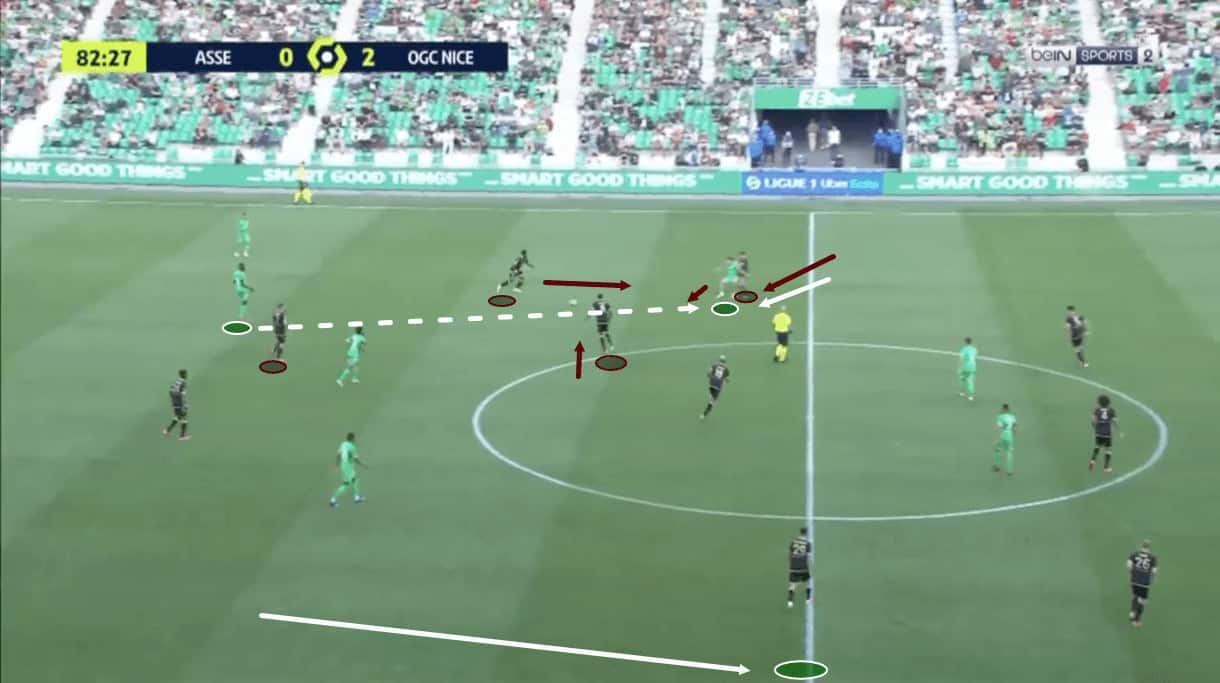
We see a similar situation here in figure 13. The left centre-back sent the ball into the winger in the half-space who was surrounded by opposition bodies — another common sight at this point of the analysis. If the player is far technically superior so he can dribble out of this tight area or has a physical advantage so he can back into the man behind him before spinning out and driving forward, then this is fine, but in general, you don’t want to be putting your players in situations where they’re significantly overloaded as often as we’ve seen Saint-Étienne doing in this tactical analysis. Unfortunately for Les Verts, the attacker was unable to escape the opposition’s cage here with either technical or physical quality and was dispossessed in central midfield while Les Verts’ left-back was positioned high on the left-wing.
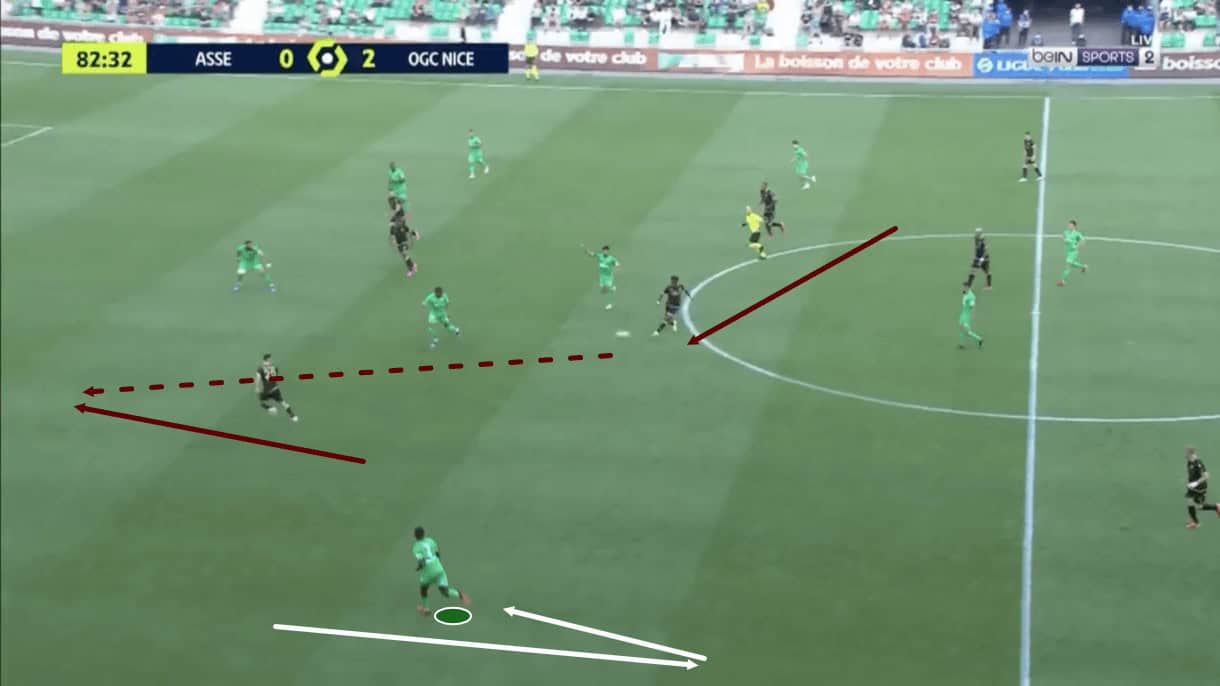
The opposition, Nice, took advantage of the central turnover and left-back’s positioning very well with their counter-attack, as we see in figure 14. After winning the ball back, Nice progressed through midfield with a dribble and this player then sent a through ball to a player exploiting the space that’s been vacated by Les Verts’ left-back. As play moves on, just like in figures 11 and 12, this player progressed into the box before setting a teammate up for an easy finish.
Highlighting this isn’t to say Saint-Étienne shouldn’t send their full-backs forward — it’s necessary to do so for the sake of their progression possibilities — nor is it to say they need to bolster their midfield, although I would advocate for adding another body to it based on all we’ve seen in this analysis, whether that’s by dropping the ‘10’ deeper or otherwise, but it is to say that Saint-Étienne have to stop being their opponents’ best playmaker by losing the ball so much, which goes without saying, but it’s clear from our analysis that this failure to progress from their half is the catalyst for their early-season struggles. If Puel solves this problem, or at least makes a dent in it, via his work on the training ground, then he should be able to turn things around for the French giants. If he fails to do so, then questions will continue to be rightfully asked about his future at the club.
Conclusion
To conclude this tactical analysis piece, I feel that the highlighted issues in build-up and progression are the main reason for Saint-Étienne’s poor start to the season. This is a solvable problem and Les Verts’ current state likely isn’t as bleak as the table may make it seem, as they’ve managed to play plenty of good football and create more chances than their goals tally would suggest this term.
One thing I’d like for Puel to consider, other than working on better patterns of play and preparing the players to make positive off-the-ball movements to create passing options and/or move the opposition around in the progression phase — which he’s undoubtedly going to be doing at present anyway — is to drop the ‘10’ away from the striker and into a deeper position more often to give his side more of a presence in the centre if they do need to use this part of the pitch, while I’d also like to see Saint-Étienne try to create more moments of transition in attack to make use of their quality pressing from the front and good counter-attacking ability. Maybe the lack of an aerial presence up front, at times, hurts this possibility, but you don’t need to win aerial duels to win the second ball, just put them in the right area and create the right structure around the second ball to benefit your side, so maybe Les Verts could make better use of their pressing and counter-attacking quality too.
There are plenty of potential solutions to these problems for Puel, but the immediate focus has to be on giving the ball away less cheaply and getting stifled in the progression phase less.
