
Lorient were promoted to Ligue 1 for the 2020/21 campaign as the 2019/20 Ligue 2 champions and life hasn’t entirely been comfortable for Les Merlus in the top-flight this term. They managed to secure just three wins and three draws in their first 19 games of the season, leaving them with just 12 points by the middle of the campaign, sitting in 19th place and looking on course for a drop straight back to Ligue 2.
However, the second half of the season has seen Lorient enjoy an upturn in form, with Christophe Pélissier guiding his side to five wins and five draws in their last 12 games. They’re now sitting in 17th place, with 32 points and just seven games remaining in the Ligue 1 season.
So, how have Pélissier and his players pulled off this turnaround? In this tactical analysis, in the form of a scout report, we’ll provide analysis of how Lorient have put themselves in a much more comfortable position heading into the final stretch of the season. We’ll analyse some changes that the 55-year-old coach has made to his tactics during the second half of the campaign so far and explain how those changes have helped relegation-battling Lorient to become one of France’s in-form sides.
Change in shape and statistical analysis
The catalyst of Lorient’s change in form has been a change in the shape with which they play. During the first half of the season, Les Merlus primarily used either a 4-3-3 or a 4-2-3-1 formation, however, they’ve mainly played with a 5-4-1 over the last 12 games and they’ve also used a 5-3-2 in that time.
Lorient only played with a four-at-the-back formation in three of their last 12 games, with the Brittany-based club suffering their only two losses during this positive period in two of those three games.
So, Lorient’s results have clearly taken a turn for the better following their change in shape but what do the stats say about how their performance has differed over the last 12 games compared to the rest of the season?
Plenty of key stats would seemingly back up the claim that Pélissier’s decision to switch from playing primarily with two centre-backs to playing primarily with three centre-backs, starting with their 3-2 win over title challengers Paris Saint-Germain 11 games ago, was an inspired one in terms of boosting his team’s overall performance levels.
Firstly, Lorient have faced an average of 9.38 shots per 90 over the last 11 Ligue 1 fixtures from that PSG game onwards. This number is down from the average of 11.01 shots per 90 that they’ve faced thus far over the entirety of the 2020/21 league campaign.
Secondly, Lorient have engaged in an average of 75 defensive duels per 90 over the last 11 games, which is essentially equal to the 75.03 defensive duels per 90 they’ve engaged in, on average, for the 2020/21 season, however, their defensive duel success rate has improved during this successful period, as they’ve won 61.22% of their defensive duels during the last 11 games, compared to 58.8% for the whole league season so far.
As well as that, Les Merlus have managed to make an average of 44.64 interceptions per 90 over the last 11 games, which is an improvement on the average of 42.23 interceptions per 90 that they’ve made thus far in Ligue 1 this term.
It’s not just defensively that this switch to playing with three centre-backs more often than not has boosted Lorient’s stats, however. They’ve also seen an improvement in some key areas offensively. For example, Les Merlus have taken an average of 11 shots per 90 over the last 11 games, which is an increase on the average of 10.46 shots per 90 that they’ve taken overall this season.
Furthermore, it’s worth noting that Lorient are a heavily counterattack-focused side. One consequence that has come largely as a result of this is that they have kept the third-lowest average percentage of possession (44.8%) of any side in France’s top-flight this season.
This style of attack has helped Lorient to score more goals (37) than as many as seven other teams in their first season back in the top-flight. In contrast, they’ve conceded the joint-second-most goals (54) of any Ligue 1 team this season, so it’s clear that their defence has performed far worse than their attack during the 2020/21 campaign, in general.
Lorient have made an average of 3.48 counterattacks per 90 this season in Ligue 1, however, they’ve had four or more counterattacks – a higher number than average – in seven of their 11 games since switching to playing primarily with three centre-backs versus PSG on 31st January.
So, it’s clear that Pélissier’s tactical alterations have led to some statistical improvements in several key areas for Lorient of late. Offensively, they’re enjoying more counterattacks – one of their main routes to goal this season – and taking more shots than they had been in the first half of the season, while they’re generally now limiting their opponents to fewer shots at goal while winning more defensive duels and making more interceptions.
Lorient defending against counterattacks
While Lorient have effectively used counterattacks to their advantage to score goals in Ligue 1 this season, they’ve also been quite susceptible to conceding goals from opposition counterattacks during the 2020/21 campaign.
They’ve conceded a lot of goals on the counter primarily for two reasons. Many of the chances and goals that they’ve conceded from opposition counterattacks have come after they’ve lost possession in the middle third of the pitch while building an attack of their own, while they also tend to place at least one full-back/wing-back far up the pitch during the build-up, if not both, which has led to their backline getting overloaded fairly easily on the counter.
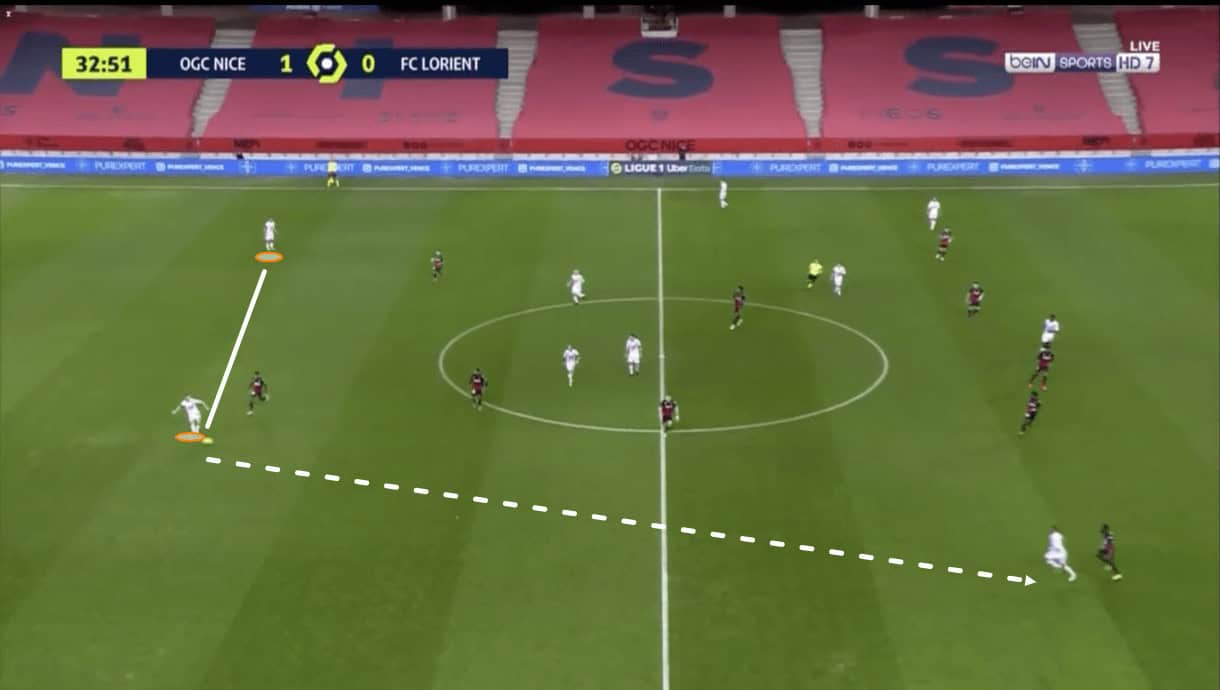
Figure 1 shows a typical example of Lorient building into the middle third of the pitch from their centre-backs while playing with four-at-the-back. In this particular case, they’re utilising a 4-3-3. This image is from an away clash with Nice back in December.
At this moment, Les Merlus’ right-back is positioned centrally, alongside the central midfielders, while the left-back is positioned high on the left-wing. Meanwhile, three Nice players are sitting in between these centre-backs and Lorient’s next line, so it’s clear how the centre-backs could easily get outnumbered in the case of a turnover occurring and the ball being played quickly up to the other end of the pitch.
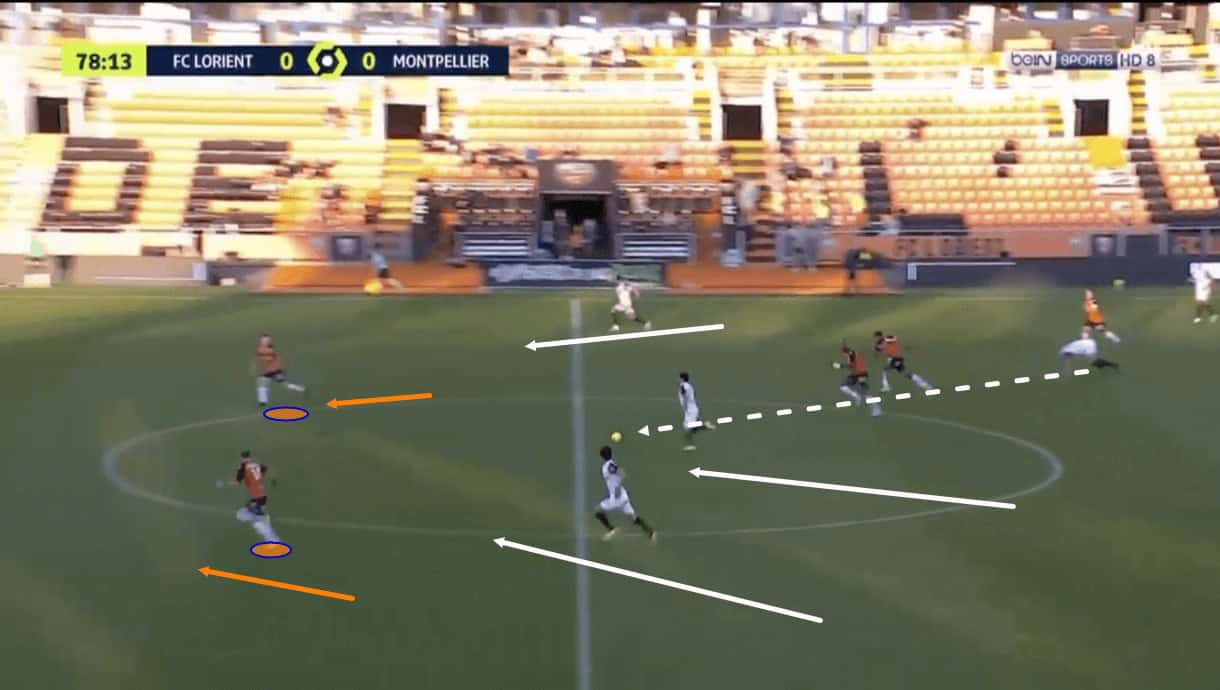
This has happened on several occasions this season, with Lorient’s centre-backs getting put under plenty of pressure and goals being conceded as a result. An example of one such occasion is seen in figure 2, which is taken from Lorient’s 1-0 loss at home against Montpellier earlier this season.
Similar to figure 1, three Montpellier players are between Lorient’s two centre-backs and the rest of their outfield players, and on this occasion, the opposition managed to quickly find them in between the lines after Lorient lost possession. This immediately creates a 3v2 advantage for Montpellier on the counter and as play moves on, they make this advantage count by scoring what would end up being the only goal of the game from this move, which shows just how deadly this kind of scenario can be and how dangerous it was for Les Merlus to allow their opponents to enjoy these kinds of chances so often.
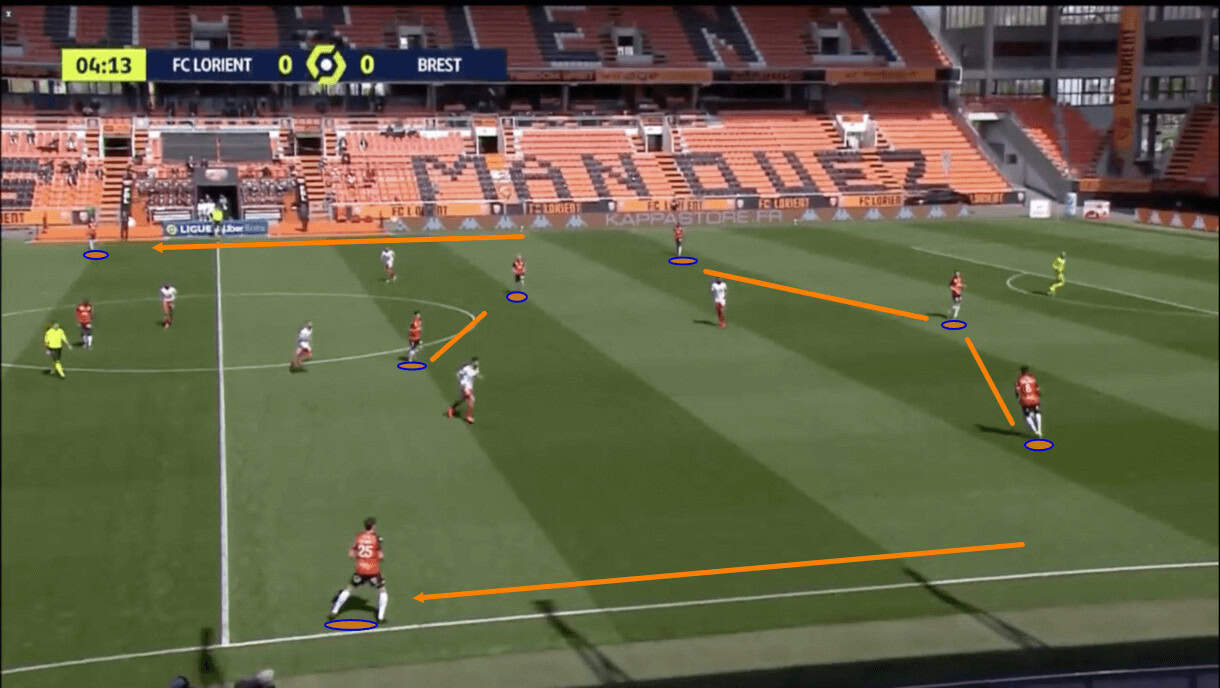
In contrast to figure 1, here in figure 3 we see Lorient building into the middle third of the pitch from their centre-backs while playing with three centre-backs. This particular example is taken from the Brittany-based side’s recent 1-0 win over Brest and in this game, they utilised a 5-4-1 in defence, which turned into a 3-4-3 in attack.
This image clearly shows that now, it would be more difficult for situations like the one we saw in figure 2 to occur, because Lorient have more bodies behind the ball during this stage of play, with an additional centre-back providing extra cover in front of goal.
Their decision to play with three centre-backs in the majority of their most recent games hasn’t completely stopped them from conceding goals on the counter, however, there have been some instances where it has clearly helped them to put a stop to an opposition counter, where life would likely have been much more difficult with just two centre-backs.
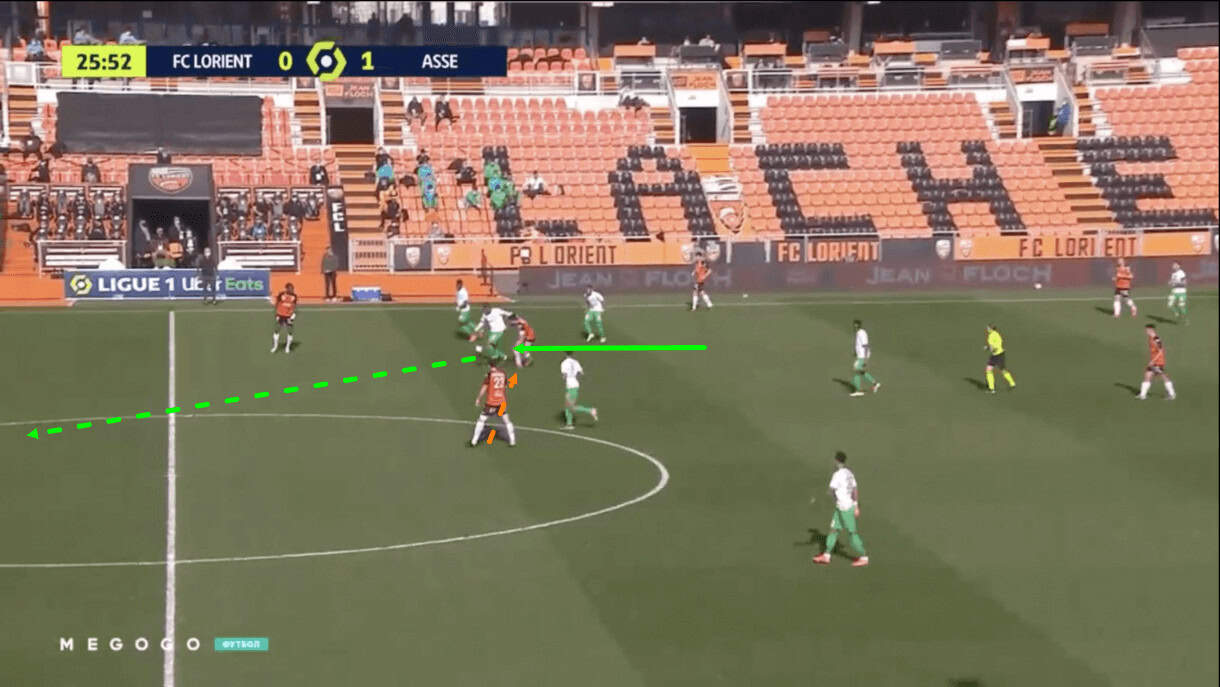
In figure 4, we see an example of the start of an opposition counterattack where having three centre-backs ended up paying off for Lorient. Just before this image, which is taken from Lorient’s recent 2-1 win over Saint-Étienne, Les Merlus’ right central midfielder passed the ball to the left central midfielder, who promptly attracted pressure from a Saint-Étienne player that ultimately dispossessed the Lorient man and quickly played the ball forward, setting his side off on a counterattack.
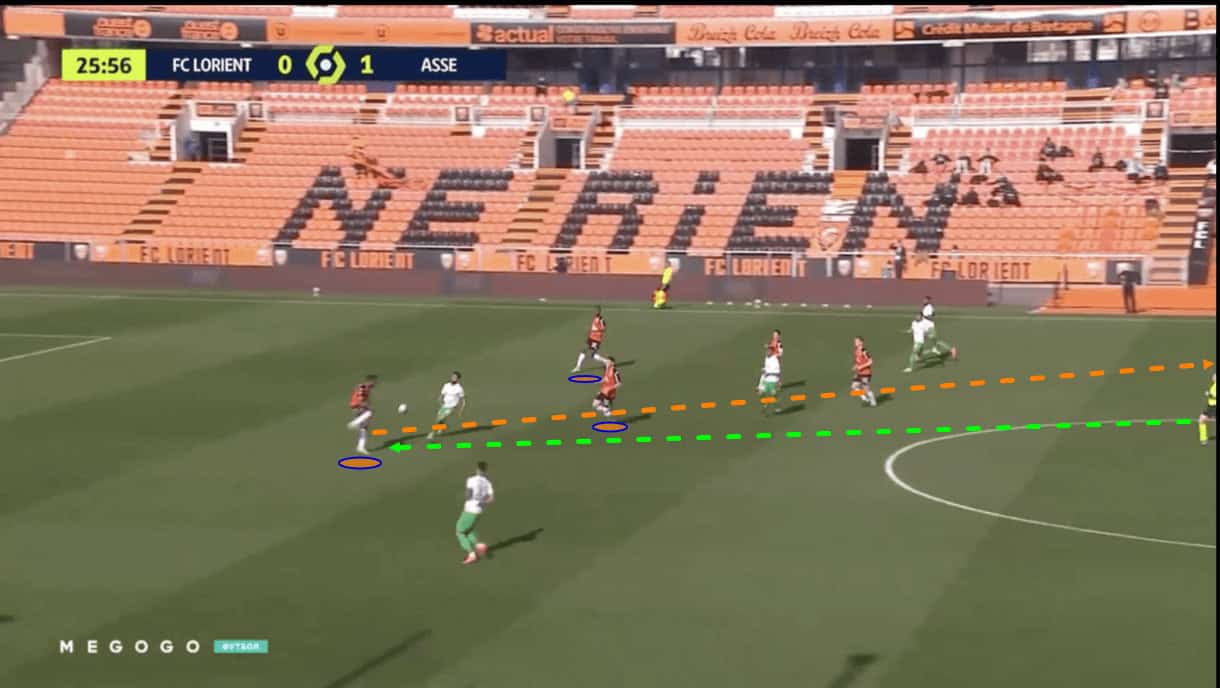
As Saint-Étienne played the ball forward, Lorient’s central centre-back was dragged out of position by an opposition attacker’s movement, however, despite this player being dragged out of position and three Saint-Étienne attackers running at Lorient’s backline, as we see in figure 5, Pélissier’s side were able to deal with the danger and put a stop to this attack.
A lot of the credit for that should go to the fact that Lorient simply put more men in this area of the pitch than they have on many occasions this season. We’ve seen how their centre-backs did get overloaded on the counter as a result of their susceptibility to losing possession in the middle third of the pitch in the build-up and figures 4 and 5 show another example of an occasion where this could well have happened.
Pélissier and his backroom team have done well to identify a major problem area and come up with a solution that is making the issue less significant.
Space between Lorient’s defenders
Lorient haven’t just been conceding goals on the counter, however, they’ve conceded plenty of their goals from other types of attacks as well and one area in which their backline notably struggled at times during the first half of the 2020/21 campaign was with opposition attackers exploiting space between their defenders as they got pulled out of position.
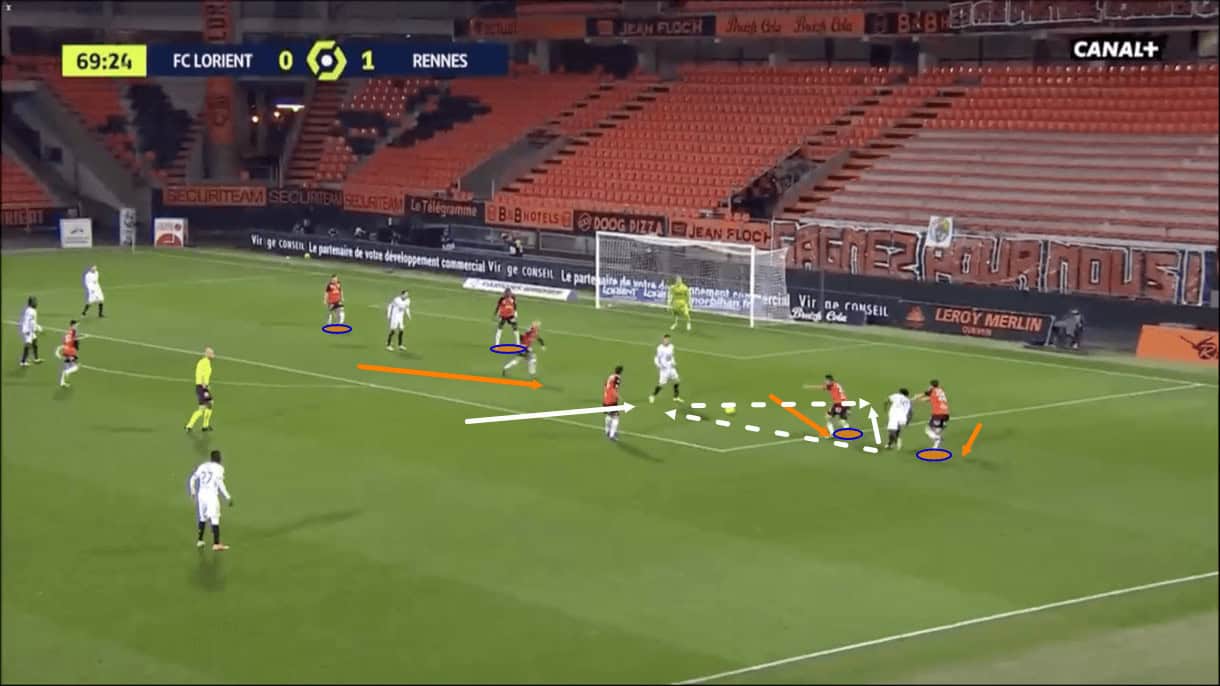
Figure 6 shows an example of this happening in Lorient’s 3-0 loss to Rennes back in December. Just before this image, Rennes’ highly-rated right-winger Jérémy Doku, who was linked to clubs like Liverpool and Arsenal before joining Rennes, dribbled past Lorient’s left-back and his movement dragged Les Merlus’ left centre-back out of position as he attempted to provide support to his teammate at and stop Doku.
This naturally created extra space between Lorient’s two centre-backs as the right centre-back was occupied in the middle of the box and didn’t shift further to the left to close the space between him and his central defensive partner.
As the image above shows, a Rennes attacker, Benjamin Bourigeaud, drifted into this space and while Lorient’s holding midfielder began attempting to drop into the space that would’ve been occupied by a central centre-back, he was too slow to get there before Doku and his teammate linked up, playing a one-two around the left centre-back before Doku ended up cutting the ball back to this teammate on the edge of the box, from where he slotted the ball away into the far corner of the net.
You could certainly argue that had this holding midfielder dropped into the backline quicker, then this goal wouldn’t have been scored and you could also argue that if Lorient had been playing with a third centre-back here, this goal would’ve been prevented but what we can say for sure is that this goal came as a result of Rennes effectively dragging Lorient’s backline apart and exploiting the space that presented itself between the defenders.
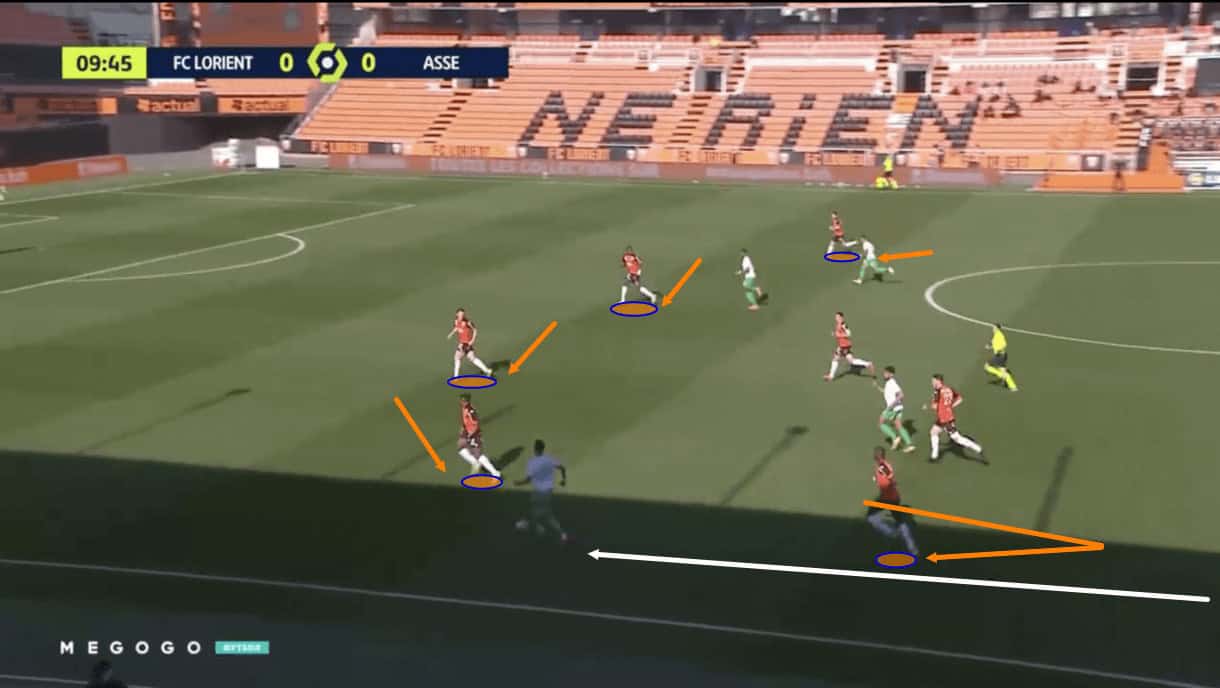
In more recent games, Les Merlus have done a much better job of preventing these gaps from opening up in their backline when players do get dragged out of position. We see one example of this in figure 7, where just before this image, the Saint-Étienne player carrying the ball up the left-wing dribbled past the Brittany club’s right wing-back, as the Lorient man pressed the ball-carrier when he entered Les Merlus’ half of the pitch.
It’s common for Lorient’s wing-backs to press more aggressively as the opposition enters their half of the pitch like this but when that player is beaten by the dribbler, then the rest of the defence must provide cover.
On this occasion, the right centre-back shifted over to what you might call a more natural right-back position. This player is dragged out of position similar to how his teammate at left centre-back was dragged out of position in figure 6 versus Rennes but the key difference here is the fact that in this example, figure 7, Lorient are playing with three centre-backs. As a result, the distance between the left and right centre-back is essentially plugged by the central centre-back.
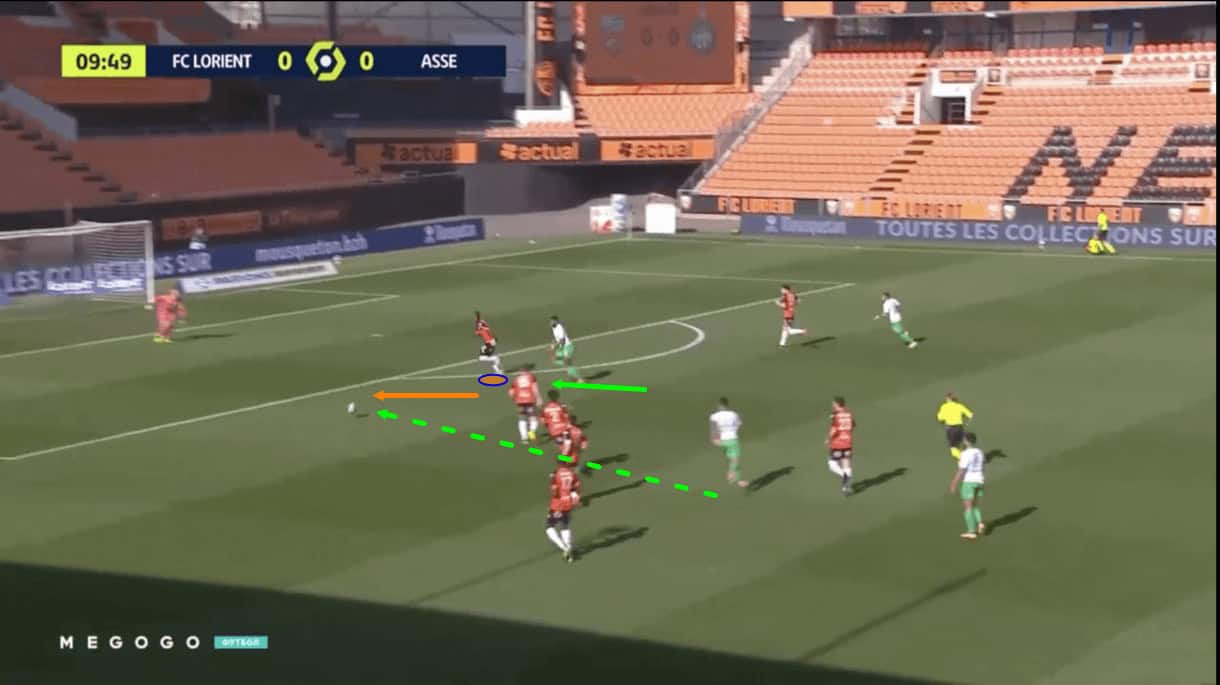
As play moves on, figure 8 shows us that it was far more difficult for Saint-Étienne to exploit space between Lorient’s defenders here than it was for Rennes to do so in the previous passage of play. Had the central centre-back not been where he was, the furthest forward Saint-Étienne attacker would have had much more space to run into but thanks to the third centre-back, Les Merlus retained control of the situation and the right centre-back ultimately ended up intercepting Les Verts’ eventual through ball, winning back possession and ending this attack.
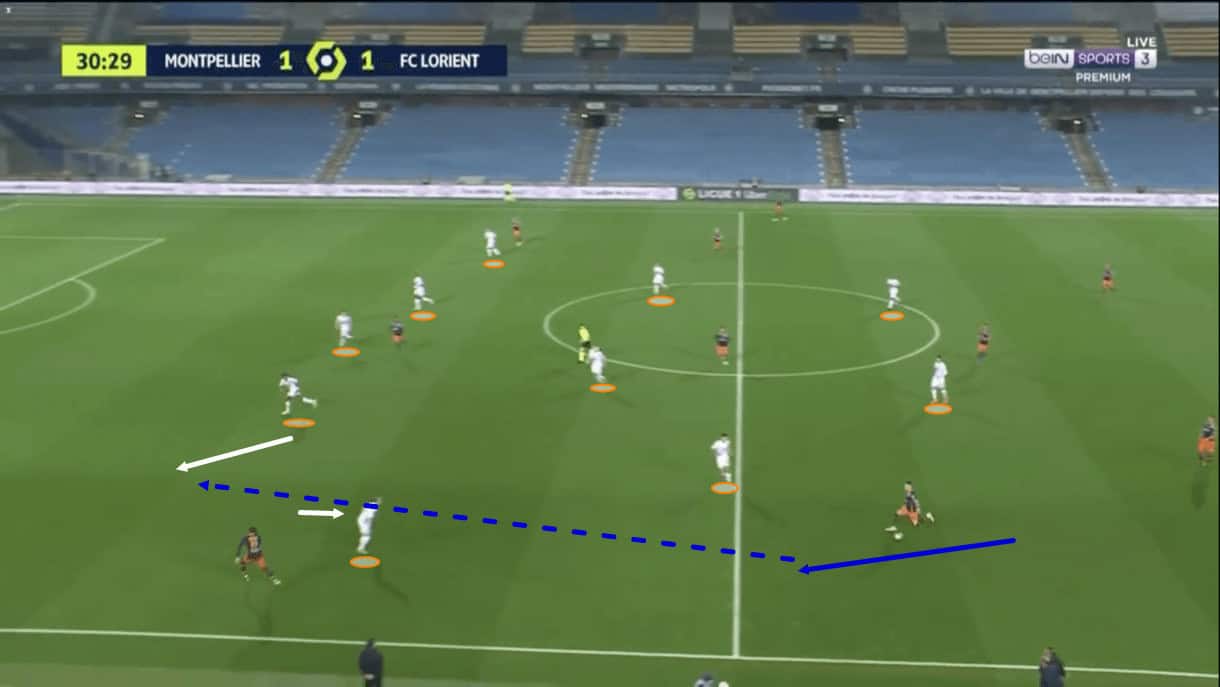
Figure 9 shows an example of a similar situation that occurred during Lorient’s 1-1 draw with Montpellier back in March. Here, we can see the right wing-back primed and ready to press the ball carrier as he nears the halfway line, allowing the right centre-back to shift over and deal with the opposition winger running in behind him.
Lorient’s central centre-back, right centre-back and right wing-back essentially enjoy a 3v2 advantage against Montpellier’s centre-forward and left-winger, and as play moves on, this right centre-back manages to intercept a through ball played by the ball-carrier just before entering Lorient’s half of the pitch.
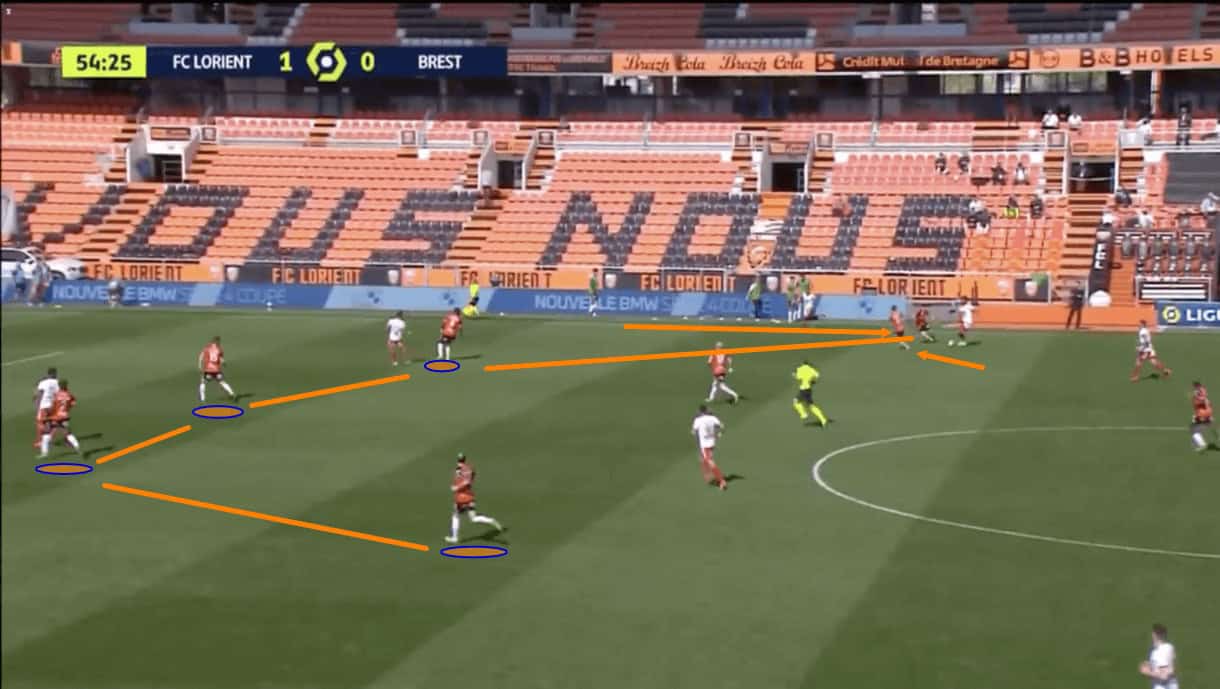
We see an example of Lorient’s left wing-back pressing high and the left centre-back shifting over to provide cover in figure 10 versus Brest. Here, the central centre-back finds himself as the free man, with the right centre-back and left centre-back both occupying opposition forwards.
As play moves on, this numerical advantage pays off for Lorient, as the left wing-back’s pressure, combined with support from the left-winger, forces the ball-carrier to play the ball forward, leading to Les Merlus winning back possession.
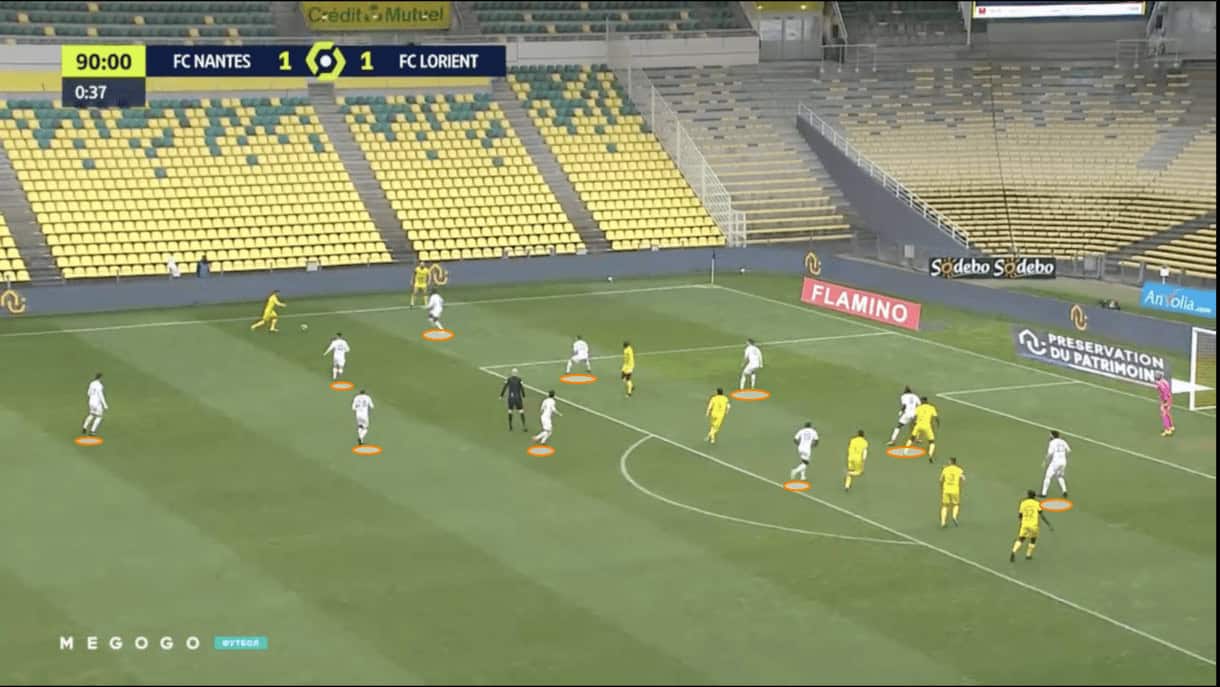
Lastly, in figure 11, we can see Lorient defending deep in their 5-4-1 shape late on in their recent 1-1 draw with fellow relegation-battling side Nantes. Here, Nantes find themselves in possession on the left-wing, in a similar position to the one Doku was occupying on the right-wing when Rennes exploited the space between Lorient’s centre-backs in figure 6.
We can see that the right wing-back has approached the ball-carrier similar to how the left-back approached Doku in figure 6, while the right centre-back has also shifted out towards the edge of the penalty area, providing support to the right wing-back and occupying a Nantes player at the corner of the box, preventing the opposition from passing around the wing-back.
This would open up space between the left centre-back and right centre-back for a central Nantes attacker to exploit if not for the presence of the central centre-back who effectively plugs this area, helping his side to avoid getting overloaded by the Nantes onslaught and resulting in the Brittany-based side winning back possession and kickstarting a counterattack.
So, it’s clear from these examples that while Lorient have struggled with teams exploiting space between their defenders at times this season, Pélissier and his team have, again, done well to pinpoint an issue and solve it.
Lorient’s attack
As mentioned previously, Lorient’s attack hasn’t suffered as a result of their switch to playing primarily with three centre-backs in the second half of the season. A large part of that is due to the offensive role performed by Pélissier’s wing-backs in this system.

Figure 12 shows an example of Lorient’s typical offensive shape when playing with three centre-backs. Here, we see how Les Merlus’ wing-backs stay wide and push high, providing the width for Pélissier’s men inside the final third, allowing the wingers to shift inside, between them and the centre-forward.
A lot of Lorient’s build-up moves through the wings and, as a result, the wing-backs are heavily involved. Just before this image, the left wing-back was in possession. This attracted pressure from the nearest opposition defenders and drew the opposition’s shape in general towards that side of the pitch.
As this image shows, the wing-back was offered support by the left central midfielder who dropped into the vacated space at left-back behind the wing-back but he opted to play the ball all the way to the left centre-back. Through him, Lorient then switched play to the opposite wing, forcing Saint-Étienne to quickly reorganise and shift across to the other side of the pitch. As play moves on, the right wing-back ends up playing a low cross into the box which is ultimately converted, giving Lorient the lead late on in this clash which they ultimately won 2-1.
Quick switches of play like this are typical of Lorient’s tactics in this three-centre-back system. This helps the wing-backs, who are afforded a lot more freedom than they would be in a two-centre-back system thanks to the additional cover behind them, to get the ball in space high up on the wing from where they can create goalscoring chances.
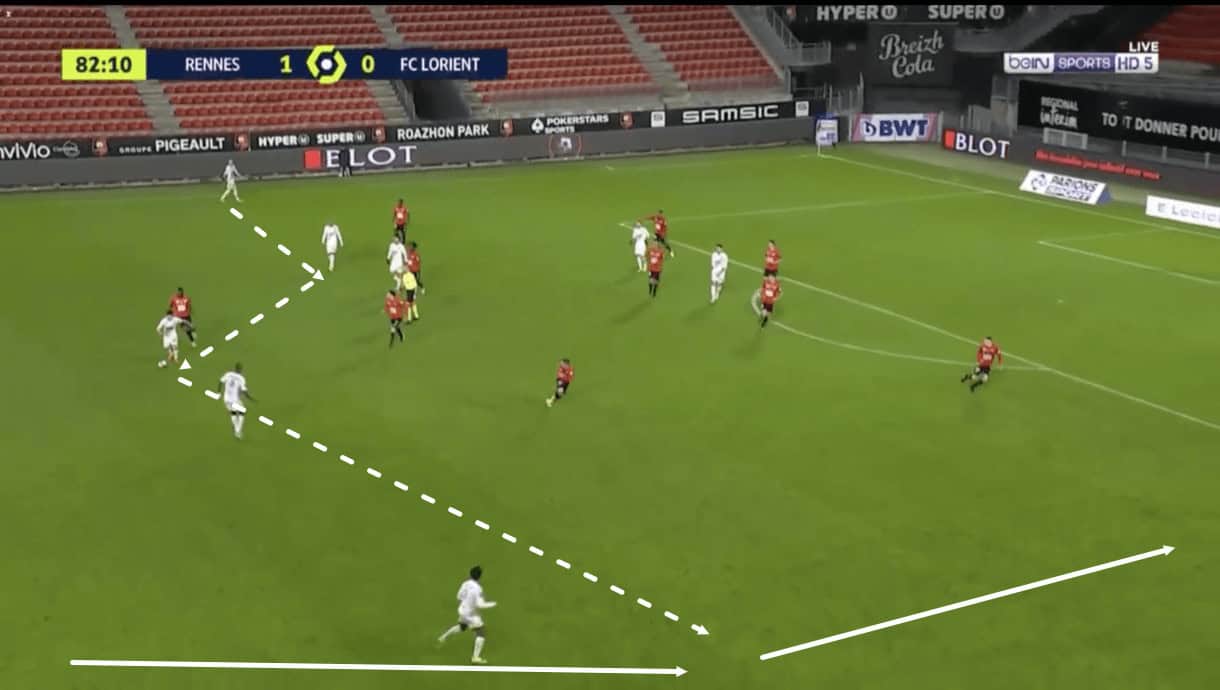
We see another example of Lorient quickly switching play to achieve this in figure 13, which is taken from their 1-1 draw away to Rennes in February – a game that saw them produce vast improvement on their performance versus the same team in December, which featured the Doku-produced goal analysed in figure 6.
Just before this image Lorient’s left wing-back was in possession out wide on the left-wing. As a result, Rennes’ defensive shape was attracted to this side of the pitch and plenty of space was left open on the right-wing for Les Merlus to potentially exploit, which they ultimately end up doing as the left wing-back plays the ball into midfield, which leads to Lorient’s midfielders switching the play over to the right-wing, picking out the overlapping runner.
This highlights the importance of the wing-backs’ offensive role in this system, as their positioning, decision-making and movement is key to Lorient’s attempts to progress through the thirds and stretch the opposition.
Conclusion
To conclude this tactical analysis piece, in the form of a scout report, it’s clear that Pélissier has effectively solved some glaring issues in his side’s defensive tactics through his switch to playing primarily with three centre-backs. This has boosted his team’s stats in several key defensive areas and, as a result, led to Lorient putting far more points on the board so far in the second half of the campaign than they did in the first half of the season.
Additionally, we can see that Pélissier’s tactical changes haven’t harmed his side’s attacking output, as the wing-backs are afforded greater freedom thanks to the extra cover behind them and they have proven to be key elements of Les Merlus’ attack of late. All in all, Pélissier’s current system suits his team far more than the previous one and Lorient are now in a positive position to avoid going straight back to France’s second-tier.
