
After finishing a staggering 39 points behind the title-winning Inter Milan, SSC Napoli officially entered the record books with one of the worst title defences in Serie A history.
Their long wait for the Scudetto was followed by a staggering decline within the space of only 12 months, having failed to qualify for European football for the first time in over a decade.
Their golden opportunity to maintain winning momentum and build upon a triumphant return to the top step fell at the first hurdle, with the club unable to properly replace key figures both on and off the pitch.
Club president Aurelio De Laurentiis has borne some of the onus, having begun to alienate the adored Luciano Spalletti before hiring the uninspiring Rudi Garcia as his replacement.
However, Napoli’s latest acquisition appears to signify a much-needed change in approach and a rebuilding of the club after such a dismal display.
Antonio Conte will be the man tasked with guiding Napoli back to success.
He has an incredible history of swiftly rejuvenating elite teams.
After achieving Scudetto triumphs with both Inter Milan and Juventus, the Partenopei will be incredibly intrigued by how Conte can rescue a fragile Napoli team and revitalise its key talents.
Off the pitch, the relationship between two of Italy’s most fiery footballing personalities will certainly garner headlines throughout the season, with Conte showing throughout his tenure at Tottenham that he is willing to condemn key club figures where he sees fit.
This tactical analysis will highlight Conte’s key philosophies, identifying which tactics we could expect to see when attempting to swiftly morph this Napoli squad into a traditional Conte team.
Our analysis will also identify some key players we think would be great additions in the summer window. Conte anticipates key players’ departures and aims to sign those who match his unique profiles.
Antonio Conte Preferred Formation
Throughout his managerial career, we have seen an evolution in Conte’s tactical approach based upon the squad which he inherits, modifying the tactical setup to accommodate his most talented player profiles.
However, his overarching theme and preferred system would have to be utilising the three-man defence to utilise energetic wing-backs.
The system that has made him so successful across Europe has multiple variations, including the 3-1-4-2 with Italy and Juventus and the 3-5-2 when returning to Serie A with Inter.
However, with Napoli’s current squad, it would be wise to suggest that Conte would probably continue with the 3-4-3/3-4-2-1, which saw him dominate the Premier League with Chelsea.
Whilst murmurings of a potential four-man defensive system have been discussed during Conte’s time away from elite football, it would be sensible to suggest that Napoli’s new head coach would prefer not to compromise and instil his desired three-at-the-back formation throughout pre-season.
Conte’s build-up play relies on the comfortability of the three central defenders in possession, with his wing-backs often remaining as wide as possible to stretch the pitch.
Opposition pressors initially aim to deny passing outlets towards the wings, which creates space for the wide central defenders to penetrate space in the inside channels, whether it be with progressive carries or looking to break the lines with varied passing.
A key element of Conte’s 3-4-2-1 would be the diamonds which form in possession of the ball.
With the wide central defender at the base of the diamond, the wing-back and central midfielders can offer clear passing outlets towards the inside or the outside of the pitch, with the inside forward dropping deeper to become the next point of progression.

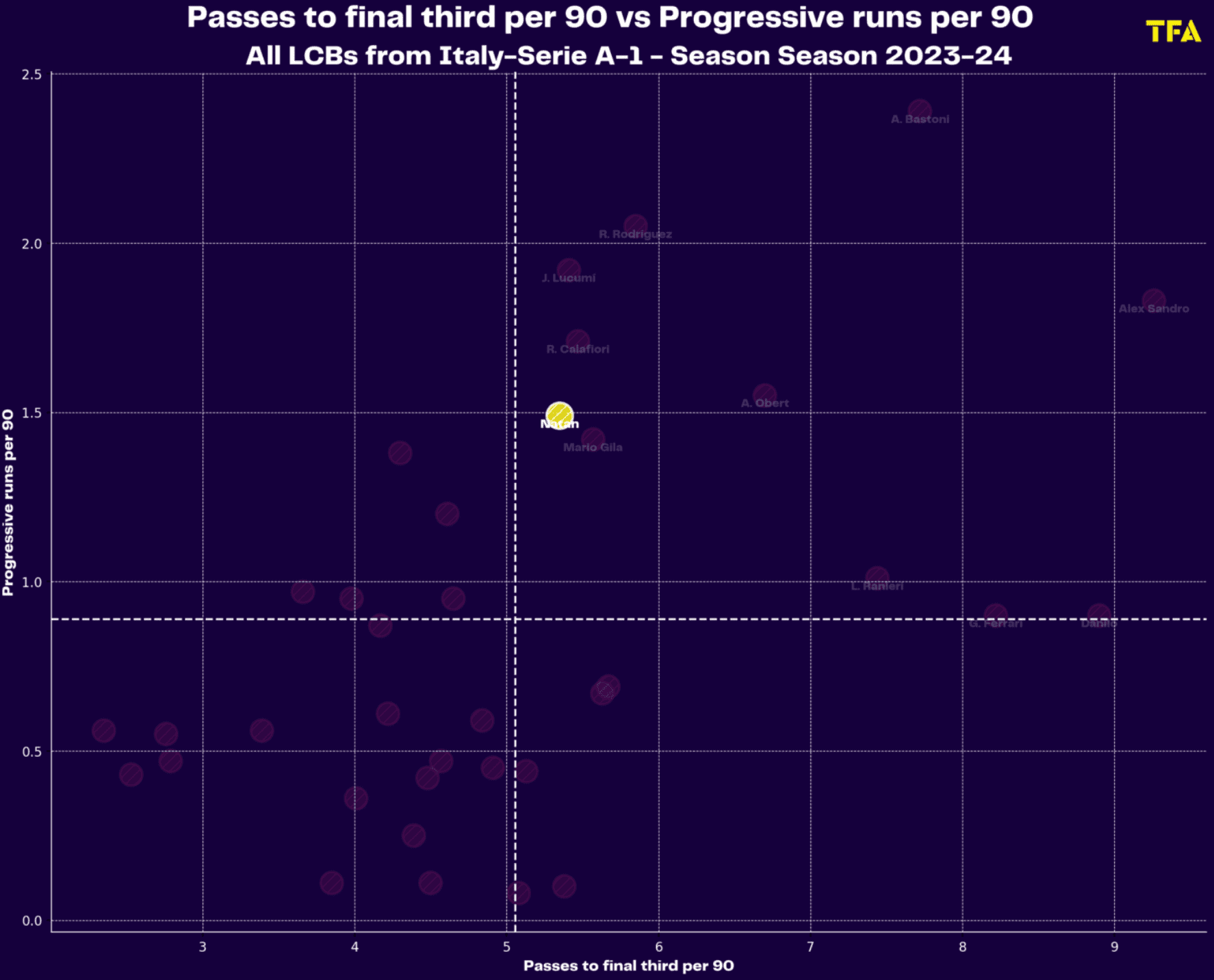
Having struggled in his debut season in Italian football, left-sided central defender Natan stands out as a player who can continue to evolve under Antonio Conte.
He has completed 1.67 progressive carries per 90 in the Serie A, representing a worthy ball progressor with additional defensive support as part of a three.
Like most teams who line up in a three-man defensive system, the wing-backs are integral at both ends of the pitch and must coordinate well with the inside forwards.
In Conte’s teams, wing-backs like Achraf Hakimi and Marcos Alonso have excelled due to their attacking freedom and ability to overlap in possession.
Their natural tendency to stretch play towards the touchline has meant that Conte can exploit the aforementioned diamond overloads on one side of the pitch with a quick switch to the opposite flank, attacking the space quickly to bear down on goal.
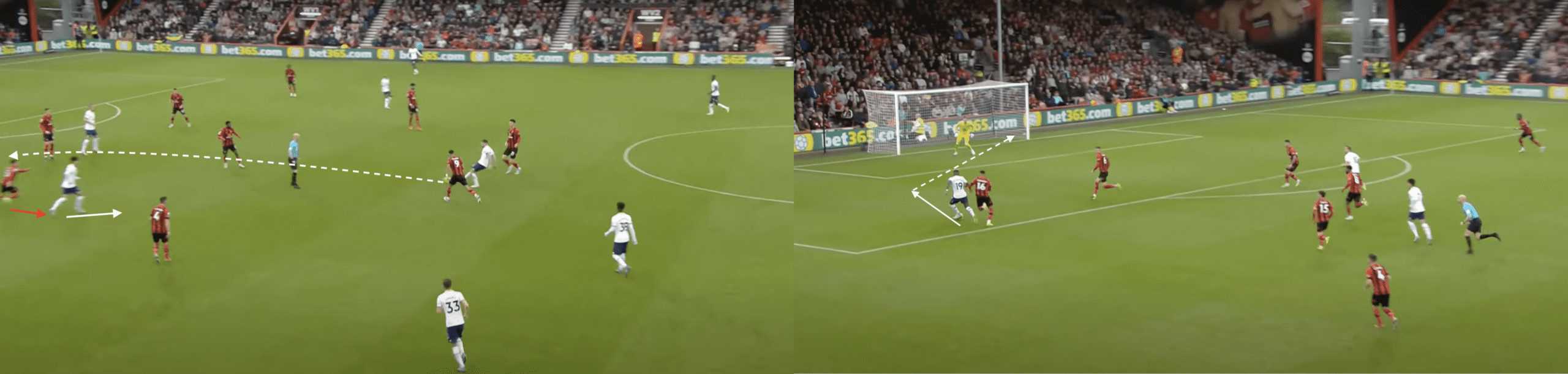
In this example, we see Son Heung-min dropping deeper into the inside channel, where Højbjerg can pick out the overlapping run of Sessegnon with a golden opportunity to break into the penalty area.
Additionally, the underlapping runs from both the wide centre-backs and wing-backs are equally effective.
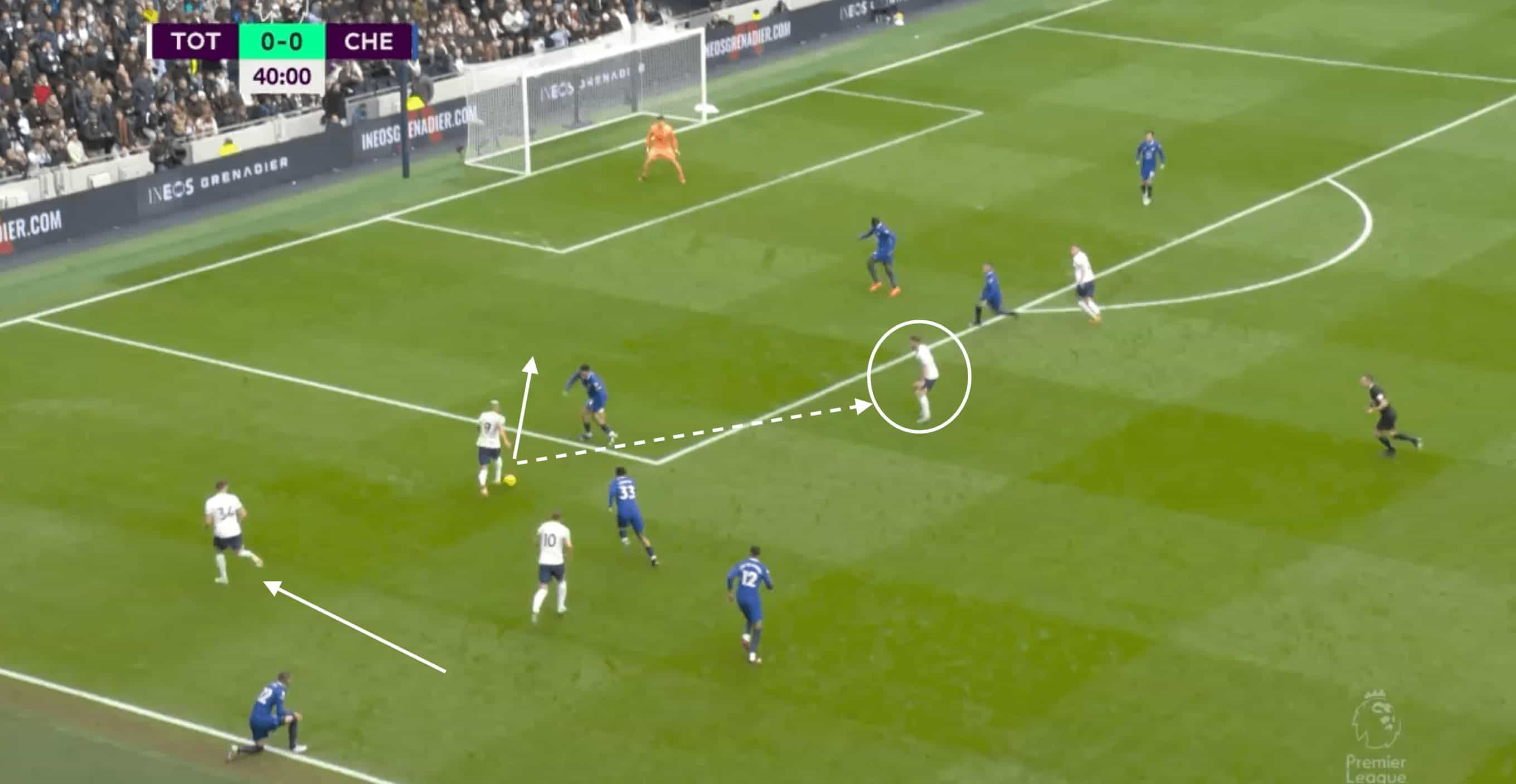
In their match against Chelsea, Conte’s Tottenham were able to employ Lenglet as an overlapping centre-back whilst Ben Davies occupied the half-space as a wing-back, inverting to occupy the space vacated by Harry Kane.
Despite continuous noise about his desired departure, Giovanni Di Lorenzo is certainly a versatile profile that Conte would love to keep around, with 2.16 passes into the penalty area per 90, signifying how impactful he can be creatively.
Antonio Conte Attacking principles
Conte has been heralded as a ‘tactical genius’ with his preconceived attacking sequences when it comes to finding success in the attacking third.
These ‘automatisms’ often include a direct approach from players within the defensive line, looking to bypass the opposition press.
One of these sequences includes the central defenders playing the ball into the feet of their corresponding wing-back, who can then avoid the midfield with a lofted pass around the corner.
With the inside forward dropping deeper to collect, what would usually be an audacious pass becomes a successful progressive pass, with the recipient able to find runners in space.
Alternatively, similar sequences can be used to connect the striker with members of the double pivot, with the centre forward becoming a physical presence and coming deep to receive to feet.
In these situations, the inside forward is often used to attack space behind with strategic runs, anticipating potential through balls from the striker.
As Tottenham‘s manager, Conte was able to lean on Harry Kane’s hold-up play to unleash Son’s explosive movement.
It is interesting to anticipate which Napoli players would be able to fit into Conte’s key attacking plans.
Victor Osimhen is an exceptionally well-rounded striker capable of excelling in a variety of tactical setups. With his future consistently linked away from Naples, has Conte already set his sights on an immediate replacement?
Khvicha Kvaratskhelia was Spalletti’s ultimate superstar on the left wing, but for his nation, he has relished the opportunity to roam into the central areas and influence the game more consistently.
It begs the question of whether operating with his back to goal in static positions will be ultimately beneficial.
Still, Kvaratskhelia will certainly enjoy the freedom and space this Napoli side will receive when stretching the opposition and inverting off the left wing.
Antonio Conte Defensive phase
When analysing Antonio Conte’s sides, they have usually found defensive success with a compact and organised mid-to-low block.
Ahead of his start with Napoli, we would expect them to deploy a resilient 5-4-1 when looking to keep it tight, with both wing-backs sitting in and the inside forwards dropping into the midfield line.
When managing Tottenham, Conte was focused on minimising space between the lines with overall compression.
Both members of the double pivot had an engine capable of being influential on both sides of the ball.
Lobotka and Zambo-Anguissa stand out as Conte’s key pairing.
The Slovakian midfielder is incredibly efficient in his distribution and defensive contributions.
When pressing from the front, we often see the centre-forward sitting slightly lower to shadow the opposition’s holding midfielder, negating the easy playmaking outlet.
This then leaves the two inside forwards to press the split central defenders, taking intelligent angles also to negate any passes toward the flanks.
In the event of facing a double pivot, the striker would remain focused on one of the midfielders, while one of Conte’s double pivots would push forward to support. This would require the central defenders to be proactive and aggressive, with only a single player ahead of the defensive line.
Napoli Potential signings
Romelu Lukaku Radar Map
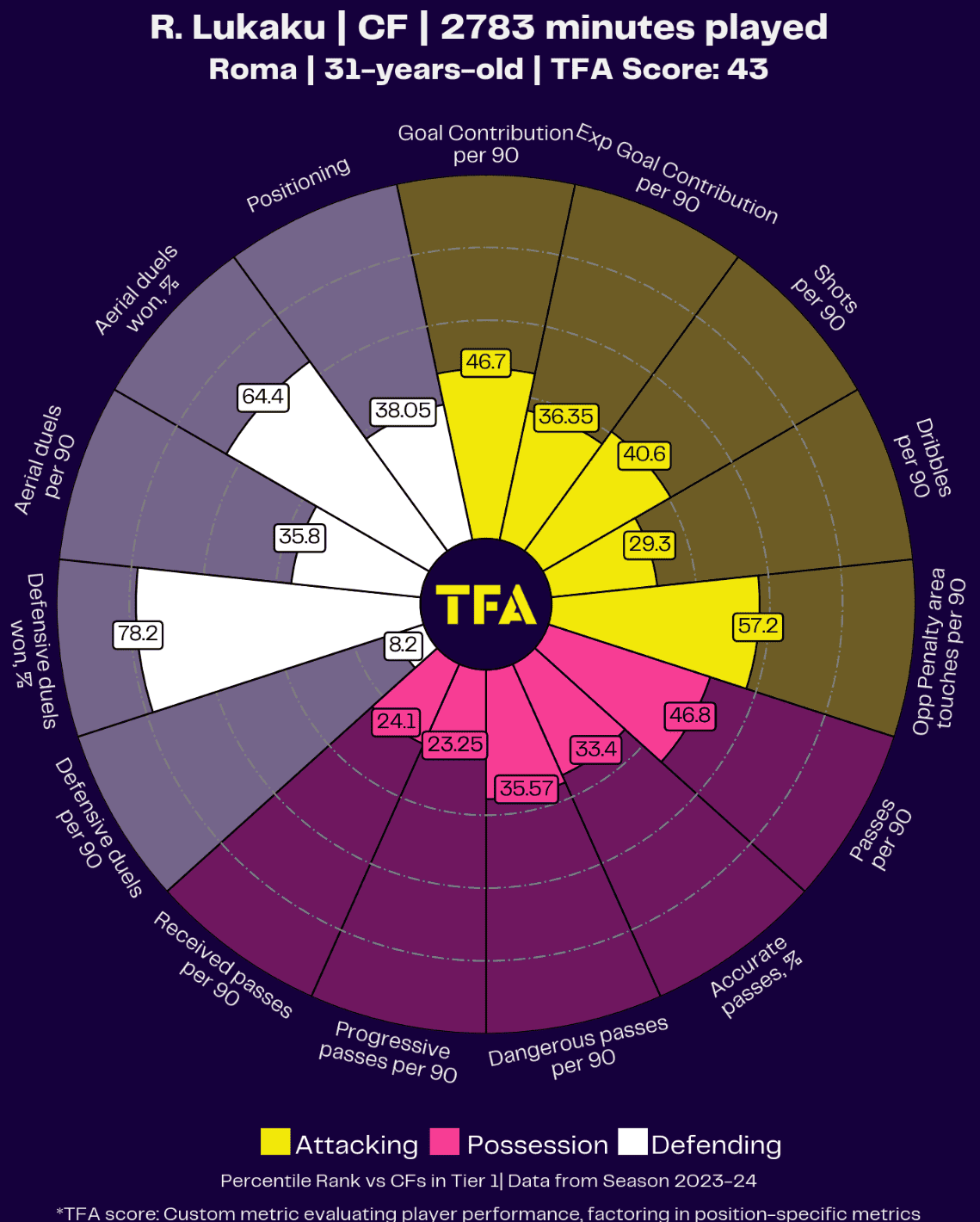
Having found success under Conte at both Chelsea and Inter, Romelu Lukaku stands out as an excellent option to replace the outgoing Victor Osimhen this season.
With Lukaku returning to London, Napoli will feel confident in finding a deal for the Belgian, who would relish a chance to return to the Serie A under his old boss.
With such a crucial role in Conte’s system, the introduction of Lukaku will hopefully act as a catalyst for a swift tactical overhaul, with familiarity for Conte’s system to be effective as soon as possible.
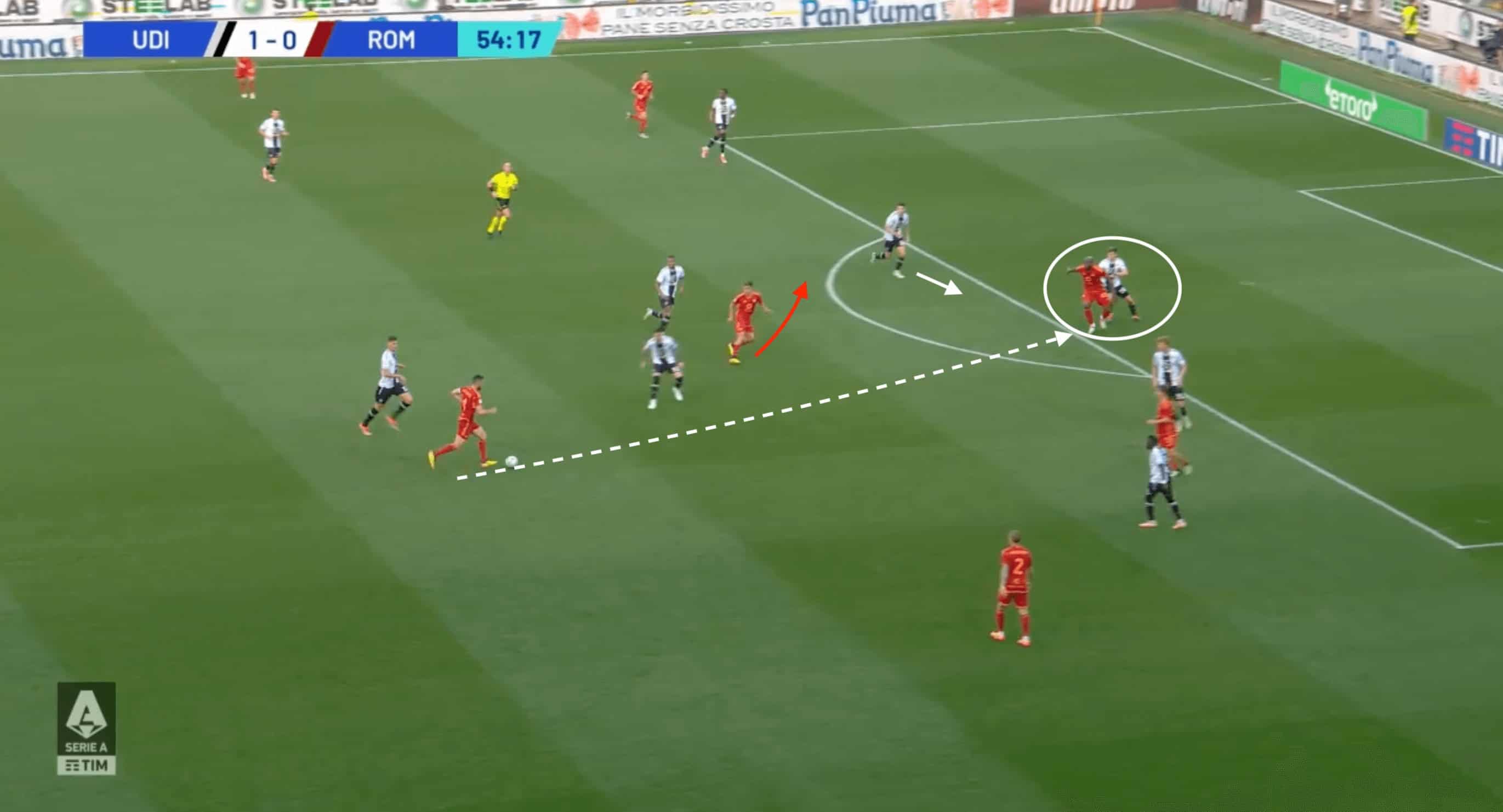
The experienced striker has been key to De Rossi’s rejuvenation of Roma this season, successfully receiving 7.80 progressive passes per 90- highlighting his effectiveness in acting as the attacking outlet with an increased physical stature.
Not only could he indirectly draw increased defensive attention to free up space for the likes of Kvaratshkelia and Raspadori, but Lukaku’s ability to pin the strongest defenders in the league.
It will be also intriguing to see a potential relationship between the Belgian and Lobotka, with the Slovakian midfielder having the technical ability to receive a pass and allow Lukaku to spin in behind.
Alessandro Buongiorno Radar Map
With Napoli’s defensive frailties being at the forefront of fans’ minds after the loss of Kim Min-jae, many have questioned whether this current crop could successfully line up in a back three.
Therefore, it is little surprise that Torino central defender Alessandro Buongiorno has been scrutinized ahead of a potential summer transfer.
The defensive colossus has been a key to Torino’s success.
Due to his size and defensive contribution, he is naturally able to play in the centre of a back three.
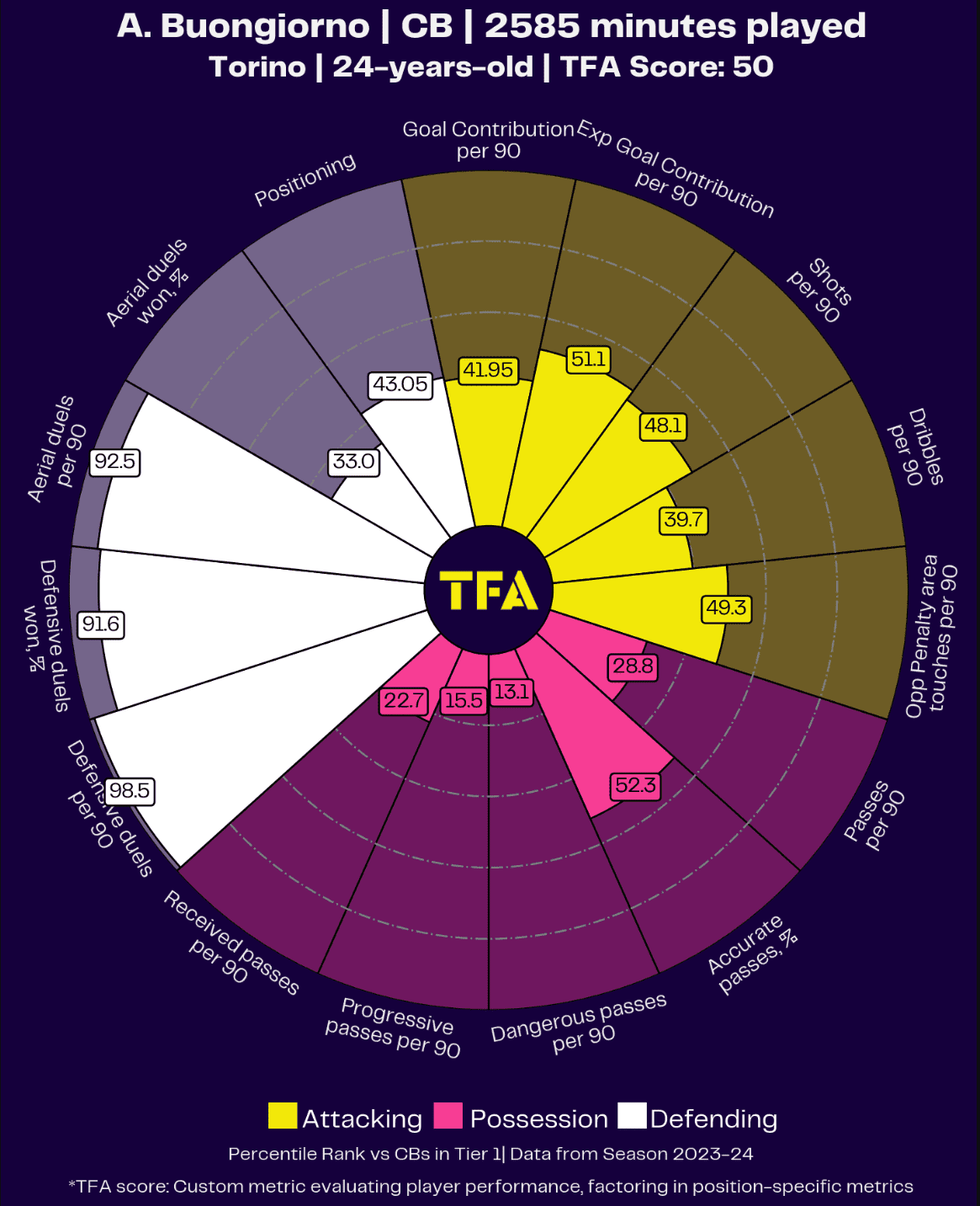
Whilst not being the best progressor of football, Buongiorno makes up for it with his 4.95 tackles and interceptions per 90.
Since Conte’s sides often press quite intensely, his defensive line often relies on aerial dominance to combat the subsequent long balls that are played as a result.
Buongiorno fits this need to a tee, providing an aerial threat at both ends of the pitch with 2.78 aerial duels won per 90.
Having recently broken into the national team under former Napoli boss Luciano Spalletti, Buongiorno represents a smart acquisition that would bolster Conte’s rebuild of youthful Italian prospects.
Conclusion
Conte’s appointment is set to spark excitement across Naples.
A proven winner will take the reins and aim to guide this side back into European football.
With minimal distractions from other competitions, Napoli will be focused on returning to the top of the Serie A, and significant financial backing is expected in this upcoming window.
Whilst losing key players may sting at the moment, it represents an excellent opportunity for Conte to reinvest in his desired profiles, which he would hate to compromise on.
Off the field, the appointment puts Napoli back into the spotlight after a dismal season, with the relationship between two polarising figures, de Laurentiis and Conte, expected to be stretched should results not fall their way.
The version of Conte we see at Napoli will be revealed soon enough, with fans hoping to witness a rejuvenated manager on the charge for his fifth Scudetto.
