
Feyenoord are the current champions of the Eredivisie and are enjoying a positive start to their season in their efforts to retain the title whilst also hoping to make the UEFA Champions League knockout rounds.
Their set plays this season have been very simple to the eye yet highly refreshing to watch from a tactical point of view.
Many sides attempt to force their way through deep blocks from set plays, where space isn’t available, yet the attackers still dart into the crowds, hoping that a slight touch from close range will be enough to result in a goal.
It reeks of desperation, like a pack of starving wolves hunting their prey. However, I believe many teams have lost sight of the advantage set plays provide to the attacking side.
Unlike most sides, Feyenoord take a step back to think about where the spaces to exploit are and prepare the routines from game to game.
In doing so, they are able to gain easy access into the 18-yard box on most occasions, something teams can’t do often from open play.
Rather than going for extremely risky routines, Feyenoord have been able to consistently rack up penalty area touches, whether that is a headed effort from inside the six-yard box or if it’s a shot from just under 18 yards.
Even though the distance may seem far, an unopposed attempt from the edge of the box has to be seen as a high-quality goalscoring chance, better than a 50/50 duel from a nearer position.
In this tactical analysis, we will look into Arne Slot tactics behind Feyenoords’s attacking corner setups, with an in-depth analysis of why their ability to find open space has been highly effective so far.
This set-piece analysis will examine how Feyenoord have been able to exploit different spaces around the box, the reasons for variations against different defensive setups and the potential room for improvement to reach their optimal level.
Attacking the Achilles’ Heel
As mentioned earlier, Feyenoord thrive in simply attacking the available space rather than making too many movements to drag defenders to score the perfect corner.
Feyenoord take advantage of what they are given, whether in the six-yard box or twenty yards out.
Against heavy man-marking setups, the space is nearer the goal, with fewer zonal defenders present.
No attacker is free in this scenario, but Atletico Madrid risk providing easy access to the six-yard box for the attacking side.
In the example below, Atletico only use two zonal defenders, both within the width of the goal, meaning that the space in the picture is easy for Feyenoord to access.
This sort of space isn’t always so easily accessible, but Feyenoord simply identify the open area and deliver the ball into it whilst the attackers attempt to get into the space.
Something admirable about Feyenoord is their players’ trust in one another to make the vital touch. Often, when a space in the six-yard box opens up, attackers’ eyes light up, and they all attack the ball, bringing numerous defenders with them in the process.
However, Feyenoord have limited this to only one player attacking the open space, giving him maximal space and time to lose his marker and arrive in the space unmarked.
The attacker highlighted uses his teammate as a blocker, running around him and causing his marker to avoid the block.
This gives the target attacker the separation to arrive in the six-yard box unmarked.

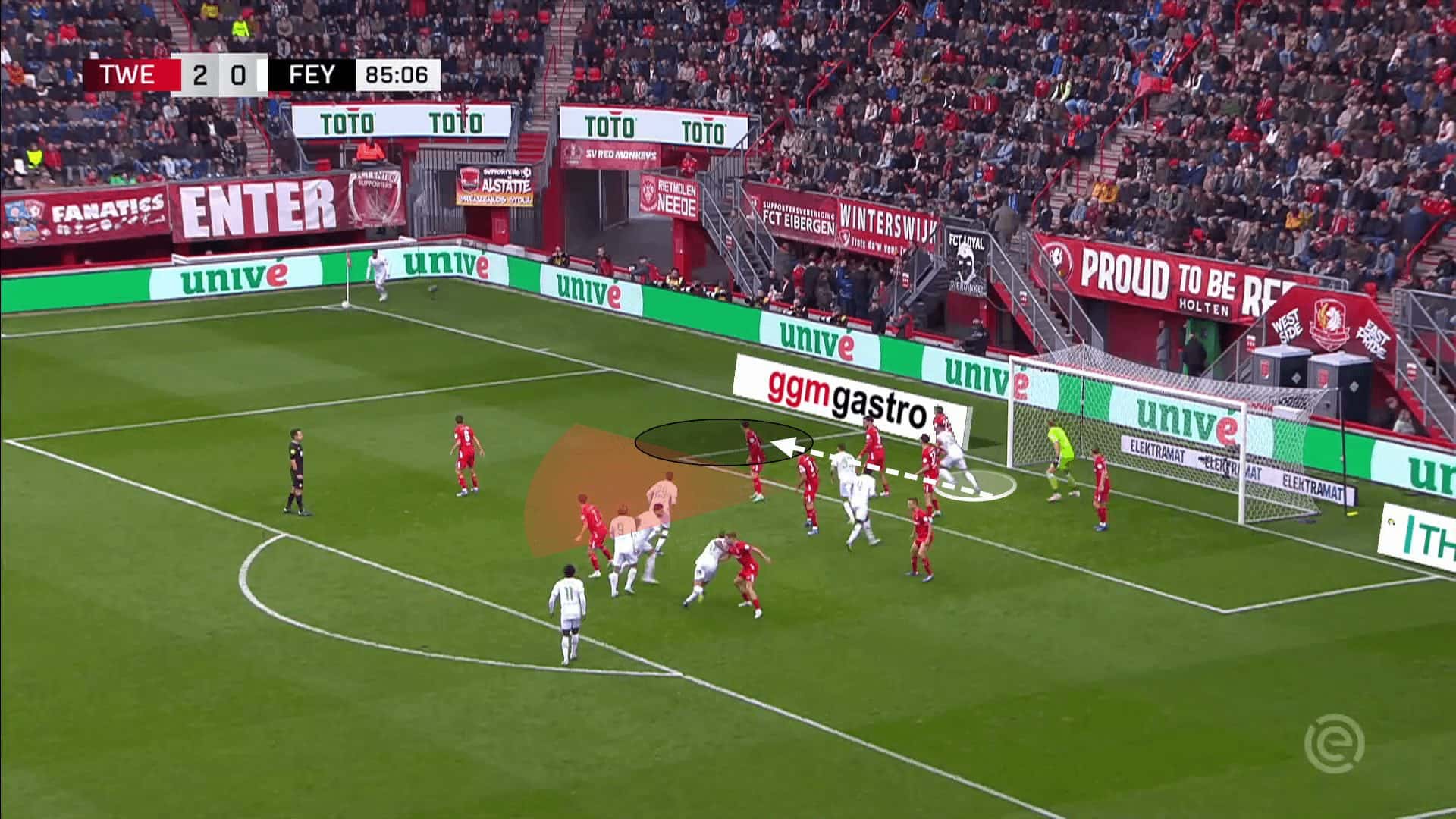
Below, we can see how Feyenoord exploit the space against a different defensive setup.
The man markers remain the same, although deeper, whilst there is also a stronger zonal defensive presence in the six-yard box.
I believe there are two different access points in this scenario: one at the back of the six-yard box, with no zonal defenders, and one at the near side of the six-yard box, with the zonal markers positioned deep by the front post.
The deep positioning of the two zonal markers allows Feyenoord to get into the six-yard box from the near side.
At the same time, we can also see a man marker close to the target area, but with his priority on other players, it’s possible to attack the target area even with his close position.
Coming in from the defender’s blind side allows the attacker to enter the target area with time and space, redirecting the header goalwards.
Furthermore, even though the position of the access point doesn’t provide the attacker with the opportunity for an easy headed effort, the attacker can flick the ball across the face of the goal, where the deeper attackers have the chance to lose their man markers during that second phase.
As mentioned at the start, Feyenoord take what they are given in terms of space.
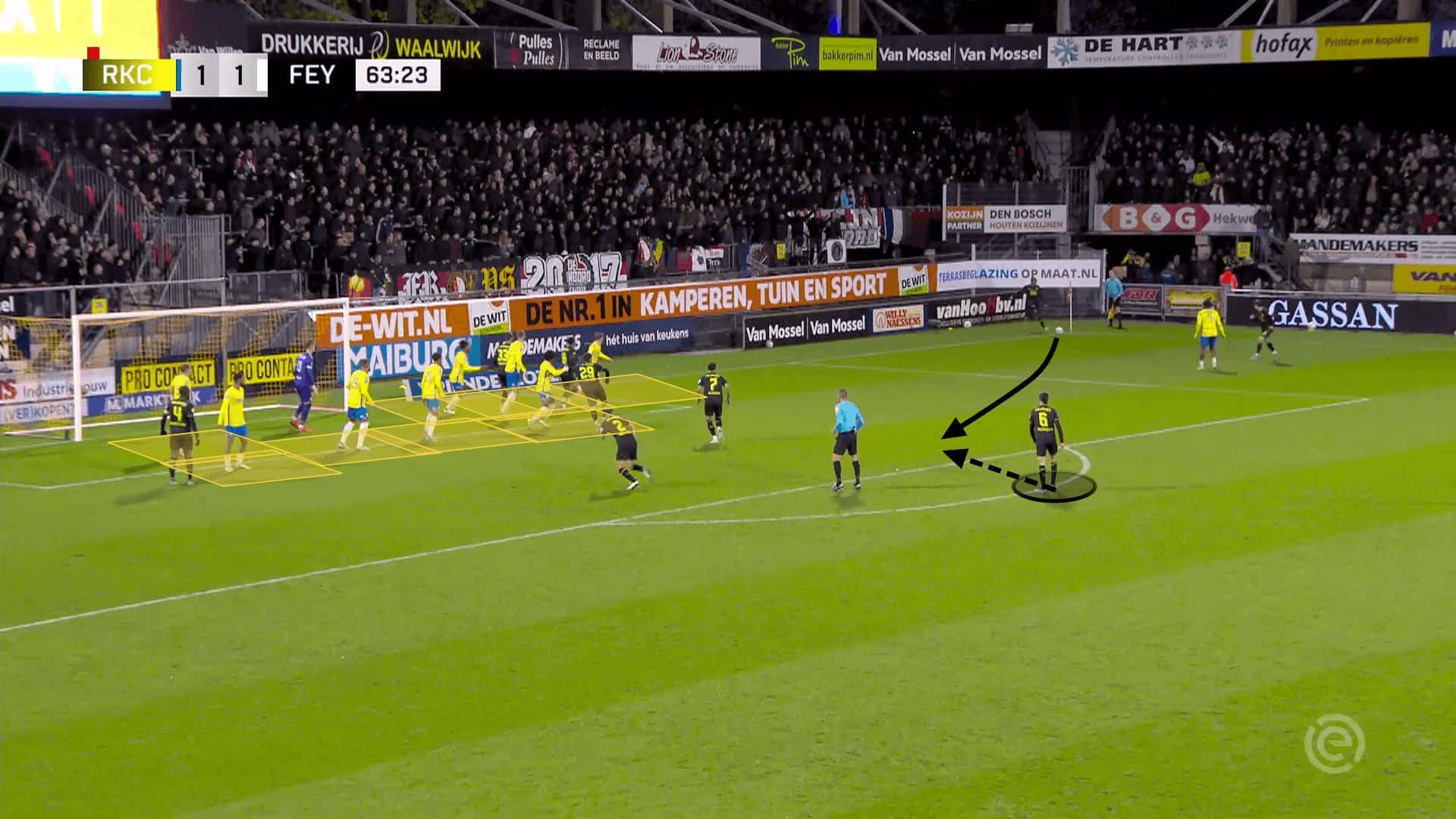
In the example below, eight outfield players are all positioned extremely deep, with no one being further than six yards away from the goal.
It would be unlikely for an attacker to win an aerial duel inside the six-yard box, where the goalkeeper can freely roam, whilst there is the potential for an attacker from deep to win an aerial duel just outside the six-yard box.
However, the clear and safest passing option is the player located on the edge of the box, whom Feyenoord deliver the ball to.
Granted, this opportunity comes against a side that is a man down, but there are many opportunities available like this.
Still, teams often attempt to cross the ball into the six-yard box, with the basic thought that crossing the ball closer to goal is more likely to result in a goal.
An unopposed first-time shot from the edge of the box is like finding gold for teams when creating chances in open play and should be viewed equally during set plays, even if there is the potential of a header from within six yards from a direct cross.
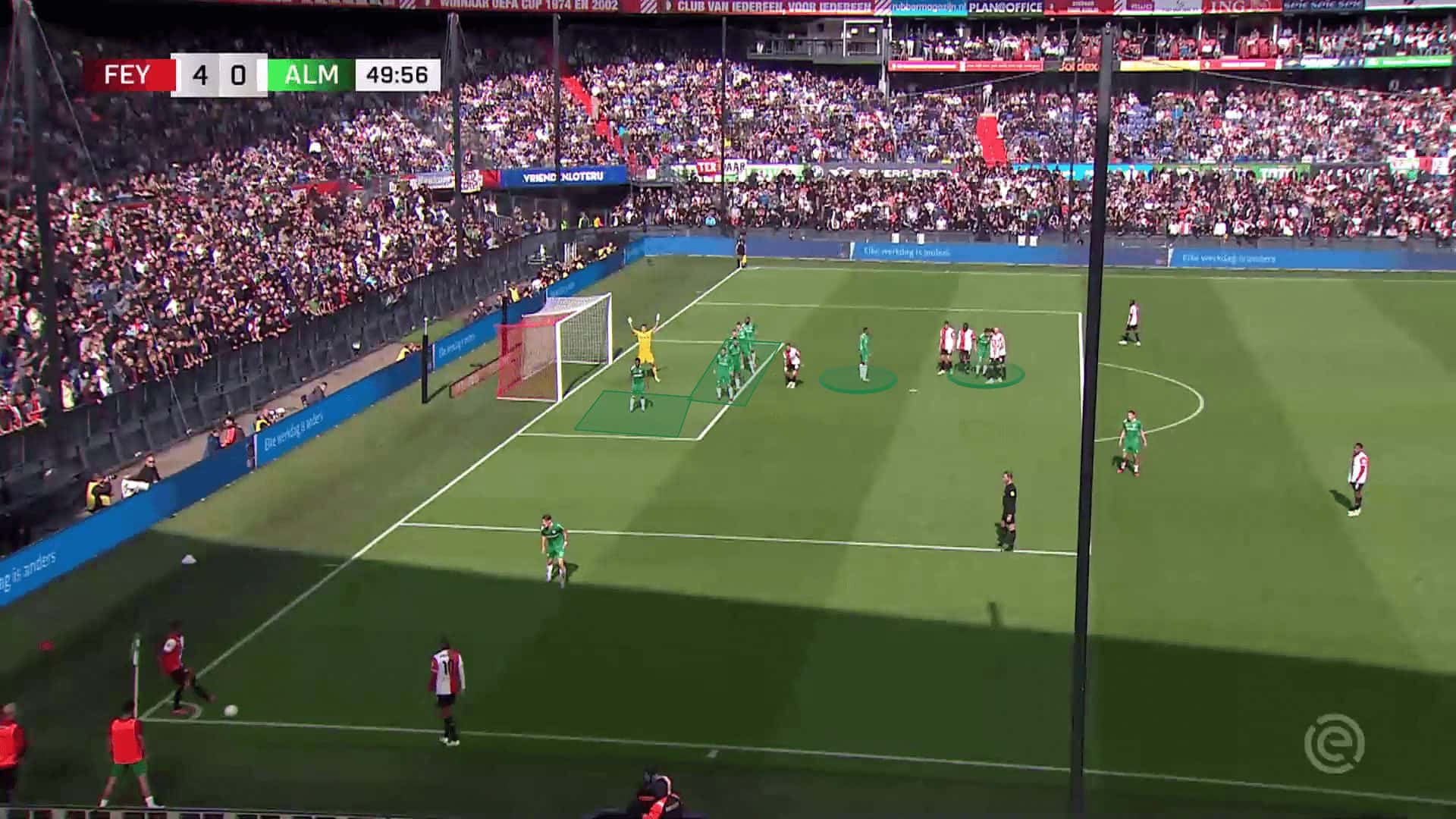
Similarly to the chance above, Feyenoord come up against a side with six zonal defenders inside the six-yard box, with an additional two man markers up against four attackers from deep.
The numerical mismatch is apparent, instantly allowing Feyenoord to gain an advantage in numerous ways.
An unmarked attacker could compete for the cross at the six-yard box against the zonal defenders, or that same free attacker could be found in space for an unopposed shot on goal from a slightly deeper position.
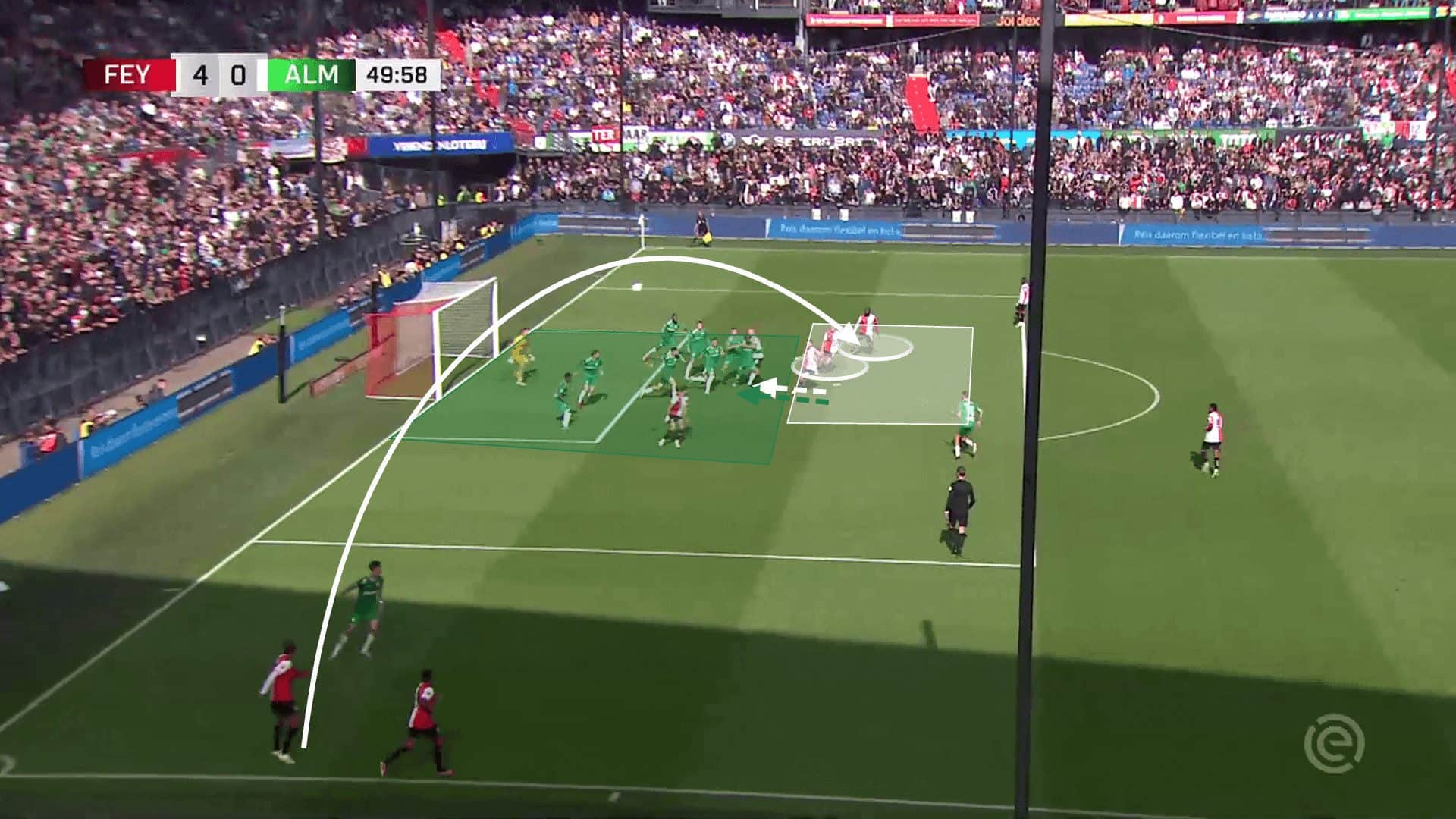
To create that space in a deeper position around the penalty spot, two Feyenoord attackers sacrifice themselves by making decoy runs towards the six-yard box, dragging the man markers with them, which creates plenty of space for the two deeper players.
The white area below shows the space which Feyenoord have easy access to, where their players can simply wait for the ball without needing to think about anything else.
From this position, because of the space available, the attackers have the option to volley the ball rather than heading it.
Yet again, a volley from the penalty spot is a golden chance in open play and equally valuable from set plays, although few teams consider it an option.
Fulham are a side that have done this on several occasions to great effect in games against the strongest sides in the Premier League, where they could only dream of creating such chances from open play.
I believe a mixture of zonal and man markers like Twente’s use is the most effective defensive tool, although nothing is impenetrable.
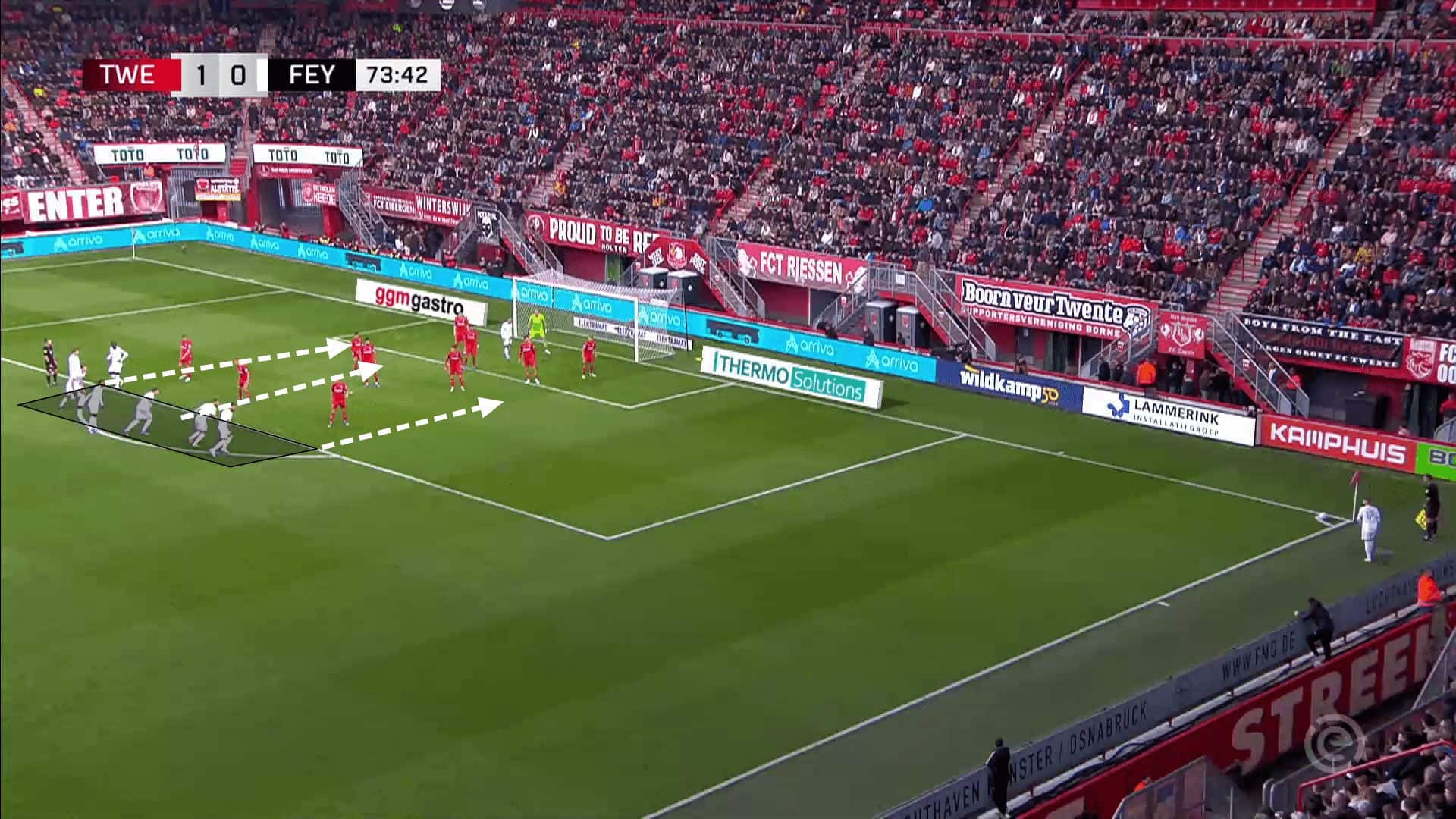
An out-of-the-box solution against these man-markers is to increase the distance between an attacker and his marker.
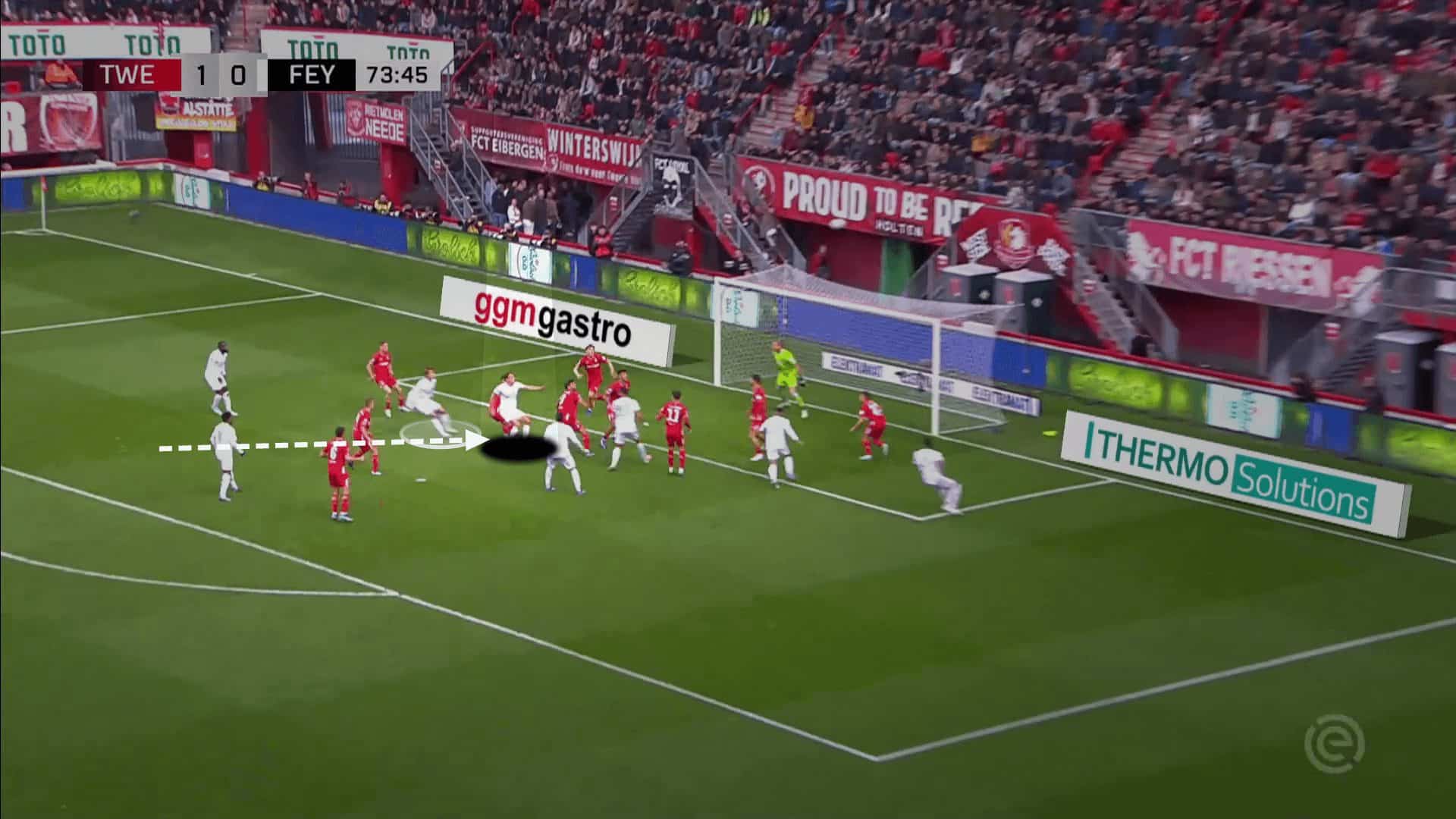
With that extra distance, the Feyenoord players can sprint towards the six-yard box and change direction with speed, something a static man marker won’t be able to do, so any attacker who times the run right and changes direction at the right moment will have the separation from a man marker, and be able to attack the six-yard box with the momentum advantage against a zonal defender without a run up for the aerial duel.
We can see here that while the defenders competing for the ball are leaning back and static, the attacker is about to spring up after a long run-up, which allows him to tower over any defender in the surrounding area.
Room for Improvement
One issue that the Dutch champions have sometimes faced has been with the timing and frequency of setting screens for their teammates.
While they attempt to target space, there are occasions when space is quite limited.
In these instances, it is crucial to be able to gain separation from your marker either through individual movement or by working with teammates to form screens for one another.
When screens have been necessary, Feyenoord has shown a lack of know-how with poorly timed screens, allowing opposition defenders to rotate their markers to ensure each defender is covered.
The screen should be made in the last moment before an attacker makes his move so that by the time he sets off it is too late for his marker to recover their position.
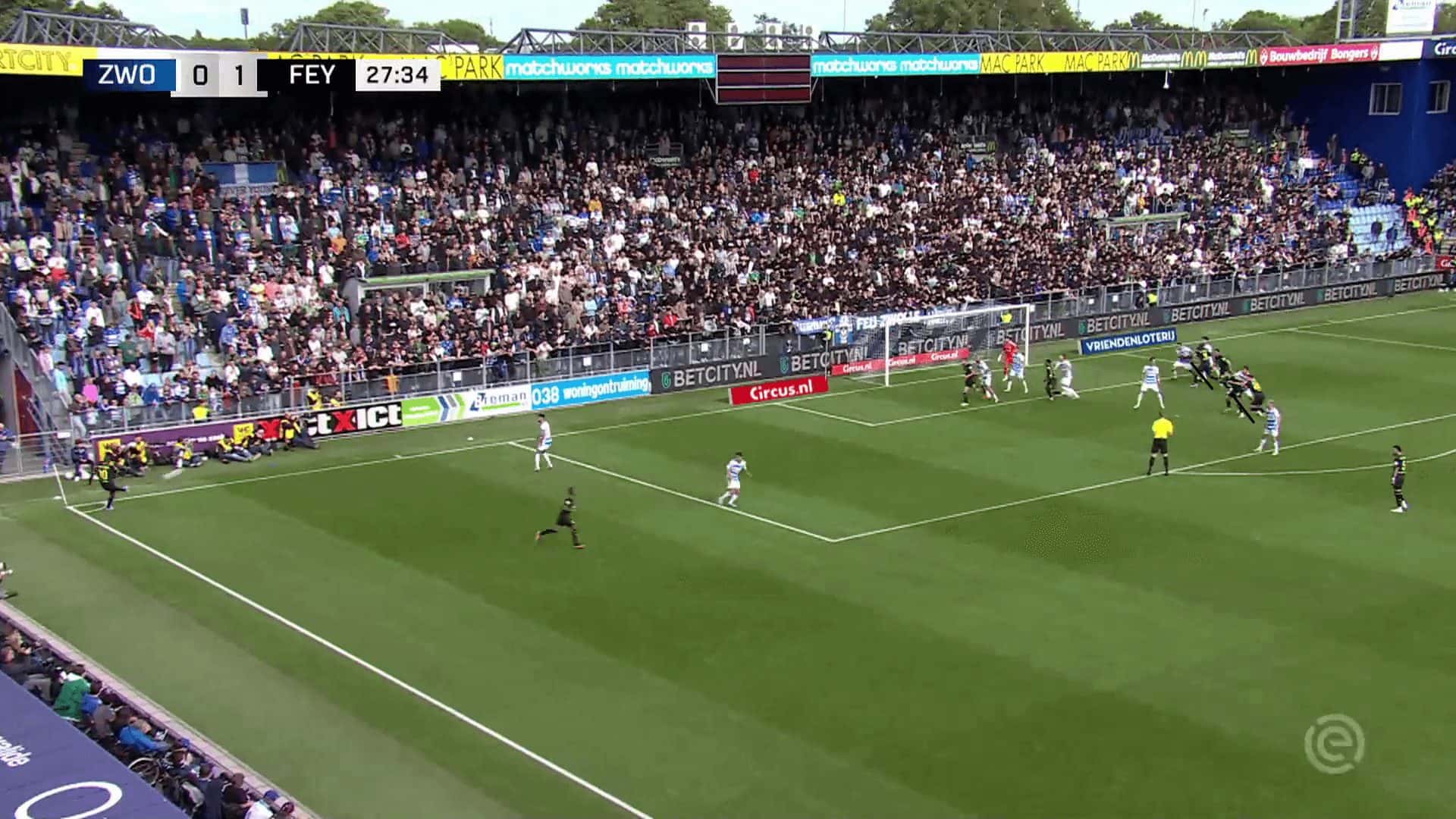
Furthermore, there has been a lack of variation in their use of screens, with them often coming in front of the defender’s eyes, allowing him to see the screen coming and evade it or communicate early with a teammate to rotate positions.
A screen from the blindside can shock the defender in the last moment, where there wouldn’t be any time to rotate with anyone else, and they wouldn’t see it coming.
Deep Free Kicks
Feyenoord have also consistently created chances from deep free kicks, giving them another key method of creating chances.
The deep free kicks never have a clear open space to find; instead, the space is always available behind the defensive line.
One recent trend that successful set-play teams have utilised is decoy free-kick takers.
Defending sides, while instructed to be brave and hold the line, struggle with someone running over the ball.
Maintaining the same defensive line height can be challenging for eight or nine players, especially when that line sometimes contains attackers.
Furthermore, some players may want to gain an advantage by dropping deep earlier to avoid being exploited in behind.
In these instances, the line always becomes broken, with one or two players deeper than the rest of the defensive line.
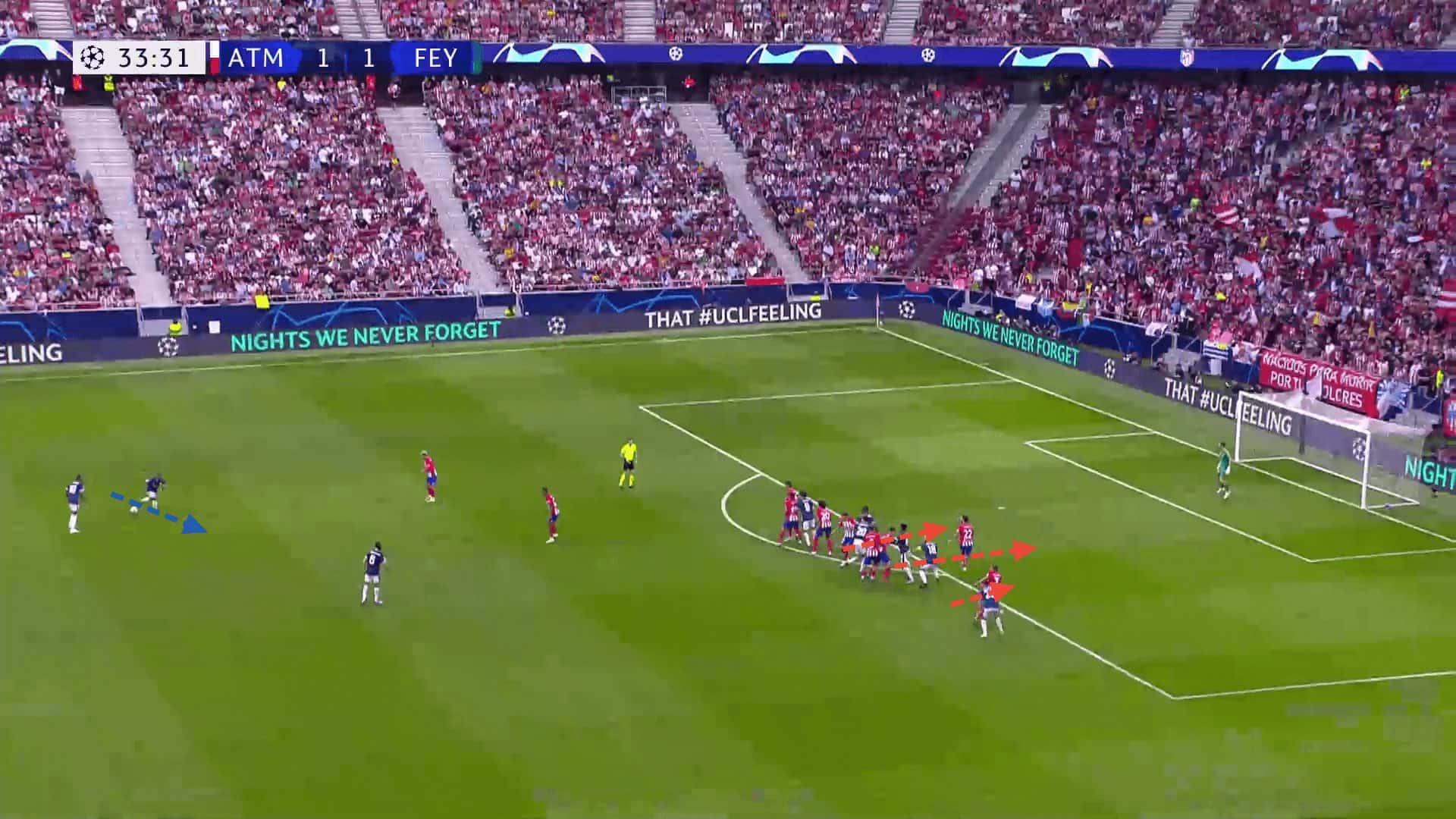
These moments allow Feyenoord attackers to get goalside of their markers, allowing them to directly attack the space behind with the defender on the wrong side and unable to recover their position.
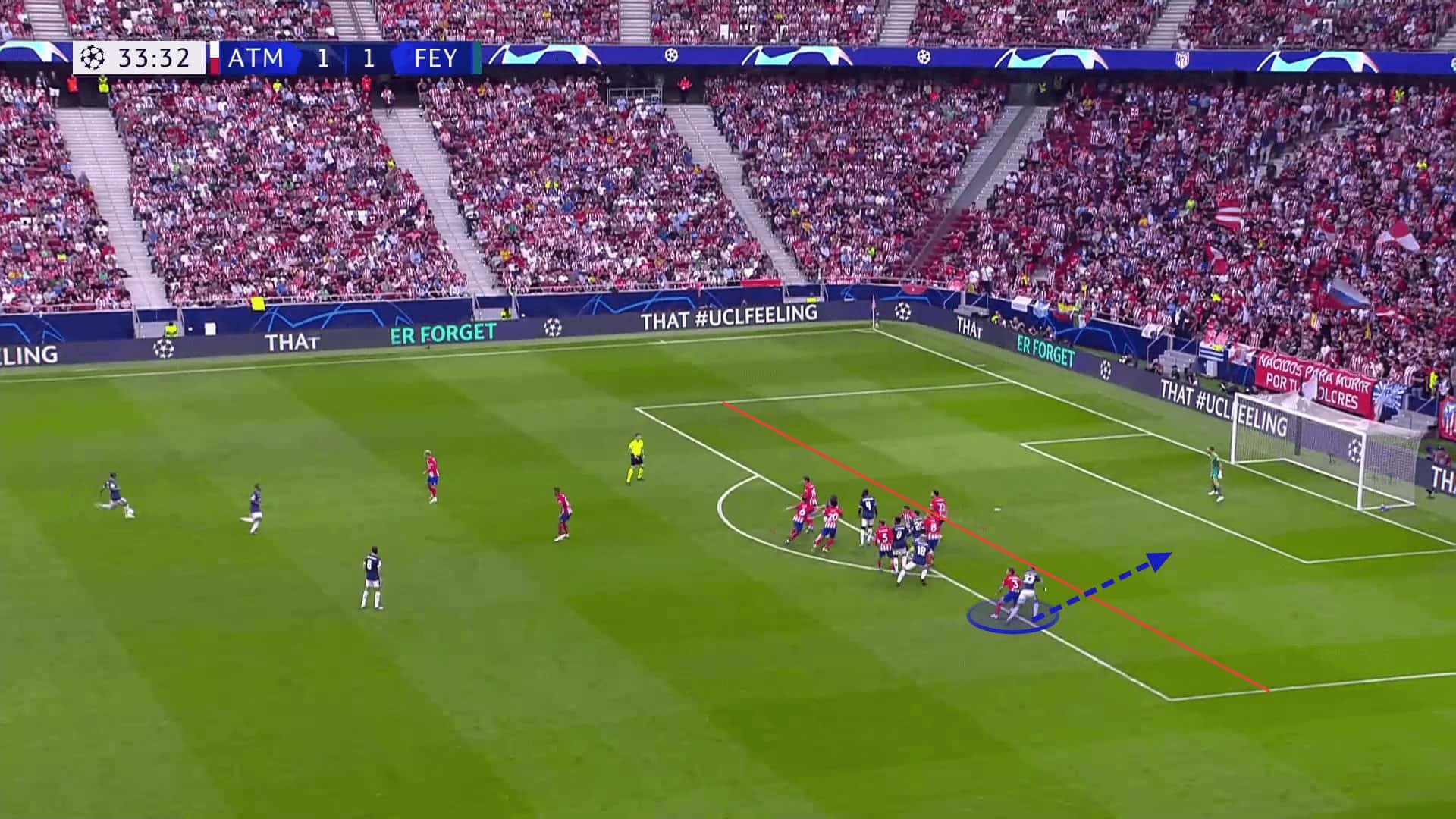
An alternative method of penetrating a high line is using runs from deep. During the deep free kicks, the aim is always to penetrate the space behind a high defensive line, where there is a race into the area around the penalty spot.
Simply speaking, a player from a deeper position can accelerate to their top speed before the ball is kicked, while the defenders cannot move until the free kick is taken.
If timed right, the deep player can be just about to penetrate the defensive line while at high speed when the free kick is being taken, whilst the defenders are only about to make their first step, giving the attacker the chance to penetrate the space first.
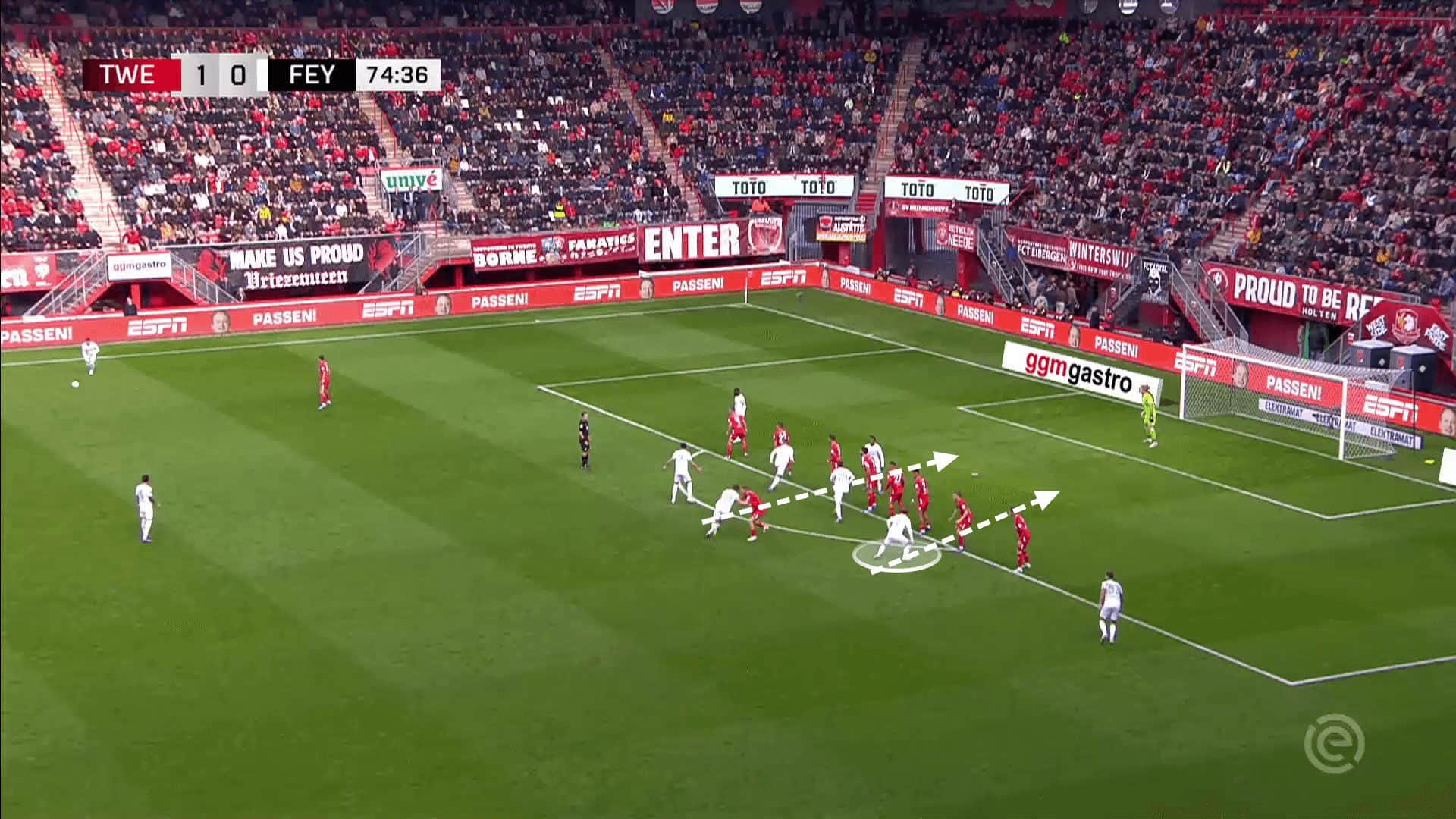
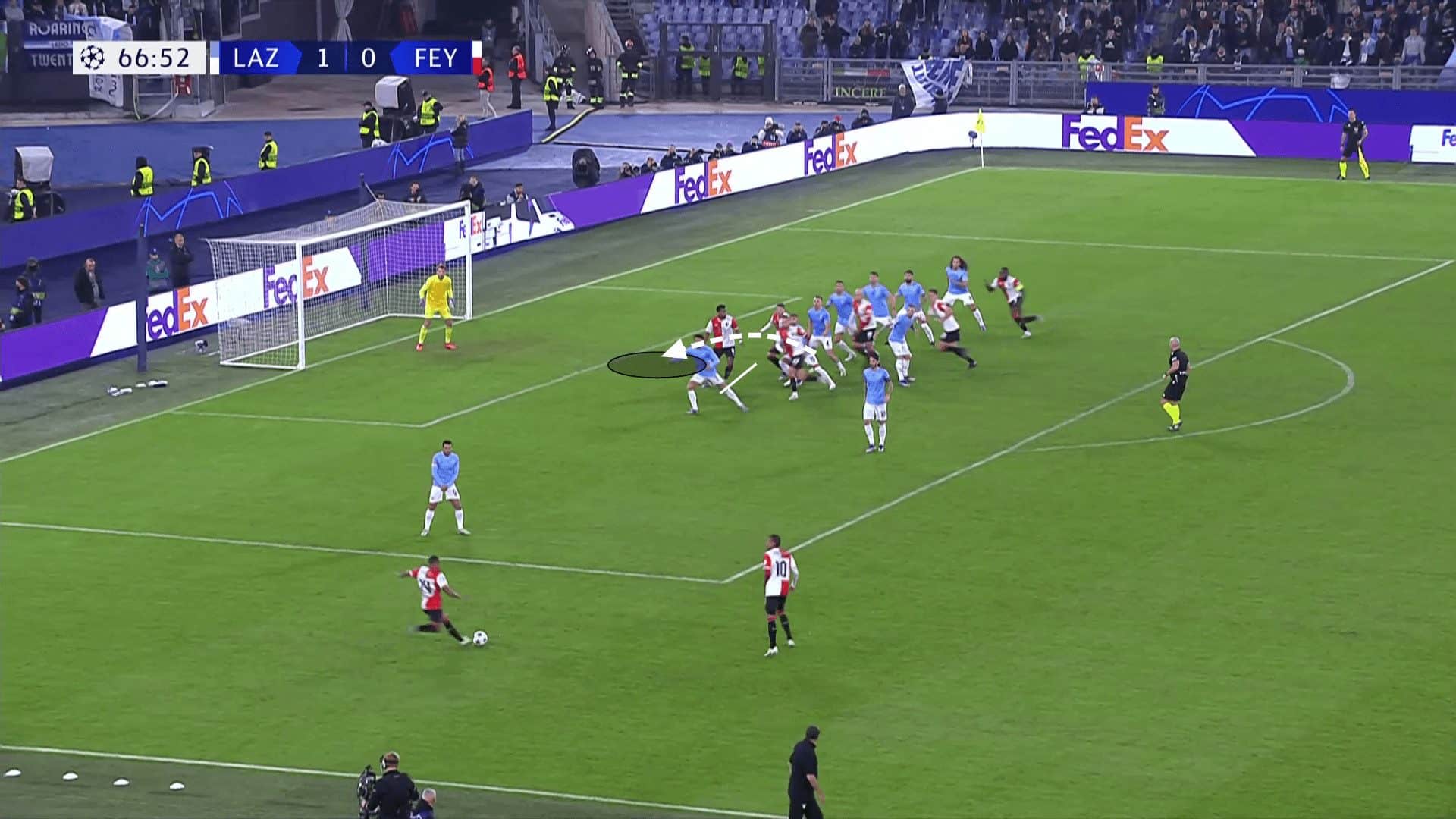
The last way in which Feyenoord have exploited space behind defensive lines from free kicks has been to attack the space behind a screen.
When defending free kicks, a team will have their entire defensive line in a vertical line, all in different lanes.
This way, it is possible for attacking teams to predetermine whether to clear a lane, by setting a screen on an individual player protecting a particular lane.
The example below shows one player setting a screen where a different teammate is already attacking the space behind the screen setter, knowing that no one else is responsible for that lane, and he will arrive unmarked.
Summary
This Arne Slot set piece analysis has shown the simple yet effective methods Feyenoord have used to become a set-piece threat.
Identifying the space and having a clear plan where everyone knows their role is critical to creating goalscoring chances, rather than having all the attackers chasing one ball in one space.
Feyenoord have been brilliant at finding space, with no bias to the proximity of the space to the goal.
From both corners and free kicks, the Dutch champions have consistently shown that their prior preparedness for the defensive sides’ structures has allowed them to develop accessible and direct methods of creating goalscoring chances.
