
While most of Europe’s domestic football campaign is ending, the footballing calendar is not letting up.
While Sweden, Norway, and Iceland, amongst others, continue to play through their league campaigns, we also see the start of the youth international tournaments that will continue throughout the summer.
We are a couple of weeks away from the U19 European Championships in Slovakia this year.
However, at the time of this writing, we have just reached the end of the group stages of the U17 European Championships in Israel.
The quarter-finals have not been decided, with Germany facing France, the Netherlands facing Italy, Spain playing Portugal, and Denmark facing Serbia.
Each quarter-final tie is intriguing in its own right, with a lot of talent throughout each squad that has made it through the group stages.
This article will examine the players who stood out to us in the group stages.
This is the first in a series of articles examining the standout players in this tournament and the U19 tournament later in June.
This time, we will concentrate mainly on attacking players.
#1 Mathys Tel, 17-years-old, Winger/Forward, Rennes and France
For the most part, in this tournament, we are seeing players who have yet to make any sort of impact at the first-team level.
However, this is not the case with Mathys Tel, who has ended the French domestic season with 77 minutes in Ligue 1.
Tel is very much seen as an attacking player.
He is versatile and can play in wide areas or through the middle as a central striker. His dynamism and positional awareness stand out.
When Tel was signed by Rennes, though, it was as a central defender, as this was the position he was in when he was scouted for his club in Paris.
The decision to convert Tel to an attacking player is now looking to be an inspired one.
Coming into this tournament, the French youngster was widely tipped to be one of the standout players.
So far those predictions are being proved correct.
Tel has a great frame to go along with his athletic profile.
He stands just over 6′ tall, and given his age, there is still potential for him to grow a little more.
He is a very physical attacking player, which makes sense given that he used to play as a central defender. He likes to make contact with opposition defenders to force them off balance.
He also, however, has a very strong technical base.
He can comfortably receive the ball with his back to goal or in space as he drifts into the half-spaces to find pockets of space, and he typically moves very fluidly in possession of the ball.

For such a young player Mathys Tel displays very good decision-making and composure when in possession of the ball in the final third of the pitch.
Despite his young age, he has already shown that he can score various goals, which suggests that his attacking output will continue as he develops into a regular first-team player at Rennes.
We see an example above of his composure in the final third.
This was a moment in the group stage match between France and Bulgaria.
He has options as the ball breaks to Tel, positioned centrally around 25 yards from the goal.
There are runners making progress into the area to provide passing options, but given Tel’s time on the ball, he will always look for a shooting opportunity.
He maintains composure and opens his body before placing the ball into the top corner of the Bulgarian goal.
Tel is not.
However, just a forward who relies on the spectacular when scoring goals.
He also displays good anticipation and movement when breaking into the opposition area to attack crosses.
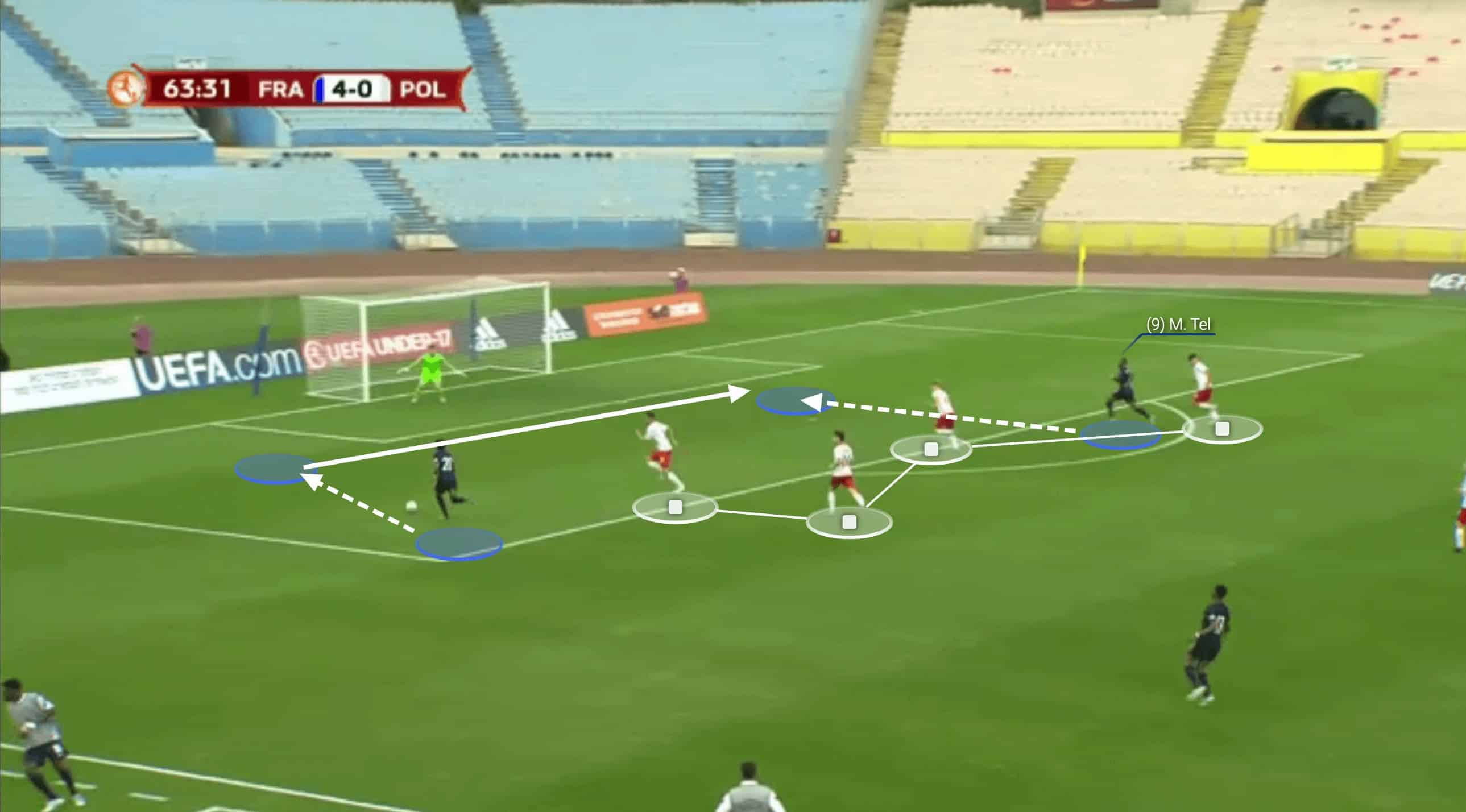
We see an example of this here as his teammate is attacking through the half-space on the near side of the pitch.
The Polish defensive line is looking to drop in to cover the threat, but on the far side of the pitch, Tel is breaking into the area on the blind side of the central defender.
As the cross is played over the young forward is in position to slot the ball past the goalkeeper.
We expect Mathys Tel to become a more regular member of the first-team squad at Rennes next season.
From that point, scouts from the bigger sides around Europe will start to circle.
Afonso Moreira, 17-years-old, Winger, Sporting CP and Portugal
Please make no mistake about it, this is a very talented generation of Portuguese players.
It would have been easy to pick one of the many players enjoying their development in Benfica‘s youth system.
Still, instead, we have gone for a wide attacker who is currently with Benfica’s crosstown rivals, Sporting CP.
Afonso Moreira is a wide player who seems to be comfortable in a variety of roles.
He prefers to play on the right of the attack but he is actually quite two-footed.
He can receive the ball, attack the defender on the outside, and get down the wing, but he can also cut inside and threaten in half-spaces or even the central areas.
He has yet to make an impact for his club at the first-team level, but this should not come as a surprise given the talent that Sporting CP tends to develop through its youth systems.
Moreira’s comfort on either foot makes him very difficult to defend against in 1v1 situations.
If a defender gets too tight to him, he will turn them and look to either draw a free kick or look to burst past them.
However, if they sit off and allow him to receive possession easily, he will face them up and attack them down either side.
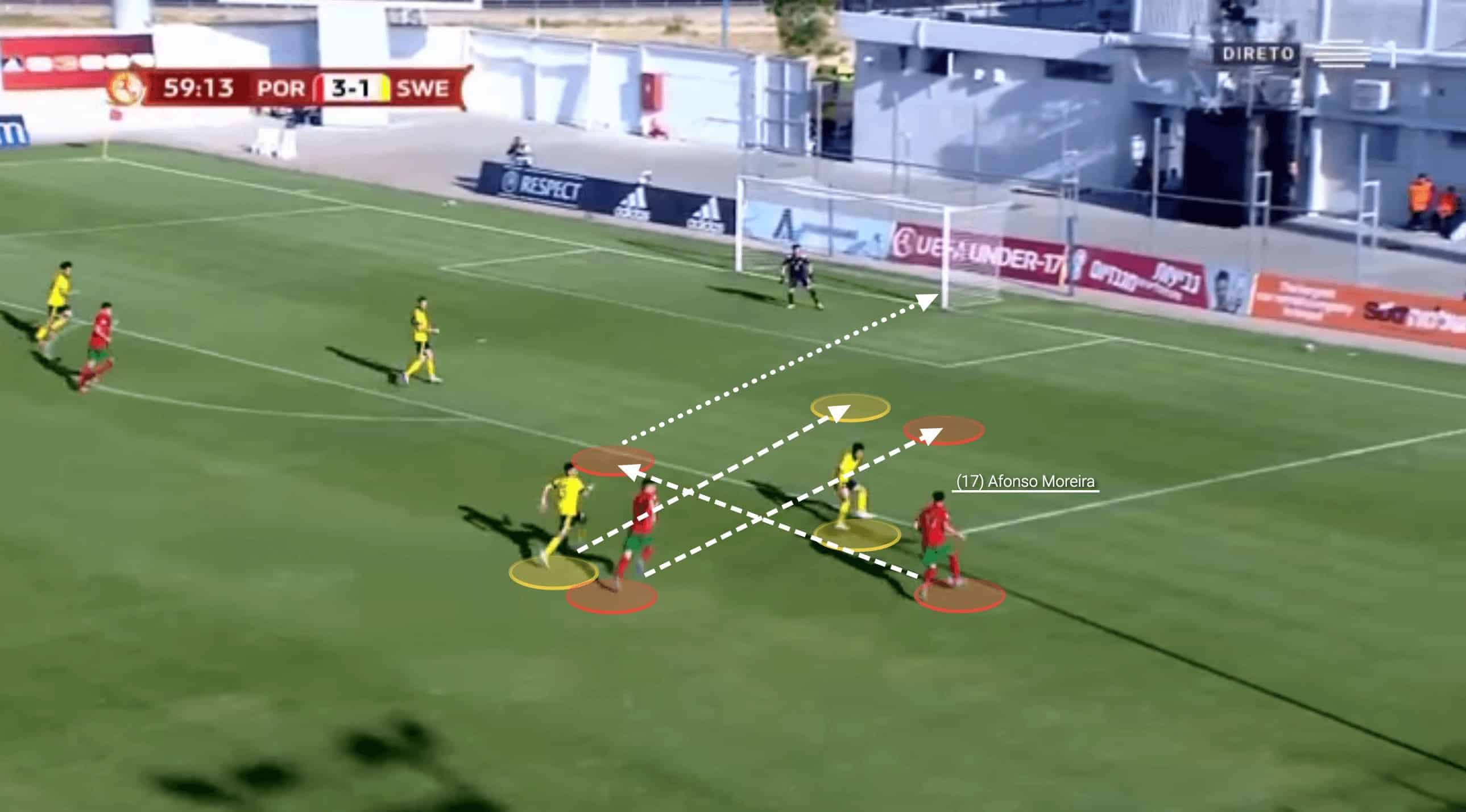
In this example, we see Moreira in possession just outside the corner of the penalty area.
He has a teammate making an underlapping run, which drags one of the defenders out of the way.
This opens up the space, and with some quick feet, we see Moreira cut inside before shooting low and hard with his left foot towards the near post.
For such a young player Moreira already displays very good movement.
He understands how to time his runs to drag defenders out of space and then how to spin and attack the space with the right timing.
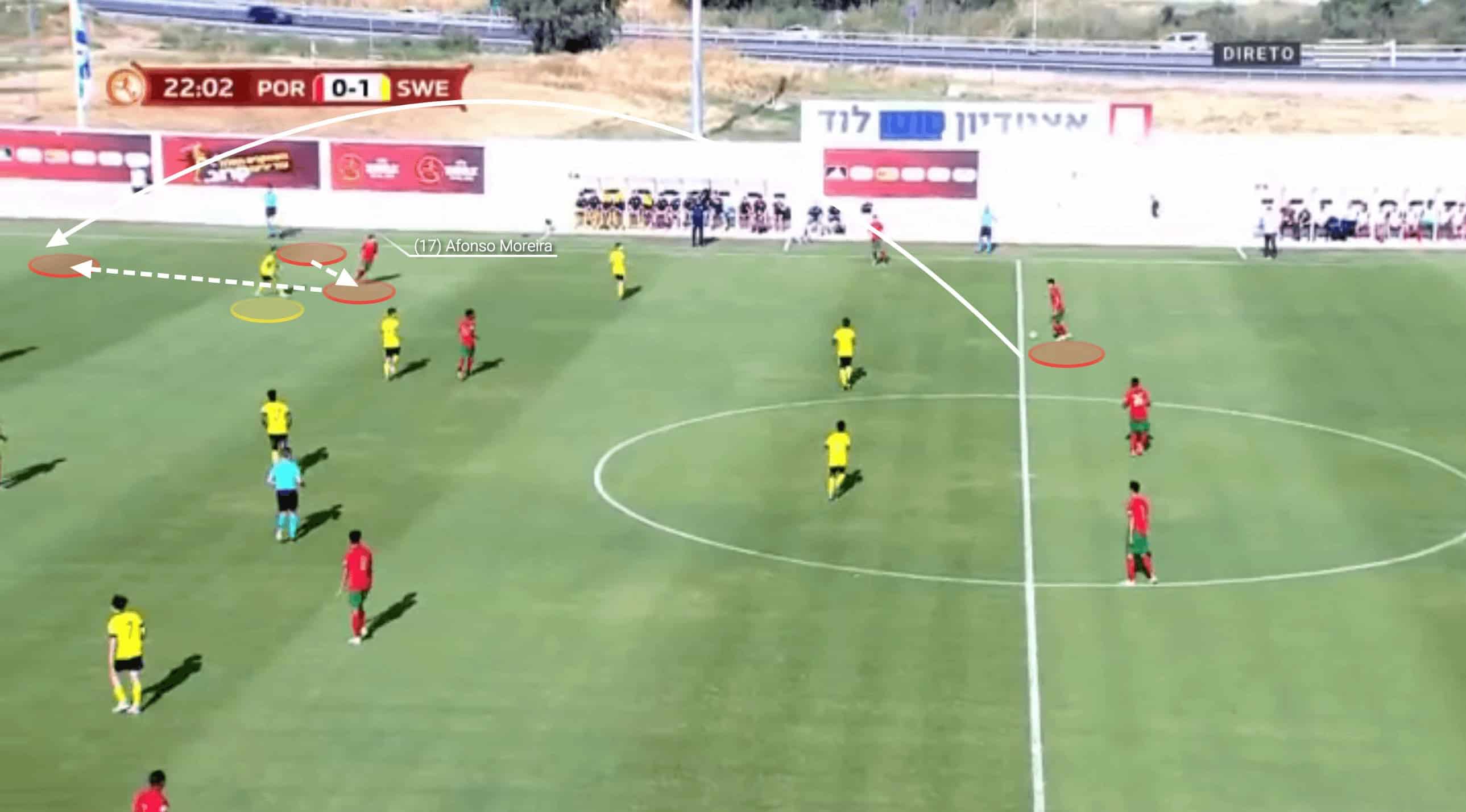
We see an example of this here as the Portuguese defender is in possession of the ball.
Initially, we see Moreira check inside and back towards the ball.
This simple movement drags the opposition defender forward, and Moreira spins and attacks the space behind the defensive line.
This movement gives the man in possession a passing option and allows the ball to be dropped over the top and into space.
Going forward, we are less sure that Afonso Moreira will make an immediate impact on the first team at Sporting CP.
Instead, he may have to go out on a loan deal in order to further his development.
Jardell Kanga, 16-years-old, Striker, Bayer Leverkusen and Sweden
Jardell Kanga is the youngest player in our initial article and the only one who has made a significant transfer in his young career so far.
The young Swedish forward is actually a product of the youth academy at the highly productive academy of IF Brommapojkarna, which plays in the lower leagues of Swedish football.
Despite his young age, he played over 1,000 minutes at first-team level for the club before agreeing to join the German side Bayer Leverkusen.
While Kanga is currently part of Leverkusen’s youth system, the club is undoubtedly aware that it has signed a young player with real potential.
Kanga is a naturally left-footed player who is comfortable leading the line as the main striker or playing in a slightly withdrawn role as the second striker or ’10’.
His movement and anticipation in the final third, when combined with his dynamic physical profile, make him difficult to defend against as he times his movements to break the defensive line extremely well.
When he receives in the area, he has composure and can wait for the goalkeeper to make the first move before slipping the ball into the goal.
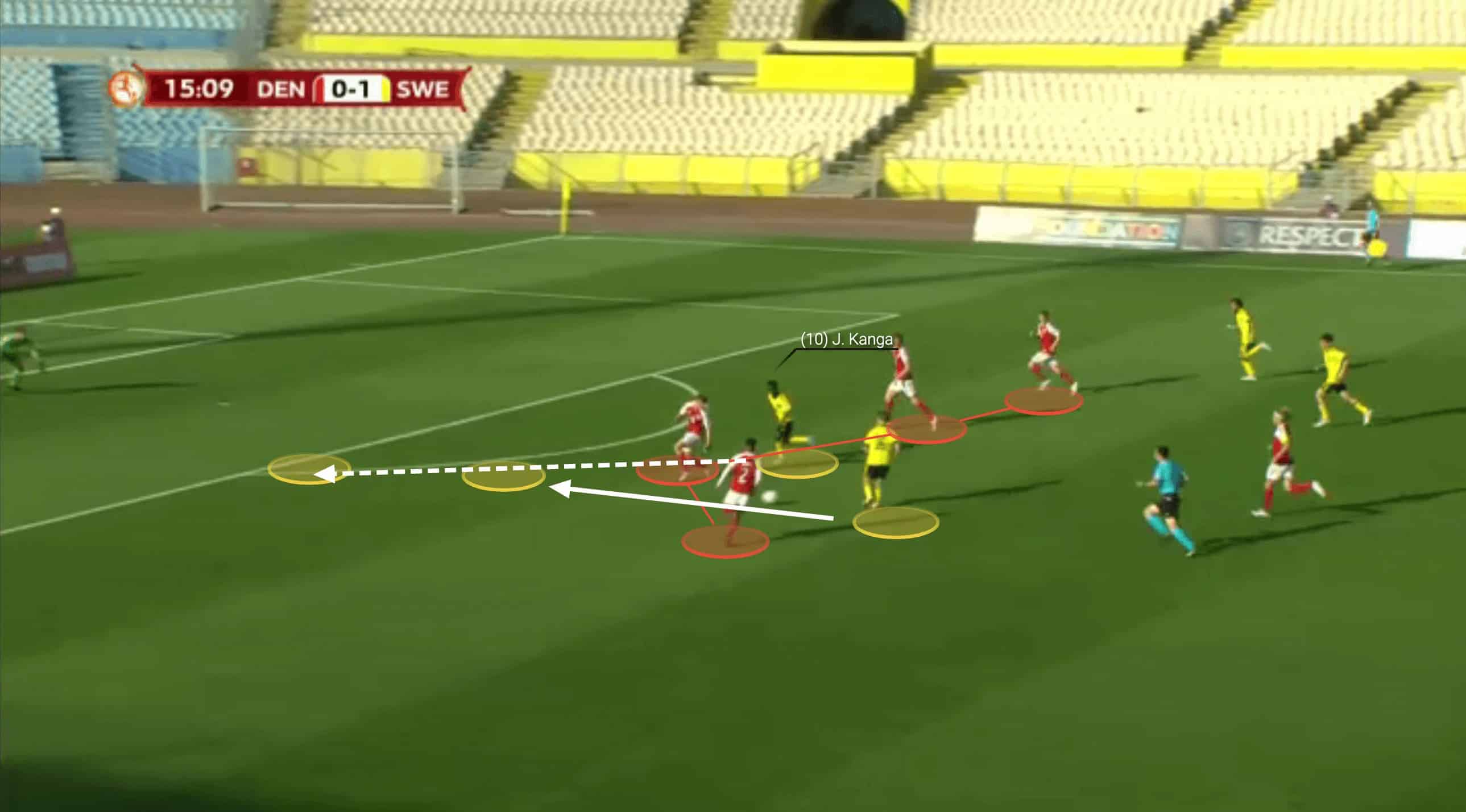
We see this movement here as Kanga is making a diagonal movement across the line in order to maintain his onside position.
He naturally attacks the gaps between opposition defenders and he likes to position himself on the blind side of the defender.
Here, as his teammate has time on the ball Kanga makes a dynamic diagonal run to break the last line.
This allows the player in possession to play the easy pass to access this run.
When breaking into the area in these situations Kanga is a very dangerous finisher.
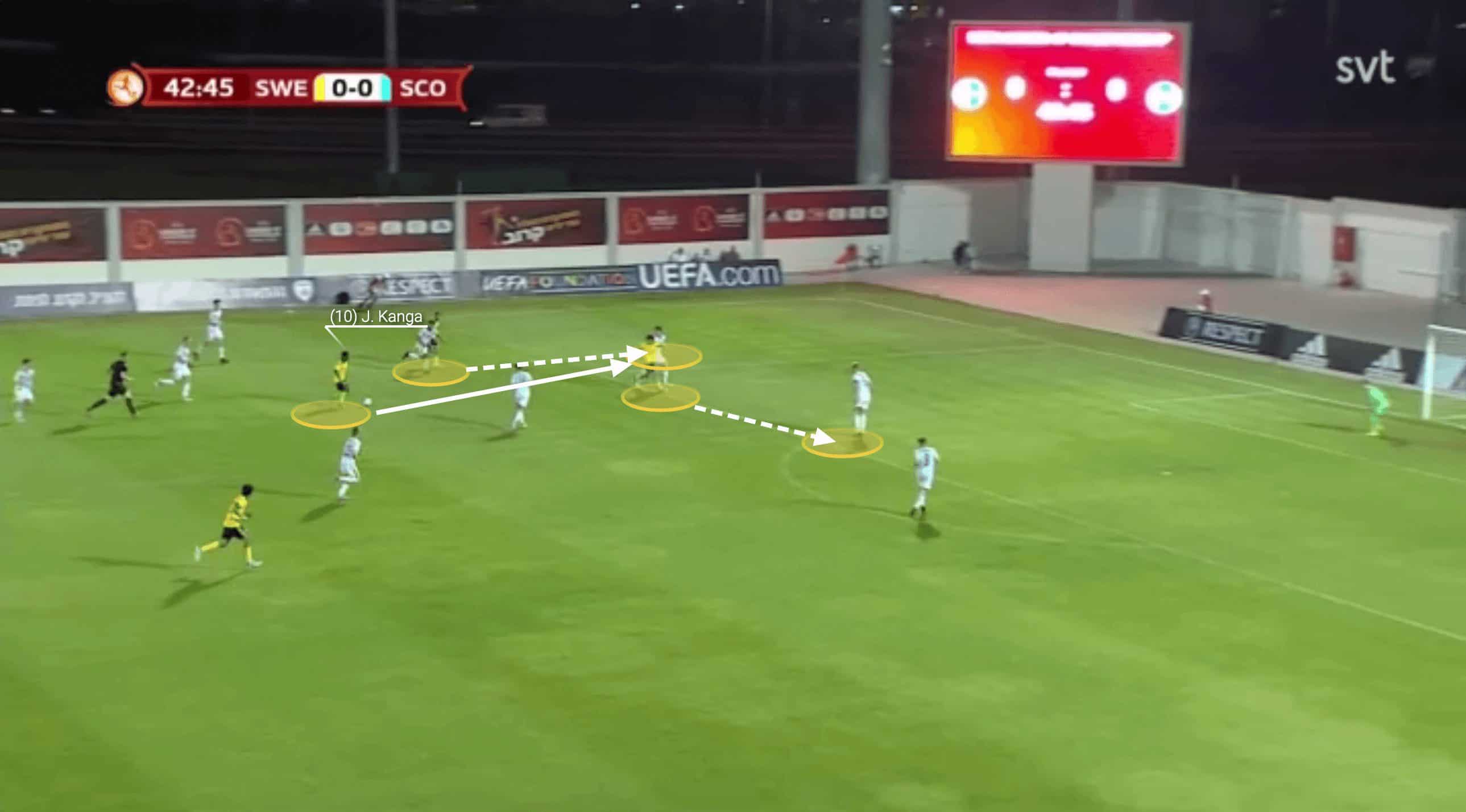
Kanga is also a very capable and creative player when moving in possession of the ball in the final third.
We see an example of this above, as Kanga has received possession of the ball and then made an incisive movement or pass that broke the opposition’s defensive line.
He drives forward in possession, first dropping off of his marker to receive the ball in space.
As a teammate moves into a more positive position in the wide area, Kanga slips the through ball into space.
Looking ahead to next season, we will see Bayer Leverkusen use Kanga around their first team.
After all, they are a club that has given significant minutes to young players like Kai Havertz and Florian Wirtz in recent seasons.
Conclusion
The U17 European Championship is often the tournament where we can first see some of the most promising young talents from across Europe.
So far, this tournament has not disappointed. It has produced a very high level of football and brought to light some extremely interesting young players.
At this point, France would probably be considered the favourite to win the tournament, but there is really still all to play for.
