
Bayer Leverkusen were more active in the winter transfer period than many European teams.
Timothy Fosu-Mensah from Manchester United and Demarai Gray from Leicester City were signed from the Premier League, while Jeremie Frimpong was purchased from the Scottish Premiership.
Frimpong was the most expensive acquisition – on the longest deal – signing a four-year contract for a fee that could reportedly rise to £11.5m.
Leverkusen’s Sporting Director, Simon Rolfes, stated that since these players come from Great Britain, they will be used to a dynamic, physical style of play.
In this football analysis, we will cover how Frimpong has handled this in Scotland to this point.
Standing at 5’9” / 175cm, Frimpong possesses an electric pace coupled with a very direct and positive approach to ball progression and driving his team forward.
Under Neil Lennon tactics at Celtic, in possession, he was positioned as more of a right-winger who would take on opponent left-backs with his strong ability in one-on-one duels.
This scout report will further analyse where he excels and is limited.
In this tactical analysis, we will cover his role in Lennon’s system, how well this will translate to Peter Bosz’s, and how great a value he will provide to Leverkusen over his proposed time at the club.
Jeremie Frimpong Player profile
Frimpong had been apart of the Manchester City academy from the age of 10 years old, coming over from Amsterdam to pursue his footballing dreams at the summit of English football.
He impressed over the years, making his way through the youth ranks and finally to the U23 level. Celtic tracked him closely throughout that first U23 season before purchasing him from City for £350k.
Celtic are no stranger to this method of recruitment – signing from higher-profile academies across Europe (see Odsonne Édouard from PSG).
Celtic have experimented with several formations this season, but their most frequent formation is the 4-2-3-1, in which Frimpong has occupied the right-back role.
Positioned behind Ryan Christie at right-wing, who will typically roam infield, Frimpong has room to gallop up and down the wide-right zone of the pitch, continually making overlaps.
Frimpong has also been used in a back-five, back-three, and on one occasion, starting as a right-winger, despite this being the space he typically operates in anyway.
Frimpong’s style of play meshes well with Christie’s, who likes to operate in central areas due to his strong ability in tight spaces.
This means that Frimpong has free reign over the wide-right zone.
While Christie can drag opponents to his location, Frimpong can burst into space and either hit a whipped early cross towards the far post or carry the ball into the penalty area himself and find a teammate closer to him, leading him to become more accurate with his chance creation.

Frimpong’s player profile, created by the wonderful Sathish Prasad (@SathishPrasadVT on Twitter).
Celtic’s nucleus of ball progression
Looking at his ball progression numbers is a good starting point for explaining what Frimpong does best in matches.
Now, this should be predicated on the fact that Celtic hold 62% of possession on average—they are the dominant team in this league behind Rangers—so understand that by joining Leverkusen, Frimpong’s numbers will naturally drop as he has less time on the ball across the 90.

Scatter plot of Scottish Premiership full-back’s progressive runs per 90 compared with dribbles per 90.
As the visualisation shows, Frimpong leads the way (by some distance, too) for progressive runs and dribbles within full-backs in the Scottish Premiership.
It is his primary tool for ball progression, and the eye test alone shows that a good proportion of these ball carries result in a shot on goal for his side.
This is certainly where he stands out on the pitch, and at Leverkusen, he should be given free roam to provide his best value.
Usually, we see Celtic build-up over on the left side of the pitch, and as such we typically see the Dutchman position himself higher up the pitch, but not too high as to draw attention to his location.
Naturally, the opposition left-back will tuck in, leaving Frimpong in acres of space to receive the ball, drive into the penalty area, and find a teammate with a drilled delivery to feet.
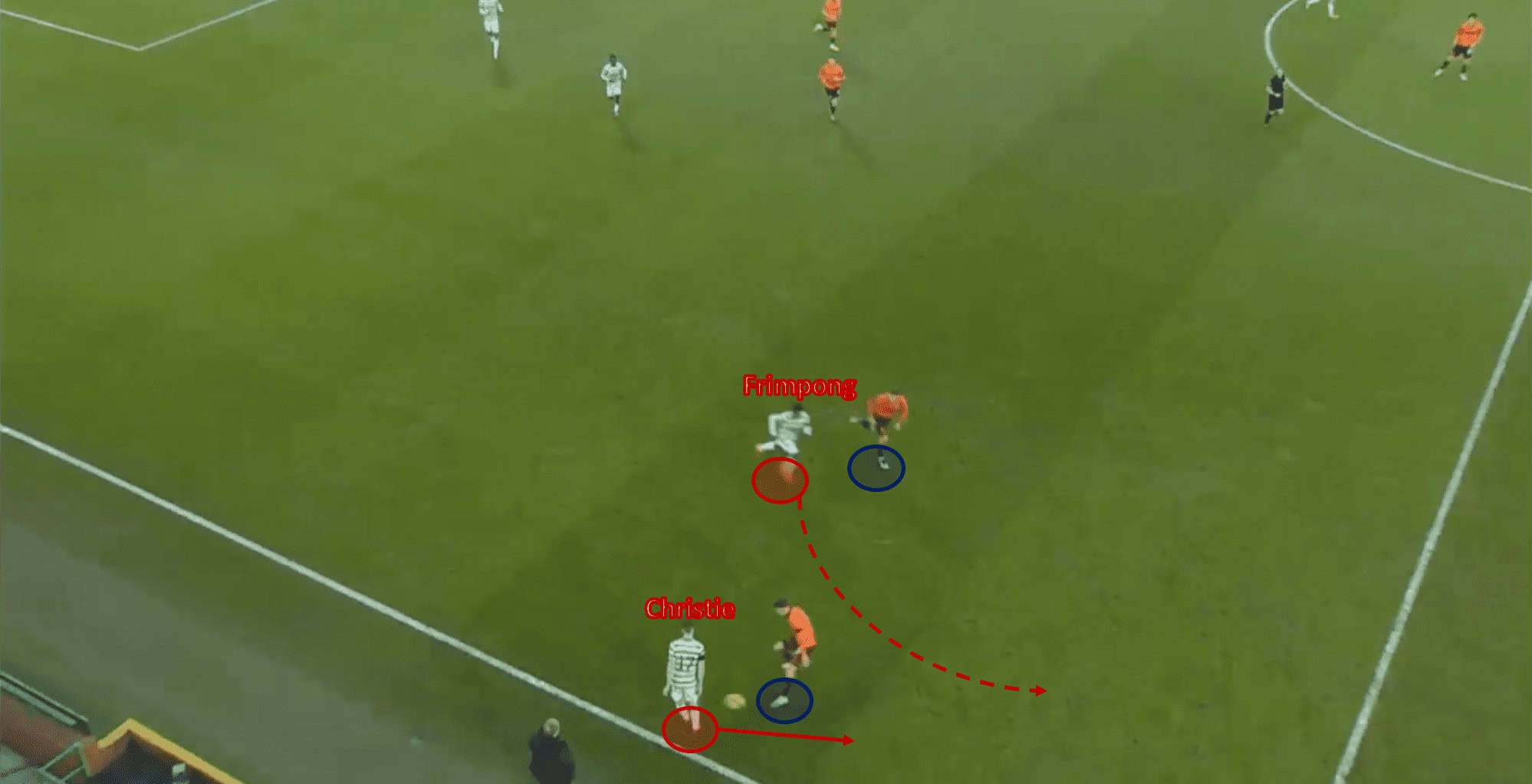
Here, Frimpong plays the swift one-two with Christie down the right-wing, bypassing the opposition press.
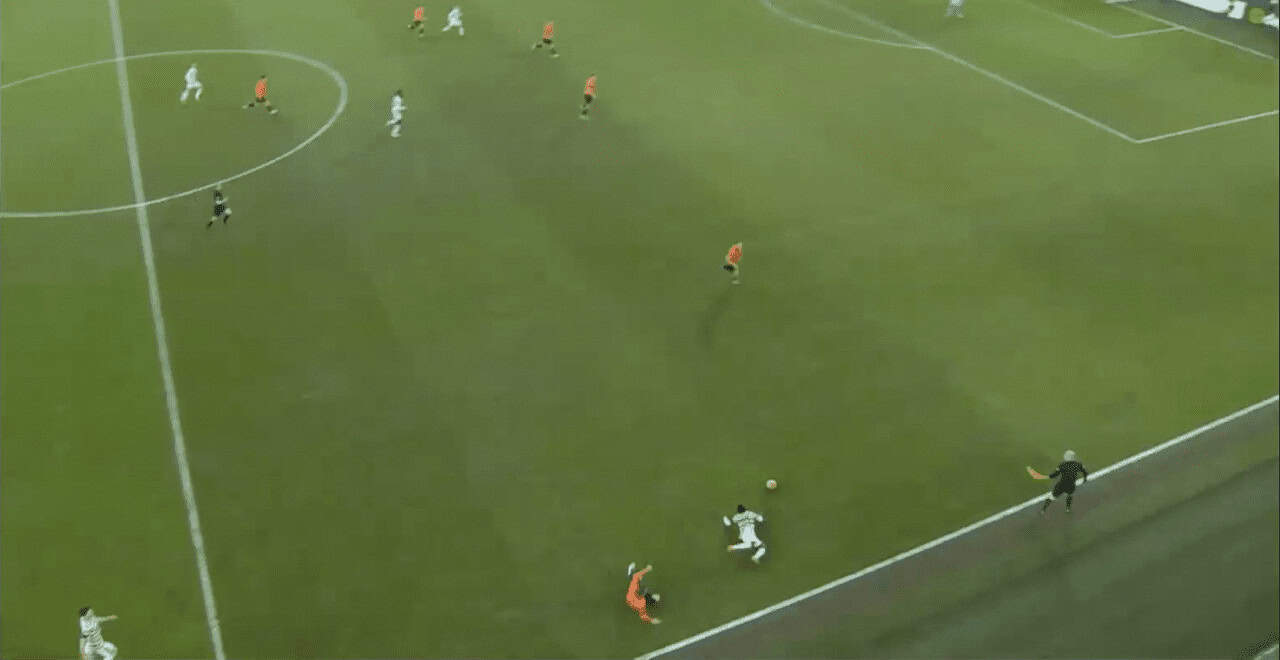
In this scenario, he is ultimately fouled, but he has made headway for his side in terms of possession and has won a free-kick in a useful position.
He links up well with Christie, who is himself a fairly wise player and knows where to position himself in these attacking patterns of play.
This is one way that Frimpong breaks through the press.
His pace in these situations is extra useful, as he ‘turns on the afterburners’ to speed past his opponent, and in these moments, he is a very difficult player to stop.
At Leverkusen, this would provide a different option to their current right-backs.
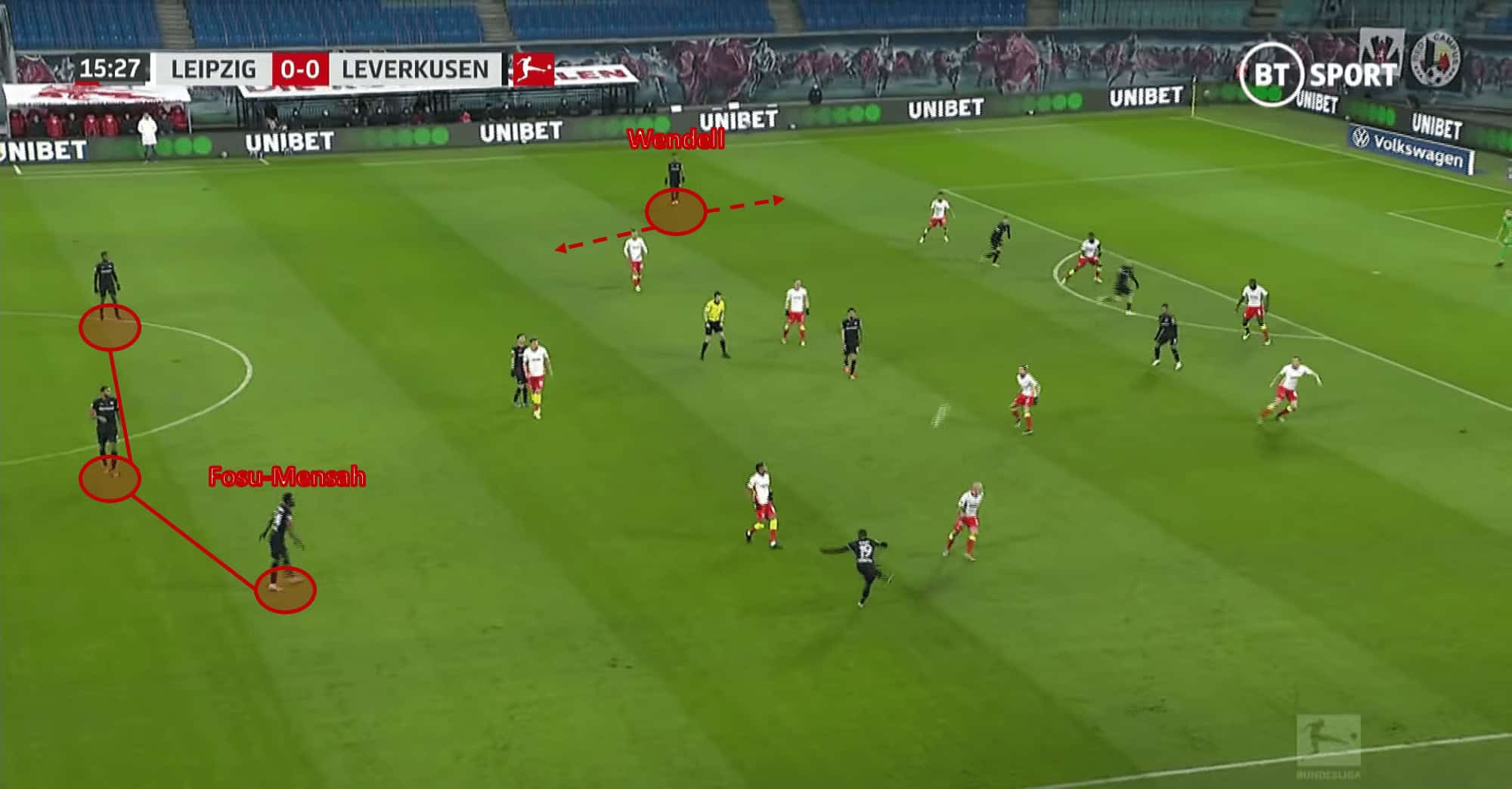
Notice Fosu-Mensah’s positioning in the build-up, Leverkusen’s right-back for this match versus RB Leipzig.
Although in this example, Leverkusen are up against a strong Leipzig team who can hurt teams offensively, we can see what difference Frimpong could make in this Leverkusen team.
While Fosu-Mensah, a more defensive-minded full-back, has been instructed to sit back in the build-up and form part of a back three, Frimpong could be used more like Wendell and position himself much higher up the pitch when Leverkusen are in possession.
Now, Frimpong can also progress possession via his passing, but it has not been seen whether he is efficient enough in this regard at the top level.
At Celtic this season, he played 7.61 progressive passes per 90, which ranks as subpar within the Scottish Premiership, but his 72.97% success rate on these attempts is a good return on his efforts.
This is, however, in a league where the pressing intensity is far lower than the Bundesliga.
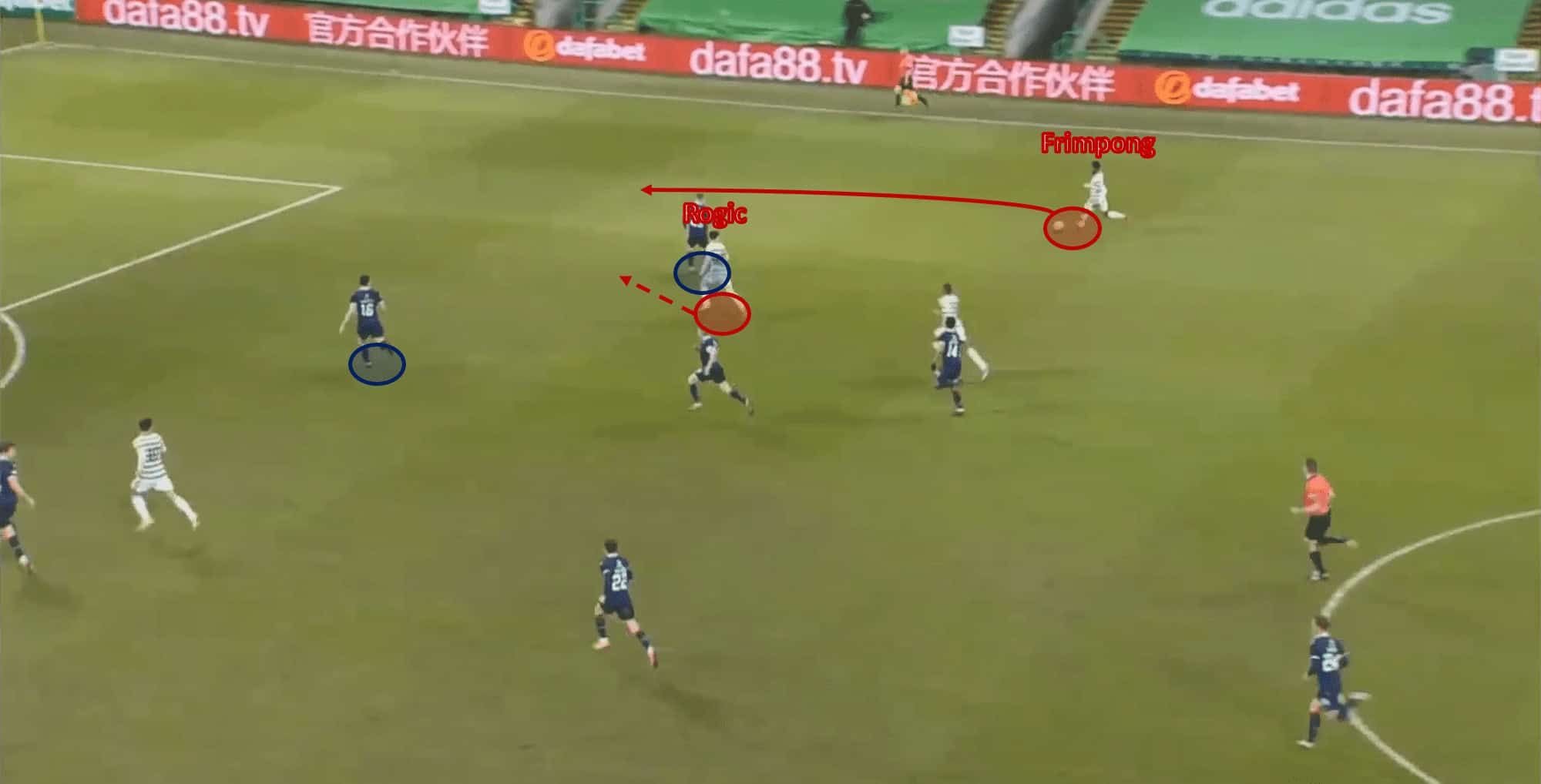
Approaching the final third, Frimpong plays the pass around the corner for Tom Rogic to meet while Frimpong moves into a more central position.
Frimpong displays promise in his progressive passing, but basic issues with his passing pop up frequently upon further viewing.
The weight of his passing – more often than you might like from a player who likes to operate high up the pitch – is inconsistent.
He will have the right idea, playing a smart through pass or sneaking an effort around the corner, but too often, the ball will go beyond its intended target.
Although this seems to be a problem with composure more so than any lack of technical ability, it should improve with game time.
Jeremie Frimpong defensive contribution
As we mentioned previously, Celtic hold a lot of the ball, and as such, their players will attempt fewer defensive duels.
Similarly, Leverkusen plays a possession-based style of football, but it competes in a league with a handful of other dominant sides.
As a result, their possession is slightly lower at 58%, and therefore, we could see Frimpong’s defensive activity increase.

Scatter plot of Scottish Premiership full-backs defensive duels per 90 compared with defensive duels won %.
From this graph, we can gather that Frimpong contends for a small number of defensive duels but wins a large proportion of them.
You would rather this than the other way round, that is for sure.
Comparatively, Lars Bender – Leverkusen’s first-choice right-back this season – engages in more defensive duels per game and is generally more successful with his contests, which is expected of a former defensive midfielder.
Here, Frimpong uses his pace to catch up with his opposing man and aims to ‘rough and tumble’ him off the ball.
In the tackle, Frimpong displays solidity.
He typically uses his body and speed wisely to get around his man and nip the ball from under his feet.
His technique in these situations is not sublime, and it certainly needs work, but it is serviceable for now, which is more than most 20-year-old full-backs can say at their age.
At Leverkusen, though, he has the potential to be palmed away by more combative wingers in the Bundesliga.
He is not small per se, but Frimpong’s slight frame does leave him somewhat disadvantaged in one-on-one duels defensively.
Players with a more extended reach than Frimpong have been able to fend off his advancements just by holding out their arms.
The Dutchman does not let off easily, but taller, stronger players can counteract his intensity.
Compared to players of a similar build, Frimpong is usually quite dominant.
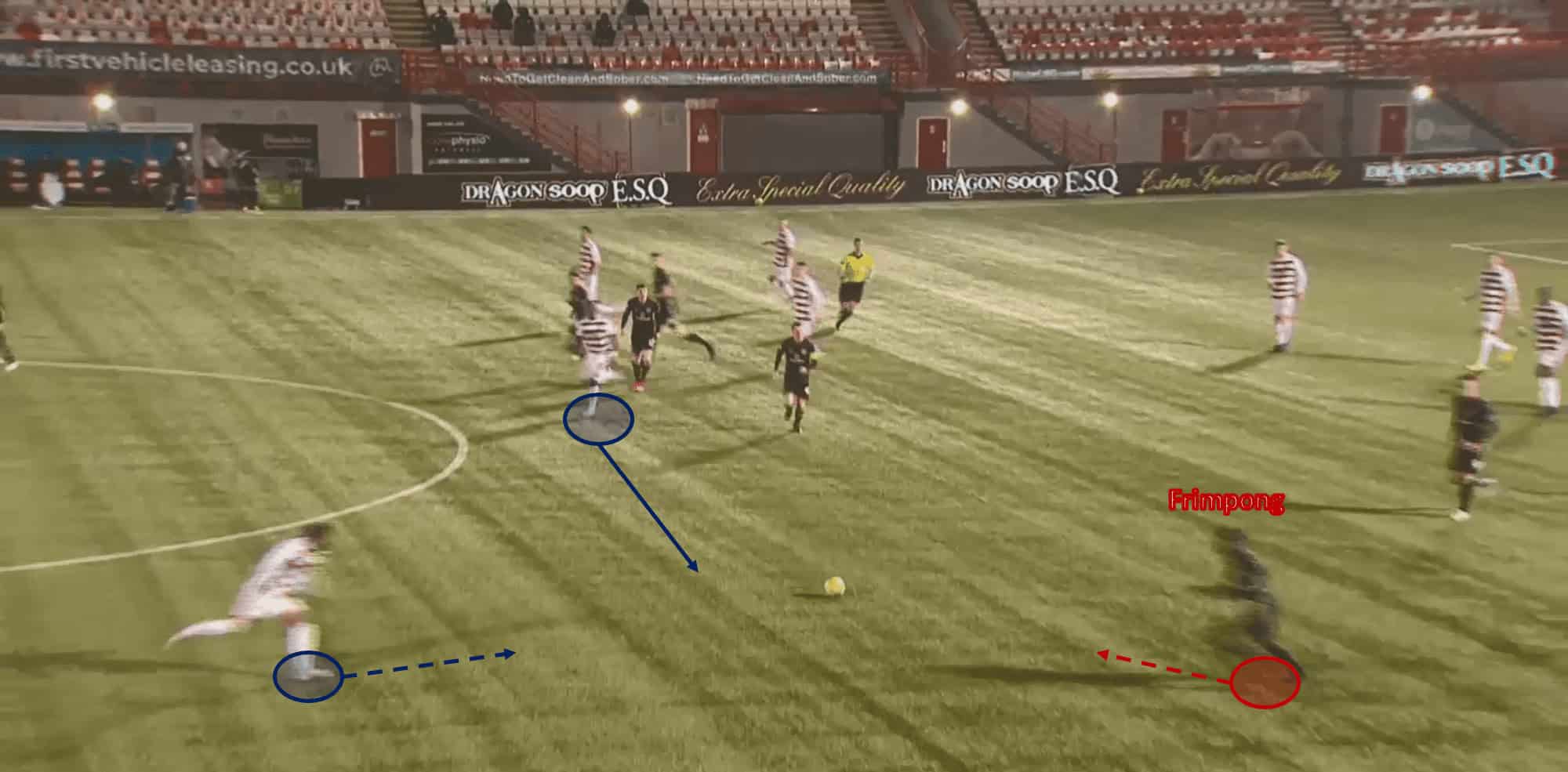
Frimpong anticipates the pass from the opposition and uses his pace to intercept the ball cleanly.
For a young defender of his age, Frimpong reads the game moderately well, and his speed helps him win footraces in the fifty-fifties.
Once the ball is won back, Frimpong’s positive and direct approach is ever-present.
He will look to carry the ball up the pitch and hit teams when they are at their most vulnerable, high up the pitch on the counterattack.
Frimpong’s ability in these situations is dangerous, and if utilised wisely, he can win his team points through this alone.
Jeremie Frimpong goal contribution
Across all competitions, Frimpong played 51 times for Celtic, scoring three goals and eight assists.
This can be seen as a decent return for a player who does not take any set pieces and was just learning his trade at the senior level.
He poses the opposition a huge challenge in trying to stop him at full flow.
His searing speed, agility, and close control in tight spaces make him very difficult to stop.

Scatter plot of Scottish Premiership full-backs xG per 90 compared with xA per 90.
If it were not for James Tavernier – an elite-level attacking full-back in his own right (though, set-pieces and penalties help tremendously) – Frimpong would stand out as the league’s best-attacking full-back.
His xA per 90 of 0.16 is good, and at 20 years old, this should only improve with time, as his composure gets better as well, as we mentioned before, this is a big weakness of his currently.
He was deployed as a right-winger at Man City throughout the academy ranks and his days as a winger can be seen during his time at Celtic.
We displayed his dribbles earlier, 6.84 attempted at a 54.14% success rate is a high rate, and much steeper than Leverkusen’s current crop of full-backs.
Daley Sinkgraven comes the closest with 1.5 successful dribbles per 90, so Frimpong’s high-octane energy will inject life into dull games where needed.
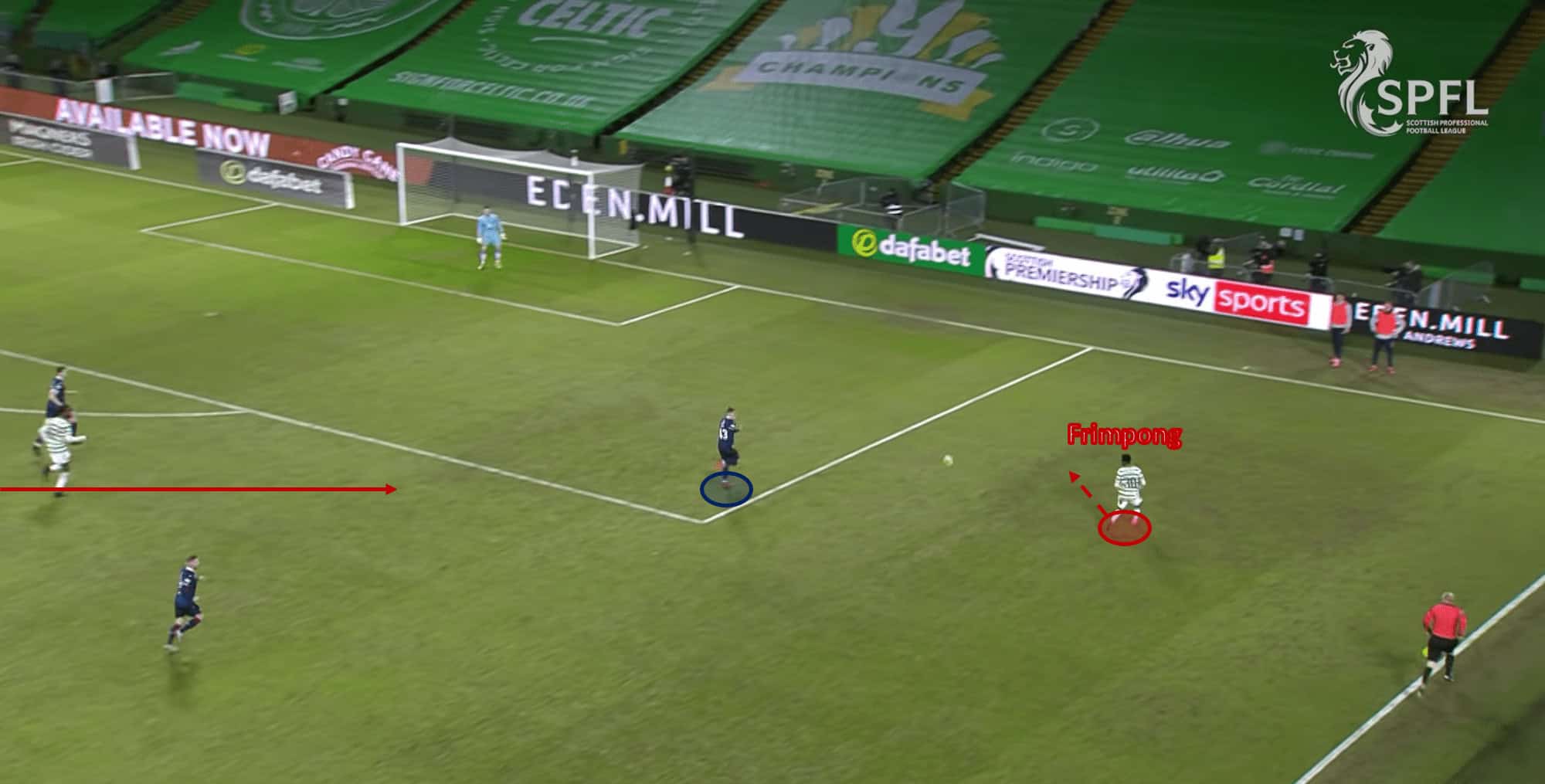
Like we mentioned before, Celtic complete their typical bait-and-switch in possession, to find Frimpong in plenty of space.
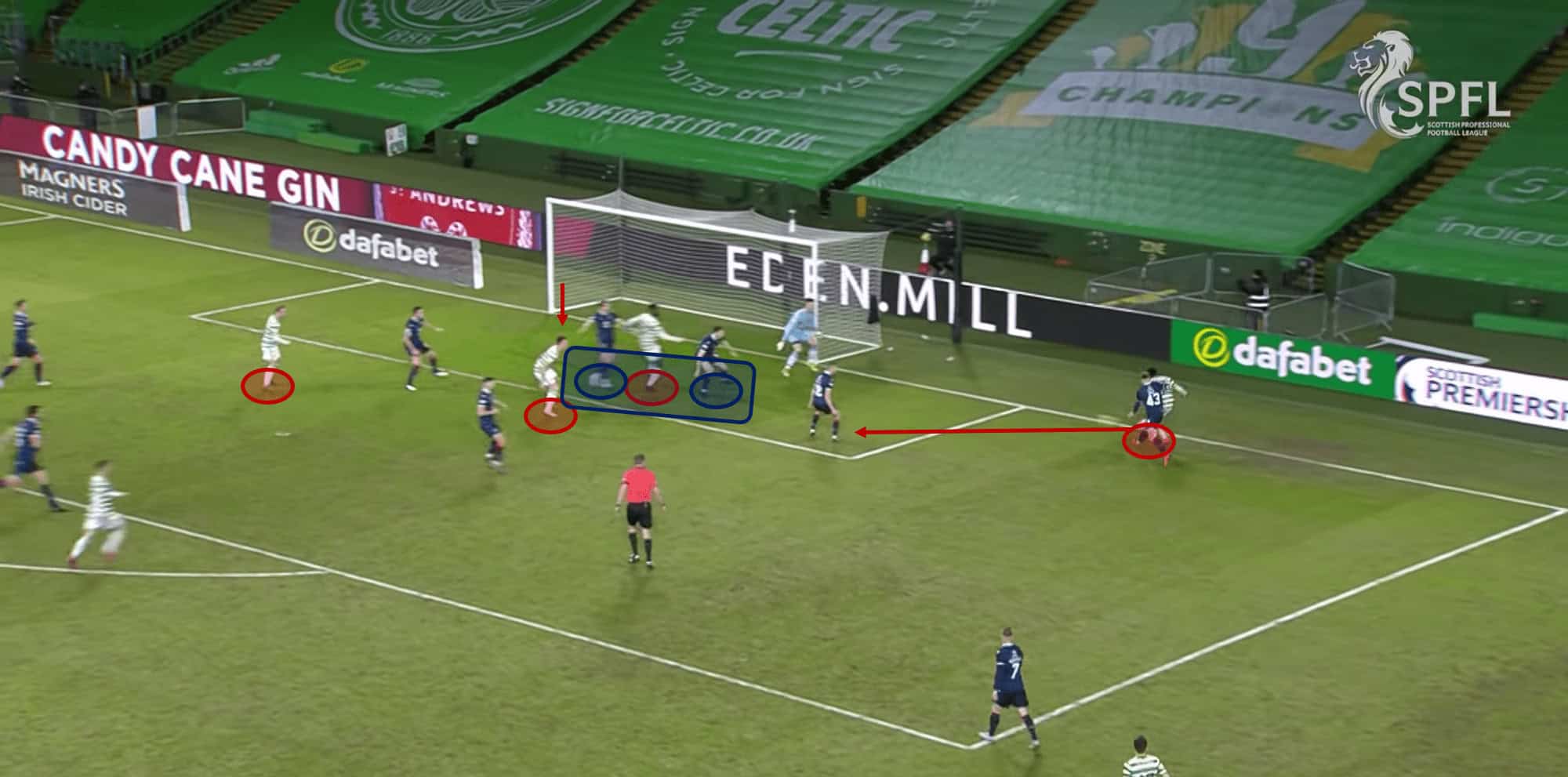
Next to the byline, Frimpong has a few options for the cutback.
Edouard has been boxed out of space, while David Turnball has room to collect the ball and shoot.
Frimpong’s acceleration from a standing start is staggering, and this aids him greatly in these attacking patterns of play.
This is how it often goes down at Celtic: They build up play down the left flank, switch it to Frimpong in a wide-right zone, and he creates half a yard of space through his agility and pace alone. He then finds a teammate inside the penalty area to create a goalscoring opportunity.
He has the league’s fourth-highest shot assists per 90, standing at 1.39, but this does mean that he ranks the lowest out of the four starting full-backs within Rangers and Celtic, the two dominant teams in the division.
However, he is currently more creative than Leverkusen’s crop of full-backs. However, he is expected to not be positioned as high at Leverkusen, and as such, he must be less wasteful with his chances.
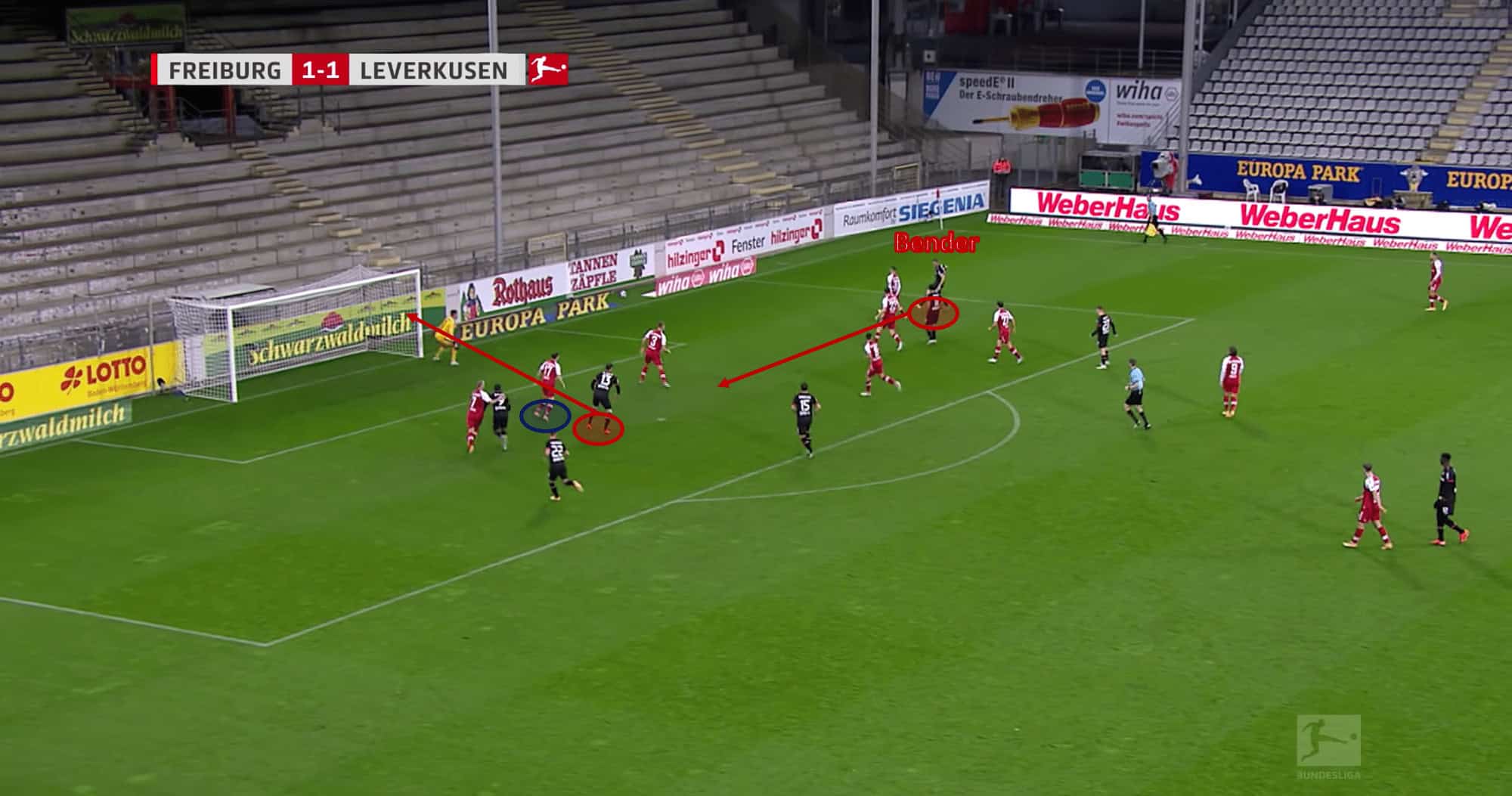
On occasion, Bender will roam forward like in this example, and look to create a chance with his passing.
In terms of attacking the opposition, Frimpong would be far more ruthless and riskier than Bender, who acts far more preserved.
Frimpong can make both overlapping and underlapping runs.
He drives into the penalty area, often towards the far post, to get on the end of a through pass and tap it in the net.
It is with this unpredictability and rawness in his game where he can be most difficult to defend against.
Jeremie Frimpong Forecast for the future
In one and a half seasons, Frimpong has impressed to the extent that a top Bundesliga club has entrusted him with a four-year contract.
He is expected to make an immediate impact and is expected to stay at the club in the long term.
He possesses a unique added value that we have not really covered from a recruitment point of view as well.
He can play as both a wing-back and a full-back.
In a couple of seasons, elite teams across Europe should keep an eye on Frimpong if they are looking to replace their ageing full-back.
Think Barcelona’s dearth of right-back or Bayern Munich’s lack of a natural right-back.
Frimpong has a ceiling that is high enough to play for these clubs, most definitely.
He’s excited fans a Park Head, and long may that continue for the foreseeable at the BayArena.
