
Harry Kane was regarded to be one of the best strikers in world football a couple of seasons back. The 2014/15 season saw him win the Professional Footballers’ Association Young Player of the Year, and the Professional Footballers’ Association Team of the Year after lead Tottenham Hotspur to a fifth-place finish, a Europa League spot for the next season. The season after saw him win the Golden Boot, appear for the second time in the PFA Team of the Year, and lead Tottenham to a third-place finish, qualifying them for the UEFA Champions League. 2016/17 saw him win his second golden boot, and finish the league as runners up, while 2017/18 saw him become Europe’s top goal-scorer in a calendar year, being the first player outside of Lionel Messi and Cristiano Ronaldo in seven years to achieve this feat, along with scoring thirty league goals and a total of 100 league goals in 141 matches. A Champions League final later, and global pandemic later, Kane is still Spurs’ star striker, though under a different manager, with most of his individual success coming under the guidance of Mauricio Pochettino, not the current Spurs’ manager José Mourinho. Kane has still put high numbers in these last two seasons, but there has been a decline. The fact that he is seemingly always rushed back from injuries is likely to be a factor, and this tactical analysis will look at why Kane seems to have declined by looking at the numbers, and the difference between Pochettino and Mourinho’s tactics and what that means for Kane.
Goal-scoring Decline
Kane is compared to the best strikers of the world, both past and present, because of his prolific goal-scoring stats – the numbers speak for themselves when it comes to his goals in previous seasons. Coming through the youth ranks, he was not seen as a potentially world-class player early on, because physically he was underdeveloped compared to the players in his same age-group. However, after a few loan spells across England (playing for Leyton Orient, Millwall, Norwich City and Leicester City), he caught up physically and was able to gain experience. Pochettino was impressed enough to make him his starting striker in the 2014/15 season.
In terms of goals scored since that season, Kane’s best season in the league was the 2017/18 season, and his worst has been this current season, with only 13 goals netted so far. However, it’d be quite foolish to just look at goals scored, and claim that there has been a decline. To do a proper analysis, one must look at the number of appearances, and more importantly the number of minutes, and the player’s goals per 90.

The chart above shows us that there has been a decline though. Not only in goals scored, but also Kane’s goals per 90, regardless of the minutes he’s played, and the matches he has missed out due to injury. The decline can be accredited due to the fact that he’s often rushed back after injury (World Cup, Champions League final), but also because of a managerial change.
Mourinho’s tactics
Kane has suffered the consequences of a striker being managed with a pragmatic approach. Under Pochettino, Kane was more than a poacher, but now that responsibility of dropping even deeper than he was before is effecting his shots and his overall position.
Kane’s responsibility under Mourinho, who was the former Manchester United manager, is to be involved in the build-up play when Tottenham are in possession and to drop deep when possible to help with link-up play as well as successfully target weaker defensive players in the opposition defence by teaming up with a teammate(s) and targeting that player (for example creating a 2v1 situation).
However, the deeper Kane drops when Spurs are out of possession, the more ground he has to make up when they regain possession, and either counter-attack or if they decide to patiently build-up play. The more ground he covers, the quicker he tires obviously, and that starts to build-up and showcase in his performances. Kane is covering more ground than he’s used to, and taking fewer shots because of his positioning.
Pochettino vs Mourinho
Take the Tottenham’s first match of the season against Aston Villa, when Tottenham was under Pochettino. Kane’s heatmap shows that he spent most of the game in the box, with some touches around it – almost all of his touches were in the opposition half.


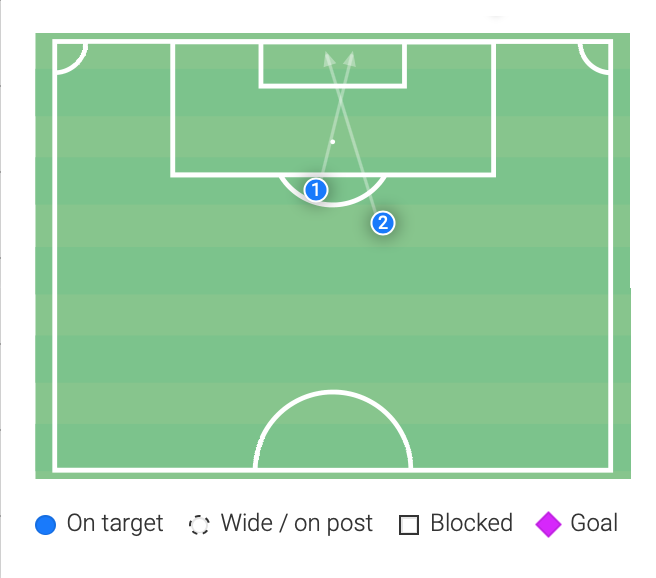
Kane’s ‘decline’ doesn’t just come from injury-related reasons or just a general loss of ability. Mourinho has utilized him to make up for Eriksen leaving, as well as Tanguy Ndombele not being favoured by the Portuguese. Time can only tell whether this new Kane will be worth it for Spurs, I mean, if they finally win a trophy under Mourinho, will it matter that he isn’t as prolific? Probably not.
So, is Kane declining?
In early January, Kane suffered another injury, this time, a thigh muscle rupture. He missed 14 of Spurs’ matches but the stoppage of football due to the pandemic did allow him to recover, and he was able to play for Tottenham after the league returned, featuring in three of their matches so far, and scoring two goals.
Not much of Mourinho’s tactics have changed during these three matches. Kane is still dropping deeper than he used to, earlier in his career, however, if anything, it looks like the Englishman has become more accustomed, or used to his new role.
I personally am in the camp that Kane is experiencing an early-career decline. He’s been rushed back from injuries too many times, and his poorer performances (when comparing them to his elite seasons) have been consistent, not just a one-off match. I also think that Mourinho’s tactics do not help him showcase how prolific he can be and that if Tottenham were to be managed under a more proactive manager (or if Kane were to move to another club with that type of manager), his numbers would slightly improve on what they are now. That being said, I don’t think he will reach the numbers of his 2016/17 and 2017/18 season again; he is too relied on both by club and country, and they have shown numerous times that Kane is put in the starting XI as quickly as possible, and the long-term effects are starting to show.
Nonetheless, despite most footballers having a downward trajectory once they hit there peak, there are players who bounce back, and put up very high numbers later on in their career. Rober Lewandowski hit career-high numbers of 36 goals in 49 appearances in all competitions back in the 2012/13 season and following that up with two seasons of goals in the mid 20 range. However, now, he’s putting up higher numbers than that 2012/13 season, scoring 49 goals in 42 appearances this season, his record best at 31 years old. Kane is still 26 years old; should he remain fit, he can very easily get back to producing the numbers he had in his record-breaking seasons. He has plenty of time to prove me wrong.
