
The UEFA Champions League has thrown another curveball at Pep Guardiola’s Manchester City, as a second-half collapse at the hands of Feyenoord has further compounded their issues.
But Brian Priske’s Feyenoord wouldn’t go down without a fight, launching a formidable comeback that again exploited the home side’s key defensive frailties.
As Dávid Hancko headed home to draw Feyenoord level at 3-3, collective groans across the Etihad sounded like a broken record, with the persisting issues plaguing the Cityzens’ progression on the European stage.
Our tactical analysis will begin to highlight how things changed so rapidly for Manchester City after putting on an impressive display for the opening 70 minutes.
While Pep Guardiola’s tactics didn’t change too drastically, the personnel changes late in the second half were certainly questionable, as the home side appeared to lose all poise and balance when tasked with managing their lead.
Even though things may appear to be a one-sided capitulation on behalf of Manchester City, the following analysis will also identify the tactical tweaks that allowed Feyenoord to boast their offensive strengths late in the match.
Manchester City Vs Feyenoord Lineups & Formations

Manchester City lined up in their experimental 3-4-2-1 setup, with sweeper keeper Ederson protected by a defensive line of three central defenders: Nathan Aké, Manuel Akanji and Joško Gvardiol.
Ilkay Gündogăn and Rico Lewis appeared to create a partnership at the base of midfield, whilst Phil Foden and Matheus Nunes operated in more advanced positions through the centre.
Jack Grealish and Bernardo Silva provided the home side’s width, and the Norweigan talisman Erling Haaland spearheaded the attack.
On the other hand, Brian Priske’s formation opted for a more conservative 4-3-3 approach, as the Danish coach recognised the opportunity to sacrifice their usual ‘possession-based’ style for something a bit more conservative.
Timon Wellenreuther was between the posts for Feyenoord, and Gijs Smal, Dávid Hancko, Gernot Trauner and Bart Nieuwkoop looked to stifle the City attack as a defensive quartet.
Hwang In-Beom looked to be a controlling figure as a deeper-lying midfielder, whilst Quinten Timber and Antoni Milambo lined up as box-to-box midfielders to contest a crucial battle through the middle.
Feyenoord’s front three saw Igor Paixão and Anis Hadj-Moussa operate on the wings, with Julián Carranza leading the line.
Man City’s Early Strengths
Despite a first half with minimal clear-cut chances for either side, Manchester City looked to bounce back from an embarrassing home defeat at the hands of Ange Postecoglou‘s Tottenham in the previous match.
Certain individuals’ pressing efforts and energy expenditures when in possession were critical to Man City’s offensive strengths in the first half.
Matheus Nunes was the standout performer with his movement in the offensive phase, as he constantly threatened through the right half-space, with Bernardo Silva occupying the Feyenoord left back out towards the flank.
Here, we see how City’s shape supports the double pivot of Gündogăn and Lewis, allowing Nunes to hurt Feyenoord in these more advanced positions.
Timber is unable to react in time to either block the passing lane or track down the Portuguese midfielder’s run.
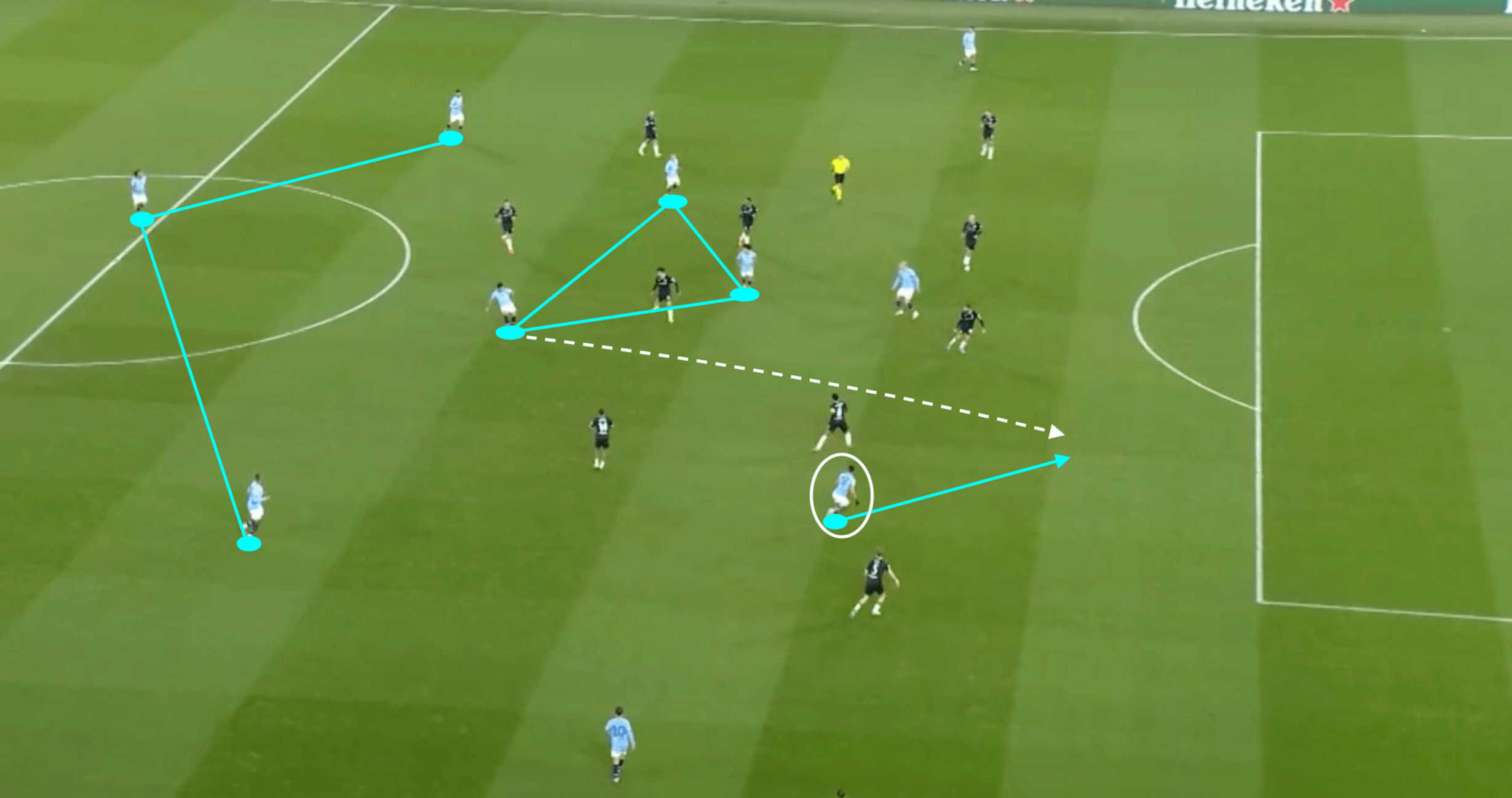
City’s midfield setup saw Foden and Nunes often dropping deeper in the initial phase to try to circulate the ball, creating more of a diamond or box shape to combat Feyenoord’s three-man midfield.
This helped to combat Feyenoord’s high-pressing efforts, which have allowed them to create multiple high turnovers throughout this Champions League campaign.
It even was a huge catalyst in their victory over Girona.
With Feyenoord pressing man-to-man, Gündogăn was often allowed enough time and space to receive the ball as the extra man in midfield, an essential remedy to alleviate the loss of the press-resistant Mateo Kovačić through injury.
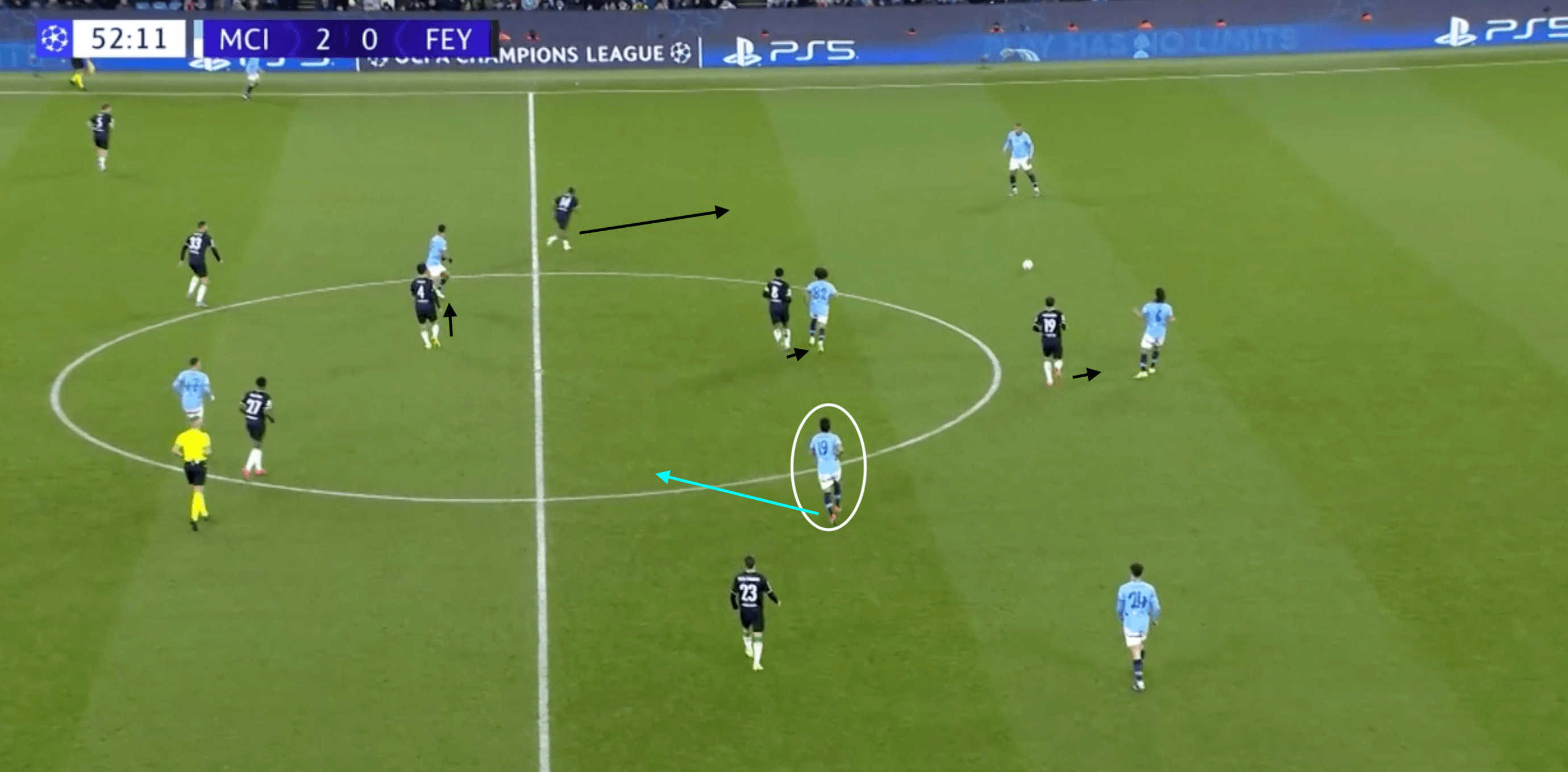
Even when Gündogăn did face immediate defensive pressure when receiving from deep, the speed at which City could progress play forward meant that the likes of Nunes or Foden had acres of space to advance unopposed between the lines.
This eventually resulted in Manchester City storming into a 3-goal lead, with Nunes striding forward to provide a pinpoint cross for Haaland to sweep past the goalkeeper.
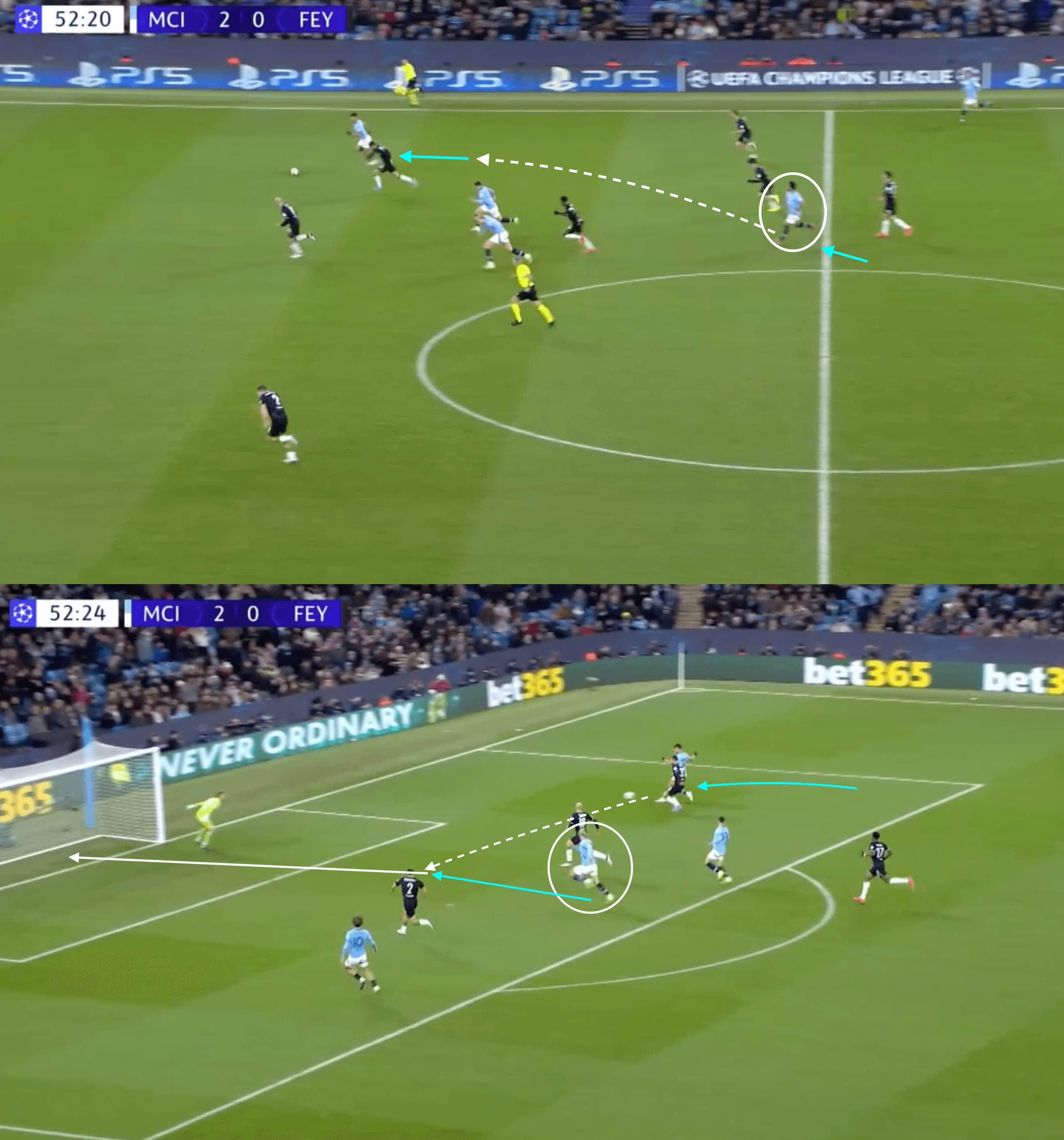
Guardiola’s men once again pressed high in the 4-4-2 initially, and unlike in the defeat to Tottenham, they were able to frustrate their opponents and force mistakes high up the pitch.
The example below highlights how City’s desire to press was aided by Feyenoord’s poor structure early on, with Haaland not only applying pressure to Wellenreuther but also blocking the passing lane to two key players, Hancko and Hwang.
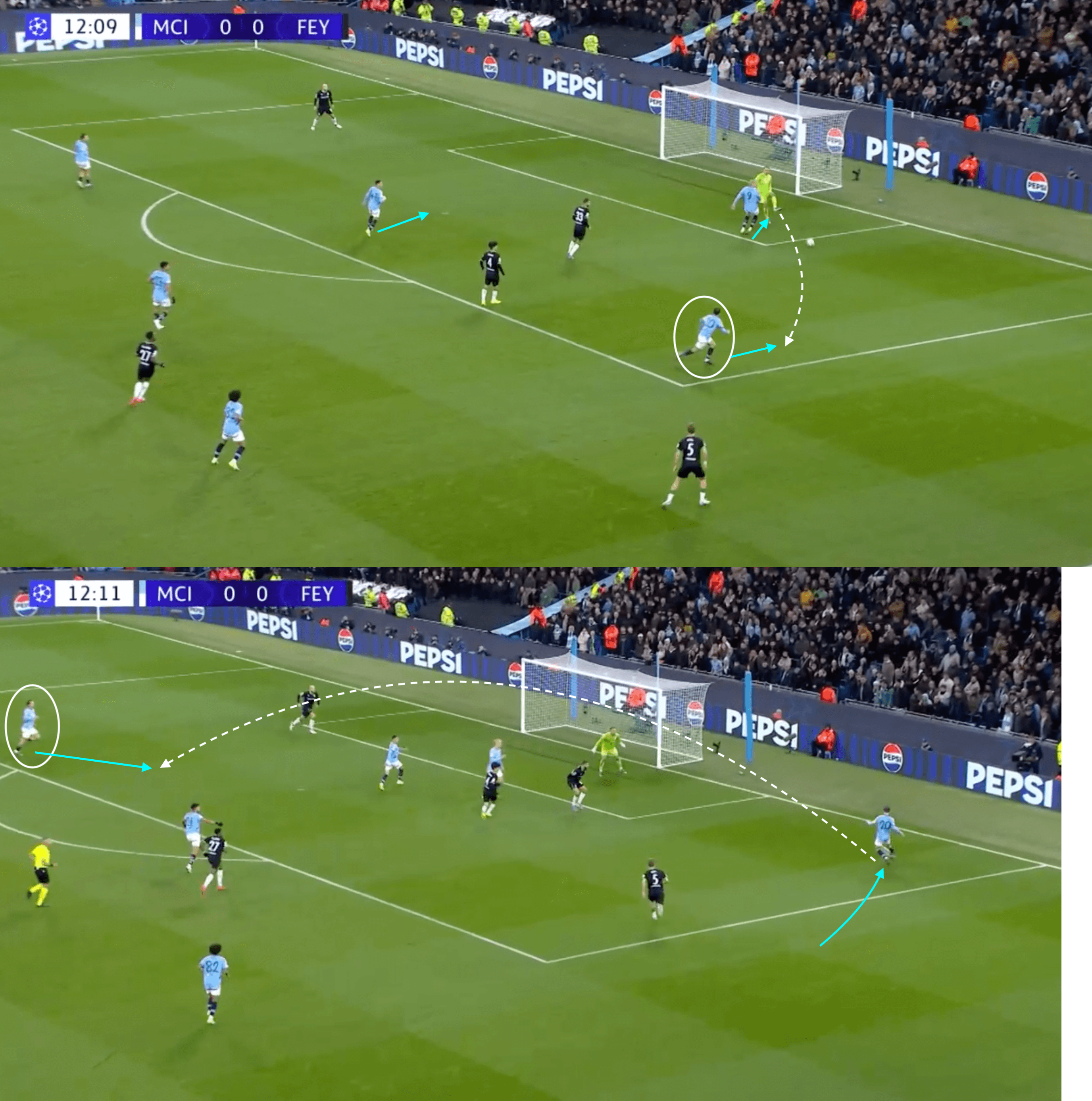
Bernardo Silva could easily pounce on the misplaced pass from the Feyenoord goalkeeper, subsequently creating an excellent chance as Grealish darted into the penalty area to meet his looped cross.
Feyenoord Finding Their Feet
With the match seemingly heading towards a certain Manchester City victory, problems arose when substitutes were made late in the second half.
Pep Guardiola was obviously thinking about a huge Premier League encounter with Liverpool when he decided to substitute Aké, Foden, and Gündogăn in the 68th minute.
Still, the replacements failed to instil the same confidence when out of possession.
The introduction of Kevin De Bruyne meant that Foden’s ball-circulating efforts were lost in the deeper positions, with the Belgian operating much higher and closer to Haaland—when he wasn’t also picking up space out wide.
James McAtee replaced Gündogăn, forcing the impactful Nunes to drop deeper alongside Rico Lewis.
Once again, this reduced the combative and controlling presence in the midfield at a time when Feyenoord were growing into the match.
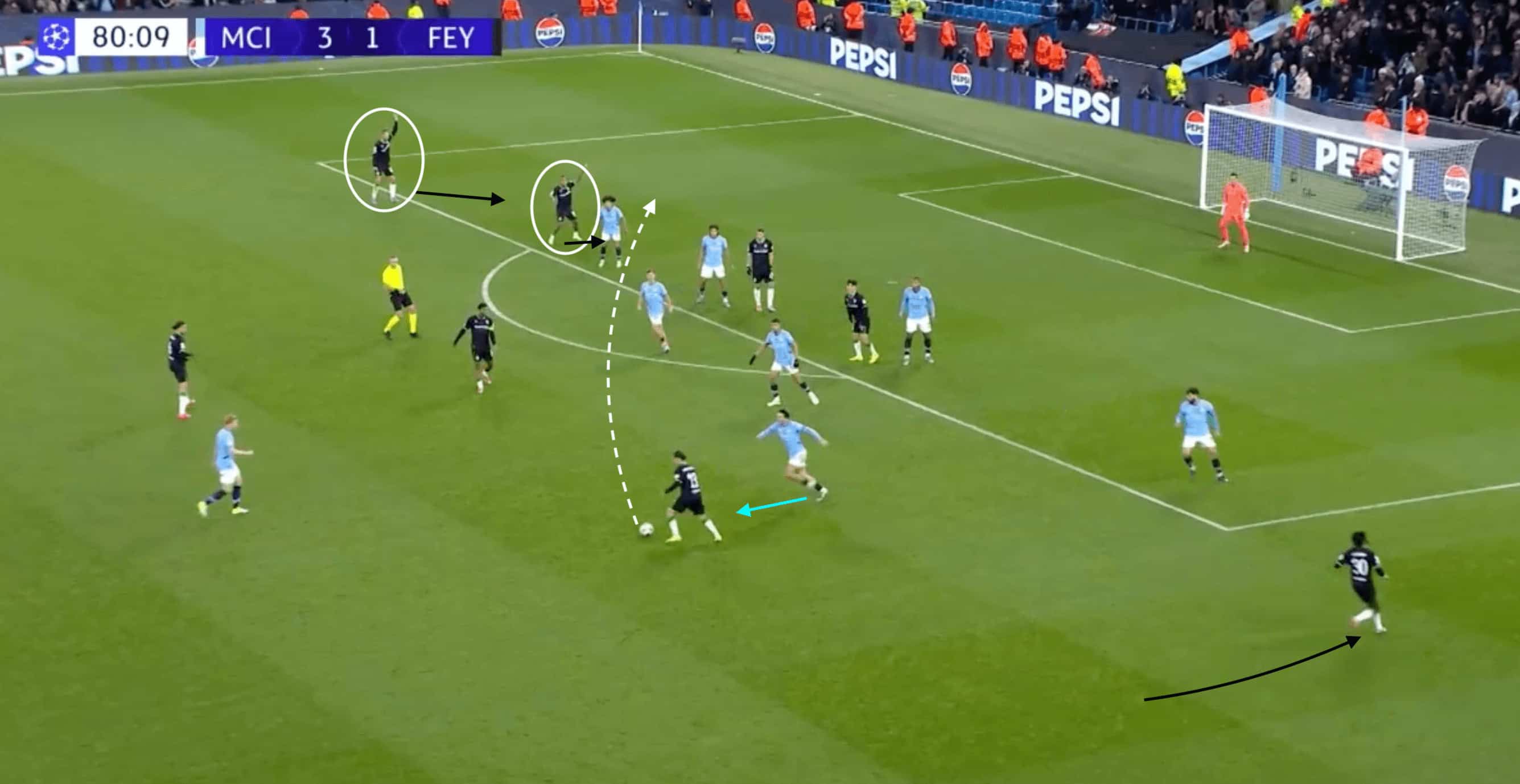
Feyenoord’s opener was certainly against the run of play, but their second goal targeted a defensive frailty that has been a consistent thorn in City’s side this season.
Brian Priske’s tactical decision to stretch the City defence coincided with Hancko adopting a more advanced role as left back.
At the same time, Jordan Lotomba was introduced to provide the same attacking width on the right.
When dropping into their 4-4-2 when out of possession, the following example highlights just how narrow the Manchester City defensive line can be: Lewis settles into the right-back position, and both Hancko and Paixão look to play in behind the young full-back to attack the deep cross.
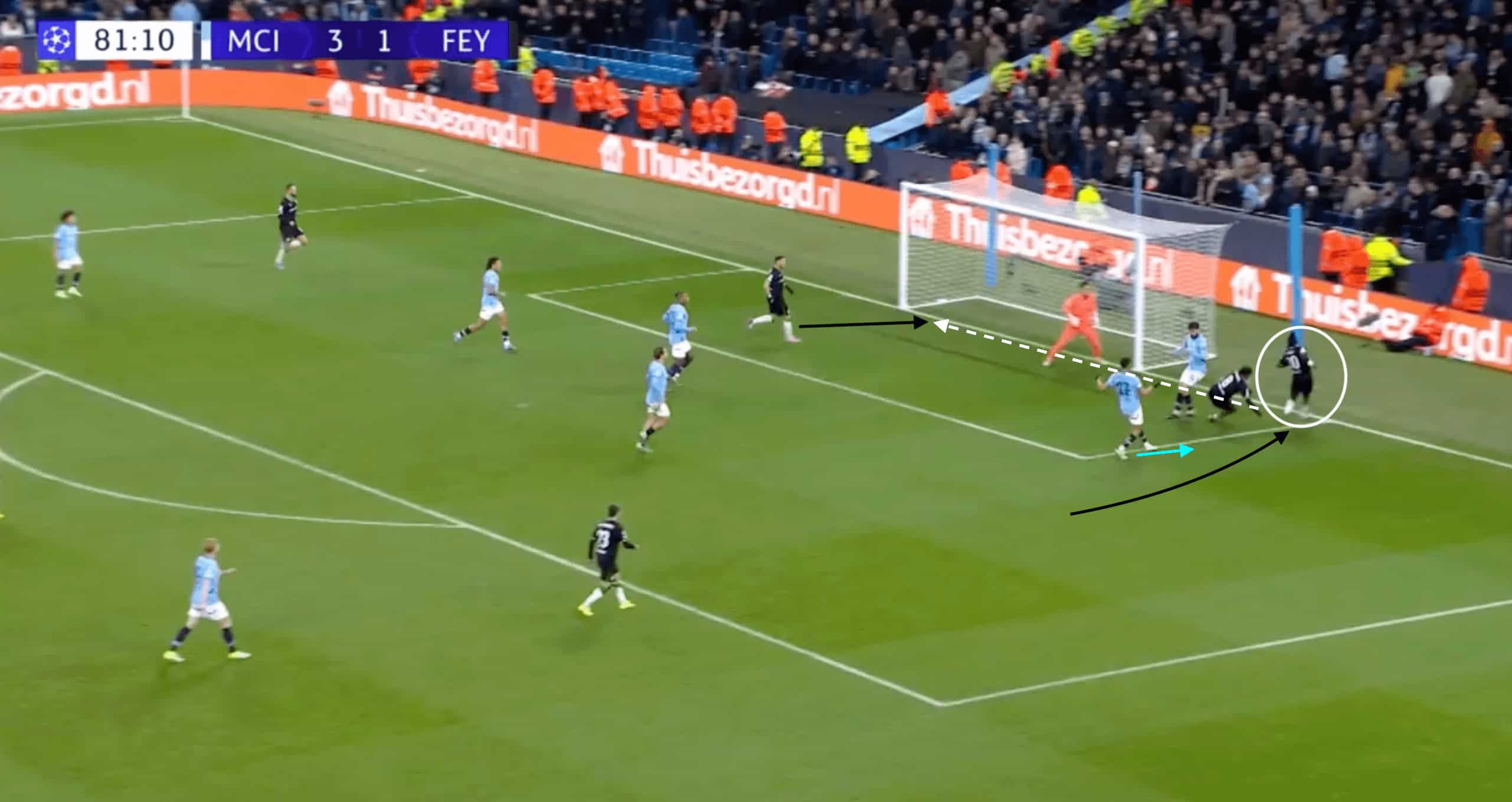
Feyenoord would eventually breach the City defence once again when utilising this strategy from the opposite flank.
As Timber occupied Gvardiol, Nunes failed to track Lotomba’s run to meet the cross at the back post, with the ball falling to Santiago Giménez to tap home from a yard out.
In the eyes of Feyenoord fans, the game was really back on, and the following sequences reiterated City’s defensive struggles.
Defensive Line Depth
There has been an interesting trend this season concerning the defensive height of Manchester City’s defensive line, and this was once again a major issue in transition.
City’s average defensive height throughout the 24/25 season has been 41m away from their goal, a significant increase of 8m compared to last season’s numbers.
Along with an average defensive action height of 57.0m against Feyenoord, this coincides with their desire to be dominant in possession and neutralise opposition attacking opportunities as soon as possible.
However, for Guardiola’s team, inexperience and match sharpness within the defensive line have made the Premier League champions extremely vulnerable when their structure is incorrect.
We saw glimpses of this early in the match, as Rico Lewis was unable to identify the run of Timber through the channel accurately, and City was unable to revert to a more conservative formation.
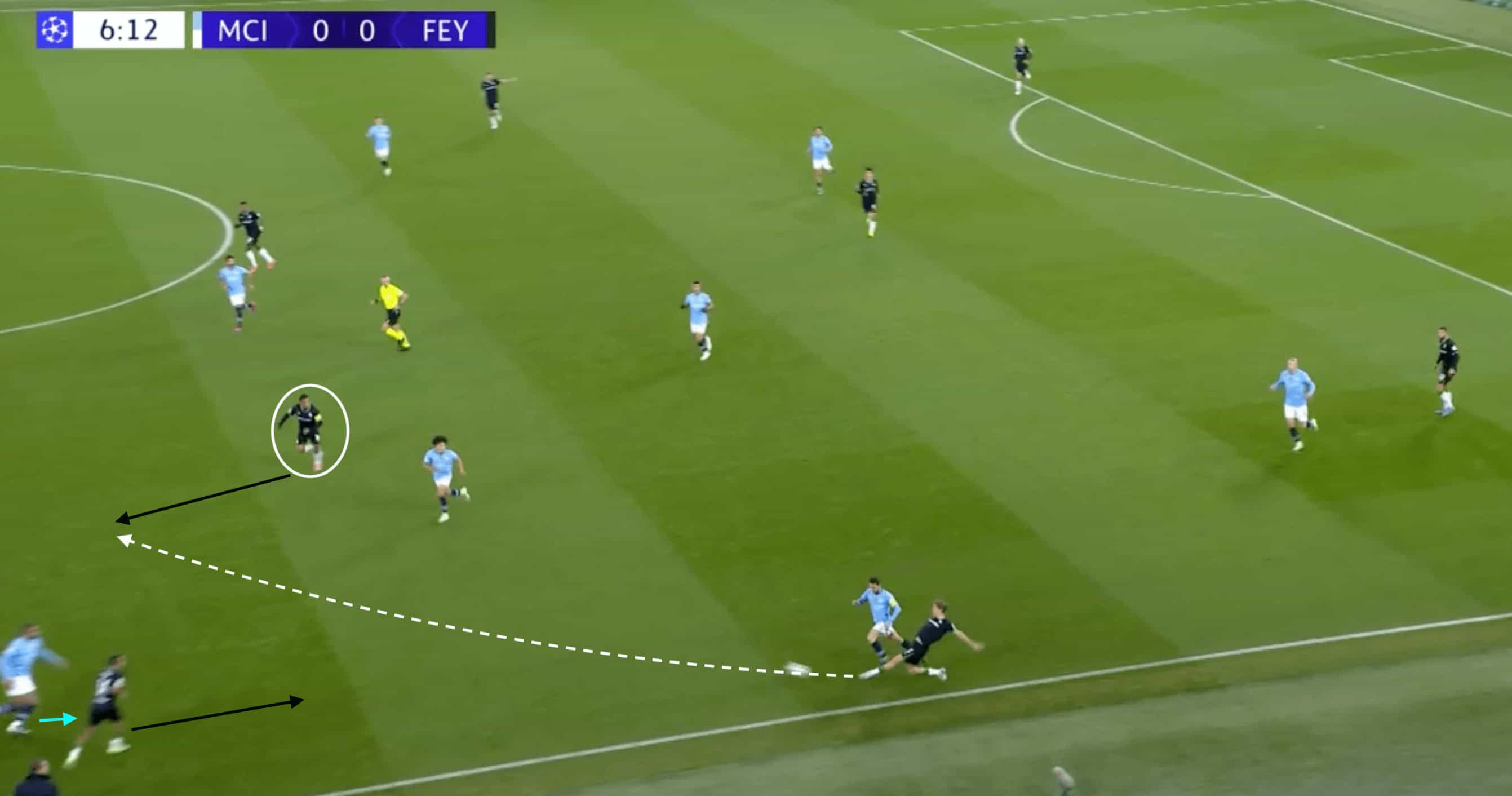
As Akanji had also stepped forward to track Paixão, Feyenoord was allowed to craft an excellent 3v2 attacking move in transition, which was only disrupted by an energetic recovery from Gvardiol.
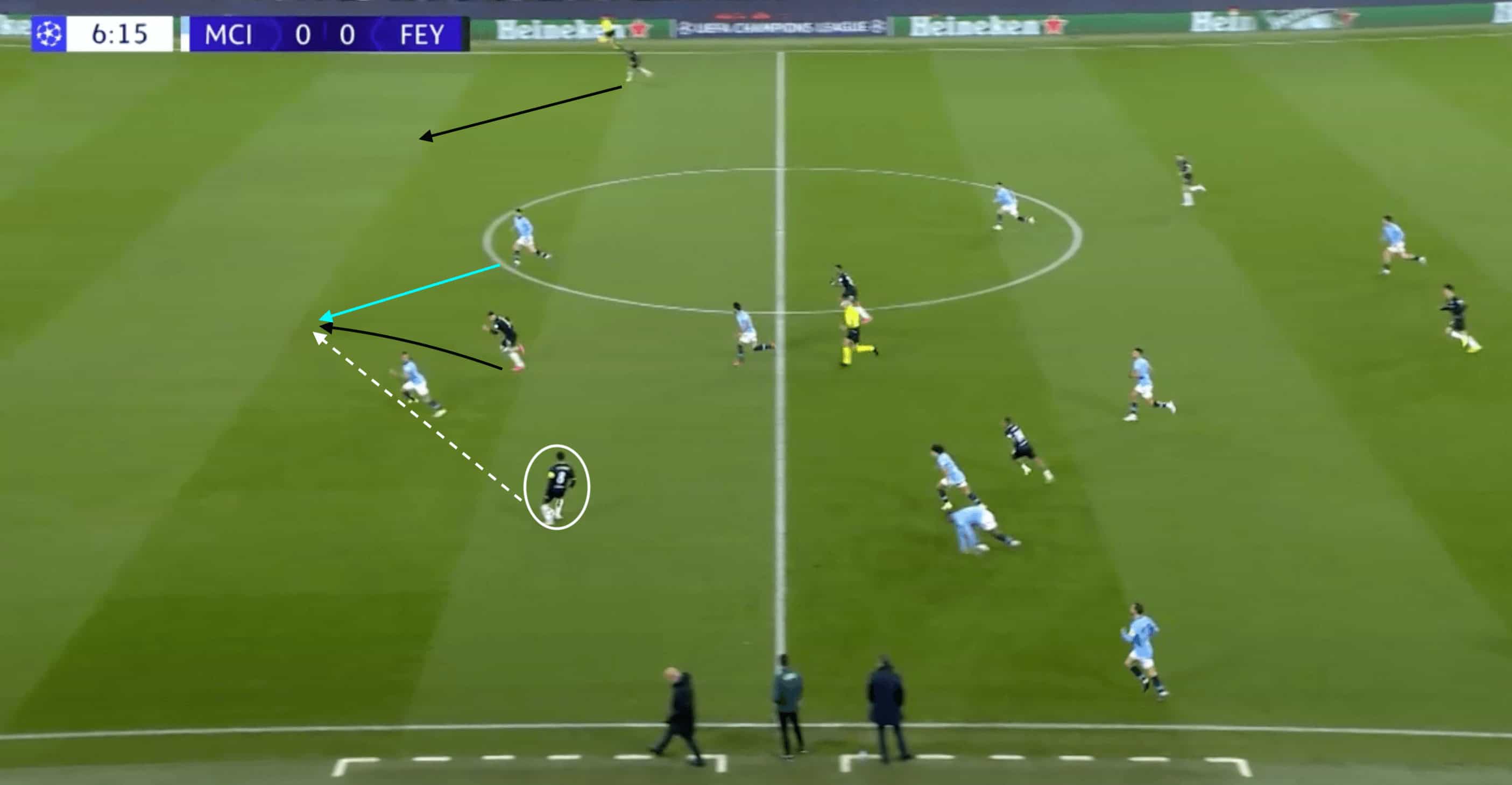
City weren’t so fortunate in the match’s final minutes, as the previously mentioned inexperience came in the form of youngsters McAtee and Simpson-Pusey.
With Gvardiol looking to jump out and deny Hadj-Moussa the opportunity to play the long pass in behind, City were caught on their heels with five Feyenoord players waiting to dart beyond the unbalanced and overly advanced defensive line.
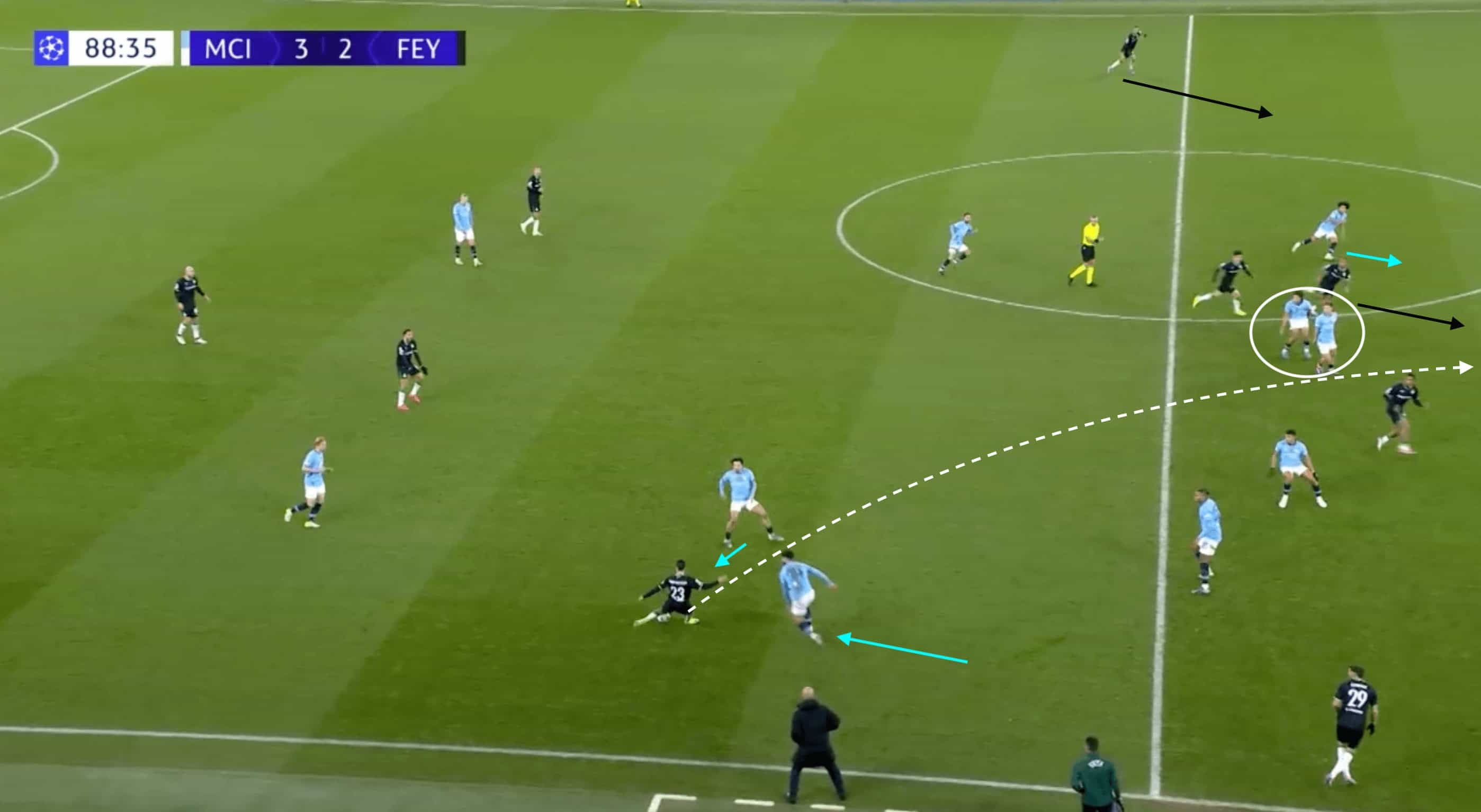
Simpson-Pusey and McAtee appeared to be occupying the same defensive area, leaving Paixão free to stride in behind and round the onrushing Ederson.
The damning part for Manchester City was the movement of Hancko at the top of the image, running into the penalty area on the blindside of Lewis to nod home a huge equaliser as Paixão delivered a smart cross.
Another messy defensive sequence resulted in the hosts’ conceding an avoidable goal, capping off a fine Feyenoord comeback in the space of 15 minutes.
Conclusion
What feels like another defeat for Manchester City left Pep Guardiola extremely perplexed.
It feels as though the current Man City side are clearly hampered by a lack of energy and plagued by the loss of key components to the Guardiola system.
The nature in which they are conceding goals is definitely a worrying sight, but they will still be comforted by their attacking display to race ahead in the first place.
With two tricky away matches against Juventus and PSG on the horizon, it would appear that if Guardiola’s side are unable to put things right quickly, they will have to endure the playoff round on their path to another Champions League success.
It was a resilient performance from Brian Piske’s Feyenoord, who never felt as though they were down and out.
Currently sitting in 21st place, they also look like they are achieving a crucial playoff berth to prolong their European campaign.
