
The early weeks of the English Premier League season have been anything but predictable with all of the pre-season favourites being on the wrong end of surprising results, indeed the fact that Aston Villa go into this match week as the only side with a 100% record is telling. In a normal season, where teams have had the opportunity to plan through a full pre-season, it tends to take around 7-8 matches for the table to settle down. There is a genuine possibility with the early season results that this season could take up to 15 matches to fully settle down and for clear patterns to form. To muddy things further, for some at least, this week has seen the resumption of the group stages of the Champions League and Europa League competitions with time between games coming at an even greater premium.
This is the context that surrouds the upcoming match between Manchester United and Chelsea, two sides that finished in the top-4 last season and were tipped to do so again this season.
It is interesting to view the differences in the way that the two sides apporached the summer transfer window after their qualification for the Champions League this season. Chelsea were somewhat opportunistic in their signings of Timo Werner and Kai Havertz as the effects of COVID on club finances contributed to expected moves to Liverpool and Bayern Munich respectively falling through. They added more creativity with the mercurial Hakim Ziyech from Ajax and solidified their defensive options with the signings of Thiago Silva, at centre-back, and Edouard Mendy in goal. Manchester United, on the other hand, saw a hugely drawn our move for Jadon Sancho fail to materialise while Donny van de Beek signed to offer midfield options and late business saw the likes of Alex Telles, at left-back, and Edison Cavani, in attack, added.
Those transfers have changed the dynamic of each squad and the early matches this season have seen Frank Lampard and Ole Gunnar Solskjær attempting to find the right system to make the most of the players at their disposal.
Now, with both sides having played their opening fixture in the Champions League a picture is starting to emerge of what we may expect to see in this upcoming fixture. This tactical analysis is designed to give an insight into what we may see from each team tactically and how this will work against the other side. We will provide an analysis of the tactics we expect to see from each side.
Manchester United and the 3-4-3
I was recently on the Two Footed Podcast, part of the EPL Index group, with the excellent Dave Hendrick and we were discussing the decision by Manchester United to sign Alex Telles from Porto. On that podcast, we agreed that the signing presented an opportunity for Solskjær to pivot to a tactical system that is more of a 3-4-3 with Luke Shaw being able to move inside to play as the left-sided central defender. This is a role that Shaw had played at points last season and in which he looked comfortable. The ability of United to then transition from a back 3 to a back 4, with Shaw, stepping forward in the attacking phase would provide tactical balance and the opportunity to build attacking overloads in wide areas or the half-space.
In the 2-1 away win over Paris Saint-Germain we saw United utilise a variation of this 3-4-3 in a structure that played more like a 3-4-1-2 with the Portuguese international Bruno Fernandes playing behind a front two of Anthony Martial and Marcus Rashford. The attacking variations available in this structure are very interesting and appear to play to the strengths of the United squad. This is especially evident when United are building out from the back.

In the image above we see an example of the structure that United had in possession against PSG. As Luke Shaw receives the ball he has split wide into the half-space. There is an immediate passing option with Alex Telles on the touchline and he has dragged a defensive player out with him. There is a secondary option as one of the two strikers has moved across to position himself in on an advanced line in the half-space. The third passing option is created by the width generated by the front two who have split apart and occupied defensive players. This spacing creates a gap in the defensive line that can be accessed by Bruno Fernandes, from the 10 position, making a timed vertical run.
These options are all vertical and present interesting options for United to play quick passing combinations that give the option of breaking through the Chelsea defensive block. This is particularly true as we expect Chelsea to use a 4-2-3-1 structure in which there tends to be space that can be exploited between the lines of defence and midfield when Chelsea are in the defensive phase.
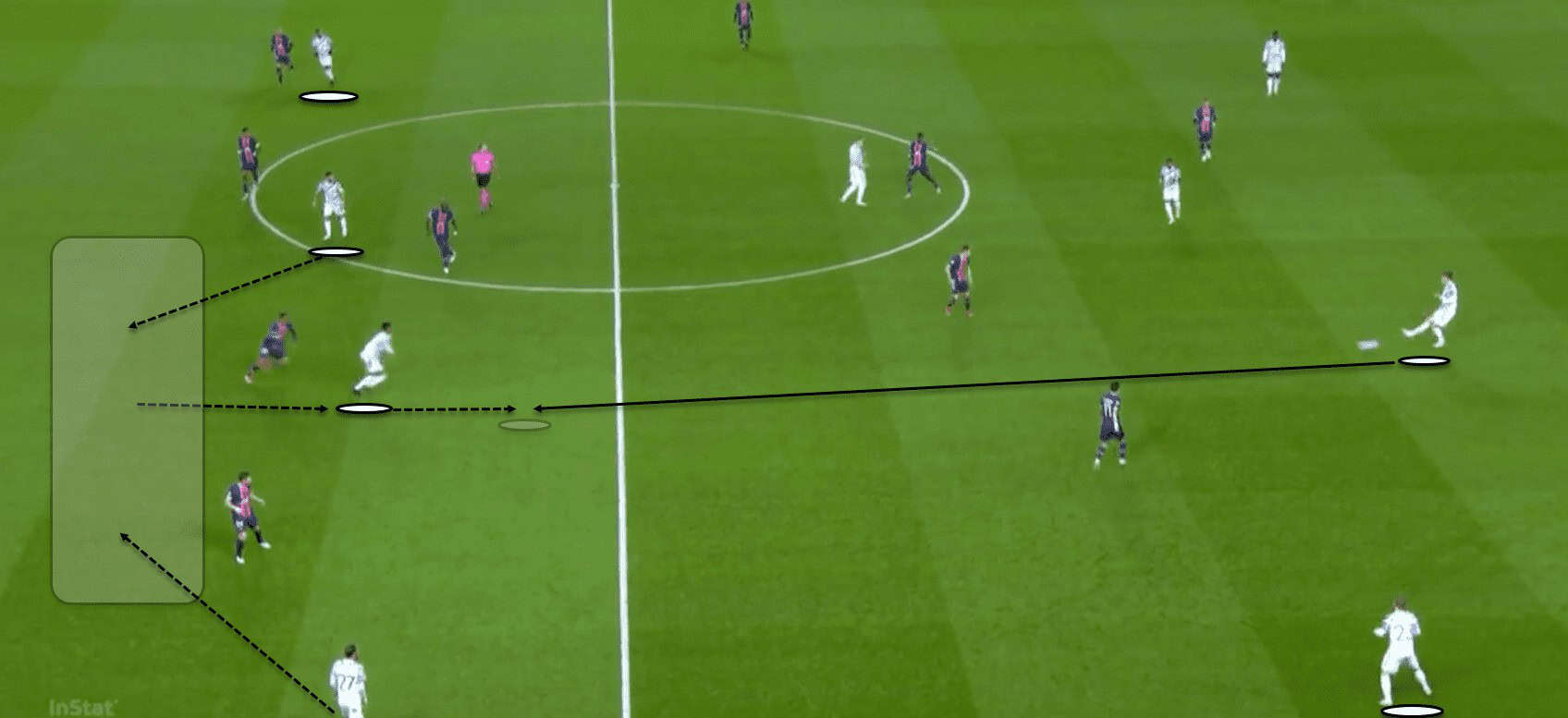
This time we see a slightly different angle for the progression of the ball as Victor Lindelof, playing in the centre of the back three, has possession of the ball. As a note it is entirely possible that this is the position that we would see Harry Maguire occupy should he be available for the match. While the ball can be played out to Shaw, on the left-hand side, his positioning has split the three PSG attackers on the first line and Lindelof has a passing lane through which he can play a vertical pass. As the forward comes back towards the ball he pulls the PSG defender with him and this creates crucial space in the PSG defensive line. This space can be accessed via diagonal runs from Telles, from the wide-area, or Fernandes, from the centre of the pitch.
This is particularly important should Chelsea choose to start with the experienced Thiago Silva as the right-sided central defender. Although the Brazilian international is vastly experienced he can be exposed by pace when he is asked to play in a high defensive line in this manner. With Martial still unavailable in the match expect Mason Greenwood to slot into that position.
Indeed, we should probably consider the ways in which these passing combinations can be used against the 4-2-3-1 structure that Lampard is expected to use.

Here we have a potential scene in the build-up from which United can use Shaw to progress the ball. In their Champions League match against Sevilla, the 3-1 from Chelsea were Christian Pulisic, Kai Havertz, Mason Mount and then Timo Werner. The three players behind Werner were narrow for the majority of the game and this allows for the opportunity that Shaw and possible Axel Tuanzebe at right centre-back will have time in which they can find vertical passes to progress the ball.
In this example, as Shaw receives the ball I have identified four potential lanes through which the ball could move. As the ball comes out to Shaw there are two immediate reactions that are likely from Chelsea, an advanced midfielder will move to press the ball and the right-back (probably Reece James) will move tighter to Alex Telles. The first passing option I have identified is an easy pass outside to Telles on that line. The second option is into the space behind the right-back, who has moved tighter, and this pass to either Martial or Rashford is especially interesting as their pace can isolate and beat Thiago Silva. The third option is into the space between the two central defenders where the far side attacker can attack diagonally. the fourth immediate option is into the feet of Bruno Fernandes. These four options and passing lanes are just a selection of the options that will be available from the 3-4-1-2 against the 4-2-3-1 structure.
Finally, it is worth talking about the performance of the United attackers against the ball as they prevented PSG from having comfortable possession as they built from the back.
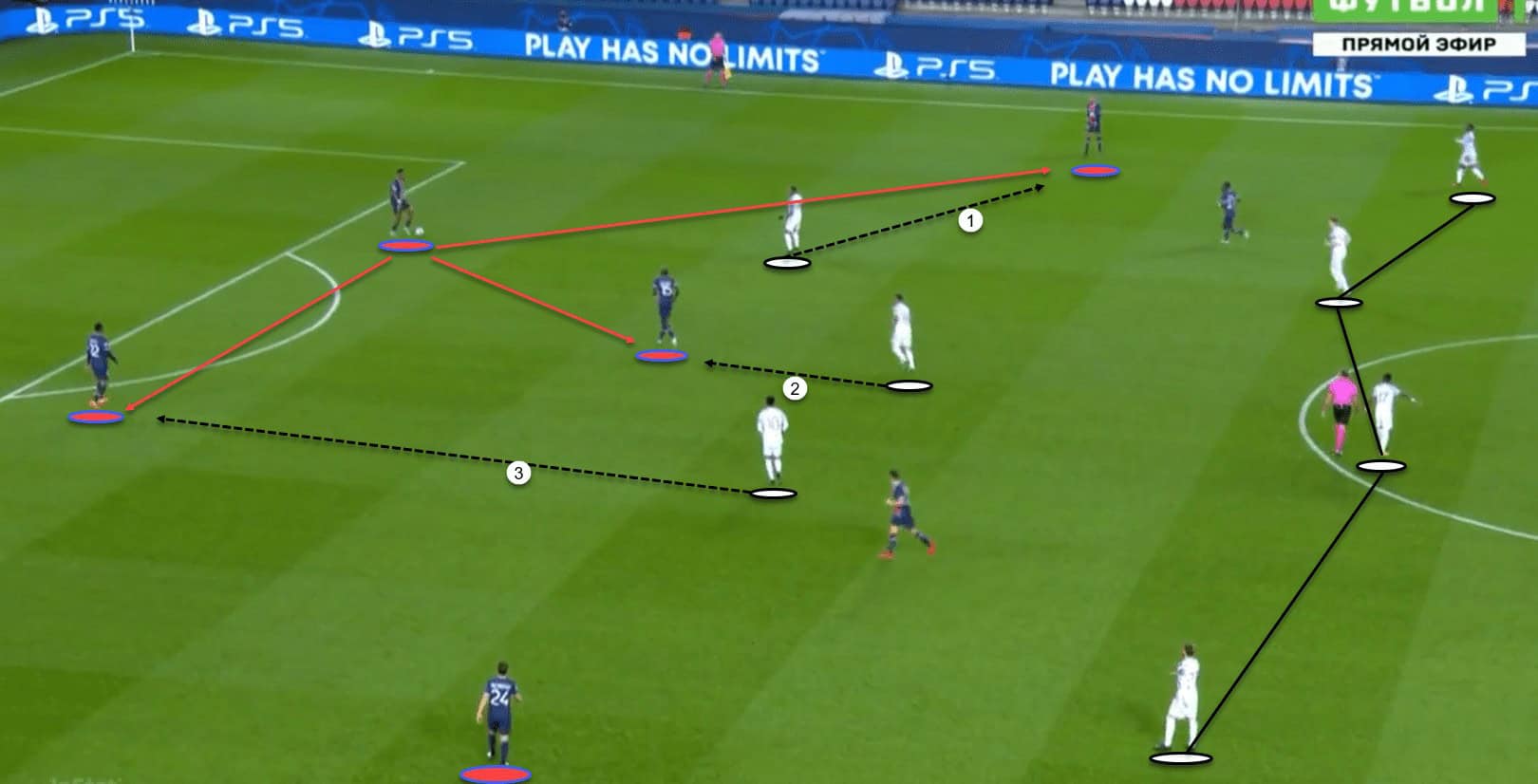
Out of possession Martial, Fernandes and Rashford held relatively high positions and had specific zones in which they would engage the ball carrier or receiver. If the ball went wide from this position then option 1 would see Martial press the ball, if it moved centrally then option 2 saw Fernandes press and option 3, to the near side, saw Rashford move to engage.
Against Chelsea, the picture is slightly different and we could see Bruno Fernandes in a more deep position as he looks to split the likely double pivot of Chelsea (Jorginho and N’golo Kante) to prevent comfortable ball progression.
Chelsea’s issues within the 4-2-3-1
One of the biggest problems that faced Frank Lampard at the start of this season, and one that he has not fully solved, was how to fit the new attacking talent into the Chelsea side in a cohesive manner. So far Chelsea have almost exclusively used a 4-2-3-1 with Timo Werner playing either as the 9 or on the left-hand side and Kai Havertz as the 10 or from the right. So far they have failed to settle into the system but perhaps for good reason. At RB Leipzig Werner excelled as the second striker with a tendency to drift out to the left-hand side before exploding through diagonal runs towards the penalty area. He did, after all, first breakthrough at first-team level with VfB Stuttgart as a left-winger. So far as a lone forward there have been flashes of promise but relatively little end product.
If Werner is difficult to define as a forward player then Kai Havertz is another matter entirely. He can play comfortably as an 8, a 10, a wide attacker or even as a 9 and to an extent this versatility has made it difficult for Lampard to decide on how best to use the young German international. In recent matches, it looks as though Lampard as settled on using Havertz in the traditional 10 role but the two wide attackers tend to play relatively narrow, with width provided from full-back.
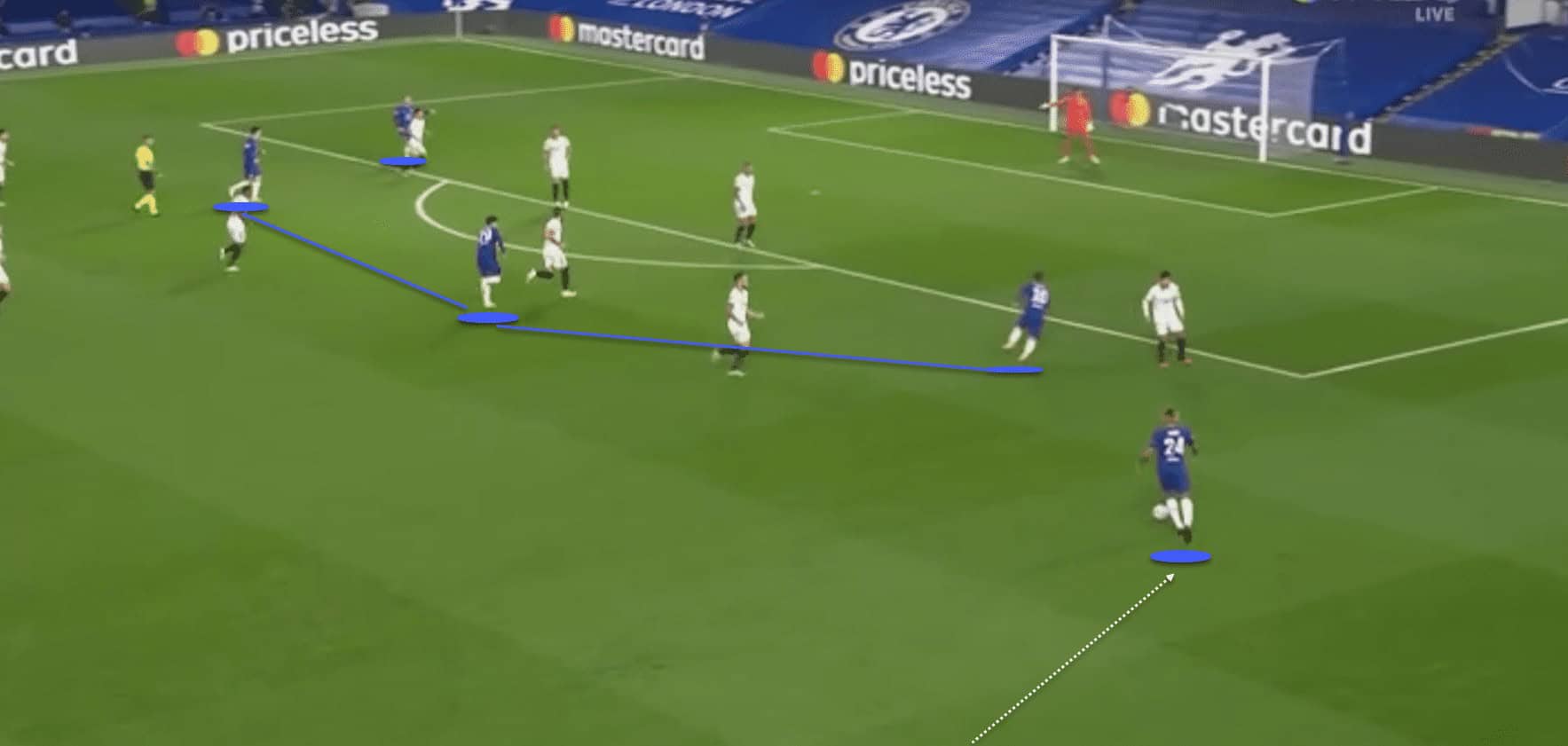
One of the problems that we saw from that midfield three in the recent Champions League match against Sevilla was that they were relatively one dimensional in terms of their movements and the spaces that they occupied. We see an example of this in the image above with Reece James advancing in possession on the right-hand side. Timo Werner is positioned away from the ball but Havertz, Mount and Pulisic are all on the same line looking to make the same movements.
In this situation, it would be better if there were more varied movements from the three advanced midfielders. Having one player move towards the ball, for instance, would provide an option to move the ball to a different angle. This could be especially important against United if they line up in the 3-4-1-2 where there could be gaps between the lines of defence and midfield.
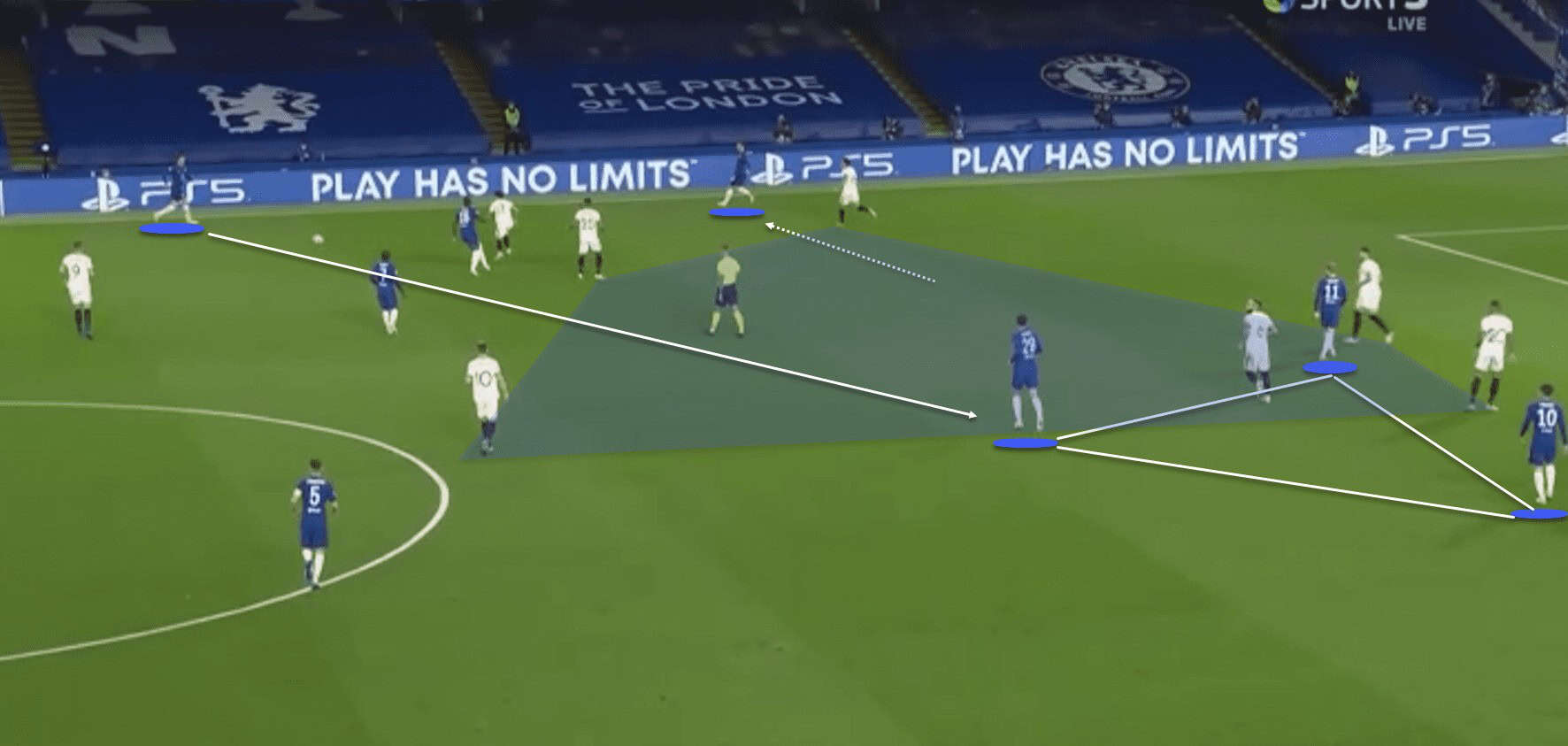
Havertz can provide this as we see in the image above. This time the ball is progressing down the left-hand side and the structure of the advanced midfield three is slightly different. Once again Pulisic (10) is narrow and Havertz and Werner are also positioned in close proximity centrally. This time Mason Mount has moved outside to provide width but the passing lane is opened up to access Kai Havertz centrally.
This could be a key passing route for Chelsea to access the final third.

Against United, we could see Havertz access space in the structure we have above. As the ball is played out to the right-hand side where James has moved into a high position we could well see Havertz position himself between the lines. In this kind of area, Havertz would provide an option to quickly narrow the angle of the attack when moving inside.
Werner tends to position himself away from the ball and this creates space for Havertz, especially if whoever plays as the wide right attacker is narrow and positioned on Shaw. There is an option for United to rotate and cover the threat with Tuanzebe moving on to Werner and Lindelof/Maguire moving on to the right-sided attacking midfielder. This would then free up the opportunity for Shaw to rotate out to cover the threat of Havertz.
The narrow positions of the attacking midfielder mean that the two fullbacks for Chelsea have to continuously move high in the attacking phase to provide the width and stretch the opposition defensive block horizontally. This does, of course, lead to potential issues with the Chelsea central defenders then potentially being exposed. Especially by attacking players with pace, which United, of course, have in abundance.
Conclusion
While it can be interesting and illustrative to discuss the potential tactical systems for clubs before a big game all of these thoughts could go out of the window as the game state changes on the first goal.
If Solskjær holds his nerve and continues with the 3-4-1-2 and doesn’t select Paul Pogba then my suspicion is that United will have the edge over their opponents in this match. The attacking threat that Rashford, Greenwood and Fernandes pose will be difficult for Chelsea to defend against effectively. Especially given their lack of pace in the defensive line.
