
So Euro 2020 has officially come to an end and the Italians reign as the champions of Europe.
Across the tournament as a whole, it is difficult to argue that Italy are not deserving champions.
Their coach Roberto Mancini has removed the shackles of tradition that so often surrounded the Italian game and the result was a technically and tactically interesting team that impressed with their attacking endeavour.
For all that the Italians impressed across the competition as a whole, however, it would be wrong to dismiss the contribution of England.
With a backdrop of accusations that the English had been given an easier schedule as they played all but one of their matches at ‘home’ at Wembley Stadium and surrounded by the increasing excitement of a fan base that believed they were ready to win their second major trophy, we saw an England team emerge that was actually likeable.
Raheem Sterling was reborn after a difficult season at Manchester City.
Kalvin Phillips and Declan Rice prowled the midfield with intelligence that belied their relative inexperience at this level, and Luke Shaw seemingly completed his redemption arc following a difficult period of injury and low confidence.
From a purely tactical perspective, the final was an intriguing prospect, albeit one that was possibly ruined when Luke Shaw met a Kieran Trippier cross in the second minute to fire low into the Italian net.
The English coach Gareth Southgate had acted first with a change of system coming into this match that saw England line up in a 3-4-3 against the regular 4-3-3 of the Italians.
On paper,t the systems should have afforded England a slight advantage centrally, where all three central defenders are comfortable in possession and capable of stepping into midfield.
At the same time, the Italians would have the advantage 2v1 in the wide areas.
That would have been the case had the effervescent candidate for player of the tournament Leonardo Spinazzola not succumbed to a terrible injury against Belgium.
Instead, however, we saw Roberto Mancini line up with Emerson Palmieri, of Chelsea, at left-back and Giovanni Di Lorenzo, of Napoli, at right-back.
Neither fullback was confident from the start in supporting the attack.
As such, the English wingbacks were comfortable defending 1v1 with support from the wide central defenders as the Italian attack stalled.
In the end, the early goal, and the resulting outpouring of emotion from the stands, seemed to freeze the English.
There was a sense in the first 20 minutes especially that England could have scored one or two more goals and taken a firm hold on the final.
Instead, the English dropped deeper.
They started to defend in a medium to low block, and it became common to see 11 English players behind the ball as the Italians struggled to penetrate the compact defensive block.
Roberto Mancini, though, is too intelligent a tactician to allow this to become the established pattern of the match.
In the second half, we saw the Italians make a key tactical change that shifted the momentum of the match decisively in favour of the Italians.
This is the tactical story of the match.
Italy Vs England Lineups

As previously mentioned the Italians retained faith with their 4-3-3 structure.
In Leonardo Bonucci and Giorgio Chiellini, they had a central defensive partnership that was forged in club football with each player knowing the other’s tendencies and movements inside and out.
The fullbacks for the Italians were the weak points of the team but the midfield of Jorginho, Nicolo Barella and Marco Verratti provided balance and steel.
In the attack, Ciro Immobile had led the line for the entire tournament but only really impressed in flashes while Lorenzo Insigne was a constant threat from the left.
It was on the right that Italy hoped to have their difference maker as Federico Chiesa had emerged as one of the stars of the tournament.
For England they started with a back three with the versatile Kyle Walker converted to play on the right of the defence.
Walker, along with John Stones and Harry Maguire all had the ability to step forward in possession or to find line-breaking passes that progress the ball through the thirds.
We saw Kieran Tripper recalled to play as a wing-back on the right while Luke Shaw patrolled the left.
In the centre of midfield, Declan Rice and Kalvin Phillips provided a blend of intelligence and composure while both being able to provide aggression when needed.
Mason Mount and Raheem Sterling were positioned behind Harry Kane.
England Start By Exploiting Wide Areas
There was an element of risk vs reward for the English in the opening stages of this match as they looked to exploit the wide areas.
The Italians looked to leave their wide forwards high to look for moments of transition that would see them able to attack 1v1 against the wide central defenders for England.
This meant, however, that the English were able to create moments of overload with their wingbacks moving high and taking advantage of space in the Italian defensive line.
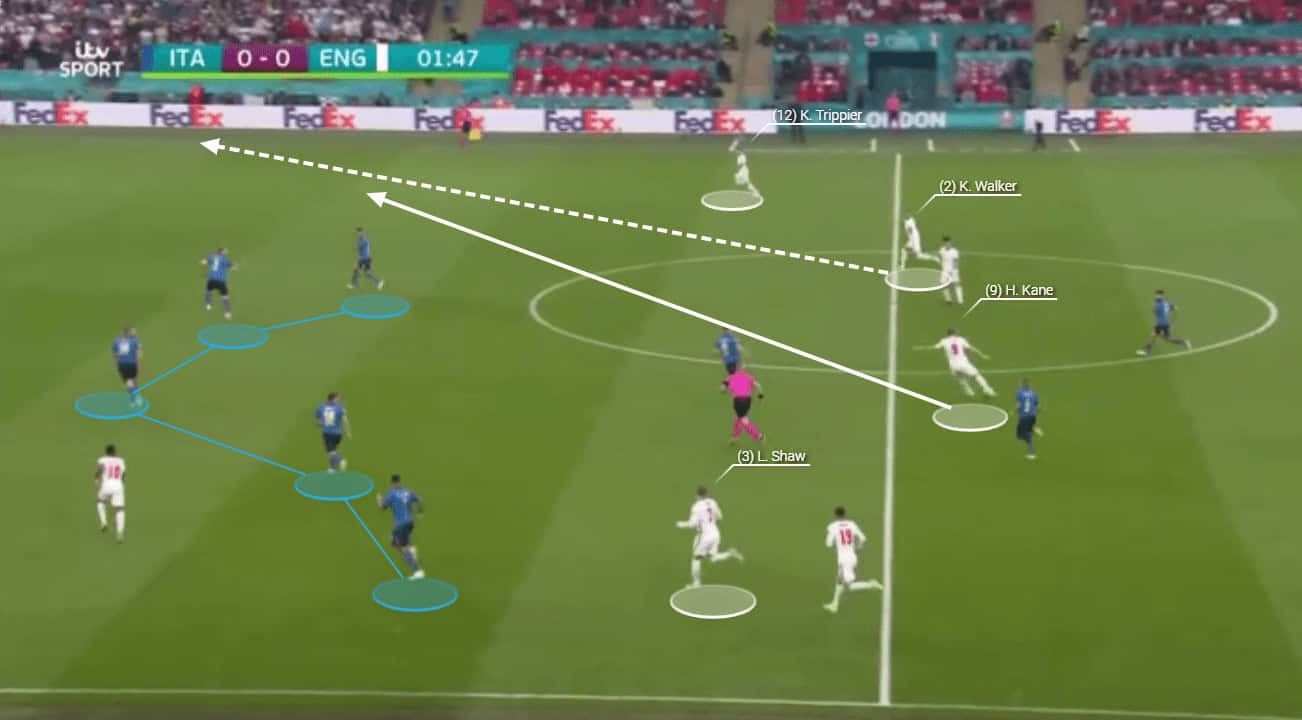
This moment is captured from the build-up to the opening goal for the English and actually comes in transition from a corner kick for the Italians.
The player in possession, having picked up possession of the ball deep inside his own half was the English centre forward Harry Kane and indeed this positioning from the English talisman became a constant feature of the match as it developed.
From this position the Italian defensive structure was poorly positioned but Kane was still intelligent enough to play to the space on the far side and to release Kieran Tripper.
It was the movement from Kyle Walker, from RCB, that created the opportunity for the goal though as Walker took a long run outside of Trippier and pulled Emerson out to prevent him engaging the ball properly.
You can also see in this image the starting position from this pass of Luke Shaw as he made a run to arrive unmarked and in space at the far post to finish the move.

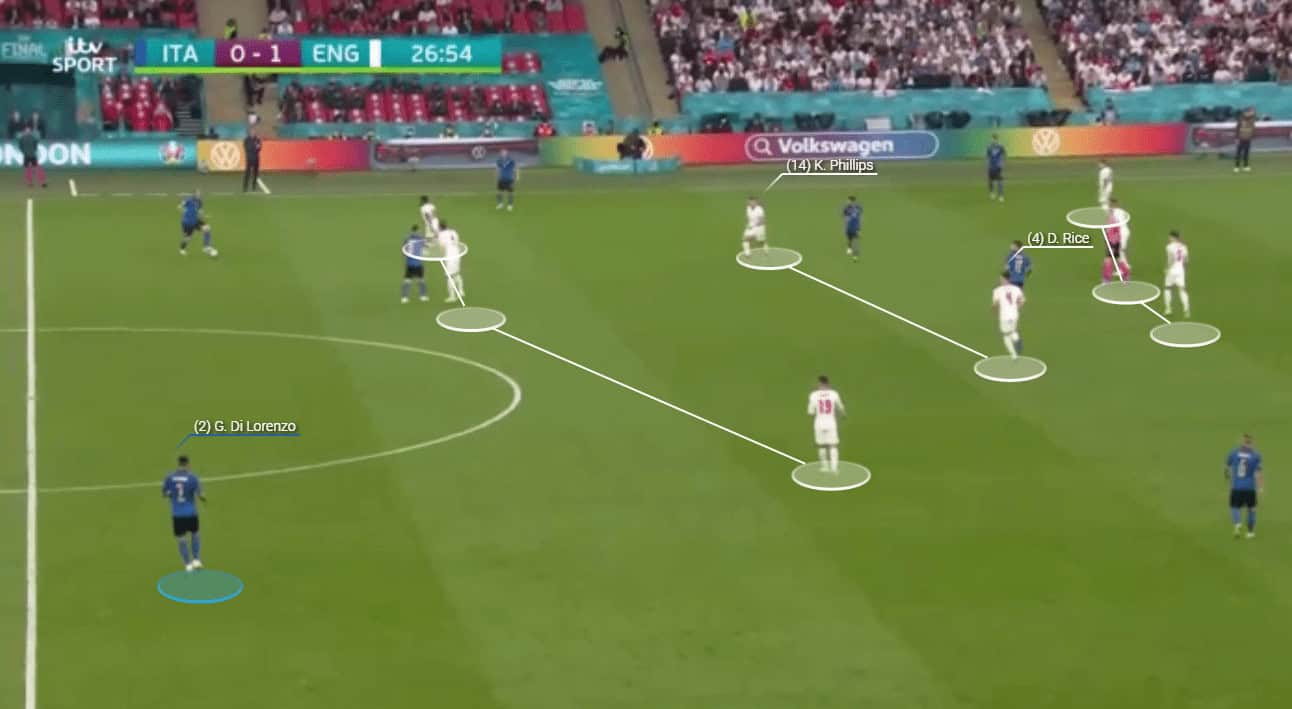
A similar situation here albeit with Italy in a more structured and organised defensive block.
Before talking about the phase of play shown though there are some positional notes to mention.
First of all look at how high Kyle Walker was as he played the pass that broke the defensive line of the Italians.
Harry Maguire is almost as high on the other side.
Harry Kane, however, is extremely deep and is not in a position here to easily access and threaten the penalty area.
It is the pass from Waker and movement from Trippier here that was key though.
Trippier is positioned outside and Emerson is completely isolated and pinned.
One quality through pass was enough for England to outplay the Italian defensive line and move into a dangerous area.
This was the point of the game where England were still well on top, and when they had real momentum, that should have led to them being able to create another breakthrough to score a second goal.
The positioning of Kane, however, started to become a problem for England as the first half went on.
He was superb at holding the ball and interlinking with teammates in deeper areas but England needed him to be doing that from a position 15-20 yards higher up the pitch in order to allow them to build out and towards a reference player centrally.
This was the start to England playing deeper and deeper.
England Defend In A Low Block
As the first half of the match progressed, we started to see the English drop deeper and deeper into a low to medium defensive block that challenged the Italians to find a way to break through.
Unfortunately, this defensive shift from England also limited their ability to attack effectively in transition or to turn the Italians around to exploit the space behind their defensive line.
The Italians were too passive at this point as they retained both Jorginho and Verratti in deeper areas instead of moving one of them higher to disrupt the double pivot in the English midfield.
Here, we start to see how deep the defensive block for the English was dropping as the Italians were in their build-up phase.
It is at this point that the tendencies of the Italian fullbacks, and especially Di Lorenzo on the right, became clear.
There were opportunities to attack the English block along the outside, where both Insigne and Chiesa are comfortable drifting inside to the half-spaces and disrupting the positioning of the English wingbacks.
This would only be effective, however, if the Italian wingbacks moved to a high line in order to provide width and stretch the English defenders.
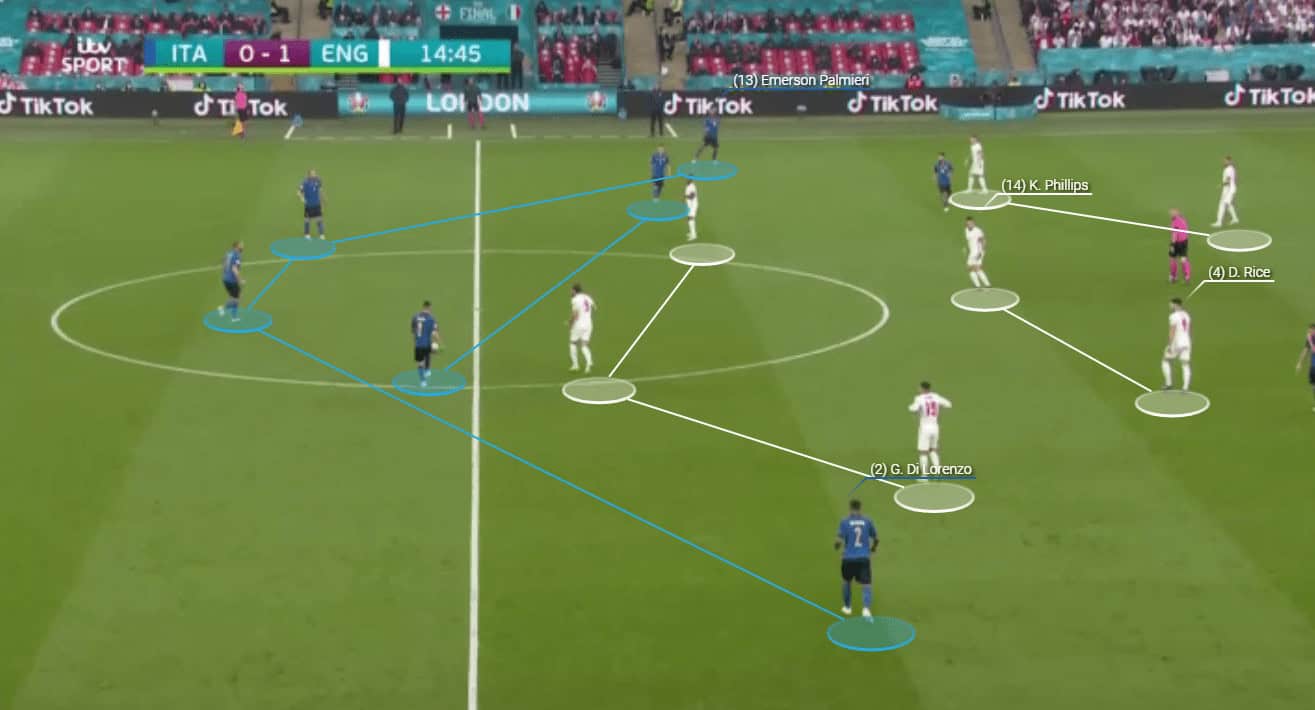
The lack of height from the Italian wingbacks, when combined with the likes of Jorginho and Verratti looking to play and receive in front of the English defensive block meant that the Italians really struggled to find genuine moments of penetration.
You can see in this image that the Italian midfield block, Barella aside, is sitting deep and not disrupting the English double pivot or Rice and Phillips at all.
These two players for England displayed tactical discipline throughout the match, with Rice in particular dominating his area of the pitch.
On those occasions when the Italians did find a pocket to break the first line with a player behind the English forwards then we would see Phillips move aggressively to snap into a challenge and prevent the Italians from having comfortable penetration and possession in these areas.
From this point in the game the English were comfortable with the game state and when defending in this manner.
The onus was on the Italians and their coaching staff to find a way to change the game state.
They did so with a key tactical change in the second half.
The Italians Disrupt The Game
Roberto Mancini found the key to unlocking the match in the 55th minute as he made a double substitution.
The Roma midfielder Bryan Cristante came on for Nicola Barella, who had been booked, but the ineffectual Ciro Immobile was also replaced by the Sassuolo forward Domenico Berardi.
This attacking change saw Berardi position himself on the right, where he likes to attack inside on his left foot, while Chiesa switched to the left and Lorenzo Insigne moved centrally.
The diminutive Insigne would never be a threat aerially or when playing right against the English central defenders but he was capable of finding pockets of space behind the English pivots in which he could receive the ball.
From this point, the Italians started to fully control the game with their game intelligence and technical ability allowing them to play through the English block almost at will.
For almost the entirety of the second half the pattern of the game was set.
The Italians passed and probed while the English worked hard against the ball and chased shadows.
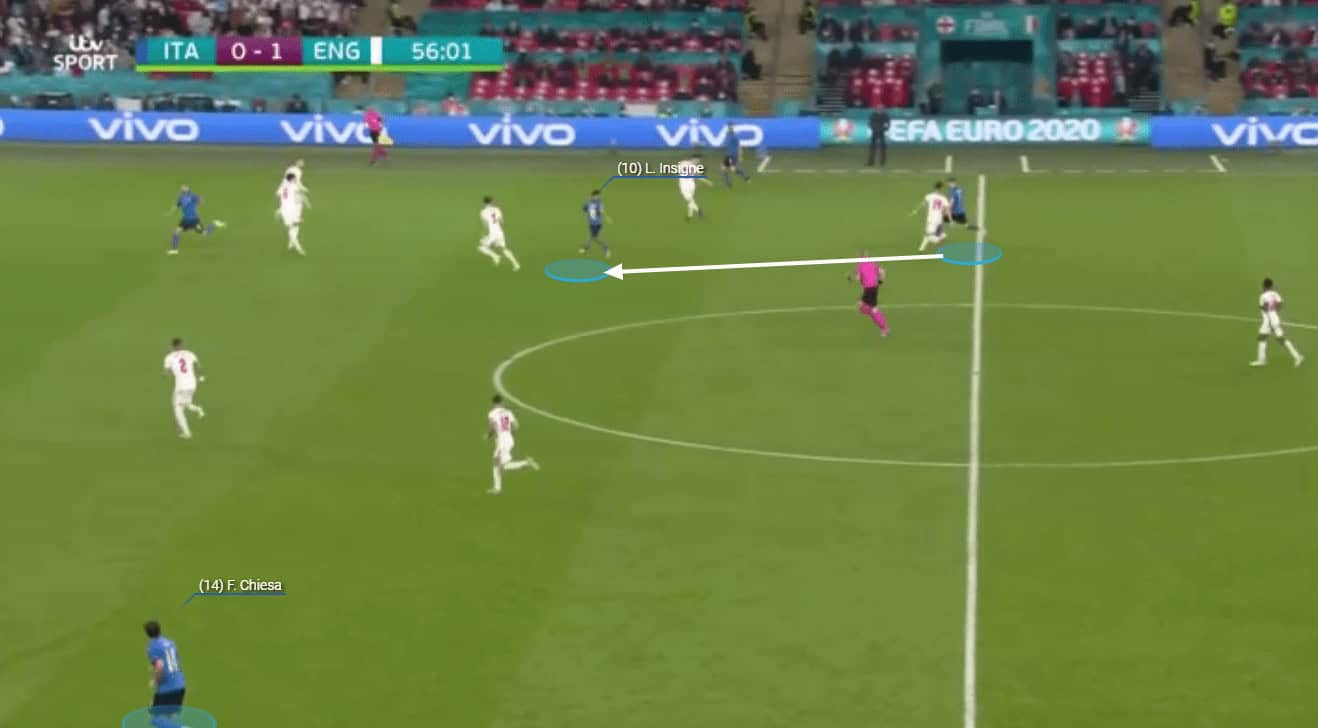
While in the first half the English defensive line was comfortable covering Immobile as he looked to position himself on their shoulders to look for an opportunity to run in behind the movement of Insigne in central spaces provided an entirely more difficult challenge.
Whether moving from deep to receive in pockets between the lines or when moving back from a fixed forward position to receive the ball at feet we saw the movement profile from Insigne begin to allow the Italians to penetrate centrally before moving forward as a block in order to occupy higher positions.
Here we see the Italians attacking in a moment of transition where Insigne drives forward to receive and then play in the central space.
This allows the Italians to retain possession in dangerous spaces.
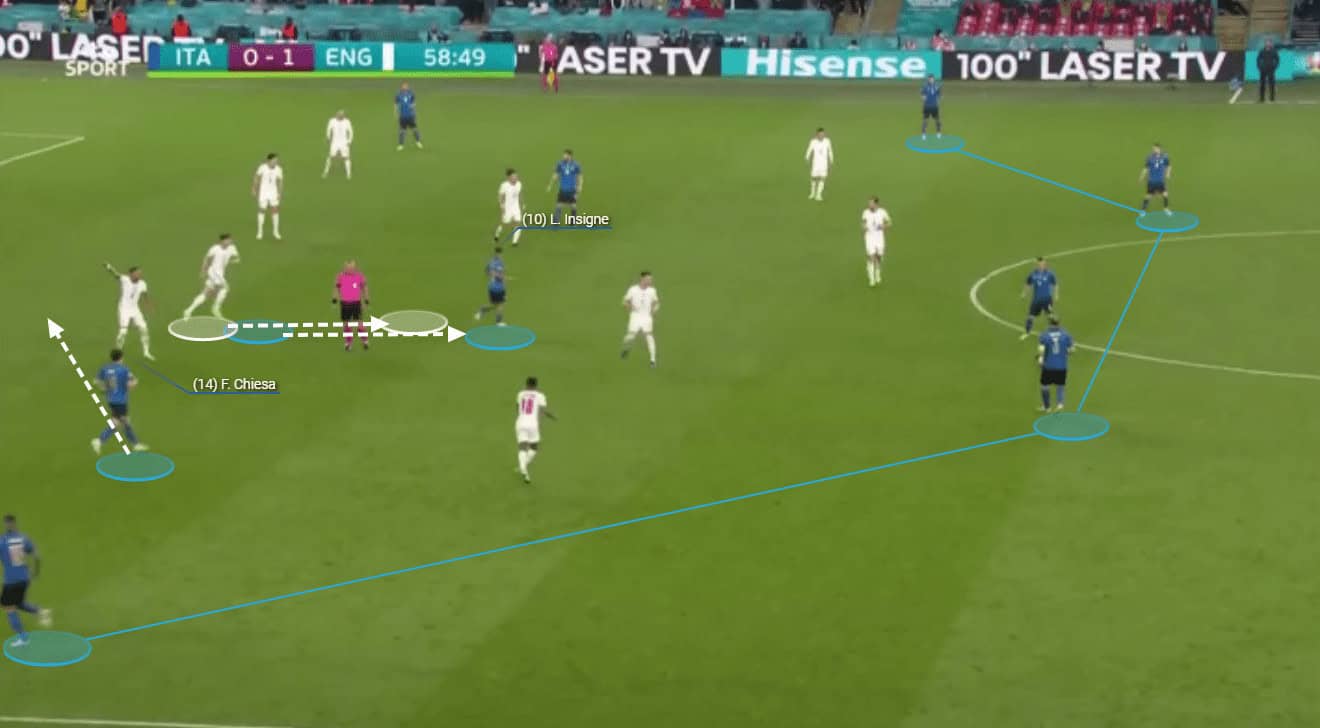
This time we see Insigne moving back towards the ball as the English were defending in a deep and compact defensive block and the Italians were in possession on their first line.
The movement from Insigne back to take up a pocket of space behind the midfield line of England.
This deep movement immediately disrupts the central defenders for England, and we saw Harry Maguire move to follow the run as he understood the danger that Insigne was posing to the English defensive structure.
You can also see that Kyle Walker has recognised that he is in trouble with two Italian players outside him.
As Insigne drops off and as Maguire drops to follow, this is a cue for Chiesa to make a diagonal attacking run to break beyond the defence.
These movement profiles and patterns began to pose England more and more problems as the Italians probed for a way to break through their block.
Conclusion
The early goal killed the game for me.
What would have been a fascinating battle between the two teams became a nervy match with the English dropping and playing passively as they tried to defend a lead that would prove elusive as the match wore on.
It was here that the difference in quality from a tactical perspective became evident.
While Gareth Southgate appeared indecisive in his decision-making, we saw Roberto Mancini make decisive changes that shifted the momentum of the match and shifted the game state clearly and decisively in favour of the Italians.
