
Following a historic promotion which ended a 15-year wait to return to the top flight, FCV Dender was gutted to lose the man responsible for it all, Timmy Simmons, who ended his managerial spell at the club to take over at now fellow Jupiler Pro League side Westerlo.
His replacement?
None other than Vincent Euvrard, a man who had also led a side to the top flight when he did so with RWD Molenbeek just 12 months prior.
The former Zulte Waregem manager jumped at the opportunity after just missing out on promotion himself with his former side.
This also gave him a platform to manage for the first time in the Jupiler Pro League, having had several stints in the Challenger Pro League with Leuven, Cercle Brugge, and Geel, as well as the aforementioned Molenbeek and Zulte.
He was uncannily sacked by RWD Molenbeek a week before the start of the season, which meant he was never officially a manager among the top ranks in Belgian club football.
Until now…
It’s been early days into a new season back amongst the big boys in Belgium for Dender, but after four games, they are one of just three sides who have yet to be beaten so far in the league this term.
More surprisingly, they are also, the second highest scoring outfit to date.
This FCV Dender tactical analysis will take a more detailed look at Vincent Euvrard tactics and why it’s been a smooth transition to Belgium’s top level for a club that has been away for a decade and a half.
FCV Dender Attacking Style Under Vincent Euvrard
As alluded to, Dender have started the season as one of the highest-scoring teams in the league, but in their home opener against Royal Union SG, Euvrard set the side up in a more defensive-minded approach with a 5-4-1 diamond system.
The game plan appeared simple: keep it tight at the back and try to get the wing-backs high as quickly as possible or play Bruny Nsimba, the lone striker on the day, in behind the Union defence with an early release or ball over the top.
Aside from an instance in the first half when Nsimba did receive such a ball that led to a goal eventually ruled out for offside, Dender struggled to create anything of note, only amassing a measly three shots in the entire 90 minutes, with none hitting the target.
All three registered attempts came after Euvrard made the decision to make a double switch midway through the second half when he swapped out both Nsimba and Roman Květ, who was playing off him at the tip of the diamond, for Jordy Soladio and Mohamed Berte and going with two strikers up front which seemed to have more potential given the greater threat they posed to the Union defence with their runs and more aggressive approach to the game compared to the original setup.
Euvrard decided to stick with this for the next game away at Gent and brought in Soladio for Květ to partner Nsimba, who was frustratingly stranded on an island throughout his hour on the pitch in the opener, upfront and switching to a 5-3-2 base system.
But the bigger change was the team’s general mindset, which was to be more brave, get on the ball more, and add short, combination plays to their game instead of constantly just looking for the early release long ball in behind, as against Union.
One player who noticeably embodied this change was Joedrick Pupe, the left centre-back of the three-man central defensive line who got on the ball more often and helped progress attacks from a deeper position with powerful runs with the ball, as well as taking up a bigger tactical responsibility in the build-up phase by taking more of a higher starting position as an auxiliary left-back so left wing-back Fabio Ferraro could be freed up to move much higher up the field almost as a winger.
Euvrard also swapped Nathan Rodes with Malcolm Viltard, with the latter taking more of an advanced role as a central midfielder to make better use of his attributes to press higher up the field and get on the ball to link up with others. At the same time, Rodes instead sat deeper as the facilitative pivot of the midfield three.
Roman Květ ended up being the player sacrificed for this particular game, but he eventually found his way back into the team in successive games in the left-sided midfield role, which is a more natural fit for him than playing behind a striker like he did against Union.
The changes from the first game that led to the 5-3-2 system being deployed were hardly tinkered with after that in the games that followed, with Euvrard only opting to change personnel to give different players an opportunity to start but keeping the base approach and always having two outlets up front, which has come to devastating effect with all of their strikers finding their scoring boots early on in the campaign.

In terms of build-up play, Dender have mainly focused on their efforts on playing the ball long upfield and beginning their build-up higher up the pitch in the second phase.
However, on occasions they have attempted to play out from the back, it’s looked mostly like as illustrated above.
Gilles Ruyssen would go out wide from his right centre-back position to offer an option down the right, while David Hrnčár moved high up the field almost in the same line as the forwards.
On the other side, Ferraro would underlap to balance the defensive line in case of transitions as a left-back, while Kobe Cools and Pupe would stay central either side of goalkeeper Michael Verrips to play it short.
Then, when the build-up shifted more towards the left side, it’d be the opposite, with Pupe moving out wide to left-back and Ferraro pushing up, while Hrnčár stayed deeper and Ruyssen tucked in more centrally.
The midfielders would take turns in terms of who would drop into the pivot role to receive a short pass from the back (as Rodes does above) and who would stay further forward to support the attack and be ready to attack second balls or counter press in case they lose possession.
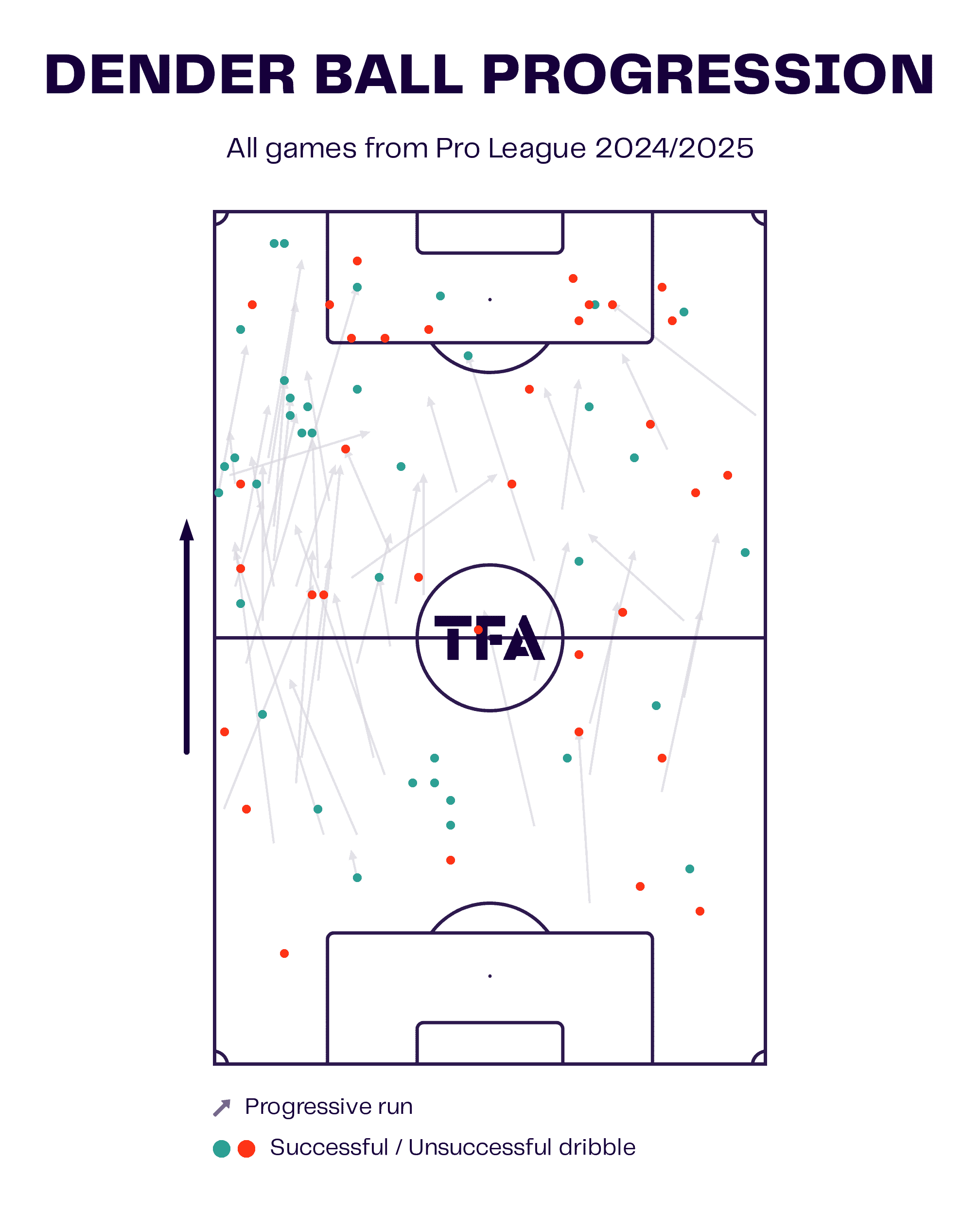
As the above data viz graphic illustrates, Dender’s attacks have been very left-hand-centric this season.
Pupe’s abilities to get on the ball and support the offense have been a big reason why, which Ruyssen on the opposite side is not as skilled at doing.
The number of long balls and switches that make their way towards the left indicates that this is their preferred way of generating attacking opportunities.
Possessing players who are able to dribble and pass in tight quarters has also been a great asset for them, as we can see by the number of successful dribbles versus unsuccessful ones, particularly in the final third.
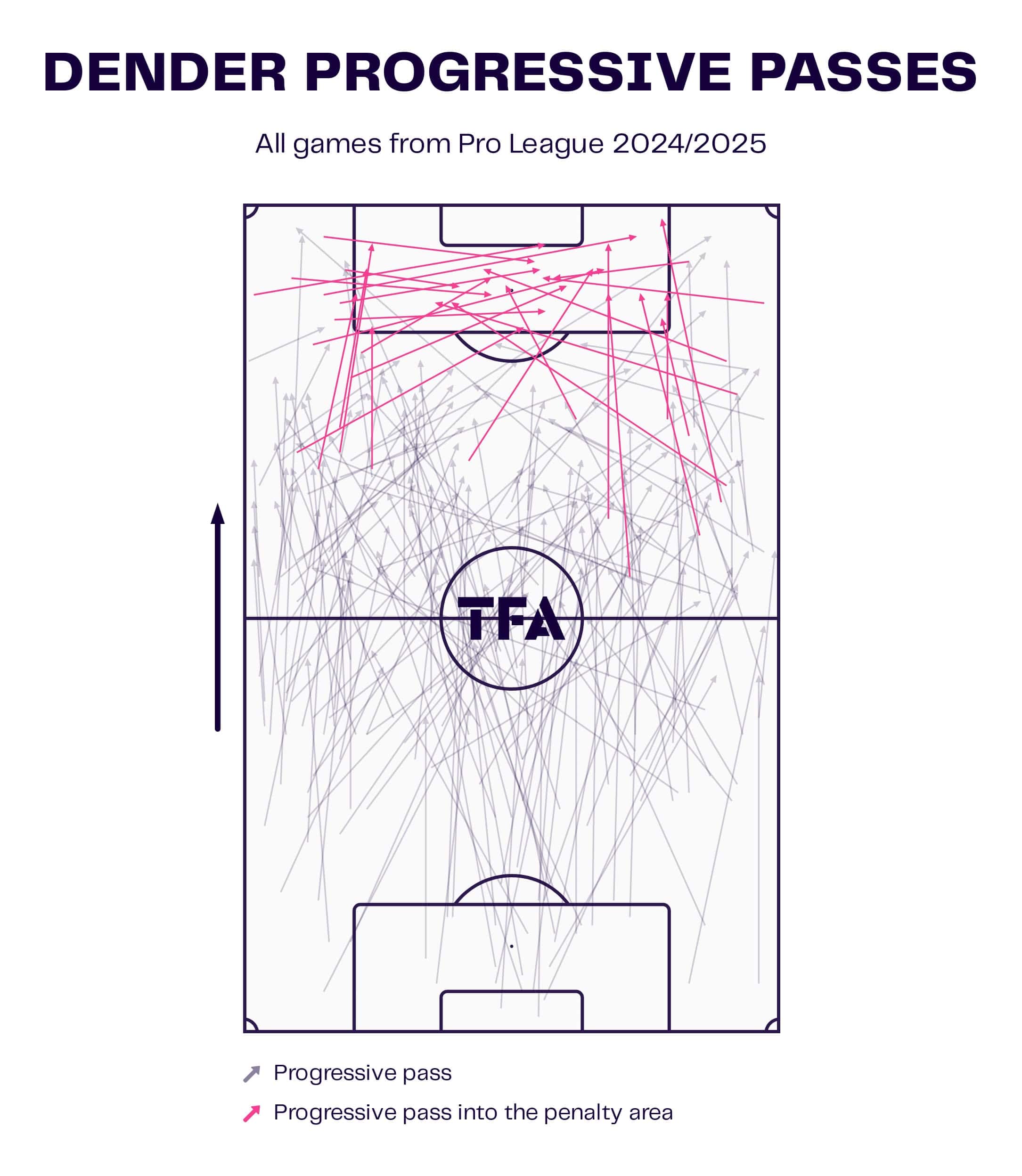
As the data viz graphic above highlights, we can see trends in how and where Dender’s attacks often start from.
As mentioned earlier, their build-up routine consists mostly of long balls from the back to create opportunities higher up the field.
Most of them are quite clearly aimed at the strikers and onrushing wing-backs who move into forward areas as swiftly as possible early on in the build-up phase.
They try to get the ball to the players that can impact the game the most as much as they can, and in this case, it’s the two forwards and two wing-backs, and every goal they’ve scored this season has come from attacks that started in those wide areas.
FCV Dender Defensive Style Under Vincent Euvrard
Defensively, Dender’s general approach is to put an emphasis on man-to-man marking and closing the opposition’s passing lanes, both individually and collectively.
The wing-backs set the tone for how the team shifts to press together, with the near-side wing-back pushing up first, joined by the midfielders and then the wide centre-backs behind him.
They don’t tend to press high up the field, so it’s not quite an aggressive approach like Klopp’s Liverpool in their heyday, but it’s well-organised and, for the most part, well-executed.
The two forwards typically standoff and stay narrow to cut out the central passing options, while the pressing only begins once the opposition is in their half or nearby.
From there, they commit quickly and aggressively to try to win the ball back, which they either do or force the opponent long or backward, as we’ll see below.

In the above illustration against Union SG, we see Ferraro moving out wide to cover the winger after his initial attempt to press and win the ball not being successful, thus freeing up with Pupe to push up and close down the passing option nearby while being joined by Viltard and Rodes who came over to remove any possible passing opportunities and thus forcing Union to go backwards and start their build-up over again.
Small examples like this could be found in every Dender game under Euvrard so far, where the wing-back nearest to the ball pushes up high to press, and the opposite side drops deeper to man mark.
The central midfielders and outside centre-backs join in the pressing efforts to not allow the opposition a moment’s peace or any easy opportunities to pass and turn towards goal, which has led to many regained possessions for Dender.

When it came to defending higher up the field, Dender would adopt a man-to-man coverage approach like in the example above.
As part of their counter pressing strategy, when the opposition had a throw-in in their own half, they would push forward as many men as they could to block out passing options and force their opponents to either throw it long or into crowded areas where they were highly likely to lose it because of their press.
This ended up being one of Dender’s most effective strategies for regaining possession in each of their games, as illustrated by the data viz graphic below.
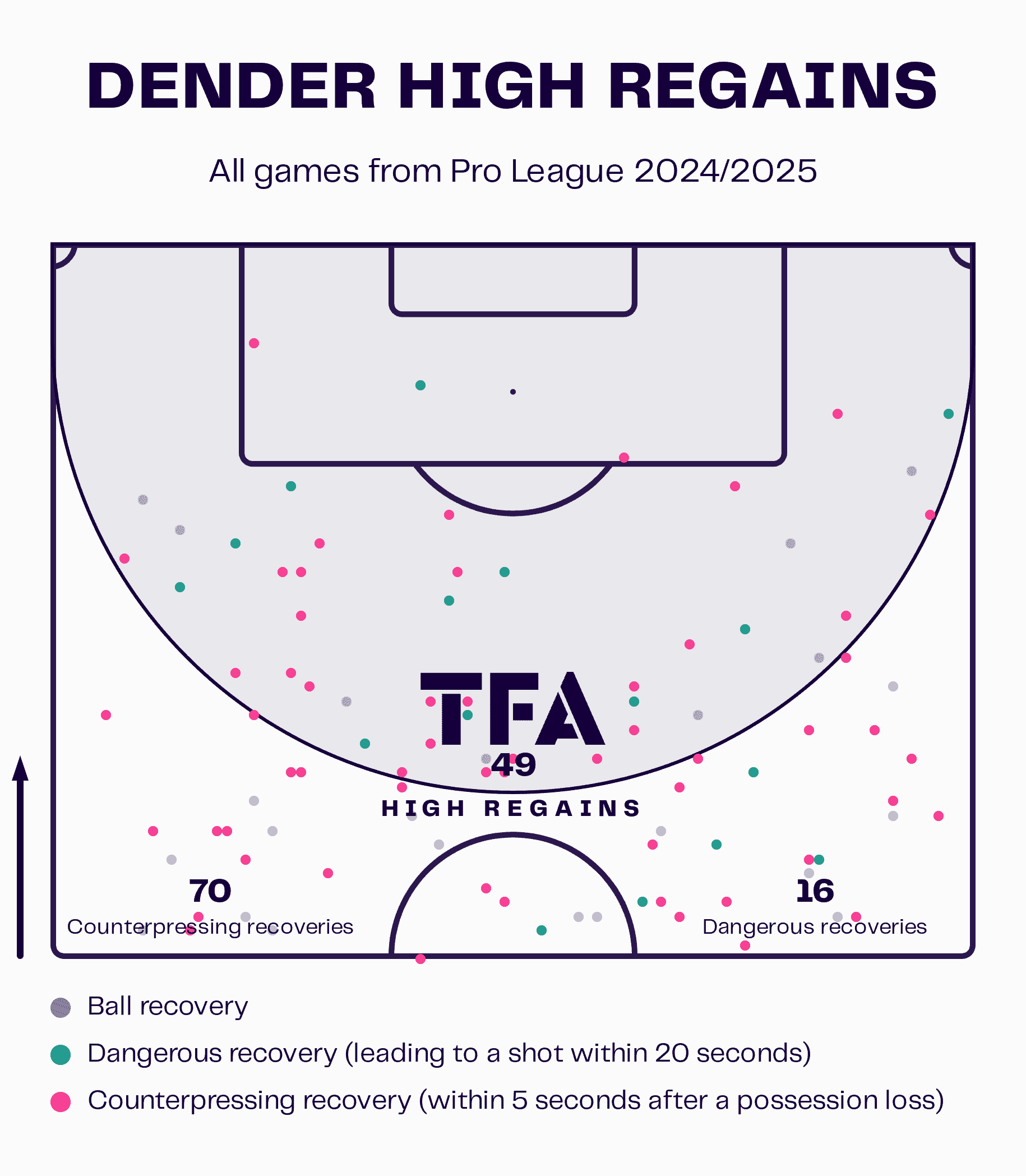
As we can see, Dender have enjoyed a lot of success with their counter pressing approach, averaging 17.5 recoveries and four dangerous recoveries per game.
Their commitment to pushing bodies forward in hopes of regaining the ball has paid dividends so far, with 49 total high regains.
Their bravery has already been rewarded on multiple occasions, making them a tough side to contend with.
FCV Dender Set Pieces – Zonal Marking Routine
Unlike when defending throw-ins, where they use man-to-man marking, as shown above, Dender opts for a zonal marking routine when defending corners and free-kicks.
All outfield players participate in defending set plays, meaning no one is left forward to provide an outlet for a counterattack.
They’re all tasked with covering a certain ‘zone’ in the penalty area to prevent the opposition from scoring or getting a quality chance away.

Above is an illustration from the opening game against Royal Union SG, where Dender were defending a corner during the first half.
They left one man on the near post, with the goalkeeper covering the far.
Five players covered the zone right in front at the edge of the six-yard box, two stood just outside that box in close proximity, and two more positioned around the penalty spot near the edge of the penalty area.
This particular set-up was consistent throughout all their games, with very little tailoring based on the opponent, so it’s clear that the coaching staff believes this is their best strategy for defending corners.
They did have a lapse against Kortrijk when they conceded from this routine, showing that this approach has flaws, but otherwise, they’ve been relatively comfortable so far defending in this manner.

On the other hand, with the attacking set plays mentioned above, we see an example early on in the game against Gent.
Ruyssen and Cools, two of their taller options to attack these sort of opportunities, started their runs from outside the penalty area, where they weren’t able to be picked up by a marker.
In contrast, Soladio started at the near post before peeling away to drag his marker out and create space for the centre-backs to run into.
On this occasion, Hens sent the ball towards the far post, which didn’t lead to a scoring chance, but the idea was evident in what they were setting out to do.
With throw-ins higher up in the field, Dender preferred to send them long into the box rather than playing them short, maintaining possession, and finding other means to carve out an opening.
It pretty much embodied what Euvrard is about as a manager: looking to get the ball into dangerous situations as quickly and efficiently as possible.
FCV Dender Transitions – High Risk, High Reward
As a result of their counterpressing man-to-man scheme, Dender take many risks that teams of their stature often don’t take.
It’s a high-risk, high-reward strategy, and that is what Euvrard wants from his teams.
A big emphasis goes into this aspect of their game because with the pace and physical presence they boast going forward, it’s their fastest route to the opposition’s net by trying to win the ball high up the field and attack the spaces left behind.

An example of them using space well in transitions came in the example above against Gent.
Soladio started his run back from an offside position and went into space on the blind side of the Gent left-back, whose eyes were only on Hrnčár.
Thus, Cools had an option to play the ball into a more advanced area.
In this sequence, Soladio receives the ball and passes it to Hrnčár, while Hens (standing in the centre circle) curves his run and moves into the space left behind by the defence and gets a cross in that’s narrowly put wide by the overlapping Ferraro.
This is a great example of them using their speed and wide players to go from back to front in a few seconds to create a chance, but they were just not successful on this occasion.

The above example shows the other side of Dender’s risky man-to-man approach.
Against St. Truiden, Ruyssen attacked the nearest passing option, coming far out of his position, while Cools covered the man behind him.
This resulted in a gap between the centre-backs, which was exploited as the ball was played into the forward.
They managed to finish excellently despite Pupe’s best efforts to come across and foil the attack.
Most of the goals Dender has scored and conceded have come through transitional phases, which shows that there is good and bad in Euvrard’s desire to have his troops push high, always looking to win the ball and use it as fast as possible.
A better defensive balance needs to be struck to avoid conceding too many in this manner as the season goes in, but as we are seeing, their bravery will undoubtedly come with rewards.
Conclusion
As this tactical analysis has shown, Dender has been a brave newcomer to the Belgian top flight thus far and has been rewarded for it four games in, as they sit in third place.
After a sluggish start, Vincent Euvrard tactics made the necessary tweaks to get the offence firing, and so far, it’s paid dividends.
Whether they will be able to sustain this level throughout the season remains to be seen, but so far, it’s been a start that few could have expected from a club that’s been absent from the first division for a long time.
