
“It is a sadistic pleasure. The suffering never stops.”
Quite a grim quote, but these were the words used by Roy Hodgson in an interview with The Guardian back in January 2018 to describe the miserable rapture of football management.
Last May, after guiding Crystal Palace to their fourth successive mid-table finish, the former England head coach called it a day on his illustrious managerial career.
Hodgson stepped away from the insufferable line of work as the oldest manager in Premier League history at 73 years and 287 days old.
However, this record has since been broken…by Roy Hodgson.
In true masochistic fashion, the 74-year-old has returned to the dugout to suffer some more.
In January, the former Liverpool coach agreed to take over from Claudio Ranieri at Watford for the remainder of the season.
The Hornets were certainly insufferable during the Italian’s brief reign, picking up merely seven points in the league out of a possible 42.
When Ranieri’s dismissal was announced, the newly-promoted side sat 19th in the league, giving Hodgson an extremely difficult task on his hands to guide Watford out of the depths of despair.
Hodgson’s greatest task at Vicarage Road – besides keeping them up – is to solve the team’s wildly detrimental defensive record.
So far, Watford have seen an improvement in this front.
This article will be a tactical analysis of Watford under Roy Hodgson.
It will be an analysis of the defensive tactics employed by the experienced coach, examining how he has improved things on the pitch, with the exception of Wednesday night’s 4-1 catastrophic defeat at the hands of Patrick Vieira’s Palace.
A switch to the 4-3-3
Watford began the season with Xisco Muñoz in charge.
Despite being a disciple of Rafael Benitez, the Spanish coach demanded attacking football from his players, one which relied heavily on build-up play and possession-based football.
In stereotypical Spanish fashion, Muñoz was an admirer of the 4-3-3 system, which was his preferred formation during his tenure with the London club. However, towards the end of his reign on the sidelines, Muñoz moved more towards a 4-2-3-1 formation.
The 41-year-old was prematurely dismissed at the start of October and replaced with Ranieri.
During the Premier League winner’s dire three-month spell at the helm, Watford went from deploying a 5-4-1 to a 4-4-2 and ultimately to a 4-3-3.
When Hodgson took the reins, he refused to overhaul the tactical system too much but switched to a 4-4-2, his favoured structure throughout his career.
Watford has now utilised various formations in this bleak campaign.

Two losses and a draw in his first three goalless matches in charge prompted a reversion to the 4-3-3 in Watford’s recent bout against Brighton and Hove Albion.
The Hornets were a goal down at the interval using a 4-4-2 with the side looking completely unbalanced against the fluid Seagulls.
So Hodgson made the change, dropping Imran Louza in as the ‘6’ in a 4-3-3, supported by Tom Cleverley and Moussa Sissoko as the two ‘8’s.

While Watford still lost 2-0 in the end, the side looked much more balanced overall, and it became clear that the tactical shift from the experienced head coach had worked.
In fact, the Londoners sustained their best spell of possession within the first fifteen minutes after the game restarted, as Hodgson’s side finally gained a foothold in the match that they had been quickly losing.

In Watford’s recent bout against Steven Gerrard’s Aston Villa at Villa Park, Hodgson stuck with the 4-3-3.
This tweak worked a treat as the relegation-battlers picked up a clean sheet and a much-needed three points in a vital 1-0 win.
It is highly plausible that Hodgson will continue to employ the conventional tactical structure in the coming matches as it gives Watford the best balance, according to the manager himself.
Speaking in a recent interview with The Athletic, Hodgson simplistically explained the switch to the 4-3-3: “It’s always been a question of trying to balance out making certain that you don’t concede loads and loads of goal chances to the opposition, but at the same time creating loads of goal chances ourselves.”
Better high pressing
Hodgson has never been one for intense pressing, and this hasn’t changed since taking over at Vicarage Road.
However, the Hornets have been far better with their pressing, showing greater coordination and cohesion, which is also represented in the data.
A useful metric to analyse how well and high a team presses is through their Passes allowed Per Defensive Action, most commonly referred to in the football analytics world as PPDA.
PPDA measures the number of passes a team allows the opposition to have before challenging for the ball.
The lower the statistic, the fewer passes the attacking side makes, and the defensive team applies the more pressure.

This graph displays all 20 Premier League clubs and their PPDA this season in the league.
To evaluate how much more Hodgson’s men have been pressing, Watford have been split up into their three different managerial reigns.
Surprisingly, Muñoz’s Watford pressed the least, showing a PPDA of 13.71 over his seven top-flight matches.
Ranieri’s side were not much better, boasting 13.17 across his thirteen-game spell in charge, whereas this number has been reduced to 12.82 since Hodgson’s appointment.
This doesn’t necessarily signify that Watford are now pressing much higher towards the opposition’s goal.
It instead conveys that they are pressing more efficiently, and the opponent now has less time on the ball.
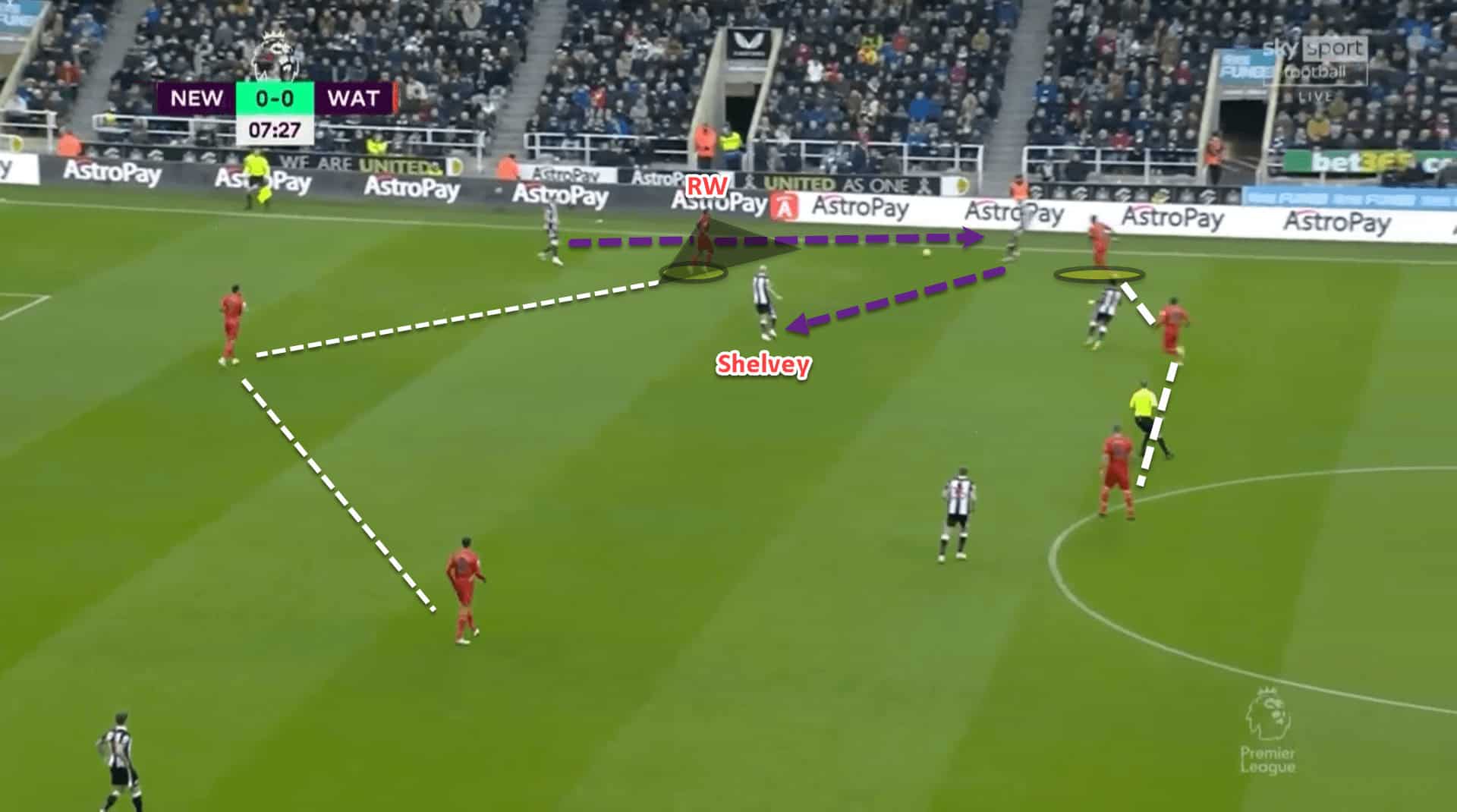
This image shows an example of Watford’s poor, uncoordinated pressing under Ranieri from the Italian’s penultimate game in charge of the London club.
The Hornets are applying pressure in a 4-3-3 high block and have forced Newcastle United to the left flank.
However, Watford have made it astonishingly easy for the Magpies to play out of their pressure by using Shelvey as the third man who is free in the central area.
Watford’s right-winger, Emmanuel Denis, has blocked the original passing lane to Shelvey whilst pressing the player in possession of the ball.
However, once the pass is played down the line, Dennis should have dropped off and blocked the now-open lane to Shelvey once again, forcing the ball-receiver to play back to where it originally came.
Instead, he didn’t, and Joelinton played a simple pass into Shelvey to break Watford’s press.
The Hodgson-led side are far more tactically diligent with the centre-forwards being much more adept at covering passing lanes, applying cover shadows and pressing opponents when necessary.

Now, here’s an example of Watford’s 4-3-3 high block pressing under Hodgson.
Passing lanes, are being blocked off, players are man-marked, whilst Imran Louza is sitting behind his two ‘8’s to play zonally, marking any players who drop into the zone in front of the backline.
Because of Watford’s excellent, coordinated pressing in this instance, the Villa fullback had to play backwards, as there were no forward or inside passes available.
The tactical tweaks by Hodgson are not radical or revolutionary.
In fact, they are quite basic, but now teams are finding it much tougher to bypass the Premier League strugglers’ pressing, which can only be positive.
Hard-working midfield and Hodgson’s modesty
Hodgson has always been a relatively modest character, if not highly critical of his own players.
In his post-match interview on Saturday, following Watford’s 1-0 victory against Villa, the Croydon-born coach praised his players’ execution of the tactical game plan but hinted that the midfield’s job is made excessively difficult due to the front three’s lack of defensive contribution.
“I don’t know what more risks we can take when you’re playing three out-and-out front players who are not contributing enormously to our defending, and we’ve got three midfielders who do a fantastic job covering the width of the pitch.”
In this regard, the team’s tactics have not changed too much from Ranieri’s reign.
The midfield three are tasked with covering the width of the pitch constantly, which means hard-working, energetic and defensively proficient midfielders need to be deployed in the middle of the park.
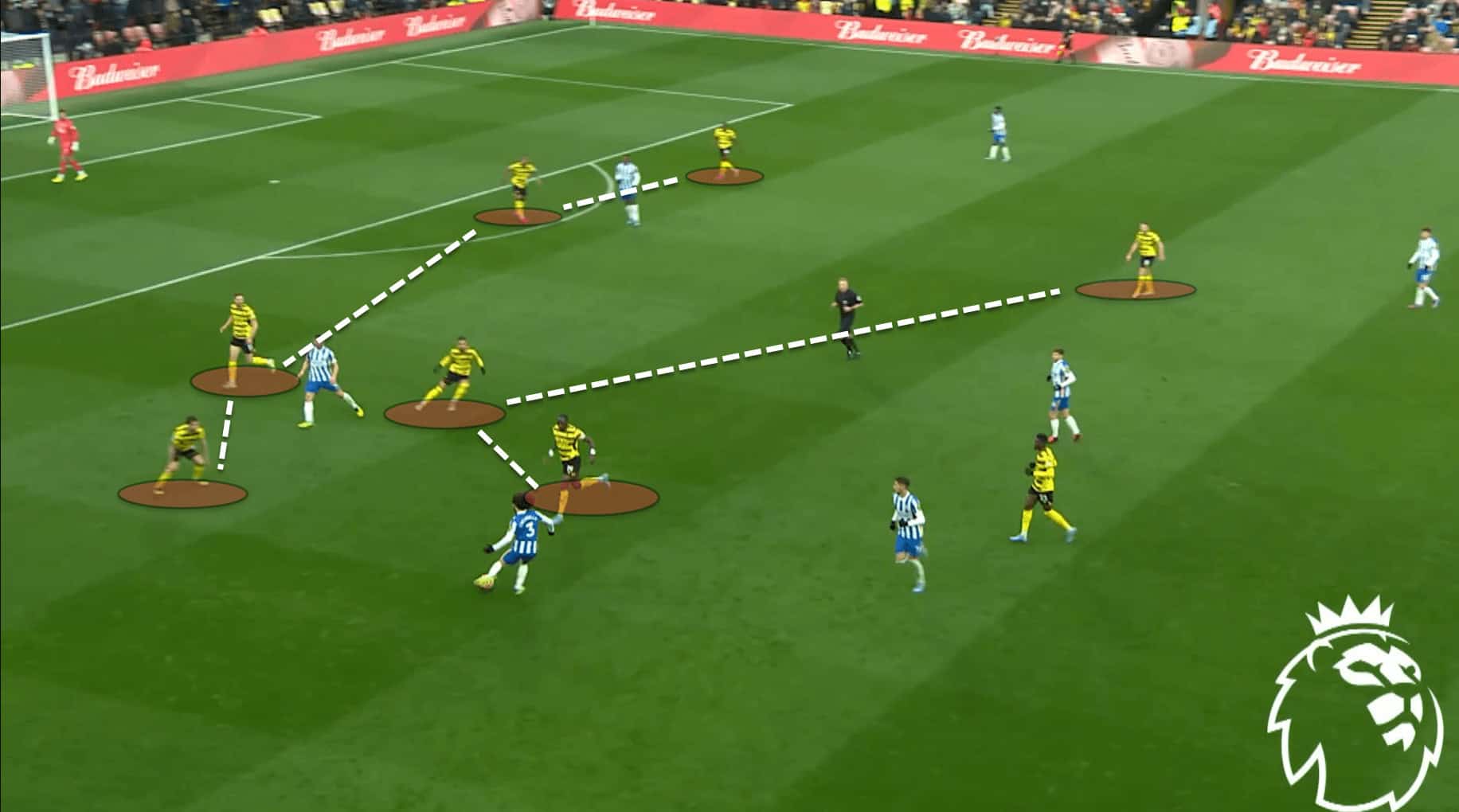
Having players such as Sissoko, Louza and Cleverley certainly make this a much more plausible defensive set-up, allowing the front three to stay higher in case the ball breaks so they can exploit the gaps in the opposition’s defensive line.
The attacking sides have tried to take advantage of this by looking to switch the play at the first available opportunity in order to unlock gaps in what is essentially a block of seven for Watford, including the three central midfielders and four defenders.
Even when Hodgson deployed a 4-4-2 in his first few games in charge, there was constantly space on the far side for the opposition to switch the ball into.
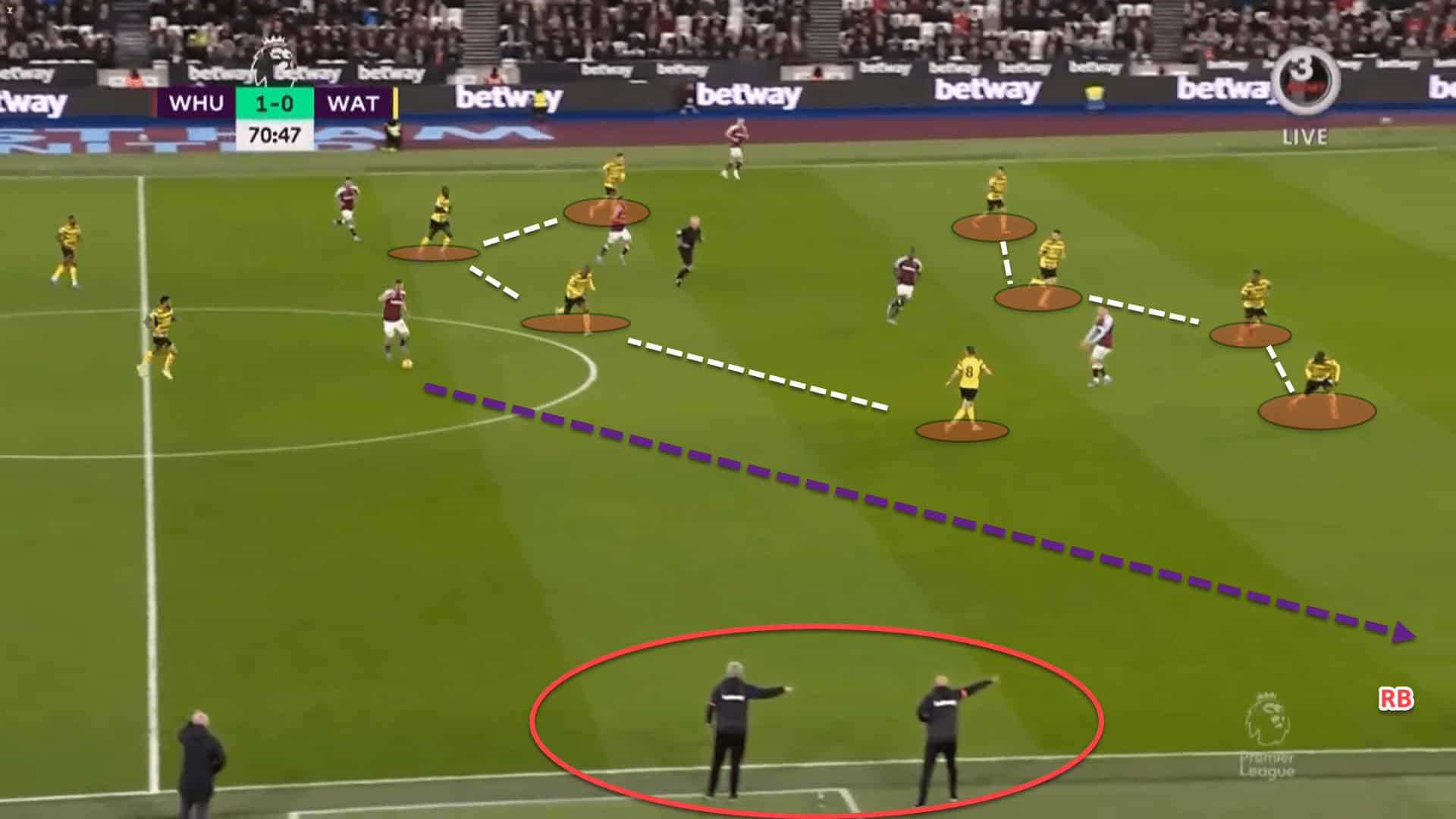
The reason for this is that the superannuated manager wants his side to defend as a compact unit on one side of the pitch, trying to win the ball back by using the wide areas as an extra defender.
This has been a noticeable improvement under Hodgson.
The side shifts the entire defensive block to one side, preventing the opposition from progressing the ball on the flank whilst trying to regain possession.
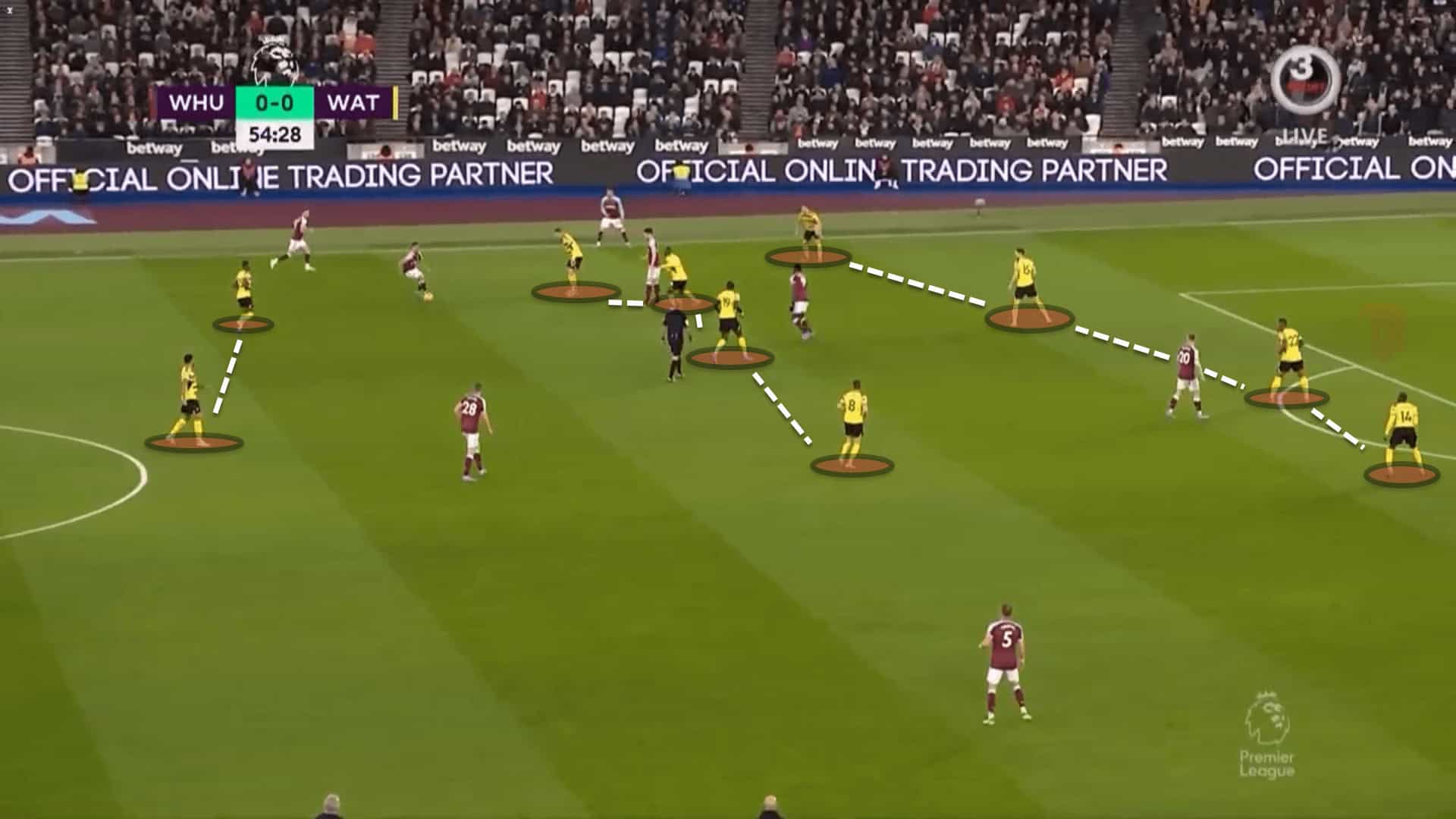
Then, once the ball is switched to the opposite flank, the players must shift across in unison.
This is a non-negotiable from Hodgson.
Watford’s goalkeeper Ben Foster spoke about this in a recent interview with The Athletic, highlighting the importance the experienced coach has put on his defensive principles already in just five matches in charge at Vicarage Road:
Foster said: “The way Ray (Lewington, Hodgson’s assistant) and Roy (Hodgson) like to do things is when the ball is on one side of the pitch, we’ll get across as a unit.
When it goes over the other side, we have to bust a nut to get over there.”
Observing Watford’s ball recoveries from their matches under Hodgson, the vast majority come from the flanks as the side come to grips with the 74-year-old’s defensive demands.

Here are all 99 of Watford’s recoveries from a recent game against Brighton.
75 percent of the team’s recoveries were in the halfspaces and wide areas.
Hodgson has been rather modest with regard to his front three’s defensive responsibilities.
While the forward line certainly doesn’t have anywhere near the tactical shackles of the backline or midfield, they do still contribute to the team’s defending, generally when Watford pushes back into a low block to defend the goal.
As the side have been using a 4-3-3, the defensive structure becomes a 4-5-1.
This worked exceptionally well against Villa, denying Steven Gerrard’s side many high-quality opportunities at goal, with an xG of just 0.75 conceded throughout the match.
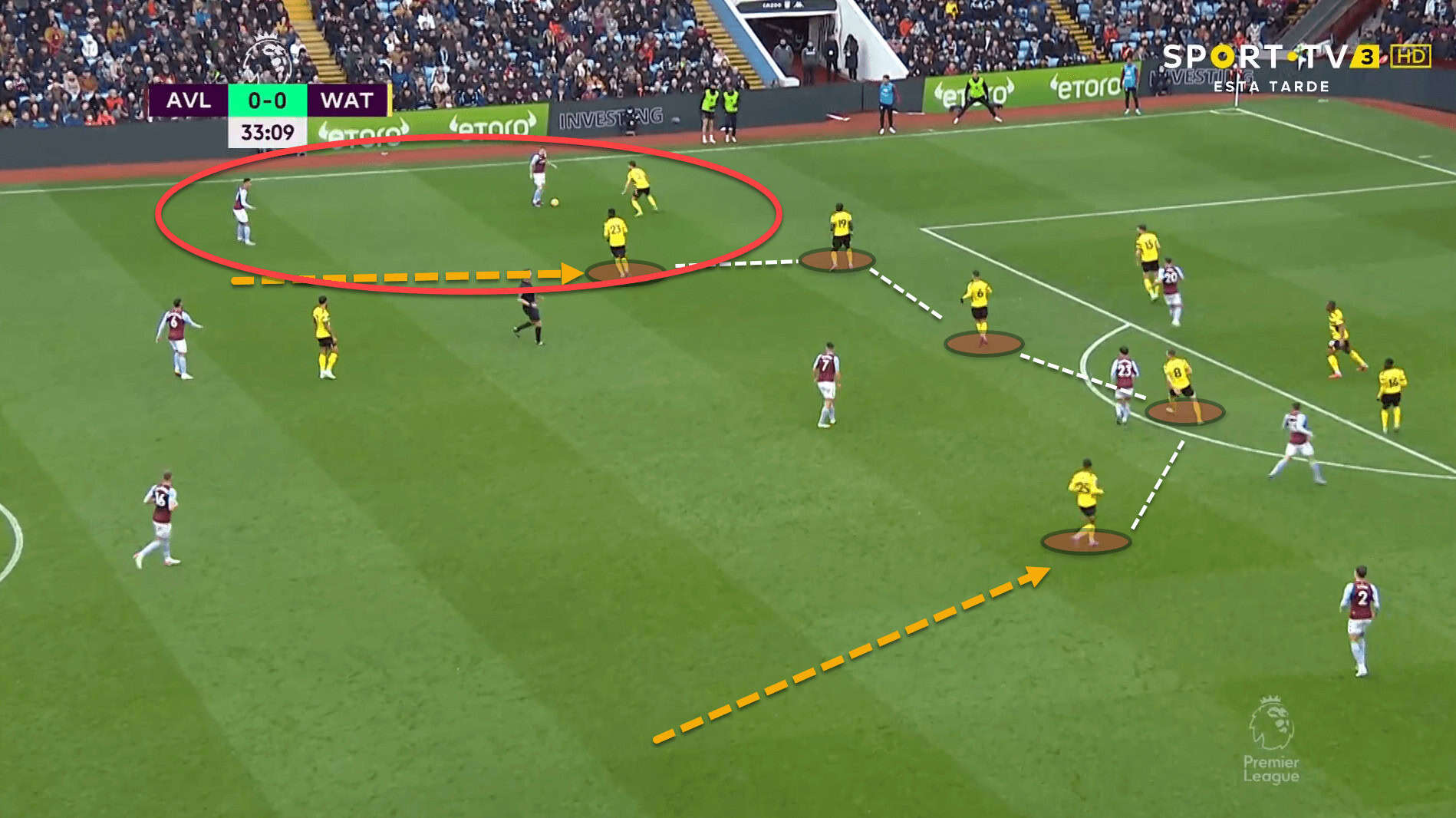
The wingers drop back during the low block phase to provide support to the fullback, ensuring they are not overloaded on that side by the opposition, which would allow for easy access to cross the ball into the box.
Backline depth and squeezing the space
One of the most noticeable differences between Hodgson’s Watford and the side that played under Ranieri is just how coordinated the backline are when the opponent are looking to carve them open centrally.
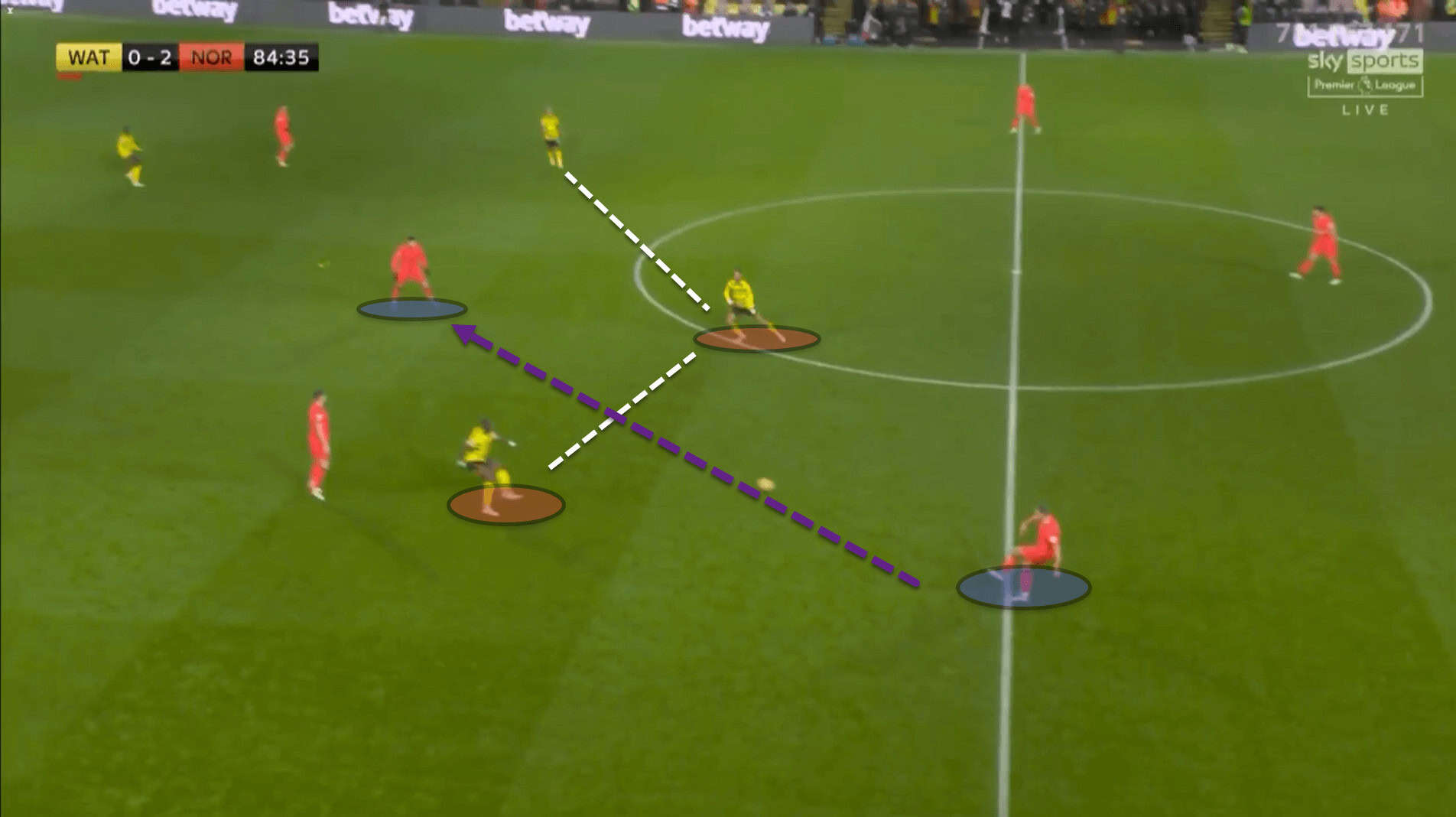
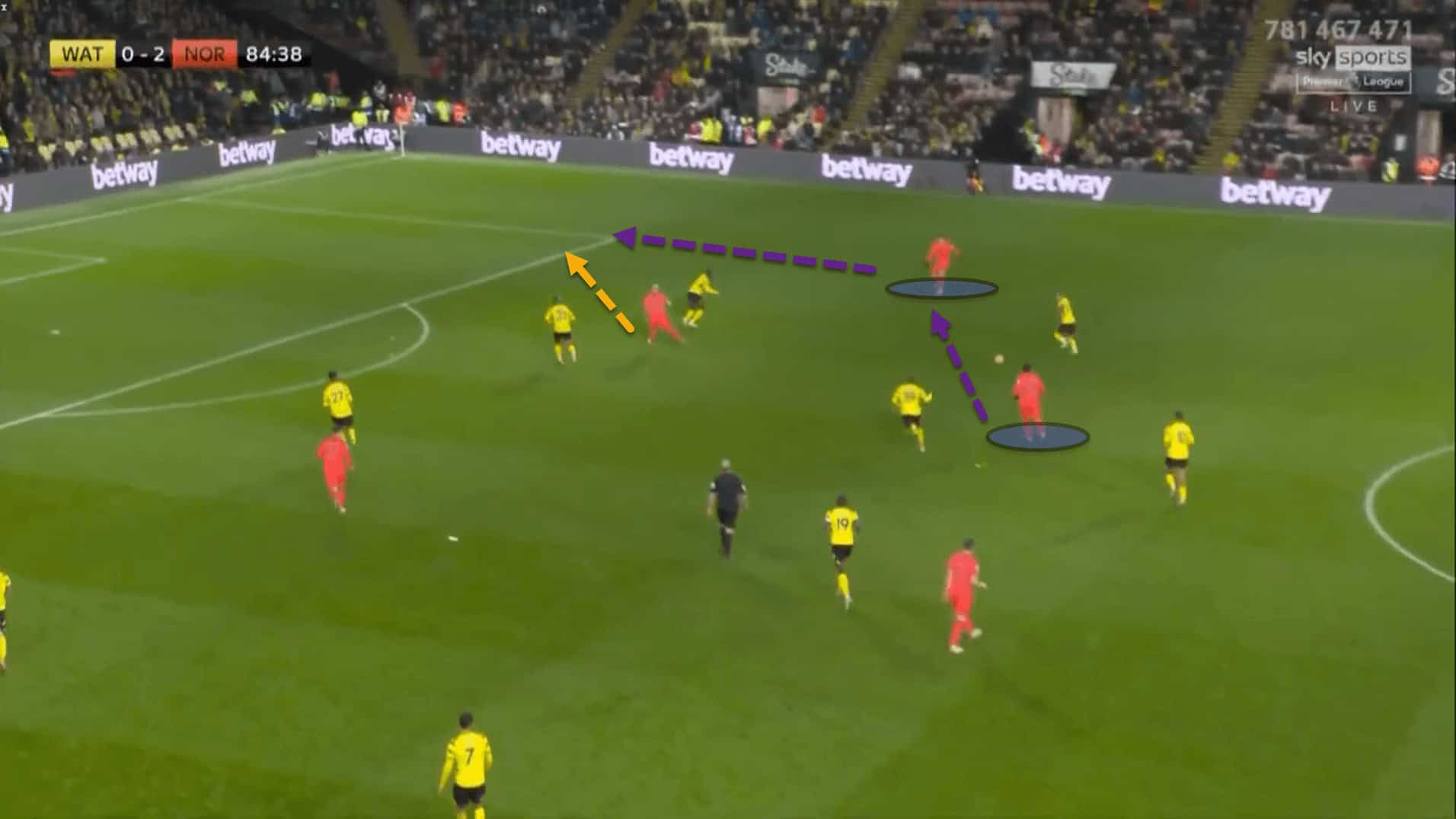
Here is an example from Ranieri’s final game in charge of Watford where the Hornets were cut open in two passes from the central corridors and reacted extremely poorly.
When the original pass was played from Norwich City, Watford’s midfield hardly reacted to the player receiving the ball, and so he was able to turn unscathed.
The backline barely dropped back either, which allowed them to slip in a runner in behind.
For a Premier League defence, this is utterly ghastly.
Hodgson has made them much more resilient when teams break through the first two lines of their defensive structure.
For instance, if an opposition player receives the ball in the space in front of their four defenders, the backline squeezes together instantly and block off central access, forcing the offensive side to go wide where Watford can deal with the attack better.
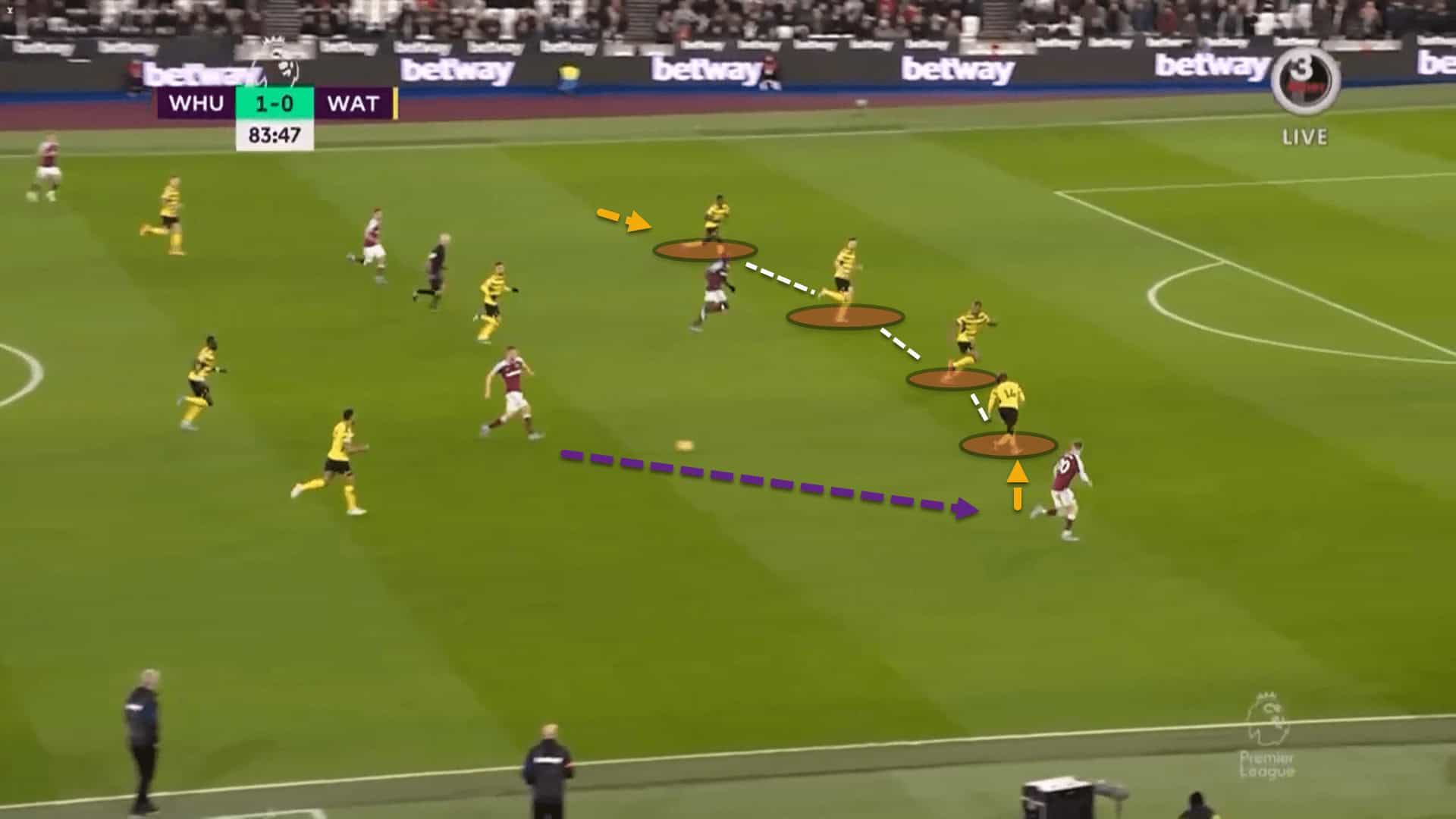
In this situation, the West Ham United midfielder drove into the space between the lines, breaking the midfield line.
Watford’s back four squeezed together, with the fullbacks moving tighter to the centre-backs and began receding closer towards the goal.
The Hammers were forced to go wide to Jarrod Bowen where Hassane Kamara, the Hornets’ left-back, could deal with the threat away from the goal.
Conclusion
Hodgson has been in charge for a very short period, and therefore, the sample size for analysing his impact is rather small.
However, structurally, the team are much sounder in the defensive phases.
Watford arguably regressed under Ranieri compared to the side he inherited from Muñoz.
Still, Hodgson has brought back a grit and determination to the side that could be massive for the Hornets as they enter the final stretch of the Premier League campaign.
Ultimately, the end goal is survival, and once this is achieved, the 74-year-old sadist can sail off into the sunset and finally put his outstanding managerial career to bed.
Until he takes over another struggling club next season, that is.
