People often obsess over formations and forget that it is the personnel and the actions behind the structure that determine whether a formation becomes functional or not.
The numbers on paper are just a base or a reference point.
What matters is how the system breathes, how players interpret their zones, and how the manager manipulates space.
Inside them are principles of width, depth, and relational spacing.
A three-at-the-back shape can be expansive, hard to break down, or transitional, depending on those human decisions.
Oliver Glasner and Ruben Amorim both favour a three-at-the-back system, but their executions are completely different.
Oliver Glasner Crystal Palace expands, accelerates, and adapts; Ruben Amorim Manchester United compresses, slows, and suffocates.
The same design, the same backbone, but drastically different outcomes.
This tactical football analysis will aim to dissect both models, their mechanics, their logic, and their failures.
The 3-4-2-1 Structural Blueprint
Both managers build around a back three, two wing-backs, a double pivot, and two inside forwards behind a central striker.
However, Glasner’s 3-4-2-1 is an expanding system, while Ruben Amorim’s is a contracting one.
Oliver Glasner Expansion
Oliver Glasner’s Palace builds through a 3+1 structure with three central defenders plus Dean Henderson, who steps into the line as an auxiliary centre-back.
Centre-backs Maxence Lacroix, Marc Guehi, and Chris Richards split wide, inviting the press, while Henderson becomes the spare man.
As shown in their home win versus Liverpool, Henderson steps out to create a numerical advantage (as well as making it easier) to build up and find a teammate centrally or out wide (i.e., the wing-backs).
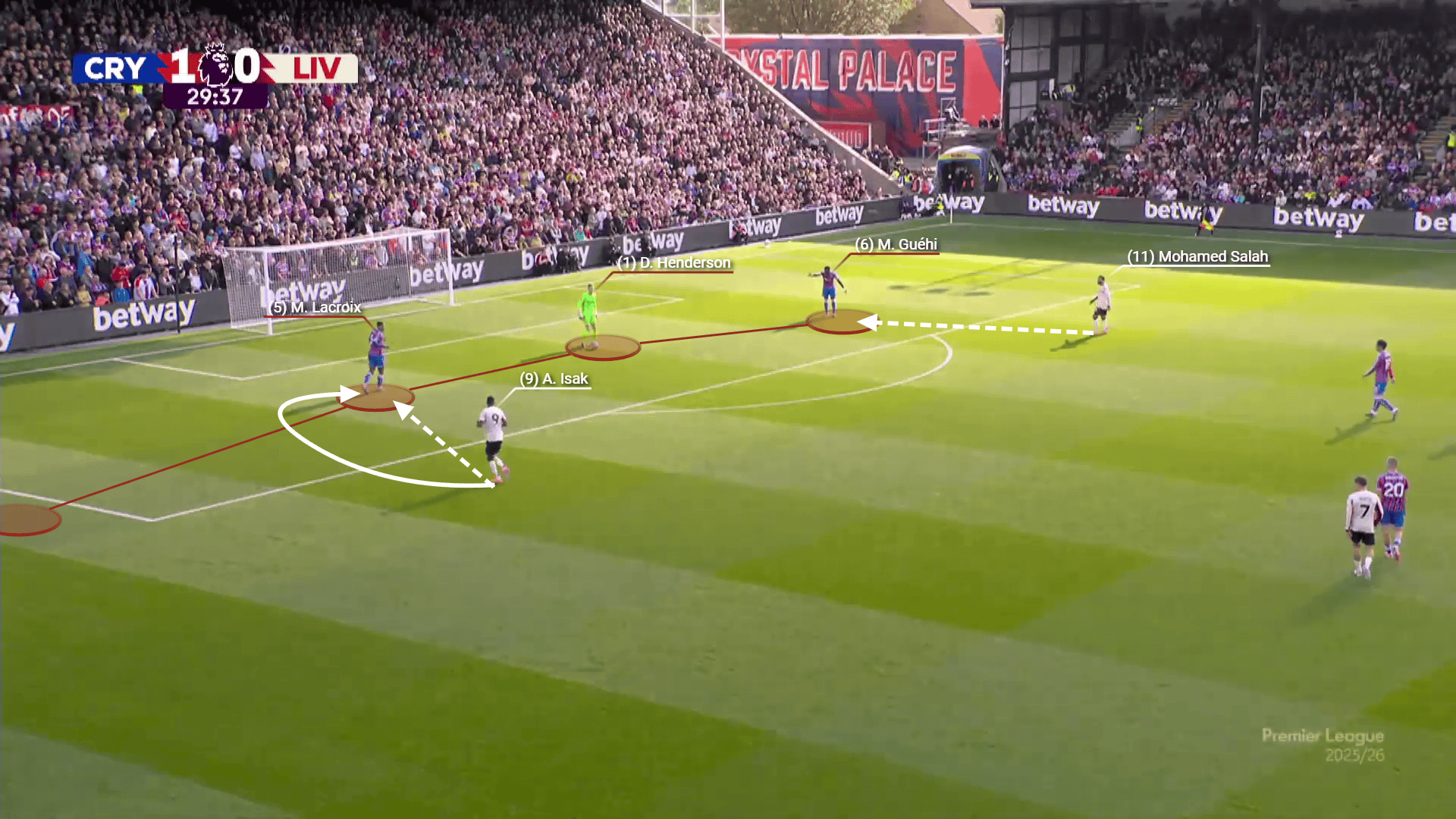
The wing-backs Daniel Munoz and Tyrick Mitchell push high and wide, giving the shape a lateral stretch.
This progression produces a 3-2-5 in possession, with three at the base, a pivot pair connecting centrally, and five across the top line.
![Lazio Vs Napoli [0–2] – Serie A 2025/2026: Maurizio Sarri Zonal Marking Weaknesses And Unsuccessful Attacking Choices – Tactical Analysis](https://totalfootballanalysis.com/wp-content/uploads/2026/01/Lazio-Vs-Napoli-tactical-analysis--350x250.png "Lazio Vs Napoli [0–2] – Serie A 2025/2026: How Antonio Conte Tactics Exploited Structural Flaws – Tactical Analysis 3")



![PSG Vs Strasbourg [3–3] Ligue 1 2025/2026: Strasbourg Double-Edged Defensive Organisation And The Joaquín Panichelli Impact - Tactical Analysis](https://totalfootballanalysis.com/wp-content/uploads/2025/10/PSG-Vs-Strasbourg-20252026-75x75.png "PSG Vs Strasbourg [3-3] - Ligue 1 2025/2026: Liam Rosenior Pressing Tactics & Joaquín Panichelli Finishing In Focus – Tactical Analysis 11")