
Since joining as manager from Austrian side LASK near the end of the 2021/22 season, Andreas Wieland is now in his second full season in charge of Belgian side Beerschot. Last season, he guided the Antwerp-based side to 3rd place, just missing out on promotion back to the Belgian Pro League. This season, however, the 40-year-old Austrian is looking to go one better, with his Beerschot side going into this international break second in the table, level on points with leaders Zulte-Waregem.
With the top two in the second tier of Belgian football now in line for automatic promotion to the top flight, this looks like the season that Wieland can lead the club back to the Pro League for the first time since being relegated at the end of the 2021/22 season, the season when he was appointed in April of 2022. This tactical analysis and scout report will take a more in-depth look at the tactics of the Austrian manager, looking at what he has done to get Beerschot into the position they currently find themselves in.
Possession-oriented attack with quick ball circulation
When watching how Beerschot have looked to attack this season under Andreas Wieland, a clear picture begins to emerge when it comes to how the Austrian wants his side to attack. Beerschot have typically played some version of a back three this season, with the starting shape being either a 3-4-2-1 or a 3-4-3. Most back-three systems are not known to be possession-based, with most coaches utilising this shape, focusing more on counterattacking principles. Wieland is no different; his side also excels in counterattacking moments; the Austrian looks to play a more possession-oriented brand of football.
Looking at the statistics, Beerschot have the highest average ball possession in the Challenger Pro League this season, sitting at 58.4%. They also hold the second-highest total passes this season, as well as the highest passing rate in the division at 14.9, a statistic that looks at the number of passes per minute of possession.

The data viz graphic above shows the pass map of Beerschot this season, which also helps to lend their tendencies in possession under Wieland. As we can see, most of Beerschot’s ball progression, when they get into the opponent’s half, is in the wide channels and half spaces, with the ball not often being played into central areas once they reach the final third.
This leads us to another possession-based attacking principle that Wieland tends to utilise: off-the-ball movements and the use of width in attack to stretch opposition defences.
This attacking principle also looks to create overloads in these wide channels, with the Beerschot attackers commonly looking to make runs off each other and into deeper pockets to drag opposition defenders out of position to create space. Wieland also looks to implement many one- and two-touch passing moves, looking for quick ball circulation in these pitch areas.
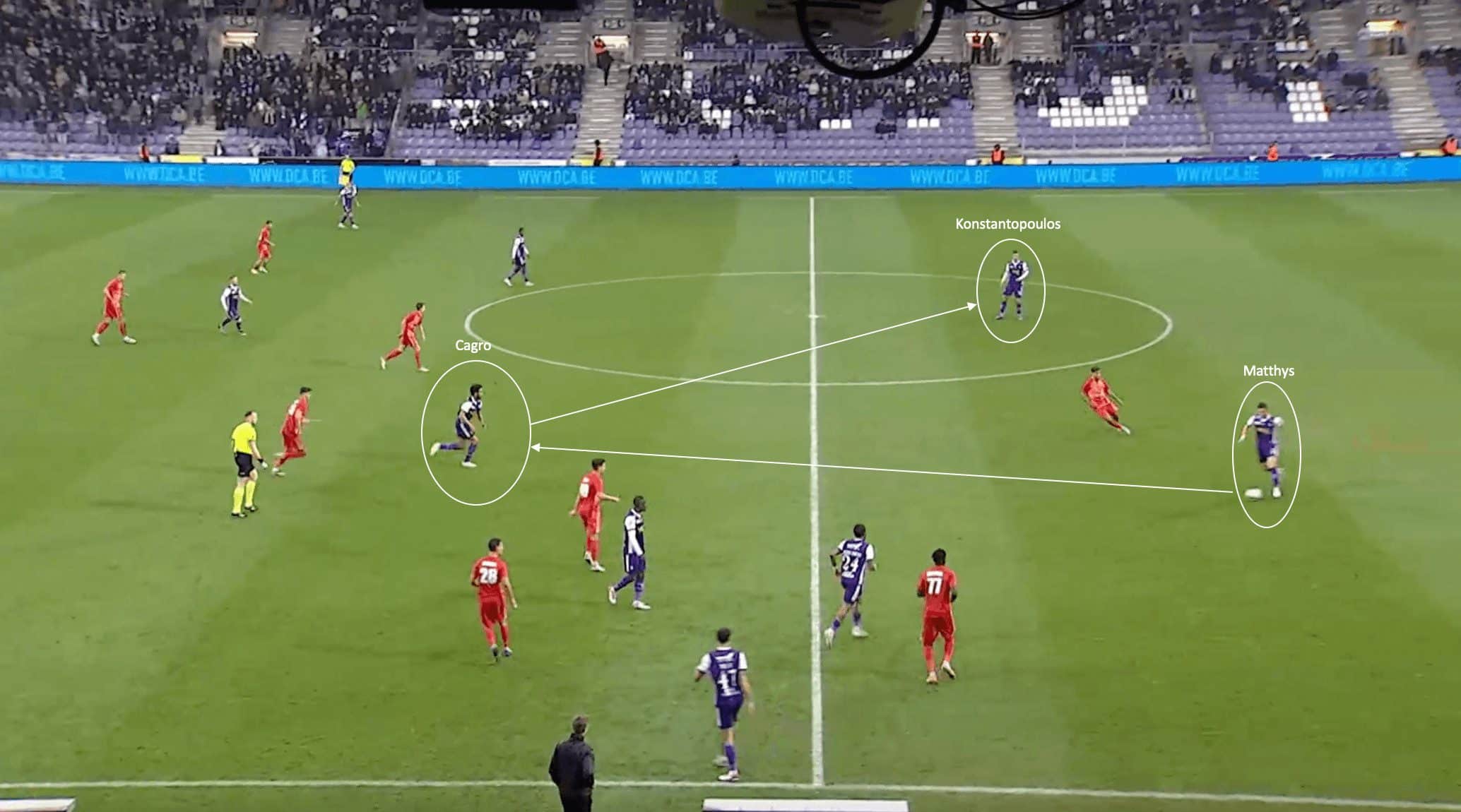
The image above shows an example of this quick ball circulation from Beerschot, creating an overload on the far touchline. This attacking move from Beerschot originated within the back three, with centre-back Hervé Matthys in possession. After taking a touch centrally, the 27-year-old is able to find 24-year-old Welat Cagro dropping into a pocket of space in the Dender defence.
At this point, the Dender defensive shape has shifted over to this near side, looking to suffocate the Beerschot attackers. However, after receiving possession, Cagro is able to find Apostolos Konstantopoulos, with the Greek central defender unmarked inside his own half. This quick ball circulation allows Wieland’s side to escape the pressure and quickly get out the other side, catching the opposition defence out of shape.

The image above shows the next phase of this attack from Beerschot, with the quick ball circulation allowing the Belgian side to escape the opposition pressure and create an overload on the far side. After the ball is received by Konstantopolous, the Greek defender has two potential passing options, either Simion Michez or Thibaud Verlinden. These two attackers can create an overload against the Dender wing-back, with the defender caught trying to guard both players and the rest of the defence slowly shifting over.
Due to the wing-back’s more passive position, the Greek central defender can find the more advanced option, playing to the feet of Verlinden. This puts the opposition wing-back in a tricky position with his decision to go out and put pressure on the wide player. This allows Michez to turn and drive towards the backline and behind the Dender defenders. This will enable Verlinden to play a pass into the space for Michez to run onto, with a corner resulting from this attacking move.
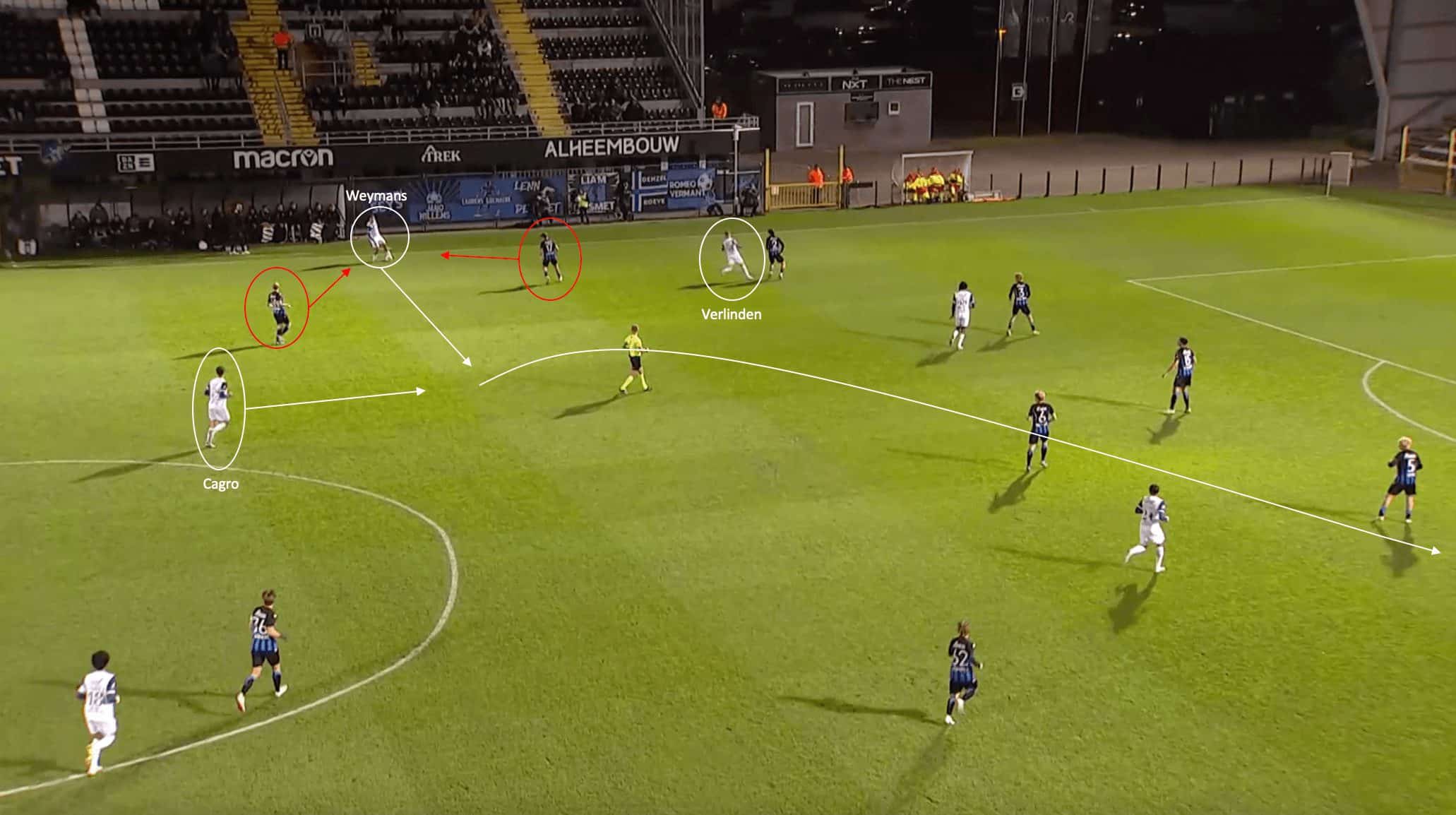
The image above shows another example of an attacking move from Beerschot, showing how the wide channels are not always used to progress the ball into the final third directly but rather as decoys to open up space centrally. In this phase of play above from a recent match against Club Brugge Nxt, the ball is in possession of the left-sided wing-back, Marco Weymans. Further forward, Thibaud Verlinden made a decoy run, with the Belgian looking to show a give-and-go with the wing-back.
As we can see, the two Club Brugge Nxt players closest to Weymans are caught ball-watching, with both looking to engage the Beerschot player, with the space left in the central area for Cagro to move into. Weymans spots him and plays a ball into his path, with the Belgian midfielder able to take a touch, turn, and spray a long diagonal into the run of Michez in the other wide channel, who can take the pass on and drive into the opposition penalty area.
As this section has been able to illustrate, Andreas Wieland looks to play a possession-oriented brand of attacking football, with a heavy emphasis on the use of the wide channels in attacking moves to create chances going forward.
Strategic pressing philosophy
Another principle Andreas Wieland has implemented at Beerschot is an aggressive pressing philosophy. Beerschot have been one of the more strategic and best pressing sides in the Challenger Pro League this season, boasting a PPDA of 8.43, which is top five in the league, as well as the highest challenge intensity in the Challenger Pro League at 6.6.

The data viz graphic above shows the high regains of Beerschot this season under Andreas Wieland. Notice how the majority of these actions have occurred outside of the opposition’s penalty area, with Beerschot not looking to put immediate pressure when the defenders receive the ball from their goalkeeper. Wieland looks for his side to press more strategically and use pressing cues to press higher up the pitch. Typically, Beerschot looks to lock the opposition to one side during build-up phases before looking to lock the ball to one side and force turnovers in these wide areas.
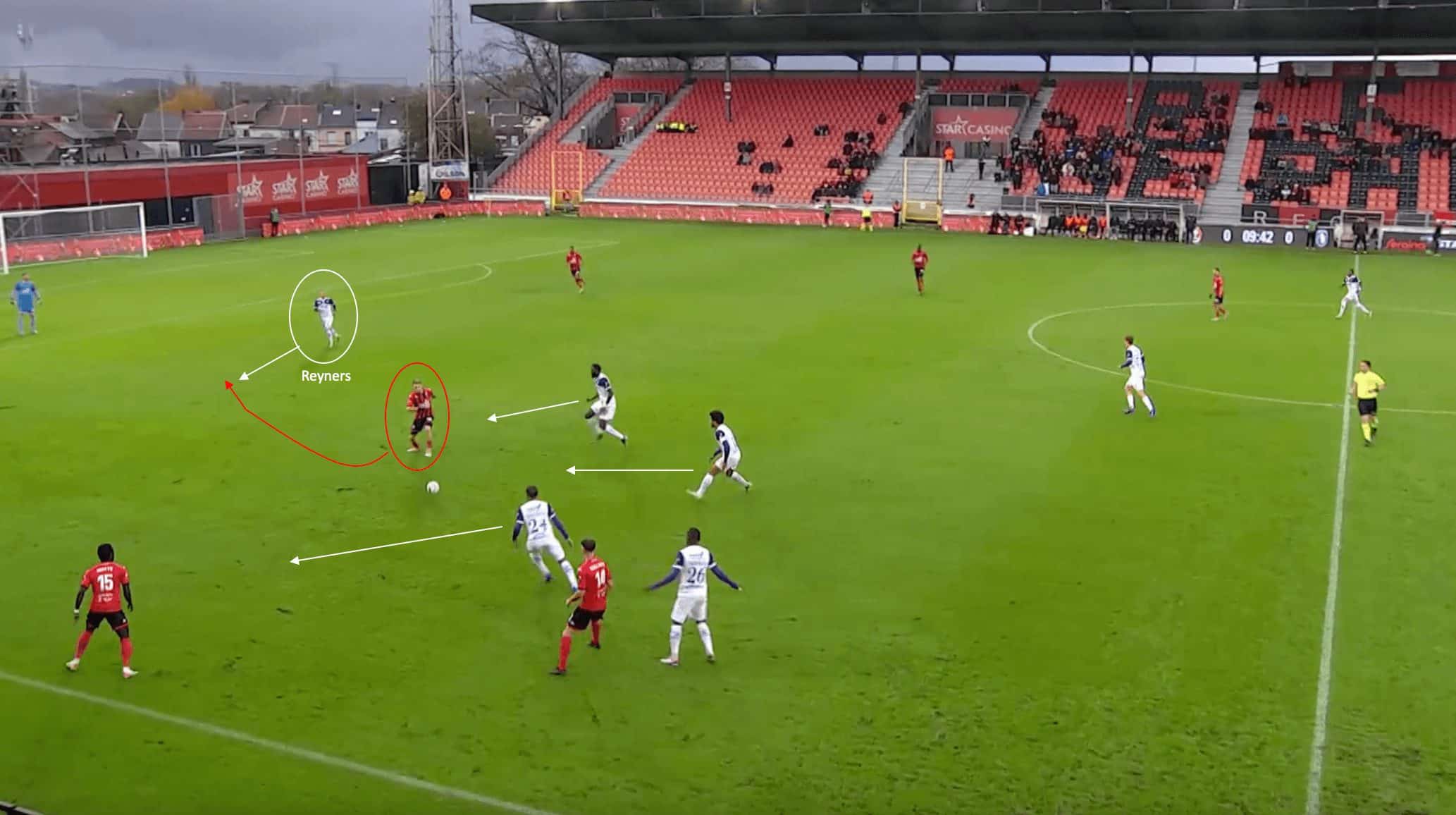
The image above shows how Beerschot look to press in action, with this phase of play against Seraing leading to a goal for Wieland’s side. Preceding this image, Seraing were in possession with their goalkeeper, with Beerschot sitting off slightly and letting them build with their centre-backs. As soon as the ball was played out to the Seraing wing-back on the near touchline, the press for Beerschot activates, with the defending players shifting to lock the ball to this near side.
The Seraing player in possession is then left with only two realistic options: the wing-back on the touchline, who would instantly get closed down, or attempting to play back to this goalkeeper to build out the other side. The opposition player chooses the latter, with him blindly playing a pass back to his goalkeeper. He does not notice the movement of the Beerschot forward, Tom Reyners, sliding over to cut off this passing lane. As a result, the ball is played right to Reyners, who finishes past the goalkeeper in a 1v1 situation.
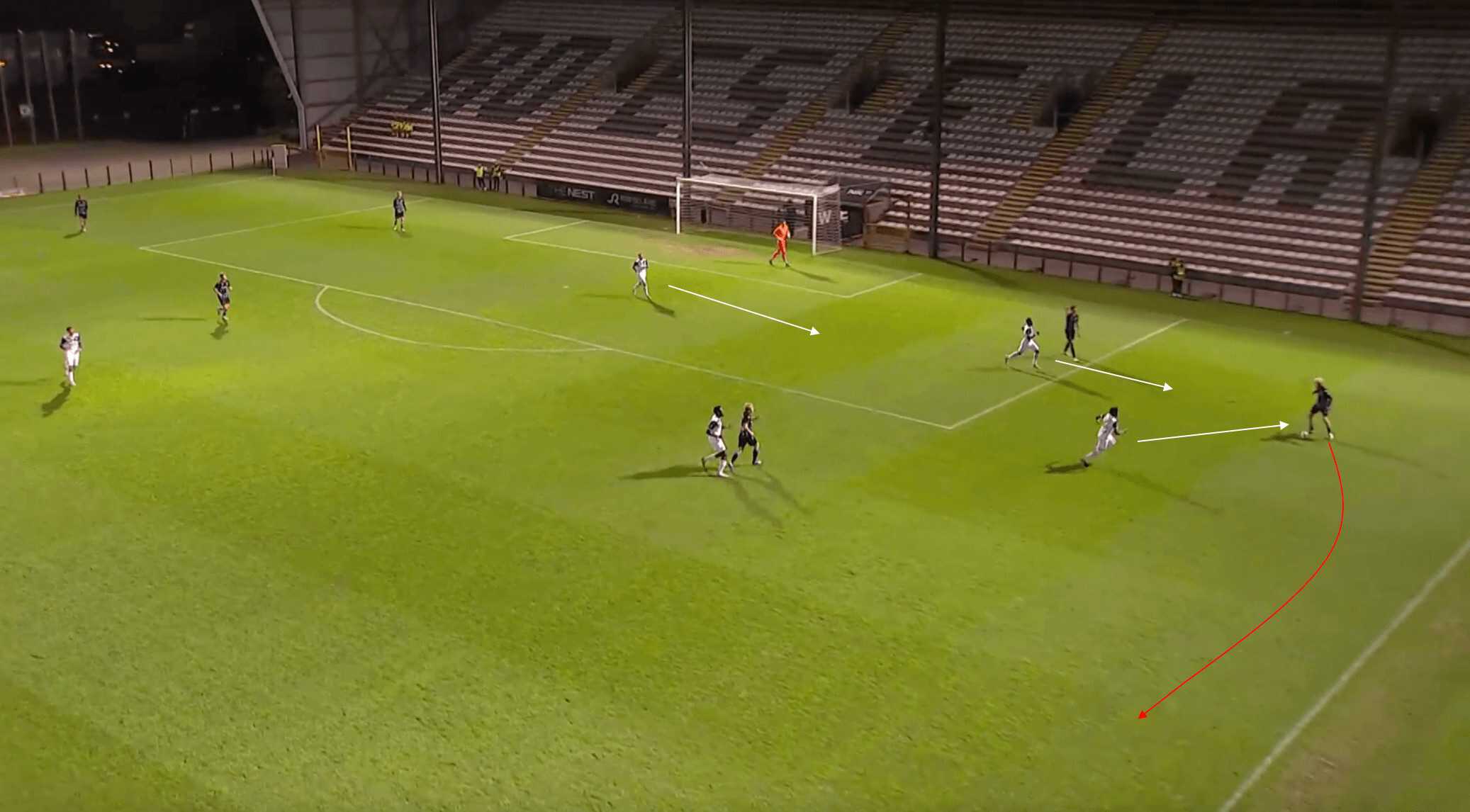
The image above shows another example of the pressing style that Andreas Wieland has implemented at Beerschot. In this phase of play against Club Brugge Nxt, the opposition side is looking to build from the back, with the ball rotating from the goalkeeper to its current location, with the left back. As the ball rotated over to this near side, the Beerschot defensive shape also did, looking to again lock the ball to this side.
Notice how the three closest Beerschot defenders have all angled their runs to block off the possibility of the defender attempting to switch the ball to the opposite side. This forces the defender to play the ball down the line to the winger, who has dropped deeper into midfield to become a passing option. However, with the Beerschot numbers already shifting over and the wing backtracking the winger back, Wieland’s side can regain possession in an advanced area of the pitch, forcing a turnover.
As this section has shown, Andreas Wieland has turned Beerschot into a pressing side that looks aggressive at times but mainly are looking for pressing cues to engage. They look to shape and angle their runs to force opposition sides to play out wide to one side before looking to lock it, a strategy that has lent them plenty of success this season.
Best defence statistically in the league
Regarding the defensive side of things for Beerschot this season, they have statistically been the best defence in the Challenger Pro League. Their 10 goals conceded through 11 matches this season are the fewest in the Belgian second tier, while they also have the fewest shots against with 106. A big reason, in part, why they have faced the fewest shots this season is their ability to win the ball back in advanced areas of the pitch, as the previous section illustrated. However, Andreas Wieland’s side also does really well to keep the game in front of them when opposition sides enter their defensive half, with Beerschot looking to get tight and compact in a 5-3-2 shape.

The data viz graphic above shows the shots against Beerschot this season, highlighting areas where most of their shots against have come from. As we can see, along with giving up the fewest number of shots in the Challenger Pro League this season, they also have not given much up in regards to the xG numbers. In general, Beerschot have been very good at keeping opponents off the score sheet this season due to their solid defensive record.

This data viz graphic takes a look at the defensive territory of Beerschot this season, looking at the Belgian club from a more all-around defensive perspective. As mentioned earlier, a lot of the defensive work from Beerschot occurs from the front, with the main aim not to allow the opposition to build out, instead forcing them to play the ball long. Wieland’s side also aim to have a pretty high defensive line, with it not uncommon to see all of Beerschot’s outfield players in the opposition half.
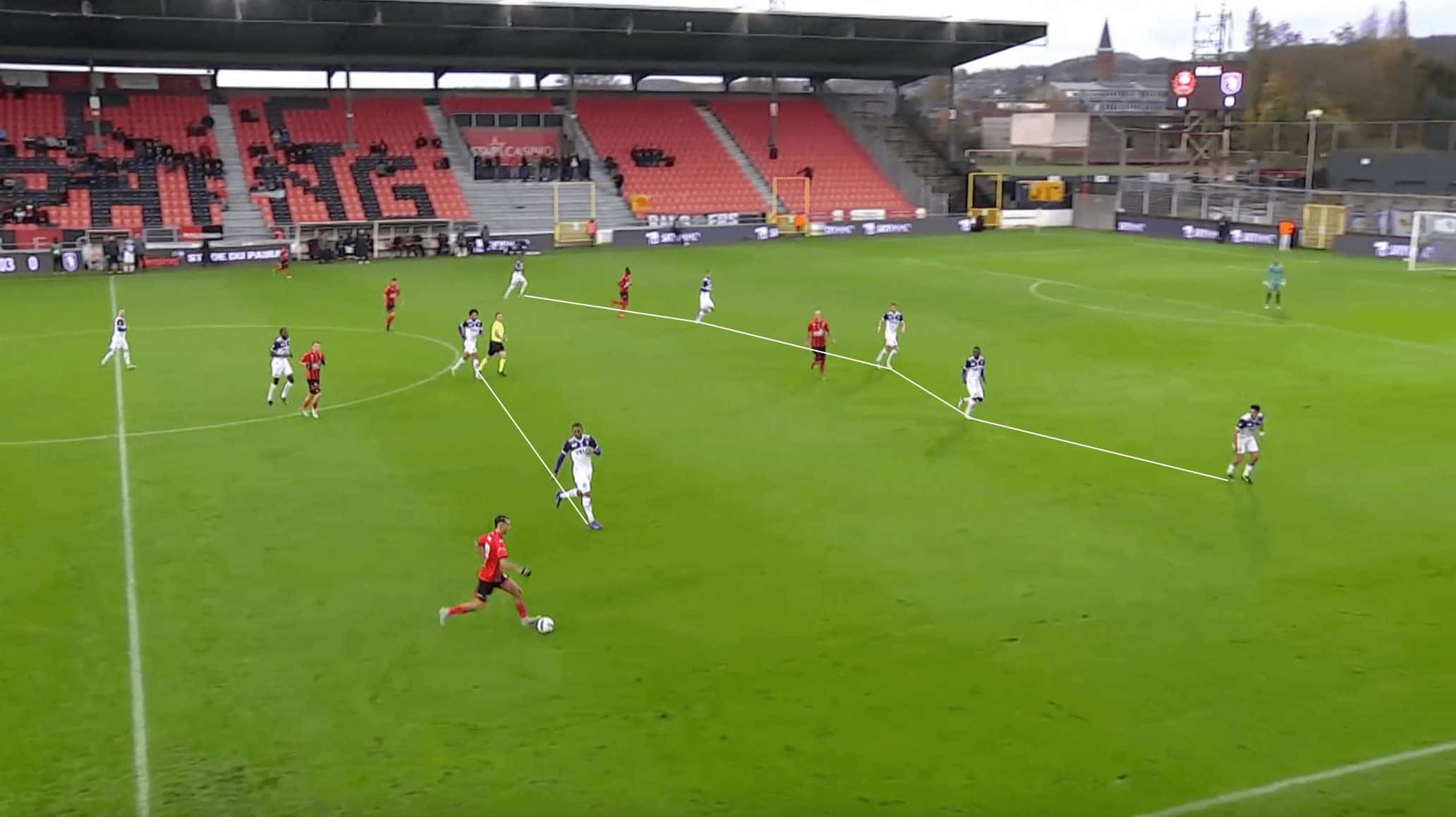
The image above looks at the typical defensive shape for Beerschot under Andreas Wieland. As we can see from this match against Seraing, the Belgian side tend to drop into a back five shape, with either a line of two or three in front of them. This shape allows them to stay tight and compact, eliminating space between the lines for opposition attackers to drop into to progress the ball into the central areas.
This defensive shape has had great success for Beerschot this season, with the club conceding the fewest goals in the Challenger Pro League this season, as previously mentioned. As this section has been able to illustrate, Andreas Wieland has been able to implement a very strong defensive unit at Beerschot, one that hopefully will be able to stay consistent until the end of the Challenger Pro League season.
Conclusion
As this tactical analysis and scout report has shown, Andreas Wieland has put together a very strong Beerschot side in his second entire season in charge of the club. For Beerschot fans, and everyone associated with the club, the hope is that the Austrian coach can now lead this club back to the top division, where they can face the likes of Club Brugge and Antwerp, two teams consistently in European competitions like the UEFA Champions League.
