
Aitor Karanka is back and this time with Birmingham City. After an ultimately unsuccessful tenure at Nottingham Forest and gaining promotion with Middlesbrough five years ago, Karanka has decided yet again to take his next project in the Championship. Many bemoaned Birmingham’s lack of identity under Pep Clotet last season as they stumbled to a 20th place finish, only two points above the drop zone. Karanka is a manager that has a defined style and will imprint it very quickly on the squad, which is shown by the early season form and performances.
Karanka’s team has picked up five points this season in an unbeaten start, winning one and drawing two. In this time, Birmingham have only conceded one goal, which was a late penalty against Rotherham in their 1-1 draw. In the other two games, Karanka’s new look side picked up clean sheets against Brentford and Swansea, who finished third and sixth respectively last season. The early signs are promising, and this data analysis will analyse what Karanka is changing and still must change further to take this team to the next level.
Karanka’s defensive system
Throughout his time in management Karanka has opted for a 4-2-3-1 formation with an emphasis on narrow defensive solidity and utilising counterattacks to hurt the opposition. In their first two games against Brentford and Swansea, Karanka’s men had 38% and 36% possession respectively. This highlights his intent on sitting off the opposition to maintain a rigid defensive base, which is why he is renowned as an extremely effective defensive coach. A lot of Karanaka’s philosophies originate from his time working at Real Madrid when he was assistant manager under arguably the greatest defensive manager ever, José Mourinho. When he gained promotion to the Premier League with Middlesbrough in 2016, his team had the best defensive record in the league as they only conceded 31 goals in 46 games. So, how has he started to imprint this philosophy on his Birmingham side after only three games?
There have been limited changes for Birmingham so far and when Karanka has used the 4-2-3-1 formation, the side has had a core group of players. Karanka’s preferred line-up from the evidence we have gathered so far can be seen below.

The new acquisition of experienced goalkeeper Neil Etheridge means he will probably take the number one spot with an unchanged back four of Maxime Colin, Harlee Dean, George Friend, and Kristian Pedersen starting the first three games so far. Karanka is intent on playing two defensive midfielders as they hold extreme importance in his style of play. So far, Adam Clayton and Ivan Sunjic have played as the double pivot in front of the back four and have been extremely impressive. The three attacking midfielders in front of the double pivot are Ivan Sanchez and Jérémie Bela who flank the experienced Jon Toral, who plays in the number 10 role. In terms of the striker position, it is a tight tussle between Scott Hogan and Jutkiewicz, with both playing a key part in Birmingham’s survival the last term. Karanka has even experimented with a 4-4-2, which he tried in Saturday’s disappointing draw at home to Rotherham.
Maintaining the shape
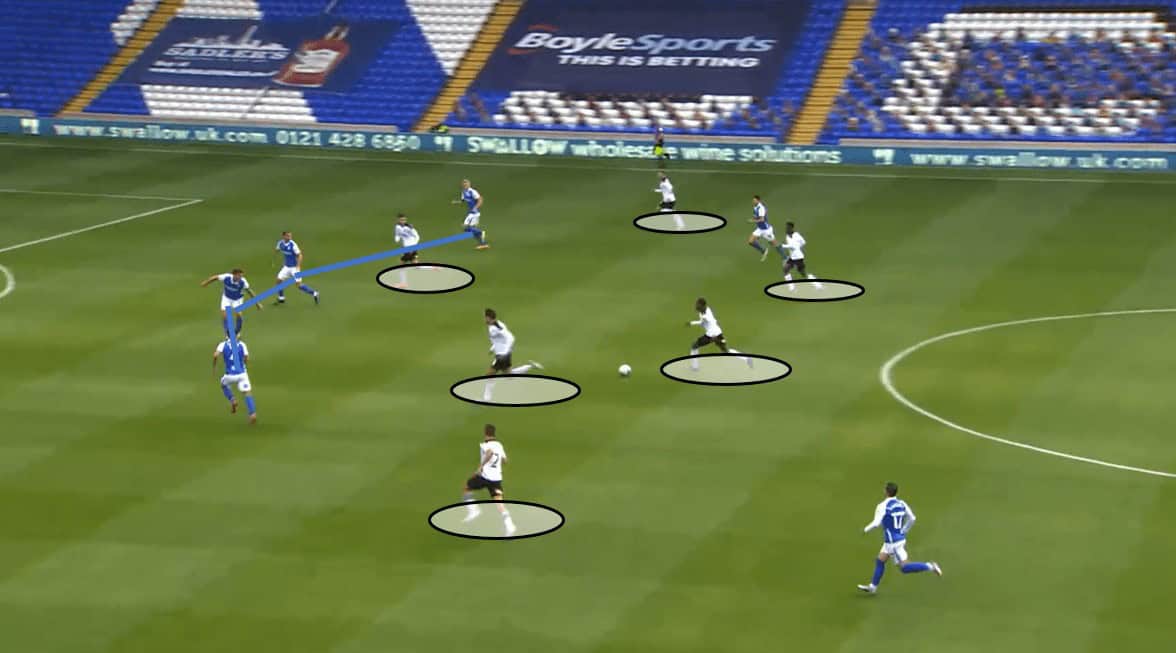
A key part of Birmingham’s defensive solidity under Karanka so far has been the lack of pressing from their forward players to maintain their rigid shape. Through a closer analysis of their performance against Brentford, when they were completely dominated in terms of possession, we can see the effectiveness of their shape in action. The first example can be seen below in a passage of play that was common throughout the course of the game.

As Pontus Jansson passes the ball, Clayton decided to track Josh Dasilva in order to force him back once more. It is notable that the three attacking midfielders and striker Jutkiewicz stay strictly to their positions with an emphasis on man-marking and cutting off passing lanes. The reason Clayton pushes up to follow up Josh Dasilva is because it allows left-winger Bela to maintain his position between the right-back and right-winger so that he can stop a move on this side progressing.
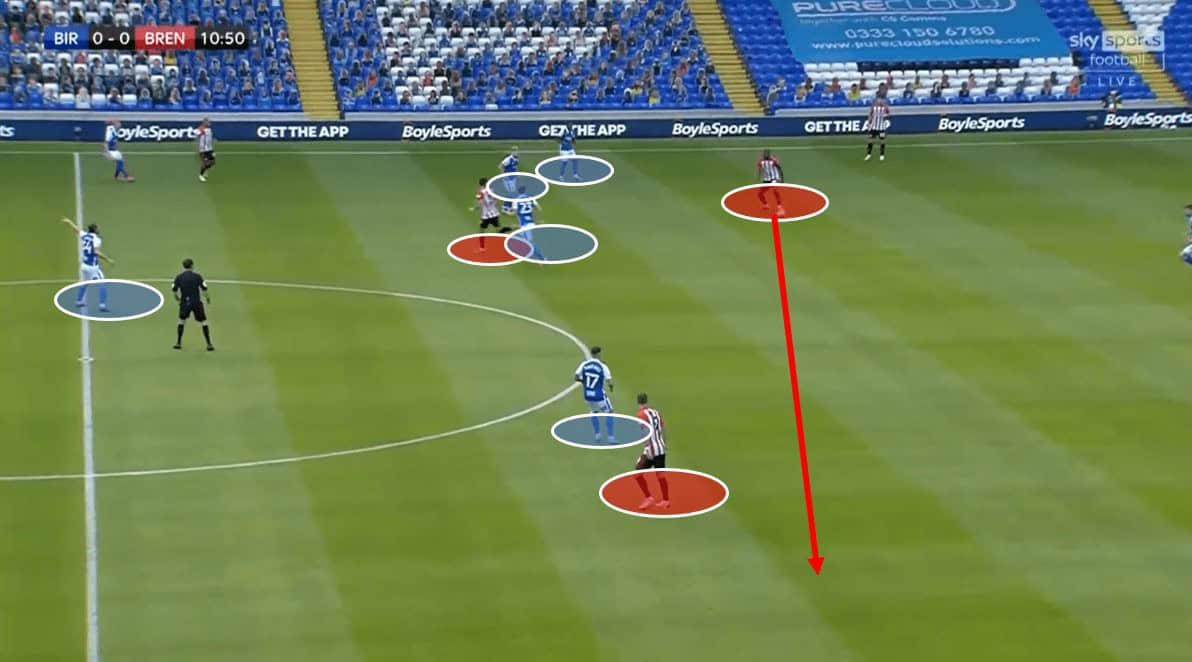
Ultimately, as the move progressed Clayton stopped pressing Dasilva and Bela took up an extremely wide position to shut off the ball to the right side. As already mentioned, Clayton tracked Dasilva in the first place, but as soon as the options became scarce, he chose to drop off back into his original position. Brentford ended up recycling the ball to the other end of the pitch in search of options as the move developed, which was something that happened regularly during this game. Birmingham’s defensive setup is all about man-marking, removing any options possible through a shape that is extremely hard to play against.
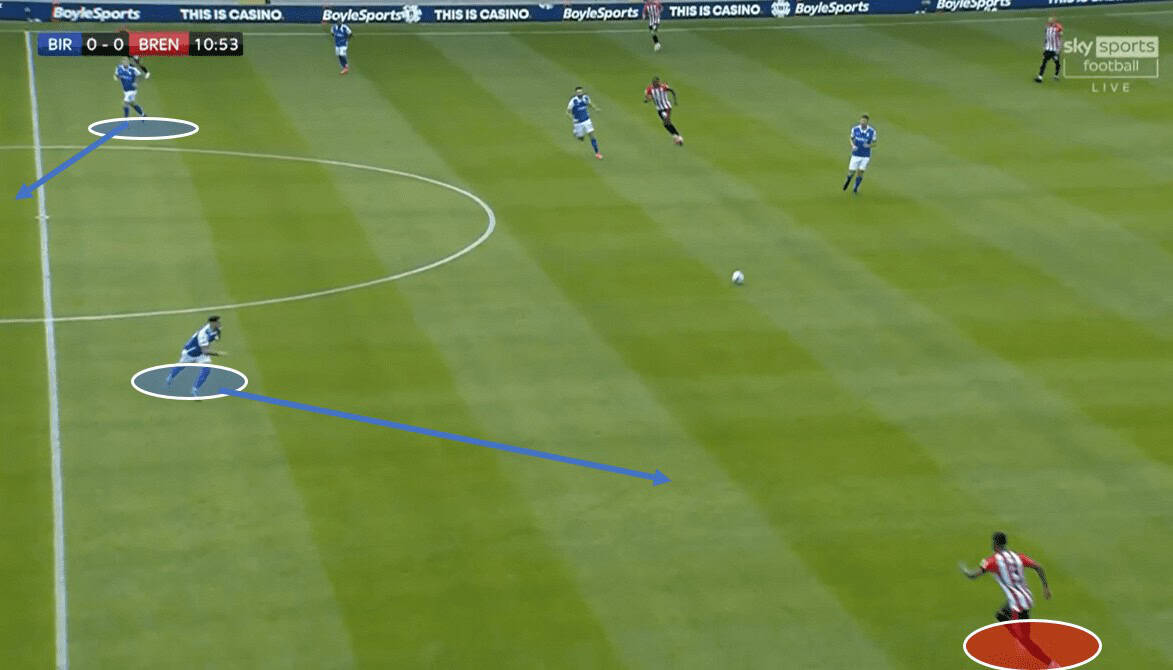
We can see in the final frame of this move above that as the ball is switched to the left-back by Dasilva, Clayton rushes back to his position in the double pivot. This is a perfect example of how Karanka’s sides control the game out of possession as they frustrate their opponent who enjoy long periods of the ball. In fact, it is in these sorts of games that Birmingham will thrive under Karanka this season. When they are dominated through possession and can attack on the counter and through set-pieces, they will be a real threat and will cause many superior teams problems.
A closer look at Birmingham’s off the ball data shows their reluctance to press and engage the opposition. The graph below plots the PPDA (presses per defensive action) data alongside interceptions per 90 and it is intriguing to see the positioning of Karanka’s team so far this season.

Of course, Birmingham’s PPDA stats are exacerbated by the fact that they have already played Swansea and Brentford, who will be near the top of the Championship this season and like to enjoy possession. However, there are a lot of teams who like to play with large amounts of possession in the Championship which means that Karanka will continue to play with a style that advocates a lack of pressing.
In terms of the graph above, it is evident that Birmingham are below average for both interceptions per 90 and presses per defensive action. The average for interceptions per 90 is 43.25, while Birmingham’s is 37.92 and the average for PPDA is 9.60, whereas Birmingham have a PPDA of 18.88. In fact, Birmingham’s PPDA numbers are by far the highest in the league and indicate Karanka’s clear style of play, which is to maintain their shape and sit off the opposition in a compact low-block.
Hogan is back
Hogan made his first start of the season on Saturday after Birmingham were able to secure his signature on a permanent basis after last season’s successful loan spell. The role of Hogan in helping Birmingham get enough points to stay up cannot be understated. Hogan’s nine goals in a Birmingham shirt after he joined in January resulted in an upturn of form and performances for the Blues with the Irishman also picking up the Championship player of the month award for February. He was able to form an extremely effective partnership with Jutkiewicz in a 4-4-2 system that produced goals and excitement. However, when the goals dried up Birmingham did look suspect defensively, which saw a negative run of results costing Pep Clotet his job and nearly their place in the division. So, now that they have Hogan permanently, what does he offer the team and how can he find his goalscoring touch again?
In order to measure the efficiency of Hogan as a striker, we will analyse the graph below, which plots shots per 90 next to goal conversion percentage for all Championship strikers. This will help us understand the type of player Hogan is and whether that fits in to the Karanka style of play already discussed. It is important to note that to qualify for this graph the striker must have played at least 1500 minutes, meaning there will be no outliers in the data.

In terms of comparing Hogan against the averages for shots per 90 and goal conversion percentage, there are some interesting findings. The average for shots per 90 is 2.14 with Hogan’s shot per 90 only 2.1 and therefore below average. However, for goal conversion percentage Hogan is well above the average, which is 16.78 compared to Hogan’s 20.93. Ultimately, these statistics show that Hogan doesn’t shoot too often but when he does, he makes it count. Hogan is extremely clinical, and this is a quality that will be desperately needed in a side that will base their strategy on defensive structure instead of creating a flurry of opportunities. At his previous clubs, Karanka had clinical strikers to perform the limited chances that came their way through the likes of Jordan Rhodes and Lewis Grabban. Karanka is lucky in the respect that he does also have Jutkiewicz who is perhaps not as clinical but offers something different with his aerial ability.
Low-block issues
Saturday’s 1-1 draw against Rotherham will feel like two dropped points for Karanka even if they did equalise in the last minute of the game. This was a game that they were expected to win and the first game this season that the emphasis was on Birmingham to break down a team as they had 57% possession. When smaller teams go up against Karanka they often look to nullify his defensive tactics by sitting off his team and allowing them possession. Saturday was no different and Birmingham’s failure to break down Rotherham in open play is a worrying sign of their potential creativity issues.
The problem with Saturday’s 4-4-2 experiment is that Karanka stuck with the double pivot pairing and their positioning was often far too deep to affect the game. Throughout the game, Birmingham lacked midfield options in central areas and the formation often looked more like a 4-2-4 instead of a 4-4-2. Birmingham’s attacks often relied on the wingers providing creativity with a lack of numbers in support in the middle. Clayton and Šunjić are not the type of players that like to push on and link the play, which caused problems throughout as Rotherham were often able to counter attack through the middle on transitions. An example of Birmingham’s disjointed attacking structure can be seen in the frames below.
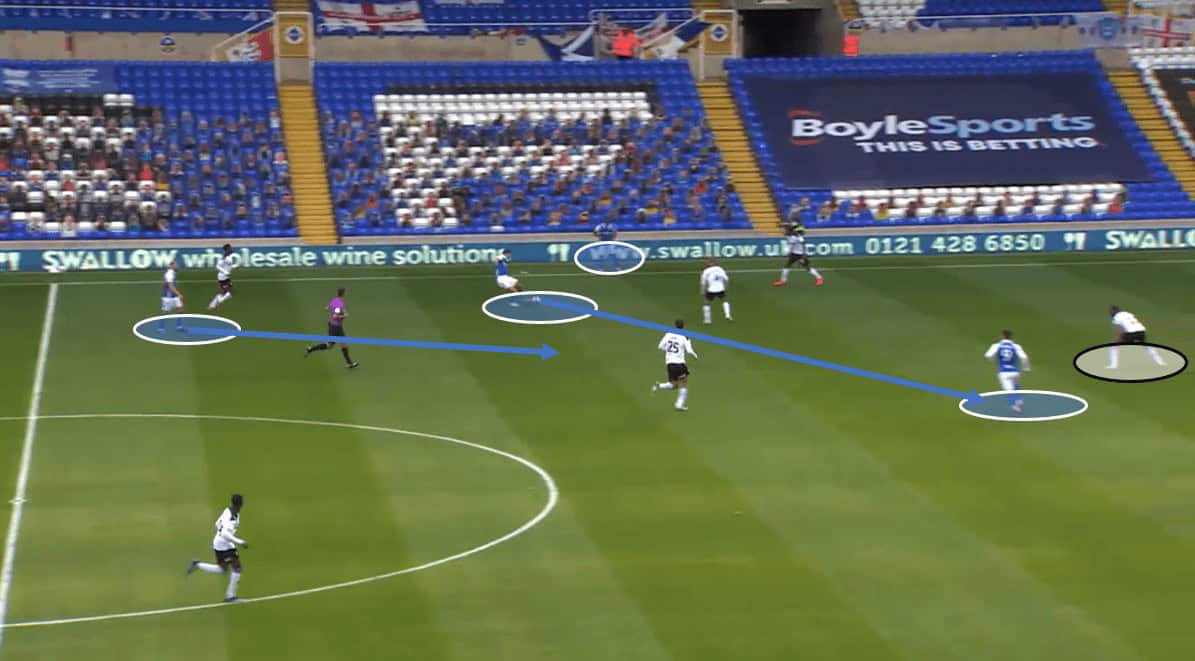
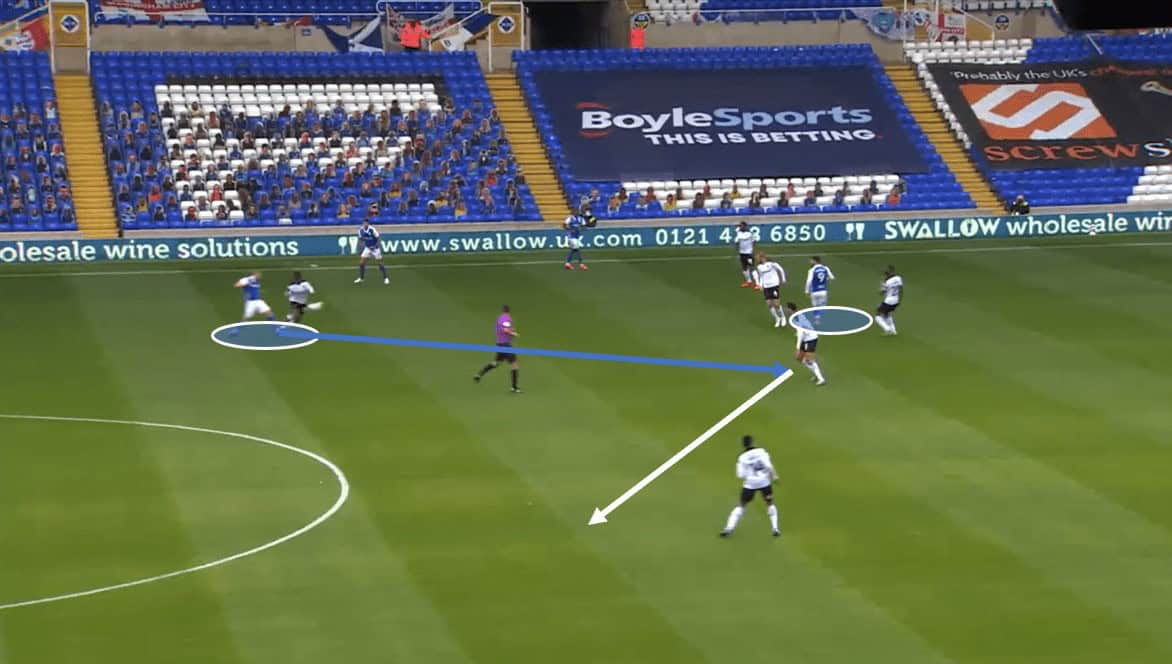
Friend has made a challenge in his own half and has driven up the pitch into a position where can he play the ball in to Hogan’s feet. Bela is marked and Jutkiewicz is out of the picture as a right-sided striker, so Hogan is clearly Friend’s only option. However, it is the positioning of Clayton where many of the problems lay for Birmingham. As a result of his deep positioning, there is a large gap between the Rotherham midfield and defence, which a link player could have capitalised on. Yet, Clayton was playing a two-man central midfield partnership and as Hogan played the ball back, he was caught in two minds. This resulted in a panicked, first-time ball and Birmingham losing possession with five people ahead of the ball as Michael Miller can then run into the huge space left by Clayton.
Ultimately, Miller’s shot was dragged wide, but Rotherham were able to constantly find themselves in these dangerous counter-attacking situations as a result of Birmingham’s disjointed midfield two. A more clinical attacking outfit would have punished Birmingham in situations like the one above, meaning Karanka will have to rethink his 4-4-2 in games like this where they dominate possession.
The data also supports the notion that the midfield two occupy positions throughout matches that are too deep for a 4-4-2 to make sense. A closer look at Birmingham’s successful dribbles in the final third further highlights this.


As you can see from the graphic above, Birmingham’s main ball carriers come from wide positions. In fact, wingers Bela and Sánchez have been responsible for 48% of Birmingham’s successful dribbles in the final third. Perhaps what is more notable is that Clayton and Sunjic have had zero successful dribbles in the opposition third, which is a testament to the roles Karanka wants them to fulfil. In order to be a more productive outfit against teams that utilise a low block like Rotherham, Karanka must think of alternative methods. Even if it is a return to his favoured 4-2-3-1, this would provide Birmingham with greater numbers in central areas to match the opposition. Most importantly though would be that it could allow a number 10 to produce further creativity alongside the wingers and support the lone striker. It will be intriguing to see how Karanka adapts his methods in these sorts of games.
Conclusion
This data analysis has looked at the methods of Karanka and how he has implemented them so far with his new-look Birmingham side. They already look like an extremely tough side to beat when they are out of possession, which is the trademark of Karanka’s football throughout the years in the Championship. It will be no surprise to see them pull off some shocks this season against some of the bigger sides in the division. However, they may experience some creativity issues as a result of their blunt midfield attacking output. If Karanka can find a way to beat teams that play a low block against them then Birmingham may just be in for a very good season under the highly experienced Championship manager.